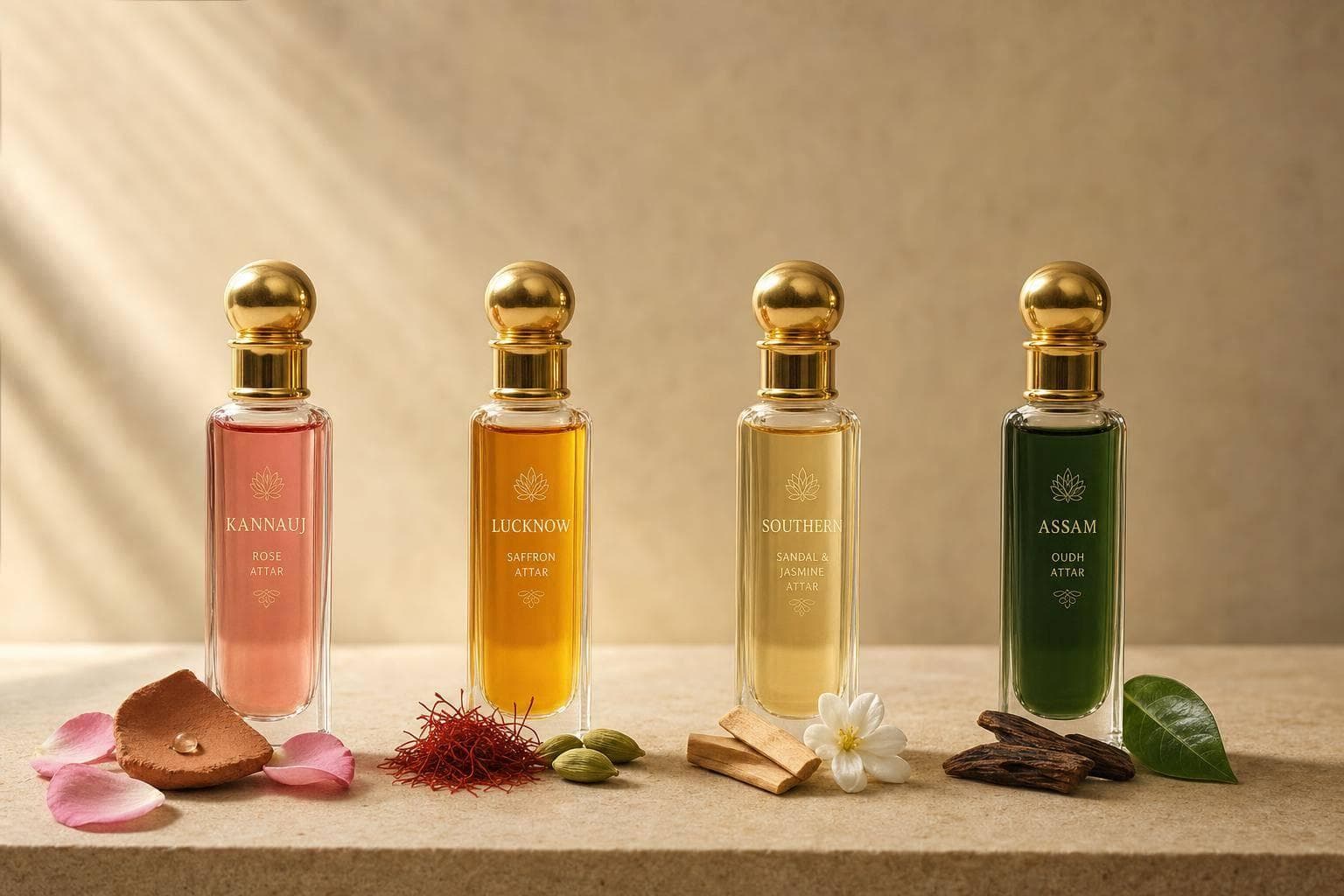
If you want a scent that stays close, lasts well, and feels more personal than a spray, Indian attars are worth a look. I’d group the main regional styles like this: Kannauj gives earthy and cooling oils such as mitti and khus, Lucknow leans rose, spice, and occasion wear, Southern India brings sandalwood, jasmine, champa, and vetiver, and Assam adds smoky agarwood for deeper evening scents.
In simple terms, this is what matters:
- Attars are perfume oils, often carried in sandalwood oil
- They usually wear closer to the skin than spray perfumes
- Some oils are aged for up to 10 years
- Kannauj suits layering and summer wear
- Lucknow fits dressier and festive moods
- Southern styles often feel creamy, floral, or dry-woody
- Assam oud works best if you like darker, smokier scents
- For a first try, I’d start with a 2 ml or 5 ml sample and give it 20–30 minutes on skin before judging it
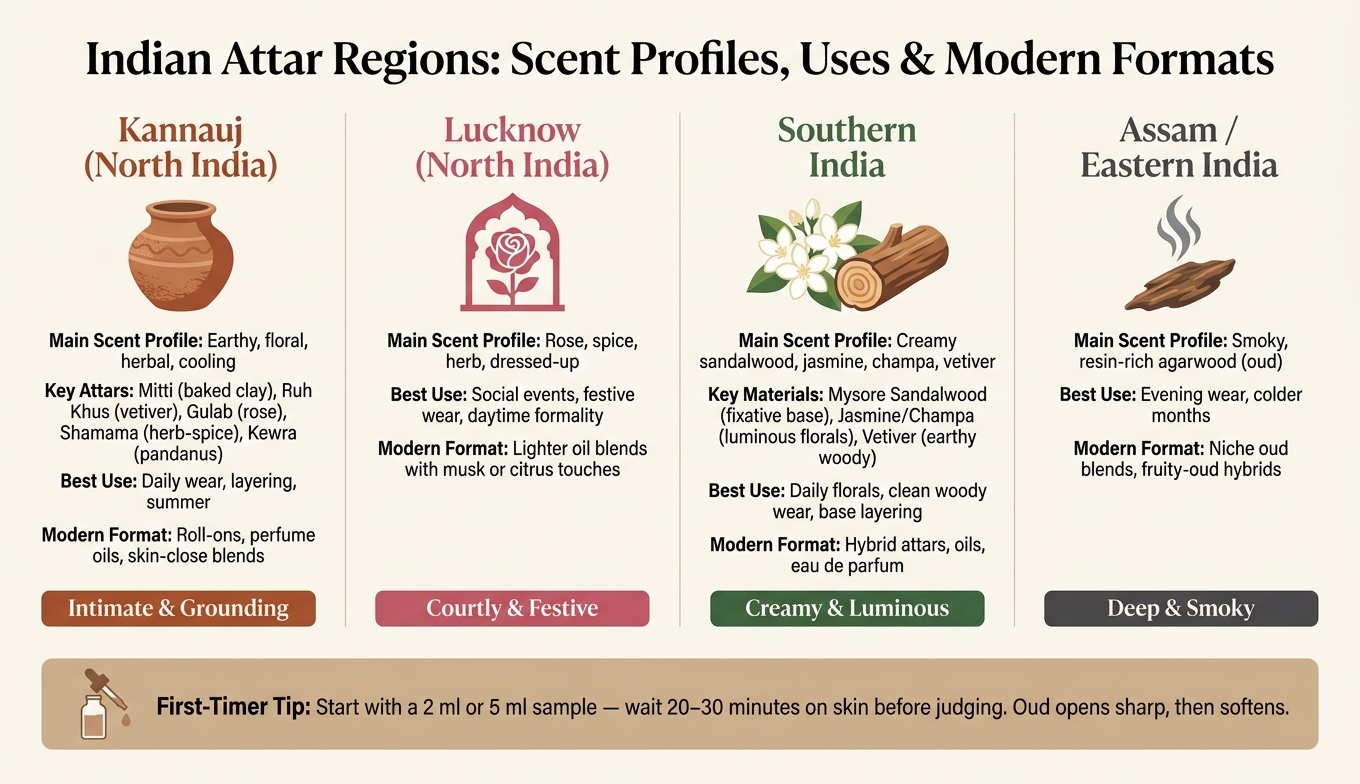
Indian Attar Regions: Scent Profiles, Uses & Modern Formats
What Is Mitti Attar? India’s Earthy Sandalwood Fragrance Oil
Quick Comparison
| Region | Main scent profile | Best use | Modern format fit |
|---|---|---|---|
| Kannauj | Earthy, floral, herbal, cooling | Daily wear, layering, summer | Roll-ons, perfume oils, skin-close blends |
| Lucknow | Rose, spice, herb, dressed-up | Social events, festive wear, daytime formality | Lighter oil blends with musk or citrus touches |
| Southern India | Creamy sandalwood, jasmine, champa, vetiver | Daily florals, clean woody wear, base layering | Hybrid attars, oils, eau de parfum |
| Assam / Eastern India | Smoky, resin-rich agarwood | Evening wear, colder months | Niche oud blends, fruity-oud styles |
I see modern Indian attars less as one style and more as a small scent wardrobe. Each region plays a different role, which is why these oils now fit so well into modern perfume habits in Europe.
Kannauj and Lucknow: North Indian attars from heritage craft to daily wear
North Indian attars tend to fall into two clear camps: Kannauj’s material-led oils and Lucknow’s courtly blends.
Kannauj’s classic oils: from mitti to ruh khus
Kannauj’s oils often lean earthy, floral, and herbal, with a strong culture of layering. Some attars are aged for up to 10 years, which gives them a depth that synthetic bases rarely reach.
Each of these classic attars has its own material character and a clear place in modern wear:
| Attar | Key Material | Traditional Use | Modern Interpretation |
|---|---|---|---|
| Mitti | Baked clay (terracotta) | Monsoon nostalgia; cooling | Layering base; soft earth note |
| Ruh Khus | Wild vetiver grass | Cooling palaces; summer relief | Green, woody daily wear |
| Gulab | Rosa damascena | Ceremonial; cooling in summer | Floral heart for complex niche blends |
| Shamama | Traditional herb-spice blend | Winter warmth; medicinal | Dense resinous winter scent |
| Kewra | Pandanus flowers | Food flavouring; cooling | Bright floral accent |
Mitti and Ruh Khus have been especially easy to bring into modern routines. They sit close to the skin, feel calm rather than loud, and work well as layering bases. That softer profile also lines up with the growing pull toward gender-neutral fragrance, which helps explain how Kannauj oils move from heritage craft into daily wear.
If Kannauj feels earthy and intimate, Lucknow takes the same oil tradition in a more dressed-up direction.
Lucknow’s courtly style and festive use
Lucknow brings a different mood. Its attar tradition grows out of courtly refinement and Ganga — Jamuni culture. Put simply, Kannauj is material-led; Lucknow is courtly and festive. The classic Lucknow style leans on rich rose, spice, and herb-led compositions, often linked to occasions like Eid and Holi.
Modern versions tend to lighten those denser bases with citrus or white musk accents. That small shift makes them easier to wear day to day. The warmth and layered feel stay in place, but the finish is softer and more relaxed.
That contrast with the south and east becomes even sharper in sandalwood, temple florals, and agarwood.
Ihr persönlicher Duftexperte erwartet Sie
Machen Sie unser kurzes Duftquiz und entdecken Sie authentische Designer- und Nischenparfums, die zu Ihrem Geschmack passen – als 2–8ml Dekants und Proben, damit Sie jeden Duft testen können, bevor Sie sich für einen ganzen Flakon entscheiden.
Finden Sie Ihren DuftSouthern and eastern India: sandalwood, temple florals, vetiver, and agarwood
In the south and east, the story shifts. Here, the focus is less on craft style and more on the materials themselves.
Southern sandalwood and temple flower influences
Mysore sandalwood gives fragrances a creamy, skin-close feel. That soft texture is one reason it works so well as a fixative in modern blends. It helps hold a scent together without making it feel loud.
Temple florals like jasmine and champa carry deep ties to ritual attars and weddings. In perfume, they often show up as smooth floral oils that feel bright and glowing, not dense or overpowering. There’s a softness to them that makes sense for daily wear, especially if you want something floral without the old-fashioned weight.
Vetiver, long used for summer cooling, has also found a new place in modern scent profiles. Now it often appears as an earthy, clean woody note that fits city wear with ease. It feels polished, a little dry, and very easy to live with.
Assam and the eastern agarwood revival
Eastern India, especially Assam, is closely linked with agarwood, or oud. Its background is rooted in incense, including bakhoor, as well as medicinal use. In scent, it brings a smoky, resin-rich character that stands apart from the creamy side of sandalwood.
Modern perfume takes oud in two main directions. Some blends keep that darker, smoky edge front and centre. Others soften it with fruit or florals, making it easier to wear during the day and less intense on first spray.
| Region | Key Raw Material | Traditional Use | Modern Fragrance Style |
|---|---|---|---|
| Southern India | Mysore Sandalwood | Royal courts, Ayurvedic medicine, religious rituals | Creamy, skin-scent base; fixative |
| Southern India | Jasmine / Champa | Temple garlands, ritual attars, weddings | Luminous, smooth floral oils |
| Southern India | Vetiver (Khus) | Summer cooling | Earthy, clean woody notes for city wear |
| Eastern India (Assam) | Agarwood (Oud) | Incense (bakhoor), medicinal use | Smoky, resinous niche compositions; fruity-oud hybrids |
These materials work well in roll-ons, dabbers, and hybrid attars. That ease of use is a big part of what modern Indian niche perfumery builds on.
Modern Indian niche perfumery: attar techniques in contemporary formats
Brands connecting regional botanicals with modern composition
Regional materials are now showing up in modern perfume formats. A new wave of Indian niche houses is turning these notes into more structured releases, including eau de parfum, extrait, and perfume oil. Some makers are also reworking sandalwood-based bases for these newer launches. The method changes from brand to brand, but the aim stays the same: keep the ingredient at the centre, and let the craft stay visible.
What’s changing isn’t just the formula. It’s also the way the fragrance is packaged, introduced, and sold. Traditional attars are being rediscovered through D2C brands with clearer branding and smaller discovery formats.
How attar craftsmanship fits modern fragrance habits in Europe
That skin-close style fits today’s fragrance habits in Europe, too. Younger buyers often rotate scents by mood and occasion. Attar-inspired perfumes work well in that kind of wardrobe because they’re concentrated, long-lasting, and distinct enough to earn their place in a rotation.
They also wear in a quieter way. Instead of filling a room, they stay close to the skin and often outlast many sprays. The result is a softer scent trail that suits people who want restraint rather than sheer projection.
Conclusion: What regional Indian attars add to a modern fragrance wardrobe
Regional Indian attars play a clear part in a modern fragrance wardrobe. Kannauj leans earthy and cooling, so vetiver (khus) and mitti fit well as a summer base or a grounding layer. Lucknow brings a rose-led, courtly style that works nicely for formal events and daytime social settings. In Southern India, Mysore sandalwood works as a fixative base, helping lighter notes last longer. Eastern India gives you the deepest and heaviest profile in this group: agarwood, with its smoky feel, suits evening wear or winter best.
Once you know the role each style plays, try it in a small size first. For European readers, a 2 ml or 5 ml decant is a smart place to start. Give it 20–30 minutes before you decide. Oud can open sharp, then soften into something more balsamic.
That shift toward a fragrance wardrobe - a small set of scents for different moods and seasons, instead of one signature scent - makes regional Indian attars a natural match. Each region lines up with a clear wardrobe role, which is part of what makes this craft worth your time.
FAQs
Which attar region suits beginners best?
For beginners getting into oud-based attars, Cambodian oud is often the easiest place to start. It has a sweet, balsamic scent that feels softer and more welcoming than the denser, more animalic, or smokier style often found in Indian or Assamese oud.
Pure oud oils can take a little time to understand and enjoy. That’s part of the charm, but it also means a full bottle can feel like a big step at the start. Decants make this much easier. They let beginners try oud from different regions, compare the styles on skin, and learn what they like before spending more on a full bottle.
How do I apply attar for the best wear?
Apply attar straight to pulse points like the wrists, neck, and behind the ears. These warmer areas help the scent open up on the skin. For longer wear, put it on moisturised skin.
Attars are highly concentrated, so one drop is often enough. You can also wear attar as a base layer before adding a light spray of your preferred alcohol-based perfume. Always patch test first.
Can attars replace spray perfumes?
Not necessarily. Attars offer a different kind of scent experience. They don’t replace spray perfumes so much as sit alongside them.
Unlike standard sprays, which mix fragrance oil with alcohol, attars are highly concentrated perfume oils. Many people apply them to pulse points as a rich base, then layer a spray fragrance on top for a more personal scent that lasts longer.

