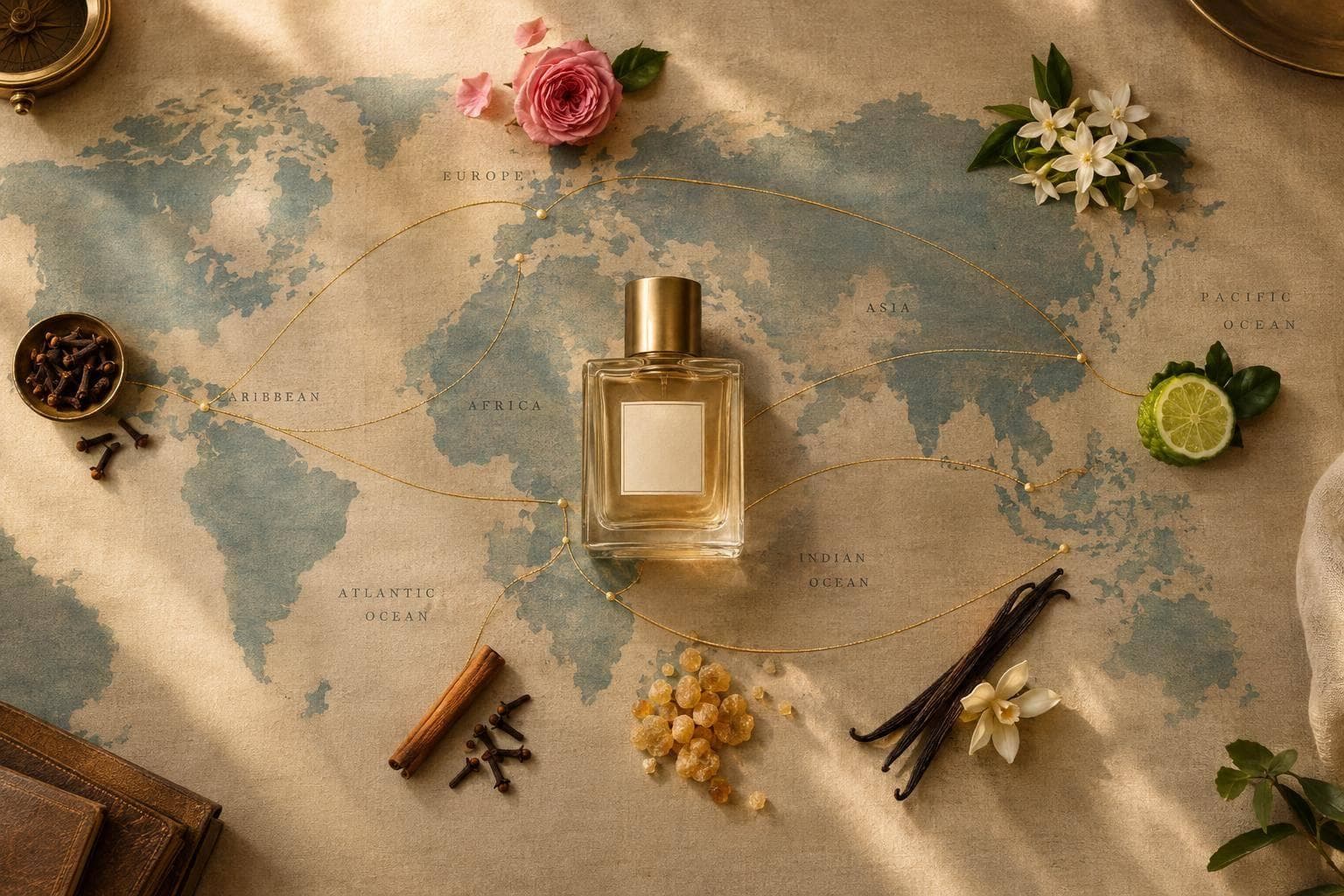
Perfume trade existed long before European colonialism. I trace how colonial powers later controlled parts of that trade - and why an old shipping route cannot prove where today’s perfume ingredients come from.
My starting point is simple: <u>follow the material, not just the bottle</u>. Portugal’s seizure of Malacca in 1511, for example, changed control of a port within existing trade networks.
In this guide, I look at:
- Materials: Where spices, resins, woods and rose water came from, and how they became perfume materials.
- People and power: Who harvested, traded and processed them - and who controlled labour, ports and prices.
- Perfume making: How supplies and knowledge reached European workshops.
- Today’s labels: Why a scent note or “Made in France” claim does not prove ingredient origin.
I keep what you smell separate from what records can prove. Samples help you judge a fragrance; dated records and supplier details help you check its sourcing.
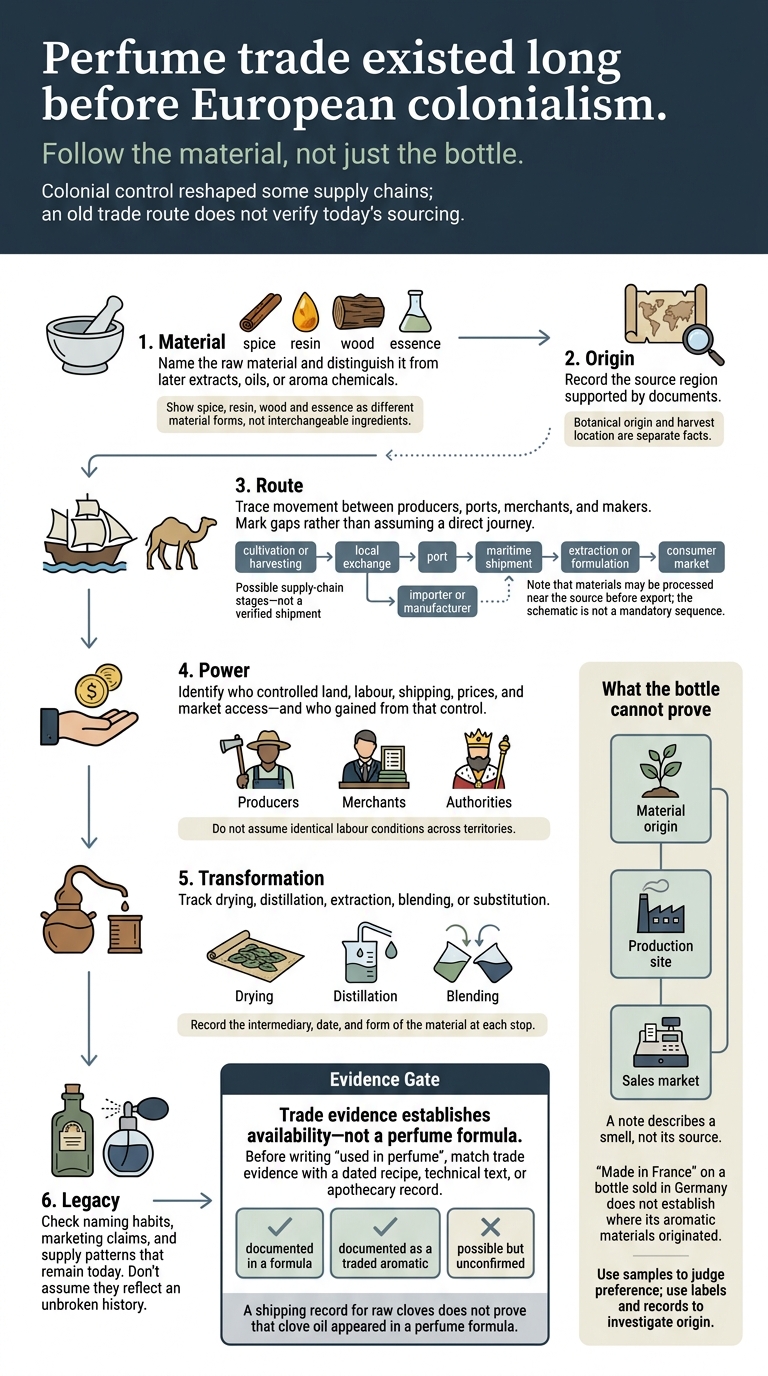
Tracing Perfume Origins: From Material to Modern Label
Step 1: Trace a Material from Source to Perfume
For each material, record origin → route → control → use, including its form at each stage: spice, resin, wood, or essence. An ingredient might pass through local, regional, and colonial hands before reaching perfume. A shipping record for raw cloves does not prove that clove oil appeared in a perfume formula.
Track Spices, Resins and Woods
Cloves came chiefly from Maluku, while nutmeg and mace came especially from the Banda Islands. Before European intervention, local producers and merchants traded these materials through Asian maritime networks. Founded in 1602, the Dutch East India Company (VOC) gained state-backed trading powers and took Ambon in 1605, tightening its control. Its warehouses and sale prices show that this control covered storage and pricing as well as transport.
For frankincense and myrrh, trace resin collection separately from grading, blending, burning, or extraction. Follow caravan and maritime routes rather than assuming one European-controlled chain. For sandalwood, identify the species and source, then check whether the record refers to wood, powder, or oil. An Indian Ocean connection alone cannot establish a precise shipment.
Compare Materials and Trade Routes
The table separates source, route, control, and perfume use. Treat it as a tracing guide, not proof of use in perfume. “Uncertain” means the connection needs more evidence, not that it never existed.
| Material | Source region | Route or port | Colonial or commercial power | Perfume application |
|---|---|---|---|---|
| Cloves | Maluku Islands, especially North Maluku | Asian maritime networks; later VOC-controlled shipping and warehouses | Local producers and merchants; later VOC restrictions and monopoly efforts | Dried spice; later oils, extracts, and spicy accords. Formula links remain uncertain. |
| Nutmeg and mace | Banda Islands | Banda Sea networks, then broader Asian and European trade | Banda producers and merchants; later VOC control of production and distribution | Raw spices, infusions, and extracts; nutmeg and mace are distinct materials. |
| Frankincense | Southern Arabia and East Africa | Arabian caravans, Red Sea trade, and Mediterranean markets; Gaza was an Incense Road endpoint | Harvesting communities, caravan merchants, rulers, and port authorities | Burned resin and aromatic extracts. |
| Myrrh | Southern Arabia and East Africa | Arabian, Red Sea, and Mediterranean networks | Merchants and authorities; control of individual shipments may be uncertain | Raw resin, burned incense, tinctures, and later resinous accords. |
| Sandalwood | South Asian and Indian Ocean source regions; identify species | Maritime networks; exact ports depend on period and source | Producers and merchants; specific colonial involvement requires evidence | Wood, powder, incense, or distilled oil; Islamic accounts describe rose water enriched with sandalwood and other aromatics. |
| Rose water | Persian and broader Islamic production regions | Islamic and Mediterranean networks; individual routes need dated evidence | Growers, distillers, merchants, and authorities | Distilled floral water, not raw roses; record rose oil and attar separately. |
Before writing “used in perfume”, match trade evidence with a dated recipe, technical text, or apothecary record. VOC sales establish availability - not a formula. Label each finding documented in a formula, documented as a traded aromatic, or possible but unconfirmed.
Next, follow the ports and merchants that carried the material.
Step 2: Follow Ports, Merchants and Knowledge
Trace perfume materials and formulas along this route: cultivation or harvesting → local exchange → port → maritime shipment → importer or manufacturer → extraction or formulation → consumer market.
Materials could be dried, sorted, distilled, pressed, or processed in other ways near the source before export. At each stop, record the intermediary, date, and form of the material, not just its destination. Then trace the ports and people who moved it.
Map the Main Trading Ports for Aromatic Cargoes
Malacca linked the Indian Ocean with the South China Sea, drawing Malay, Javanese, Chinese, Gujarati, Persian, and Arab merchants. Cloves and nutmeg travelled west through these networks before Portugal seized the port in 1511. From 1510, Goa served as a Portuguese naval, administrative, and commercial base. Portuguese control of Hormuz in 1515 extended access to Persian Gulf trade.
For Venice and Genoa, investigate Mediterranean connections rather than assuming identical cargoes or routes. Venice’s state-run convoys structured maritime access, and the city supported makers of perfumes, scented goods, and soap. Marseille’s example dates to a later period: during the long eighteenth century, its Levant trade included spices, perfumes, incense, and goods recorded as Syrian benzoin. Treat that market name as a lead, not proof of origin.
With the ports mapped, follow the people and decisions behind each shipment.
Identify Traders and Knowledge Transfers
Identify each role. Harvesters supplied collection knowledge, local traders gathered small lots, and brokers handled quality and credit. Exporters, shipowners, and port officials managed storage, transport, and duties. Their decisions helped determine which materials could enter perfume making. Importers, processors, and perfume manufacturers then handled further sorting, extraction, and blending.
Fees, insurance, commissions, and losses could increase costs. State a price increase only when dated accounts support it. Next, trace how techniques travelled alongside goods.
Track knowledge separately: technique → practitioner or text → language → transmission route → date → evidence. Apprenticeships, migration, medical texts, and workshops could spread methods independently of cargo routes.
In Venice, imported materials and skilled practice converged in the workshops of perfumers, apothecaries, spice sellers, and soap makers. The techniques used to turn materials into perfume were crucial; their presence does not establish that a particular recipe arrived with the cargo.
Label each connection documented transfer, plausible influence, or unsupported assumption. Keep those distinctions clear when moving from trade records to modern perfume labels.
Step 3: Link Supply to European Perfume Making
Separate source regions from processing and branding centres. Trace how raw materials reached workshops, pharmacies and branding centres. Grasse processed imported spices and resins alongside regional flowers, while Paris branded and distributed much of the output. These industries drew on longstanding aromatic practices, including Asian benzoin use in medicine and ritual. Place of origin is only part of the story: who turned the materials into perfume?
Check Evidence of Colonial Sourcing
Record five facts: botanical origin, harvest location, colonial relation, extraction site, and blending or sales centre. Together, they help distinguish raw supply and cultivation from final formulation.
Lao benzoin comes from Styrax tonkinensis; historical evidence places it in older Mekong-region trade routes, and European pharmacies received it in quantity as Portuguese maritime routes to the Indies expanded.
These records show how materials moved. They do not prove what went into a finished perfume.
Tahitian vanilla shows why those distinctions matter. Vanilla originated in the Americas. It was introduced to Tahiti in 1848, five years after the French protectorate agreement of 1843.
A scholarly overview links lemongrass from the French Congo to Grasse suppliers.
This documents a sourcing connection, not a complete shipment history. To link it to a specific period or formula, look for dated purchasing or factory records. The overview alone does not establish volumes, extraction facilities or labour conditions.
Compare Supply Controls and Production Effects
| Colonial trade mechanism | Effect on supply | Effect on perfume production |
|---|---|---|
| Control of ports and maritime access | Concentrated power over access and restricted trade. | Shaped manufacturers’ access to imported aromatics for processing. |
| Expanded Portuguese shipping, sixteenth century | Brought benzoin to European pharmacies in quantity. | Supported access to resin later used in perfume extracts and balsamic bases - not proof that early cargoes supplied perfumers. |
| British East India Company commerce | Expanded European access to Asian spices and other materials. | Expanded access to Asian aromatics, while food, medicine and incense uses remained separate. |
| French colonial cultivation in Tahiti, starting in 1848 | Established vanilla cultivation outside its American botanical homeland. | Added a distinct vanilla supply used in perfumery; production depended on skilled labour. |
Greater access often rested on coercion. Check who controlled land, export permissions and prices, and who harvested, pollinated or processed each crop. Use specific records to investigate coercion, unequal bargaining power and labour exploitation rather than assuming conditions were the same across territories. For vanilla, labour-intensive hand pollination is documented, but that fact alone does not establish workers’ pay or freedom.
Next, compare these sourcing traces with what modern perfume labels actually claim.
Ihr persönlicher Duftexperte erwartet Sie
Machen Sie unser kurzes Duftquiz und entdecken Sie authentische Designer- und Nischenparfums, die zu Ihrem Geschmack passen – als 2, 5, 8 & 30 ml Dekants und Proben, damit Sie jeden Duft testen können, bevor Sie sich für einen ganzen Flakon entscheiden.
Finden Sie Ihren DuftStep 4: Read Today’s Perfume Shelf
After tracing historic routes, turn to the modern bottle for a final check on origin claims.
Separate Notes, Ingredients and Origins
Treat listed notes as research prompts, not proof of ingredients. A note describes a smell, not its source. It may come from an extract, a lab-made molecule or an accord.
EU labels usually list fragrance mixtures as “parfum” or “aroma”, alongside certain allergens above regulatory thresholds. For perfume and other leave-on products, that threshold is 1 %. Labels don’t reveal the full formula or where ingredients come from. Limonene, linalool and geraniol, for example, may be natural or synthetic.
Material origin, production site and sales market are three different things.
“Made in France” on a bottle sold in Germany does not establish where its aromatic materials originated.
Look for brand disclosures that name a material, supplier region or extraction method. Compare those details with relevant historical records, and mark each claim with its level of evidence. Treat “exotic” and “oriental” as marketing terms, not statements of origin.
Compare Fragrances in Small Sizes
With labels and origin claims kept separate, use small samples to test the scent itself.
For sensory comparison, Scento offers 2 ml, 5 ml, 8 ml and 30 ml decants. These sizes let you test the published note profile before buying a full bottle.
Record the brand, fragrance name, concentration, sample size, price paid in euros and test date. Write down your impressions after about 5 minutes, 1 hour and 4–6 hours, keeping scent observations separate from sourcing claims. Compare scent, comfort and longevity over repeated wears. Use samples to judge preference; use labels and records to investigate origin.
Conclusion: Use a 6-Point Tracing Checklist
Before trusting an origin claim, check these six points.
- Material: Name the raw material and distinguish it from later extracts, oils, or aroma chemicals.
- Origin: Record the source region supported by documents.
- Route: Trace movement between producers, ports, merchants, and makers. Mark gaps rather than assuming a direct journey.
- Power: Identify who controlled land, labour, shipping, prices, and market access - and who gained from that control.
- Transformation: Track drying, distillation, extraction, blending, or substitution.
- Legacy: Check naming habits, marketing claims, and supply patterns that remain today. Don’t assume they reflect an unbroken history.
These checks keep movement, control, and later branding separate. Aromatics travelled long distances well before European colonialism. Colonial control reshaped some supply chains through monopolies, plantations, and control of shipping; it did not create long-distance trade.
When reading a label, test its claim against records. Save the source record, mark the claim documented, probable, or unresolved, and compare historical trade records with modern supplier documents. An old trade route does not verify today’s sourcing.
FAQs
How can I check a perfume’s ingredient origins?
Look into the notes in your fragrance and where their ingredients historically came from. Brands often highlight classic materials to tell the story of their heritage.
For example, frankincense and myrrh were historically sourced from Southern Arabia and the Horn of Africa, while cinnamon, cardamom and pepper travelled from India and Southeast Asia.
These links connect your perfume to the trade routes and botanical practices that shaped perfumery.
Does colonial trade still shape perfume sourcing?
Ancient and colonial trade routes still shape where perfume ingredients come from and how fragrances are composed. Frankincense, myrrh and agarwood (oud), once brought to the Mediterranean by caravan and sea, remain key materials in luxury and niche perfumery. They lend fragrances resinous, smoky and woody notes.
Today, perfumers combine natural extracts with synthetic molecules to support consistency and ethical sourcing. Yet the prestige and scent profiles of these materials still draw on historic supply chains and exchanges between societies.
What should I ask brands about ethical sourcing?
Ask whether they use organic farming practices and fair-trade partnerships to source raw materials. Do they use biotechnology or lab-grown alternatives in place of rare or endangered natural ingredients, including animal-derived substances?
Ask how openly they share ingredient details, whether they choose packaging with a lower ecological footprint, and if they offer refillable bottles to reduce waste. Do they use production methods such as slow perfumery or made-to-order batches to limit overproduction and reduce harm to the planet?

