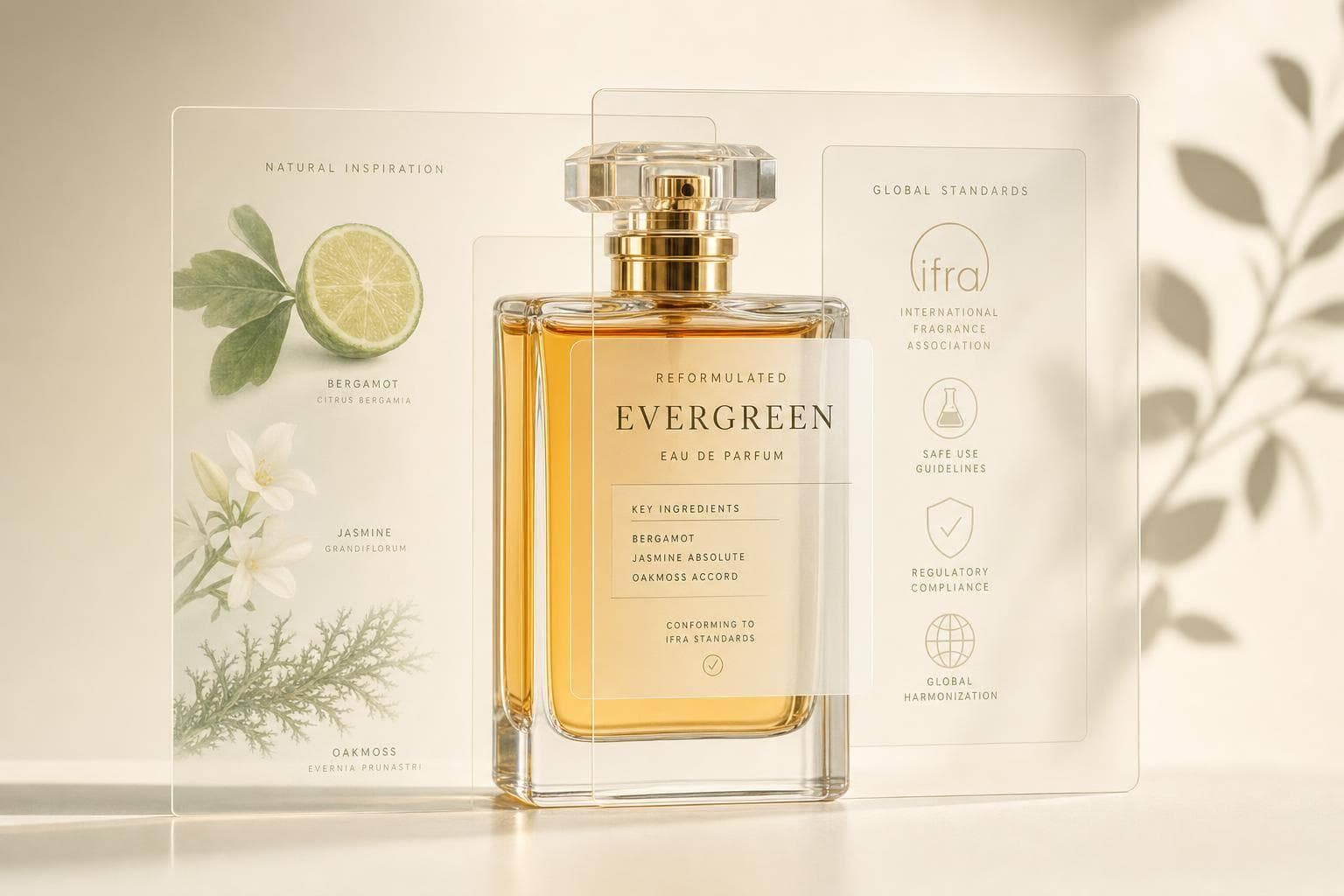
Ja - Ihr Parfum kann heute anders duften, selbst wenn Name und Flakon unverändert wirken. In den meisten Fällen liegt der Grund in einer Reformulierung: Marken passen Formeln an, um IFRA-Standards und EU-Kosmetikrecht einzuhalten, insbesondere wenn Grenzwerte für Inhaltsstoffe strenger werden.
Wenn ich es kurz zusammenfassen möchte, dann so:
- Ältere und neuere Flakons können sich unterscheiden, weil bestimmte Materialien gestrichen, reduziert oder ersetzt wurden.
- Eichenmoos, Lyral, Nitromoschusverbindungen und einige Zitrusmaterialien zählen zu den bekanntesten Beispielen.
- In der Parfümerie zählen selbst kleinste gesetzliche Grenzwerte - zum Beispiel ist 1 % der EU-Schwellenwert für die Allergenkennzeichnung bei Leave-on-Produkten.
- Seit dem 31.07.2026 erfassen die neuen EU-Regeln zur Allergenkennzeichnung rund 80 Stoffe, statt bisher 26.
- Bevor ich 150 €, 200 € oder mehr für einen Flakon ausgebe, würde ich den Chargencode, die Inhaltsstoffliste und, wenn möglich, einen direkten Tragetest im Vergleich prüfen.
- Wenn ich unsicher bin, ist eine 2-ml-, 5-ml- oder 8-ml-Probe die sicherere Wahl.
Was verändert sich am stärksten? Meist nicht der erste Sprühstoß. Es ist der Dry-down. Genau dort kann eine neuere Formel leichter, klarer wirken oder näher an der Haut sitzen als ein älterer Flakon.
Hier der schnelle Vergleich:
| Thema | Was es für mich bedeutet |
|---|---|
| IFRA-Grenzwerte | Einige Parfuminhaltsstoffe müssen reduziert oder entfernt werden |
| EU-Regeln | In Deutschland verkaufte Marken müssen verbindliches Kosmetikrecht einhalten |
| Eichenmoos-Kürzungen | Viele klassische Chypres und Fougères verloren einen Teil ihrer dunklen, moosigen Basis |
| Allergenkennzeichnung | Neuere Verpackungen können mehr Allergene aufführen, selbst wenn das Duftprofil ähnlich bleibt |
| Chargencodes | Helfen, das Produktionsdatum einzuschätzen und neuere Chargen zu erkennen |
| Beste Möglichkeit, einen Fehlkauf zu vermeiden | Zuerst testen, dann den Vollflakon nur kaufen, wenn die aktuelle Version für mich noch funktioniert |
Wenn ein Duft aus meiner Erinnerung also nicht mehr zum Flakon vor mir passt, sollte ich nicht automatisch meine Haut, das Wetter oder schlechte Lagerung verantwortlich machen. Häufig hat sich die Formel selbst verändert - und das kann das gesamte Dufterlebnis verändern.
What IFRA Does and Why It Leads to Reformulations
Die International Fragrance Association (IFRA) veröffentlicht Standards, die wissenschaftlich fundierte Sicherheitsgrenzwerte für Duftstoffinhaltsstoffe in Verbraucherprodukten festlegen. Es handelt sich um freiwillige Branchenregeln, die auf Sicherheitsbewertungen des Research Institute for Fragrance Materials (RIFM) beruhen. Genau deshalb behält ein Parfum oft denselben Namen, während sich ein Teil seiner ursprünglichen Struktur verändert.
Wenn ein Parfum also bei einem seriösen Händler in Deutschland verkauft wird, wurde seine Formel mit sehr hoher Wahrscheinlichkeit angepasst, um IFRA-Regeln zu erfüllen.
Wie IFRA-Standards funktionieren
IFRA-Standards treten in drei Formen auf: als Verbot, als Grenzwert oder als Reinheitsanforderung.
- Ein Verbot bedeutet, dass ein Inhaltsstoff überhaupt nicht verwendet werden darf. War er Teil einer klassischen Formel, muss der Parfümeur ihn entfernen und den Akkord um das Verbleibende herum neu aufbauen.
- Ein Grenzwert legt je nach Produkttyp eine maximale Konzentration fest. Derselbe Inhaltsstoff kann in einem Shampoo mit 0,3 % erlaubt sein, in einem Parfum jedoch nur mit 0,03 %, weil ein Leave-on-Produkt deutlich länger auf der Haut bleibt.
- Eine Reinheitsanforderung bedeutet, dass ein Inhaltsstoff nur zulässig ist, wenn er bestimmte Reinheitsregeln erfüllt. Ein natürliches ätherisches Öl darf beispielsweise nur verwendet werden, wenn ein bestimmtes sensibilisierendes Molekül darin unter einem festgelegten Wert bleibt.
IFRA ordnet Produkte in Kategorien ein, um diese Grenzwerte anzuwenden. Kategorie 4 umfasst die Feinparfümerie, darunter Eau de Parfum, Eau de Toilette und Cologne. Da diese Produkte stundenlang auf der Haut verbleiben, gelten in Kategorie 4 häufig sehr niedrige Obergrenzen für sensibilisierende Materialien. Wenn IFRA einen Grenzwert der Kategorie 4 senkt, müssen Marken, die in Deutschland verkaufen, diesen Inhaltsstoff in der Formel reduzieren oder ersetzen. Das ist der direkte Grund, warum eine neuere Charge leichter oder weniger vielschichtig duften kann als eine ältere.
EU- und deutsche Vorschriften neben IFRA
IFRA setzt die Formulierungsgrenzen. EU-Recht legt die gesetzliche Grundlage fest. Die Verordnung (EG) Nr. 1223/2009 ist der verbindliche EU-Rahmen für Kosmetika und gilt unmittelbar in Deutschland. Sie legt durchsetzbare Regeln zu Sicherheit, verbotenen Stoffen und Kennzeichnung fest, und deutsche Behörden setzen diese Regeln auch durch. IFRA geht einen Schritt weiter, indem RIFM-Sicherheitsdaten in exakte Formulierungsregeln übersetzt werden, denen Marken anschließend folgen.
Ein Bereich, in dem beide Systeme zusammentreffen, ist die Allergenoffenlegung. Nach EU-Regeln müssen Duftstoffallergene in der Inhaltsstoffliste einzeln genannt werden, sobald sie festgelegte Schwellenwerte im Endprodukt überschreiten: 1 % bei Leave-on-Produkten wie Parfum, Bodylotion oder Gesichtscreme und 0,01 % bei Rinse-off-Produkten wie Duschgel oder Shampoo.
Ein älterer Flakon kann also lediglich "Parfum" aufführen, während eine neuere Charge "Parfum" plus Allergene wie Linalool, Citral und Geraniol nennt. Das bedeutet nicht automatisch, dass die Formel schlechter ist. Meist heißt es nur, dass die Kennzeichnungsregeln inzwischen mehr Details verlangen. Die Verordnung (EU) 2023/1545 der Kommission hat die Zahl der kennzeichnungspflichtigen Allergene von 26 auf ungefähr 80 erweitert; neue Produkte, die nach dem 31.07.2026 auf den EU-Markt gebracht werden, müssen diese Regeln erfüllen. Einige Marken senken Allergenwerte unter 1 %, um verpflichtende Angaben auf dem Etikett zu vermeiden.
Wichtige IFRA-Änderungen, die Formelanpassungen erzwangen
Das 43. Amendment traf Eichenmoos und Baummoos besonders hart. Beide Materialien sind zentral für klassische Chypres und Fougères. Die Änderung behielt ein Maximum von 0,1 % für Eichenmoos im fertigen Parfum bei, fügte aber strenge Reinheitsregeln hinzu: Atranol und Chloroatranol, die wichtigsten Sensibilisatoren in Eichenmoos, mussten im Extrakt jeweils unter 100 ppm bleiben.
Das drängte Marken zu verarbeitetem "atranolarmem Eichenmoos", das deutlich anders duftet als das Vintage-Material.
Spätere Änderungen brachten neue Fristen für die Einhaltung mit sich, und Marken aktualisierten Formeln häufig vor den endgültigen Stichtagen. In der Praxis bedeutet das, dass eine Reformulierung still in die Regale gelangen kann, ohne öffentliche Ankündigung. Eichenmoos bleibt eines der klarsten Beispiele dafür, wie diese Regeln den Duft vieler klassischer Parfums verändert haben.
Welche Inhaltsstoffe sich verändert haben und warum klassische Parfums neu aufgebaut wurden
Eichenmoos und der Verlust klassischer Chypres
Eichenmoos und Baummoos leisteten in klassischen Chypres und Fougères früher Schwerstarbeit. Sie gaben diesen Parfums ihre trockene, erdige Basis und jene schattige, moosige Tiefe, von der bis heute gesprochen wird. Düfte wie Guerlain Mitsouko (1919), Dior Miss Dior (1947) und Chanel N°19 (1971) stützten sich in erheblichem Maße auf dieses Rückgrat.
Dann griff die Regulierung ein. Beide Materialien enthalten starke Kontaktallergene, weshalb IFRA ihre Verwendung begrenzte, und die EU verbot die wichtigsten Sensibilisatoren später vollständig in kosmetischen Produkten. Parfümeure mussten die Basis mit Ersatzstoffen neu aufbauen, etwa atranolarmen Eichenmoos-Fraktionen, synthetischen Moosnoten wie Veramoss sowie Labdanum, Patchouli und klareren Hölzern.
Diese Verschiebung veränderte das Gefühl vieler Klassiker. Die Eröffnung kann noch vertraut wirken, doch die Basis verliert oft jenen feuchten Waldboden-Effekt, der ältere Versionen dunkel, texturiert und ein wenig geheimnisvoll erscheinen ließ.
Weitere eingeschränkte Materialien, die die Basis veränderten
Eichenmoos ist das bekannteste Beispiel, aber nicht das einzige.
Nitromoschusverbindungen wurden aus Sicherheits- und Umweltgründen schrittweise aus dem Verkehr gezogen. Sie wurden durch polyzyklische und makrozyklische Moschusstoffe ersetzt, die sauberer und weniger pudrig duften. Das ist ein Grund, warum viele ältere orientalische und florale Basen heute weniger opulent wirken als früher.
Lyral (HICC), ein zentraler Maiglöckchen-Duftstoff, wurde im Rahmen des 49. IFRA-Amendments und der EU-Verordnung 2017/1410 verboten. Parfums, die davon abhingen, insbesondere Dior Diorissimo, mussten mit Hydroxycitronellal, das unter strengeren Grenzwerten verwendet wird, und neueren Muguet-Materialien wie Florol neu aufgebaut werden. Das Ergebnis ist meist ein Maiglöckchen-Akkord, der weniger cremig und weniger voll wirkt.
Methyleugenol, enthalten in Basilikum, Nelke und einigen Rosenmaterialien, ist wegen Bedenken hinsichtlich Genotoxizität eingeschränkt. Wenn methyleugenolreiche Naturstoffe weniger verwendet werden, verlieren Vintage-artige Kompositionen etwas von ihrer würzigen Wärme und floralen Tiefe. Sie können auch weniger ausstrahlend wirken.
Eingeschränkte Bergamotteöle führten Parfümeure zu bergaptenfreien Zitrusmaterialien. Diese duften weiterhin strahlend, doch ein Teil der öligen Natürlichkeit geht verloren.
Vintage vs. reformuliert: Was sich tatsächlich verändert hat
Der größte Unterschied zeigt sich in der Basis, nicht in der Eröffnung. Man bemerkt ihn am deutlichsten im Dry-down, wenn sich das Parfum setzt und die Struktur allein tragen muss.
Die folgende Tabelle vergleicht Guerlain Mitsouko über beide Epochen hinweg anhand öffentlich dokumentierter Inhaltsstoffbeschränkungen und vielfach berichteter sensorischer Beobachtungen.
| Vintage Mitsouko | Modernes Mitsouko | |
|---|---|---|
| Basischarakter | Dunkel, tintig, erdig | Klarer, trockener und weniger opak |
| Projektion | Dicht und ausstrahlend | Leichter, hautnäher |
| Haltbarkeit | Langanhaltend; die Basis bleibt viele Stunden präsent | Kürzerer Dry-down; die Pfirsichnote kann später stärker hervortreten |
Wenn ein eingeschränktes Material einst als Brücke oder Fixateur diente, konnte sein Austausch die gesamte Gestalt eines Parfums verändern. Deshalb können zwei Flakons mit demselben Namen zunächst ähnlich riechen und dann auseinanderdriften, sobald die Kopfnoten verfliegen.
Ihr persönlicher Duftexperte erwartet Sie
Machen Sie unser kurzes Duftquiz und entdecken Sie authentische Designer- und Nischenparfums, die zu Ihrem Geschmack passen – als 2, 5, 8 & 30 ml Dekants und Proben, damit Sie jeden Duft testen können, bevor Sie sich für einen ganzen Flakon entscheiden.
Finden Sie Ihren DuftWie Sie eine Reformulierung erkennen, bevor Sie kaufen
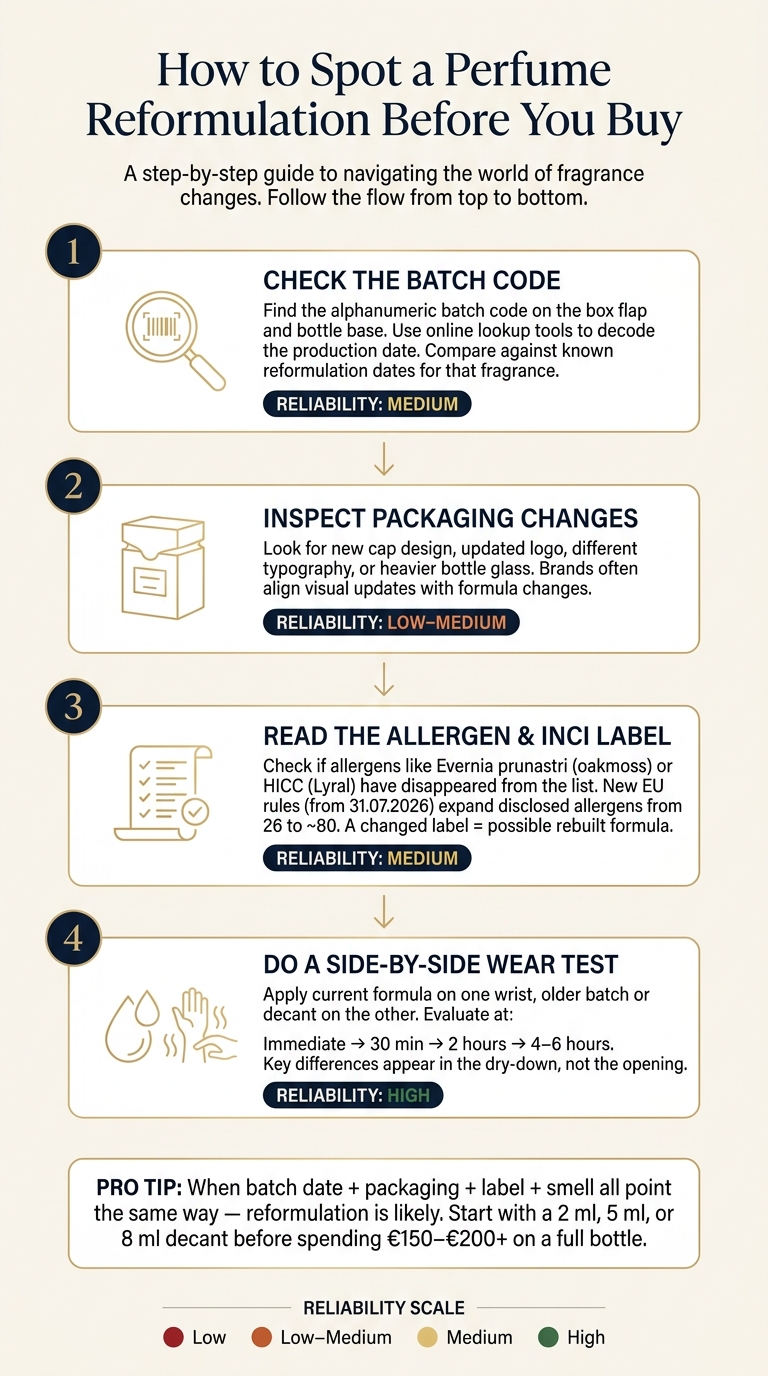
So erkennen Sie eine Parfum-Reformulierung vor dem Kauf
Chargencodes, Verpackung und Hinweise auf das Produktionsdatum
Die meisten Parfumflakons und Verpackungen tragen einen Chargencode: eine kurze alphanumerische Zeichenfolge, die auf die Produktionscharge und häufig auf Monat und Jahr der Herstellung verweist. Sie finden ihn meist auf der unteren Lasche des Kartons und am Boden des Glasflakons. Wenn der Code auf dem Flakon mit dem auf der Verpackung übereinstimmt, spricht das für Echtheit. Wenn sie nicht übereinstimmen, schauen Sie genauer hin.
Duftliebhaber haben die Chargensysteme vieler Häuser entschlüsselt und Suchwerkzeuge erstellt, die einen Chargencode in ein Produktionsdatum übersetzen. Das gibt Ihnen einen nützlichen Prüfpunkt. Vergleichen Sie das Chargendatum mit bekannten Reformulierungsdaten und nutzen Sie anschließend das Etikett zur Bestätigung.
Verpackungsänderungen können helfen, beweisen allein aber nichts. Eine neue Kappe, andere Typografie oder dickeres Flakonglas kann gleichzeitig mit einer Formelanpassung auftauchen. Marken stimmen solche visuellen Aktualisierungen häufig mit compliancebedingten Formelanpassungen ab.
Inhaltsstofflisten und Allergenkennzeichnungen als Hinweise auf Reformulierungen
Etiketten liefern meist den stärkeren Hinweis. In der EU werden Duftstoffallergene einzeln aufgeführt, und Veränderungen dort können auf eine neuere Formel hindeuten.
Wenn eine neuere Verpackung desselben Duftes Evernia prunastri (Eichenmoosextrakt) oder Evernia furfuracea (Baummoosextrakt) nicht mehr aufführt, ist das ein starkes Zeichen dafür, dass die Moosbasis verändert oder entfernt wurde. Wenn HICC/Lyral verschwunden ist, enthält die Formel kein Lyral mehr.
Nutzen Sie die Allergenliste als schnellen Filter. Sie hilft Ihnen zu erkennen, ob ein Flakon möglicherweise eine neuere Charge mit neu aufgebauter Basis ist, ohne sich in den Vorschriften hinter dem Etikett zu verlieren.
Ein kurzer Leitfaden zu Reformulierungssignalen
Kein einzelner Hinweis entscheidet alles. Beginnen Sie mit dem Chargencode und vergleichen Sie dann Etikett und Duft mit bekannten älteren Flakons.
| Signal | Art des Hinweises | Zuverlässigkeit |
|---|---|---|
| Chargencode passt zu bekanntem Reformulierungsdatum | Hinweis auf Produktionsdatum | Mittel |
| Verpackungsrelaunch (Kappe, Logo, Typografie) | Visuell / ästhetisch | Niedrig–Mittel |
| Änderung der INCI- oder Allergenliste | Etikett / regulatorisch | Mittel |
| Direkter Duftvergleich | Sensorisch | Hoch |
| Wiederholte Berichte von Sammlern | Sammler-Konsens | Hoch |
Wenn Chargendatum, Verpackung, Etikett und Duft alle in dieselbe Richtung weisen, wird eine Reformulierung deutlich wahrscheinlicher. Sobald mehrere Signale zusammenpassen, lässt sich oft erkennen, ob ein Flakon die aktuelle Formel oder eine ältere Charge enthält.
Wie Sie vermeiden, Geld für eine Reformulierung auszugeben, die Ihnen nicht gefällt
Direkte Tragetests vor dem Kauf eines Vollflakons
Hinweise helfen nur, wenn sie Ihr nächstes Handeln verändern. Wenn Chargencodes, Etiketten oder der Duft selbst auf eine Reformulierung hindeuten, raten Sie nicht. Testen Sie die aktuelle Formel, bevor Sie einen Vollflakon kaufen.
Die beste Methode ist ein kontrollierter Tragetest im direkten Vergleich. Tragen Sie die aktuelle Formel auf ein Handgelenk auf und eine ältere Charge oder eine authentische Abfüllung auf das andere. Halten Sie die Bedingungen gleich und prüfen Sie beide Düfte in festen Abständen.
| Testintervall | Worauf Sie achten sollten |
|---|---|
| Sofort | Auftakt und erster Eindruck |
| 30 Minuten | Übergang ins Herz des Duftes |
| 2 Stunden | Kerncharakter, Körper und Komplexität |
| 4–6 Stunden | Dry-down und Basis - dort, wo Unterschiede am deutlichsten werden |
Die Eröffnung sagt nicht viel aus. Die meisten Reformulierungsunterschiede zeigen sich später, besonders im Dry-down. Dort bemerken Sie möglicherweise eine dünnere Basis, weniger Moos, schwächere Projektion oder kürzere Haltbarkeit. Um den Test ehrlich zu halten, bewerten Sie jede Phase für sich: Projektion, Fülle und Haltbarkeit. So können Sie besser zwischen einer echten Formelanpassung und normaler Chargenvariation, Oxidation oder bloßer Erinnerungstäuschung unterscheiden.
Warum Abfüllungen das Risiko senken, wenn Reformulierungen unklar sind
Wenn Sie die aktuelle Formel enttäuscht, bleiben Sie bei Abfüllungen, statt direkt zum Vollflakon zu greifen. Wenn Bewertungen von Charge zu Charge gemischt sind oder Sie nicht bestätigen können, welche Formel in einem Flakon steckt, ist ein Kauf in Originalgröße ein Glücksspiel. Das kann bedeuten, 200 €+ für etwas auszugeben, das nicht mehr wie die Version duftet, in die Sie sich verliebt haben.
Scento bietet authentische Fläschchen mit 2 ml, 5 ml und 8 ml sowie bei den meisten Düften eine Flakon-Abfüllung mit 30 ml an. So können Sie die aktuelle Formel mit geringem Risiko testen, bevor Sie sich für die Originalgröße entscheiden.
Fazit: Was Sie mitnehmen sollten
IFRA-Regeln verbessern die Sicherheit, führen aber dennoch zu Formelanpassungen. Betrachten Sie Chargencodes, Verpackungsupdates und Änderungen bei der Allergenkennzeichnung vor dem Kauf als Hinweise darauf, dass ein Parfum reformuliert worden sein könnte. Testen Sie dann zuerst. So kaufen Sie den Duft, der tatsächlich im Flakon ist, nicht den, an den Sie sich erinnern.
FAQs
Macht eine Reformulierung ein Parfum immer schlechter?
Nein. Eine Reformulierung macht ein Parfum nicht automatisch schlechter, kann für Parfümeure aber eine anspruchsvolle Aufgabe sein.
Wenn IFRA-bedingte Beschränkungen Inhaltsstoffänderungen erzwingen, versuchen Parfümeure, den ursprünglichen Charakter des Duftes zu bewahren und zugleich Sicherheits- und Compliance-Regeln einzuhalten. Dennoch können kleine Veränderungen im Duft oder in seiner Performance auftreten.
Wie kann ich Chargenvariation von einer echten Reformulierung unterscheiden?
Oft entscheidet sich das an den Inhaltsstoffen.
Wenn ein Duft natürliche Materialien verwendet, sind leichte Unterschiede von Flakon zu Flakon normal. Faktoren wie Boden, Wetter und Erntezeitpunkt können beeinflussen, wie der Duft riecht. Eine Rosenernte aus einem Jahr duftet nicht immer exakt wie die nächste, und solche Schwankungen gehören dazu.
Eine echte Reformulierung ist wahrscheinlicher, wenn Regeln eine Änderung der Formel erzwingen. Das kann bei IFRA-Grenzwerten für Allergene wie Eichenmoos passieren. Wenn ein Duft also deutlich anders riecht oder auf der Haut nicht mehr so lange hält, handelt es sich vermutlich eher um eine Reformulierung als um normale Chargenvariation.
Kann ein Vintage-Flakon allein durch sein Alter anders riechen?
Ja. Mit der Zeit kann Parfum in einem Vintage-Flakon auch ohne Reformulierung anders riechen. Es kann oxidieren und sich nach Jahren der Lagerung verändern, besonders wenn der Flakon lange unbenutzt stand.
Deshalb empfiehlt Scento kleinere Größen oder Abfüllungen. Sie können erleben, wie ein Duft auf Ihrer Haut wirkt, bevor Sie sich für einen Vollflakon entscheiden, und Sie bemerken möglicherweise auch, wie sich der Duft im Laufe der Lagerung verändert.

