

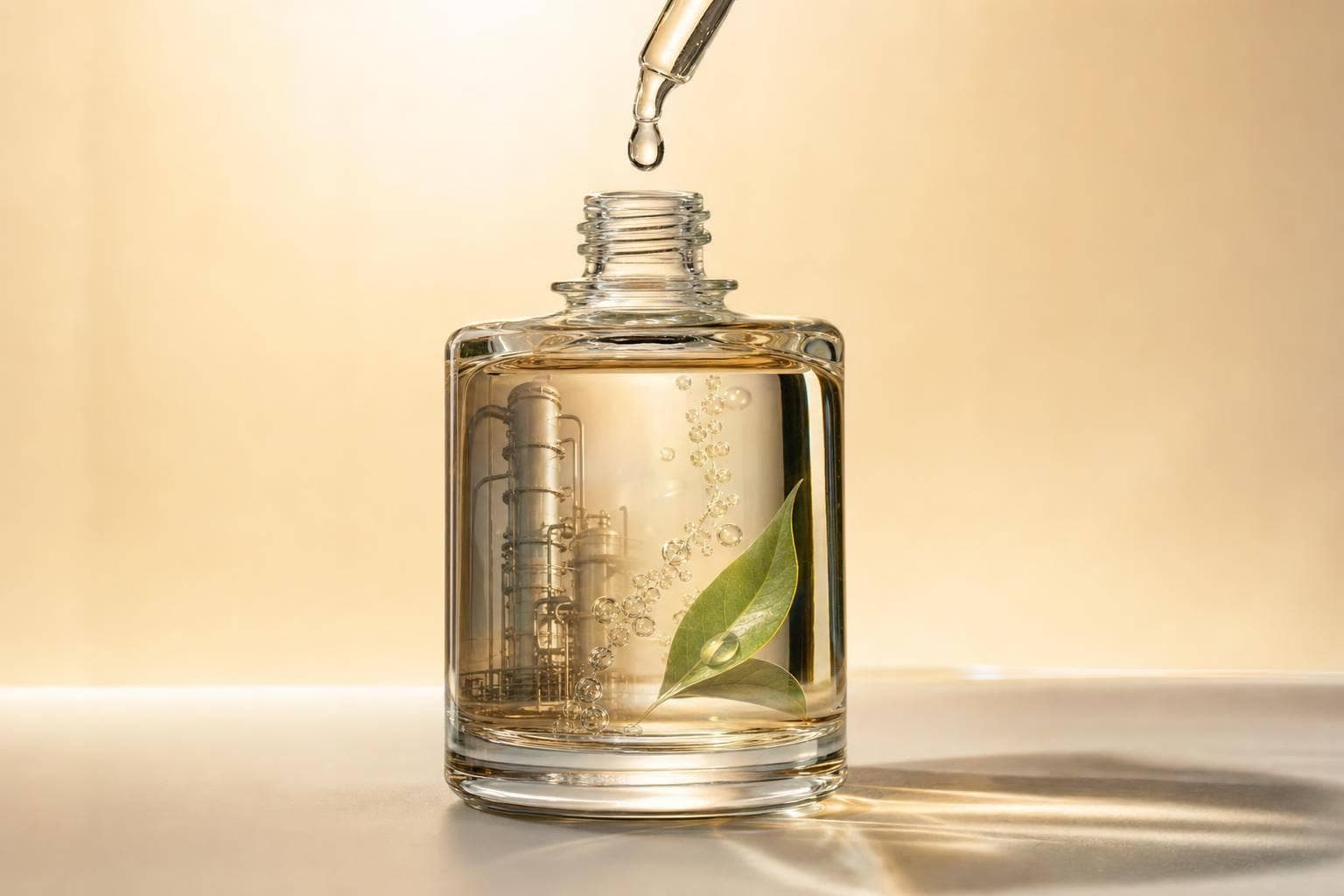
Most “recycled carbon” perfume claims are about the alcohol, not the scent oils. I’d sum it up like this: brands can make perfume ethanol from industrial CO₂ instead of crops, and if that alcohol is refined to fragrance-grade quality, it smells and performs the same in the bottle.
Here’s the short version you need:
- What changes: the carbon source for the ethanol
- What stays the same: the smell, skin feel, and spray performance
- Why it matters: ethanol can make up 70–95 % of a perfume by volume
- Where the carbon often comes from: steel plant gas that is cleaned, then fed to microbes
- What the process needs: strong purification to reach about 99,0–99,5 % alcohol purity
- What the claim does not mean: the whole perfume is low-impact
- What to check: proof of source, chain of custody, and an independent life-cycle assessment
I see this as a supply-chain change with a narrow but clear scope. It can cut land and water demand tied to crop-based ethanol, and it may cut emissions too if the plant runs on low-carbon energy. But it does not fix packaging, shipping, or the scent materials themselves.
If you want the plain answer: recycled-carbon perfume alcohol is standard perfume ethanol made from waste CO₂, not from crops - and that matters most behind the scenes, not on your skin.
How CO2 becomes perfume alcohol
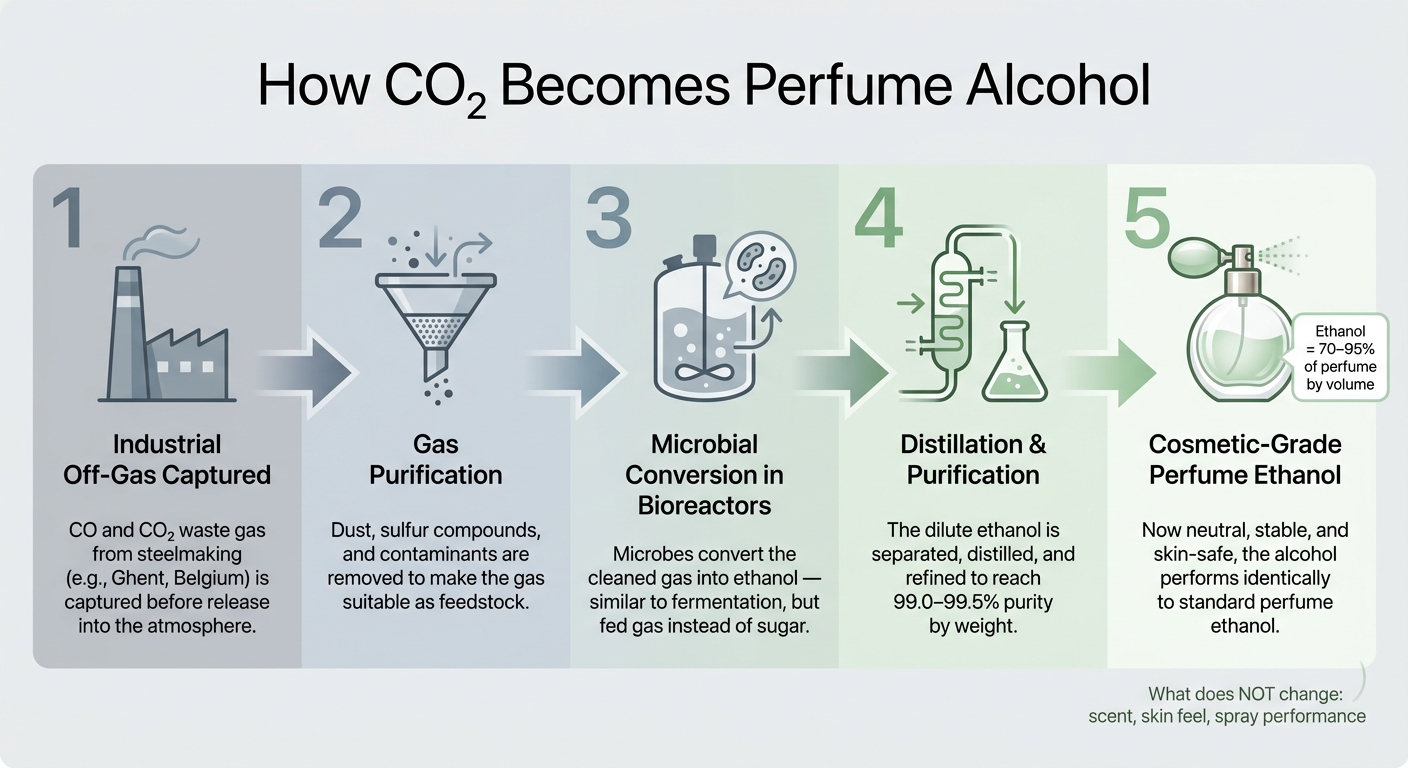
How CO₂ Becomes Perfume Alcohol: The Recycled Carbon Process
Where the carbon comes from
The carbon usually starts as steelmaking off-gas, mostly CO and CO₂, captured before it escapes into the air. A well-known case is the steel plant in Ghent, Belgium, where waste gas is turned into ethanol.
Before that gas can be used, it has to be cleaned up. Dust, sulfur compounds, and other contaminants are removed first, so the gas is fit to serve as feedstock.
How it turns into ethanol
After cleaning, the gas moves into bioreactors. There, microbes convert it into ethanol. The basic idea is close to fermentation, but instead of feeding the microbes sugar, you feed them gas.
The result is still too dilute to use as-is, so it goes through separation, distillation, and refining until it reaches about 99,0–99,5 % by weight. At that point, the alcohol can work exactly like standard perfume ethanol.
Why purity matters in perfume
Raw ethanol can’t just go straight into a fragrance. Even tiny traces of impurities, odd smells, or leftover by-products can throw off the scent or irritate skin. That’s why the alcohol has to be distilled, dehydrated, and refined to cosmetic-grade standards before it enters a perfume formula.
Purity is the whole game here: perfume-grade ethanol needs to be neutral, stable, and safe on skin.
That matters because ethanol does most of the heavy lifting in a perfume formula.
Why ethanol matters in perfume
Ethanol carries the scent
Ethanol is the main carrier in most spray perfumes because it dissolves a broad mix of aroma molecules and keeps them in a clear, stable liquid. That matters more than it sounds. Many essential oils and aroma chemicals simply don’t blend well with water on their own, while oil-based carriers tend to feel heavier and dry more slowly.
You notice ethanol’s role the moment you spray a perfume. It evaporates fast - its boiling point is around 78–83 °C - which helps lift aroma molecules into the air. That fast evaporation is also part of why a fragrance opens in stages, moving from top notes to base notes. And because ethanol has low viscosity, atomisers can turn it into a fine, even mist.
What changes with recycled-carbon ethanol
Once it has been refined, recycled-carbon ethanol behaves like standard perfume alcohol. For the person wearing the fragrance, almost nothing changes. The fragrance concentrate stays the same, so the scent stays the same too. At cosmetic purity levels, ethanol adds almost no smell of its own. It’s a delivery medium, not a fragrance note.
Brands usually check the switch with blind wear tests and stability checks. If they use the same denaturants and keep impurity levels in line, test panels often can’t tell one from the other. So the shift happens mostly behind the scenes: in the supply chain and the carbon footprint, not in how the perfume smells or feels on skin.
That leaves the main question: what environmental benefits does recycled-carbon ethanol deliver, and what limits still remain?
Ihr persönlicher Duftexperte erwartet Sie
Machen Sie unser kurzes Duftquiz und entdecken Sie authentische Designer- und Nischenparfums, die zu Ihrem Geschmack passen – als 2–8ml Dekants und Proben, damit Sie jeden Duft testen können, bevor Sie sich für einen ganzen Flakon entscheiden.
Finden Sie Ihren DuftPros and limits of recycled-carbon perfume alcohol
Where lower emissions and resource use may come from
Ethanol is the main carrier solvent in perfume. So when you change where that ethanol comes from, you change part of the product’s footprint without changing how the scent smells.
Crop-based ethanol, usually made from sugarcane or corn, depends on farmland, irrigation, and fertiliser. Brazilian sugarcane ethanol requires about 108 gallons of water for every gallon of ethanol produced. Recycled-carbon routes cut out the farming stage, which means far less land use and much lower feedstock water demand.
The bigger issue, though, is energy. The carbon source matters less than the power used to convert it into ethanol. Emissions can go down, but that only happens when the plant runs on low-carbon energy. Under those conditions, life-cycle assessments show lower or similar impacts than grain ethanol in some cases, with clear gains in land use and water consumption.
What it does not fix
That upside is limited to the alcohol itself.
Switching the carrier solvent does not make the whole perfume low-impact. A formula can use recycled-carbon alcohol and still depend fully on standard petrochemical materials for its scent accord. So when a brand presents recycled-carbon alcohol as the whole sustainability story, it’s saying more than the switch can support.
How brands can prove the claim
Without documentation, terms like recycled carbon and captured carbon are hard to check. Brands should publish:
- chain-of-custody records
- the carbon source and conversion method
- an independent life-cycle assessment for the alcohol, including measured CO₂e and water-use data
- a clear statement showing whether the claim applies only to the ethanol or also to other parts of the formula
That level of proof separates a supply-chain shift from a marketing label.
Conclusion: Where recycled carbon fits in perfume
Recycled carbon changes the ethanol supply chain, not the smell in the bottle. Recycled-carbon ethanol is perfume-grade alcohol made from captured industrial CO₂. After purification, it performs like standard ethanol. And because ethanol often accounts for 70–90 % of a fragrance formula by volume, changing where that carbon comes from is a big shift in sourcing, even though the fragrance itself stays the same when the alcohol meets the same perfume specs.
The main upside is pretty clear: less pressure on crops, land, and water. If the process runs on low-carbon energy, emissions can also come in lower than with grain-based ethanol. That gives it a real place in modern perfumery, but not as a catch-all answer.
Perfume still carries a footprint beyond the alcohol. Energy use, packaging, and distribution all continue to matter.
So it makes sense to read recycled-carbon claims with a careful eye. They carry weight only when brands state the ethanol source, explain how the conversion works, and share an independent life-cycle assessment. Recycled carbon is a meaningful change in input, not a full fix.
FAQs
Is recycled carbon used in the alcohol or the scent oils?
Yes. Recycled carbon is used to make the ethanol that forms the base of a perfume, usually 75% to 90% of the full formula.
Companies take industrial carbon emissions, turn them into high-grade alcohol, and use that in place of petroleum-based ingredients. The result is a lower-impact option that can help cut the fragrance’s overall carbon footprint.
Will recycled-carbon perfume smell different on skin?
Yes, but not in a way that hurts quality.
Perfumes made with recycled or upcycled ingredients can smell a little different because these materials may bring more layered, more intense, or less expected aromatic profiles than standard sourcing methods.
For example, second-distillation techniques can bring out new spicy or honeyed notes that add depth. And like any perfume, the way it opens, settles, and wears on skin can change from person to person because of individual skin chemistry.
How can I verify a recycled-carbon claim?
Look past vague labels like natural or green. What matters is clear proof.
Check whether the brand shares Life Cycle Assessment (LCA) data and points to standards such as EN 16785-1. That tells you a lot more than soft marketing language ever will.
It also helps to look for third-party certifications like COSMOS or Ecocert. And if a brand publishes detailed sourcing reports or technical markers such as renewable carbon content, that’s usually a strong sign it has done the homework.