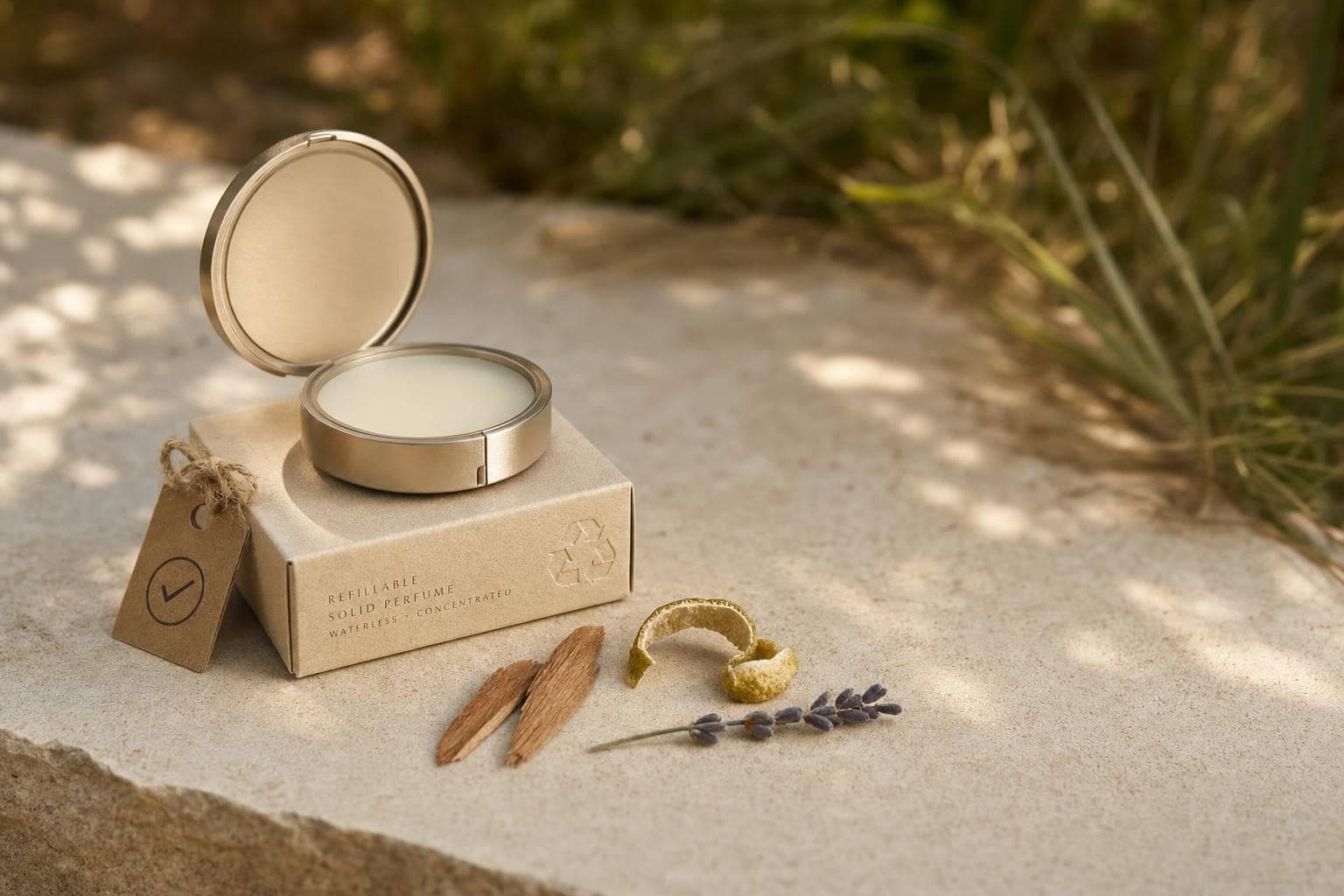
Wasserfreies Parfum ist nicht automatisch die umweltärmere Wahl. Mein Fazit ist klar: Diese Formate können direktes Rezepturwasser, Verpackungsgröße und Versandgewicht reduzieren, doch der größte Fußabdruck entsteht häufig vorgelagert – bei Inhaltsstoffen, Verarbeitung und Verpackung.
Wenn ich mich heute in Deutschland für ein solches Produkt entscheiden würde, würde ich zuerst auf vier Dinge achten:
- Wie konzentriert es ist pro Anwendung
- Wie leicht die Verpackung ist
- Woher die Inhaltsstoffe stammen
- Ob die Marke klare Nachweise liefert, statt vager grüner Aussagen
Ein festes Parfum oder ein Öl kann im Transport weniger Material beanspruchen als ein 50-ml-Spray. Dieser Vorteil kann jedoch schrumpfen, wenn die Rezeptur auf wasserintensiven Botanicals, schweren Nachfüll-Etuis oder wachsreichen Sticks basiert, die pro Dosis mehr Material benötigen.
Wichtige Zahlen aus dem Artikel:
- Wasserfreie Formate enthalten in der Rezeptur häufig ≈ 0 % direktes Wasser
- Klassische Sprays können 70–80 % Wasser enthalten
- Das indikative Transportgewicht pro 100 Anwendungen kann von etwa 0,20 kg auf 0,10–0,12 kg sinken
- Givaudan meldete bis 2020 eine Senkung der Wasserintensität um 31 %
- IFF meldete bis 2018 eine Senkung des Wasserverbrauchs um 66 %
- dsm-firmenich meldete im Reporting 2025 eine Verbesserung um 11 % an Standorten mit Wasserstress
Für Deutschland sticht ein Punkt besonders hervor: Ab dem 27. September 2026 dürfen Marken nicht mehr auf breite, verbrauchergerichtete Aussagen wie „grün“ oder „umweltfreundlich“ setzen, ohne dafür anerkannte Nachweise zu erbringen. Für mich lautet die kluge Frage daher nicht „Ist es wasserfrei?“, sondern „Wie sieht der gesamte Lebenszyklus aus?“
| Prüfpunkt | Was ich sehen möchte |
|---|---|
| Rezeptur | Wenig direktes Wasser, stabiles Design, kein extra schweres Füllsystem |
| Inhaltsstoffe | Beschaffung mit geringerem Wasserbedarf oder klare Lieferantendaten |
| Verpackung | Leicht, recycelbar, wenig zusätzliche Dekoration |
| Größe | Ein Format, das ich aufbrauche, statt es zu verschwenden |
| Aussagen | Klare Zahlen und ein klarer Geltungsbereich, keine weichgespülten Formulierungen |
Die Kurzfassung lautet also: Wasserfreies Parfum kann eine Wahl mit geringerem Fußabdruck sein – aber nur, wenn Rezeptur, Lieferkette, Verpackungsdesign und Nutzungsverhalten zusammenpassen.
Was Studien über die Vorteile wasserfreier Parfums zeigen
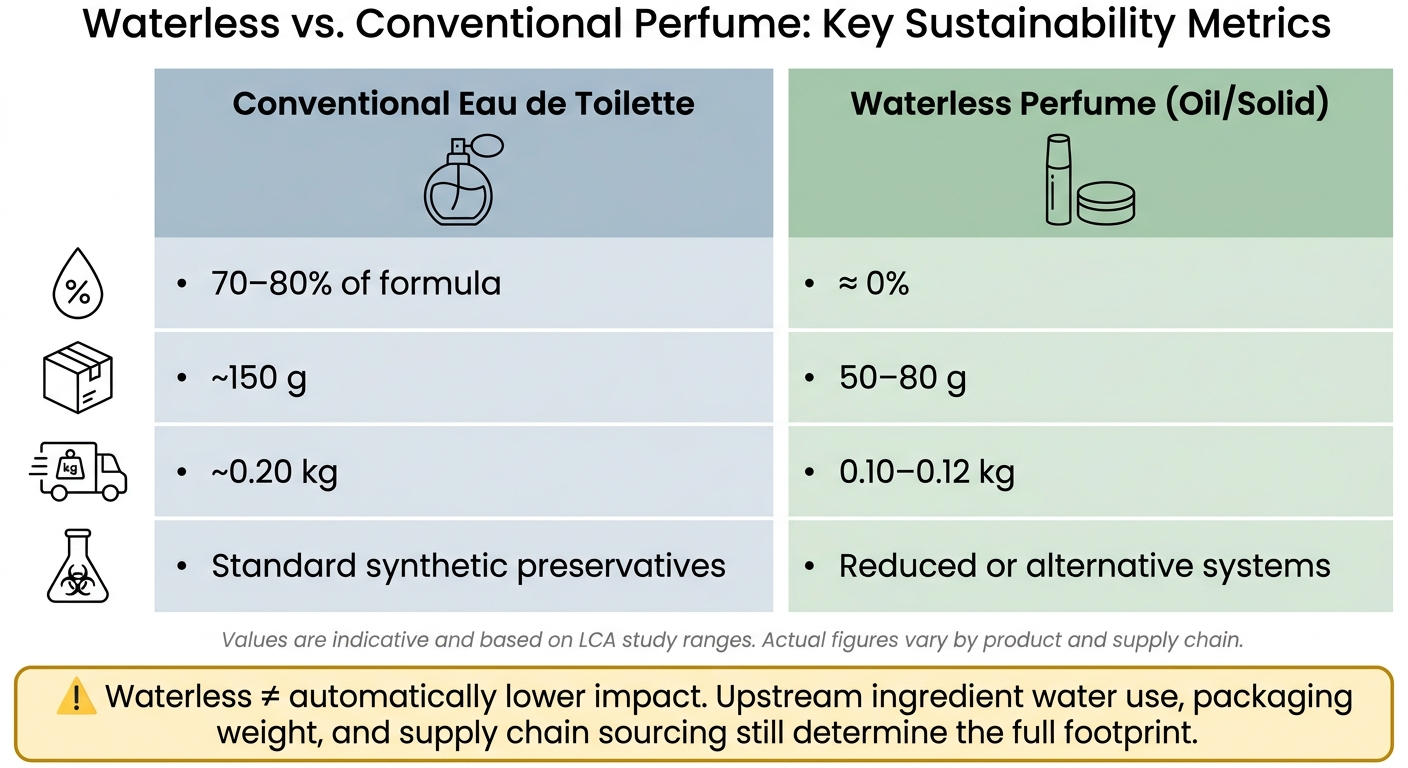
Wasserfreies vs. konventionelles Parfum: Nachhaltigkeitskennzahlen im Vergleich
Gemessen an diesen Lebenszyklus-Kriterien verweist die Forschung auf drei zentrale Vorteile.
Weniger Wasser in der Rezeptur
Wasserfreie Formate ersetzen den größten Teil oder das gesamte Trägerwasser durch Öle, Wachse und Puder. Dadurch sinkt der direkte Wasserverbrauch bei der Formulierung. Für sich genommen klingt das überzeugend. Der größere Gewinn entsteht jedoch meist dann, wenn diese Umstellung zugleich Verpackungsgröße und Frachtgewicht reduziert.
Kleinere Verpackungen und geringeres Transportgewicht
Sobald das Wasser entfernt wird, wird das Produkt konzentrierter. Das bedeutet: Die gleiche Anzahl an Anwendungen passt in ein kleineres, leichteres Format. LCA-basierte Studien zu festen Kosmetika zeigen, dass dieser Konzentrationseffekt sowohl die Verpackungsmasse als auch das Transportgewicht pro 100 Anwendungen senken kann.
Ein 10-g-fester Stick oder ein kleines Ölfläschchen benötigt schlicht weniger Material und wiegt im Transport weniger als ein 50-ml-Spray. Es ist derselbe Grundgedanke wie beim Versand eines schlanken Buches statt eines schweren Hardcover-Bands: weniger Volumen, weniger Gewicht, weniger Aufwand auf dem Weg von A nach B.
| Kennzahl | Konventionelles Eau de Toilette | Wasserfreies Parfum (Öl/Fest) |
|---|---|---|
| Direkter Wassergehalt | 70–80 % der Rezeptur | ≈ 0 % |
| Verpackungsmasse | ~150 g | 50–80 g |
| Transportgewicht pro 100 Anwendungen | ~0,20 kg | 0,10–0,12 kg |
| Bedarf an Konservierungsstoffen | Standardmäßige synthetische Konservierungsstoffe | Reduzierte oder alternative Systeme |
Hinweis: Die Werte sind indikativ und basieren auf Bandbreiten aus LCA-Studien. Tatsächliche Zahlen variieren je nach Produkt und Lieferkette.
Weniger Konservierungsstoffe und Unterstützung für ein wirkungsärmeres Design
Ohne Wasser haben Mikroben deutlich weniger Nahrung. Daher liegen wasserfreie Produkte häufig unterhalb der Wasseraktivitäts-Schwelle, ab der Konservierungsstoffe erforderlich sind. Stattdessen bleiben sie durch niedrige Wasseraktivität, antioxidative Systeme und luftdichte Verpackungen stabil.
Bei Duft kann das Rezepturen mit weniger Konservierungsstoffen und kürzeren Inhaltsstofflisten bedeuten. Es harmoniert außerdem gut mit nachfüllbaren Metall- oder Glasetuis und minimalen papierbasierten Umverpackungen, die Einwegkunststoff reduzieren können.
Allerdings entstehen diese Vorteile nicht automatisch. Herkunft der Inhaltsstoffe, Produktstabilität und End-of-Life-Design bleiben entscheidend. Der nächste Abschnitt betrachtet, wo solche Nachhaltigkeitsaussagen genauer gelesen werden müssen.
Wo Nachhaltigkeitsaussagen zu wasserfreien Produkten Vorsicht verlangen
Die Kernfrage ist einfach: Hält die Aussage eines geringeren Fußabdrucks auch dann noch, wenn man die gesamte Lieferkette betrachtet? Wasser aus einer Parfumrezeptur zu entfernen, ist nicht dasselbe, wie Wasser aus der Produktion zu entfernen. Deshalb ist der Wasserverbrauch in der Lieferkette wichtiger als die Aussage auf dem Etikett.
Indirekter Wasserverbrauch zählt weiterhin
Jeder Inhaltsstoff in einem wasserfreien Parfum hat eine lange Geschichte, bevor er den Flakon erreicht. Botanischer Anbau, Destillation, biotechnologische Fermentation und Kühlung in Fabriken verbrauchen Wasser. Dieser vorgelagerte Verbrauch kann deutlich größer sein als die Menge, die eingespart wird, indem man Wasser aus der Rezeptur herauslässt.
Das CDP-Reporting zur Wassersicherheit von IFF schließt Wasserentnahmen für vorgelagerte Rohstoffe und Verpackungen aus; Symrise unterscheidet zwischen direkten Entnahmen in der Herstellung und Wasserverbrauch in der Lieferkette. Einfach gesagt: Unternehmenskennzahlen zum Wasser lassen oft einen großen Teil des Gesamtbildes außen vor.
Für Leserinnen und Leser in Deutschland bedeutet das: „wasserfrei“ ist kein automatisches Zeichen für eine geringere Wirkung auf die Umwelt. Ein Rosenabsolue oder Jasminextrakt kann durch Bewässerung und Destillation weiterhin einen erheblichen Wasserfußabdruck haben. In manchen Fällen können natürliche Materialien sogar mehr Wasser verbrauchen als hochreine synthetische oder biotechnologisch gewonnene Duftnoten. Die alte Abkürzung funktioniert hier also nicht: Natürlich bedeutet nicht automatisch eine geringere Wasserwirkung.
Sicherheit, Stabilität und Formulierungs-Kompromisse
Wasserfreie Produkte widerstehen mikrobiellem Wachstum meist besser, weil Bakterien und Pilze Wasser zum Wachsen benötigen. Produkte mit einer Wasseraktivität (aw) unter ungefähr 0,60 zeigen minimales mikrobielles Wachstum. Dennoch können feuchte Finger oder Kondensation kleine Feuchtigkeitsnester einbringen und ein Kontaminationsrisiko schaffen.
Mikroben sind nicht das einzige Thema. In öl- und wachsreichen Rezepturen ist Oxidation oft das größere Problem. Ungesättigte Pflanzenöle und Buttern können ranzig werden, wenn sie Luft, Licht oder Wärme ausgesetzt sind. Das kann zu Fehlgerüchen und potenziell sensibilisierenden Nebenprodukten führen. Um dies zu kontrollieren, setzen Marken häufig auf antioxidative Systeme, stabile Emollients und Verpackungen, die Luft und Licht abhalten.
Diese Lösung bringt eigene Kosten mit sich. Einige dieser zusätzlichen Systeme hängen von petrochemischen Inputs oder Verpackungsformaten ab, die schwer zu recyceln sind. Ein Problem wird also reduziert, während an anderer Stelle in der Kette ein neues entstehen kann.
Oxidation kann auch den Materialeinsatz erhöhen. Manche Sticks und Balms benötigen viel Wachs und Öl, um ihre Form zu halten und Duft gut abzugeben. Anders gesagt: Ein wasserfreies Format kann den Fußabdruck vom Wasser im Flakon hin zu mehr Feststoffen und mehr Verpackung pro Anwendung verlagern. Das ist nicht automatisch der bessere Tausch.
| Dimension | Vorteil wasserfreier Formate | Zentrale Herausforderung |
|---|---|---|
| Direktes Wasser in der Rezeptur | Kein zugesetztes Wasser; geringerer Bedarf an klassischen Konservierungsstoffen | Geringe Wirkung auf den gesamten Wasserfußabdruck, wenn der vorgelagerte Verbrauch hoch ist |
| Vorgelagerter Wasserverbrauch | Potenzielle Reduktion durch biotechnologische oder synthetische Inhaltsstoffe | Hohe Wasserfußabdrücke bei manchen Botanicals und Destillationsprozessen |
| Verpackung | Kleinere Formate möglich; nachfüllkompatible Designs | Schwere Dosen oder komplexe Mechanismen können direkte Wassereinsparungen aufheben |
| Mikrobiologische Stabilität | Niedrige Wasseraktivität reduziert mikrobielles Wachstum | Kontakt durch Verbraucher und Feuchtigkeitseintrag bergen weiterhin Kontaminationsrisiken |
| Materialintensität | Hohe Duftdichte pro Einheit kann das versprühte Volumen senken | Hohe Wachs- und Ölmasse pro Dosis kann Ressourceneinsatz und Transportgewicht erhöhen |
Der nächste Abschnitt untersucht, ob Nachhaltigkeitsberichte von Unternehmen diese indirekten Auswirkungen widerspiegeln.
Ihr persönlicher Duftexperte erwartet Sie
Machen Sie unser kurzes Duftquiz und entdecken Sie authentische Designer- und Nischenparfums, die zu Ihrem Geschmack passen – als 2, 5, 8 & 30 ml Dekants und Proben, damit Sie jeden Duft testen können, bevor Sie sich für einen ganzen Flakon entscheiden.
Finden Sie Ihren DuftBranchendaten: Wasserverbrauch, grüne Chemie und Duftproduktion
Was Nachhaltigkeitsberichte von Unternehmen zeigen
Große Duftstofflieferanten verbrauchen weniger Wasser, doch das Bild ist nicht überall gleich. Deshalb sagen Lieferantendaten oft mehr aus als eine einfache ohne-Wasser-Aussage auf dem fertigen Produkt.
Givaudan, IFF und dsm-firmenich gehören zu den größten Anbietern von Duftstoffkompositionen weltweit, und alle drei veröffentlichen Kennzahlen zur Wassereffizienz. Givaudan meldete bis 2020 eine Senkung der Wasserintensität um 31 % gegenüber dem Basisjahr 2009 und erreichte damit sein Reduktionsziel von 15 % drei Jahre früher. Das Ziel für 2030 ist eine Verbesserung der Wassereffizienz um 25 % an Standorten mit Wasserstress gegenüber dem Basisjahr 2020, verbunden mit der Zusage, dass 100 % der Abwassereinleitungen regulatorische Standards erfüllen oder übertreffen werden.
IFF meldete bis 2018 eine Senkung des Wasserverbrauchs um 66 % und übertraf damit sein Ziel von 50 %. Am Standort Tilburg in den Niederlanden sollte ein eigenes Recyclingprojekt bis zu 110.000 m³ Wasser pro Jahr einsparen.
dsm-firmenich meldete für 2024 eine gesamte Wasserentnahme von 103,2 Millionen m³, nach 104,4 Millionen m³ im Jahr 2023. Das ist insgesamt nur ein kleiner Rückgang, doch ohne Durchlaufkühlung beträgt die Reduktion 17 %. Das freiwillige Ziel für 2030 betrachtet Standorte mit Wasserstress: eine Senkung der Wasserintensität um 10 % von 2023 bis 2030. Im Reporting 2025 gab das Unternehmen an, an diesen Standorten bereits eine Verbesserung um 11 % erreicht zu haben und damit leicht vor Plan zu liegen.
| Unternehmen | Basisjahr | Erreichte Reduktion | Ziel 2030 | Geltungsbereich |
|---|---|---|---|---|
| Givaudan | 2009 | 31 % Reduktion der Wasserintensität gegenüber dem Basisjahr | 25 % Verbesserung der Wassereffizienz an Standorten mit Wasserstress bis 2030; 100 % der Abwassereinleitungen sollen Standards erfüllen oder übertreffen | Standorte mit Wasserstress; Standards für Abwassereinleitungen |
| IFF | n/a | 66 % Reduktion des Wasserverbrauchs bis 2018, über einem Ziel von 50 % | n/a | Globale Geschäftstätigkeit |
| dsm-firmenich | 2023 | 1 % geringere Gesamtentnahme; 17 % Reduktion ohne Durchlaufkühlung | 10 % Reduktion der Wasserintensität an Standorten mit Wasserstress bis 2030 | Standorte mit Wasserstress |
Warum ist das wichtig? Weil Konzentrate pro Milliliter mehr Duftmaterial enthalten als Sprays. Die Wassereffizienz des Lieferanten steht daher in engerer Verbindung zum Endprodukt. Wenn eine Fabrik pro Einheit Konzentrat weniger Wasser verbraucht, sinkt auch die vorgelagerte Last, die mit einem wasserfreien Parfum verbunden ist.
Warum grüne Chemie und biotechnologische Inhaltsstoffe wichtig sind
Fabrikeffizienz ist ein Teil der Geschichte. Der andere Teil ist die Rezeptur selbst. Grüne Chemie und weiße Biotechnologie helfen dabei, die Prozesslast hinter Aromamolekülen zu senken, die in Ölen, Balms und festen Parfums eingesetzt werden. Diese Veränderung wirkt direkt auf den vorgelagerten Fußabdruck wasserfreier Düfte.
Biokatalyse kann mehrstufige wässrige Aufreinigung ersetzen. Weiße Biotechnologie kann außerdem Aromamoleküle aus erneuerbaren Rohstoffen mit weniger Prozesswasser und weniger Abwasser herstellen.
Der Standort von Mane in Le Bar-sur-Loup, Frankreich, liefert ein gutes Beispiel für sauberere vorgelagerte Verarbeitung. Das Jungle Essence™-Extraktionssystem mit überkritischem CO₂ gewinnt 96,5 % der verwendeten Lösungsmittel zurück. Das hilft, Freisetzungen in die Umwelt zu vermeiden, und reduziert den Bedarf an wasserbasierten Reinigungsschritten. Diese geringere Prozesslast überträgt sich auf die Inhaltsstoffe, die in wasserfreien Parfums verwendet werden.
Für Käuferinnen und Käufer in Deutschland erzählt das Format allein nicht die ganze Geschichte. Die Herkunft der Inhaltsstoffe zählt. Lieferantendaten zum Wasser zählen ebenfalls. Damit verschiebt sich der Blick vom Etikett auf dem Flakon zu den Standards hinter der Rezeptur.
Was das für Duftentscheidungen in Deutschland bedeutet
Designprinzipien für wasserfreie Parfums mit geringerem Fußabdruck
Sobald man über Lieferantendaten zum Wasser hinausblickt, wird der nächste Schritt praktisch: Worauf sollten deutsche Marken und Käufer achten?
Konzentration steht an erster Stelle. Wenn ein Parfum starke Aromamoleküle mit guter Diffusion nutzt, braucht man pro Tragen weniger Produkt. Das reduziert die Nachfrage weiter oben in der Lieferkette. Biobasierte Träger, etwa Pflanzenwachse oder biobasiertes Ethanol, sind hier ebenfalls sinnvoll, weil sie besser zu den Kriterien des EU Ecolabel passen.
Der EU-Ecolabel-Referenzwert setzt ein Packaging Impact Ratio (PIR) von unter 0,20 g Verpackung pro Gramm Produkt. Das drängt Marken zu leichteren Verpackungen und einfacheren Formaten. Denken Sie an Aluminiumdosen oder nachfüllbare Glaszerstäuber mit weniger Umverpackung. Das unterstützt sowohl das PIR-Ziel des EU Ecolabel als auch das deutsche Verpackungsgesetz, das volumenarme, recycelbare Verpackungen begünstigt. Dekorative Extras, die das Sortieren in deutschen Abfallsystemen erschweren, bleiben am besten außen vor.
Aussagen müssen präzise und belegbar sein. Ab dem 27. September 2026 wird die EU-Richtlinie zur Stärkung der Verbraucher für den ökologischen Wandel (EU 2024/825) breite Begriffe wie "umweltfreundlich" oder "grün" im B2C-Marketing verbieten, sofern sie nicht durch eine anerkannte hervorragende Umweltleistung gestützt sind, etwa durch das EU Ecolabel oder ein anderes zugelassenes Typ-I-Umweltzeichen. Eine deutsche Marke kann also nicht einfach behaupten, ein wasserfreies Parfum sei "nachhaltiger". Sie muss zeigen, was sich verändert hat, wie stark es sich verändert hat und an welcher Stelle im Lebenszyklus diese Veränderung stattgefunden hat.
Kleinere Volumina, weniger Verschwendung
Selbst eine Rezeptur mit geringerem Fußabdruck kann Verschwendung bedeuten, wenn der Flakon halbvoll im Regal stehen bleibt.
Viele Käuferinnen und Käufer erwerben teure Vollgrößen und brauchen sie nie auf. Das bedeutet verschwendete Inhaltsstoffe, verschwendete Verpackung und verschwendeten Transport. Kleinere Formate - 2 ml, 5 ml oder 8 ml - geben Menschen die Möglichkeit, einen Duft wirklich zu tragen, bevor sie sich festlegen. Das kann die Wahrscheinlichkeit senken, dass ein großer Flakon gekauft wird und später unbeachtet bleibt.
Es gibt jedoch einen Haken. Decants benötigen pro Milliliter meist mehr Verpackung als ein großer Flakon. Der Vorteil hängt also davon ab, ob sie überhaupt einen unnötigen Vollgrößenkauf verhindern. In Deutschland ist dieser Kompromiss relevant. 38 % der Verbraucher sind nicht bereit, für nachhaltigere Produkte mehr zu bezahlen, während 67 % sagen, sie würden bevorzugen, dass alle Kosmetika nachhaltig sind. Einfach gesagt: Ein Modell rund um kleinere Volumina funktioniert besser, wenn es sowohl kostenbewusst als auch weniger verschwenderisch positioniert wird – nicht nur als grüne Idee.
Fazit: Wasserfreie Parfums helfen – aber nur mit vollständigem Lebenszyklusdenken
Die wichtigste Erkenntnis ist einfach: Das Format hilft, aber Herkunft, Herstellung und Kaufgewohnheiten entscheiden über das Endergebnis.
Wasserfreie Parfums reduzieren den direkten Wasserverbrauch in der Rezeptur. Sie können auch Verpackungsgewicht und Transportemissionen senken. Doch sie entfernen Wasser nicht aus der Lieferkette. Agrarrohstoffe, Lösungsmittelprozesse und Syntheserouten bringen weiterhin eigene Wasser- und Energie-Fußabdrücke mit sich. Für Verbraucherinnen und Verbraucher in Deutschland, die bewusster wählen möchten, ist der praktische Schritt, über das Etikett "wasserfrei" hinauszublicken, zu prüfen, was die Marke tatsächlich zu Verpackung, Inhaltsstoffen und Produktion dokumentiert, und Formate sowie Größen zu wählen, die zu dem passen, was man ehrlich nutzen wird.
FAQs
Woran erkenne ich, ob ein wasserfreies Parfum wirklich einen geringeren Fußabdruck hat?
Prüfen Sie die Inhaltsstoffliste, um sicherzugehen, dass kein Wasser oder Alkohol zugesetzt wurde. Hinweise wie alkoholfrei oder mikrokapselbasiert können ebenfalls helfen, die passende Rezeptur schnell zu erkennen.
Bei Nachhaltigkeitsaussagen sollten Sie sich nicht allein auf das Wort der Marke verlassen. Achten Sie auf anerkannte Zertifizierungen durch unabhängige Dritte, etwa COSMOS, Ecocert oder Fair for Life. Hilfreich ist auch, wenn eine Marke klare, messbare Produktionsdetails teilt, etwa überkritische CO2-Extraktion oder biotechnologisch gewonnene Inhaltsstoffe.
Sind natürliche Inhaltsstoffe in wasserfreien Parfums immer besser?
Nein. Natürliche Inhaltsstoffe sind nicht automatisch besser oder nachhaltiger als synthetische oder im Labor gewonnene Optionen.
Natürliche Extrakte können versteckte Kosten mit sich bringen: Überernte, Lebensraumschäden und Verlust an Biodiversität. Biotechnologie kann dagegen naturidentische Duftnoten nachbilden und dabei weniger Land, weniger Wasser und weniger Energie verbrauchen.
Der entscheidende Punkt ist einfach: Die Wirkung hängt davon ab, wie ein Inhaltsstoff beschafft und hergestellt wird – nicht nur davon, ob er natürlich oder synthetisch ist.
Reduzieren kleinere Parfumgrößen wirklich Abfall?
Ja. Kleinere Größen können Verschwendung in der Duftbranche auf sehr direkte Weise reduzieren. Viele Menschen geben mehr als 300 € für einen Flakon in Originalgröße aus, nur um später festzustellen, dass sie den Duft nicht tragen möchten. Dann bleibt er im Regal stehen, kaum berührt.
Kuratierte 2-ml-, 5-ml- oder 8-ml-Decants geben Ihnen Raum, einen Duft richtig zu testen, bevor Sie sich für einen großen Flakon entscheiden. Das bedeutet weniger Fehlkäufe, weniger ungenutztes Produkt und weniger Verpackung im System. Da diese Formate kleiner und leichter sind, können sie außerdem helfen, Transportemissionen zu reduzieren.

