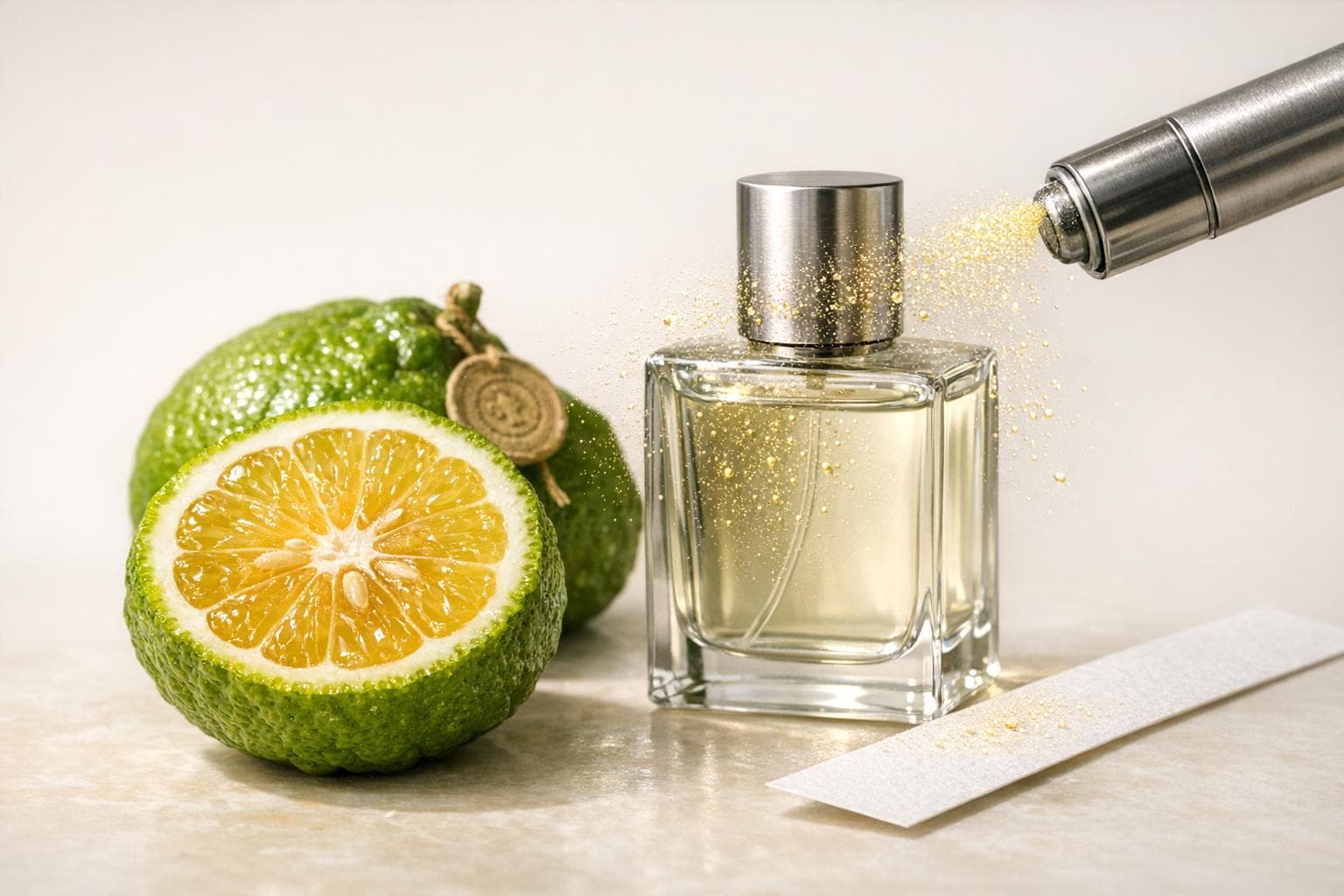
La bergamota es la estrella discreta de la perfumería, presente en más del 50 % de las fragancias de lujo. Su perfil químico único equilibra la vivacidad cítrica con una suavidad floral, lo que la convierte en la nota de salida por excelencia. La mayor parte del aceite de bergamota de alta calidad procede de Reggio Calabria, Italia, donde el clima y el suelo dan lugar a una profundidad aromática inigualable. En 2026, los perfumistas apuestan por formulaciones más verdes y acordes cítricos facetados, consolidando el papel de la bergamota como piedra angular de los aromas contemporáneos. Ya sea liderando composiciones eminentemente cítricas o sirviendo de apoyo a fragancias amaderadas y especiadas, su versatilidad la hace indispensable.
Puntos clave:
- Equilibrio químico: Combina limoneno (25–46 %) con acetato de linalilo (22–41 %) para ofrecer un aroma suave y floral.
- Origen italiano: Calabria produce entre el 80 % y el 95 % del aceite de bergamota de calidad perfumería del mundo.
- Proceso de extracción: El prensado en frío garantiza la máxima calidad del aceite al preservar sus compuestos más delicados.
- Tendencias en 2026: Enfoque en el abastecimiento natural y en innovadores acordes cítricos.
- Fijación en la piel: La bergamota de alta calidad se integra a la perfección, prolongando su presencia hasta el secado.
Esta joya cítrica no es un simple ingrediente, sino un auténtico emblema de la maestría artesanal en perfumería.
BERGAMOT OBSESSION: 50+ Scents from Niche to Designer 🍋
¿Qué es la bergamota en perfumería?
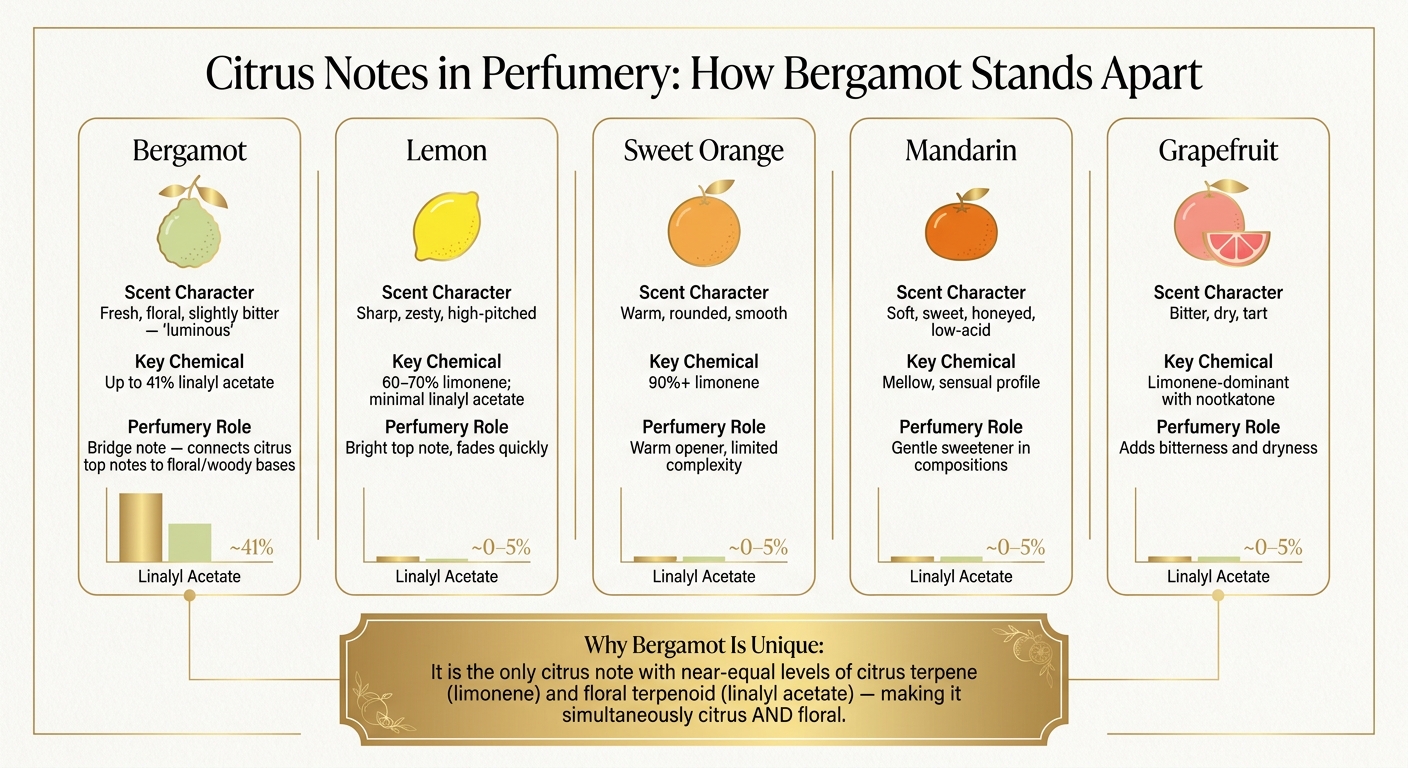
Bergamota frente a otras notas cítricas en perfumería: diferencias clave
La bergamota (Citrus bergamia) es un pequeño fruto cítrico, de un tamaño similar al de una naranja, pero con una tonalidad verde pálida. Desde el punto de vista botánico, es un híbrido natural de limón (Citrus limon) y naranja amarga (Citrus aurantium), como han confirmado diversos análisis moleculares. A diferencia de otros cítricos, la bergamota no se consume fresca; su pulpa es excesivamente amarga y ácida. Su verdadero tesoro reside exclusivamente en el aceite esencial contenido en su corteza.
Durante siglos, la bergamota ha sido un pilar indispensable de la perfumería. Su trascendencia se remonta a 1709, cuando Giovanni Maria Farina la incorporó a la primera Eau de Cologne: una creación revolucionaria que marcó el paso de fragancias pesadas y resinosas hacia composiciones más ligeras y transparentes. Este legado sigue definiendo la perfumería moderna.
Perfil olfativo: el aroma inconfundible de la bergamota
La bergamota suele describirse como luminosa, una cualidad que la distingue de cualquier otra nota cítrica. Su aroma es fresco y radiante, matizado por un dulzor floral sutil y un trasfondo ligeramente amargo y especiado. Esto le otorga un carácter refinado, alejado de la estridencia que a menudo presentan otros aceites cítricos.
Lo que hace verdaderamente singular a la bergamota es su composición química. Mientras que la mayoría de los aceites cítricos están dominados por el limoneno —por ejemplo, el limón contiene entre un 60 % y un 70 %, y la naranja dulce supera el 90 %—, la bergamota posee hasta un 41 % de acetato de linalilo. Este compuesto, presente también en la lavanda, aporta una delicadeza que enlaza con naturalidad las vibrantes notas de salida con las facetas florales o amaderadas más profundas.
| Nota cítrica | Carácter olfativo | Diferencia química clave |
|---|---|---|
| Bergamota | Fresca, floral, sutilmente amarga; «luminosa» | Hasta un 41 % de acetato de linalilo |
| Limón | Incisivo, chispeante, vibrante | 60–70 % de limoneno; mínimo acetato de linalilo |
| Naranja dulce | Cálida, envolvente, suave | Más del 90 % de limoneno |
| Mandarina | Delicada, dulce, amielada, de baja acidez | Aterciopelada y sensual antes que brillante |
| Pomelo | Amargo, seco, punzante | Predominio de limoneno con nootkatona |
Esta complejidad floral hace que la bergamota sea insustituible para los maestros perfumistas, ya que actúa como un puente armónico entre el frescor cítrico y los acordes más intensos y opulentos, una función que ni el limón ni la mandarina pueden desempeñar con la misma maestría.
La extracción del aceite de bergamota para alta perfumería
Para las fragancias de lujo, el método de extracción predilecto es el prensado en frío. Este procedimiento emplea maquinaria que raspa con suavidad la corteza exterior del fruto bajo un fino flujo de agua, rompiendo las glándulas oleíferas sin someterlas a calor. A continuación, la emulsión resultante se centrifuga para aislar el aceite esencial puro.
El calor es perjudicial para la bergamota, ya que degrada las moléculas responsables de su sofisticada faceta floral. Aunque la destilación por vapor resulta más rápida y económica, compromete la riqueza del extracto, razón por la cual la expresión en frío se mantiene como la norma de excelencia para la perfumería de autor.
Tras el prensado en frío, el aceite se somete a una rectificación para garantizar su total seguridad cutánea. Mediante una destilación fraccionada al vacío, se elimina el bergapteno, una molécula fototóxica capaz de provocar manchas o irritación al contacto con la luz solar. El extracto resultante, denominado Bergamot FCF (libre de furanocumarinas), cumple rigurosamente con las directrices de la IFRA, que limitan la concentración del aceite de bergamota en alta perfumería a un máximo del 0,4 %.
«En cualquier perfume exquisito de talla internacional, si aspira a la máxima excelencia, encontrará la huella de la bergamota». — Kazimiera Alberti, escritora
La obtención de este aceite requiere una gran cantidad de recursos: se precisan cerca de 200 kg de fruta para obtener tan solo 1 kg de esencia pura, lo que representa un rendimiento de apenas el 0,55 %. Un bergamoto maduro produce entre 20 y 40 kg de fruta al año, proporcionando escasamente de 100 a 220 gramos de esencia por temporada. Esta producción limitada, unida a su excepcional riqueza aromática, convierte a la bergamota en una de las materias primas más codiciadas de la alta perfumería.
Bergamota italiana: la trascendencia del origen
Dónde crece la bergamota en Italia
La inmensa mayoría de la bergamota destinada a la perfumería de prestigio proviene de una estrecha franja costera en Reggio Calabria, situada en el extremo sur de la península itálica. Este enclave de 100 kilómetros —que se extiende desde Villa San Giovanni hasta Brancaleone— concentra entre el 80 % y el 95 % de la producción global de aceite esencial de bergamota. La variedad más apreciada se cultiva a lo largo de la emblemática Costa dei Gelsomini, bañada por las aguas del mar Jónico.
Esta tradición agrícola se sustenta en unas 400 familias de agricultores que custodian 1500 hectáreas de plantaciones. En 2003, gran parte de estos productores se agruparon en la cooperativa Unionberg OP, que reúne a unas 380 explotaciones para proteger su valioso saber hacer. Bautizada en la región como el «oro verde», la producción de bergamota en Italia alcanzó una valoración estimada de 180 millones de dólares en 2025. El paisaje está dominado por tres cultivares principales —Femminello, Castagnaro y Fantastico—, aportando cada uno matices olfativos singulares. Femminello destaca por su fructificación temprana; Castagnaro, por su corteza gruesa y aromática; y Fantastico, por su generoso rendimiento. La sinergia entre este esmerado cultivo y un microclima excepcional da como resultado una esencia de una pureza incomparable.
Por qué la bergamota italiana se considera la mejor
La calidad insuperable de la bergamota de Calabria es fruto directo de su particular entorno natural. Protegida entre el macizo de Aspromonte y el mar Jónico, la zona disfruta de suelos arcillo-calcáreos, una humedad constante y temperaturas templadas y estables que oscilan entre los 15 °C y los 30 °C. Además, los acuíferos subterráneos alimentados por el deshielo de las cumbres ofrecen un suministro hídrico inmaculado para el riego.
Estas condiciones propician un extracto con un perfil aromático de perfecto equilibrio, donde la frescura cítrica convive con delicadas notas florales. Dicha armonía está indisolublemente ligada al terroir calabrés.
«Es el concepto de terroir en su sentido más puro: un producto tan arraigado a su geografía que trasladarlo a cualquier otro lugar alteraría por completo su esencia». — Première Peau
Por el contrario, los aceites de bergamota procedentes de Brasil, Turquía o Costa de Marfil suelen contener concentraciones superiores de limoneno, lo que se traduce en una esencia más plana que carece de la riqueza floral propia de Calabria.
En 2001, el aceite esencial de bergamota de Calabria obtuvo la prestigiosa Denominación de Origen Protegida (DOP), garantizando que se elabore con métodos tradicionales exclusivamente en Reggio Calabria. Este reconocimiento eleva notablemente su cotización: el aceite con certificación DOP se sitúa entre los 900 y 1200 USD por kilogramo, frente a los 200 a 400 USD de otras procedencias. No obstante, un estudio llevado a cabo durante dos décadas demostró que los cambios climáticos, como las olas de calor y las sequías prolongadas, pueden mermar los compuestos florales del fruto. Para salvaguardar su calidad, los productores han extendido el riego hasta el mes de diciembre cuando es necesario, poniendo de manifiesto que la materia prima predilecta de la alta perfumería depende íntimamente del delicado equilibrio de este rincón de Italia.
La bergamota en grandes creaciones: alta perfumería y firmas de autor
La versatilidad de la bergamota es legendaria. En función de la fórmula, puede erigirse como la gran protagonista o servir de enlace invisible que armoniza acordes complejos. Descubra cómo brilla esta joya cítrica en creaciones icónicas y de nicho.
Composiciones cítricas donde la bergamota es protagonista
En las fragancias centradas en la frescura, la bergamota suele llevar la voz cantante. Un claro ejemplo es Acqua di Parma Colonia Il Profumo Millesimato. Su apertura despliega una cuidada sinfonía de bergamota, naranja sanguina, petitgrain y pomelo. Giulio Bergamaschi, CEO de Acqua di Parma, define sus notas de salida como una introducción «inmediata, etérea y fugaz», donde los cítricos dialogan con una luminosidad radiante.
Para una experiencia más pura, Perris Monte Carlo Bergamotto di Calabria sitúa la bergamota calabresa en el centro mismo de la estructura olfativa, exaltando la nota en su vertiente más noble y cristalina.
Si prefiere una propuesta contemporánea y accesible, Essential Parfums Nice Bergamote (alrededor de 130,00 €) ofrece un perfil limpio y vibrante, libre de fondos pesados, que permite que la chispa del cítrico se exprese con total plenitud.
Acordes amaderados y especiados enriquecidos con bergamota
La bergamota no se limita a fragancias ligeras y veraniegas; también desempeña un papel estructural decisivo en creaciones amaderadas y especiadas. Su singular dualidad cítrico-floral suaviza la transición desde la salida hacia corazones y fondos más densos y opulentos.
En Prada Infusion de Santal Chai, por ejemplo, la bergamota aporta un soplo de aire fresco antes de que la fragancia se adentre en un cremoso sándalo y en cálidas especias de chai como la canela y el cardamomo. Un matiz de almizcle culmina la obra, donde la bergamota realza la mezcla sin eclipsar sus elementos.
De igual modo, Gravitas Capitale de Première Peau utiliza la bergamota de Calabria como cimiento, conectando armoniosamente con un corazón seco y mineral que otorga a la fragancia una silueta impecable.
A continuación, detallamos los distintos roles de la bergamota según la familia olfativa:
| Estilo de fragancia | Papel de la bergamota | Acordes habituales | Ejemplo |
|---|---|---|---|
| Cítrica dominante | Nota principal | Limón, pomelo, neroli | Nice Bergamote (Essential Parfums) |
| Amaderada | Puente estructural | Sándalo, cedro, vetiver | Gravitas Capitale (Première Peau) |
| Especiada | Acento de vivacidad | Cardamomo, pimienta negra, jengibre | Infusion de Santal Chai (Prada) |
| Gourmand | Contrapunto sofisticado | Vainilla, haba tonka, caramelo | Vanilla Smoke |
Lo que distingue a la bergamota de cítricos como el limón o la naranja es su notable persistencia. Mientras que la mayoría de las notas hespérides se disipan con rapidez, el equilibrio entre su chispa inicial y sus matices florales le permite evolucionar sin rupturas a lo largo de la pirámide olfativa, consolidándose como un elemento insustituible en la paleta del perfumista.
Tu experto en fragancias personal te espera
Haz nuestro test olfativo rápido y descubre auténticos perfumes de diseñador y de nicho elegidos según tu gusto: explóralos en decants y muestras de 2–8ml para probar cada uno antes de decidirte por un frasco completo.
Encuentra tu fraganciaLa bergamota en las tendencias de perfumería de 2026
El universo de la perfumería evoluciona constantemente, y la bergamota no es una excepción. En 2026, dos corrientes principales marcan el uso de esta apreciada nota: el giro hacia interpretaciones más verdes y naturales, y la sofisticación de acordes cítricos en múltiples capas. Estas tendencias reafirman el estatus de la bergamota como la nota de salida por excelencia.
Una aproximación más verde y natural a la bergamota
A medida que la industria reduce su dependencia de ingredientes sintéticos, el interés por materias primas sostenibles y de recolección ética no deja de crecer. La bergamota prensada en frío y libre de modificaciones genéticas encaja a la perfección con esta filosofía. Su esencia natural regala una riqueza de matices que ningún sucedáneo de laboratorio logra emular con fidelidad.
La corriente del «lujo silencioso» también deja su impronta en la creación de fragancias, favoreciendo estelas sutiles e íntimas que se funden con la piel en lugar de proyecciones invasivas. En este terreno, la bergamota resulta fundamental para matizar la potencia de notas complejas como el oud o el cuero, transformándolas en composiciones elegantes y llevaderas.
«Ya no se buscan las bases rotundas y estridentes del pasado, sino estructuras más intimistas; fragancias que susurran sobre la piel y se sienten vividas, no impuestas». — Gustavo Romero, fundador de Fragrance Alliance Network
Un magnífico exponente de esta inclinación botánica es Valentino Donna Born In Roma Green Stravaganza, que asocia la bergamota con flor de loto y té Lapsang Souchong para ofrecer una propuesta vanguardista y revitalizante.
Acordes cítricos complejos con la bergamota en el epicentro
Más allá de las formulaciones naturistas, los creadores están explorando acordes cítricos polifacéticos donde la bergamota ocupa el centro del escenario. Estas creaciones trascienden el simple concepto de frescor para tejer texturas ricas y complejas al dialogar con notas complementarias.
La alta concentración de acetato de linalilo (22–41 %) confiere a la bergamota un perfil floral y ligeramente herbáceo idóneo para la superposición de capas. Por ejemplo, Parfums de Marly Athénaïs (aprox. 410,00 €) fusiona la bergamota con yuzu y vainilla, ofreciendo una salida tan radiante como redonda. Por su parte, Fabbrica Della Musa Opera Infernal (aprox. 295,00 €) la combina con piña, logrando una estela jugosa e hiperrealista conectada con la naturaleza.
Otra tendencia al alza es el maridaje de la bergamota con notas inspiradas en infusiones y café selecto. Acordes de matcha, hojicha y espresso se entrelazan con la bergamota para evocar la cálida intimidad de estas bebidas, acercando la perfumería de autor a experiencias sensoriales cotidianas y contemporáneas.
Cómo reconocer la bergamota de alta calidad en un perfume
Saber distinguir una bergamota sublime de un extracto ordinario transforma por completo la apreciación de un perfume. Las diferencias son palpables y, una vez educado el olfato, resultan mucho más evidentes de lo que parece.
A qué huele la buena bergamota
La bergamota de excepción, en particular la de Calabria, es aclamada por los maestros perfumistas por su luminosidad. Lejos de limitarse a un simple estallido cítrico, despliega múltiples planos aromáticos: un frescor cítrico efervescente, un matiz de dulzor floral, un toque de amargor verde y una sutil calidez herbácea. Esta riqueza procede de su elevado contenido en acetato de linalilo, que evoca la delicadeza aterciopelada de la lavanda. Al catar una fragancia, observe si la bergamota conjuga armoniosamente lo cítrico y lo floral: un aroma exclusivamente punzante o ácido suele delatar una calidad inferior.
El aceite esencial de bergamota de Calabria con certificación DOP alcanza cifras de entre 900 y 1.200 € por kilo, contrastando claramente con los 200 a 400 € de destilados de otros orígenes. Esta cotización responde directamente a su incomparable profundidad olfativa.
«La bergamota por sí sola ofrece un balance prácticamente simétrico entre terpenos cítricos (limoneno) y terpenoides florales (acetato de linalilo), razón por la cual se percibe a la vez como cítrica y floral». — Première Peau
Desconfíe de cualquier matiz vegetal apagado o amargo —que algunos comparan con «espinaca húmeda»—, pues suele ser síntoma de materias primas deficientes o reformulaciones desafortunadas.
Cómo comparar la bergamota en distintas fragancias
Con estas claves olfativas en mente, podrá juzgar la presencia de la bergamota en cualquier creación. La virtud esencial es la paciencia. Como afirma con acierto Première Peau:
«El secado a la cuarta hora encierra la verdad; la primera vaporización no es más que la promesa».
La pulverización inicial revela la frescura inmediata de la nota, pero la verdadera prueba de nobleza se desvela en su desarrollo. Una bergamota de alta calidad no se disuelve en cuestión de minutos: persiste y se funde armoniosamente con el corazón de la fragancia, dialogando a menudo con flores blancas como el jazmín o el neroli. Si el acorde cítrico desaparece por completo en 20 o 30 minutos sin dejar rastro, es muy probable que se trate de un ingrediente volátil, mal fijado o puramente sintético.
Al evaluar, fíjese en la redondez de la bergamota, en cómo abraza al resto de notas y en la elegancia con la que eleva la composición. Un extracto de primera calidad confiere continuidad a la fragancia, logrando una evolución sofisticada que mantiene su presencia a lo largo de las horas. Esta solidez es el sello inconfundible de la más alta perfumería.
| Criterio | Bergamota de alta calidad | Bergamota de menor calidad |
|---|---|---|
| Aroma | Cítrico equilibrado, floral, verde y suavemente amargo | Estridente, plano o excesivamente ácido |
| Transición | Se entrelaza con suavidad en las notas de corazón | Desaparece de forma abrupta |
| Textura | Redonda, pulida y luminosa | Tenue, áspera o punzante |
| Secado | Deja una estela floral suave y persistente | No deja rastro o se torna opaca |
Recomendaciones de fragancias con bergamota según la ocasión
Inspiradas en la incomparable calidad de la bergamota calabresa, estas recomendaciones han sido seleccionadas para encajar a la perfección en distintos momentos del día. Las notas que acompañan a este cítrico resultan determinantes para definir el carácter y la distinción de cada aroma.
Para el día: fragancias sutiles de bergamota para uso cotidiano
Durante las horas diurnas, las creaciones más etéreas logran el equilibrio soñado entre frescor y sofisticación. Tanto en un entorno profesional como en planes relajados, la estela debe acompañar con elegancia sin llegar a imponerse, reservando su encanto para las distancias cortas.
Le Labo Bergamote 22 es una elección magistral gracias a su lectura vanguardista y depurada de la bergamota. Al combinar la esencia calabresa con otras 21 notas, logra eludir la brevedad que suele achacarse a los cítricos. Con una puntuación de longevidad de 4,5/5 y una permanencia confirmada por sus devotos de entre 8 y 10 horas, es perfecta para acompañar jornadas intensas. El historiador de perfumería Dr. Laurent Beaumont la sintetiza con brillantez:
«Es el equivalente olfativo a una camisa blanca de corte impecable o a un espacio minimalista exquisitamente concebido: de aparente sencillez, pero de una maestría y calidad extraordinarias al apreciarse de cerca».
Esta propuesta atemporal y sin género pasa con fluidez de una reunión de negocios a una tarde de descanso. Su precio se sitúa aproximadamente en 90 € por 15 ml o 180 € por 50 ml. Por su parte, para quien busque una opción más desenfadada y luminosa, Atelier Cologne Bergamote Soleil ofrece una bergamota radiante matizada con notas de coco y ámbar: una delicia pensada para los días soleados de verano.
Al caer la tarde, sustituirla por una fragancia de noche realzará su presencia en ocasiones más memorables.
Para la noche: mezclas sofisticadas de bergamota para ocasiones especiales
Las creaciones nocturnas toman la luminosidad de la bergamota y la envuelven en acordes opulentos y profundos, dando lugar a una experiencia mucho más rica y envolvente. Estas fragancias suelen deslumbrar con una apertura cítrica antes de posarse sobre fondos cálidos y texturizados de ámbar, vetiver o almizcle.
Frédéric Malle Eau de Magnolia representa una opción impecable para citas de gala. Inicia con un cítrico cristalino y evoluciona hacia una base amaderada y almizclada, exudando una distinción que perdura toda la noche. Para los amantes de la suntuosidad, Tom Ford Mandarino di Amalfi entrelaza la bergamota con una dulzura amielada y un corazón floral, logrando un perfil decadente y señorial concebido para grandes celebraciones.
Si prefiere descubrir cómo evoluciona cada creación antes de adquirir el frasco completo, los decants de Scento a partir de 2 ml le permitirán apreciar cómo interactúan estas fragancias con su piel durante toda una velada.
| Fragancia | Ocasión | Notas clave | Duración |
|---|---|---|---|
| Le Labo Bergamote 22 | Oficina / Diario | Bergamota, petitgrain, vetiver | 8–10 horas |
| Atelier Cologne Bergamote Soleil | Informal / Día de verano | Bergamota, coco, ámbar | Moderada |
| Frédéric Malle Eau de Magnolia | Formal / Noche | Cítricos, magnolia, almizcle | Alta |
| Tom Ford Mandarino di Amalfi | Ocasiones especiales | Bergamota, miel, acordes florales | Alta |
Conclusión: el lugar eterno de la bergamota en la perfumería
La bergamota, gracias a su sublime equilibrio entre limoneno y acetato de linalilo, forma parte indispensable de más de la mitad de las composiciones de alta perfumería, actuando como un puente magistral entre las notas de salida chispeantes y los fondos más intensos y sugerentes.
Nacida en la franja costera de 100 kilómetros de Reggio Calabria, su origen le otorga una identidad única, comparable a la del terroir de los grandes vinos. Sin embargo, las variaciones del clima están influyendo en su composición botánica, aumentando los niveles de limoneno en detrimento del delicado acetato de linalilo que la singulariza. Por ello, la certificación DOP se revela hoy más decisiva que nunca. Frente a estos desafíos, la bergamota preserva su trono inamovible en la alta perfumería.
A la hora de decantarse por una fragancia con bergamota, tenga en cuenta tres claves: observe el perfume tras cuatro horas en la piel para juzgar su integración, busque la mención FCF (libre de furanocumarinas) para un uso estival seguro y apueste por etiquetas que certifiquen «Bergamota de Calabria» si desea disfrutar de la máxima complejidad olfativa.
Desde la mítica Eau de Cologne de 1709 hasta los acuerdos de vanguardia de nuestros días, la bergamota es mucho más que una salida efímera: constituye el alma viva de la perfumería moderna, uniendo a la perfección el legado clásico con la creatividad contemporánea en un diálogo que sigue más vivo que nunca en 2026.
Preguntas frecuentes
¿Dura la bergamota más tiempo en la piel que otros cítricos?
La bergamota ofrece una longevidad moderada en la piel. Aunque suele evaporarse antes que las familias olfativas más pesadas, tiende a prolongar su presencia durante más tiempo que otros cítricos cuando reposa sobre notas de fondo como el almizcle o maderas nobles. Su fijación definitiva dependerá de la armonía de la fórmula y de la química particular de cada piel.
¿Qué significa «Bergamot FCF» y por qué es tan relevante en verano?
La designación Bergamot FCF señala un aceite esencial de bergamota rectificado para eliminar el bergapteno, la molécula causante de fotosensibilidad. Este proceso permite utilizar la fragancia con total tranquilidad en verano, ya que evita la aparición de manchas o irritaciones al exponerse al sol. Es la alternativa perfecta para disfrutar de notas cítricas en los días más luminosos.
¿Cómo saber si un perfume contiene auténtica bergamota de Calabria?
Para comprobar si una fragancia utiliza auténtica bergamota calabresa, busque en el listado de ingredientes términos botánicos como Citrus bergamia o Citrus aurantium var. Bergamia. El aceite genuino y de calidad suprema procede del prensado en frío, presenta un tono verdoso intenso y regala un bouquet profundo e inconfundible: señales inequívocas de pureza y excelencia olfativa.

