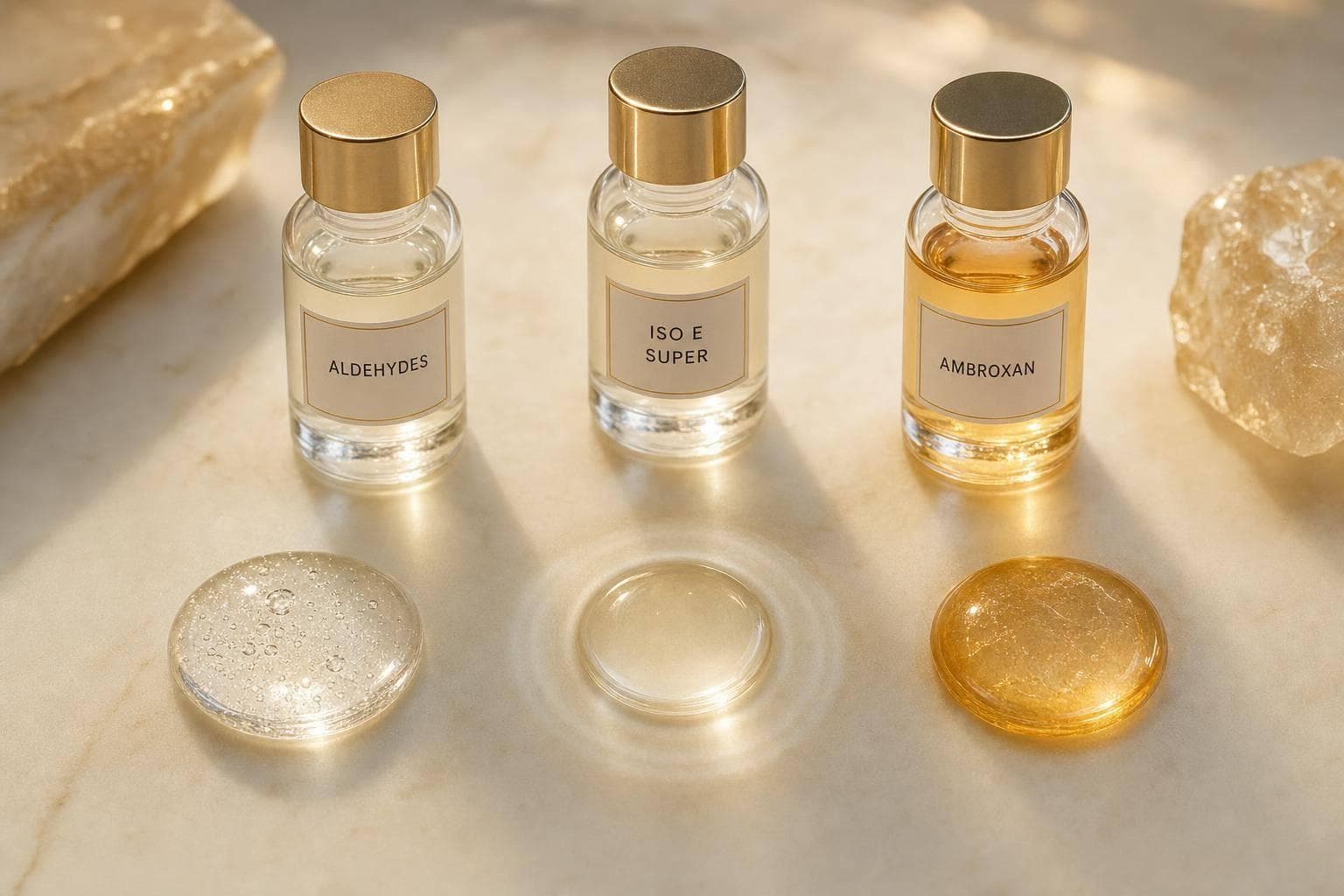
El perfume moderno a menudo se construye menos sobre listas de notas y más sobre el efecto. Si reduzco esta guía a su esencia, la idea principal es sencilla: materiales como aldehídos, ISO E Super, Ambroxan, Hedione, Galaxolide, Calone, etil maltol, cis-3-hexenol y semilla de ambreta moldean cómo una fragancia se mueve, se expande y se asienta sobre la piel.
Si quiero entender por qué dos perfumes con notas similares no se parecen en absoluto, observo la estructura que hay debajo. En esta guía, las ideas clave son:
- Los aldehídos aportan elevación, pulido y esa sensación de tejido recién planchado
- ISO E Super y Ambroxan construyen madera seca, calidez de piel y larga duración
- Hedione añade un espacio floral aireado
- Galaxolide ofrece un almizcle limpio, suave y con tono de ropa recién lavada
- Calone crea efectos acuáticos, marinos y de estancia alicatada
- El etil maltol impulsa el azúcar, el caramelo y la calidez de la pastelería
- cis-3-hexenol aporta hierba cortada, hoja triturada y un golpe verde
- La semilla de ambreta añade una sensación suave de almizcle de piel con calidez de pera
La guía también muestra cómo los perfumistas convierten estos materiales en acordes con carácter de objeto, como:
- algodón planchado
- papel satinado
- azulejos mojados
- aire de piscina
- brisa marina
- hoja de tomate
- dulzor de obrador
Y también hay un ángulo práctico de compra: antes de gastar €120,00 a €250,00+ en un frasco, probaría estos estilos primero sobre la piel, idealmente en decants de 2 ml, 5 ml u 8 ml, porque materiales como Ambroxan, aldehídos y Calone pueden cambiar mucho según la piel, el tejido y el clima.
Quick Comparison
| Grupo de materiales | Efecto principal | Lugar habitual en la evolución | Qué puede sugerir |
|---|---|---|---|
| Aldehídos | Brillo, pulido ceroso, elevación | Salida | Camisa planchada, superficie brillante |
| Sintéticos amaderado-ámbar | Calidez seca, difusión, estela prolongada | Corazón a fondo | Calidez de piel, papel, madera seca |
| Almizcles | Aura suave y limpia | Fondo | Ropa lavada, algodón, tejido |
| Materiales marinos | Aire acuático, espacio fresco | Salida a corazón | Sala de piscina, brisa marina, piedra mojada |
| Materiales gourmand | Textura de azúcar y caramelo | Corazón a fondo | Pastelería, caramelo, mermelada |
| Materiales verdes | Golpe vegetal, sensación de tallo cortado | Salida | Hierba, tallos, follaje |
| Materiales de almizcle natural | Efecto suave de piel | Fondo | Piel cálida, almizcle con matiz de pera |
Así que, si tuviera que resumir todo el artículo en una sola frase, sería esta: estos ingredientes importan porque moldean la textura y la atmósfera, no solo el olor.
Por qué los ingredientes experimentales importan en la fragancia moderna
Estos materiales son las herramientas que los perfumistas utilizan para hacer que una fragancia se sienta como tela, metal, agua o incluso pastelería. En este contexto, experimental se refiere a ingredientes usados para la abstracción, la transparencia, la textura, la difusión y otros efectos que no buscan oler de forma estrictamente literal. A menudo son sintéticos modernos o naturales menos comunes que llevan un perfume más allá de las construcciones florales, amaderadas, cítricas u orientales estándar. Los notarás con frecuencia en florales transparentes, fragancias de piel, acordes metálicos y perfumes que se sienten más como un objeto o una atmósfera que como una simple pirámide olfativa. La lista siguiente muestra cómo se crean esos efectos.
Cómo cambian la proyección y la textura
Los ingredientes experimentales funcionan menos como notas clásicas y más como dispositivos estructurales. Moldean la proyección, la textura y la radiancia: cómo una fragancia se desplaza por el aire, cómo descansa sobre la piel y si se siente aérea o densa, afilada o suave, íntima o expansiva.
La proyección no trata solo de volumen. Trata de cómo un perfume ocupa el espacio alrededor de quien lo lleva. Y ese espacio puede expandirse, suavizarse o recogerse hacia dentro de forma intencionada, según la volatilidad. Materiales como Calone, Ambroxan, Hedione e ISO E Super dan a los perfumistas una forma de ajustar elevación, apertura y permanencia con mucho más control.
Por qué importan más de lo que sugieren las listas de notas
Dos perfumes pueden enumerar las mismas notas - jazmín, almizcle, ámbar - y aun así no olerse en absoluto. Uno puede sentirse transparente y levemente metálico. El otro puede percibirse cremoso y denso. Esa distancia suele venir de los materiales que sostienen la lista de notas y de la proporción en que se usan.
Una cantidad mínima de aldehído puede hacer que una composición se sienta nítida, luminosa y abstracta. Retíralo, y esas mismas notas pueden sentirse más redondas y mucho más familiares. Por eso los perfumistas piensan en términos de estructura y equilibrio, no solo de familias olfativas.
Qué incluye y qué excluye esta lista
Esta lista cubre únicamente materiales documentados:
- aldehídos
- ISO E Super
- Ambroxan
- Hedione
- Galaxolide
- Calone
- etil maltol
- cis-3-hexenol
- semilla de ambreta
A continuación vienen los 12 ingredientes en sí.
1. Aldehído C-10 (Decanal)
El aldehído C-10 es un buen punto de partida porque establece el ánimo de toda la familia de los aldehídos. También conocido como decanal, es un aldehído cítrico usado en perfumería y presente de forma natural en el aceite de piel de naranja. En ese aceite, aparece en torno a 0,1–0,5 %.
Efecto olfativo
Por sí solo, el Aldehído C-10 huele agudo, ceroso y ligeramente oleoso - más cercano a la cera de vela que a algo que querrías llevar directamente del frasco. Pero en dosis bajas cambia de carácter. El borde graso se suaviza, y lo que emerge es un efecto luminoso de piel de naranja cerosa, con un toque limpio y levemente jabonoso.
Una forma sencilla de imaginarlo: ralladura de naranja sobre un pastel especiado. Obtienes corteza brillante, una calidez cerosa y una elevación limpia al mismo tiempo. Ese tono cítrico ceroso da a los perfumes la sensación de superficies pulidas o interiores luminosos, no solo de piel de naranja literal.
Función en la construcción de acordes
El Aldehído C-10 se utiliza principalmente para añadir elevación y difusión. En acordes cítricos, impulsa naranja, bergamota y pomelo hacia delante mientras añade un destello ceroso que los aceites cítricos puros no pueden sostener mucho tiempo por sí solos.
También cambia la sensación de los florales. En mezclas de flores blancas como jazmín, gardenia y peonía, las hace parecer más luminosas y menos directas o naturalistas. Combinado con almizcles, puede insinuar algodón recién planchado, con ese mismo giro cítrico-ceroso.
Sin embargo, hay una advertencia. Usa demasiado, y la fragancia puede volverse aguda y química. Ese empuje luminoso y estructural es también una de las razones por las que los aldehídos quedaron tan ligados a los florales abstractos.
Relevancia de vanguardia
Aquí es donde un material en traza empieza a sentirse más grande que su dosis. El Aldehído C-10, usado con C-11 y C-12, ayudó a dar forma al estilo floral abstracto y sigue estando en el centro de muchos acordes modernos con carácter de objeto.
Hoy, los perfumistas experimentales lo usan a menudo para sugerir superficies y espacios en lugar de flores o frutas. Piensa en interiores bañados por el sol, páginas de revista brillantes o el aire de un piso impecablemente limpio un domingo por la mañana. Funciona especialmente bien en fragancias construidas alrededor de escenarios cotidianos - oficina, cocina o atelier - donde el objetivo es la atmósfera más que una pirámide olfativa clásica.
Ubicación típica en la estructura
Suele funcionar como material de nota de salida, ofreciendo un destello inicial y, a veces, dejando una tenue calidez cerosa hacia el corazón.
2. Aldehído C-11
El C-11 conserva esa elevación aldehídica aireada, pero se inclina hacia una dirección más suave. Piensa en algo ceroso, cítrico-metálico, con suaves toques rosados y verdes en el fondo. En un perfume terminado, normalmente no huele como una nota solista clara. Actúa más como una textura brillante que se posa sobre la fórmula. Esa es una gran parte de por qué los perfumistas lo utilizan más en acordes limpios y abstractos que en construcciones florales evidentes.
Efecto olfativo
Por sí solo, el Aldehído C-11 huele luminoso, jabonoso y cítrico-ceroso. En pequeñas cantidades, añade elevación y una sensación pulida. Usa demasiado, sin embargo, y puede volverse marcadamente aldehídico o empezar a oler a productos de limpieza industriales.
Función en la construcción de acordes
Los perfumistas suelen trabajar con C-11 en dosis de traza a moderadas, a menudo alrededor del 0,15–0,25 % del concentrado, porque domina con rapidez. Para mantenerlo bajo control, a menudo lo prediluyen al 10 % o al 1 %.
En los florales aldehídicos clásicos, el C-11 suele situarse junto a C-10, C-12, ylang-ylang, jazmín, rosa y almizcles empolvados. Esa mezcla ayuda a construir la salida chispeante, tipo champán, asociada con los perfumes florales de estilo vintage. En fórmulas más modernas, combina bien con ISO E Super, Hedione y almizcles blancos. El resultado es un efecto refinado, limpio-abstracto y de tejido impecable, que se siente suave en lugar de estridente.
Relevancia de vanguardia
Ese mismo lustre da a los perfumistas una forma de convertir materiales ordinarios en superficies, no solo en olores. Ahí es donde el C-11 se vuelve interesante. Puede hacer que florales, maderas o almizcles familiares se sientan como objetos en lugar de suaves o naturales: ropa recién lavada, champú seco, papel satinado o incluso un espacio clínico.
En fórmulas más experimentales, los perfumistas pueden potenciarlo con materiales metálicos u ozónicos para sugerir cromo, vinilo y otras superficies futuristas.
Ubicación típica en la estructura
El C-11 es un material de nota de salida. Su efecto más intenso suele aparecer durante los primeros 5–20 minutos. Aun así, sobre tejido puede durar lo suficiente para llevar un tono seco, pulido y limpio hacia el inicio del corazón. Givaudan señala este rasgo directamente, lo que ayuda a explicar por qué el C-11 aparece tan a menudo en acordes de ropa lavada y conceptos de camisa limpia.
3. Aldehído C-12 MNA
El Aldehído C-12 MNA, también llamado 2-metilundecanal, es un aldehído de cadena ramificada. En perfumería, funciona menos como una nota que hueles claramente por sí sola y más como un material que moldea toda la construcción. Da a una fragancia elevación y un resplandor satinado desde la salida hasta el corazón. Junto a C-10 y C-11, el C-12 MNA se percibe más suave, más actual y menos obviamente aldehídico.
Efecto olfativo
Su olor se siente luminoso, ceroso, ligeramente metálico-limpio, aireado y difusivo, con una elevación cítrica de naranja y una tenue sombra ambarada-musgosa en el fondo. La mayor parte del tiempo, no lo percibes como una nota separada. En cambio, se comporta como una película luminosa extendida sobre el resto de la fórmula. En algunas mezclas, también puede insinuar tejido recién planchado.
Función en la construcción de acordes
En una fórmula, el C-12 MNA desempeña un papel estructural. Añade elevación, proyección y pulido sin empujar la fragancia hacia un territorio aldehídico vintage evidente. Los perfumistas suelen combinarlo con limón, Floralozone, Hedione, ISO E Super, Helvetolide y Ambroxan para afilar la luminosidad.
La dosificación es donde las cosas se vuelven delicadas. Este material es muy potente, por lo que incluso pequeños cambios pueden transformar todo el efecto. Un proveedor indica un uso típico en compuestos de perfume de 10 %, con una media de 100 % y un máximo de 2500 %. Si se lleva demasiado lejos, puede volverse áspero o similar a detergente. Si se usa demasiado poco, se desvanece en el fondo.
Relevancia de vanguardia
El C-12 MNA puede hacer que los florales se sientan más brillantes, los almizcles más suaves y los cítricos más luminosos. Una flor blanca puede volverse más translúcida. Un almizcle puede parecer más pulido y cercano a la piel. Un acorde cítrico puede volverse chispeante y difusivo en lugar de jugoso. Por eso encaja tan bien en florales transparentes, fragancias de piel y construcciones cítricas limpias.
Ubicación típica en la estructura
El C-12 MNA suele situarse en la nota de salida o en el corazón temprano, donde crea luminosidad y elevación inmediatas. En la práctica, a menudo moldea los primeros 10–30 minutos de uso y ayuda a que el desarrollo posterior se sienta más limpio y cohesionado. Lo encontrarás en perfumes aldehídicos clásicos y en acordes frescos modernos, lo que explica por qué encaja tanto en fórmulas de aire vintage como en composiciones contemporáneas depuradas.
4. Aldehído de ciclamen
Si el C-12 MNA aporta brillo, el aldehído de ciclamen aporta una frescura húmeda y verde. El aldehído de ciclamen (CAS 103-95-7) es un material aromático completamente sintético creado para insinuar una frescura de estilo muguet, aunque en la práctica se siente menos como una copia directa de una flor y más como un efecto floral aireado. El aroma se sitúa en un espacio verde-floral y ozónico, con una faceta de pepino-melón que evita que se sienta dulce o denso. Huele al aire alrededor de las flores, no a las flores en sí.
Función en la construcción de acordes
Los perfumistas suelen tratar el aldehído de ciclamen como un potenciador de difusión en acordes florales frescos y acuáticos, no como el protagonista. En acordes de muguet, aporta elevación y una sensación más transparente. También puede afilar acordes acuáticos y fougère, empujándolos hacia efectos de espacio limpio y húmedo. Por eso funciona tan bien cuando una fórmula necesita luminosidad floral sin dulzor evidente.
Relevancia de vanguardia
El aldehído de ciclamen puede desplazar una idea floral hacia algo más atmosférico: azulejos mojados, tejido al vapor o superficies sintéticas brillantes.
“azulejos mojados, tejido al vapor o superficies sintéticas brillantes.”
Ubicación típica en la estructura
Úsalo temprano en la construcción. Aparece rápido en la salida y se prolonga hacia el corazón, donde establece el ánimo antes de que entre el fondo y ayuda a que la transición hacia los almizcles blancos se sienta más suave.
5. ISO E Super
Después de la elevación luminosa, casi superficial, de los aldehídos, ISO E Super da a la fragancia su estructura seca subyacente.
ISO E Super es una molécula amaderada-ámbar completamente sintética desarrollada por International Flavors & Fragrances (IFF) en la década de 1970. Los perfumistas la utilizan por su calidez de cedro seca y aterciopelada y por su tenue resplandor similar al ámbar gris.
Efecto olfativo
ISO E Super tiende a sentirse más como un aura que como una nota claramente definida. Emite una amaderación suave y pulida: piensa en virutas de lápiz, cedro seco y un leve toque mineral o de tinta, pero sin el espesor de un fondo cargado de resinas. Algunas personas son parcialmente anósmicas a él, por lo que puede parecer tenue sobre la piel y, sin embargo, percibirse con más claridad en el tejido.
Función en la construcción de acordes
ISO E Super funciona como un conector silencioso. Une materiales, suavizando los bordes de florales, notas cítricas y resinas en un único campo amaderado seco. Cuando se combina con aldehídos, modera su brillo afilado y los desplaza hacia una sensación más limpia y seca. Junto a almizcles sintéticos, añade profundidad a la idea de piel limpia o cachemira. Con notas verdes o metálicas, ayuda a construir efectos más abstractos, como grafito, papel de dibujo o aire de estudio.
Relevancia de vanguardia
Uno de los ejemplos más claros de ISO E Super usado como concepto completo es Molecule 01 de Escentric Molecules, elaborado con 100 % de ISO E Super en el aceite de perfume. Esa idea desafió la vieja visión de que una fragancia necesita una pirámide olfativa completa. En su lugar, puso la textura, la química de la piel y la difusión espacial en primer plano. Usar una sola molécula en dosis alta para estudiar cómo se comporta, en lugar de simplemente preguntar a qué huele, dio forma a todo un estilo construido alrededor de maderas transparentes y fragancias de segunda piel en la perfumería nicho europea.
Ubicación típica en la estructura
ISO E Super se sitúa principalmente en el fondo, pero su naturaleza difusiva significa que empieza a moldear la fragancia mucho antes, normalmente desde el corazón en adelante, a menudo entre 30 y 60 minutos después de la aplicación. No actúa como una resina pesada. En cambio, lleva partes de las notas de corazón hacia fuera y prolonga su presencia percibida sin hacer que la fragancia se sienta más pesada. Su baja volatilidad también ayuda a que la estela permanezca en la piel durante horas, e incluso más tiempo en el tejido.
A continuación viene Ambroxan, que hace que esa estructura suave sea más cálida y más duradera.
6. Ambroxan
Después del armazón seco y depurado de ISO E Super, Ambroxan aporta calidez y ese resplandor similar al ámbar gris. Es un material sintético inspirado en el ámbar gris, casi siempre elaborado a partir de esclareol derivado de la salvia esclarea, para que los perfumistas puedan recrear ese perfil olfativo sin tomar el material natural del mar.
Efecto olfativo
Ambroxan huele a ámbar amaderado seco con facetas almizcladas, minerales y levemente salinas. Piensa en madera flotante blanqueada por el sol, piedra cálida y piel limpia. Para algunas personas, se siente intenso e inconfundible. Para otras, apenas aparece.
Función en la construcción de acordes
Ambroxan ayuda a unir cítricos, maderas, aromáticos y almizcles. Puede alargar la duración y añadir un efecto luminoso a toda la mezcla. Un rango común se ve así:
- 1–3 % para apoyo
- 3–6 % para estructura
- 6–10 % cuando domina tanto el perfil olfativo como la permanencia
Ese cambio, de fijador discreto a motor principal del acorde, es lo que le permite funcionar en muchos estilos de fórmula.
Relevancia de vanguardia
Ambroxan se convirtió en un material clave en las fragancias dirigidas por materiales porque puede alejar una composición de oler como una cosa y acercarla a sentirse como una superficie, una calidez o una estela. Molecule 02 de Escentric Molecules y Not A Perfume de Juliette Has A Gun son ejemplos conocidos construidos alrededor de Ambroxan.
Se informa que Molecule 02 utiliza alrededor de 13,5% de Ambroxan, lo que se sitúa cerca del límite práctico superior antes de la cristalización en solución. Eso ayuda a explicar por qué el material ocupó un lugar tan central en este estilo de perfumería.
Ubicación típica en la estructura
Ambroxan suele situarse en el fondo e impulsa la larga estela presente en muchas fórmulas amaderado-ámbar modernas.
7. Hedione
Hedione, o metil dihidrojasmonato, es un material sintético usado para aportar una elevación transparente, similar al jazmín. Si Ambroxan aporta permanencia seca, Hedione aporta aire. Esa diferencia importa porque cambia cómo se mueve un perfume por el espacio, no solo cómo huele sobre la piel.
Efecto olfativo
Huele como el aire alrededor del jazmín: luminoso, aireado y difuminado, en lugar de floral en un sentido directo y literal.
Función en la construcción de acordes
Ese carácter ligero y flotante es la razón por la que los perfumistas lo usan como material de construcción más que como nota protagonista. Hedione aumenta la difusión y ayuda a que una fórmula se sienta más grande, más ligera y más abierta.
Relevancia de vanguardia
Hedione ayudó a empujar la perfumería hacia florales difuminados y atmosféricos en lugar de densos y literales. En la perfumería minimalista, hizo que la transparencia se sintiera como una decisión de diseño deliberada, no como un efecto secundario accidental. Desde aquí, la lista pasa de la elevación aérea a efectos más suaves y más textiles.
Ubicación típica en la estructura
Úsalo en el corazón cuando una composición necesite aire, elevación y una transición suave.
Tu experto en fragancias personal te espera
Haz nuestro test olfativo rápido y descubre auténticos perfumes de diseñador y de nicho elegidos según tu gusto: explóralos en decants y muestras de 2, 5, 8 y 30 ml para probar cada uno antes de decidirte por un frasco completo.
Encuentra tu fragancia8. Galaxolide
Galaxolide es un almizcle policíclico sintético, también llamado HHCB, con un perfil de almizcle limpio de lino y piel. Evoca lino recién lavado o piel desnuda después de una ducha: limpio, neutro y suavemente almizclado. La mayoría de las personas no lo perciben como una nota destacada. Lo perciben como limpieza en el fondo. Un glosario indica una tenacidad en tira olfativa de más de 400 horas, lo que ayuda a explicar por qué su rastro puede permanecer mucho después de que las notas de salida y corazón hayan desaparecido.
Ese carácter suave, casi silencioso, es exactamente la razón por la que los perfumistas se apoyan en él más como material que como nota que señalarías por su nombre.
Función en la construcción de acordes
Los perfumistas usan Galaxolide como columna vertebral de fondo que ancla, suaviza y estira una fórmula. Atenúa bordes agudos o ásperos y ayuda a unir familias olfativas que, de otro modo, podrían sentirse separadas. En perfumería fina, 5–15 % del concentrado es un rango de trabajo común cuando un perfumista quiere una base almizclada clara. Si se sube más, Galaxolide puede empezar a moldear toda la identidad de la fragancia.
Relevancia de vanguardia
En la perfumería experimental, el carácter discreto de Galaxolide se convierte en parte de la idea. Los perfumistas lo utilizan para sugerir textiles y superficies creadas por el hombre: algodón planchado, fibras sintéticas, tapicería o incluso la sensación fresca de una habitación blanca clínica. A menudo lo combinan con materiales metálicos, aldehídicos u ozónicos para llegar ahí. En dosis más altas, puede mantener materiales más intensos en su sitio sin dominar. Ese efecto textil neutro también facilita dirigir una fragancia hacia un territorio más húmedo, fresco y atmosférico.
Ubicación típica en la estructura
Galaxolide se sitúa firmemente en el fondo, aunque su evaporación lenta significa que también colorea el corazón. Los perfumistas suelen añadirlo durante la fase de fondo para moldear la longitud del secado y el aura suave alrededor de quien lo lleva. En la práctica, eso puede convertir una salida luminosa en un secado que se siente limpio, aireado y casi como ropa recién lavada.
9. Calone
De los efectos textiles limpios, el foco pasa ahora al agua y al aire. Calone - también conocido como Calone 1951 o cetona de sandía - es una molécula sintética que dio forma al estilo acuático moderno. Hace que el agua se perciba como un acorde, no como una nota literal. Sintetizada por primera vez por los químicos de Pfizer en la década de 1960, llegó a la perfumería en la década de 1980 y más tarde contribuyó a definir la ola de fragancias azules de la década de 1990.
Efecto olfativo
Su impresión principal es fresca, marina y ozónica. Piensa en brisa marina, piedra mojada, agua mineral, con un tenue giro de sandía o piel de pepino debajo. En pequeñas cantidades, se siente aireado, diáfano y ligeramente afrutado. Usa más, y empieza a mostrarse un lado más afilado, yodado, de concha de ostra y metálico. Ahí es donde Calone puede sugerir agua de piscina o aire de tormenta, no solo un ánimo de playa fácil.
Función en la construcción de acordes
Calone hace más que oler marino. También funciona como material de apoyo clave dentro de un acorde acuático. Los perfumistas suelen construir alrededor de él con cítricos, florales suaves, almizcles, maderas y notas verdes. La dosificación lo cambia todo:
- 0,05–0,3 % del concentrado da una elevación acuática suave
- 0,3–0,5 % crea un claro efecto de aire marino
- 0,5–1,5 % entra en territorio marino intenso
Fragancias emblemáticas como Acqua di Giò pour Homme muestran cómo una sola molécula puede moldear todo un estilo acuático.
Relevancia de vanguardia
Muchos perfumistas nicho ahora evitan usar Calone como un simple atajo costero. En cambio, lo recontextualizan o distorsionan. Ese giro es parte de lo que mantiene interesante al material. Añade notas metálicas y aldehídos, y puede oler a aire de piscina clorada o cemento húmedo en lugar de mar abierto. Mézclalo con ISO E Super y almizcles minerales terrosos, y el acorde se inclina hacia pavimentos urbanos mojados o estaciones subterráneas después de la lluvia.
Usado en cantidades mínimas con almizcles suaves y florales pálidos, Calone también puede crear un velo de humedad ultradiáfano. Puede que no lo notes de inmediato, pero lo sientes. La fragancia parece respirar, en lugar de quedarse plana sobre la piel.
Ubicación típica en la estructura
Sobre la piel, Calone ayuda a que el efecto acuático perdure después de que las notas de salida empiecen a desvanecerse. Se comporta como una nota de corazón, aunque su apertura se siente muy fresca. Permanece presente en el corazón y mantiene clara la firma acuática mucho después de que el primer estallido cítrico haya desaparecido. Los perfumistas suelen anclarlo con almizcles y maderas ligeras para que el acorde marino se mantenga transparente.
10. Etil Maltol
El etil maltol es una molécula aromática sintética con un perfil intensamente dulce y cálido - piensa en azúcar hilado, caramelo y mermelada. En este punto, la guía se aleja de la ligereza y la difusión para entrar en efectos similares al sabor. El etil maltol es más potente y más duradero que su pariente cercano, el maltol, que desprende un dulzor más suave y más parecido al pan. Así que aquí el foco pasa de la estructura a la textura comestible.
Efecto olfativo
La impresión principal es algodón de azúcar y azúcar quemado, con fruta confitada y malvavisco debajo. En una fórmula, el etil maltol puede inclinarse hacia lo afrutado y confitado. En otra, puede sentirse más cercano al praliné o al algodón de azúcar. Se registra por debajo de 10 ppb en el aire, por lo que incluso una dosis mínima puede cambiar una fórmula con rapidez.
Esa potencia es exactamente la razón por la que los perfumistas lo utilizan - y por la que lo manejan con cuidado. Un poco puede endulzar y redondear una mezcla. Demasiado, y el perfume puede volverse pesado o pegajoso.
Función en la construcción de acordes
El etil maltol rara vez se sostiene por sí solo. Su función principal es la de modificador de dulzor y constructor de acordes. Los perfumistas lo combinan con vainillina, materiales afrutados y notas ambaradas para añadir profundidad de confitería y suavizar bordes más afilados. En concentrados de fragancia, el uso suele situarse entre 0,05 % y 0,5 %, aunque algunas composiciones muy dulces se acercan a 1 %.
También aparece en mezclas de tabaco y madera, donde suaviza bordes más rugosos y construye un vínculo azucarado entre notas que, de otro modo, podrían chocar. En la práctica, puede unir la salida, el corazón y el secado.
Relevancia de vanguardia
El etil maltol desempeñó un papel importante en la formación de la perfumería gourmand moderna. En trabajos de vanguardia, los perfumistas no siempre lo usan para imitar un postre literal. Más a menudo, lo usan para dar a una fragancia un dulzor sobredimensionado, casi artificial - la versión olfativa de un glaseado brillante de azúcar.
A menudo se habla de él como un material definitorio en el auge de la perfumería gourmand moderna, especialmente después de Thierry Mugler Angel (1992). A continuación viene cis-3-hexenol, que desplaza el foco del dulzor hacia la verdura.
11. cis-3-Hexenol
Después del dulzor, el ánimo se vuelve intensamente verde.
cis-3-Hexenol - también conocido como alcohol de hoja o (Z)-3-hexen-1-ol - es uno de los materiales verdes más conocidos de la perfumería.
Efecto olfativo
cis-3-Hexenol huele a hierba recién cortada, hojas trituradas y tallos verdes. En dilución, puede percibirse ligeramente acuático o incluso similar al pepino. En la dosis adecuada, da a una mezcla un golpe limpio de carácter vegetal fresco. Si se usa demasiado, sin embargo, la fragancia puede girar hacia una hierba áspera o una sensación excesivamente vegetal.
Función en la construcción de acordes
Los perfumistas usan cis-3-Hexenol en acordes verdes, florales y de fruta fresca. Combina bien con:
- geranio
- gálbano
- musgo de roble
- lavanda
- menta
Funciona especialmente bien en florales de estilo muguet. El uso típico va desde 0,01 % para una ligera elevación hasta 0,5 % para un efecto verde intenso. Un ejemplo emblemático es Balmain Vent Vert (1945), donde se combinó con gálbano para moldear un efecto verde moderno.
Relevancia de vanguardia
En perfumería experimental, cis-3-Hexenol puede sugerir hojas rotas, tallos quebrados, savia verde y vegetación húmeda. El efecto es inmediato y fácil de reconocer, lo que ayuda a que una fragancia se sienta menos como un ramo impecable y más como un lugar, una superficie o un ser vivo. Chanel No. 19 y Cristalle lo utilizaron para crear esa abstracción pulida y naturalista. En perfumes más abstractos, puede leerse menos como un jardín y más como follaje mojado o tallos recién quebrados.
Ubicación típica en la estructura
cis-3-Hexenol se sitúa principalmente en la apertura, o estructura de salida, donde ofrece la primera impresión verde. Se evapora rápido y luego deja que florales, frutas o maderas transparentes aparezcan por debajo.
12. Semilla de ambreta
Después de la elevación verde y afilada del cis-3-hexenol, la ambreta mueve la paleta hacia una dirección más suave y más cercana a la piel.
La semilla de ambreta procede de Abelmoschus moschatus y es uno de los pocos almizcles naturales de la perfumería. Su compuesto principal, ambrettolide, le da ese efecto de almizcle vegetal que se siente cálido, suave y próximo a la piel.
Efecto olfativo
La ambreta huele suavemente almizclada, empolvada y un poco animal, con toques de pera, fruta seca y un tenue tono parecido al coñac. Sobre la piel, a menudo empieza con un resplandor afrutado, luego se inclina hacia lo floral y similar al iris antes de asentarse en un almizcle cálido.
Función en la construcción de acordes
En acordes florales, la ambreta aporta calidez empolvada que hace que rosa, iris y jazmín se sientan más cercanos y menos afilados. En construcciones ambaradas y amaderadas, añade una calidez suave, ligeramente avellanada, que suaviza el paso entre ámbar, sándalo y notas resinosas. En mezclas gourmand y afrutadas, su lado de pera y fruta seca puede apoyar higo, pera, ron o coñac sin inclinar la fragancia hacia un estilo de caramelo.
Incluso en dosis bajas - normalmente 0,5 % a 2 % en perfumería fina - la ambreta puede añadir redondez y ayudar a que una fórmula se expanda con más suavidad. En composiciones soliflore, los perfumistas pueden llevarla más alto, hasta alrededor de 8 %.
Relevancia de vanguardia
Lo que hace tan interesante a la ambreta en perfumería experimental es su doble carácter. Se siente animal y vegetal al mismo tiempo. Esa tensión da a los perfumistas espacio para construir acordes abstractos de segunda piel que se sitúan entre la calidez corporal y la suavidad limpia del tejido, sin apoyarse en los almizcles estándar de ropa lavada.
Su lado pera-coñac también funciona bien en acordes de fruta fermentada y madera envejecida. En dosis más altas, especialmente cuando se combina con ambrettolide sintético, la ambreta puede pasar de nota de apoyo a protagonista: un halo almizclado con matiz de pera que se lee menos como una nota clásica de perfume y más como una forma olfativa abstracta.
Ubicación típica en la estructura
La ambreta se sitúa firmemente en el fondo, donde su ambrettolide sustantivo permanece presente hasta bien entrado el secado. Deja una estela silenciosa, cálida y parecida a la piel que puede durar muchas horas. Eso la convierte en un puente sólido entre los materiales naturales y la estructura almizclada moderna.
Cómo los perfumistas convierten estos ingredientes en acordes con carácter de objeto
Estos materiales hacen más que añadir notas. Construyen textura, espacio e incluso una sensación de superficie. Cuando un perfumista los mezcla con cuidado, el resultado deja de oler meramente “floral” o “amaderado”. En cambio, empieza a sentirse como un objeto o un lugar: una camisa planchada, un pasamanos frío, una sala de piscina alicatada o un mostrador de pastelería cálido.
Ese desplazamiento es parte de lo que hace tan interesante a la perfumería moderna. No estás oliendo ingredientes uno por uno. Estás oliendo una atmósfera.
Estas combinaciones suelen seguir cuatro patrones principales.
Efectos de tejido limpio y camisa planchada
Un acorde textil-limpio clásico suele empezar con C-10, C-11 o C-12 MNA combinado con Galaxolide. Juntos, crean ese efecto nítido de recién lavado. Si se empujan más los aldehídos, el acorde se siente más almidonado y afilado, como manteles recién planchados. Si se apoya más en el almizcle, se vuelve más suave, más cercano al algodón cálido o a una toalla doblada. Un pequeño toque de ISO E Super puede añadir un borde seco que se siente como lino planchado.
Efectos de metal, vinilo e impresión satinada
Los aldehídos también pueden desplazarse hacia una dirección más fría. Con ISO E Super y Ambroxan, adquieren un brillo pulido, casi industrial. Más sequedad sugiere metal. Más Ambroxan aporta una sensación de vinilo. Los aldehídos más ligeros pueden insinuar papel brillante o superficies impresas.
Efectos de aire de piscina, brisa marina y espacio húmedo
Calone, Hedione y almizcles limpios se usan a menudo para construir la sensación de humedad de piscina cubierta. Es aireada, húmeda y ligeramente resonante, casi como una fragancia con paredes de azulejo. Añade cítricos, hierbas y Ambroxan, y el acorde se desplaza hacia el aire marino. Dosis más bajas de Calone mantienen todo contenido y ozónico, lo que encaja con un ánimo moderno de spa o bienestar. Dosis más altas se sienten más abiertamente marinas y más sintéticas en su literalidad costera.
Efectos de jardín, fruta y pastelería
En niveles bajos, alrededor de 0,1 %, cis-3-Hexenol desprende una elevación verde y limpia. Auméntalo, luego combínalo con notas terrosas y ligeramente sulfurosas, y empieza a leerse como hoja de tomate. La semilla de ambreta ayuda aquí. Redondea los ángulos verdes más afilados con una suavidad almizclada cálida, de modo que el acorde se siente botánico en lugar de áspero.
Para la calidez de pastelería, el etil maltol es el principal punto de control. En pequeñas cantidades, da un suave resplandor de caramelo, como el aire dulce alrededor de una vitrina de pastelería. Usa más, y domina con rapidez. Los almizcles y la ambreta ayudan a mantener ese dulzor bajo control, para que el resultado se sienta llevable en lugar de como un postre directo.
| Efecto | Materiales principales | Efecto |
|---|---|---|
| Algodón planchado / lino prensado | Aldehídos C-10, C-11, C-12 MNA + Galaxolide | Nitidez y calidez textil |
| Metal frío / impresión satinada | Aldehídos + ISO E Super + Ambroxan | Brillo frío |
| Piscina cubierta / brisa marina | Calone + Hedione + almizcles limpios | Humedad y elevación |
| Jardín / hoja de tomate | cis-3-Hexenol + semilla de ambreta | Golpe verde y calidez botánica |
| Obrador / calidez de pastelería | Etil maltol + almizcles + notas avainilladas | Dulzor de caramelo |
Familias de ingredientes experimentales: una comparación rápida
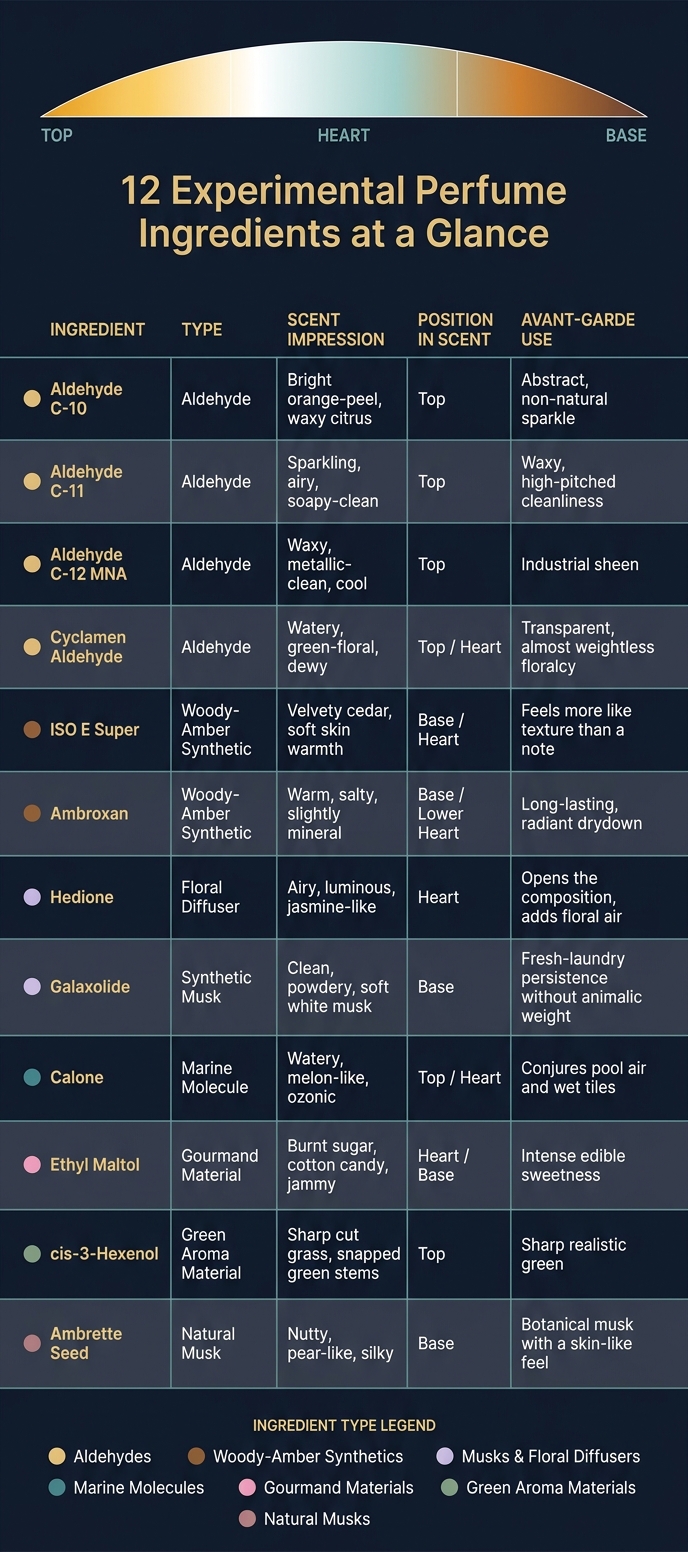
12 ingredientes experimentales de perfume: efectos, ubicación y uso en acordes
Estos materiales no hacen todos el mismo trabajo. Algunos se evaporan rápido. Algunos se expanden por el aire. Algunos añaden dulzor. Otros sostienen toda la estructura en su sitio.
Esta tabla reduce cada uno a su función principal en una fórmula.
| Ingrediente | Tipo | Impresión olfativa | Uso común en acordes | Posición típica | Uso de vanguardia |
|---|---|---|---|---|---|
| Aldehído C-10 | Aldehído | Piel de naranja luminosa, cítrico ceroso | Florales aldehídicos, cítricos limpios | Salida | Brillo abstracto, no natural |
| Aldehído C-11 | Aldehído | Chispeante, aireado, limpio-jabonoso | Ropa recién lavada, florales clásicos | Salida | Limpieza cerosa y aguda |
| Aldehído C-12 MNA | Aldehído | Ceroso, metálico-limpio, fresco | Impresión satinada, acordes de metal frío | Salida | Brillo industrial |
| Aldehído de ciclamen | Aldehído | Acuático, verde-floral, húmedo | Efectos de pétalo mojado, aire de piscina | Salida / Corazón | Floralidad transparente, casi ingrávida |
| ISO E Super | Sintético amaderado-ámbar | Cedro aterciopelado, suave calidez de piel | Ámbares amaderados modernos, fragancias de piel | Fondo / Corazón | Se siente más como textura que como nota |
| Ambroxan | Sintético amaderado-ámbar | Cálido, salino, ligeramente mineral | Acordes de calidez de piel, secados lavados por el mar | Fondo / Corazón bajo | Secado radiante y duradero |
| Hedione | Difusor floral | Aireado, luminoso, similar al jazmín | Flores blancas, colonias cítricas transparentes | Corazón | Abre la composición, añade aire floral |
| Galaxolide | Almizcle sintético | Limpio, empolvado, suave almizcle blanco | Bases de ropa recién lavada, secados suaves de piel | Fondo | Persistencia de ropa recién lavada sin peso animal |
| Calone | Molécula marina | Acuático, similar al melón, ozónico | Acuáticos marinos, mezclas de brisa marina | Salida / Corazón | Evoca tanto aire de piscina y azulejos mojados como mar abierto |
| Etil Maltol | Material gourmand | Azúcar quemado, algodón de azúcar, confitado | Orientales dulces de caramelo, bases gourmand | Corazón / Fondo | Dulzor comestible intenso |
| cis-3-Hexenol | Material aromático verde | Hierba cortada aguda, tallos verdes quebrados | Realismo de jardín, florales verdes, acordes herbales | Salida | Verde realista y afilado |
| Semilla de ambreta | Almizcle natural | Avellanado, similar a la pera, sedoso | Almizcles botánicos de piel, composiciones de inclinación natural | Fondo | Almizcle botánico con sensación de piel |
Aldehídos
Los aldehídos aportan luminosidad, lustre y una superficie pulida a una fragancia. Añaden efervescencia y elevación, a menudo con un borde ceroso o metálico que los naturales no ofrecen fácilmente por sí solos.
Piensa en ellos como la camisa blanca impecable de un armario. No se limitan a estar ahí. Cambian cómo se siente todo lo que los rodea.
Sintéticos que moldean la textura y la difusión
Estos materiales ayudan a decidir cómo una fragancia se mueve y respira. ISO E Super añade un halo cálido y aireado. Calone arrastra la fragancia hacia un espacio más fresco y acuático. Hedione se sitúa en medio, aportando luz y aire floral sin hacer que la fórmula se sienta pesada.
Ambroxan y Galaxolide desempeñan un papel distinto pero relacionado. Ambroxan da una calidez seca y salina que permanece en la piel durante horas, mientras que Galaxolide añade ese efecto de almizcle suave y recién lavado que muchas personas reconocen al instante.
Materiales gourmand, verdes y naturales
El etil maltol trata por completo de dulzor comestible. Huele a azúcar quemado, algodón de azúcar y notas de postre espesas y confitadas. Usado con cuidado, puede hacer que una fragancia se sienta suntuosa. Si se lleva demasiado lejos, puede dominar la estancia.
cis-3-Hexenol hace casi lo contrario. Da el golpe afilado de la hierba cortada y los tallos verdes rotos. Los perfumistas suelen combinarlo con materiales C6 relacionados para que el efecto verde se sienta más redondo y completo.
La semilla de ambreta suaviza este grupo con una sensación más cálida y cercana a la piel. Se inclina hacia lo almizclado, pero no al modo de ropa limpia de muchos almizcles de laboratorio. Se siente más botánica, sedosa y vivida.
Juntas, estas familias muestran cómo los materiales abstractos se convierten en efectos familiares: tejido limpio, aire húmedo, maderas luminosas o dulzor comestible.
Cómo probar fragancias experimentales antes de comprar un frasco completo
Por qué probar es aún más importante con los perfumes experimentales
Una vez que has mirado los ingredientes, el siguiente paso es sencillo: lleva la fragancia sobre la piel. Con perfumes experimentales, una tira olfativa no basta. Necesitas una prueba de uso adecuada.
La química de la piel y la temperatura corporal pueden cambiar una fragancia más de lo que muchas personas esperan. Materiales como aldehídos, ISO E Super y Calone pueden volverse más suaves, más afilados o mucho más intensos según cómo se asienten sobre tu piel. Una prueba de día completo te da la imagen más clara de lo que estás obteniendo.
Cuándo un formato más pequeño tiene más sentido que un frasco completo
En Alemania y en toda Europa, los frascos completos suelen situarse alrededor de €120,00 a €250,00, y los lanzamientos nicho experimentales pueden superar fácilmente los €180,00. Es una inversión importante para algo que puede sentirse polarizante, demasiado ligado a una estación o simplemente no adecuado para el uso diario.
Ahí es donde ayudan los formatos más pequeños. Te permiten probar la salida, el secado y la duración antes de comprometerte.
| Formato | Sprays aprox. | Mejor uso |
|---|---|---|
| 2 ml | ~30 | Primera impresión, prueba inicial en piel |
| 5 ml | ~75 | Prueba de varios días en distintos entornos y climas |
| 8 ml | ~120 | Uso regular |
| Frasco completo | - | Compromiso con una fragancia distintiva |
Una fragancia de piel construida alrededor de Ambroxan, por ejemplo, puede sentirse radiante en clima cálido pero extrañamente plana en el aire frío del invierno. Probar en al menos dos condiciones de temperatura suele ser la decisión más inteligente antes de comprar un frasco completo.
Usar decants para comparar estilos lado a lado
Los decants pequeños también son excelentes para una comparación directa. Pon una fragancia aldehídica en tu muñeca izquierda y una fragancia marina o basada en Calone en la derecha. Luego lleva ambas en las mismas condiciones interiores y exteriores. Hazlo de nuevo en un día más cálido, y el contraste suele volverse mucho más fácil de detectar.
Scento ofrece fragancias de diseñador y de nicho en viales de 2 ml, 5 ml y 8 ml, además de un decant de 30 ml de la mayoría de los perfumes para probar una fragancia durante un poco más de tiempo. Así resulta más fácil comparar estilos aldehídicos, marinos, gourmand y almizclados antes de decidirte por un frasco completo.
Conclusión
Qué revelan estos 12 ingredientes sobre la fragancia moderna
En conjunto, estos materiales muestran cómo la perfumería moderna construye objetos, superficies y atmósfera en lugar de apoyarse en una simple pirámide olfativa. Los aldehídos aportan brillo. Los ámbares amaderados aportan estructura. Hedione aporta aire. Calone aporta agua. El etil maltol aporta dulzor. Cis-3-hexenol aporta un golpe verde. La ambreta aporta esa calidez parecida a la piel.
No son solo notas. Son efectos. Los perfumistas los utilizan para moldear textura, proyección y ánimo. Ese es el punto más profundo aquí: no la lista de notas en sí, sino la lógica material que hay debajo.
Eso es lo que hace que esta guía sea útil más allá de una simple lectura. Te ayuda a descifrar qué está haciendo un perfume sobre la piel.
Cómo usar esta guía al probar perfumes
Trata esta lista de ingredientes como un decodificador para tu nariz. La próxima vez que pruebes una fragancia, pregúntate: ¿Qué textura estoy oliendo realmente? Una salida limpia, almidonada, casi efervescente, suele significar que los aldehídos impulsan ese efecto. ¿Una calidez amaderada y suave que parece venir de tu piel en lugar del frasco? Muy probablemente ISO E Super o Ambroxan. Una acuosidad fresca, similar al melón, apunta a Calone. Una calidez pegajosa de caramelo dulce suele venir del etil maltol.
Usa esta guía como herramienta de decodificación. Cuando una fragancia se sienta chispeante, acuática, verde o cercana a la piel, intenta identificar la familia de materiales detrás de ese efecto. Así conviertes una primera impresión en un punto de referencia que puedes utilizar.
Preguntas frecuentes
¿Cómo afectan los ingredientes experimentales a un perfume sobre la piel?
Los ingredientes experimentales, incluidas las moléculas sintéticas y los compuestos idénticos a los naturales, pueden cambiar cómo se comporta una fragancia sobre la piel. Interactúan con tu química corporal, pH y niveles de grasa, por eso la misma fragancia puede oler un poco diferente de una persona a otra.
Los extractos naturales suelen cambiar de formas más suaves y sutiles a medida que se evaporan. Los sintéticos, en cambio, están hechos para ofrecer estabilidad, consistencia y proyección controlada. Eso da a los perfumistas más precisión, pero tu piel sigue teniendo la última palabra.
Como la química de la piel varía, la mejor decisión es sencilla: prueba una fragancia sobre tu propia piel y observa cómo evoluciona durante 24 horas.
¿Por qué dos perfumes con las mismas notas pueden oler diferente?
Incluso cuando dos perfumes enumeran las mismas notas, puede que no huelan igual sobre la piel. Eso se debe a que la química de la piel desempeña un papel importante en cómo las moléculas de fragancia se abren, se asientan y se desvanecen. El calor y la humedad también importan. Una fragancia puede sentirse más ligera, más afilada o más difusiva según las condiciones a tu alrededor.
Hay otra capa en ello. Pequeños cambios en la estructura molecular, la forma en que se extrae un ingrediente e incluso cómo tu propia nariz percibe ciertas moléculas pueden cambiar lo que hueles. Sobre el papel, dos fragancias pueden parecer cercanas. En el uso, pueden contar una historia distinta.
¿Qué ingredientes debería probar antes de comprar un frasco completo?
Antes de comprar un frasco completo, conviene probar primero la fragancia sobre tu propia piel. Esto es aún más importante con los aromas basados en materias primas naturales, moléculas sintéticas como Iso E Super y extractos intensos como el oud y el ámbar gris. No siempre se comportan igual en cada persona, y la química de la piel puede cambiar cómo evoluciona un aroma al principio, cómo se asienta y cuánto dura.
Los aceites esenciales requieren un cuidado especial. Haz una prueba en la parte interna de la muñeca durante 24 horas para comprobar si se produce irritación antes de aplicarlos en zonas más amplias.
Los decants de Scento vienen en viales de 2 ml, 5 ml y 8 ml, y en un decant de 30 ml de la mayoría de los perfumes, lo que facilita mucho el proceso. Puedes llevar una fragancia más de una vez, ver cómo evoluciona con el tiempo y decidir si es adecuada para ti antes de comprometerte con un frasco completo.

