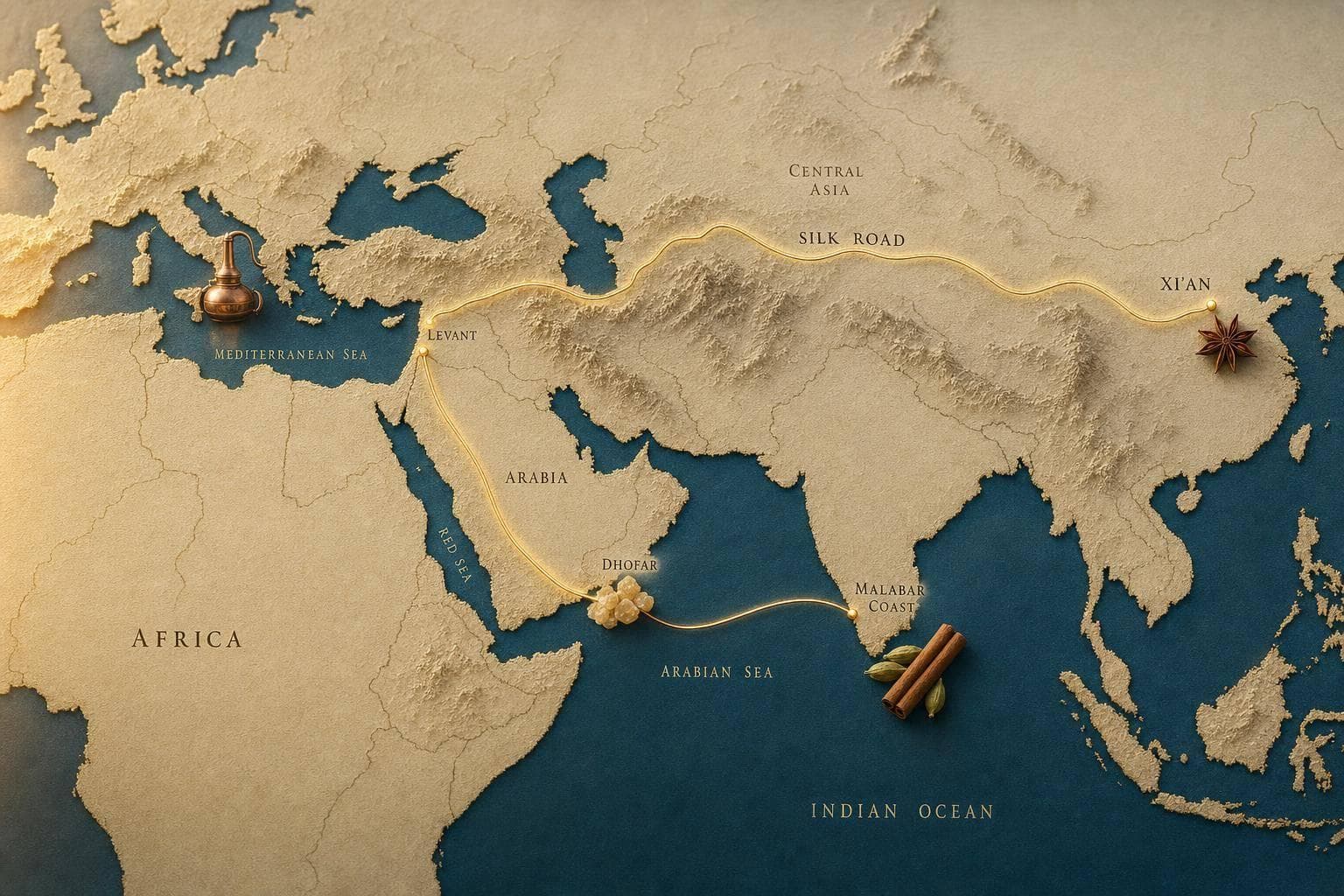
El perfume europeo medieval dependía del comercio a larga distancia. Si reducimos la historia a su esencia, tres sistemas de rutas realizaron la mayor parte del trabajo: el Mediterráneo, el mar Rojo y el océano Índico, y la Ruta de la Seda.
He aquí la versión resumida:
- Los puertos italianos como Venecia y Génova fueron los principales puntos de entrada a Europa.
- Arabia, África oriental, la India y el sudeste asiático suministraban gran parte de las materias primas aromáticas.
- El incienso, la mirra, el almizcle, el ámbar gris, el sándalo, la canela, el clavo y la madera de agar figuraban entre las mercancías clave.
- En la Edad Media, el perfume significaba mucho más que un frasco de fragancia. También abarcaba el incienso litúrgico, los aceites perfumados, las aguas de hierbas, las medicinas y las pomandras.
- Estos artículos solían ser bienes de lujo, por lo que su acceso estaba reservado mayoritariamente a iglesias, cortes, boticas y hogares adinerados.
- El comercio no solo transportaba materias primas, sino también conocimientos sobre destilación procedentes del mundo arabófono hacia Europa.
Un dato resulta elocuente: el viaje de una sola caravana por la ruta del incienso podía abarcar entre 2.400 y 3.400 km y prolongarse durante unos 65 a 100 días. Ello ayuda a explicar por qué tantas materias aromáticas eran escasas, costosas y se asociaban al estatus social.
Si desea una visión global en una sola frase, es esta: el universo olfativo de la Europa medieval fue forjado tanto por barcos, caravanas, puertos y traductores como por perfumistas.
Comparativa rápida
| Sistema de rutas | Función principal | Mercancías clave | Principal impacto en Europa |
|---|---|---|---|
| Mediterráneo | Introducía mercancías en Europa a través de sus puertos | Especias, resinas, almizcle, ámbar gris, maderas | Abastecía a los mercados italianos y del interior continental |
| Mar Rojo y océano Índico | Trasladaba materias primas hacia el oeste desde las regiones de origen | Incienso, mirra, sándalo, alcanfor, canela | Surtía a los núcleos neurálgicos de Egipto y el Levante |
| Ruta de la Seda | Transportaba mercancías de gran valor y conocimientos técnicos | Almizcle, clavo, madera de agar, especias exóticas | Aportaba tanto ingredientes como métodos a Europa |
Lo verdaderamente decisivo no es solo de dónde procedían las mercancías, sino por cuántas manos pasaban antes de llegar a una iglesia, una corte o una botica en Europa.
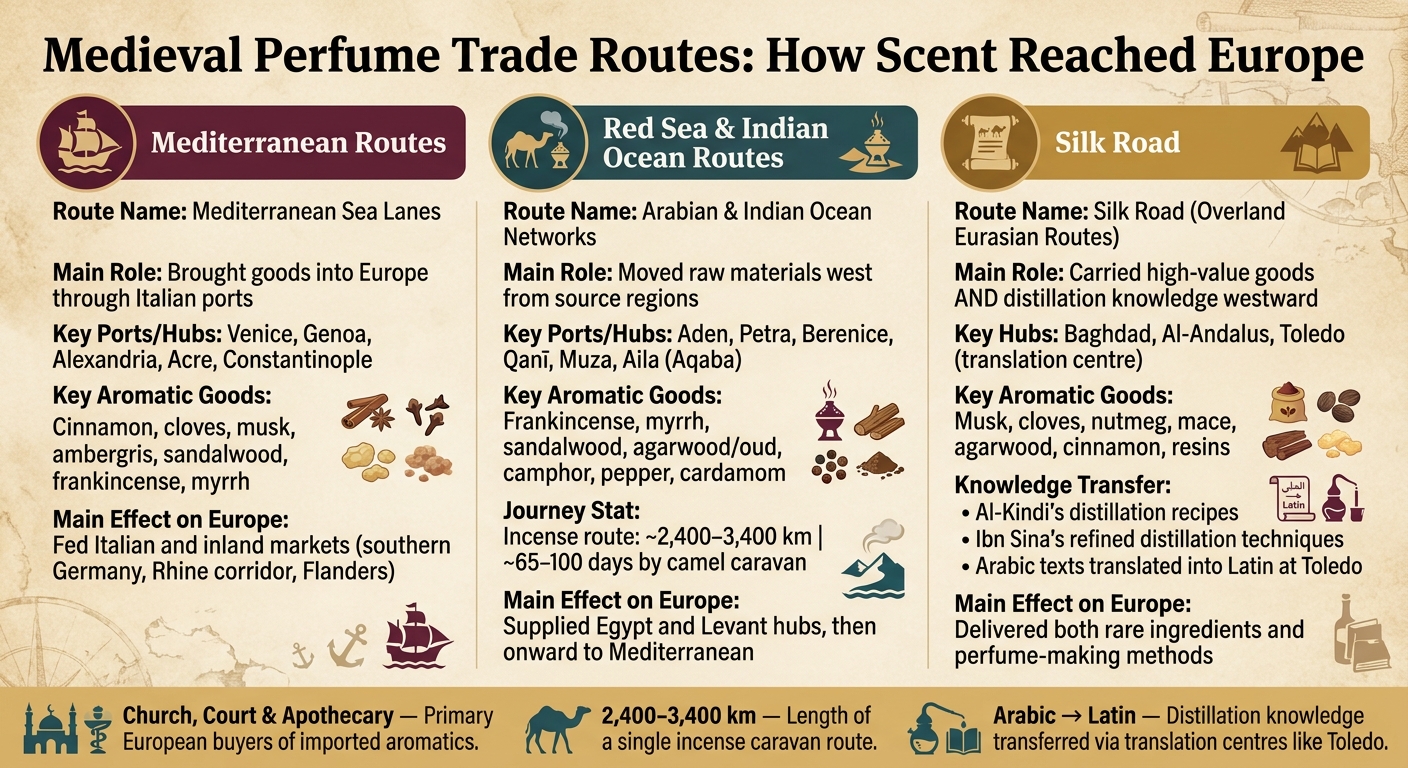
Rutas comerciales del perfume en la Edad Media: Mediterráneo, océano Índico y Ruta de la Seda
Rutas mediterráneas: Venecia, Génova y los principales puntos de entrada a Europa
Desde ca. 1100 hasta 1500, Venecia y Génova dominaron gran parte del comercio procedente del Levante y Egipto hacia Europa. Canalizaban los aromas orientales hacia los mercados occidentales y actuaban como los primeros puntos de desembarco europeos para materias olfativas que ya habían salvado inmensas distancias antes de llegar al Mediterráneo.
Las principales rutas marítimas desde Alejandría, Acre y Constantinopla
Venecia operaba convoyes navales conocidos como las mude. Estos conectaban la ciudad con Alejandría, Beirut, Chipre y el mar Negro. Génova se apoyaba en dos vías marítimas esenciales: una procedente de Oriente Próximo a través de Chipre o Alejandría, y otra desde Constantinopla pasando por Quíos. En su conjunto, estas rutas integraban directamente a Egipto y el Levante en el comercio europeo.
Una vez que las naves alcanzaban los puertos italianos, la travesía no concluía allí. Desde Venecia, las mercancías cruzaban el paso del Brennero hacia el sur de Alemania para dirigirse a ciudades como Augsburgo, Núremberg y Colonia. Los cargamentos que desembarcaban en Génova atravesaban Milán con rumbo al lago de Constanza y al valle del Rin. A partir de estos puertos, las materias aromáticas se dispersaban por el interior del continente.
Qué materias fragantes transitaban por los puertos italianos
Entre los principales artículos aromáticos figuraban especias, resinas, maderas, almizcle y ámbar gris. El incienso y la mirra se empleaban a gran escala, pero su acceso distaba de ser igualitario. En la mayoría de los casos, estaban reservados para iglesias, cortes y familias nobles. El almizcle y el ámbar gris ostentaban los precios más elevados, mientras que el sándalo y el áloe constituían artículos de lujo custodiados habitualmente por boticarios en las urbes más destacadas.
Esa jerarquía resultaba fundamental. Las especias más comunes ocupaban el escalafón inferior, mientras que las resinas singulares y los componentes aromáticos de origen animal coronaban la cúspide. Esta escala de precios moldeó la percepción que la sociedad europea medieval tenía del perfume, el prestigio social y el aroma en sí.
Tabla: Puertos mediterráneos, aromas comercializados y destinos europeos
| Puerto | Principales regiones de origen y puntos de tránsito | Principales productos aromáticos | Grandes destinos europeos |
|---|---|---|---|
| Venecia | Alejandría, Siria, Bizancio y el Mediterráneo oriental en su conjunto | Canela, clavo, almizcle, ámbar gris, sándalo, áloe | Sur de Alemania, corredor del Rin, Flandes, norte de Italia |
| Génova | Chipre, Alejandría, Constantinopla, puertos del mar Negro | Especias, resinas, aromas, artículos de lujo orientales | Norte de Italia, Milán, lago de Constanza, valle del Rin, Europa occidental |
| Alejandría | Redes del mar Rojo y el océano Índico a través de Egipto | Incienso, mirra, áloe, resinas aromáticas | Venecia y Génova para su posterior redistribución |
| Acre | Redes comerciales costeras sirio-palestinas | Especias levantinas, resinas, nardo | Venecia, Génova y posteriormente el interior europeo |
| Constantinopla | Redes del mar Negro, bizantinas y terrestres asiáticas | Almizcle, sedas, especias, aromas orientales selectos | Venecia, Génova y posteriormente Europa central y occidental |
Venecia ejercía una hegemonía más firme sobre el comercio de Levante y Egipto, mientras que Génova desempeñaba un papel más destacado en el Mediterráneo occidental y el mar Negro. Pese a ello, ambos puertos dependían de cadenas de aprovisionamiento orientales iniciadas a una distancia inmensamente mayor: en Arabia y a lo largo del océano Índico.
Redes de Arabia y del océano Índico: la cuna de incontables ingredientes de perfumería
Gran parte de las materias primas sobre las que floreció la primitiva cultura del perfume no eran originarias de Europa. Se desplazaban de este a oeste, a través de Arabia y del océano Índico. El incienso y la mirra, en particular, alcanzaban las riberas mediterráneas únicamente tras largas travesías por los desiertos árabes y las rutas de navegación del mar Rojo y del Índico.
La ruta del incienso y el corredor del mar Rojo
La ruta árabe del incienso conectaba las zonas de producción de los actuales Omán, Yemen y el norte de Somalia con los mercados septentrionales de Egipto y el Levante. Las caravanas cargadas de incienso y mirra atravesaban los reinos de la Arabia meridional siguiendo pistas desérticas, con altos en oasis y urbes como La Meca y Medina antes de alcanzar enclaves neurálgicos como Petra y Gaza.
Petra constituyó un eslabón capital en este engranaje. Bajo la hegemonía nabatea, articulaba las rutas de suministro árabes con los mercados de Siria y el Mediterráneo. Según el itinerario elegido, la travesía completa rondaba los 2.400–3.400 km, y una caravana de camellos podía requerir entre 65 y 100 días para culminarla.
Posteriormente, los mercaderes combinaron las vías terrestres con la navegación por el mar Rojo. Las resinas se embarcaban en puertos de la Arabia meridional como Qanī y Muza, para trasladarse después por vía marítima rumbo al norte hacia Berenice, Myos Hormos, Aila (Áqaba) y Alejandría. Dicho giro supuso un hito: el transporte marítimo permitía movilizar mercancías en volúmenes muy superiores y estrechar el vínculo entre el comercio árabe y los puertos egipcios y mediterráneos.
Los gobernantes de la era islámica gravaban las paradas de las caravanas y el tráfico de los puertos, e integraron estas antiguas rutas en nuevos sistemas de poder y comercio. Entre los siglos 11 y 15, el mar Rojo y Egipto se habían convertido en el principal paso de los aromáticos hacia el Mediterráneo. Eso sustituyó al papel más importante del golfo Pérsico entre los siglos 9 y 11. Desde allí, estos materiales se extendieron al resto del mercado mediterráneo.
El comercio de especias, maderas y resinas en el océano Índico
El incienso y la mirra solo constituían una faceta de este intercambio. Un caudal incomparablemente más vasto de sustancias perfumadas viajaba hacia occidente a través de las redes del océano Índico y del golfo Pérsico. Los navegantes sacaban partido del ritmo constante de los vientos monzones, lo que confería regularidad a las singladuras estacionales entre el sur de Asia, el sudeste asiático y la península arábiga.
De la costa de Malabar en la India y de Sri Lanka procedían la pimienta, el cardamomo, la canela y el sándalo. Su empleo no se limitaba al ámbito culinario; resultaban indispensables en formulaciones cosméticas y preparados medicinales. La madera de agar (oud), recolectada en las selvas del sudeste asiático, surcaba el estrecho de Malaca y emporios como Kaläh en el universo malayo. Al prenderse, liberaba un humo denso, dulcemente balsámico. Fue venerada en las cortes islámicas mucho antes de ser acogida en Europa como una rareza suprema.
Otros componentes desempeñaban funciones singulares. El alcanfor gozaba de gran aprecio por su perfil punzante y sus virtudes refrescantes, tal como se interpretaban en la época. Por su parte, los ingredientes de origen animal como el almizcle otorgaban cuerpo y fijación a los perfumes, permitiendo la creación de composiciones más ricas y complejas. Adén se erigió en uno de los centros de acopio primordiales para los aromas del Índico —incluidos el almizcle, el alcanfor, el ámbar gris y el sándalo— antes de su posterior distribución.
Un único ingrediente podía transitar por innumerables manos y puertos. El sándalo, verbigracia, podía originarse en un bosque de la India, viajar a un muelle de Sri Lanka, surcar el mar Arábigo hasta Omán o Yemen, y avanzar por las rutas del mar Rojo y el Mediterráneo hacia las ciudades italianas que abastecían a perfumistas y congregaciones religiosas europeas. En definitiva, se trataba de redes de suministro extensas y estratificadas, que nutrieron el comercio mediterráneo y cimentaron el posterior intercambio con el corazón del continente.
Tabla: Familias olfativas, regiones de procedencia y rutas medievales
| Familia olfativa | Región de procedencia | Principal corredor comercial | Uso primordial en Europa |
|---|---|---|---|
| Resinas (incienso, mirra) | Arabia meridional (Omán, Yemen), Somalia | Ruta del incienso (caravanas), mar Rojo | Incienso litúrgico, medicina, celebraciones sagradas |
| Maderas (sándalo, madera de agar/oud) | India, sudeste asiático | Océano Índico, golfo Pérsico, estrecho de Malaca | Perfumería personal exclusiva, ritos espirituales, mezclas de sahumerio |
| Especias (pimienta, cardamomo, canela, clavo) | India, Sri Lanka, Indonesia | Del océano Índico a los puertos del mar Rojo o golfo Pérsico | Composición de fragancias, medicina, aceites aromáticos |
| Ingredientes de origen animal (almizcle, ámbar gris) | Tíbet, océano Índico | Redes marítimas de artículos suntuarios | Fijadores olfativos, perfumería personal de alta alcurnia |
Tu experto en fragancias personal te espera
Haz nuestro test olfativo rápido y descubre auténticos perfumes de diseñador y de nicho elegidos según tu gusto: explóralos en decants y muestras de 2, 5, 8 y 30 ml para probar cada uno antes de decidirte por un frasco completo.
Encuentra tu fraganciaIntercambios en la Ruta de la Seda y difusión del arte del perfume
Las redes de Arabia y del océano Índico antes descritas fueron solo una parte del conjunto. En paralelo a ellas —y convergiendo con frecuencia en sus cauces— discurrían las vías terrestres euroasiáticas agrupadas bajo el nombre de Ruta de la Seda. Estas sendas de interior acarreaban mucho más que bienes tangibles: transmitían ideas, fórmulas y la maestría técnica necesaria para procesar las sustancias aromáticas.
Cómo el comercio terrestre euroasiático abasteció el mercado mediterráneo
Si Venecia y Génova operaban como las compuertas, las ramas de la Ruta de la Seda constituían los canales continentales que las nutrieron. Las caravanas trasladaban materias olfativas de altísimo valor desde el sudeste asiático y Asia Central hasta los mercados persas, levantinos y mediterráneos. Allí, estos cargamentos se entrelazaban con la cadena del tráfico marítimo. De igual relevancia fue el trasvase técnico: recetarios, metodologías de destilación y aplicaciones terapéuticas viajaban a la par de las materias primas.
El flete de mercancías por vía terrestre multiplicaba varias veces el coste del transporte por mar. Ello condicionaba la viabilidad de lo que convenía transportar: únicamente los aromas pequeños y sumamente valiosos justificaban el empeño del periplo, lo cual explica por qué las especias y las resinas más singulares coparon estos trayectos y alcanzaron Europa con cotizaciones que superaban con creces su valor en origen.
El comercio movilizaba los ingredientes. Los sabios, por su parte, transmitían los métodos concebidos para sublimarlos.
Al-Ándalus, los centros de traducción y la técnica de la destilación
Durante la Edad de Oro del islam, los eruditos árabes y persas estructuraron un corpus de conocimiento en torno a las sustancias aromáticas, contemplándolas no solo como expresiones de lujo, sino también como materias de estudio químico, médico y farmacológico. Al-Kindi compuso El libro de la química del perfume y las destilaciones, un minucioso tratado que aunaba decenas de formulaciones e instrucciones precisas sobre la destilación, incluidos métodos para elaborar agua de rosas. Posteriormente, Ibn Sina (Avicena) perfeccionó los alambiques y las técnicas destilatorias, facilitando la obtención de aguas florales cristalinas, attares (aceites de perfume concentrados) y primitivas preparaciones de base alcohólica.
Aquel saber irradió hacia occidente desde Bagdad. Al-Ándalus —la Iberia islámica— se convirtió en el puente definitivo hacia la Europa latina. En centros de saber como la escuela de traductores de Toledo, los eruditos vertieron al latín textos científicos y médicos árabes, entre los que destacaban tratados de botánica aromática, farmacopea y destilación. De forma paulatina, boticarios y facultativos europeos adoptaron las aguas aromáticas destiladas y las tinturas en su quehacer cotidiano. Con el tiempo, la maestría técnica árabe y persa se propagó hacia el oeste a través de Al-Ándalus y de focos como Toledo, sentando los fundamentos técnicos sobre los que más tarde florecería la perfumería europea.
Tabla: Rutas terrestres frente a rutas marítimas en el comercio de ingredientes de perfume
| Tipo de ruta | Mercancías características | Riesgos principales | Impacto en la rareza y el coste |
|---|---|---|---|
| Terrestre (Ruta de la Seda y corredores de caravanas) | Almizcle, clavo, nuez moscada, macis, madera de agar, canela, resinas | Bandolerismo, geografía inhóspita, inestabilidad política, desorbitados costes de transporte | Precios extraordinariamente elevados; la multitud de intermediarios encarecía el producto muy por encima de su valor en origen |
| Marítima (océano Índico, golfo Pérsico, mar Rojo) | Incienso, mirra, sándalo, pimienta, cardamomo, alcanfor, ámbar gris | Piratería, tempestades, sujeción a los monzones, deterioro de la carga | Permitía mayores volúmenes; los costes unitarios resultaban inferiores a los de la vía terrestre, aunque los artículos se mantuvieron en el rango del lujo durante toda la Edad Media |
De forma coordinada, estas vías convirtieron el perfume en un bien suntuoso, cosmopolita y de una sofisticación creciente en todo el suelo europeo.
La impronta de estas rutas en la cultura europea del perfume
Del sahumerio y la medicina a la fragancia personal
Una vez que estos materiales llegaron a Europa, dejaron de ser simples mercancías en poco tiempo. Entraron en el ritual de la Iglesia, en la práctica médica y en la vida de la corte. Las iglesias fueron de los primeros grandes compradores, y el incienso y la mirra pasaron a formar parte de la liturgia cristiana. A partir del siglo 12, con el crecimiento del comercio, el incienso se volvió habitual en la misa, las procesiones y los funerales. El aroma quedó ligado a la santidad y al favor divino.
La medicina experimentó una evolución análoga. Los galenos atribuían las enfermedades a los miasmas, por lo que las resinas y especias ultramarinas se quemaban o destilaban en aguas aromáticas con el propósito de purificar el aire. Durante la peste negra, entre 1347 y 1352, los médicos prescribían preparados fragantes generosos en especias como la nuez moscada y la pimienta. Al unísono, las boticas de Venecia y Montpellier dispensaban aguas aromáticas como el agua de Damasco, una refinada mezcla de diversas notas olfativas realzada con almizcle y algalia.
De las boticas, estas esencias conquistaron el indumento de las élites y la intimidad de las estancias nobles. El almizcle, la algalia, el sándalo y el ámbar gris se empleaban para perfumar guantes, vestimentas y aposentos en las cortes reales y ducales de todo el continente. En Venecia, en las inmediaciones de Rialto, los comercios ofrecían hierbas aromáticas, especias, perfumes, cosméticos y guantes perfumados.
Por qué los ingredientes medievales perduran en las creaciones actuales
Las materias primas introducidas en Europa a través de las rutas comerciales medievales jamás abandonaron el patrimonio olfativo. El incienso y la mirra continúan erigiéndose en pilares de la perfumería contemporánea, donde vertebran acordes resinosos y ahumados que evocan recintos sagrados y caravanas pretéritas. La madera de agar, que antaño transitaba las rutas árabes y del Índico, forjó el concepto actual del oud. Hoy día, las notas de oud confieren profundidad, misterio y carácter a incontables creaciones nicho y fragancias de alta gama.
El almizcle protagoniza una trayectoria similar. Aunque antaño procedía del ciervo almizclero, en la actualidad suele recrearse mediante moléculas sintéticas de alta precisión. Con todo, su impronta cálida y sensual continúa definiendo los acordes de fondo de multitud de composiciones. El ámbar gris, transportado durante siglos a través de las rutas del mar, se evoca predominantemente mediante acordes ambarados o recreaciones olfativas que preservan su calidez salina y marina, soslayando los dilemas éticos vinculados a la recolección de la materia prima natural.
Estos elementos siguen moldeando la perfumería de nuestros días, manifestándose con especial elocuencia en acordes resinosos, amaderados y almizclados.
Conclusión: Los grandes caminos que forjaron el universo olfativo de la Europa medieval
Los puertos mediterráneos, las redes marítimas árabe-índicas y los corredores de la Ruta de la Seda dotaron a Europa de materias aromáticas sublimes y de la pericia técnica necesaria para refinarlas. Su labor excedió el mero traslado de mercancías entre latitudes remotas: esculpieron la propia cultura europea del perfume, dando vida al incienso litúrgico, a los bálsamos aromáticos contra las epidemias, al lujo de las cortes y a los cimientos científicos sobre los que aún reposa la perfumería renacentista y moderna.
Preguntas frecuentes
¿Por qué eran tan caros los ingredientes del perfume en la Edad Media?
Los ingredientes del perfume medieval alcanzaban precios exorbitantes debido a su escasez, la dificultad que entrañaba su recolección y lo laborioso de su preparación. Muchos de ellos, incluidos el incienso y la mirra, llegaban desde tierras remotas a través de travesías comerciales prolongadas y repletas de peligros, lo que encarecía notablemente su cotización final.
La intensa demanda añadía una presión adicional. Estas materias no se reservaban exclusivamente a la ornamentación olfativa: resultaban indispensables en la medicina y los rituales litúrgicos, por lo que múltiples estamentos competían por un suministro muy limitado.
Otros ingredientes debían su elevado coste a una razón más terrenal: requerían un despliegue ingente de mano de obra. El azafrán ilustra a la perfección esta realidad, pues la obtención de una cantidad minúscula exigía un concienzudo trabajo manual.
¿Cuál fue la ruta comercial más determinante para el perfume en Europa?
La arteria más trascendental para el perfume en suelo europeo fue la ruta comercial marítima del incienso en el Mediterráneo. Esta vía canalizaba aromas tan codiciados como el incienso, junto a diversas resinas y especias afines, desde la Arabia meridional y el Cuerno de África hasta los fondeaderos del Mediterráneo.
A partir de estos enclaves, los cargamentos se distribuían por los mercados griegos y romanos, apoyándose con asiduidad en las travesías marítimas del mar Rojo durante la época romana.
¿En qué medida transformaron las rutas comerciales la perfumería europea?
Las rutas mercantiles transformaron por completo la perfumería europea. Aseguraron un abastecimiento continuo de materias primas extraordinarias como el incienso, la mirra, el azafrán y la canela procedentes de Arabia, la India y África.
Esta regularidad en el acceso expandió el horizonte creativo de los artesanos. En lugar de limitarse al empleo de flores, resinas y hierbas autóctonas, tuvieron la oportunidad de combinar elementos exóticos con especies botánicas locales. Con el paso de los siglos, este diálogo ayudó a elevar la perfumería desde una práctica rudimentaria hasta convertirla en un oficio noble y estructurado.
Asimismo, la fragancia adquirió una dimensión social de gran calado: dejó de ser un agradable aditamento para convertirse en un emblema indiscutible de linaje, distinción y refinamiento.

