El sándalo sigue siendo un ingrediente preciado en perfumería, pero no todo el sándalo es igual. El sándalo de Mysore indio (Santalum album) es conocido por su aroma cremoso y opulento, así como por su alto contenido de santalol (70–90%), lo que lo convierte en una elección lujosa, de disponibilidad limitada y costes elevados (1.900–4.700 €/kg). En cambio, el sándalo australiano (Santalum spicatum) ofrece un aroma más seco y verde, con niveles moderados de santalol (20–40%), por lo que resulta más asequible (185–465 €/kg) y más fácil de obtener gracias a una recolección regulada.
Diferencias clave:
- Mysore indio: Cremoso, cálido, duradero, precio prémium, suministro limitado.
- Australiano: Seco, terroso, perfil más ligero, menor coste, abastecimiento fiable.
Comparación rápida:
| Característica | Mysore indio (S. album) | Australiano (S. spicatum) |
|---|---|---|
| Perfil olfativo | Cremoso, mantecoso, suave | Seco, terroso, ligeramente punzante |
| Contenido de santalol | 70–90% | 20–40% |
| Duración | Más de 72 horas | Moderada |
| Precio (por kg) | 1.900–4.700 € | 185–465 € |
| Disponibilidad | Limitada, especie vulnerable | Regulada, suministro estable |
El sándalo de Mysore indio es ideal para fragancias más profundas y lujosas, mientras que el sándalo australiano se adapta a composiciones más ligeras y modernas. Los decants de Scento te permiten probar ambos perfiles antes de comprometerte con un frasco completo, ayudándote a encontrar la combinación perfecta para tus preferencias y estilo de vida.
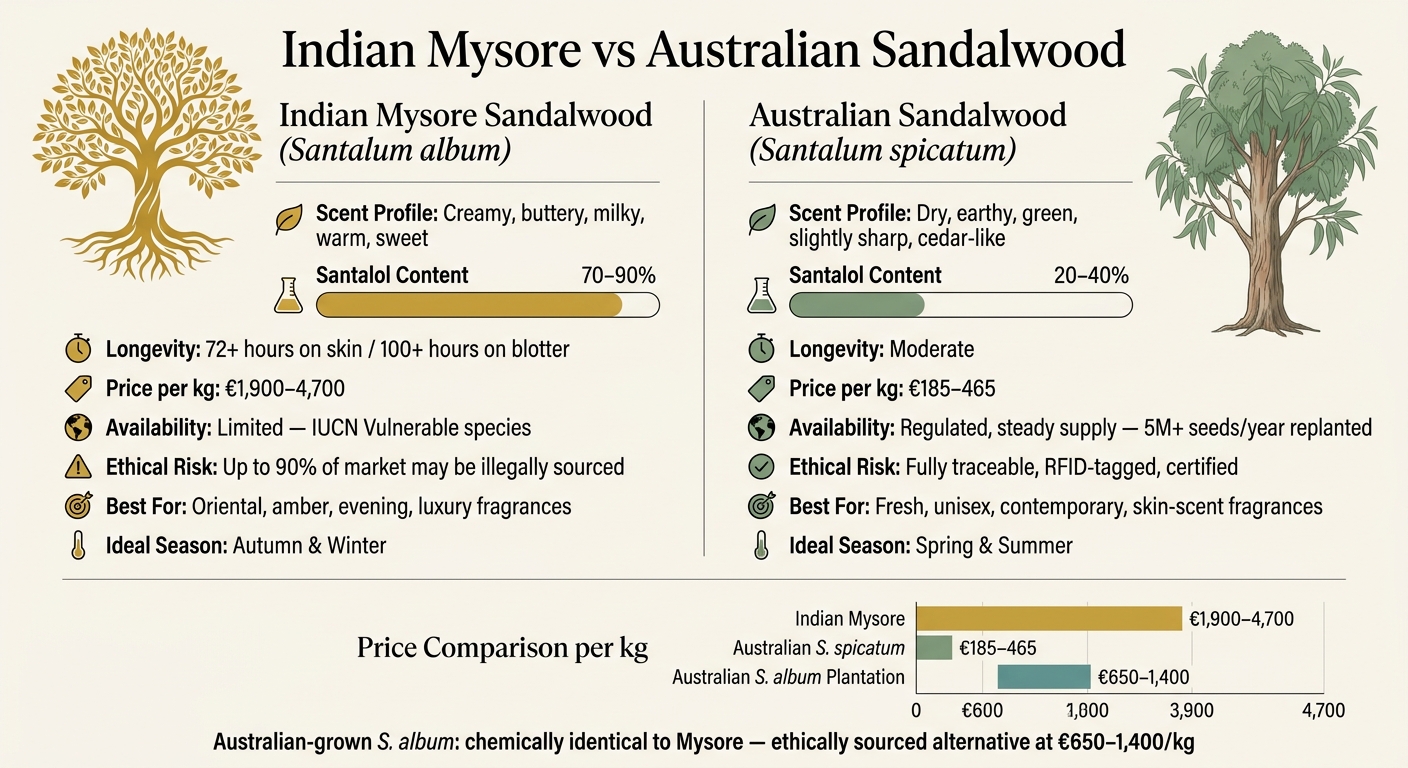
Mysore indio vs sándalo australiano: diferencias clave de un vistazo
Sándalo de Mysore indio: el patrón oro
Historia, escasez y estatus protegido
El sándalo de Mysore indio (Santalum album) ha sido atesorado durante más de 4.000 años, desempeñando un papel esencial en la medicina ayurvédica, los rituales religiosos y las cortes de la realeza. El término "Mysore" se refiere específicamente a S. album procedente de Karnataka, célebre por su aceite rico y aromático.
En 1792, el gobernante de Mysore declaró el sándalo "Árbol Real", poniendo todos estos árboles bajo control estatal. Este monopolio, unido a la caza furtiva ilegal generalizada, provocó un drástico descenso de las poblaciones silvestres. En 1997, la UICN clasificó la especie como vulnerable. La situación empeoró, y la producción legal en Karnataka se desplomó de 3.000 toneladas en 1978 a apenas 20 toneladas en 2002: una caída asombrosa del 99,3% en menos de 25 años. Un árbol maduro de sándalo de Mysore puede producir entre 20 y 40 kg de duramen, que hoy alcanza un valor de mercado de 47.000–94.000 €.
"El sándalo indio tiene una historia larga y sagrada, pero también ha afrontado algunos retos en el camino. El comercio ilegal y la sobreexplotación de la especie lo hicieron escaso a principios de la década de 1990." - Dr. Dhanushka Hettiarachchi, Ph.D., Product Manager, Quintis Sandalwood
Esta historia legendaria, combinada con normativas estrictas y una disponibilidad limitada, ha consolidado su reputación como una materia prima codiciada en perfumería.
Perfil olfativo y rendimiento en perfume
El aceite auténtico de S. album se caracteriza por una alta concentración de santaloles, con un 70–90% de santaloles totales requerido para cumplir las normas ISO 3518:2002. En concreto, debe contener un 41–54% de alfa-santalol y un 16–24% de beta-santalol. El aroma resultante es cremoso, lácteo y sutilmente dulce, con una suavidad amaderada que evita cualquier matiz áspero o amargo.
"El sándalo huele a piel cálida después de dormir. Cremoso, lechoso, tenuemente dulce, con una madera tan redondeada que no tiene aristas." - Premiere Peau
Al aplicarse, el sándalo de Mysore evoluciona hacia una calidez mantequillosa, revelando una delicada profundidad almizclada y dejando una estela seca, casi mineral, que puede permanecer durante más de 72 horas. Su estructura molecular se une a la queratina de la piel, convirtiéndolo en un excelente fijador que prolonga la duración de la fragancia. Esta cualidad única lo ha convertido durante décadas en un elemento esencial de las composiciones chipre y orientales.
Normativas, uso moderno y alternativas sintéticas
La rareza del sándalo de Mysore ha provocado cambios significativos en su uso y abastecimiento. Con precios que oscilan entre 1.900 y 4.700 € por kilogramo, el sándalo genuino queda hoy reservado principalmente para marcas de perfumería nicho y de lujo. Como resultado, muchas fragancias comerciales y de diseñador recurren a alternativas sintéticas. Moléculas como Javanol y Bacdanol están diseñadas para replicar las facetas cremosas y amaderadas del sándalo. Sin embargo, muchos perfumistas sostienen que estos sustitutos sintéticos carecen de la complejidad y profundidad del material natural, y a menudo se perciben como "partes que imitan un todo".
En respuesta a la sobreexplotación y la escasez, Karnataka ha introducido políticas que permiten a agricultores privados cultivar y comercializar sándalo legalmente. Mientras tanto, grandes plantaciones en Australia Occidental se han convertido en una fuente importante de S. album, con más de 5,5 millones de árboles. Estos aceites procedentes de plantación, con precios de 660–1.400 € por kilogramo, ofrecen una opción más accesible para los perfumistas que buscan el perfil natural de S. album sin los desafíos regulatorios y de suministro asociados al sándalo de origen indio.
Sándalo australiano: una opción favorable para el abastecimiento
De dónde procede y cómo se cultiva
El sándalo australiano (Santalum spicatum) prospera en las regiones semiáridas de Australia Occidental, con un suministro cuidadosamente gestionado mediante una combinación de recolección silvestre regulada y cultivo en plantaciones. La Forest Products Commission (FPC) supervisa este proceso, garantizando prácticas sostenibles mediante cuotas de recolección y programas de replantación. Cada año, la FPC distribuye más de 5 millones de semillas en aproximadamente 20.000 hectáreas para asegurar la disponibilidad futura. Este enfoque respalda su creciente importancia en la perfumería moderna.
Al igual que su homólogo indio, Santalum album, el sándalo australiano es hemiparásito, lo que significa que depende de plantas huésped como la acacia para prosperar. Esta característica hace que el monocultivo no sea adecuado, por lo que los operadores de plantaciones emplean métodos de cultivo intercalado. Los avances en programas de mejora genética de árboles han incrementado los rendimientos de duramen en un 18%, mejorando aún más la eficiencia de la cadena de suministro.
Los árboles de sándalo australiano están listos para la cosecha en 10–15 años, considerablemente antes que los 15–30 años que requiere el S. album indio para producir duramen de alta calidad. Este ciclo de crecimiento más corto, combinado con una replantación regulada, garantiza un suministro estable y predecible.
Con estos métodos de abastecimiento fiables en marcha, el perfil olfativo único del sándalo australiano lo distingue de su homólogo indio.
Perfil olfativo y usos habituales en perfumería
El aroma del sándalo australiano difiere notablemente del sándalo de Mysore. Mientras que el S. album indio es reconocido por su riqueza cremosa y mantequillosa, S. spicatum ofrece un aroma más seco y verde, con rasgos terrosos, resinosos y ligeramente punzantes.
"Aunque conserva la clásica nota de fondo amaderada sinónimo del sándalo, el sándalo australiano ofrece un perfil olfativo distinto, con una nota de salida más verde y fresca en comparación con el sándalo indio, a menudo descrito como más crudo, terroso y agudo." - Dr. Dhanushka Hettiarachchi, Ph.D., Product Manager, Quintis Sandalwood
Este carácter distintivo convierte al sándalo australiano en una elección popular para fragancias frescas, contemporáneas y unisex. También encaja muy bien con la tendencia creciente de las "fragancias de piel": perfumes diseñados para realzar el aroma natural de quien los lleva con un toque limpio y sutil. Su perfil más ligero y transparente le permite integrarse armoniosamente sin imponerse. Muchos perfumistas lo utilizan también como base sostenible, a menudo combinándolo con moléculas sintéticas como Javanol para reproducir las cualidades cremosas del sándalo de Mysore y reducir, al mismo tiempo, la dependencia del limitado suministro indio.
"El sándalo australiano es legalmente sostenible, pero huele distinto al indio. Los perfumistas deben ajustar las fórmulas en consecuencia." - Syed Asif Sultan, Fundador, House of Sultan
Suministro, coste y posición en el mercado en 2026
La diferencia de coste entre el sándalo australiano y el indio es notable. El aceite de S. spicatum australiano recolectado en estado silvestre tiene un precio de entre 185 y 465 € por kilogramo, mientras que el S. album australiano cultivado en plantación oscila entre 650 y 1.400 € por kilogramo. Ambos son mucho más asequibles que el sándalo de Mysore indio, que alcanza entre 1.900 y 4.700 € por kilogramo. Esta ventaja de precio, combinada con una rigurosa trazabilidad, hace que el sándalo australiano resulte especialmente atractivo para marcas de lujo comprometidas con el medio ambiente.
Los productores garantizan una trazabilidad completa mediante documentación detallada y sistemas de certificación, y algunos incluso emplean etiquetas RFID para rastrear los troncos desde la cosecha hasta el procesamiento. Esta transparencia es un argumento clave para marcas comprometidas con el abastecimiento ético, especialmente cuando se cree que hasta el 90% del sándalo indio en el mercado global procede de la tala ilegal.
"Si el sándalo indio es el rey de las maderas, entonces el sándalo australiano es el príncipe." - Deniz Ataman, Periodista independiente
Como resultado, el sándalo australiano se ha convertido en una opción destacada tanto en la perfumería convencional como en la perfumería de lujo de gama media: no como una concesión, sino como una decisión consciente y responsable.
Sándalo indio vs australiano explicado
Tu experto en fragancias personal te espera
Haz nuestro test olfativo rápido y descubre auténticos perfumes de diseñador y de nicho elegidos según tu gusto: explóralos en decants y muestras de 2–8ml para probar cada uno antes de decidirte por un frasco completo.
Encuentra tu fraganciaMysore vs sándalo australiano: una comparación directa
Esta comparación explora cómo las diferencias entre el sándalo de Mysore indio y el sándalo australiano influyen en su papel dentro de la perfumería y en las decisiones de abastecimiento.
Aroma y diferencias olfativas
El aroma es donde estos dos sándalos divergen de forma más evidente. El Mysore indio (S. album) ofrece una calidez cremosa y láctea, con un matiz dulce que evoluciona hacia un fondo suave y almizclado. Su perfil es célebre por ser terso y libre de cualquier arista punzante. Por otro lado, el sándalo australiano (S. spicatum) presenta un filo más fresco, con notas de salida verdes y cítricas que se asientan en un acabado más seco y mineral. Esta diferencia se debe en parte a su menor contenido de alfa-santalol, con otros compuestos como el farnesol y el bergamotol contribuyendo a su aroma único.
Rendimiento y mezcla en perfumería
El sándalo indio es celebrado por sus excepcionales propiedades fijadoras. Ancla las notas más ligeras de una fragancia, prolongando su presencia en la piel y asegurando una mayor duración. De forma notable, su aroma puede permanecer en una tira olfativa durante más de 100 horas.
"El sándalo indio es el más codiciado de la familia del sándalo en la formulación de fragancias finas debido a su suave nota de fondo amaderada. Es el fijador perfecto para las fragancias, aportando a una fórmula profundidad, complejidad y, por supuesto, longevidad." - Dr. Dhanushka Hettiarachchi, Ph.D., Product Manager, Quintis Sandalwood
En contraste, el sándalo australiano tiene cualidades fijadoras moderadas. Su perfil más seco y ligero lo hace ideal para fragancias contemporáneas y unisex. Los perfumistas suelen combinarlo con moléculas sintéticas como Javanol o Polysantol, o realzarlo con materiales de fondo más ricos para crear composiciones equilibradas con un giro moderno.
Abastecimiento, precio e impacto ambiental
El abastecimiento y la sostenibilidad desempeñan un papel crucial en la dinámica de mercado de estos sándalos. La siguiente tabla destaca las principales diferencias en precio, disponibilidad y consideraciones ambientales:
| Característica | Mysore indio (S. album) | Australiano silvestre (S. spicatum) |
|---|---|---|
| Precio (aprox.) | 1.900–4.700 € por kg | 185–465 € por kg |
| Estatus ambiental | Vulnerable (según la UICN) | Sostenible; cosecha regulada |
| Fiabilidad del suministro | Extremadamente limitada; mayor riesgo de fraude | Constante; documentado legalmente |
| Preocupaciones éticas | Historial de caza furtiva y contrabando | Alianzas indígenas; certificado |
El sándalo australiano destaca por su cadena de suministro trazable y regulada, ofreciendo a marcas y consumidores una opción transparente y fiable. El Mysore indio, aunque apreciado por su perfil lujoso, se enfrenta a desafíos como disponibilidad limitada, costes elevados y preocupaciones éticas vinculadas al comercio ilegal. Estos factores moldean sus roles diferenciados en el mercado de la perfumería de lujo en 2026.
Elegir el sándalo adecuado para ti
Adaptar el sándalo a tus preferencias olfativas
Para encontrar tu fragancia de sándalo perfecta en la colección de Scento, conviene comprender los perfiles distintivos de este ingrediente tan apreciado. Si prefieres un aroma más profundo y envolvente, el sándalo de Mysore indio es una elección excelente. Para algo más fresco y con mayor conexión a tierra, el sándalo australiano podría encajar mejor contigo.
El sándalo de Mysore indio es reconocido por su aroma cremoso y lujoso, tan duradero como rico. Su alto contenido de santalol le confiere un carácter cálido y suave que combina maravillosamente con fragancias orientales, ambaradas y de almizcle delicado. Este perfil es ideal para la noche o para climas más frescos, donde su profundidad reconfortante puede brillar plenamente.
Por otro lado, el sándalo australiano ofrece una alternativa más seca y discreta. Con una nitidez similar al cedro y un filo fresco, ligeramente amargo, es perfecto para quienes se inclinan por aromas más limpios y contemporáneos. Como Première Peau lo describe acertadamente:
"El sándalo australiano es más seco, más amaderado, con un final ligeramente amargo, más cercano al territorio del cedro."
Si la riqueza del sándalo de Mysore te resulta demasiado intensa, el perfil más ligero y fresco del sándalo australiano puede sentirse más accesible y versátil para el uso diario.
Qué sándalo funciona mejor para distintas ocasiones
El sándalo adecuado para ti también depende de cuándo y dónde planeas llevarlo. En los meses más frescos de otoño e invierno en Alemania, las fragancias de sándalo de Mysore resultan especialmente apropiadas. Su riqueza densa y cremosa aporta una sensación de calidez y confort, mientras que su longevidad —más de 72 horas sobre la piel— garantiza que el aroma transite con elegancia del día a la noche.
Para climas más cálidos o entornos diurnos, el sándalo australiano es una elección más práctica. Su cualidad más ligera y aireada lo hace ideal para la oficina o salidas informales. También se mezcla sin esfuerzo con notas cítricas o florales ligeras, aportando una vibra fresca y moderna que se adapta a un estilo de vida activo.
Prueba antes de comprar: usa los decants de Scento para comparar
Una vez que hayas alineado el perfil de sándalo con tus preferencias y estilo de vida, el siguiente paso es probarlo. Las fragancias de sándalo pueden ser difíciles de evaluar porque su verdadero carácter se desarrolla lentamente. El aroma inicial suele diferir de forma significativa del fondo completo, que puede tardar horas en revelar la calidez almizclada que hace tan codiciado al sándalo de Mysore.
Aquí es donde los decants de Scento resultan especialmente útiles. Al ofrecer pequeños formatos de muestra, Scento te permite experimentar la evolución de la fragancia sin comprometerte con un frasco completo. Dado que los perfumes auténticos basados en Mysore pueden superar los 200 €, comenzar con un decant es una forma inteligente y asequible de explorar tus opciones.
Para una experiencia más curada, considera la suscripción mensual de 8 ml de Scento (desde 12,90 €). Este servicio te permite experimentar con variaciones estacionales de sándalo —quizá una fragancia con fuerte presencia de Mysore en los meses fríos y una composición más centrada en el sándalo australiano en verano— sin ningún compromiso a largo plazo.
Conclusión: qué le espera al sándalo en perfumería
El sándalo de Mysore indio ofrece una profundidad rica y cremosa, mientras que el sándalo australiano aporta un carácter más seco y amaderado. El Mysore indio (Santalum album) es apreciado por su alto contenido de santalol —entre el 70 y el 90%—, lo que lo convierte en el patrón oro de las notas de fondo lujosas. Por otro lado, el sándalo australiano (Santalum spicatum) tiene una concentración menor de santalol, del 20–40%, lo que lo hace ideal para composiciones más ligeras y modernas. La diferencia de precio refleja este contraste: el aceite de Mysore cuesta entre 1.850 y 4.650 € por kilogramo, mientras que las variedades australianas son más asequibles y cuentan con una ventaja sostenible.
La industria está atravesando una transformación, impulsada en parte por la aparición de Santalum album cultivado en Australia. Esta variedad es químicamente idéntica al sándalo de Mysore, pero suma el beneficio de una cadena de suministro ética y transparente. Como señaló el escritor de fragancias Clayton Ilolahia:
"Cuando las plantaciones sostenibles de Santalum album de Australia Occidental anunciaron que estaban listas para la cosecha, los perfumistas soltaron un suspiro colectivo de alivio."
Este cambio está remodelando discretamente el paisaje de la perfumería de lujo, ofreciendo a los perfumistas una alternativa legítima al mercado ilegal del sándalo, que actualmente representa una estimación del 90% del sándalo indio.
El sándalo también está viviendo un resurgimiento como protagonista de la tendencia de las "fragancias de piel". Antes utilizado principalmente como fijador de fondo, ahora ocupa el centro de muchas composiciones. Para equilibrar coste, riqueza cremosa y preocupaciones ambientales, los perfumistas mezclan cada vez más sándalo australiano natural con moléculas sintéticas como Javanol. Esta combinación se está convirtiendo rápidamente en el nuevo estándar de la industria.
Al explorar fragancias basadas en sándalo, revisa siempre el nombre botánico. Santalum album garantiza el perfil cremoso, similar al de Mysore, mientras que Santalum spicatum ofrece un carácter más seco y contenido. Ten cuidado con el "sándalo de las Indias Occidentales", que se refiere a una especie completamente distinta. Comprender estas diferencias te ayudará a navegar con confianza por el mercado de fragancias en evolución y a tomar decisiones alineadas con tus preferencias personales.
Preguntas frecuentes
¿Cómo puedo saber si un perfume utiliza sándalo real o sintético?
Para determinar si un perfume incluye sándalo genuino, busca nombres botánicos como Santalum album (comúnmente sándalo de Mysore de la India) o Santalum spicatum (nativo de Australia) en la lista de ingredientes. El sándalo genuino suele tener un aroma suave, cremoso y amaderado, y a menudo procede de fuentes sostenibles. Si la etiqueta simplemente menciona "sándalo" o incluye alternativas sintéticas como Ambroxan, probablemente se trate de una versión sintética, que a menudo presenta un perfil más punzante y menos matizado.
¿El Santalum album cultivado en Australia huele igual que el sándalo de Mysore?
El Santalum album cultivado en Australia y el sándalo de Mysore (Santalum album indio) son bastante distintos en aroma. El sándalo de Mysore es conocido por su aroma cremoso, rico y ligeramente dulce, mientras que el sándalo australiano (Santalum spicatum) tiende hacia un perfil más seco, ligero y cítrico-amaderado. Aunque ambos son apreciados por sus fragancias, sus características olfativas son marcadamente diferentes, por lo que distan mucho de ser intercambiables.
¿Cómo evito el sándalo ilegal o falso en los perfumes?
Al comprar productos con sándalo, es fundamental priorizar marcas reputadas que ofrezcan documentación transparente sobre el origen y la especie de su sándalo. El sándalo auténtico de Mysore indio es raro y costoso, en gran medida debido a las estrictas regulaciones sobre su recolección. Por otro lado, el sándalo australiano representa una alternativa más sostenible y cultivada legalmente. Ten cuidado con productos con etiquetado poco claro o precios demasiado buenos para ser verdad: suelen ser señales de sándalo falsificado o de origen ilegal. Opta siempre por marcas que respeten prácticas de abastecimiento éticas y sostenibles.

