L’IA transforme la manière dont les parfums sont fabriqués, en offrant des processus plus rapides, des économies de coûts et de nouvelles possibilités pour les créateurs. Bien qu’elle puisse produire des échantillons de fragrance en seulement 48 heures et réduire les coûts des ingrédients de 50 %, elle peine à égaler la profondeur émotionnelle et l’art du parfumeur humain. Voici un aperçu des points essentiels :
- Avantages de l’IA : accélère le développement (jusqu’à seulement 2 mois), réduit les coûts et simplifie la conformité réglementaire.
- Limites de l’IA : manque d’intuition émotionnelle, s’appuie sur des données historiques et peine à faire preuve d’originalité.
- Parfumeurs humains : apportent intuition, expériences personnelles et connexions émotionnelles à leur travail.
- Approche hybride : associer l’efficacité de l’IA à l’expertise humaine offre les meilleurs résultats.
Des outils d’IA comme Osmo et Givaudan‘s Carto transforment déjà l’industrie, mais l’art des parfumeurs humains demeure irremplaçable.
Parfums générés par IA : l’avenir de la parfumerie ?
Votre expert parfum personnel vous attend
Faites notre quiz olfactif express pour découvrir des parfums de créateurs et de niche authentiques, choisis selon vos goûts – explorez-les en décants et échantillons de 2–8ml, pour essayer chaque fragrance avant de vous engager sur un flacon entier.
Trouvez votre parfum1. Développement de parfums par IA
L’IA redessine la création de fragrances en accélérant les processus et en exploitant l’analyse des données. Prenons des plateformes comme Osmo, par exemple : elles peuvent produire des échantillons de fragrance dans les 48 heures suivant la réception d’une demande. Comparez cela à la méthode traditionnelle, qui peut nécessiter des semaines, voire des mois, d’essais et d’erreurs. Un exemple marquant ? En 2025, le Museum of Pop Culture de Seattle a collaboré avec Osmo et le maître parfumeur Christophe Laudamiel pour créer Electric Harmony, une fragrance inspirée par la photo d’une immense sculpture de guitare. Du concept au produit emballé, l’ensemble du processus a été finalisé en moins de deux mois. Ce niveau d’efficacité permet non seulement de gagner du temps, mais aussi de réduire drastiquement les coûts.
En parlant de coûts, l’IA change également la donne sur ce terrain. Grâce à des cartes principales d’odeurs pilotées par l’IA, les coûts de développement des ingrédients sont réduits jusqu’à 50 %, et les délais se raccourcissent considérablement. Jacques Cavallier — Belletrud, maître parfumeur pour Louis Vuitton, a souligné cette évolution : "Il y a trente ans, calculer le coût d’un parfum prenait 10 à 15 minutes à la main. L’IA change tout cela". L’IA simplifie également la conformité réglementaire en recoupant instantanément les formulations avec les normes de l’IFRA, en signalant les substances restreintes et en éliminant le besoin d’examens toxicologiques manuels.
Cependant, l’IA a ses limites. Bien qu’elle puisse suggérer des combinaisons moléculaires innovantes et des accords inattendus, elle n’a pas la capacité de réellement percevoir les senteurs ni de comprendre les émotions qu’elles suscitent.
Un autre aspect passionnant réside dans la manière dont l’IA ouvre les portes à davantage de créateurs. Avec seulement 600 à 1 000 parfumeurs professionnels dans le monde — un nombre inférieur à celui des astronautes vivants — les outils d’IA permettent aux marques indépendantes et aux particuliers de concevoir des collections de parfums sur mesure sans avoir besoin d’une expertise avancée en chimie ni de budgets colossaux.
Bien sûr, l’innovation a un prix. Les principales start-up de la parfumerie par IA ont collectivement levé plus de 130 millions d’euros pour financer la construction de laboratoires et accroître leurs capacités de production. Malgré cet investissement initial élevé, la technologie fait tomber les barrières traditionnelles, comme les quantités minimales de commande élevées, rendant le développement de senteurs sur mesure accessible aux plus petites marques, sans les obstacles financiers habituels.
2. Développement traditionnel des parfums
Créer des parfums de manière traditionnelle est un subtil mélange d’art et de savoir-faire minutieux. Tout commence par un "brief" — un concept, une émotion ou un souvenir — qu’un parfumeur traduit en senteur au fil d’innombrables essais de formulation. Ce processus peut prendre entre 6 et 18 mois, et dans l’univers de la parfumerie de luxe, il peut même s’étendre jusqu’à 2 ans. Bien que chronophage, cette approche permet une profondeur créative et un niveau de détail que les modèles guidés par les données ne peuvent tout simplement pas reproduire.
Ce qui distingue véritablement les parfumeurs humains, c’est leur capacité à insuffler des souvenirs personnels, des expériences vécues et de l’intuition dans leurs créations. Cet élément humain donne souvent naissance à des senteurs qui suscitent des connexions émotionnelles profondes — quelque chose que les algorithmes peinent à atteindre. Les parfumeurs humains ont également la liberté d’expérimenter des combinaisons inattendues, en s’affranchissant des schémas établis pour créer des fragrances à l’attrait émotionnel singulier. Comme l’exprime Nina Simona Briazu, parfumeuse chez Torti :
"La parfumerie est une expérience sensorielle et émotionnelle qui ne peut être réduite à une modélisation prédictive — la touche humaine demeure primordiale".
Les méthodes traditionnelles exigent également des ressources importantes, tant en temps qu’en matières premières. Par exemple, calculer manuellement le coût et la composition d’un seul essai peut prendre 10 à 15 minutes. Chaque ajustement implique l’utilisation de matières premières réelles, souvent rares et coûteuses — comme la rose ou le oud, qui peuvent nécessiter des années de culture. Le développement d’une nouvelle molécule "captive", un ingrédient propriétaire propre à une marque, est encore plus exigeant, nécessitant généralement 7 à 10 ans de recherche et développement.
Avec seulement 600 parfumeurs professionnels dans le monde, leur expertise est à la fois rare et inestimable. Dans une industrie où l’intuition et l’art façonnent le produit final, ces créateurs demeurent au cœur de la création olfactive.
Avantages et inconvénients
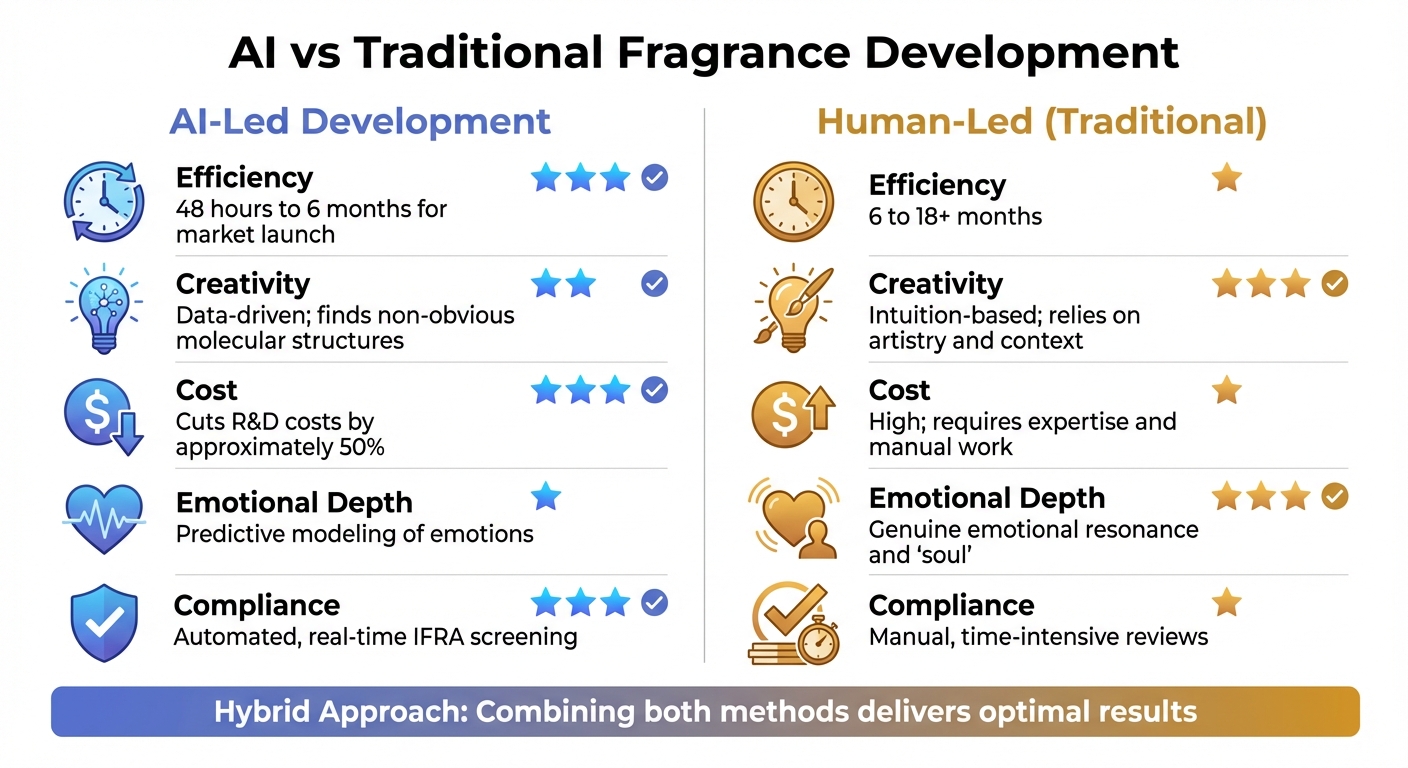
Comparaison entre le développement de parfums par IA et traditionnel : rapidité, coût et créativité
Lorsque l’on compare le développement de parfums piloté par l’IA aux méthodes traditionnelles, les différences sont saisissantes. Des plateformes d’IA comme Osmo peuvent livrer des échantillons en seulement 48 heures, un contraste marqué avec les délais typiques de 6 à 18 mois des approches conventionnelles. Cette rapidité se traduit également par des économies, réduisant les dépenses de développement des ingrédients jusqu’à 50 %.
L’un des atouts majeurs de l’IA est sa capacité à simplifier la conformité réglementaire. Au lieu de vérifier manuellement les ingrédients au regard de normes IFRA en constante évolution — un processus qui peut s’éterniser — les systèmes d’IA signalent instantanément les substances restreintes et suggèrent des alternatives conformes. Cette fonctionnalité est de plus en plus précieuse dans un monde où les exigences réglementaires ne cessent de croître. Johan Chaille de Nere, directeur de la transformation digitale chez Givaudan, souligne cet avantage :
"L’IA permet à nos parfumeurs de rester concentrés sur la création, même si le nombre de contraintes augmente continuellement".
Cependant, si l’IA excelle en matière d’efficacité, elle ne parvient pas tout à fait à saisir la profondeur émotionnelle nuancée que la créativité humaine apporte à la parfumerie.
Au-delà de la rapidité et du coût, les limites de l’IA apparaissent clairement dans des domaines comme la créativité et la résonance émotionnelle. L’IA peut générer des combinaisons moléculaires innovantes en analysant des schémas de données, mais elle n’a pas la capacité de véritablement "sentir" ni d’éprouver les réactions physiologiques et émotionnelles que les humains associent aux fragrances.
Une autre limite réside dans la tendance de l’IA au surapprentissage — elle répète en quelque sorte les succès passés au lieu de repousser les frontières pour créer quelque chose d’entièrement nouveau. Puisqu’elle s’appuie fortement sur des données historiques, elle peut avoir du mal à s’affranchir des modèles établis. Emmanuelle Moeglin, fondatrice de l’Experimental Perfume Club, explique :
"L’IA passera à côté d’astuces essentielles dans la création de parfums, là où les parfumeurs tentent des combinaisons inhabituelles".
Pour clarifier la comparaison, voici un tableau présentant les principales différences entre les méthodes pilotées par l’IA et les méthodes traditionnelles :
| Caractéristique | Développement piloté par l’IA | Développement humain (traditionnel) |
|---|---|---|
| Efficacité | 48 heures à 6 mois pour un lancement sur le marché | 6 à 18 mois et plus |
| Créativité | Pilotée par les données ; identifie des structures moléculaires non évidentes | Fondée sur l’intuition ; s’appuie sur l’art et le contexte |
| Coût | Réduit les coûts de R&D d’environ 50 % | Élevé ; exige expertise et travail manuel |
| Profondeur émotionnelle | Modélisation prédictive des émotions | Résonance émotionnelle authentique et "âme" |
| Conformité | Contrôle IFRA automatisé en temps réel | Vérifications manuelles et chronophages |
Si l’IA accélère et simplifie incontestablement de nombreux aspects du développement de fragrances, elle a encore un long chemin à parcourir avant de rivaliser avec l’art et la profondeur émotionnelle des parfumeurs humains.
Exemples dans l’industrie et applications actuelles
L’IA redessine l’industrie du parfum, plaçant efficacité et créativité au premier plan. Plusieurs acteurs majeurs ont déjà adopté cette technologie, démontrant son impact concret. Givaudan, l’un des plus grands fabricants de parfums au monde, a lancé sa Digital Factory à Paris dès janvier 2019. Celle-ci sert de centre névralgique à son programme de création assistée par ordinateur, avec le système Carto — une interface tactile qui remplace les tableurs traditionnels et les pyramides olfactives. Ce qui distingue Carto, c’est son robot d’échantillonnage instantané, capable de créer des échantillons à partir d’ingrédients réels à une vitesse auparavant inimaginable. Yann Vasnier, parfumeur Fine Fragrance chez Givaudan, a souligné son influence :
"’Carto’ est un complément futuriste à notre artisanat ancestral, qui nous permet d’expérimenter les formules plus facilement et plus efficacement. Les parfumeurs peuvent utiliser ce nouvel outil pour créer avec davantage de liberté, ce qui nous permet de repousser les limites de la création parfumée."
Cette fusion de la technologie et de l’art ouvre la voie à une adoption plus large dans l’ensemble de l’industrie.
Un autre exemple remarquable est Osmo, une entreprise qui a développé une plateforme d’intelligence olfactive capable de numériser les senteurs. En cartographiant les molécules et en prédisant les profils olfactifs, Osmo transforme des impulsions abstraites — comme des images ou du texte — en formules de parfum précises. Leur plateforme fournit des échantillons physiques en seulement 48 heures, là où le processus nécessitait traditionnellement plusieurs semaines. Dans un cas concret, Osmo a réussi à numériser la signature moléculaire d’une prune d’été et à la convertir en un code parfum prêt pour une exploitation commerciale.
L’IA améliore également la manière dont les marques interagissent avec les consommateurs. Des plateformes comme Scento exploitent l’IA pour personnaliser l’expérience parfum. À l’instar de l’Aroma Kiosk de Givaudan, Scento utilise l’IA pour analyser les préférences olfactives et les notes des consommateurs et fournir des recommandations en temps réel. Cela réduit le risque d’"achat à l’aveugle", un défi courant dans l’univers du parfum. Grâce à des quiz pilotés par l’IA, les clients sont associés à des senteurs adaptées à leurs goûts olfactifs. De plus, une "intelligence saisonnière" alimentée par l’IA sélectionne des fragrances en fonction des changements météorologiques, des humeurs et des routines quotidiennes, afin de garantir des recommandations toujours pertinentes.
Même les applications à plus petite échelle gagnent du terrain. Par exemple, Procter & Gamble a collaboré avec l’outil d’IA Moodify White afin d’améliorer la conception de produits et d’accélérer le développement de nouveaux produits parfumés. Si ces outils numériques rationalisent les opérations, ils coexistent avec l’art traditionnel qui définit l’industrie du parfum. De la découverte d’ingrédients aux expériences consommateurs personnalisées, le rôle de l’IA continue de s’étendre, rendant ces avancées accessibles aux entreprises de toutes tailles.
Conclusion
L’IA a révolutionné le développement des parfums en offrant une rapidité inégalée, une grande précision en matière de conformité réglementaire et la capacité de proposer des solutions personnalisées. Pour les marques souhaitant lancer rapidement des produits, les outils d’IA peuvent produire des échantillons en seulement 48 heures — un contraste saisissant avec les 6 à 18 mois des méthodes traditionnelles. Ces outils simplifient également les contraintes réglementaires en identifiant instantanément les ingrédients restreints et en suggérant des alternatives conformes. Pour ceux qui privilégient la durabilité, des plateformes comme EcoScent Compass permettent aux marques d’évaluer en temps réel l’empreinte carbone et l’approvisionnement éthique, en phase avec les préférences des 90 % de consommateurs qui valorisent les achats écoresponsables.
Cependant, l’art des parfumeurs humains reste irremplaçable. Si l’IA excelle dans les tâches techniques, elle ne possède pas la capacité de composer des fragrances dotées de résonance émotionnelle et de profondeur culturelle. Comme le souligne avec justesse Francis Kurkdjian, directeur artistique de la Maison Francis Kurkdjian :
"L’IA peut mélanger des senteurs, mais elle ne peut comprendre ni le contexte culturel, ni la résonance émotionnelle, et elle ne possède pas non plus l’art qui se cache derrière un parfum véritablement exceptionnel".
Pour les maisons patrimoniales ou les créations signatures qui exigent une touche personnelle et intuitive, l’expertise humaine demeure essentielle.
L’approche la plus efficace consiste à associer l’efficacité de l’IA à la créativité humaine. Ce modèle hybride permet à l’IA de gérer les aspects techniques — comme l’analyse des ingrédients et la conformité — tandis que les parfumeurs humains se concentrent sur l’affinement des dimensions sensorielles et émotionnelles. Laurence Chirat, directrice de la création digitale chez DSM — Firmenich, résume parfaitement cet équilibre :
"L’IA soutient les experts, mais elle n’est pas nécessaire pour créer un bon parfum... elle ne peut remplacer leur talent, leur intuition et leur expérience".
Pour les marques qui adoptent l’IA, la clé réside dans le juste équilibre entre efficacité économique, rapidité et qualité artisanale. Un modèle de copilote constitue un excellent point de départ : laissez l’IA suggérer des combinaisons d’ingrédients et des modifications, tandis que des experts humains peaufinent la création finale. Protégez votre propriété intellectuelle en développant des formulations propriétaires que l’IA ne peut reproduire.
En outre, des outils comme Scento transforment la manière dont les consommateurs découvrent les fragrances. Grâce à des quiz pilotés par l’IA et à des insights saisonniers, ces plateformes associent les utilisateurs à des senteurs adaptées à leurs préférences, réduisant l’incertitude et limitant la nécessité des achats à l’aveugle. Cette approche accélère non seulement le développement, mais garantit aussi la préservation de l’art intemporel de la parfumerie.
FAQ
L’IA peut-elle créer des parfums véritablement originaux ?
L’IA est devenue un outil précieux dans l’univers de la création parfumée, offrant des capacités telles que l’analyse des données, la prévision des tendances et même la suggestion de nouvelles combinaisons olfactives. Pourtant, de nombreux experts du secteur estiment que le cœur et l’âme des fragrances véritablement mémorables résident toujours dans l’intuition et la maîtrise sensorielle des parfumeurs humains. Si l’IA peut rationaliser les processus et inspirer l’exploration créative, elle est surtout à son meilleur en tant qu’outil de soutien, venant compléter l’art et la richesse narrative qui définissent l’essence de la création parfumée.
L’IA remplacera-t-elle les parfumeurs humains ?
L’IA n’est pas destinée à se substituer totalement aux parfumeurs humains. Elle vient plutôt compléter leur art en rationalisant les processus, en anticipant les tendances et en aidant à l’assemblage des ingrédients. Cependant, le cœur de la parfumerie — son art, son intuition et sa profondeur émotionnelle — repose encore largement sur l’expertise humaine. Les professionnels du secteur décrivent souvent l’IA comme un partenaire créatif, apportant un soutien dans la découverte de combinaisons olfactives innovantes tout en préservant la richesse sensorielle et émotionnelle que seule la main humaine peut offrir.
Comment l’IA vérifie-t-elle la conformité à l’IFRA ?
L’IA joue un rôle clé dans la garantie de la conformité à l’IFRA en examinant les formulations de parfums au regard des normes établies en matière de sécurité et d’allergènes. À l’aide d’algorithmes sophistiqués entraînés sur des bases de données réglementaires, elle identifie les ingrédients interdits ou restreints et peut même recommander des combinaisons alternatives conformes. Cela dit, tous les outils d’IA n’appliquent pas strictement ces directives — certains traitent les restrictions relatives aux allergènes comme optionnelles. Cela souligne la nécessité d’intégrer des données réglementaires précises et à jour afin de maintenir une conformité totale.