La campagne Dior Sauvage, lancée le 30 août 2019, a suscité des critiques immédiates pour son usage d’images amérindiennes associé au nom du parfum "Sauvage" (souvent disponible sous forme de décants de parfum pour celles et ceux qui souhaitent tester la fragrance), un terme doté d’une histoire d’emploi comme insulte à l’encontre des peuples autochtones. Malgré la consultation de groupes amérindiens et la présence d’artistes autochtones, la campagne a été largement condamnée pour avoir perpétué des stéréotypes nuisibles et marchandisé la culture autochtone. La réaction du public fut rapide, amplifiée par les réseaux sociaux, conduisant Dior à retirer la campagne en moins de 24 heures.
Principaux enjeux :
- Nom problématique : "Sauvage" a été perçu comme offensant lorsqu’il était associé à des thématiques amérindiennes.
- Faux pas culturels : les critiques ont estimé que la campagne exploitait la spiritualité autochtone à des fins commerciales.
- Opinion publique : le contexte a aggravé la controverse, les débats autour de l’appropriation culturelle étant alors particulièrement vifs.
- Le rôle de Johnny Depp : l’implication de Depp, notamment son ancienne interprétation de Tonto, a renforcé les critiques.
La réponse de Dior a consisté à retirer les supports de campagne et à mettre en avant sa collaboration avec des consultants autochtones, mais cela n’a pas permis de répondre aux préoccupations plus profondes liées au concept même de la campagne. Cet incident souligne l’importance de la sensibilité et de la responsabilité dans le storytelling des marques, en particulier lorsqu’il fait référence à des communautés marginalisées.
Le concept derrière Dior Sauvage
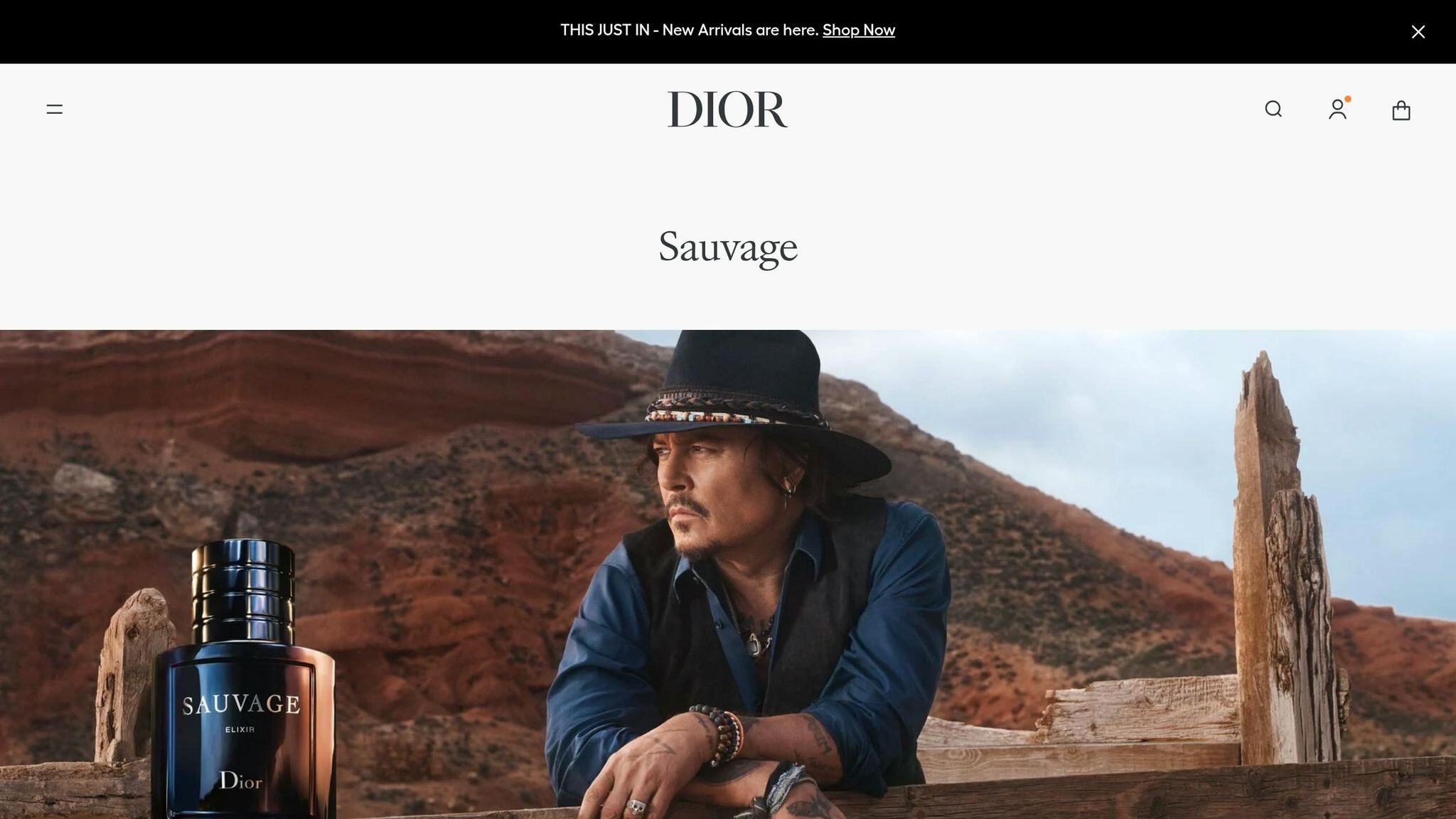
La campagne 2019 de Dior pour Sauvage était présentée comme "un voyage authentique au plus profond de l’âme amérindienne dans un territoire sacré, fondateur et séculier". Le récit olfactif avait été conçu pour mettre en lumière des thèmes de masculinité, de liberté et d’aventure. La masculinité y était décrite comme "puissante et noble", associée à une sensation de "fraîcheur brute". La campagne s’appuyait fortement sur l’imaginaire de l’Ouest américain, les paysages de roches rouges du sud de l’Utah servant de décor pour évoquer l’esprit d’exploration des frontières.
En tant qu’exemple notable de parfums de niche vs parfums de créateur, la direction créative cherchait à relier la fragrance aux "grands espaces" et au "caractère sauvage du paysage". Jean — Baptiste Mondino, réalisateur de la campagne, a intégré des visuels symboliques, comme un aigle tournoyant au-dessus de sa proie et un danseur spirituel amérindien exécutant une "Fancy War Dance". Ces éléments étaient censés représenter ce que Mondino décrivait comme la "modernité de la culture amérindienne". La vision globale visait à aligner le nom du parfum, "Sauvage", avec un récit de nature indomptée et d’exploration.
Le rôle de Johnny Depp dans la campagne
Johnny Depp, devenu l’égérie de Dior Sauvage en 2015, a joué un rôle central dans la campagne 2019 "We Are the Land". Il y incarnait un vagabond des temps modernes, explorant les étendues abruptes de l’Ouest américain. Depp a également apporté une contribution musicale en interprétant "Rumble" de Link Wray à la guitare électrique, ajoutant une dimension sonore au récit de la campagne. Dior a souligné l’adoption honorifique de Depp par la Nation comanche en 2012 afin de le relier aux thèmes amérindiens de la campagne. En collaboration avec le réalisateur Jean — Baptiste Mondino et l’organisation Americans for Indian Opportunity (AIO), Depp a travaillé à garantir ce que Dior décrivait comme une "inclusion authentique". Témoignage de leur partenariat durable, Depp a renouvelé son contrat avec Dior en septembre 2023 pour 20 millions d’euros, consolidant ainsi son association avec la fragrance.
Éléments visuels et musicaux
La campagne présentait des images saisissantes, notamment Canku One Star, membre de la tribu sioux Rosebud, exécutant une "Fancy War Dance" traditionnelle en tenue cérémonielle complète au sommet d’une falaise. L’actrice Tanaya Beatty, descendante de la Nation Da’Naxda’xw, apparaissait également dans la campagne. L’imagerie mettait en avant des éléments naturels tels qu’un soleil ardent sur un ciel d’un bleu vif et un terrain désertique escarpé, entrelacés de scènes où Depp jouait de la guitare. Le choix de "Rumble" de Link Wray comme bande-son de la campagne constituait un clin d’œil aux contributions autochtones à la musique, offrant un accompagnement empreint d’âme au récit visuel.
Malgré cette attention aux détails, l’utilisation par la campagne d’images amérindiennes aux côtés du terme "Sauvage" — un mot dont les critiques ont rappelé qu’il avait historiquement été employé comme insulte raciale — a déclenché une réaction immédiate. La juxtaposition de ces éléments a provoqué une controverse généralisée, éclipsant le message que la campagne entendait porter.
Votre expert parfum personnel vous attend
Faites notre quiz olfactif express pour découvrir des parfums de créateurs et de niche authentiques, choisis selon vos goûts – explorez-les en décants et échantillons de 2–8ml, pour essayer chaque fragrance avant de vous engager sur un flacon entier.
Trouvez votre parfumLe tollé : qu’est-ce qui a mal tourné ?
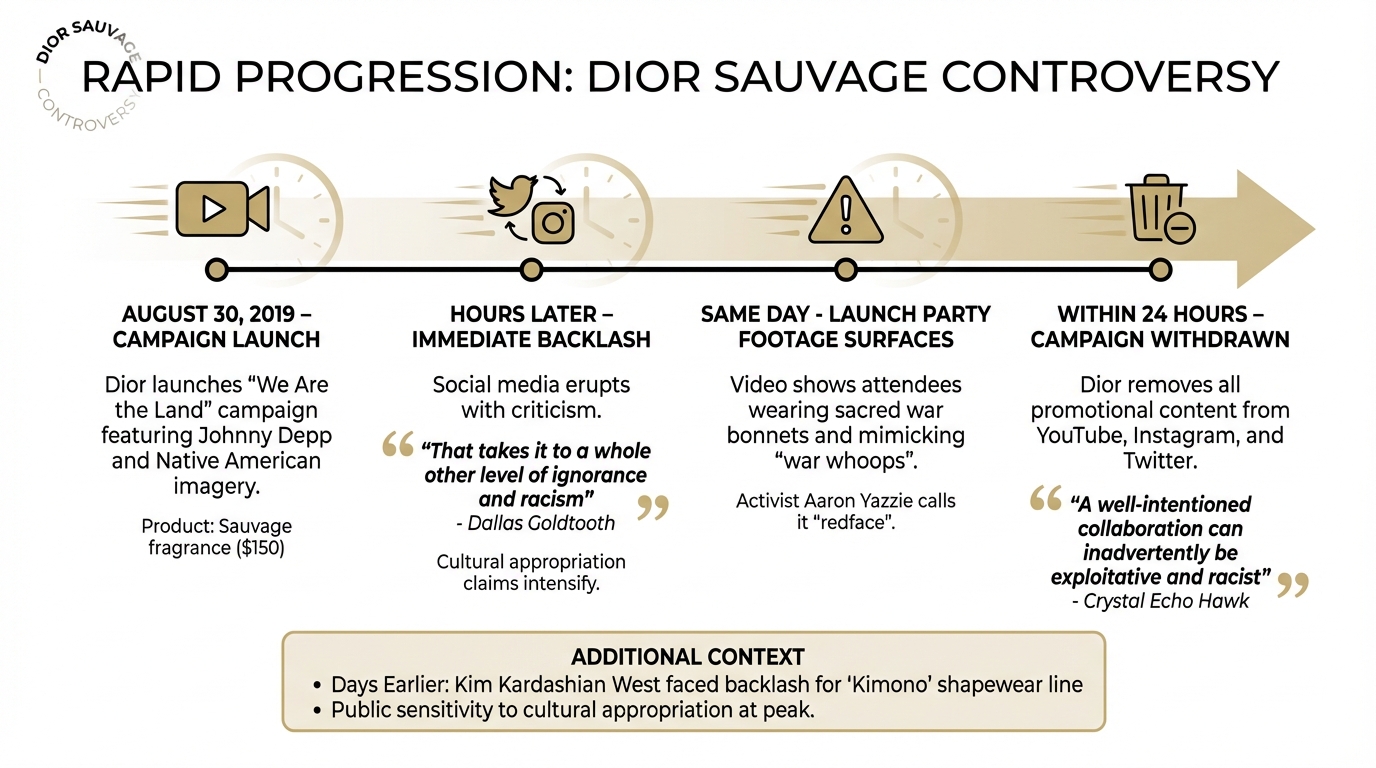
Chronologie de la campagne Dior Sauvage : du lancement au retrait en 24 heures
Accusations d’appropriation culturelle
La campagne, lancée en août 2019, a fait face à des critiques immédiates et intenses. Au cœur de la controverse se trouvait le nom du parfum, que beaucoup estimaient chargé d’une histoire d’usage injurieux. Dallas Goldtooth, militant issu de la Lower Sioux Indian Community, a exprimé son indignation :
"Cela porte l’ignorance et le racisme à un tout autre niveau. Vous devriez parfaitement connaître les implications de ce mot."
Les critiques ont accusé Dior d’exploiter la spiritualité autochtone à des fins commerciales. Le récit de la campagne, mettant en scène Johnny Depp comme explorateur blanc, a été largement perçu comme une reconstitution déconnectée de la réalité de la Destinée manifeste. Crystal Echo Hawk, directrice exécutive d’IllumiNative, a résumé le sentiment général :
"Cela montre qu’une collaboration bien intentionnée peut involontairement devenir exploitante et raciste... Ils doivent retirer toute la campagne nationale."
La situation s’est aggravée lorsque des images de la soirée de lancement de la campagne ont fait surface, montrant des participants portant des coiffes de guerre sacrées et imitant des "cris de guerre". Ces actes, décrits comme du "redface" par l’ingénieur et militant navajo Aaron Yazzie, ont suscité une indignation supplémentaire. Americans for Indian Opportunity, l’organisation à but non lucratif consultée pour la campagne, a ensuite exprimé ses regrets quant à sa participation, reconnaissant son rôle dans la facilitation d’un projet préjudiciable. En moins de 24 heures, Dior a retiré la vidéo promotionnelle de YouTube et des plateformes sociales.
Ce tollé a encore été amplifié par le contexte culturel et politique plus large.
Calendrier et opinion publique
L’échec de la campagne ne tenait pas seulement à son contenu : elle est aussi entrée en collision avec un moment où la sensibilité du public à l’appropriation culturelle était à son apogée. Quelques jours auparavant, Kim Kardashian West avait essuyé des critiques pour avoir nommé sa ligne de shapewear "Kimono", ce qui l’avait contrainte à rebaptiser la marque. Cet incident avait rendu les consommateurs particulièrement vigilants face aux marques utilisant des éléments culturels à des fins lucratives.
L’implication de Johnny Depp a jeté de l’huile sur le feu. Beaucoup se souvenaient de son interprétation de Tonto dans The Lone Ranger, qui avait été critiquée pour avoir perpétué des stéréotypes. La militante April Reign, créatrice de #OscarsSoWhite, a capturé la frustration du public :
"Depp, qui s’est immergé dans l’appropriation culturelle avec Tonto. @dior, vous ne pouvez pas être sérieux."
À l’indignation se sont ajoutées des accusations de violences domestiques visant Depp, ternissant davantage son association avec la campagne. Bien que Dior ait mis en avant l’adoption honorifique de Depp par la Nation comanche en 2012 et retiré rapidement les supports de campagne, le mal était fait. La combinaison de ces facteurs rendait la campagne impossible à défendre.
La réponse de Dior à la controverse
Défense initiale et déclarations publiques
Face au tollé, Dior a d’abord défendu sa campagne en invoquant sa collaboration avec Americans for Indian Opportunity (AIO), plutôt qu’en présentant des excuses. La maison s’est appuyée sur un communiqué de presse d’AIO, soulignant l’implication de l’organisation dans chaque aspect de la campagne, y compris le casting et la conception des décors. Par ailleurs, Dior a publié une vidéo de trois minutes intitulée "Stories Behind the Creation," réunissant Johnny Depp et des consultants amérindiens, afin de souligner l’intention de la campagne d’honorer la culture autochtone.
Dans sa déclaration, Dior présentait la campagne ainsi :
"Cette campagne s’inspire de la culture amérindienne profonde et riche, que la Maison Dior tient en la plus haute estime. Afin de garantir justesse et inclusion, la Maison Dior travaille en étroite collaboration avec des consultants, artistes, écrivains et danseurs amérindiens, ainsi qu’avec Americans for Indian Opportunity."
La marque a également mis en avant son engagement plus large dans la lutte contre le racisme et son soutien continu aux initiatives connexes.
Cependant, nombre de critiques n’ont pas été convaincus. Ils ont estimé que le recours à des consultants ne pouvait résoudre le problème sous-jacent : l’utilisation d’un produit nommé "Sauvage" aux côtés d’une imagerie autochtone. La Dre Adrienne J. Keene, professeure adjointe à l’université Brown, a résumé ce sentiment :
"On a l’impression qu’ils ont essayé de faire les choses ‘correctement’ et qu’ils ont impliqué des personnes formidables — mais cela reste une publicité pour une entreprise notoirement raciste et un produit appelé ‘Sauvage’".
Les critiques se sont intensifiées, contraignant Dior à reconsidérer sa stratégie.
Suspension et retrait de la campagne
Alors que l’indignation publique s’amplifiait, Dior a rapidement changé de cap. En seulement 24 heures après le lancement de la campagne, le 30 août 2019, la marque a commencé à retirer ses contenus promotionnels — bandes-annonces, publications sur les réseaux sociaux et vidéo "Stories Behind the Creation" — de plateformes telles qu’Instagram et Twitter.
Leçons pour l’industrie du parfum
Le tournant vers un marketing plus diversifié
La controverse Dior Sauvage rappelle avec force que consulter des experts culturels ne suffit pas lorsque le concept central d’une campagne est défaillant. Malgré la participation d’artistes amérindiens et la collaboration avec Americans for Indian Opportunity, les fondations de la campagne étaient problématiques dès le départ [10, 18]. Sage Paul, directrice artistique de l’Indigenous Fashion Week Toronto, a souligné :
"Je ne crois pas qu’une personne autochtone au niveau décisionnel de ce projet aurait autorisé un danseur traditionnel masculin de Fancy Dance à exécuter cette danse à côté du mot ‘sauvage’".
Cela met en lumière un enseignement essentiel : les marques doivent inclure des voix diverses aux niveaux de décision, plutôt que de s’appuyer sur des consultants pour valider des idées préexistantes. Comme l’a formulé Robert Passikoff, président de Brand Keys Inc. :
"Il faut simplement être prudent de nos jours quant à ce qui est politiquement correct, culturellement juste... et au moins racialement équilibré".
Équilibrer créativité et responsabilité
Les marques de parfum évoluent souvent sur une ligne délicate entre la création de récits captivants et l’évitement de stéréotypes préjudiciables. La campagne Sauvage a trébuché en présentant Johnny Depp comme un explorateur moderne aux côtés d’artistes autochtones en tenues traditionnelles, perpétuant involontairement le trope du "sauveur blanc". Même le nom "Sauvage", utilisé par Dior depuis les années 1960, porte une histoire troublante en tant que terme injurieux employé par des colons franco-canadiens pour dénigrer les peuples autochtones [9, 18].
Pour éviter de tels faux pas, les marques doivent privilégier des évaluations linguistiques et historiques approfondies avant de lancer leurs campagnes. Crystal Echohawk, directrice exécutive d’IllumiNative, est revenue sur cet échec :
"Cela montre qu’une collaboration bien intentionnée peut involontairement devenir exploitante et raciste, et je pense que c’est ce qui s’est produit ici".
La campagne ayant été retirée seulement 24 heures après son lancement du 30 août 2019, l’enjeu de faire juste est exceptionnellement élevé. Cela souligne l’importance d’une planification réfléchie et d’une approche centrée sur le consommateur dans le storytelling parfumé.
Explorer les fragrances avec responsabilité
La controverse Sauvage, liée à un parfum à 150 euros, met également en lumière la manière dont les achats haut de gamme manquent souvent d’un engagement significatif et porté par le récit. Des plateformes comme Scento proposent une approche plus réfléchie, permettant aux consommateurs d’essayer des parfums de créateur en formats plus petits — décants de parfum de 0,75 ml, 2 ml ou 8 ml — avant de s’engager pour un flacon entier. Ce modèle fondé sur la découverte encourage les acheteurs à se connecter aux histoires et à l’héritage qui entourent les fragrances, redéfinissant la manière dont les maisons de luxe communiquent leurs récits.
Conclusion
La controverse Dior Sauvage constitue un rappel saisissant, pour les maisons de luxe, des complexités liées à la représentation culturelle. La campagne a été retirée en moins de 24 heures à la suite de critiques généralisées, révélant de profondes failles dans la manière dont les marques abordent les collaborations impliquant des éléments culturels. Comme l’a souligné Crystal Echo Hawk, directrice exécutive d’IllumiNative, la campagne a involontairement exploité la culture autochtone malgré des intentions apparemment louables.
La réponse de Dior n’a fait qu’aggraver les retombées. La marque a d’abord défendu la campagne en citant son partenariat avec Americans for Indian Opportunity, mais cette stratégie s’est retournée contre elle lorsque l’organisation à but non lucratif a publiquement exprimé son "profond regret" quant à sa participation. Cela a montré que le recours à des consultants ne pouvait compenser une campagne mal conçue. De plus, la décision de conserver le nom "Sauvage", terme historiquement lié à des stéréotypes offensants, a encore éloigné les communautés autochtones bien après le retrait de la campagne.
Cet incident ne révèle pas seulement les risques des faux pas culturels : il offre aussi des enseignements aux marques qui souhaitent naviguer dans ces eaux avec responsabilité. Robert Passikoff, président de Brand Keys Inc., a résumé le problème avec concision :
"Engager une entreprise issue d’une minorité ne suffit pas, et rien n’excuse les sociétés qui s’approprient des aspects culturels et les exploitent à des fins lucratives".
La controverse reflète une exigence croissante de responsabilité — non seulement dans les produits que les marques proposent, mais aussi dans les récits qu’elles élaborent. Affichée à 150 dollars, la campagne Sauvage démontre pourquoi un engagement attentif et respectueux est essentiel, surtout dans le secteur du luxe. Une représentation authentique, plutôt qu’une esthétique superficielle, est la clé pour bâtir la confiance et assurer un succès durable. À une époque où les réseaux sociaux amplifient chaque faux pas, viser juste dès le départ n’est pas seulement éthique : c’est indispensable.
FAQ
Pourquoi le mot “Sauvage” a-t-il été jugé offensant dans cette publicité ?
Le mot “Sauvage” a suscité des critiques en raison de sa proximité avec “savage,” un terme historiquement utilisé comme insulte raciale contre les Amérindiens. La publicité a provoqué l’indignation par son recours à des représentations stéréotypées de la culture autochtone, avec une imagerie que beaucoup ont jugée comme renforçant les stéréotypes coloniaux et s’appropriant l’identité autochtone de manière irrespectueuse.
Pourquoi la consultation de groupes autochtones n’a-t-elle pas empêché le tollé ?
La campagne de Dior a suscité une réaction importante malgré l’implication de groupes autochtones dans son développement. Le problème tenait à la dépendance de la campagne envers des stéréotypes et une imagerie enracinés dans des représentations coloniales de la culture amérindienne. Ces éléments ont déclenché de nombreuses critiques, car ils étaient perçus comme perpétuant des clichés préjudiciables et relevant de l’appropriation culturelle.
Que devraient faire les marques différemment pour éviter l’appropriation culturelle ?
Les marques doivent donner la priorité à une représentation respectueuse et exacte en évitant les stéréotypes ou les portraits excessivement idéalisés. Cela signifie collaborer avec des personnes issues de la culture concernée, acquérir une compréhension approfondie du sens des symboles ou pratiques culturels, et éviter toute imagerie ou tout langage pouvant être perçu comme préjudiciable. Une communication ouverte, une écoute sincère et la volonté d’ajuster les campagnes lorsque cela est nécessaire sont des étapes essentielles pour préserver la sensibilité et garantir l’inclusivité.