Les marques de parfums font face à un défi grandissant : avec plus de 8 400 parfums lancés en 2024, se distinguer n’a jamais été aussi difficile. Si l’odorat affiche un taux de mémorisation de 65 % après un an (contre 50 % pour les visuels sur trois mois), l’immense diversité de l’offre et l’évolution des habitudes de consommation rendent la fidélité plus délicate à conquérir. La solution ? Le storytelling.
En reliant les fragrances aux émotions et aux souvenirs, les marques peuvent créer des impressions durables. Par exemple, le parfum "Missing Person" de Phlur s’est vendu en 5 heures grâce à un récit profondément personnel. La science le confirme : l’odorat est directement lié à la mémoire et à l’émotion, ce qui le rend 100 fois plus puissant que l’image ou le son.
Points clés :
- Le lien émotionnel stimule la fidélité. Les histoires associées à des lieux, des souvenirs ou des étapes de vie rendent les parfums plus personnels.
- Les défis de la fidélité : Prix élevés, choix infini et évolution vers la constitution d’une collection de parfums (73 % des jeunes consommateurs alternent plusieurs fragrances).
- Méthodes de storytelling : Mettre en lumière les parfumeurs, les éditions limitées et les récits auxquels chacun peut s’identifier permet de créer des liens plus profonds.
- Résultats : Les marques portées par le récit constatent jusqu’à 40 % d’augmentation de la fidélité, les clients récurrents dépensant 67 % de plus.
Les parfums ne sont plus de simples produits : ce sont des expériences émotionnelles. En partageant des histoires porteuses de sens, les marques peuvent transformer des acheteurs ponctuels en ambassadeurs fidèles pour la vie.
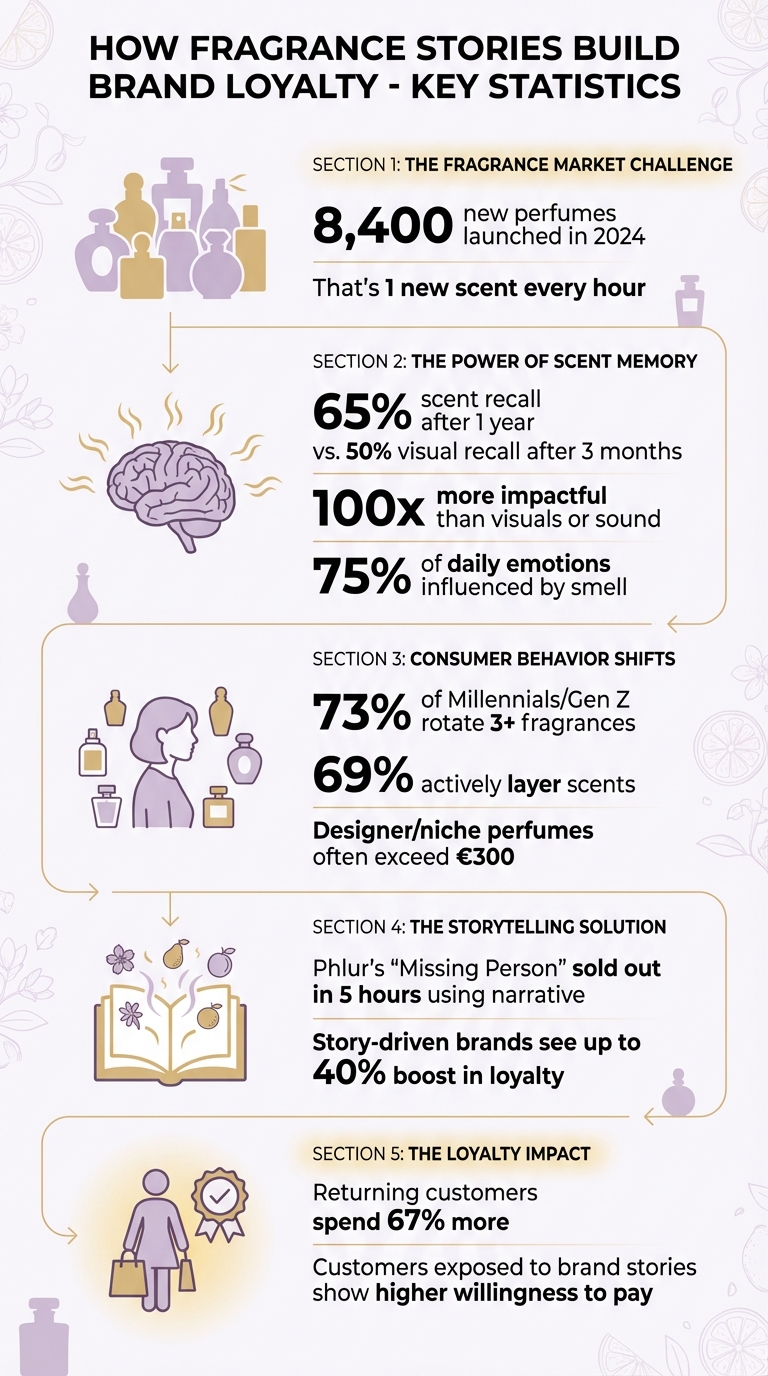
Comment le storytelling olfactif renforce la fidélité à la marque : statistiques clés
Dans les coulisses de Phlur : Chriselle Lim sur le storytelling, l’art du parfum et la création d’une marque de fragrances
Why Building Loyalty Is Difficult for Fragrance Brands
Les marques de parfums sont confrontées à un véritable défi de fidélisation. Rien qu’en 2024, plus de 8 400 nouveaux parfums sont arrivés sur le marché, soit presque une nouvelle fragrance chaque heure. Si la mémoire olfactive est remarquablement puissante (65 % de rappel après un an, contre 50 % pour les visuels après seulement trois mois), le volume considérable de choix rend difficile, pour une fragrance donnée, de se distinguer assez longtemps pour susciter un nouvel achat. Cette variété vertigineuse oblige les marques à aller au-delà du produit lui-même et à cultiver des liens plus profonds, plus signifiants avec leurs clients.
La nécessité d’un lien émotionnel
Le marketing traditionnel du parfum manque souvent sa cible en s’appuyant sur des campagnes glacées et idéalisées, parfois éloignées de la réalité du quotidien. Shaun Neff, fondateur de Noyz, a parfaitement résumé cet enjeu :
Noyz est né du constat qu’un storytelling réel et brut faisait défaut dans l’industrie du parfum, la plupart de ces récits étant enracinés dans une fantaisie ultra-filtrée.
Sans narration authentique, même la fragrance la plus exquise devient une simple transaction fugace. Sara Allbright, directrice chez Retail 100 Consulting, souligne l’importance de la résonance émotionnelle :
Si les marques parviennent à créer authentiquement un niveau d’engagement émotionnel auprès de leurs clients, cela favorisera la fidélité future à la marque et les achats répétés. C’est essentiel pour construire une marque dans ce secteur.
Un autre défi apparaît lorsque les marques s’appuient sur des fragrances génériques, toutes faites, qui ne s’alignent pas avec leur identité. Francoise Rapp, stratège olfactive, avertit :
Une senteur mal assortie peut diluer la perception de la marque au lieu de la renforcer.
Si une fragrance ne reflète pas les valeurs d’un client — qu’elles soient centrées sur le bien-être, la durabilité ou l’expression personnelle — elle risque d’être jugée sans pertinence. Sans ce lien sincère, même une fragrance prometteuse peut devenir une option de plus, jamais vraiment essayée.
Pourquoi les clients ne rachètent pas les parfums
Le prix constitue un obstacle majeur. Les flacons grand format de parfums de créateur ou de niche dépassent souvent les 300 €, ce qui rend les clients hésitants à s’engager sans essais approfondis. Cette retenue a alimenté l’essor du marché des "dupes", où les acheteurs recherchent des alternatives abordables imitant les senteurs de luxe pour une fraction du prix.
L’évolution des habitudes d’achat ajoute une difficulté supplémentaire. 73 % des consommateurs Millennials et Gen Z alternent désormais régulièrement entre trois fragrances ou plus, et 69 % superposent activement les senteurs pour créer des compositions personnalisées. Plutôt que de s’attacher à un seul parfum signature, ils composent des collections variées qui reflètent leurs humeurs et leurs occasions. Entre prix élevés, options infinies et basculement culturel vers la diversité, les parfums deviennent souvent des expérimentations coûteuses et ponctuelles plutôt que des essentiels chéris que l’on rachète avec plaisir.
Comment les histoires créent des liens émotionnels
Lorsque les molécules odorantes atteignent votre bulbe olfactif, elles empruntent une voie directe vers l’amygdale (le centre émotionnel du cerveau) et l’hippocampe (le centre de la mémoire). Ce chemin singulier explique pourquoi une simple odeur peut vous transporter instantanément vers un souvenir précis de votre passé — un phénomène que les chercheurs appellent l’effet Proust.
"Le parfum n’est pas seulement une source de plaisir : c’est un raccourci vers l’émotion." — Viti Vinci
Ce lien explique pourquoi environ 75 % des émotions quotidiennes sont influencées par l’odorat. Les marques de parfums s’appuient sur cette connexion biologique en intégrant le storytelling à leurs fragrances, les transformant de simples expériences sensorielles en ancrages émotionnels profondément personnels. Ces récits amplifient le lien entre odeur et mémoire, faisant du parfum une part unique et irremplaçable de la vie de quelqu’un.
Relier les senteurs aux souvenirs personnels
Les odeurs ont cette capacité étonnante de marquer les moments les plus précieux de la vie. La lavande peut raviver le souvenir de l’armoire à linge de votre grand-mère, tandis qu’une eau boisée peut rappeler un amour ancien. Ce n’est pas seulement de la nostalgie : votre cerveau est naturellement conçu pour stocker des souvenirs autobiographiques grâce à l’odorat.
Les consommateurs en sont de plus en plus conscients et créent eux-mêmes intentionnellement ces "ancres mémorielles". Ils choisissent souvent des fragrances spécifiques pour des jalons tels que les mariages, les voyages ou les réussites professionnelles, transformant les parfums en rappels permanents de ces événements. Lorsqu’une marque partage l’histoire derrière une fragrance — qu’elle soit inspirée par un été méditerranéen ou par un matin pluvieux à Paris — elle offre un récit que les clients peuvent relier à leurs propres expériences. Ces histoires n’évoquent pas seulement des souvenirs ; elles contribuent aussi à façonner l’identité personnelle.
Utiliser les récits olfactifs pour façonner l’identité
Au-delà du déclenchement des souvenirs, les histoires de parfums participent à définir qui nous sommes. Les senteurs boisées évoquent souvent un sentiment de puissance intérieure, tandis que les notes d’agrumes peuvent transmettre énergie et vitalité. Rien de tout cela n’est accidentel : les marques élaborent soigneusement leurs récits afin d’aligner les profils olfactifs avec des traits de personnalité et des aspirations précises.
Par exemple, en 2024, la marque indonésienne HMNS a adopté une approche narrative en partageant sur les réseaux sociaux et son site web les "sources, inspirations et techniques créatives" derrière chaque parfum. Cette transparence a approfondi les liens émotionnels et renforcé la fidélité client, aidant les consommateurs à percevoir chaque fragrance comme une extension de leur identité et de leurs ambitions.
"Le storytelling... aide à créer un lien avec le consommateur et à expliquer l’intention." — Romano Ricci, fondateur, Juliette Has a Gun
Cette évolution du marketing olfactif — qui passe de "comment vous sentez pour les autres" à "ce que cette fragrance vous fait ressentir" — trouve un écho particulier auprès des Millennials et de la Gen Z. Ces générations s’éloignent de l’idée de choisir un parfum signature pour constituer plutôt de véritables garde-robes olfactives reflétant les multiples facettes de leur personnalité. En proposant des récits riches et évocateurs, les marques ne vendent pas seulement des parfums : elles offrent des outils d’expression de soi et de connexion émotionnelle.
Les méthodes de storytelling qui construisent la fidélité
Les marques de parfums créent des liens durables en tissant émotions, savoir-faire artistique et sentiment d’appartenance au cœur de leurs récits.
Des histoires ancrées dans les lieux, les souvenirs et les émotions
Les récits olfactifs les plus captivants ont le pouvoir de nous transporter — vers une destination précise ou vers une émotion chérie. Prenez Chanel N°5, qui a bâti sa réputation intemporelle sur l’élégance et la sophistication, puisant son inspiration dans la neige arctique et la beauté éthérée des aurores boréales. De même, Gucci Bloom évoque la sensation de déambuler dans un "jardin luxuriant et magique", célébrant l’essence de la beauté naturelle. Ce ne sont pas de simples formules marketing habiles ; ce sont des invitations à s’immerger dans un monde imaginé.
Ce qui rend ces histoires liées à un lieu si efficaces, c’est leur simplicité. Les recherches révèlent que les acheteurs placés dans des environnements aux senteurs simples, comme l’orange, ont dépensé 20 % de plus que ceux exposés à des espaces aux odeurs complexes ou sans parfum. Le même principe s’applique au storytelling : les récits clairs sont plus faciles à assimiler, permettant aux clients de créer des liens personnels. Cette simplicité pose les bases d’un engagement plus profond, surtout lorsque l’attention se tourne vers les créateurs derrière les fragrances.
Mettre en lumière les parfumeurs et leur vision
Placer le processus créatif du parfumeur au premier plan transforme une fragrance, de simple produit, en histoire profondément personnelle. Cette approche résonne parce qu’elle met en valeur la main humaine — quelque chose que ni l’IA ni la production de masse ne peuvent reproduire. Lorsque les marques partagent les inspirations, les techniques et les intentions du parfumeur, elles invitent les consommateurs dans un voyage intime. Il ne s’agit plus seulement de porter une senteur ; il s’agit d’en comprendre l’âme.
Créer l’exclusivité grâce aux collaborations et aux éditions limitées
Les partenariats exclusifs et les fragrances en édition limitée suscitent un sentiment d’urgence tout en renforçant la fidélité. Sur des plateformes comme TikTok, la Gen Z a transformé des parfums de niche aux histoires singulières en symboles de statut très convoités, précisément parce qu’ils sont rares et dotés d’origines fascinantes. Cela reflète une préférence croissante des jeunes consommateurs pour l’authenticité et l’exclusivité plutôt que pour les produits de grande diffusion.
Mais l’exclusivité seule ne suffit pas : elle doit être soutenue par une histoire. Une édition limitée devient véritablement spéciale lorsqu’elle est liée à un récit porteur de sens. Qu’il s’agisse d’une collaboration avec un artiste, d’une collection saisonnière inspirée d’un lieu précis ou d’une fragrance célébrant un jalon culturel, l’histoire élève la rareté au rang d’expérience émotionnelle. Cette alliance entre rareté et storytelling accroît non seulement le désir, mais approfondit aussi le lien personnel avec la fragrance.
sbb-itb-fb213bc
Mesurer l’impact du storytelling sur la fidélité
Le storytelling ne consiste pas seulement à tisser des récits captivants : il doit aussi produire des résultats tangibles. Pour les marques de parfums, il est essentiel de déterminer si leurs narrations nourrissent réellement la fidélité client.
Suivre l’engagement émotionnel
Une histoire bien racontée peut faire naître la fidélité à la marque en créant des liens émotionnels et cognitifs. Si les émotions attirent, ce sont souvent ces connexions cognitives qui mènent à l’achat.
Une façon de mesurer ces connexions consiste à analyser la manière dont les clients parlent de la marque. Lorsqu’ils sont exposés à des récits olfactifs, les consommateurs ont tendance à employer un langage plus positif et chargé d’émotion. Les réseaux sociaux offrent une mine d’informations, car les commentaires révèlent souvent si une narration résonne sur le plan personnel. Cela renvoie au pouvoir unique de l’odorat d’éveiller des souvenirs puissants.
"Le parfum est immédiat, émotionnel et durable. Il influence la perception d’une manière que les logos et les emballages seuls ne peuvent égaler." – Francoise Rapp, spécialiste de l’identité olfactive
Lorsque les liens émotionnels se renforcent, les clients sont souvent prêts à payer davantage. Ces marqueurs émotionnels ouvrent la voie à une fidélité plus profonde, mesurable par les achats répétés et les comportements d’abonnement.
Suivre les achats répétés et les abonnements
Les données comportementales fournissent des preuves claires de la façon dont le storytelling transforme un intérêt ponctuel en engagement durable. Des indicateurs comme les achats répétés et la valeur vie client (Customer Lifetime Value, CLV) sont de solides marqueurs de fidélité, et tous deux tendent à progresser lorsque le storytelling renforce les liens émotionnels. Pour les marques axées sur le sensoriel, un storytelling efficace a été associé à une hausse allant jusqu’à 40 % de la fidélité client. De plus, les clients récurrents dépensent généralement 67 % de plus que les nouveaux acheteurs.
Des indicateurs tels que le taux d’attrition et le Net Promoter Score (NPS) peuvent également signaler les premiers signes de désengagement. Les modèles d’abonnement, en particulier, offrent des enseignements précieux. Des renouvellements réguliers suggèrent que les clients n’achètent pas seulement un produit : ils investissent dans le récit évolutif de la marque. Cet engagement continu en dit long sur le pouvoir du storytelling à bâtir des relations durables.
Comment Scento utilise les histoires pour renforcer la fidélité client
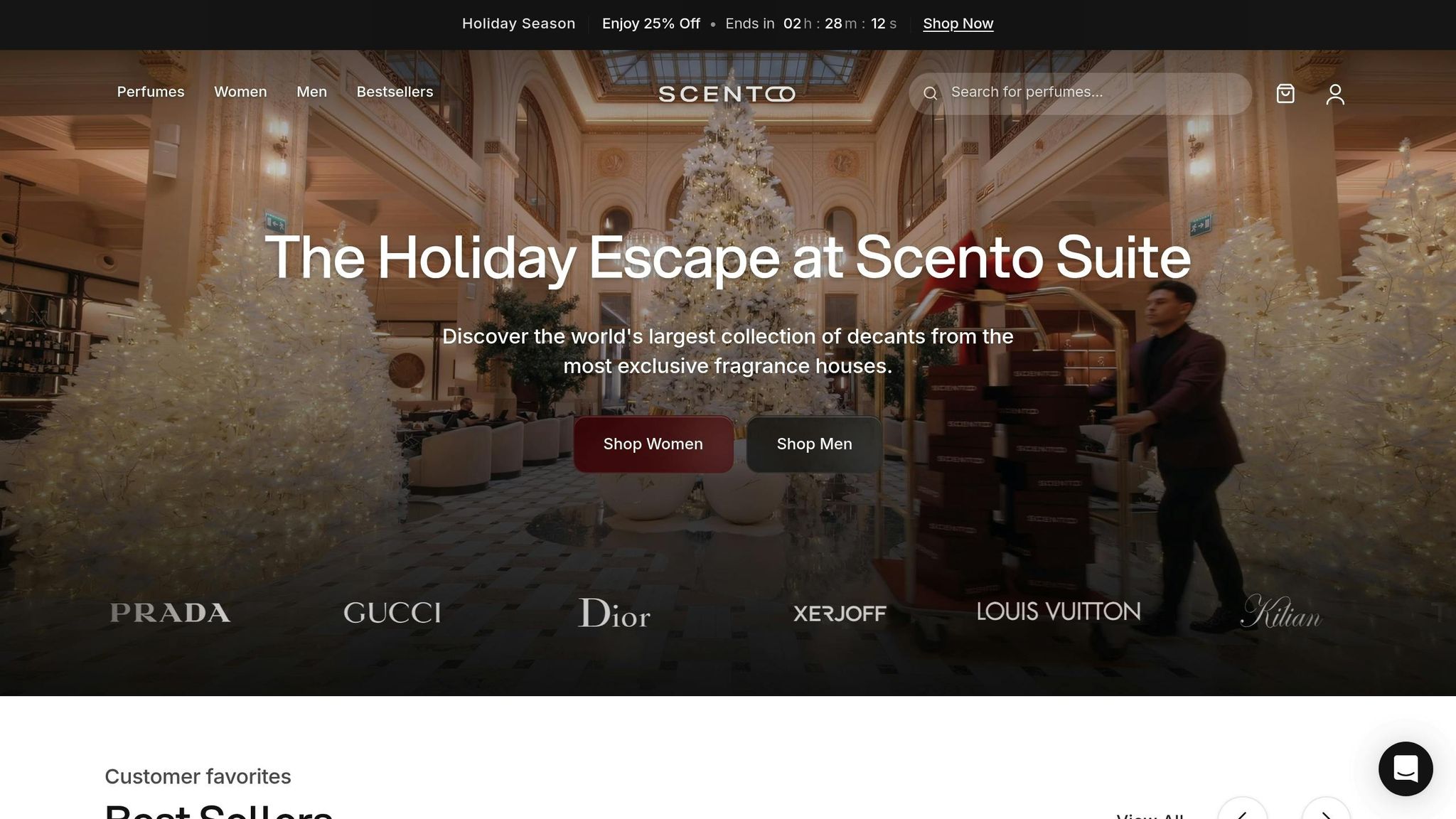
Scento maîtrise l’art du storytelling pour créer des liens significatifs avec ses clients, transformant la découverte du parfum en voyage mémorable plutôt qu’en simple achat. En associant narration, design et approche réfléchie de la constitution de collection, Scento fait des acheteurs occasionnels de véritables passionnés. Découvrons comment cette approche renforce la fidélité à chaque étape.
Partager les histoires derrière les parfums de créateur
Le marketing du parfum a profondément évolué, s’éloignant des recommandations génériques de célébrités pour se concentrer sur des récits personnels et accessibles. Scento embrasse cette évolution en élaborant des narrations pour chacune des plus de 1 000 fragrances de sa sélection. Plutôt que de simplement lister les notes olfactives ou les concentrations, la marque explore les inspirations, les origines et le savoir-faire artistique derrière chaque parfum. Cette approche narrative distingue non seulement Scento sur un marché concurrentiel, mais crée aussi un lien émotionnel entre le client et la senteur. En rendant chaque fragrance personnelle et porteuse de sens, Scento nourrit un sentiment d’appartenance et construit des relations client durables.
Des designs d’atomiseurs qui racontent des histoires
Les atomiseurs Scento — Limone di Capri, Rosso Fiore, Le Moooo et Toile de Jouy — sont bien plus que de simples contenants ; ils sont les prolongements visuels des fragrances qu’ils abritent. Chaque design raconte sa propre histoire, en parfaite harmonie avec l’identité de la senteur, et invite les clients à s’engager plus en profondeur. Cette cohérence entre design et parfum renforce les liens émotionnels et élève l’expérience globale. En intégrant des éléments artistiques à ses packagings, Scento crée une communauté autour de valeurs partagées, transformant les clients en ambassadeurs fidèles de la marque.
Aider les clients à composer une collection de parfums
Scento est un détaillant de décants et d’échantillons de parfum, et chaque produit peut être acheté à l’unité, sans aucun abonnement. Scento+ est l’adhésion optionnelle de Scento : la cotisation mensuelle vous revient intégralement sous forme de crédit en magasin, à dépenser sur n’importe quel parfum ; les membres bénéficient de 10 % de réduction, d’un échantillon offert avec chaque commande, d’un parfum offert tous les six mois et d’un cadeau d’anniversaire, et vous pouvez mettre en pause à tout moment ; pour résilier, contactez notre équipe. En permettant aux clients d’explorer les senteurs en plus petites quantités, Scento fait de la découverte olfactive une expérience continue et personnalisée. Chaque nouveau décant devient une partie du récit olfactif en évolution du client, transformant le choix d’un parfum en rituel. Cette approche accroît non seulement le plaisir de la découverte, mais approfondit aussi le lien entre le client et la marque, favorisant une fidélité à long terme.
Conclusion
Le storytelling transforme le marketing du parfum en quelque chose de bien plus significatif : une expérience émotionnelle. Lorsque les marques partagent l’inspiration derrière une fragrance — qu’il s’agisse de la vision d’un parfumeur ou du marketing de marque, d’un souvenir précieux ou du savoir-faire derrière sa création — elles nouent des liens qui dépassent largement le produit. Les études montrent que les clients exposés aux histoires de marque ont tendance à décrire les produits plus positivement et sont davantage disposés à les payer. Cette résonance émotionnelle rend les parfums inoubliables, transformant les primo-acheteurs en clients fidèles qui reviennent encore et encore.
Scento capitalise sur cette force émotionnelle en intégrant des récits à chaque fragrance de sa collection. Des histoires produits détaillées au design soigné d’atomiseurs comme Limone di Capri, chaque élément personnalise l’expérience. Leur approche est encore enrichie par l’offre de décants en fioles de 2 ml, 5 ml et 8 ml, ainsi qu’un décant en flacon de 30 ml sur la plupart des parfums, donnant aux clients la liberté d’explorer et de construire leurs propres voyages olfactifs sans s’engager dans des flacons grand format qu’ils pourraient ne pas terminer.
"Une histoire bien racontée permet aux consommateurs de développer des liens émotionnels." — Noah David, spécialiste marketing
Dans un monde où plus de 8 400 parfums ont été lancés en 2024, les marques qui se démarquent véritablement comprennent ceci : les gens n’achètent pas seulement des fragrances — ils investissent dans les histoires et les émotions qu’elles éveillent. En adoptant le storytelling, les marques peuvent transformer les acheteurs occasionnels en ambassadeurs fidèles qui chérissent les expériences associées à leurs senteurs.
FAQ
Comment le storytelling renforce-t-il la fidélité envers les marques de parfums ?
Le storytelling a le pouvoir d’élever une fragrance, d’une simple senteur à un voyage émotionnel. Comme notre odorat est intimement lié à la mémoire et à l’émotion, les marques peuvent tisser des récits autour des origines d’un parfum, de ses ingrédients ou des humeurs qu’il évoque — comme l’attrait de destinations lointaines ou l’essence d’une saison particulière. Ces histoires rendent l’expérience du port du parfum plus personnelle et inoubliable.
En puisant dans la nostalgie, le lien ou même le sentiment d’appartenance, ces récits aident les clients à établir des attaches émotionnelles positives avec la marque. Ce lien permet non seulement à la marque de se distinguer, mais renforce aussi la fidélité, encourageant les clients à revenir et même à investir davantage dans des fragrances qui ont du sens pour eux.
Pourquoi les jeunes consommateurs adoptent-ils les garde-robes olfactives ?
Les jeunes consommateurs redéfinissent leur rapport au parfum, préférant composer des "garde-robes" olfactives personnalisées plutôt que de s’engager envers une seule fragrance signature. Ces collections sont soigneusement pensées pour s’accorder à leurs humeurs changeantes, aux occasions spéciales et aux saisons. Il s’agit avant tout d’embrasser l’expression de soi et d’affirmer son individualité par le parfum.
Qu’est-ce qui motive ce changement ? Contrairement au passé, où les recommandations de célébrités dominaient l’univers du parfum, les jeunes acheteurs d’aujourd’hui se tournent vers des marques qui privilégient des expériences de proximité, nourries par la communauté. Ils apprécient la liberté d’explorer, d’expérimenter et même de superposer différentes senteurs, transformant le parfum en récit hautement personnel et créatif.
Comment les parfumeurs donnent-ils vie aux histoires à travers les fragrances ?
Les parfumeurs sont les conteurs de l’univers olfactif, transformant la vision d’une marque en expérience parfumée. Grâce à une sélection méticuleuse d’ingrédients — des fleurs exotiques aux épices de saison — ils composent des senteurs qui éveillent des souvenirs vivaces, nous transportent vers des contrées lointaines ou suscitent des émotions profondes. Ces éléments sensoriels créent un lien entre la fragrance et celle ou celui qui la porte, forgeant une connexion personnelle qui va au-delà de la surface.
Mais il ne s’agit pas seulement des ingrédients ; les parfumeurs apportent leur propre art et leur héritage à chaque création. Leur expertise et leur passion transparaissent dans des compositions qui s’accordent harmonieusement à l’identité d’une marque, enrichissant son récit. Que l’histoire soit faite d’élégance, d’aventure ou d’intimité, chaque note soigneusement choisie amplifie le message. Cette résonance émotionnelle transforme le parfum en bien plus qu’un produit : il devient une part du parcours du consommateur, cultivant une fidélité durable.

