Lorsque vous achetez un parfum, êtes-vous séduit par l’art du parfumeur ou par la puissance marketing de la marque ? C’est une question essentielle dans une industrie valorisée à 52 milliards d’euros, où la créativité rencontre la stratégie commerciale. Les parfumeurs façonnent la senteur, en assemblant les matières en compositions mémorables, tandis que les marques orchestrent le récit, le packaging et la distribution afin de porter ces créations jusqu’au marché.
Voici l’essentiel à retenir : le succès d’un parfum dépend des deux. Sans le parfumeur, il n’y a pas de senteur. Sans la marque, cette senteur pourrait ne jamais parvenir jusqu’à vous. Les parfums de niche mettent souvent en lumière la vision du parfumeur, tandis que les marques de créateur privilégient l’attrait universel et l’accessibilité. Des services comme Scento vous permettent désormais d’explorer ces deux univers grâce à de petits échantillons de parfum, afin de déterminer ce qui compte vraiment pour vous : le savoir-faire ou l’image de marque.
Aperçu rapide :
- Parfumeurs : Assemblent les ingrédients, créent la structure olfactive et garantissent la qualité.
- Marques : Gèrent le marketing, le packaging et la distribution mondiale.
- Parfums de niche : Privilégient des formules audacieuses et artistiques.
- Parfums de créateur : Misent sur un large pouvoir de séduction et l’héritage de la marque.
L’équilibre entre l’art du parfumeur et la stratégie de marque façonne l’ensemble de l’industrie du parfum. Les deux sont indispensables, et c’est leur collaboration qui permet aux fragrances de résonner auprès des consommateurs.
Le rôle du parfumeur dans la création des fragrances
Vision créative et expertise technique
Les parfumeurs sont à la fois artistes et scientifiques, alliant créativité et compréhension profonde de la chimie. Leur formation, souvent acquise dans des institutions prestigieuses comme l’ISIPCA en France, les prépare à travailler avec une vaste palette de matières, des huiles essentielles naturelles aux molécules synthétiques les plus innovantes. Grâce à cette expertise, ils conçoivent des fragrances qui se déploient avec grâce, passant de notes de tête lumineuses à un cœur riche, puis à un fond persistant.
Ce métier exige bien plus qu’un nez affûté. Les parfumeurs doivent comprendre l’évolution d’une senteur dans le temps, son rayonnement (sillage) et sa tenue sur la peau, tout en veillant à ce que la formule reste stable et sûre. Les parfums de niche, réputés pour leurs concentrations plus élevées en huiles parfumées (15–30 %), offrent souvent des expériences plus intenses et plus durables.
Prenons par exemple le travail de Dominique Ropion sur Alien de Thierry Mugler. En associant le jasmin au cashmeran, il a créé un audacieux parfum ambré-boisé qui a bousculé les codes floraux traditionnels. De même, Baccarat Rouge 540 de Francis Kurkdjian marie le safran aux bois ambrés pour composer un chef-d’œuvre gourmand-floral devenu une icône contemporaine. Ces créations révèlent la précision technique qui sous-tend leur dimension artistique.
Les parfumeurs comme conteurs
Au-delà de la science, les parfumeurs sont des conteurs, capables de transformer des idées intangibles en senteurs qui éveillent des émotions et des souvenirs éclatants. Un parfum bien composé peut vous transporter dans un bosquet méditerranéen grâce à un accord agrumes-figue, ou raviver la nostalgie avec la chaleur douce de l’iris et de la vanille. Chaque parfum raconte une histoire, souvent inspirée par la nature, l’histoire ou des expériences personnelles.
Fleurs d’Oranger de Christopher Sheldrake pour Serge Lutens, par exemple, capture l’essence de fleurs d’oranger en pleine floraison, évoquant les étés méditerranéens baignés de soleil. De même, La Scène d’Amour d’Anne Flipo pour L’Artisan Parfumeur utilise la violette et l’iris pour créer une senteur tendre et poudrée, qui incarne l’émotion d’une romance intime. Ces parfums sont bien plus que de simples senteurs : ce sont des œuvres d’art à porter, qui tissent un lien profond avec celles et ceux qui les choisissent.
Les défis auxquels les parfumeurs font face
Si l’art et la narration sont au cœur de leur métier, les parfumeurs se heurtent souvent à des obstacles importants. Les visions créatives peuvent entrer en conflit avec les réalités pratiques des attentes de marque, des budgets serrés et de la nécessité de séduire un large public. À l’inverse, les parfumeurs de niche bénéficient d’une plus grande liberté, qui leur permet d’expérimenter avec des ingrédients rares et de produire des séries plus confidentielles et exclusives. Les parfumeurs du marché grand public, quant à eux, s’appuient souvent sur des matières synthétiques afin d’assurer régularité et accessibilité lors d’une production à grande échelle.
Les réglementations, comme celles établies par l’IFRA, complexifient encore le processus. Les restrictions portant sur des allergènes tels que la mousse de chêne entraînent fréquemment des reformulations, obligeant les parfumeurs à préserver l’âme de la senteur originale. Ils doivent également concilier approvisionnement éthique, constance des lots et respect des objectifs de prix commerciaux, tout en cherchant à capturer la magie qui rend un parfum inoubliable.
Fait intéressant, le marché des parfums de niche est devenu le segment à la croissance la plus rapide de l’industrie mondiale du parfum. Cela reflète une évolution des préférences des consommateurs, de plus en plus nombreux à rechercher des créations de qualité artisanale qui privilégient l’individualité plutôt que la production de masse. Cette dynamique souligne l’équilibre délicat que les parfumeurs doivent trouver entre liberté artistique et exigences du marché, un équilibre qui définit souvent le succès de leur travail.
Le rôle de la marque dans le succès d’un parfum
Marketing et récit de marque
Si les parfumeurs composent la senteur, ce sont les marques qui transforment ces créations en objets de désir grâce au marketing et au storytelling. Les marques de créateur s’appuient sur des égéries célèbres, des campagnes publicitaires marquantes et des packagings distinctifs pour créer des liens émotionnels avec leur public. Ainsi, Chanel et Dior s’appuient fortement sur leur héritage couture et sur un imaginaire aspirationnel pour positionner leurs parfums comme des symboles d’élégance et de luxe.
Mais cela ne s’arrête pas aux publicités. Les marques construisent des univers immersifs autour de leurs fragrances, les associant à des humeurs, des occasions, voire des identités précises. Prenez Tuscan Leather de Tom Ford ou Oud Ispahan de Dior : ces parfums sont sublimés par une aura d’exclusivité et de haute mode, suscitant le désir avant même que la senteur ne soit découverte. Le packaging lui-même — flacons épurés, raffinés, matières premium — en dit long sur la qualité et justifie un positionnement tarifaire élevé. Ce récit renforce non seulement l’attrait du produit, mais prépare aussi le terrain à une présence élargie sur le marché grâce à une distribution stratégique.
Distribution et portée commerciale
Les marques de créateur tirent parti de vastes réseaux de distribution, garantissant une présence visible de leurs parfums dans les grands magasins, chez Sephora et dans les points de vente internationaux. Cette disponibilité étendue leur confère un avantage concurrentiel sur les marques de niche, qui s’appuient généralement sur de petites boutiques ou sur la vente directe en ligne.
La production de masse joue ici un rôle essentiel. En s’approvisionnant en ingrédients en grande quantité et en associant éléments synthétiques et naturels, les marques obtiennent des profils olfactifs constants d’un flacon à l’autre tout en maîtrisant les coûts de production. Cette efficacité leur permet de monter en puissance et de répondre à la demande mondiale, en approvisionnant des rayons partout dans le monde tout en conservant des prix compétitifs.
Confiance des consommateurs et héritage de marque
Lorsque vous achetez un parfum d’une maison comme Chanel ou Tom Ford, vous n’achetez pas seulement une senteur : vous entrez dans un héritage. Ces maisons de mode établies apportent des décennies, parfois des siècles, de savoir-faire et de prestige à leurs lignes parfumées. Des collections comme Les Exclusifs de Chanel ou Private Blend de Tom Ford portent une promesse implicite de qualité, donnant aux consommateurs le sentiment d’investir avec confiance.
Fait intéressant, sur le marché des parfums de créateur, la réputation de la marque éclipse souvent la contribution des parfumeurs individuels. La plupart des consommateurs sont attirés par le nom de confiance inscrit sur le flacon plutôt que par l’artiste à l’origine de la senteur. Cette confiance nourrit la fidélité, encourageant les achats répétés lorsque les clients restent attachés aux marques qu’ils connaissent et auxquelles ils se fient. Avec le temps, cette fidélité se transforme en relation durable, les consommateurs revenant vers des noms familiers plutôt que de s’aventurer en terrain inconnu. L’héritage de ces marques ne construit pas seulement la confiance : il consolide aussi leur place dans le cœur — et sur les étagères — de leurs clients.
sbb-itb-fb213bc
Parfumeurs vs marques : comparaison directe
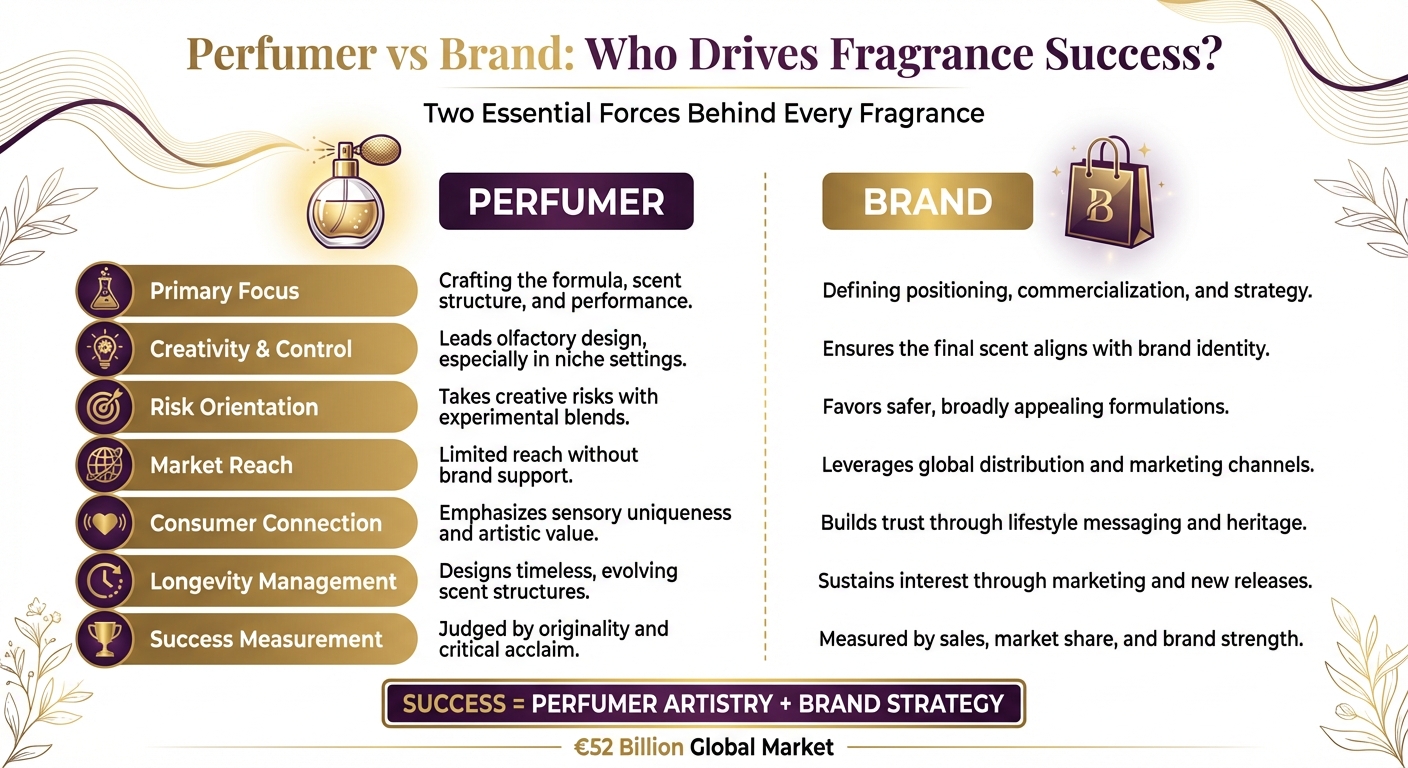
Comparaison des rôles du parfumeur et de la marque dans le succès d’un parfum
Les contributions clés de chacun
Dans la création d’un parfum, les parfumeurs et les marques jouent des rôles distincts mais complémentaires. Les parfumeurs sont les artistes derrière la senteur, transformant des idées abstraites en formules équilibrées et portables. Leur expertise consiste à assembler les ingrédients pour créer un parfum à la fois unique et techniquement abouti. Sans leur savoir-faire, il n’y aurait aucune senteur à commercialiser.
Les marques, de leur côté, prennent en charge la mise en lumière du parfum auprès du public. Elles définissent le brief créatif, identifient la cible, le positionnement tarifaire et l’orientation globale. Elles financent également le processus de production et supervisent des éléments essentiels tels que le nom, le design du flacon et les campagnes marketing. Leurs vastes canaux de marché et leur planification stratégique assurent au parfum une large audience. Même la senteur la plus magistralement composée peinerait à s’imposer sans l’infrastructure et la visibilité qu’offre une marque forte.
Dans la parfumerie de niche et la parfumerie artisanale, les parfumeurs bénéficient souvent d’une plus grande liberté créative, qui leur permet d’explorer des associations audacieuses et non conventionnelles. Cela peut donner naissance à des fragrances clivantes, mais inoubliables. À l’inverse, les marques de créateur et grand public privilégient généralement l’attrait de masse, les équipes marketing orientant la senteur vers des tendances plus larges et une forte désirabilité afin de maximiser les ventes. Ce contraste explique pourquoi les parfums de niche paraissent souvent plus audacieux, tandis que les parfums de créateur misent sur la polyvalence et le charme universel. Ces approches différentes soulignent l’importance de leur interdépendance.
La relation entre parfumeurs et marques est essentielle. Une formule admirablement composée mais dépourvue de soutien de marque solide peut rester un joyau confidentiel, admiré par quelques initiés mais largement inconnu du grand public. À l’inverse, une formule faible portée par une marque puissante peut connaître un premier élan commercial grâce au battage médiatique ou à des égéries célèbres, mais elle aura probablement du mal à bâtir une fidélité durable. Le succès à long terme naît de l’alignement entre une senteur soigneusement travaillée, une identité de marque réfléchie, une distribution stratégique et un récit captivant. Lorsqu’il est parfaitement orchestré, ce partenariat permet à l’art du parfumeur et à la présence de marché de la marque de se renforcer mutuellement au fil du temps.
Tableau comparatif : parfumeur vs marque
| Catégorie | Rôle du parfumeur | Rôle de la marque |
|---|---|---|
| Priorité principale | Élaborer la formule, la structure olfactive et la performance | Définir le positionnement, la commercialisation et la stratégie |
| Créativité & contrôle | Dirige la conception olfactive, surtout dans les univers de niche | Veille à ce que la senteur finale corresponde à l’identité de marque |
| Rapport au risque | Prend des risques créatifs avec des assemblages expérimentaux | Privilégie des formulations plus sûres et largement séduisantes |
| Portée du marché | Portée limitée sans soutien de marque | Exploite la distribution mondiale et les canaux marketing |
| Lien avec le consommateur | Met l’accent sur la singularité sensorielle et la valeur artistique | Construit la confiance grâce à un discours lifestyle et à l’héritage |
| Gestion de la longévité | Conçoit des structures olfactives intemporelles et évolutives | Maintient l’intérêt grâce au marketing et aux nouveautés |
| Mesure du succès | Évalué selon l’originalité et la reconnaissance critique | Mesuré par les ventes, la part de marché et la force de marque |
Études de cas : exemples issus de l’industrie
Ces exemples montrent comment l’art des parfumeurs et les efforts stratégiques des marques s’unissent pour créer des parfums à succès.
Succès portés par le parfumeur
Certains parfums doivent leur réussite à l’audace créative du parfumeur. Prenez Ambre Sultan de Serge Lutens, composé par Christopher Sheldrake. Cette fragrance s’est affranchie des normes grand public avec sa structure non conventionnelle, trouvant son public parmi les passionnés de niche grâce aux détaillants spécialisés et aux communautés parfum en ligne.
Autre exemple remarquable : Portrait of a Lady de Frédéric Malle, créé par Dominique Ropion. Cet assemblage complexe de rose et de patchouli est devenu une référence contemporaine de la parfumerie de niche. Son succès repose sur l’expertise technique de Ropion et sur la singularité de la composition, associées à une stratégie de marque qui valorise la vision du parfumeur. Ces cas montrent comment la liberté artistique d’un parfumeur peut donner naissance à des créations remarquables, même sur un marché souvent dominé par l’image de marque.
Succès portés par la marque
À l’inverse, de nombreuses fragrances grand public prospèrent grâce à la force de l’identité de marque, aux partenariats avec des célébrités et à une distribution étendue. Les parfums de créateur et de célébrités mettent souvent l’accent sur le nom qui porte la marque plutôt que sur le parfumeur. Ces fragrances bénéficient de budgets publicitaires considérables, de campagnes très visibles, de packagings attractifs et d’emplacements premium en rayon. Même des formulations simples peuvent atteindre une popularité massive lorsqu’elles sont soutenues par une marque reconnaissable, un pouvoir d’attraction célébrité et une visibilité mondiale.
Collaborations réussies
Certains des parfums les plus durables naissent lorsque la vision stratégique d’une marque s’accorde avec le génie créatif d’un parfumeur. Dans les lignes de niche et premium, les parfumeurs sont souvent célébrés comme de véritables auteurs, avec des récits qui mettent en avant l’inspiration et les ingrédients à l’origine de leurs créations. Ces collaborations équilibrent l’expérimentation du parfumeur avec la capacité de la marque à créer une narration captivante, à concevoir un packaging cohérent et à assurer une distribution choisie. Lorsque créativité et stratégie commerciale s’alignent, le résultat est un parfum qui conjugue profondeur artistique et large pouvoir de séduction.
Pour celles et ceux qui souhaitent explorer à la fois des chefs-d’œuvre portés par les parfumeurs et des succès portés par les marques, des services comme Scento constituent un point de départ idéal. En proposant des parfums authentiques de créateur et de niche en petits formats décantés (du 2 ml jusqu’au décant en flacon de 30 ml), Scento permet aux consommateurs d’essayer une variété de senteurs avant de s’engager dans l’achat d’un flacon entier. C’est une manière pratique de découvrir le meilleur des deux mondes.
Conclusion : comment parfumeurs et marques travaillent ensemble
Se demander si les parfumeurs ou les marques sont la force motrice du succès d’un parfum revient à passer à côté de l’essentiel. La vérité réside dans la collaboration. Le parfumeur apporte l’art, assemblant des ingrédients rares avec une maîtrise technique pour façonner l’essence d’une senteur. La marque, quant à elle, offre la plateforme — puissance marketing, canaux de distribution et confiance des consommateurs — afin que cette création atteigne le monde. La magie opère lorsque ces deux éléments agissent en harmonie : le parfumeur crée, et la marque amplifie. Ensemble, ils façonnent non seulement des succès individuels, mais aussi la trajectoire de toute l’industrie du parfum.
Ce partenariat se manifeste dans tout l’univers de la parfumerie. Les parfums de niche s’épanouissent grâce à la liberté créative, mais sans récits de marque convaincants, ils restent confinés aux étagères des boutiques. À l’inverse, les parfums de créateur dominent le marché grand public par leur accessibilité, mais leur succès dépend de la qualité apportée par des parfumeurs talentueux. Cet équilibre dynamique entre art et stratégie nourrit le marché mondial du parfum, actuellement valorisé à 52 milliards d’euros, et le maintient en constante évolution pour répondre à des goûts de consommateurs toujours plus variés.
Lorsque la vision créative s’aligne sur une exécution stratégique, il en résulte des fragrances qui captivent à la fois le cœur et l’esprit, encourageant la fidélité et les achats répétés. Les parfumeurs jouent le rôle des artistes, composant des senteurs uniques et mémorables, tandis que les marques veillent à ce que ces chefs-d’œuvre touchent un public plus large avec constance et désirabilité.
Scento illustre cette synergie grâce à son modèle de décants, offrant une manière fluide d’explorer à la fois l’art de la niche et l’excellence des parfums de créateur. Avec des décants allant du 2 ml jusqu’au décant en flacon de 30 ml, Scento facilite la découverte de parfums authentiques à un prix accessible. Que vous soyez attiré par des créations de niche exclusives ou par des incontournables iconiques de créateur, Scento offre la porte d’entrée idéale pour construire votre collection de parfums personnalisée, alliant éclat créatif et accessibilité stratégique.
FAQ
Quels rôles jouent les parfumeurs et les marques dans la création d’un parfum à succès ?
Les parfumeurs et les marques collaborent étroitement pour créer des fragrances qui laissent une impression durable et établissent un lien avec leur public. Les parfumeurs donnent vie à leur art, en s’appuyant sur leur connaissance approfondie de la composition olfactive et leur sensibilité artistique pour concevoir des fragrances distinctives et inoubliables. De leur côté, les marques apportent une précieuse compréhension du marché, identifient le public cible et définissent l’identité du parfum grâce à des stratégies de branding et de marketing soigneusement pensées.
Ce partenariat garantit qu’un parfum ne se contente pas d’offrir une senteur séduisante, mais qu’il répond aussi aux attentes des consommateurs et reflète la vision de la marque, lui donnant une assise solide dans une industrie hautement concurrentielle.
Qu’est-ce qui distingue les parfums de niche des parfums de créateur ?
Les parfums de niche sont créés par des parfumeurs indépendants ou des marques spécialisées, avec l’objectif de composer des profils olfactifs distinctifs et artistiques. Ces parfums s’adressent aux personnes qui apprécient l’originalité et l’exclusivité, intégrant souvent des ingrédients premium et des associations inattendues.
À l’inverse, les parfums de créateur proviennent de maisons de mode ou de marques de luxe établies. Ces senteurs sont conçues pour séduire un public plus large, en reflétant l’identité et le style de la marque. Elles sont généralement plus accessibles et plus faciles à trouver que les parfums de niche.
Comment le storytelling de marque façonne-t-il le succès d’un parfum ?
Le storytelling de marque a le pouvoir de transformer un parfum en bien plus qu’une simple senteur : il devient une expérience. Un récit soigneusement construit relie émotions, souvenirs et aspirations à la fragrance, la rendant personnelle et pleine de sens pour le client. Ce lien émotionnel élève la perception du parfum, le faisant souvent paraître plus précieux et digne d’être chéri.
Lorsqu’un parfum s’accompagne d’une histoire singulière, il se distingue sur un marché saturé. Ce type de storytelling aide non seulement une marque à affirmer son identité, mais laisse aussi une empreinte durable chez les consommateurs, approfondissant leur attachement et leur fidélité au fil du temps.

