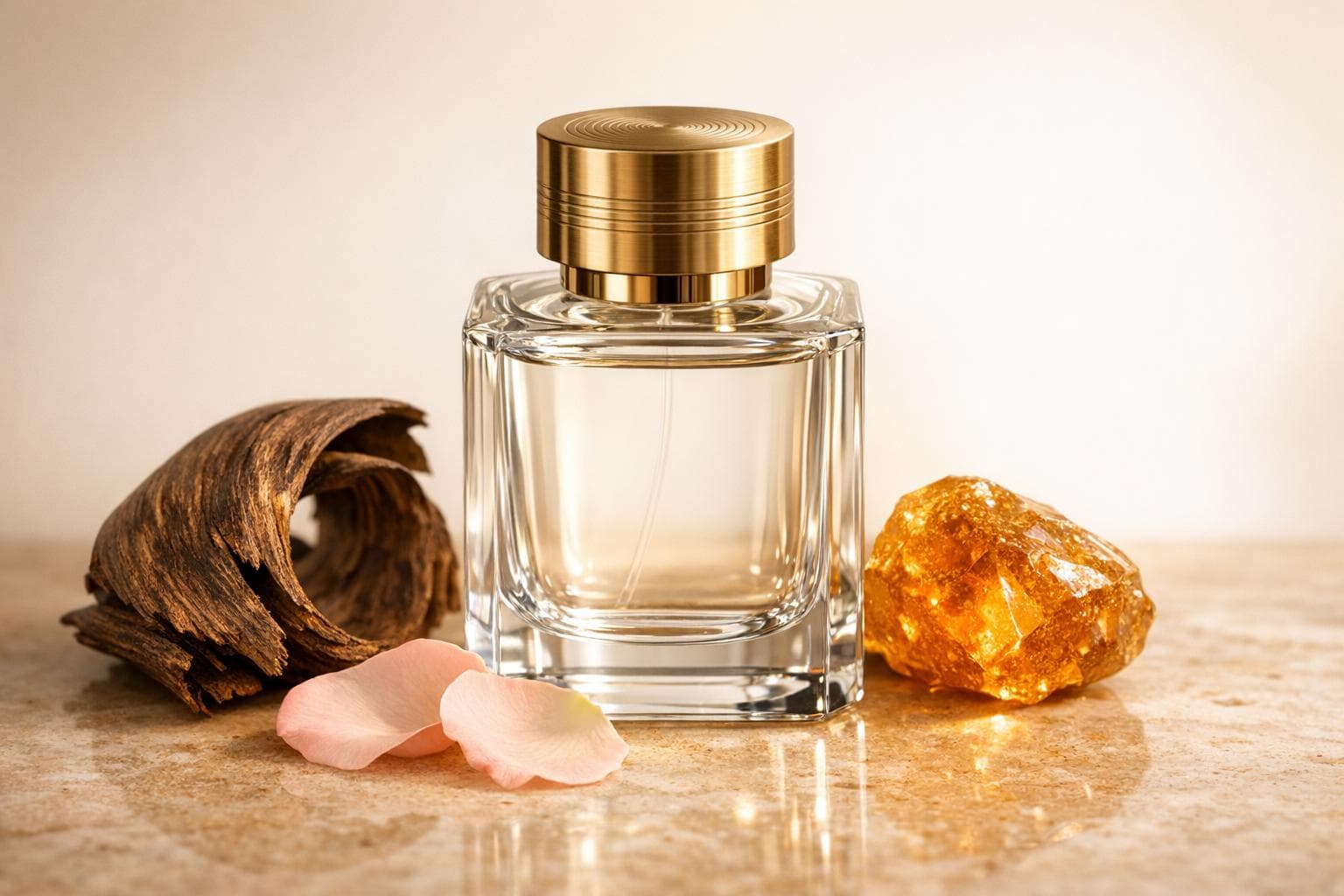
La parfumerie arabe est devenue une force mondiale, mêlant des ingrédients patrimoniaux tels que l’oud, l’ambre et la rose à des techniques modernes. Les maisons de luxe transforment ces traditions ancestrales en intégrant les senteurs du Moyen — Orient aux préférences occidentales, créant ainsi des fragrances qui séduisent un public plus large. Cette évolution est portée par :
- Expansion mondiale : des marques moyen-orientales comme Arabian Oud et Rasasi se développent à l’international, tandis que des maisons occidentales comme Louis Vuitton et Dior intègrent des influences arabes à leurs collections.
- Approvisionnement durable : l’oud étant rare, les marques privilégient désormais une récolte éthique et des alternatives synthétiques afin de préserver les ressources.
- Technologie et personnalisation : des outils numériques et des enseignes spécialisées dans le décant, comme Scento, rendent les fragrances inspirées de l’univers arabe plus accessibles aux consommateurs d’aujourd’hui.
Cette évolution équilibre la préservation de l’essence de la parfumerie arabe et les exigences contemporaines, mettant en lumière son influence croissante sur le marché du parfum de 52 milliards d’euros.
Votre expert parfum personnel vous attend
Faites notre quiz olfactif express pour découvrir des parfums de créateurs et de niche authentiques, choisis selon vos goûts – explorez-les en décants et échantillons de 2, 5, 8 et 30 ml, pour essayer chaque fragrance avant de vous engager sur un flacon entier.
Trouvez votre parfumLes fondements de la parfumerie arabe
La parfumerie arabe repose sur trois ingrédients fondamentaux : l’oud, l’ambre et la rose. Ces éléments façonnent depuis des générations les traditions olfactives de la région, étroitement liées à son histoire, à ses échanges commerciaux et à ses pratiques culturelles. Leur influence durable explique pourquoi les senteurs arabes occupent une place si éminente dans la parfumerie mondiale. Ces ingrédients intemporels ne définissent pas seulement les fragrances traditionnelles ; ils constituent également le socle des interprétations modernes.
Ingrédients clés : oud, ambre et rose
L’oud, souvent appelé bois d’agar, se forme lorsque l’arbre Aquilaria est infecté par une moisissure spécifique, produisant ainsi un bois sombre et résineux. Son sillage est riche, boisé et balsamique, prisé pour sa profondeur et son incroyable tenue. En raison de la surexploitation, l’oud est extrêmement rare et peut atteindre jusqu’à 30 000 $ le kilogramme, ce qui lui vaut le surnom d’"or liquide". Des créations classiques comme Mukhallat Oudh d’Ajmal et Ashrafi d’Al Haramain illustrent le rôle central de l’oud dans les attars à base d’huile.
L’ambre apporte une note de fond chaude et résineuse, souvent obtenue par des accords d’ambre gris, de labdanum et de vanille. Cet ingrédient confère aux fragrances une richesse sensuelle et renforce leur longévité. L’ambre est fréquemment associé à l’oud dans des compositions comme Amber Musc d’Al Haramain ou diverses créations de Swiss Arabian, confirmant son importance dans l’élaboration de senteurs enveloppantes et durables.
La rose, en particulier la rose de Taïf d’Arabie saoudite, apporte une facette florale opulente et légèrement épicée, nuancée de sous-tons miellés. Distillée en absolue pour atteindre une pureté maximale, la rose possède une profonde portée culturelle : elle symbolise la beauté et l’hospitalité, tout en jouant également un rôle dans les rituels religieux. Un exemple emblématique est Shaghaf Oud de Swiss Arabian, qui associe oud, rose et vanille afin de créer un équilibre harmonieux dans lequel la rose adoucit et sublime les notes de fond plus intenses.
Techniques d’assemblage et de superposition
La parfumerie arabe est réputée pour ses techniques d’assemblage sophistiquées, qui impliquent souvent des processus de macération durant plusieurs semaines et des méthodes de distillation sans alcool. Contrairement aux fragrances occidentales qui mettent en avant une progression nette entre notes de tête, de cœur et de fond, les compositions arabes se déploient progressivement pendant plus de 12 heures, en privilégiant une harmonie sans rupture et une tenue persistante.
La superposition est une autre signature de la parfumerie arabe, permettant de créer des fragrances personnalisées et sur mesure. Une technique courante consiste à commencer par une base d’ambre ou d’oud, à y ajouter des notes de cœur telles que la rose ou le safran, puis à terminer par le musc. Le musc agit comme un fixateur, apportant profondeur et rehaussant le sillage, tandis que des épices comme le safran et la cardamome ajoutent une touche chaleureuse et exotique. Par exemple, Huroof de Swiss Arabian montre comment le musc et l’oud peuvent être superposés pour créer un parfum riche et multidimensionnel. Les attars à base d’huile, connus pour leur remarquable longévité, peuvent durer 24 heures, ce qui les rend idéaux pour les climats exigeants de la région. Ces approches traditionnelles continuent d’inspirer les maisons de luxe contemporaines, qui marient héritage et innovation actuelle.
Comment les maisons de luxe réinventent la parfumerie arabe
Les maisons de luxe redessinent la parfumerie arabe en associant les riches traditions olfactives du Moyen — Orient à des facettes aromatiques et gourmandes occidentales. Prenons Lira de Xerjoff, par exemple : cette création marie la lavande française et l’orange sanguine méditerranéenne à une base de caramel brûlé, composant une harmonie entre la légèreté européenne et la profondeur arabe. Cette approche célèbre non seulement l’oud, l’ambre et la rose, mais fait également découvrir ces senteurs intemporelles à un public mondial moins familier des huiles de parfum traditionnelles et des attars. Cette fusion en pleine évolution ouvre la voie à l’exploration de techniques avancées, de pratiques éthiques et d’une personnalisation portée par la technologie.
Mêler les notes orientales et occidentales
Les grandes maisons de mode comme les marques de niche sont à l’avant-garde de ce mouvement entre Orient et Occident. En juillet 2022, Louis Vuitton a lancé Fleur du Désert, que le parfumeur Jacques Cavallier Belletrud a décrit comme un "hommage aux notes moyen-orientales". La fragrance révèle le jasmin, la fleur d’oranger et la rose de Damas, alliant l’élégance de l’héritage oriental à l’attrait du luxe mondial. De même, des maisons telles que Montale et Amouage réinterprètent les bases arabes traditionnelles — comme la fève tonka et l’oud — en fragrances qui captivent les publics internationaux en mettant l’accent sur l’authenticité de leurs ingrédients.
Approvisionnement durable et éthique
L’approvisionnement éthique est devenu un enjeu central dans cette transformation. L’oud étant une ressource rare, les maisons de luxe se tournent vers des méthodes d’approvisionnement responsables. Les progrès des techniques de distillation et d’extraction permettent désormais d’obtenir des essences plus pures à partir d’oud issu de récoltes durables et de matières botaniques rares, réduisant ainsi la pression sur l’environnement. L’expansion ambitieuse d’Arabian Oud, avec plus de 1 200 boutiques dans 37 pays d’ici 2024, illustre à quel point une montée en puissance éthique des ingrédients d’exception peut nourrir la croissance mondiale tout en préservant l’authenticité. En parallèle, certaines marques explorent des alternatives synthétiques capables de reproduire les arômes naturels, offrant un équilibre entre innovation et responsabilité éthique afin de répondre à la demande croissante de transparence de la part des consommateurs.
La personnalisation par la technologie
La technologie joue un rôle déterminant dans la manière dont les consommateurs découvrent les fragrances inspirées de l’univers arabe. Des outils numériques comme les moteurs de recommandation "Find My Scent" aident à associer les utilisateurs à des profils arabes complexes adaptés à leurs préférences individuelles. Les services d’abonnement permettent également aux clients de tester des ingrédients d’exception comme l’oud et l’ambre grâce à des décants de plus petit format à des prix accessibles. Ce modèle d’essai avant achat réduit non seulement la barrière financière, mais initie aussi les publics modernes aux techniques traditionnelles de superposition arabes. En associant l’oud, la rose et l’ambre dans des combinaisons personnalisées, ces innovations honorent l’héritage arabe tout en l’adaptant aux goûts contemporains. Le passage des comptoirs de parfumerie en boutique à des plateformes numériques avancées élargit encore l’accès à la parfumerie arabe de luxe, en particulier pour les consommateurs plus jeunes et férus de technologie.
Études de cas : les maisons de luxe qui transforment les senteurs arabes
LVMH et les créations inspirées de l’univers arabe
LVMH s’est imposé comme un leader dans l’introduction de fragrances inspirées de l’univers arabe auprès d’un public mondial, grâce à des lancements exclusifs en éditions limitées. En associant des éléments traditionnels du Moyen — Orient, tels que le cuir et l’ambre, à des inflexions occidentales contemporaines, la maison crée des parfums qui honorent l’héritage arabe tout en séduisant les préférences actuelles. Cette fusion du classique et du moderne a permis à LVMH d’introduire une nouvelle dimension dans la parfumerie de luxe.
Chanel et les collections moyen-orientales de Dior
Chanel et Dior se sont eux aussi inspirés des traditions arabes, mêlant exclusivité et une certaine accessibilité. Les deux maisons ont lancé des collections en édition limitée ainsi que des options de décantation, permettant aux amateurs de parfum de découvrir la richesse d’ingrédients rares du Moyen — Orient, tels que l’oud et l’ambre, sans devoir s’engager immédiatement sur un flacon grand format à plus de 300 $. Cette approche préserve le prestige de ces senteurs luxueuses tout en les rendant plus accessibles à un public élargi.
Scento : une découverte accessible de la parfumerie de luxe
Scento a réinventé la manière dont les consommateurs explorent les fragrances haut de gamme, en proposant une vision renouvelée de l’accessibilité et de l’héritage. Grâce à des décants soigneusement sélectionnés en fioles de 2 ml, 5 ml et 8 ml, ainsi qu’un décant en flacon de 30 ml sur la plupart des parfums, Scento permet aux clients de découvrir des senteurs exquises mettant à l’honneur des ingrédients iconiques tels que l’oud, le safran, l’ambre et la rose de Damas. Leur collection de plus de 1 000 fragrances de créateur comble l’écart entre la profonde tradition de la parfumerie arabe et les influences plus légères et modernes des tendances olfactives occidentales. Cette approche garantit que l’authenticité et la richesse des senteurs arabes demeurent accessibles aux passionnés de parfum partout dans le monde.
Défis et opportunités de la réinvention de la parfumerie arabe
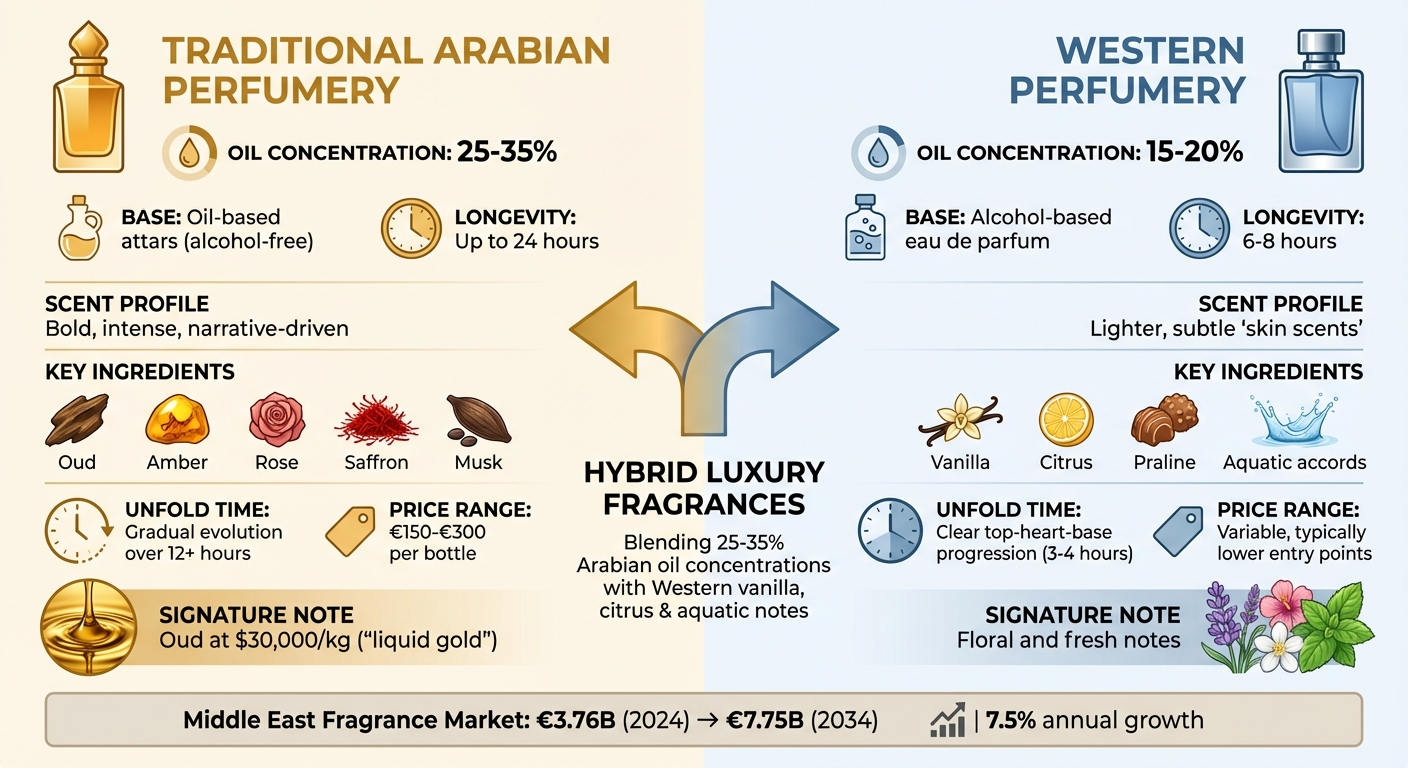
Parfumerie arabe traditionnelle vs parfumerie occidentale : principales différences de composition et de tenue
Préserver l’authenticité
Les maisons de parfumerie de luxe font face à un exercice d’équilibre délicat : préserver les riches traditions de la parfumerie arabe tout en menant leur expansion mondiale sur un marché de plus en plus concurrentiel. Le besoin de se distinguer peut parfois inciter certaines marques à s’éloigner de leurs racines, mais les maisons les plus respectées restent fidèles à leur héritage.
Comme l’explique Haisam Mohammed, fondateur de Unifrom :
"Je suis très prudent lorsqu’il s’agit de commercialiser un produit qui existe depuis des siècles sans rendre hommage à l’origine de mon intérêt pour les senteurs." – Haisam Mohammed, fondateur, Unifrom
Un excellent exemple de cet engagement est Boond Fragrances, fondée par Krati et Varun Tandon. La marque a redonné vie à l’ancienne tradition des attars de Kannauj, en utilisant des techniques d’hydrodistillation remontant à l’an 1000 de notre ère. Son parfum emblématique, Maati, met en avant des huiles de parfum 100 % pures, sans alcool ni agents de charge. Cet engagement envers l’authenticité distingue les fragrances arabes des eaux de parfum occidentales conventionnelles.
S’adapter aux préférences d’un public mondial
Tout en restant fidèles à leurs origines, les marques de parfumerie arabe doivent également relever le défi de séduire un public mondial diversifié. Les fragrances arabes traditionnelles, réputées pour leurs concentrations en huiles de 25 à 35 %, diffèrent considérablement des formules plus légères de 15 à 20 % privilégiées sur les marchés occidentaux. Cette différence représente à la fois un défi et une opportunité. Historiquement, les consommateurs occidentaux penchaient vers des "parfums de peau" plus discrets, mais la demande pour des fragrances audacieuses et très performantes ne cesse de croître.
Pour combler cet écart, de nombreuses marques élaborent des profils olfactifs hybrides, mêlant des notes traditionnelles comme l’oud, le safran et l’ambre à des éléments plus universellement appréciés comme la vanille, les agrumes, le praliné et les accords aquatiques. Cette approche respecte l’héritage tout en attirant de nouveaux publics. Les chiffres parlent d’eux-mêmes : le marché du parfum au Moyen — Orient, estimé à 3,76 milliards de dollars en 2024, devrait atteindre 7,75 milliards de dollars d’ici 2034, avec un taux de croissance annuel de 7,5 %. Cette progression reflète un intérêt mondial croissant pour des fragrances riches, évocatrices et porteuses de récit, qui stimulent l’innovation dans l’industrie.
"Partout dans le monde, les consommateurs sont attirés par des fragrances qui persistent et racontent une histoire. Les notes orientales épicées, par leur richesse et leur résonance culturelle, incarnent cela à la perfection." – Manoj Arora, directeur général et parfumeur en chef, Sacheerome
Conclusion
Les maisons de luxe redessinent l’univers de la parfumerie arabe en associant des ingrédients hérités de la tradition, comme l’oud, le safran et le musc, à des influences occidentales telles que la vanille, les agrumes et les notes aquatiques. Cet accord subtil respecte le riche patrimoine des senteurs arabes tout en touchant de nouveaux publics en quête de fragrances audacieuses, persistantes et porteuses d’histoire. C’est une interprétation contemporaine qui relie tradition et innovation, permettant à ces senteurs de résonner auprès d’une audience plus large.
Les prévisions du marché confirment cette évolution : le marché du parfum arabe devrait passer de 3,76 milliards d’euros en 2024 à 7,75 milliards d’euros d’ici 2034. Cette croissance reflète une tendance mondiale vers des fragrances intenses et très performantes, au détriment des parfums de peau plus discrets. L’avenir de la parfumerie intègre désormais pleinement les traditions arabes aux côtés des maisons occidentales de parfumerie les plus établies.
Cependant, l’accessibilité demeure un obstacle. Les flacons traditionnels de parfums arabes se situent souvent entre 150 € et 300 €, ce qui complique l’exploration de ces senteurs pour les consommateurs curieux sans investissement initial important. C’est ici qu’interviennent les plateformes de découverte digitales. Scento, par exemple, répond à cette problématique en proposant des fragrances de luxe inspirées de l’univers arabe dans des formats plus petits et plus abordables. En commençant par des formats découverte jusqu’aux fioles de 8 ml (offrant environ 120 pulvérisations), Scento permet aux consommateurs de découvrir la richesse de la parfumerie arabe sans s’engager sur un flacon grand format.
FAQ
Comment savoir si une fragrance à l’oud contient du véritable oud ou un accord synthétique ?
Le véritable oud provient de la résine produite par des arbres Aquilaria infectés, donnant naissance à un profil olfactif riche et complexe. À l’inverse, l’oud synthétique — ou accord oud — est élaboré en laboratoire à partir de composés aromatiques conçus pour reproduire l’essence de l’oud naturel. Pour déterminer si une fragrance contient du véritable oud ou une version synthétique, consultez la description du produit ou les informations relatives à son approvisionnement.
Quel est le moyen le plus simple d’essayer la superposition arabe sans acheter un flacon entier ?
Expérimenter la superposition arabe devient simple et économique lorsque l’on commence par de petits échantillons de parfum ou des décants. Ces formats compacts, souvent proposés en fioles de 2 ml, 5 ml et 8 ml, ainsi qu’en décant en flacon de 30 ml sur la plupart des parfums, permettent de découvrir des senteurs riches et persistantes autour de notes comme l’oud, le musc et l’ambre. En testant ces associations, vous pouvez composer une signature olfactive personnelle sans avoir à investir dans un flacon grand format, ce qui en fait une manière à la fois simple et abordable d’explorer cet art parfumé.
Pourquoi les parfums de style arabe durent-ils plus longtemps que de nombreux parfums occidentaux ?
Les parfums arabes sont réputés pour leur remarquable tenue, en grande partie grâce à leurs formulations à base d’huile. Cela permet au parfum d’adhérer à la peau et de perdurer souvent pendant des heures, voire toute une journée. Ces fragrances présentent également des concentrations plus élevées en huiles et en ingrédients précieux comme l’oud, le musc et l’ambre — des éléments qui contribuent naturellement à leur longue tenue.

