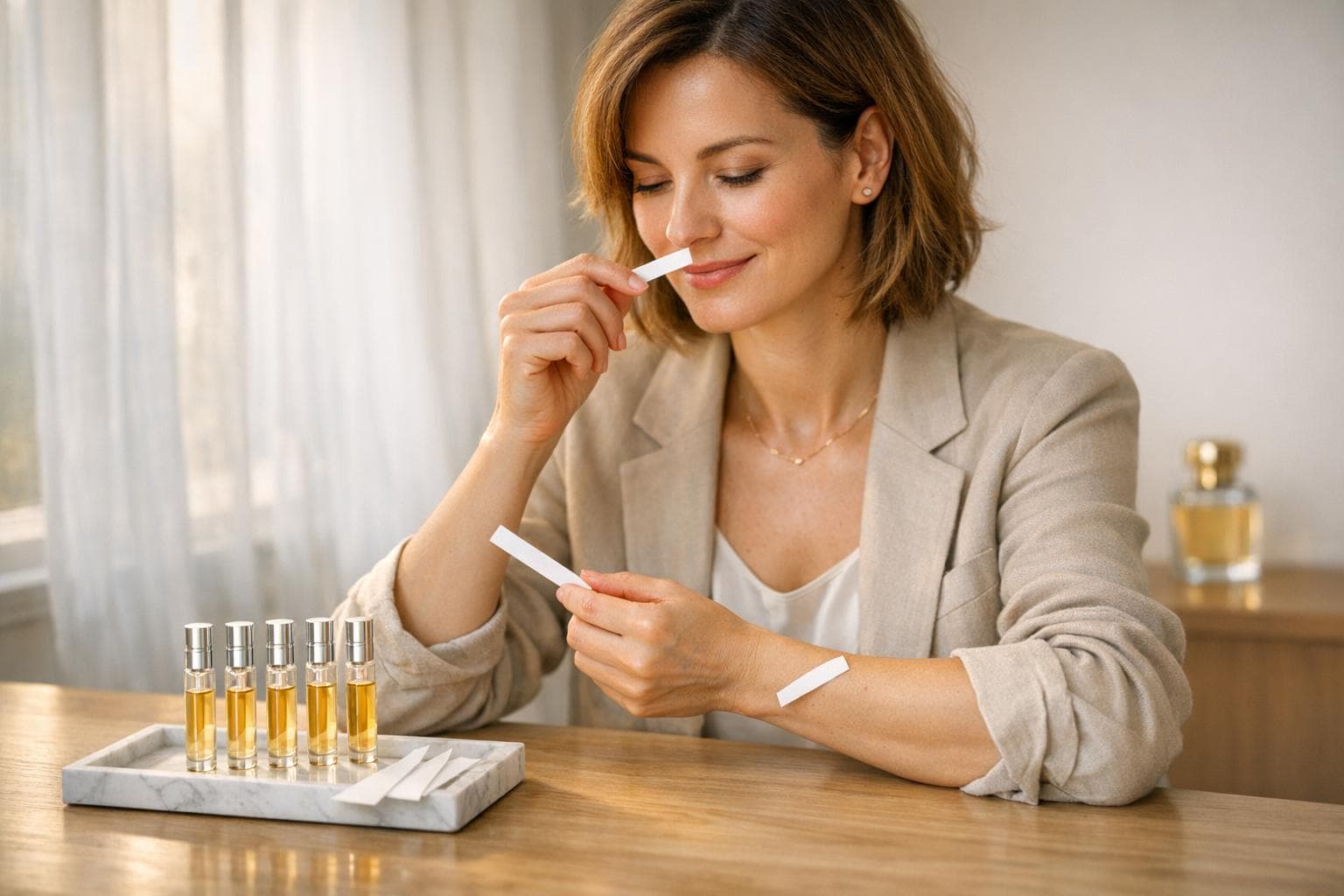
Votre choix de parfum n’a rien d’aléatoire : il reflète votre personnalité et même la chimie de votre corps. La recherche établit un lien entre les cinq grands traits de personnalité (ouverture, conscienciosité, extraversion, agréabilité, névrosisme) et certaines familles olfactives. Par exemple, les senteurs florales séduisent souvent les personnes empathiques, tandis que les fragrances boisées résonnent avec celles qui sont fiables et structurées. Au-delà de la personnalité, le pH de votre peau, votre mode de vie et votre génétique influencent aussi la manière dont un parfum se révèle sur vous, rendant chaque expérience olfactive intime et singulière.
Points clés :
- Senteurs florales : associées à la bienveillance et à l’agréabilité (par ex. rose, jasmin).
- Notes boisées : privilégiées par les personnalités consciencieuses (par ex. santal, cèdre).
- Fragrances hespéridées : les individus énergiques et optimistes y sont naturellement attirés.
- Senteurs orientales : les personnalités audacieuses et passionnées préfèrent les notes chaudes et épicées comme l’ambre.
La chimie de votre corps ajoute une dimension supplémentaire : le type de peau, le pH et même l’alimentation influencent l’évolution d’un parfum. Choisir la bonne fragrance signifie comprendre à la fois votre personnalité et la manière dont les parfums interagissent avec votre peau, ou utiliser un analyseur de profil olfactif. Commencez par des décants afin de tester l’évolution d’un parfum sur votre peau avant de vous engager dans l’achat d’un flacon entier.
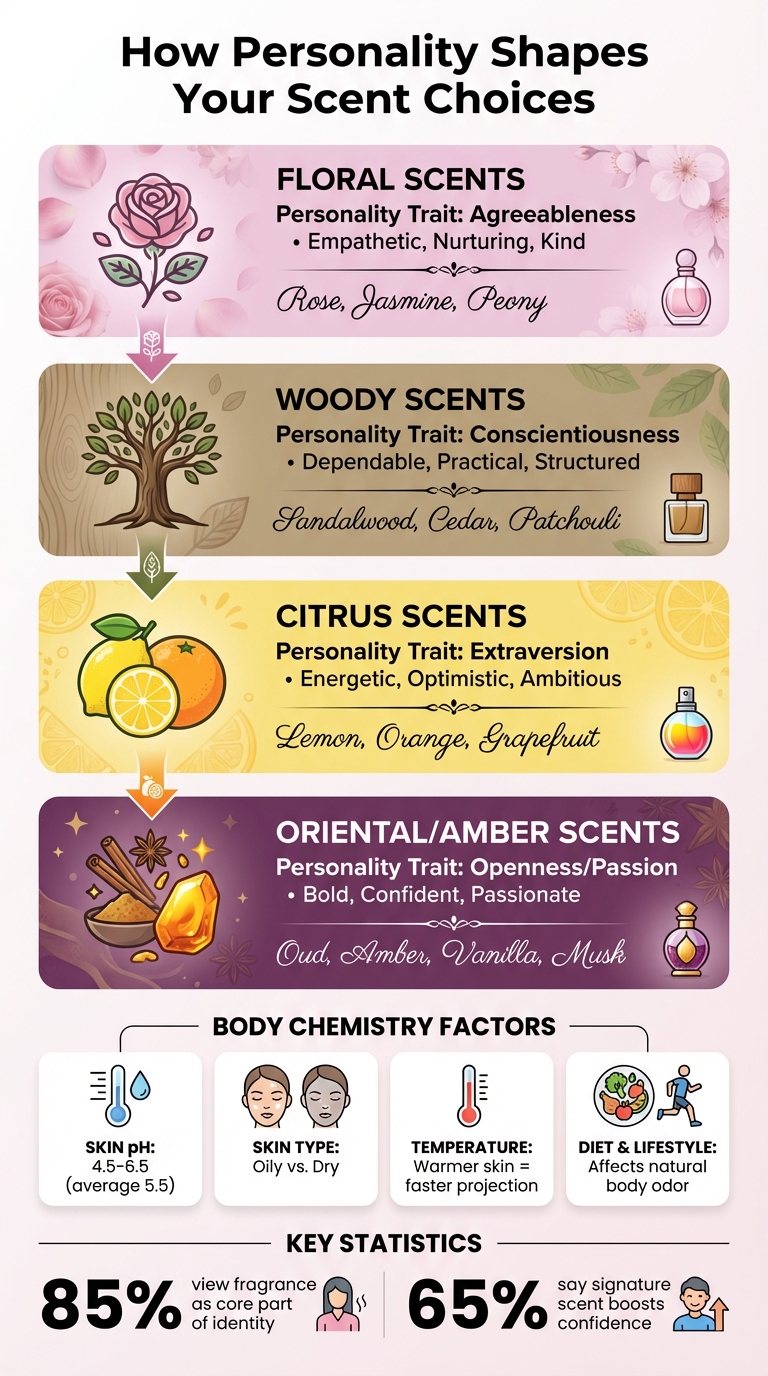
Guide des traits de personnalité et des préférences en matière de parfum
Comment trouver votre parfum signature grâce à la psychologie ! | Les 12 archétypes de Jung
Votre expert parfum personnel vous attend
Faites notre quiz olfactif express pour découvrir des parfums de créateurs et de niche authentiques, choisis selon vos goûts – explorez-les en décants et échantillons de 2–8ml, pour essayer chaque fragrance avant de vous engager sur un flacon entier.
Trouvez votre parfumComment les traits de personnalité influencent les préférences olfactives
Votre personnalité joue un rôle majeur dans les senteurs qui vous attirent. La recherche en psychologie a révélé des liens entre les cinq grands traits de personnalité et certaines familles de parfums, montrant à quel point nos préférences olfactives s’accordent avec ce que nous sommes.
Les senteurs florales et l’agréabilité
Si vous êtes une personne empathique et attentionnée — des traits liés à l’agréabilité — il est possible que vous vous tourniez spontanément vers des fragrances florales délicates. Des notes comme la rose, le jasmin et la pivoine reflètent cette personnalité douce et harmonieuse. Ces senteurs semblent incarner la bienveillance et le goût du lien, ce qui en fait un choix idéal pour les âmes chaleureuses.
Les senteurs boisées pour la conscienciosité
Pour les personnes consciencieuses, c’est-à-dire fiables et pragmatiques, les fragrances boisées aux accents terrestres se distinguent souvent. Pensez au santal, au cèdre et au patchouli. Ces senteurs ancrées reflètent une personnalité qui valorise la structure, la stabilité et l’introspection, ce qui en fait un choix naturel pour celles et ceux qui s’épanouissent dans la constance.
Les senteurs hespéridées et les personnalités ambitieuses
Si vous débordez d’énergie et d’optimisme, il y a de fortes chances que vous soyez attiré(e) par les fragrances à base d’agrumes comme le citron, l’orange et le pamplemousse. Ces senteurs éclatantes et zestées correspondent à la vitalité des personnalités extraverties qui aiment la spontanéité et l’action. Elles reflètent une approche dynamique et tournée vers l’avenir.
Les senteurs orientales et ambrées pour les tempéraments passionnés
Pour les personnes audacieuses, sûres d’elles et qui aiment affirmer leur présence, les fragrances orientales et épicées sont souvent un choix privilégié. Des notes comme le oud, l’ambre, la vanille et le musc dégagent chaleur et mystère. Ces senteurs riches et complexes trouvent un écho chez celles et ceux qui embrassent la passion et cultivent une expression de soi audacieuse.
Si la personnalité oriente vos préférences en matière de parfum, la chimie de votre corps y apporte une dimension unique. Des études suggèrent que lorsqu’un parfum choisi se mêle à l’odeur naturelle de votre corps, il devient plus séduisant qu’un parfum attribué au hasard — même si les deux sont agréables. Cette interaction entre personnalité et chimie crée une signature olfactive véritablement individuelle.
Comment la chimie corporelle influence la perception d’un parfum
Un parfum évolue différemment sur chaque personne, grâce à la chimie unique de notre corps. Lorsqu’une fragrance rencontre votre peau, elle se transforme au fil de la journée, créant une expérience olfactive entièrement personnelle.
Des interactions olfactives personnalisées
Le niveau de pH de votre peau agit comme un filtre chimique, façonnant la manière dont les notes olfactives se dévoilent. La plupart des peaux présentent un pH légèrement acide d’environ 5,5, généralement compris entre 4,5 et 6,5. Si votre peau tend vers l’acidité, les notes d’agrumes brillent davantage, tandis qu’une peau plus alcaline met en valeur les tonalités sucrées ou florales.
Le type de peau joue également un rôle majeur. La peau grasse retient mieux les notes de fond plus opulentes, comme l’ambre et le santal, ce qui prolonge la tenue du parfum. À l’inverse, la peau sèche laisse les fragrances s’évaporer plus rapidement.
La température est un autre facteur. Une peau plus chaude active plus vite les molécules du parfum, augmentant sa diffusion et accélérant son évolution. Une peau plus fraîche, en revanche, ralentit ce processus, maintenant l’arôme plus discret.
Même votre alimentation et votre mode de vie laissent leur empreinte. Des aliments comme l’ail, les plats épicés, la caféine et l’alcool peuvent subtilement modifier votre odeur corporelle naturelle, ce qui influence à son tour la façon dont un parfum se révèle sur vous. Les changements hormonaux — qu’ils soient liés au stress, à la grossesse ou au cycle menstruel — peuvent également modifier la production de sébum et les niveaux de pH, influençant davantage encore l’évolution d’un sillage. Tous ces éléments se conjuguent pour créer une interaction hautement individuelle entre le parfum et la chimie du corps.
La science des interactions entre donneur et parfum
Les parfums ne se contentent pas de reposer sur la peau : ils se mêlent à votre odeur naturelle pour créer quelque chose de totalement inédit. Une étude fascinante menée par Pavlína Lenochová et Jan Havlíček à l’Université Charles de Prague, en mars 2012, a exploré ce phénomène. Les chercheurs ont recueilli des échantillons d’odeur axillaire auprès de 21 participants masculins, qui portaient soit leur parfum préféré, soit un parfum attribué aléatoirement. Des évaluatrices ont jugé ces échantillons, et les résultats furent remarquables : lorsque l’odeur naturelle d’un homme se mêlait au parfum qu’il avait choisi, elle était jugée significativement plus attirante (Z = 2,37, p = 0,02) et plus agréable (Z = 2,48, p = 0,01) que lorsqu’elle était associée à une fragrance aléatoire.
"Les fragrances semblent ainsi interagir avec l’odeur corporelle, créant un mélange olfactif spécifique à chaque individu."
- Pavlína Lenochová, Département d’anthropologie, Université Charles
Cette interaction unique entre votre corps et la fragrance que vous choisissez explique pourquoi il est si important de tester un parfum sur votre propre peau. Une mouillette peut vous indiquer l’odeur d’une senteur en isolation, mais seule votre peau peut révéler comment elle prend véritablement vie.
Les facteurs sociaux et génétiques dans les préférences olfactives
Vos préférences olfactives sont façonnées par bien plus que la personnalité et la chimie corporelle : les influences sociales et génétiques jouent elles aussi un rôle majeur. Ensemble, ces facteurs composent un profil olfactif hautement personnalisé, reflet de votre patrimoine biologique autant que de votre environnement.
Prédispositions génétiques
Les gènes du complexe majeur d’histocompatibilité (CMH), connus chez l’humain sous le nom d’antigène leucocytaire humain (HLA), jouent un rôle essentiel dans la structuration de votre système immunitaire et de votre profil olfactif unique. Ces gènes influencent non seulement la façon dont vous sentez naturellement aux yeux des autres, mais aussi les senteurs que vous trouvez attirantes.
Fait intéressant, des recherches ont montré que les individus ont tendance à préférer l’odeur de personnes dont les gènes du CMH diffèrent des leurs. Cette préférence serait une stratégie évolutive visant à favoriser la diversité génétique et une descendance en meilleure santé. Une étude marquante publiée dans Nature Genetics en janvier 2002, dirigée par Martha K. McClintock et Carole Ober de l’Université de Chicago, a utilisé la "méthode du t-shirt" pour explorer ce phénomène. Des hommes ont porté des t-shirts pendant deux nuits afin d’y imprégner leur odeur corporelle, puis des femmes ont évalué ces senteurs. Les résultats ont montré que les femmes pouvaient détecter des différences génétiques aussi minimes qu’un seul gène et étaient plus attirées par l’odeur d’hommes partageant certains, mais pas tous, les allèles HLA hérités de leur père.
"Les femmes peuvent réellement sentir les différences génétiques. Elles peuvent percevoir des différences aussi infimes qu’un seul gène."
- Martha K. McClintock, professeure de psychologie, Université de Chicago
La génétique influence également votre choix de fragrances. Par exemple, une étude de 2005 publiée dans Hormones and Behavior a examiné 58 étudiants du sud du Brésil et mis en évidence un lien fort entre les phénotypes HLA et la perception agréable des odeurs de transpiration. L’étude a aussi observé que lorsqu’il existait une plus grande similarité génétique entre la personne qui sentait et le donneur, les participants avaient plus de difficulté à décider si l’odeur était agréable ou non.
Si la génétique pose le décor, votre environnement et vos expériences sociales affinent ensuite davantage vos préférences olfactives.
Conditionnement culturel et social
Au-delà de la biologie, votre environnement influence profondément votre manière de percevoir et de choisir les senteurs. La familiarité joue un rôle majeur : des senteurs comme les agrumes dans les régions méditerranéennes, le santal en Inde ou le gaulthérie au Canada évoquent des souvenirs et des associations spécifiques, façonnant des préférences durables. Par exemple, le gaulthérie est souvent associé aux bonbons au Canada, mais à des produits médicinaux en France.
Les facteurs sociaux influencent également la manière dont les fragrances sont utilisées comme forme d’expression de soi. Avec le temps, l’exposition répétée à certaines senteurs ne façonne pas seulement vos préférences : elle vous aide aussi à utiliser le parfum pour signaler une identité, un statut ou une humeur. Cela explique pourquoi les préférences olfactives varient largement d’une région à l’autre et pourquoi certaines familles olfactives sont associées à des occasions ou à des rôles sociaux précis.
L’interaction entre prédispositions génétiques et influences sociales crée ce que les chercheurs appellent la "superadditivité". Ce phénomène se produit lorsque le cortex orbitofrontal de votre cerveau combine des signaux biologiques, des souvenirs culturels et des expériences sensorielles pour former un profil de préférences olfactives entièrement unique. C’est un mélange de nature, d’éducation et d’expérience personnelle qui rend vos choix de parfums véritablement singuliers.
Comment choisir la fragrance idéale pour votre personnalité
Le parfum parfait ne consiste pas seulement à sentir bon ; il est le prolongement de votre identité. En comprenant votre personnalité et la manière dont elle interagit avec la chimie de votre corps, vous pouvez trouver des senteurs qui reflètent réellement qui vous êtes. Le voyage commence par l’introspection, non par un échantillonnage au hasard.
Comprendre les familles olfactives
Avant de vous plonger dans des parfums précis, prenez un instant pour considérer vos traits de personnalité. Êtes-vous audacieux(se) et extraverti(e), ou plutôt calme et introspectif(ve) ? Votre réponse peut vous orienter vers des familles olfactives qui s’accordent naturellement avec votre caractère.
- Senteurs florales : pensez à la rose, au jasmin et au lys. Elles sont idéales pour les personnalités romantiques, attentionnées ou créatives.
- Fragrances hespéridées : des notes comme le citron, la bergamote et le pamplemousse conviennent aux personnes énergiques et spontanées qui dégagent une aura lumineuse et extravertie.
- Notes boisées : le santal, le cèdre et le vétiver séduisent les personnalités ancrées et sophistiquées.
- Senteurs orientales et ambrées : la vanille, les épices et le musc sont parfaits pour les tempéraments passionnés et mystérieux qui aiment laisser une impression marquante.
"Votre choix de parfum en dit long sur qui vous êtes. Que vous rayonnez de confiance, de charme ou d’une touche de mystère, il existe une senteur en harmonie avec vos traits uniques." — Parfum.ae
Les fragrances peuvent aussi être utilisées de manière stratégique. Par exemple, une senteur apaisante peut vous aider lors d’une journée stressante, tandis qu’un parfum plus affirmé peut renforcer votre confiance avant un événement important. Une fois la famille olfactive qui vous correspond identifiée, l’étape suivante consiste à tester la manière dont ces senteurs interagissent avec votre peau.
Tester les senteurs avec des décants
Acheter un flacon grand format sans l’avoir testé au préalable peut s’avérer risqué. Une fragrance qui sent divinement bon sur une mouillette — ou même sur quelqu’un d’autre — peut ne pas évoluer de la même façon sur votre peau. C’est là que les décants se révèlent précieux.
Les décants sont de petits flacons, généralement de 0,75 ml à 8 ml, qui vous permettent de découvrir une fragrance pendant plusieurs jours. Vous pouvez ainsi observer son évolution au fil de la journée et la manière dont elle réagit avec la chimie de votre peau, sans vous engager immédiatement dans l’achat d’un flacon onéreux.
Par exemple, des plateformes comme Scento proposent une vaste sélection de fragrances de créateurs et de niche en format décant. Avec plus de 1 000 options parmi lesquelles choisir, c’est une manière accessible d’explorer et d’affiner vos préférences sans excéder votre budget.
Une fois les fragrances qui vous correspondent trouvées, il est temps de composer une collection de parfums qui accompagne les différentes facettes de votre vie.
Composer une garde-robe olfactive
Tout comme votre personnalité possède de nombreuses nuances, votre collection de parfums devrait refléter cette diversité. Une garde-robe olfactive bien pensée vous permet d’exprimer différentes facettes de vous-même — qu’il s’agisse d’une allure raffinée pour le travail, d’une humeur romantique pour le soir ou d’une sensation décontractée pour le week-end.
Envisagez l’approche suivante :
- Une fragrance hespéridée pour les matinées estivales pleines d’énergie.
- Une senteur boisée pour les soirées d’hiver feutrées.
- Une option aquatique légère pour un usage quotidien.
- Une fragrance orientale intense pour les grandes occasions.
"Comprendre votre personnalité olfactive est un voyage de conscience de soi." — Viti Vinci
Commencez modestement avec deux ou trois fragrances qui capturent vos traits essentiels, puis élargissez votre palette au fil de la découverte de nouvelles dimensions de votre identité olfactive. Grâce aux décants, vous pouvez expérimenter librement et créer une collection qui évolue avec vous — aussi multiple et raffinée que votre personnalité.
Conclusion
Tout au long de cet article, nous avons exploré la manière dont le parfum s’entrelace avec la personnalité pour façonner une forme unique d’expression de soi. Votre fragrance agit comme une signature silencieuse, une empreinte personnelle qui reflète votre individualité. Les études révèlent que les personnes sont naturellement attirées par les senteurs qui s’harmonisent avec leur chimie corporelle et leur personnalité, créant ainsi une identité olfactive profondément intime.
Les chiffres parlent d’eux-mêmes : 85 % des personnes considèrent leur parfum comme une part essentielle de leur identité, et 65 % affirment que porter leur parfum signature renforce leur confiance en elles.
"En choisissant une senteur en accord avec votre personnalité, vous faites en sorte que votre parfum devienne une part de votre histoire." — Seraphine Scents
Choisir votre parfum signature ne nécessite pas forcément d’investir dans des flacons grand format. Les décants offrent une solution pratique pour expérimenter différentes familles olfactives et observer comment elles interagissent avec votre peau. Que vous soyez attiré(e) par des notes boisées audacieuses qui inspirent la confiance, des floraux romantiques qui célèbrent la créativité, ou des hespéridés vibrants qui reflètent votre optimisme, il existe une fragrance prête à devenir un chapitre de votre récit personnel.
FAQ
Comment déterminer ma famille olfactive si je suis un mélange de traits ?
Pour trouver votre famille olfactive idéale, considérez les catégories de senteurs qui s’accordent avec votre personnalité. Réfléchissez à vos traits dominants — qu’il s’agisse de confiance, de chaleur ou de vitalité — et recherchez des fragrances qui évoquent ces émotions. Si vous vous reconnaissez dans un mélange de traits, essayez la superposition de senteurs aux notes complémentaires. Tester des décants ou des coffrets soigneusement composés est une manière pratique d’explorer différents profils et de découvrir un parfum qui vous ressemble véritablement.
Que dois-je faire si un parfum sent merveilleusement bon sur papier mais étrangement sur ma peau ?
Lorsque vous essayez un parfum, appliquez-le directement sur votre peau afin d’observer comment il interagit avec la chimie naturelle de votre corps. Des éléments comme le pH de votre peau et vos huiles naturelles peuvent modifier l’évolution d’une fragrance, la faisant souvent sentir différemment de ce qu’elle révèle sur une mouillette. Laissez la senteur se déployer pendant quelques heures afin qu’elle révèle pleinement la manière dont elle s’harmonise avec votre peau.
Combien de temps devrais-je tester un décant avant d’acheter un flacon entier ?
Lorsque vous testez une fragrance, utilisez un décant et portez-le sur votre peau pendant plusieurs heures sur une période de 3 à 7 jours. Cela vous permet d’observer son évolution avec la chimie de votre corps et d’évaluer sa tenue, afin de décider si elle mérite l’investissement dans un flacon complet.