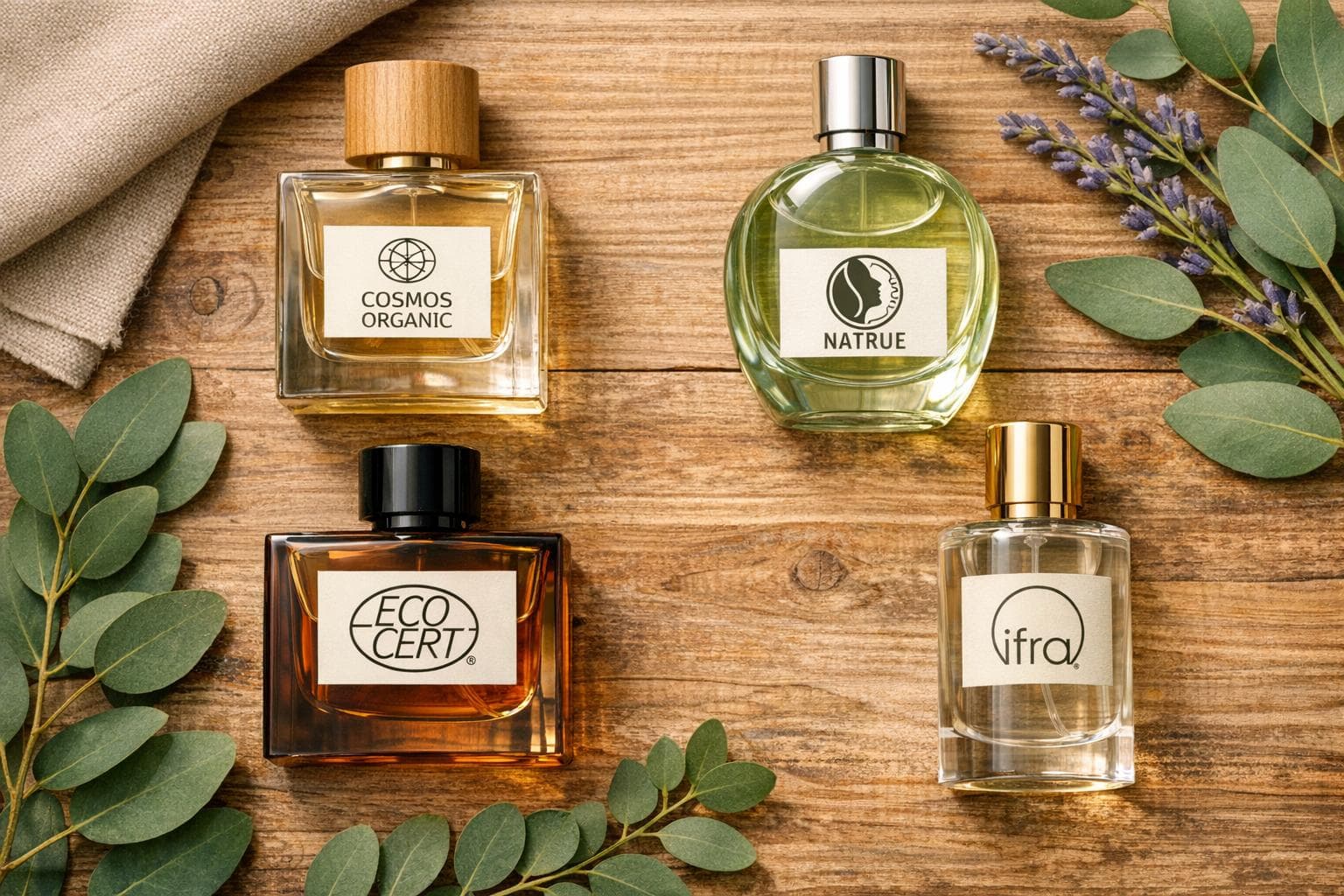
Vous souhaitez vous assurer que votre parfum est sûr et fabriqué de manière responsable ? Les certifications peuvent vous guider. Ces labels attestent que les parfums respectent des normes strictes en matière de sécurité des ingrédients, d’approvisionnement et de production. Mais toutes les allégations ne se valent pas : certaines reposent sur des contrôles rigoureux, tandis que d’autres relèvent simplement du marketing. Voici ce qu’il faut savoir :
- Certifications clés : recherchez des labels comme Ecocert, COSMOS ORGANIC ou NATRUE pour les ingrédients naturels et biologiques. Les normes IFRA garantissent des limites de sécurité pour les composants parfumants.
- Où vérifier : les logos de certification figurent souvent sur l’emballage ou près de la liste des ingrédients. Pour la conformité IFRA, demandez aux marques un certificat de conformité.
- Vérifier l’authenticité : utilisez les bases de données des organismes certificateurs, comme COSMOS ou Ecocert, pour confirmer les références d’un produit.
- Pourquoi c’est important : les parfums certifiés excluent les substances chimiques nocives, privilégient un approvisionnement responsable et offrent une véritable transparence.
Step 1: Learn the Main Certification Standards
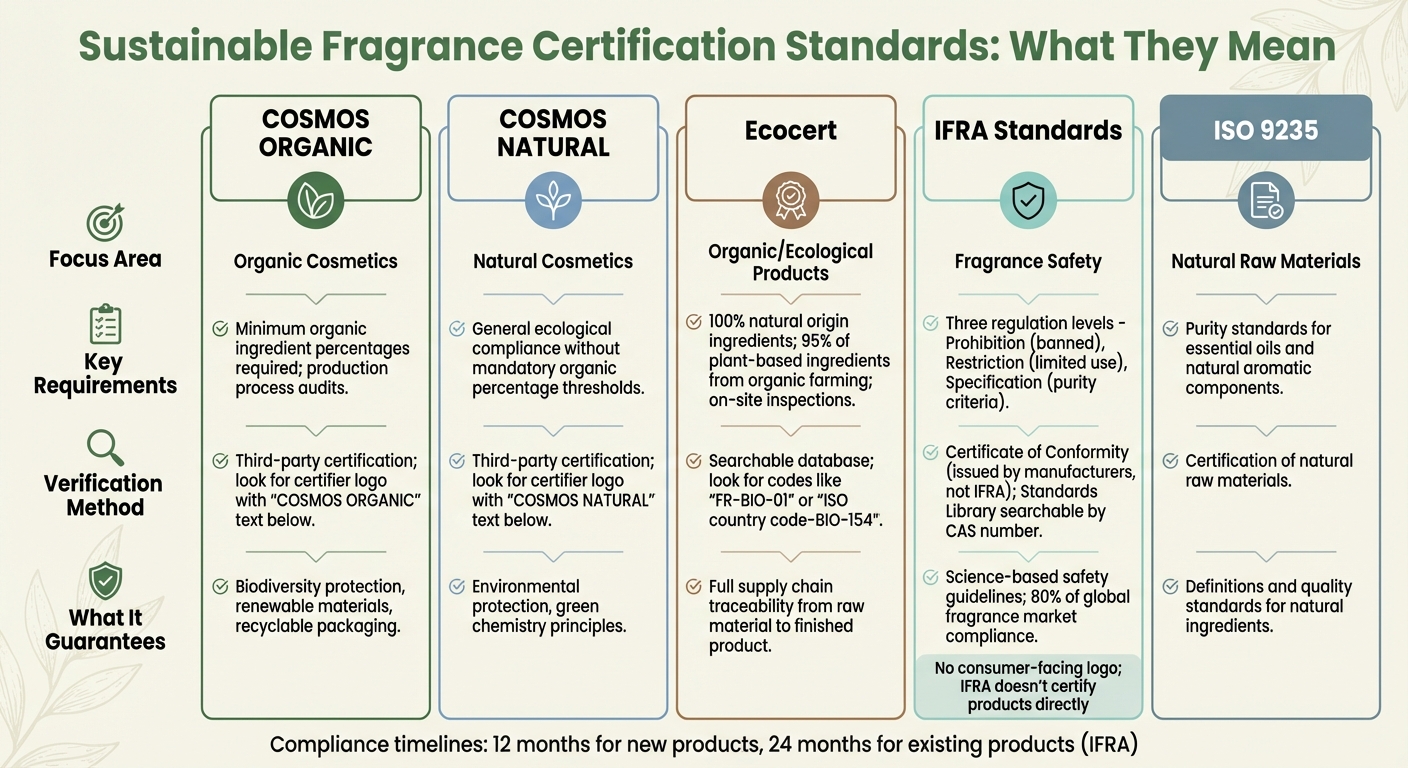
Guide comparatif des normes de certification des parfums durables
Comprendre les normes de certification est essentiel pour identifier les parfums en accord avec des pratiques durables. Les certifications peuvent varier considérablement : certaines impliquent des audits tiers stricts, tandis que d’autres reposent sur l’autorégulation. Examinons de plus près la manière dont des certifications comme Ecocert, COSMOS et d’autres établissent ces références.
Ecocert et COSMOS

Ecocert est un organisme de certification qui évalue l’ensemble de la chaîne d’approvisionnement afin de garantir la conformité aux normes biologiques et écologiques. C’est une référence reconnue dans des secteurs tels que les cosmétiques, les textiles et les éco-produits.
"La marque Ecocert est la référence en matière d’étiquetage biologique et écologique, reconnue par les consommateurs." — Ecocert
La certification COSMOS (COSMetic Organic and Natural Standard) propose deux labels distincts : COSMOS ORGANIC et COSMOS NATURAL. COSMOS ORGANIC exige un pourcentage minimum d’ingrédients biologiques, tandis que COSMOS NATURAL garantit le respect de critères écologiques généraux sans imposer de seuil biologique minimum.
Ces deux certifications mettent l’accent sur l’approvisionnement en ingrédients, la protection de l’environnement et la chimie verte. Elles favorisent la biodiversité, les matériaux renouvelables et les emballages recyclables. Pour vérifier la certification d’un produit, recherchez le logo Ecocert ou le label COSMOS, qui indique souvent le pourcentage biologique sur l’emballage.
À l’inverse, l’Environmental Working Group (EWG) adopte une approche différente, centrée sur la sécurité des ingrédients.
EWG Verified
Le label EWG Verified garantit qu’un produit répond à des normes strictes de sécurité et de transparence. Les produits portant cette certification sont évalués selon la base de données de sécurité chimique de l’EWG, en excluant les ingrédients signalés comme présentant des risques potentiels pour la santé ou l’environnement. De plus, les marques doivent divulguer tous les ingrédients pour obtenir ce label.
Les normes mondiales telles que l’IFRA et l’ISO 9235 jouent également un rôle important dans le maintien de la sécurité et de la pureté.
IFRA et ISO 9235
Les normes de l’International Fragrance Association (IFRA) sont des directives fondées sur la science pour la création de parfums. Ces normes sont élaborées avec la contribution du Research Institute for Fragrance Materials (RIFM) et examinées par un comité d’experts indépendant.
L’IFRA définit trois niveaux de réglementation des ingrédients : Interdiction (substances bannies), Restriction (usage limité) et Spécification (critères de pureté). Les nouvelles directives accordent généralement 12 mois aux nouveaux produits et 24 mois aux produits existants pour se conformer.
De son côté, la norme ISO 9235 se concentre sur les matières premières aromatiques naturelles. Cette norme définit et certifie les huiles essentielles et d’autres composants naturels afin de garantir qu’ils respectent les exigences de pureté.
Pour confirmer la conformité aux normes IFRA, recherchez un certificat de conformité IFRA. Bien que ce certificat soit délivré par les fabricants de parfums — et non par l’IFRA elle-même — il atteste qu’un mélange parfumé respecte les directives de sécurité pour l’usage auquel il est destiné. Il est toutefois important de noter que ce document ne remplace pas une évaluation complète de la sécurité.
| Norme de certification | Domaine d’application | Principaux critères de vérification |
|---|---|---|
| COSMOS ORGANIC | Cosmétiques biologiques | Pourcentages minimaux d’ingrédients biologiques ; audits des processus de production |
| COSMOS NATURAL | Cosmétiques naturels | Conformité générale sans exigence de pourcentage biologique |
| Normes IFRA | Sécurité des parfums | Interdictions (Prohibition), limitations (Restriction) ou règles de pureté (Specification) |
| ISO 9235 | Matières premières naturelles | Définitions et certification des matières premières aromatiques naturelles |
| Ecocert | Biologique/Écologique | Inspections sur site ; traçabilité de la matière première au produit fini |
Ces certifications sont des outils essentiels pour faire des choix de parfums durables en toute connaissance de cause.
Étape 2 : Repérer les marques de certification sur l’emballage
Une fois familiarisé avec les principales normes de certification, l’étape suivante consiste à localiser ces marques sur les emballages réels des produits. Les logos de certification peuvent être difficiles à repérer : ils ne sont pas toujours mis en évidence et leur emplacement varie selon le design de l’emballage et le type de certification.
Où chercher les logos de certification
Commencez par examiner l’avant et l’arrière des boîtes de parfum. Par exemple, l’Écolabel européen, reconnaissable à son logo en forme de fleur avec des étoiles en guise de pétales et un symbole "€", figure généralement sur l’emballage ou sur les encarts inclus.
Pour les certifications COSMOS, recherchez un logo en deux parties : le symbole de l’organisme certificateur placé au-dessus du texte indiquant soit "COSMOS ORGANIC", soit "COSMOS NATURAL".
"COSMOS ORGANIC ou COSMOS NATURAL apparaîtra toujours juste en dessous du logo/de la marque de l’organisme certificateur ou de l’association responsable, afin que les consommateurs puissent reconnaître des associations et certificateurs connus et dignes de confiance." — COSMOS-standard
Examinez également d’autres zones de l’emballage ou les documents d’accompagnement pour obtenir davantage de détails. Par exemple, les pourcentages biologiques sont souvent indiqués près de la liste des ingrédients ou à côté du logo de certification. Si le produit est certifié par Ecocert, recherchez des codes tels que "FR-BIO-01" (spécifique à la France) ou des codes similaires au format "code pays ISO-BIO-154".
Gardez à l’esprit que l’IFRA (International Fragrance Association) ne fournit pas de logos destinés aux consommateurs. Tout produit prétendant être "certifié IFRA" est trompeur. À la place, la conformité IFRA est confirmée par une documentation interentreprises, telle qu’un certificat de conformité.
Comprendre les allégations figurant sur l’étiquette
Au-delà des logos de certification, il est essentiel d’examiner attentivement les allégations figurant sur l’étiquette afin de s’assurer de leur légitimité. Des termes comme "naturel" ou "biologique" ne sont pas toujours étayés par une vérification tierce. Vérifiez toujours ces affirmations au regard des marques de certification afin de distinguer les normes vérifiées de simples arguments marketing.
Lorsque vous voyez le terme "biologique" sur une étiquette, recherchez le pourcentage correspondant d’ingrédients biologiques. Les produits certifiés COSMOS, par exemple, doivent afficher ce pourcentage, calculé soit comme une proportion du produit total, soit hors eau et minéraux. Cela permet de déterminer clairement si le produit relève de COSMOS ORGANIC ou de la catégorie COSMOS NATURAL.
Le terme "naturel" mérite lui aussi une attention particulière. Recherchez des références à des normes telles que l’ISO 9235, qui définit les matières premières aromatiques naturelles, ou à des certifications comme le label NATRUE, qui authentifie les cosmétiques naturels et biologiques. Sans ces marques, le terme "naturel" peut n’être qu’un procédé marketing.
Les allégations telles que "issu d’un approvisionnement durable" doivent également être associées à des certifications crédibles. Par exemple, l’Écolabel européen désigne des produits se situant parmi les 10 % à 20 % les mieux classés du marché en matière de performance environnementale. Ce label écologique de type I (ISO 14024) est vérifié par un tiers et évalue l’ensemble du cycle de vie du produit.
| Marque de certification | Ce qu’il faut rechercher | Emplacement habituel |
|---|---|---|
| Écolabel européen | Le logo de la "fleur de l’UE" | Avant/arrière de la boîte, supports promotionnels |
| COSMOS ORGANIC | Le texte "COSMOS ORGANIC" sous le logo du certificateur | Panneau arrière, près de la liste des ingrédients |
| COSMOS NATURAL | Le texte "COSMOS NATURAL" sous le logo du certificateur | Panneau arrière, près de la liste des ingrédients |
| Ecocert | La mention "Certified by Ecocert" ou des codes (FR-BIO-01) | Panneau arrière, zone de certification |
| % biologique | Pourcentage numérique (par ex. "95 % biologique") | Près de la marque de certification ou de la liste des ingrédients |
Votre expert parfum personnel vous attend
Faites notre quiz olfactif express pour découvrir des parfums de créateurs et de niche authentiques, choisis selon vos goûts – explorez-les en décants et échantillons de 2, 5, 8 et 30 ml, pour essayer chaque fragrance avant de vous engager sur un flacon entier.
Trouvez votre parfumÉtape 3 : Confirmer que les certifications sont authentiques
Repérer un logo de certification n’est qu’un premier pas. Ce qui compte vraiment, c’est de s’assurer que cette certification est authentique et ne constitue pas simplement un artifice marketing. Heureusement, la plupart des grands organismes certificateurs mettent à disposition des outils permettant de vérifier leurs allégations.
Consultez les bases de données officielles des certifications
Commencez par effectuer une recherche dans la base de données officielle de l’organisme certificateur. Par exemple, COSMOS propose une base de données publique "PRODUCTS" dans laquelle vous pouvez rechercher des articles précis afin de confirmer leur statut ORGANIC ou NATURAL. De même, Ecocert dispose d’un répertoire consultable couvrant plus de 150 normes, notamment dans les domaines des cosmétiques et des parfums d’intérieur.
Pour les produits certifiés par Ecocert, vous pouvez également vérifier les codes figurant sur l’emballage (comme FR-BIO-01 ou code pays ISO-BIO-154) via leur système afin de vous assurer de leur authenticité.
Lorsqu’il s’agit de l’IFRA, le fonctionnement est un peu différent. L’IFRA ne délivre pas directement de certificats. À la place, les fabricants utilisent un modèle officiel pour déclarer leur conformité. Vous pouvez vérifier la conformité IFRA en consultant leur bibliothèque de normes, dans laquelle il est possible de rechercher des règles spécifiques relatives à des ingrédients à l’aide du numéro CAS (Chemical Abstracts Service).
"L’IFRA elle-même ne délivre pas de certificats et n’autorise aucune organisation tierce à certifier en son nom. Chaque fournisseur signataire est responsable de l’établissement et de la fourniture d’un certificat de conformité IFRA." – IFRA
Si des doutes subsistent après consultation de ces bases de données, il est temps de passer à l’étape suivante : contacter directement la marque.
Interrogez directement les marques
Si vous ne trouvez pas un produit dans la base de données d’un certificateur ou si vous avez besoin de davantage de clarté, contactez la marque. Demandez-lui des documents précis, tels que le certificat de conformité IFRA ou le certificat délivré par Ecocert.
Lors de votre demande, soyez aussi précis que possible. Mentionnez l’organisme certificateur, la date de certification et le produit concerné. Les marques qui ont entrepris les démarches nécessaires pour obtenir de véritables certifications sont généralement heureuses de fournir les documents requis.
Étape 4 : Essayez des parfums certifiés avec Scento
Une fois familiarisé avec l’identification et la vérification des certifications, il est temps de découvrir les parfums certifiés par vous-même. Grâce aux décants soigneusement sélectionnés de Scento, vous pouvez les essayer sans vous engager immédiatement dans l’achat d’un flacon grand format.
Comment Scento confirme l’authenticité des parfums
Scento garantit l’authenticité de chaque parfum en travaillant exclusivement avec des fabricants qui respectent le Code de bonnes pratiques de l’IFRA. Ce cadre d’autorégulation est suivi par des entreprises représentant environ 80 % du marché mondial de la parfumerie. Chaque parfum est accompagné d’un certificat de conformité aux normes IFRA, garantissant sa conformité aux réglementations mondiales en matière de sécurité et d’environnement.
Pour aller plus loin dans la vérification de la sécurité, Scento recoupe les ingrédients avec la liste de transparence de l’IFRA, qui compte 3 691 entrées en 2025. Pour les produits revendiquant un caractère naturel ou biologique, Scento met en avant ceux certifiés selon des normes telles qu’Ecocert. Cette certification exige que tous les ingrédients soient 100 % d’origine naturelle, avec au moins 95 % des ingrédients d’origine végétale issus de l’agriculture biologique. Un tel niveau d’exigence garantit que chaque parfum que vous essayez est à la fois certifié et sûr.
Découvrez les parfums en formats plus petits
Scento pousse cette démarche de vérification encore plus loin en proposant des décants dans ces formats : 2 ml, 5 ml et 8 ml, ainsi qu’un décant en flacon de 30 ml sur la plupart des parfums. Ces options plus petites vous permettent de tester la manière dont les parfums certifiés interagissent avec votre peau avant d’investir dans un flacon complet. Cela est particulièrement utile, car le pH de votre peau et ses huiles naturelles peuvent subtilement modifier l’odeur d’un parfum. De plus, les parfums produits de manière durable s’accompagnent souvent d’un prix plus élevé en raison de la qualité premium de leurs ingrédients et de leurs pratiques d’approvisionnement éthiques.
Les décants vous permettent également de découvrir l’évolution d’un parfum au fil de la journée et dans différents environnements. Des facteurs tels que la chaleur et l’humidité peuvent accentuer certaines notes et révéler des nuances qui vous échapperaient autrement. En outre, ils sont parfaits pour réaliser un test cutané, ce qui est essentiel, car les huiles essentielles naturelles peuvent parfois déclencher des réactions allergiques.
"Les consommateurs attendent désormais de la transparence. Quand vous lisez l’étiquette des ingrédients d’un parfum, vous voyez essentiellement de l’alcool... ainsi que fragrance ou parfum, ce qui est un cheval de Troie pouvant littéralement recouvrir des milliers d’ingrédients." – Cat Chen, fondatrice et CEO de Skylar
Conclusion : choisissez des parfums certifiés en toute confiance
Lorsque l’on sait quoi rechercher, vérifier les certifications devient simple. Des logos comme Ecocert, COSMOS ou NATRUE servent d’indicateurs immédiats de parfums durables certifiés. Pour en garantir l’authenticité, recoupez ces certifications via les bases de données officielles ou les documents fournis par les marques. Ces logos reflètent les normes respectées et vous aident à faire des choix éclairés en toute sérénité.
Comprendre ces certifications vous permet d’aligner vos achats sur vos valeurs. Elles confirment la sécurité des ingrédients et des pratiques d’approvisionnement responsables, vous offrant une véritable tranquillité d’esprit. Étant donné que les membres de l’IFRA représentent environ 80 % de l’approvisionnement mondial en parfums, vérifier la conformité IFRA ajoute un niveau supplémentaire d’assurance quant au profil de sécurité d’un produit.
Avant de vous engager dans un achat, l’essai reste essentiel, d’autant plus que les parfums durables certifiés affichent souvent un positionnement premium en raison de leur approvisionnement éthique et de la qualité supérieure de leurs ingrédients. Les décants de Scento offrent une solution pratique pour tester des parfums certifiés sur votre peau au fil du temps, afin de vous assurer qu’ils répondent à vos attentes. Cette approche réfléchie vous aide non seulement à trouver un sillage qui vous correspond, mais limite également le gaspillage lié aux achats non désirés, contribuant ainsi à un avenir plus durable.
FAQ
Comment puis-je vérifier si un parfum est certifié durable ?
Pour confirmer qu’une certification de durabilité d’un parfum est légitime, commencez par rechercher un logo de certification sur l’emballage ou dans la description du produit. Des organismes de confiance comme NATRUE, COSMOS et Ecocert disposent de logos officiels faciles à comparer avec ceux fournis par ces organisations. Certains produits peuvent également inclure des numéros d’enregistrement ou des QR codes, que vous pouvez vérifier directement sur le site du certificateur.
Si les informations restent vagues, approfondissez votre vérification. Comparez les allégations formulées — comme le pourcentage d’ingrédients biologiques — avec les normes définies par l’organisme certificateur. Des distributeurs comme Scento incluent souvent des informations détaillées sur les certifications dans leurs fiches produit et peuvent fournir des documents complémentaires sur demande. Ces démarches peuvent vous aider à confirmer que le parfum respecte bien des normes de durabilité vérifiées.
Quelle est la différence entre les certifications COSMOS ORGANIC et COSMOS NATURAL ?
La certification COSMOS ORGANIC garantit qu’au moins 95 % des ingrédients d’origine végétale d’un produit sont biologiques, avec un minimum de 20 % de la formule totale répondant aux normes biologiques (ce seuil descend à 10 % pour les produits rincés). Il est important de noter que l’eau et les minéraux sont exclus du calcul biologique dans le cadre de cette certification.
COSMOS NATURAL, en revanche, garantit que près de 99 % des ingrédients sont issus de sources naturelles, avec seulement une faible tolérance pour certains composants synthétiques spécifiques. Contrairement à COSMOS ORGANIC, cette certification n’impose pas de pourcentage minimal d’ingrédients biologiques dans la formule.
Bien que les deux certifications privilégient la durabilité et la clarté de l’étiquetage des ingrédients, COSMOS ORGANIC accorde une importance plus marquée à la teneur en ingrédients biologiques.
Pourquoi devrais-je choisir des parfums durables certifiés ?
Choisir des parfums dotés de certifications durables signifie que votre fragrance répond à des normes élevées en matière de respect de l’environnement, de pratiques éthiques et de sécurité. Des certifications telles que NATRUE, Ecocert ou la Charte de durabilité IFRA-IOFI garantissent que les ingrédients sont approvisionnés de manière responsable, que l’usage des pétrochimiques est réduit au minimum et que les déchets comme les émissions sont activement maîtrisés. Cette démarche réduit non seulement l’impact environnemental, mais contribue également à préserver la biodiversité et à soutenir des communautés agricoles éthiques.
Ces certifications mettent également l’accent sur la sécurité des consommateurs. Les parfums font l’objet de tests approfondis pour confirmer l’absence de substances nocives. De plus, elles assurent transparence et traçabilité, afin que chaque étape — de l’approvisionnement en matières premières à la création du produit final — soit responsable et vérifiable. Opter pour des parfums durables certifiés reflète un choix éclairé, où les préférences personnelles se conjuguent à un engagement en faveur de valeurs environnementales et éthiques.

