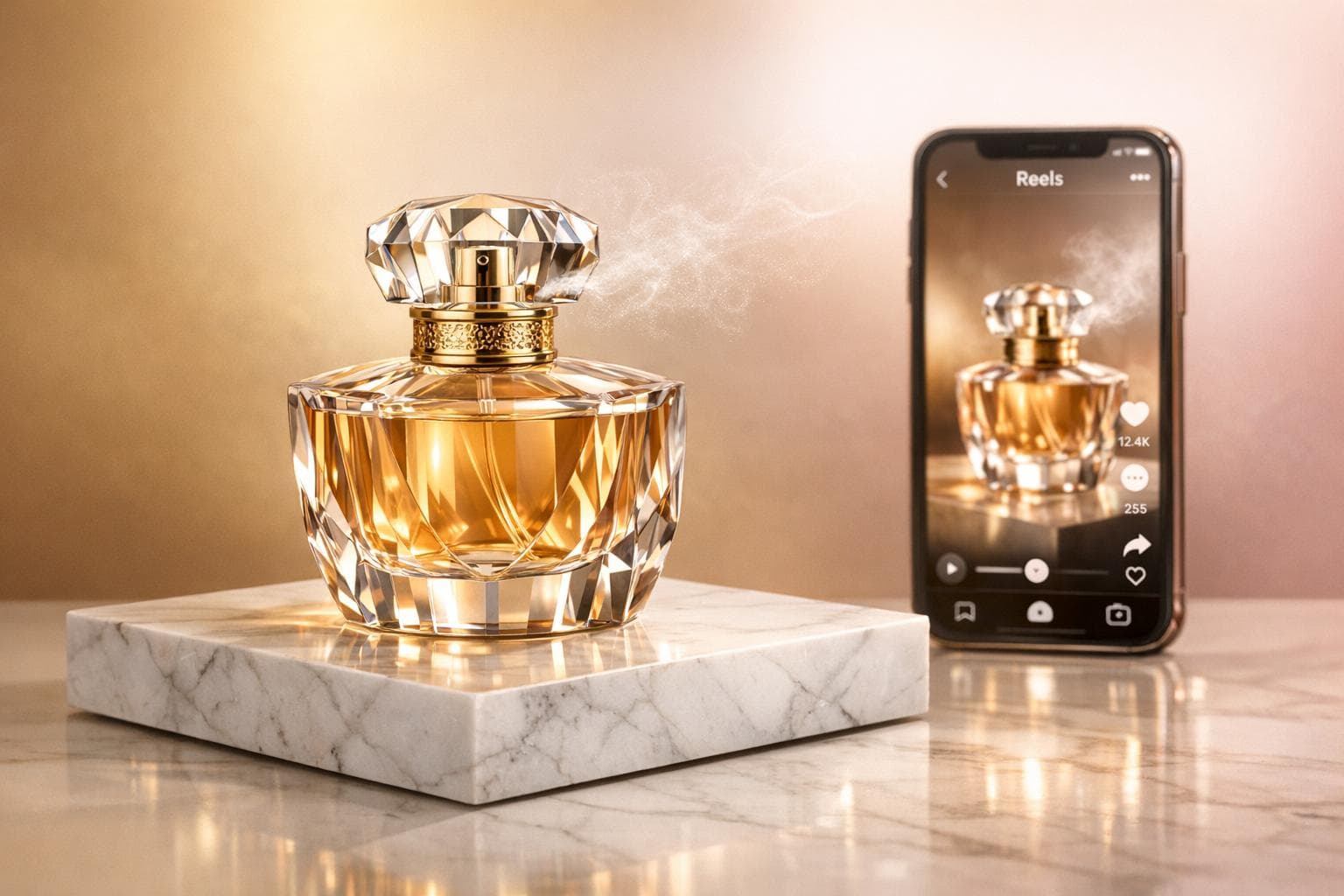
En 2025, Instagram est devenu un véritable catalyseur pour les marques de parfums de luxe. Avec plus de 2 milliards d’utilisateurs et 80 % des achats de luxe influencés par les interactions en ligne, Instagram s’impose désormais comme la plateforme incontournable pour la découverte, le storytelling et la création de liens émotionnels. Voici comment les marques de fragrances de luxe prospèrent :
- Les Reels dominent : Les vidéos courtes offrent une portée deux fois supérieure à celle des publications statiques, ce qui les rend essentielles pour mettre en scène les fragrances à travers un contenu artistique au style éditorial.
- Réalité augmentée (AR) : Des campagnes comme les filtres AR de Prada fusionnent expériences physiques et numériques, stimulant l’engagement et les achats impulsifs.
- Impact des influenceurs : Les micro-influenceurs, forts d’audiences fidèles, inspirent confiance et génèrent des ventes, tandis que les partenariats au long cours amplifient la résonance de la marque.
- Storytelling visuel : Les marques de luxe utilisent couleurs, textures et mouvement pour évoquer les profils olfactifs, créant des connexions émotionnelles par l’image.
- Intégration du shopping : Des fonctionnalités comme les tags produits et Instagram Shopping fluidifient le parcours, de la découverte à l’achat.
Les marques de parfums de luxe misent sur un storytelling porté par l’émotion, l’héritage et l’exclusivité, tout en exploitant les outils d’Instagram pour engager les utilisateurs et stimuler les ventes. Du contenu soigneusement orchestré aux campagnes d’influence, la plateforme redessine la manière dont les parfums sont commercialisés à l’ère numérique.
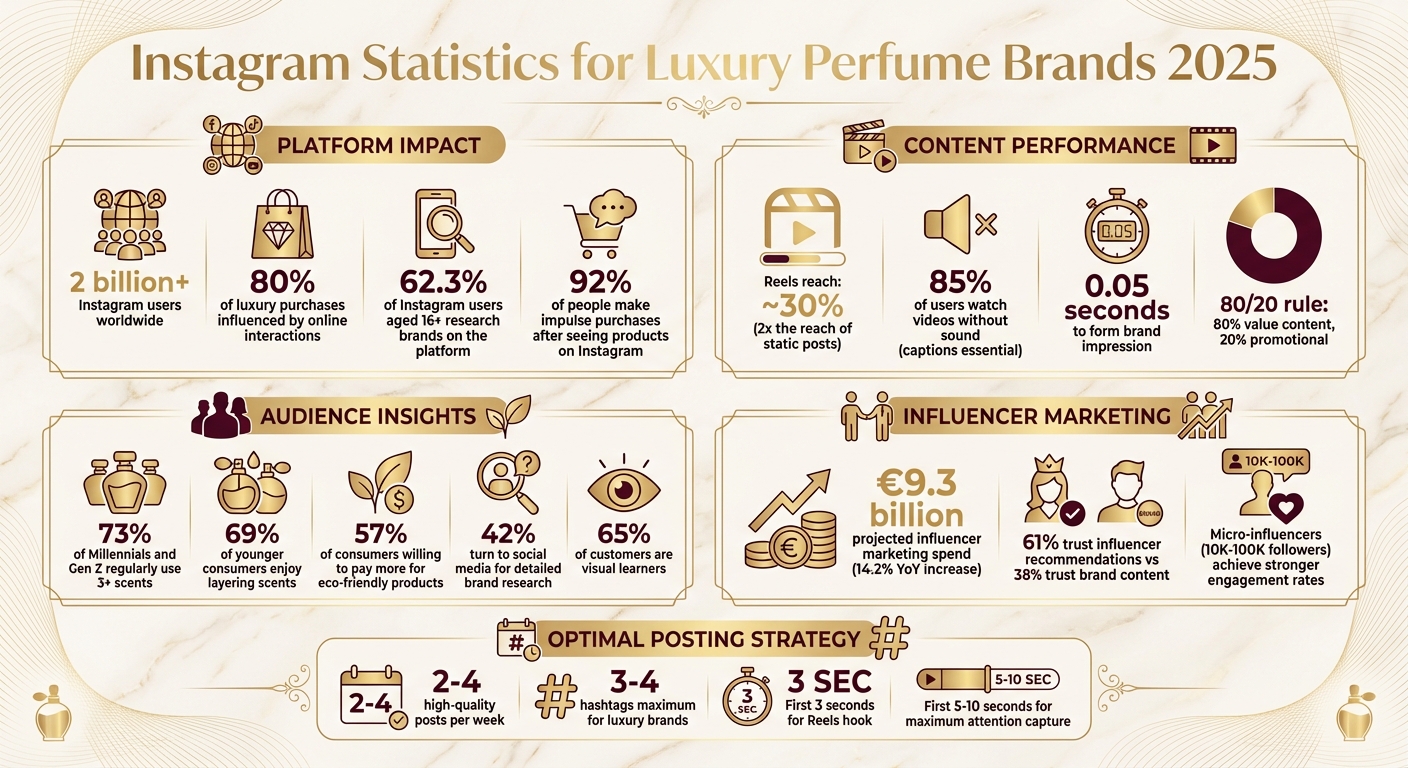
Statistiques du marketing Instagram pour les marques de parfums de luxe 2025
Construire votre marque de parfum de luxe sur Instagram
Définir les piliers de votre marque
Les piliers de votre marque constituent l’épine dorsale de votre stratégie Instagram. En 2025, les marques de parfums de luxe adoptent un storytelling guidé par l’émotion, en cherchant à éveiller des sentiments, des souvenirs et des univers esthétiques plutôt qu’à cibler des segments démographiques traditionnels.
Les marques les plus influentes bâtissent leurs piliers autour de valeurs telles que l’héritage, le savoir-faire, la durabilité, la transparence et l’exclusivité. Une tendance plus récente — le storytelling à travers la fragrance — séduit les consommateurs contemporains, en particulier les 73 % des Millennials et de la Gen Z qui utilisent régulièrement plus de trois senteurs. Ils souhaitent découvrir le parcours du parfumeur, l’origine des ingrédients et l’alchimie qui se cache derrière des compositions complexes.
Le Labo en est un exemple remarquable, avec son approche du « slow luxury ». La maison compose ses fragrances à la main en boutique et personnalise les étiquettes avec le nom du client et la date, créant ainsi un lien profondément personnel.
"Les consommateurs recherchent véritablement une nouvelle forme de storytelling — plus visuelle, plus cinématographique, plus inspirante."
- Pascal Fontaine, fondateur, Amoi Parfums
Lors de la définition de vos piliers, envisagez d’intégrer des traditions moyen-orientales, telles que les rituels de superposition et des ingrédients somptueux comme le oud et l’encens. Ces éléments exercent une influence croissante sur les tendances mondiales du luxe. Un autre domaine en plein essor est celui des fragrances fonctionnelles — des senteurs conçues pour favoriser le bien-être en améliorant l’humeur ou en encourageant la relaxation. Cette évolution redéfinit la manière dont les consommateurs choisissent leurs parfums.
Une fois vos piliers établis, l’étape suivante consiste à créer une identité visuelle qui reflète ces valeurs.
Créer votre identité visuelle
Votre identité visuelle sur Instagram doit immédiatement évoquer le luxe, avant même qu’un seul mot ne soit lu. Un placement cohérent du logo, des palettes chromatiques soigneusement choisies et un stylisme professionnel soutenu par une retouche épurée sont essentiels pour projeter le prestige.
En 2025, le contenu de luxe qui paraît authentique surpasse les formes de publicité plus traditionnelles. Plutôt que des annonces trop léchées, privilégiez une photographie lifestyle qui s’intègre naturellement dans le fil des utilisateurs. Un branding subtil — comme des filtres cohérents, des harmonies colorées ou des logos discrets — permet à vos publications de paraître organiques plutôt que manifestement promotionnelles.
Parfums de Marly illustre parfaitement cette approche. En misant sur une stratégie soigneusement éditée et en ne lançant qu’une ou deux fragrances à la fois, la maison a atteint la première place en tant que marque de parfums leader sur Instagram en mai 2025.
Limitez votre typographie à trois polices pour les textes superposés et respectez une palette de couleurs de marque clairement définie sur toutes les publications, Stories et Reels. Puisque 85 % des utilisateurs regardent les vidéos sur les réseaux sociaux sans le son, le texte à l’écran et les sous-titres sont indispensables pour transmettre votre message. Par ailleurs, utilisez des formats verticaux (9:16) ou carrés (1:1) afin que votre contenu conserve une allure irréprochable sur smartphone.
Prada a démontré la puissance d’une identité visuelle forte avec sa campagne AR Paradoxe. En partenariat avec FFFACE.ME, la maison a installé des miroirs en réalité augmentée dans des lieux emblématiques comme l’Opéra de Paris. Ces miroirs transformaient le reflet des clients en une expérience de parfum personnalisée, complétée par des filtres AR Instagram encourageant les contenus générés par les utilisateurs.
Une fois votre identité visuelle affirmée, vos légendes et vos Stories doivent refléter le même niveau de raffinement.
Rédiger des légendes et des Stories en harmonie avec votre marque
Les légendes doivent évoquer des expériences sensorielles et émotionnelles. Au lieu de simplement énumérer les notes du parfum, décrivez des souvenirs saisissants comme « le contact frais du marbre après un orage d’été » ou « la chaleur d’une peau caressée par le soleil ». Utilisez des termes aromatiques précis tels que « notes boisées chaudes », « fleurs blanches » ou « accords ambrés-musqués » pour captiver les consommateurs en quête d’une compréhension plus profonde des compositions. Cela est d’autant plus pertinent pour les 69 % de jeunes consommateurs qui aiment superposer les senteurs et apprécient des conseils sur la manière dont les fragrances se répondent.
La transparence est essentielle. Alors que 57 % des consommateurs sont prêts à payer davantage pour des produits écoresponsables, utilisez vos légendes pour mettre en lumière vos initiatives durables, vos emballages éco-conçus et vos pratiques cruelty-free. De plus, puisque 42 % des consommateurs se tournent vers les réseaux sociaux pour effectuer des recherches approfondies sur les marques, communiquez clairement vos valeurs et votre engagement envers ces principes.
Pour les Stories Instagram, misez sur des expériences personnelles et exclusives. Des unboxings en direct, des visites des coulisses de votre laboratoire et des sessions de questions-réponses peuvent instaurer une véritable proximité et nourrir la confiance. Utilisez des fonctionnalités interactives comme les sondages, les questions et les quiz pour créer un échange à double sens avec votre audience. Mettez en avant des rituels tels que des présentations de produits soigneusement composées, des tutoriels de layering olfactif ou le choix d’un parfum pour des occasions particulières afin de tisser un lien authentique avec votre communauté.
Dolce & Gabbana a démontré la puissance du storytelling avec sa campagne du 25e anniversaire de « Light Blue » en mai 2025. Portée par des talents de premier plan comme Vittoria Ceretti et Theo James, la campagne leur a permis de gagner 36 places dans les classements d’engagement Instagram grâce à des récits visuels particulièrement captivants.
"Le marketing du parfum en 2025 parle moins des caractéristiques du produit que du sillage émotionnel qu’il laisse derrière lui."
Pour les marques proposant des coffrets découverte, les légendes doivent mettre en lumière le voyage qui mène de la curiosité à l’engagement. Scento (https://scento.com) en est un excellent exemple. La marque propose des décants soigneusement sélectionnés qui permettent aux clients d’explorer des fragrances sans supporter immédiatement le coût d’un flacon au prix fort. Cette approche équilibre accessibilité et exclusivité, tout en renforçant l’attrait premium des parfums de luxe.
Stratégies de contenu pour les marques de parfums de luxe
Les principaux types de contenu et leur objectif
Une stratégie de contenu bien conçue s’appuie sur l’identité visuelle et le storytelling d’une marque pour transformer l’intérêt en action. Les marques de parfums de luxe suivent souvent la règle du contenu 80/20 : 80 % des publications visent à apporter de la valeur — comme des conseils pédagogiques, des coulisses ou du contenu généré par les utilisateurs — tandis que seulement 20 % sont directement promotionnelles. Cet équilibre permet de préserver la confiance et d’éviter une image trop centrée sur la vente.
Pour les parfums de luxe, le storytelling de marque doit mettre en avant l’héritage et le savoir-faire plutôt que les seules caractéristiques du produit. Partagez le processus créatif du parfumeur, le parcours de sourcing d’ingrédients rares ou les inspirations historiques d’une fragrance. Dans le même temps, le contenu éducatif peut guider les clients dans le choix de leurs senteurs. Par exemple, expliquez les niveaux de projection — tels que « Personal » (près de la peau), « Expressive » (perceptible à distance d’un bras) ou « Bold » (qui emplit une pièce) — afin d’aider les acheteurs en ligne à prendre des décisions éclairées.
Le contenu lifestyle relie vos fragrances à des instants aspirationnels, comme les rituels du matin, l’élégance du soir ou les échappées de voyage. Sachant que plus de 80 % des achats de luxe sont influencés par les interactions en ligne — même lorsque la vente finale a lieu en boutique — chaque contenu joue un rôle dans la formation de la décision d’achat.
Pour les marques qui proposent des kits découverte ou des échantillons soigneusement composés, mettez en avant l’expérience d’exploration avant l’engagement envers un flacon grand format. Scento (https://scento.com), par exemple, souligne la manière dont ses décants sélectionnés permettent aux clients d’essayer d’authentiques parfums de créateurs, rendant le luxe plus accessible tout en préservant son exclusivité.
Tirer le meilleur parti des formats Instagram
Chaque format Instagram remplit une fonction spécifique dans votre stratégie de contenu. Les Reels sont parfaits pour toucher de nouveaux publics et stimuler la découverte. Pour capter l’attention dans un fil parcouru à grande vitesse, le hook doit intervenir dans les trois premières secondes. Utilisez des courts-métrages à la qualité éditoriale pour renforcer l’image luxueuse de votre marque.
Les carrousels sont idéaux pour un storytelling détaillé et pédagogique. Servez-vous-en pour présenter les produits sous plusieurs angles, proposer des tutoriels de layering olfactif ou expliquer des profils de fragrance tels que les catégories « Scent Space », qui aident les acheteurs à comprendre l’expérience d’une senteur. Les Stories, quant à elles, sont excellentes pour créer des connexions en temps réel. Intégrez des éléments interactifs comme des sondages, des stickers Q&R ou des aperçus des coulisses. Utilisez le sticker « Notify » pour promouvoir des lancements à durée limitée — les abonnés qui l’activent recevront des rappels au moment de la mise en ligne de votre événement.
Les publications de grille font office de showroom digital pour votre marque. Réservez cet espace à des contenus intemporels, comme des visuels de campagne en haute résolution ou des publications mettant en scène l’héritage de votre maison. Épinglez les publications clés — comme les guides cadeaux saisonniers ou les annonces de produits en édition limitée — en haut de votre grille. Sachant que 62,3 % des utilisateurs d’Instagram âgés de 16 ans et plus utilisent la plateforme pour se renseigner sur les marques, le contenu de votre grille joue un rôle déterminant dans la perception qu’ils en ont.
Visez deux à quatre contenus de grande qualité par semaine. Cela garantit une présence régulière tout en maintenant l’engagement de votre audience sans la saturer. Dans l’univers du luxe, la qualité doit toujours primer sur la quantité. Par ailleurs, alignez votre calendrier éditorial sur les tendances saisonnières et les moments clés afin de maximiser l’engagement.
Planification de contenu saisonnier et événementiel
Une planification de contenu efficace va au-delà des publications réactives en s’alignant stratégiquement sur les lancements saisonniers, les temps forts du gifting et les événements culturels. Pendant les périodes de forte demande, comme les fêtes, privilégiez l’utilité — mettez en avant les dates limites d’expédition, créez des guides cadeaux soigneusement composés et utilisez des messages de type « Dernière chance » pour les éditions limitées afin de susciter un sentiment d’urgence.
Les outils de social listening peuvent vous aider à adapter votre contenu saisonnier aux notes de parfum en vogue et aux préférences de votre audience. Par exemple, proposer un packaging saisonnier en édition limitée avant d’intégrer une senteur à votre collection permanente peut susciter l’enthousiasme et mesurer l’intérêt du marché. Pour les marques mondiales, adapter le contenu aux fêtes régionales et aux langues locales peut renforcer le lien émotionnel avec des publics variés.
Profitez de la fonctionnalité « Publications épinglées » d’Instagram pour garder des informations importantes, comme les promotions saisonnières, visibles en haut de votre profil. Les publicités avec rappel constituent également un outil efficace, permettant aux spectateurs d’opter pour des notifications concernant de prochains lancements ou événements. Sachant que 92 % des personnes effectuent des achats impulsifs lorsqu’elles voient un produit sur Instagram, synchroniser votre contenu avec les moments clés de décision peut considérablement améliorer les conversions.
Storytelling visuel pour la fragrance
Le storytelling visuel joue un rôle essentiel dans la transformation des qualités intangibles des parfums de luxe en expériences numériques captivantes. Puisqu’un parfum ne peut être transmis directement à travers un écran, tout l’enjeu consiste à utiliser l’image pour éveiller les autres sens et forger un lien émotionnel.
Utiliser la couleur, la texture et le mouvement pour suggérer une senteur
Avec 65 % des clients identifiés comme des apprenants visuels, les visuels deviennent indispensables pour évoquer l’essence d’un parfum. Des éléments tels que la couleur, la texture et le mouvement peuvent aider à combler cette distance sensorielle.
La théorie des couleurs est particulièrement efficace pour transmettre les familles olfactives. Les teintes vibrantes conviennent parfaitement aux senteurs hespéridées, tandis que des tons profonds et fumés associés à des détails métalliques évoquent la richesse des parfums boisés et du oud. Pour les fragrances qui évoquent la nostalgie ou la propreté, des tons doux et délavés combinés à un éclairage cinématographique créent une sensation de confort et de mémoire.
Les textures jouent elles aussi un rôle clé dans le storytelling visuel. Des matières comme le lin, le bois, le marbre et le velours peuvent refléter la personnalité d’un parfum. Associez ces signaux tactiles à des visuels dynamiques, comme des ralentis de liquide se déployant sur des surfaces texturées ou la vaporisation élégante d’un atomiseur. Ces techniques suggèrent non seulement le mouvement d’une senteur, mais produisent également un contenu visuellement fascinant. En effet, les contenus vidéo tendent à générer davantage d’engagement — likes et commentaires — lorsqu’ils s’accompagnent d’une esthétique expressive et évocatrice.
"Les consommateurs recherchent véritablement une nouvelle forme de storytelling — plus visuelle, plus cinématographique, plus inspirante",
déclare Pascal Fontaine, fondateur d’Amoi Parfums.
Puisque les utilisateurs se forgent une impression d’une marque en seulement 0,05 seconde, chaque élément visuel doit communiquer instantanément l’identité de la fragrance. Cette approche guidée par les sens pose les bases des tendances émergentes qui continuent de façonner l’image de marque des parfums de luxe.
Tendances visuelles du luxe en 2026
Le minimalisme demeure une force dominante dans l’image de marque des fragrances de luxe. Des marques comme Jo Malone excellent dans l’art d’utiliser des visuels sobres — présentant leurs flacons de parfum aux côtés d’ingrédients bruts et naturels comme des fleurs, des herbes ou des plantes qui inspirent la senteur. Cette approche renforce non seulement l’identité de marque, mais dégage également une sophistication naturelle.
Les Reels cinématographiques sont devenus un incontournable de la découverte. Captiver les spectateurs dans les trois premières secondes est essentiel, avec un mouvement pensé pour refléter la personnalité de chaque fragrance. Ces courts films puisent souvent leur inspiration dans le cinéma indépendant et les éditoriaux de mode vintage, en se concentrant sur les émotions et sensations qu’un parfum suscite plutôt que sur la simple présentation du flacon.
Une autre évolution notable est l’essor des visuels authentiques et ancrés dans le lifestyle. Si les shootings aspirationnels conservent leur place, les images plus spontanées de personnes portant des fragrances dans des contextes quotidiens favorisent la confiance et la proximité. Cela rejoint l’esthétique « unbrand », qui privilégie les packagings minimalistes, les détails manuscrits et des visuels bruts, peu retouchés, suscitant davantage la curiosité que la perfection.
Le micro-détail s’est également imposé comme un outil puissant. Mettre en lumière de petits instants riches en sensations — comme le clic satisfaisant d’un capuchon de parfum, la manière dont la lumière danse à travers un flacon en verre, ou la diffusion précise du nuage de parfum par un atomiseur — permet de traduire l’expérience du luxe en contenus courts, séduisants et immédiatement captivants.
Associer les familles olfactives à des styles visuels
Dans le prolongement de ces tendances, des styles visuels adaptés peuvent enrichir le storytelling de familles olfactives spécifiques.
- Senteurs hespéridées et fraîches : Des visuels lumineux baignés de soleil, associés à des textures tropicales comme la peau, le sable et l’eau, évoquent l’énergie insouciante de l’été.
- Fragrances boisées et au oud : Une imagerie inspirée du patrimoine, aux tons profonds et fumés relevés de touches métalliques, souligne la dimension rituelle et stratifiée de ces senteurs. Mettre en scène des flacons ornés et des matières luxueuses ajoute de la profondeur et de la richesse.
- Fragrances gourmandes : Ces senteurs, souvent évocatrices de vanille, de pêche ou de pistache, gagnent à être accompagnées d’une imagerie chaleureuse inspirée de l’univers culinaire. Des gros plans sur les ingrédients, des cadres enveloppants et des tonalités accueillantes peuvent presque donner aux spectateurs l’impression de « goûter » le parfum.
- Parfums de niche et indépendants : Un branding artistique et hyper-spécifique fonctionne particulièrement bien ici. L’imagerie peut capturer des instants fugaces, comme la fraîcheur du marbre après la pluie ou le miroitement d’un bitume mouillé dans une ville vibrante comme Tokyo. Ces visuels séduisent ceux qui recherchent des expériences intimes et non conventionnelles.
Pour les marques proposant des kits découverte ou des parcours personnalisés, l’accent doit être mis sur des visuels qui soulignent l’aventure de la recherche du parfum signature. L’essentiel est de trouver l’équilibre entre accessibilité et exclusivité, afin que le luxe paraisse à la fois accueillant et aspirationnel.
sbb-itb-fb213bc
Travailler avec des influenceurs et exploiter les données
Collaborer avec des influenceurs et des créateurs
Les partenariats stratégiques avec les influenceurs demeurent un moyen puissant d’entrer en contact avec une audience ciblée. En 2025, les dépenses consacrées à l’influencer marketing devraient atteindre 9,3 milliards d’euros, soit une hausse annuelle de 14,2 %. Différents types d’influenceurs jouent des rôles distincts dans cet écosystème.
Les évaluateurs de parfums sont très appréciés pour leurs analyses approfondies des notes, de la tenue et de la composition. Leurs audiences, bien que de niche, sont fortement engagées et souvent activement à la recherche de leur prochaine fragrance signature. À l’inverse, les influenceurs lifestyle excellent dans la création de liens émotionnels et la génération d’une large notoriété grâce à un storytelling aspirationnel et à des visuels de grande qualité.
La tendance en faveur des micro-influenceurs (ceux qui comptent entre 10 000 et 100 000 abonnés) continue de croître. Ces créateurs obtiennent souvent de meilleurs taux d’engagement grâce à leurs communautés fidèles et très soudées. Lors du choix de vos influenceurs, il est essentiel de ne pas s’arrêter au seul nombre d’abonnés. Des indicateurs comme la durée moyenne de visionnage (AVD) sont particulièrement précieux, car ils reflètent un intérêt réel du public et sont plus difficiles à manipuler que les likes ou les vues. Vérifiez toujours l’authenticité de l’audience à l’aide de données first-party récentes, idéalement issues des 30 derniers jours.
L’adéquation entre les influenceurs et le positionnement de votre marque constitue également un élément clé. Par exemple, un créateur qui chronique habituellement des fragrances de créateurs à 50 € pourrait ne pas trouver d’écho auprès d’un public habitué aux senteurs de niche à plus de 200 €. Examiner les contenus précédents d’un influenceur permet de s’assurer que son style et ses valeurs s’accordent avec l’identité de votre marque.
À la lumière de ces éléments, explorer différents formats de collaboration peut contribuer à amplifier l’impact de votre marque.
Les formats de collaboration qui fonctionnent en 2025
Les collaborations réussies vont au-delà du contenu ponctuel. Construire des relations d’ambassadeurs sur le long terme permet aux influenceurs d’intégrer naturellement vos fragrances dans leurs récits continus. Cette exposition répétée est particulièrement efficace pour le parfum, dont l’achat relève souvent d’une décision mûrement réfléchie.
Les Reels co-créés, qui ressemblent davantage à des films éditoriaux qu’à des publicités traditionnelles, s’avèrent particulièrement performants. En juin 2025, par exemple, Dior s’est associé au rappeur Travis Scott pour la campagne des sneakers B713. La maison a utilisé des teasers Instagram et des images des coulisses montrant Scott en collaboration avec le directeur artistique Kim Jones. Bien que cet exemple concerne la chaussure, l’approche se transpose parfaitement à la fragrance, en mettant en scène la créativité, l’inspiration et le savoir-faire.
Les formats émergents comme les expériences AR et le contenu interactif présentent eux aussi un fort potentiel. L’envoi de sets d’échantillons soigneusement sélectionnés à des influenceurs afin qu’ils créent des contenus d’unboxing et de revue constitue une autre stratégie percutante. Cette approche fonctionne particulièrement bien avec les reviewers de parfums, qui peuvent guider leur audience dans la découverte de plusieurs senteurs et la recherche d’une fragrance signature. Fournir un brief clair avec les objectifs de campagne tout en laissant une véritable liberté créative est essentiel, car 61 % des consommateurs font confiance aux recommandations des influenceurs, contre seulement 38 % pour les contenus produits par les marques.
Utiliser les métriques pour améliorer votre stratégie
Suivre les bons indicateurs peut faire toute la différence entre une campagne réussie et des ressources gaspillées. Si le CPM mesure l’efficacité des coûts, des métriques comme les sauvegardes, les partages et les messages directs offrent des éclairages plus profonds sur l’engagement de l’audience. Il convient de rappeler que plus de 80 % des achats de luxe sont influencés par les interactions en ligne, même lorsque la vente finale se conclut hors ligne.
"Le luxe n’est pas une question de portée, mais de résonance. Buzzz construit des stratégies sociales qui élèvent la marque, sans jamais la diluer." – Ahmed Tariq, CEO de Buzzz
Des métriques telles que le volume de recherche de marque peuvent révéler l’impact plus large des campagnes. Comme l’explique Tiffany Morris :
"Je ne pense pas que nos publicités [Google] seraient aussi performantes sans le soutien des reels. Depuis que nous publions des reels régulièrement, nous avons constaté une hausse des recherches de marque".
L’utilisation de landing pages spécifiques à chaque campagne, alignées sur le message de l’influenceur, aide à suivre efficacement les conversions. Pour les lancements en édition limitée, surveiller les volumes de précommande et les inscriptions sur liste d’attente peut fournir des indications précoces sur la demande.
Les tests d’incrémentalité constituent un autre outil clé pour mesurer l’impact réel des campagnes d’influence. Ces tests permettent d’isoler la hausse des ventes directement attribuable à la campagne, offrant une lecture plus précise que les codes promotionnels, souvent peu fiables en raison de l’exposition répétée au contenu. En outre, le suivi de la valeur moyenne des commandes (AOV) provenant du trafic généré par les influenceurs permet de vérifier l’adéquation de l’audience avec vos niveaux de prix luxe.
| Métrique | Ce qu’elle mesure | Pourquoi elle compte pour le parfum de luxe |
|---|---|---|
| Durée moyenne de visionnage (AVD) | Combien de temps les spectateurs regardent le contenu | Reflète un intérêt authentique de l’audience ; difficile à falsifier |
| Sauvegardes et partages | Engagement à forte intention | Indique la valeur du contenu et l’intention d’achat |
| Volume de recherche de marque | Recherches portant sur le nom de votre marque | Montre l’effet halo des campagnes d’influence |
| Valeur moyenne des commandes (AOV) | Valeur d’achat issue du trafic des influenceurs | Confirme l’alignement avec les prix du luxe |
Points clés pour réussir sur Instagram dans l’univers du parfum de luxe
Pour établir votre marque de parfum de luxe sur Instagram, concentrez-vous sur le storytelling. Consacrez 80 % de votre contenu à des récits qui mettent en lumière l’héritage, le savoir-faire et la puissance émotionnelle de votre marque, en ne réservant que 20 % à la promotion directe. Cet équilibre renforce l’identité de votre maison tout en créant une présence Instagram plus cohérente.
La cohérence visuelle est essentielle. Tenez-vous à une palette chromatique unifiée, à un style de lumière constant et à des filtres homogènes sur l’ensemble de vos publications afin de préserver une impression de prestige. Limitez également les hashtags — trois ou quatre tout au plus — car leur surabondance peut diluer votre image de luxe. En outre, puisque de nombreux utilisateurs regardent les vidéos sans le son, ajoutez toujours des sous-titres ou du texte à l’écran dans vos Reels.
Lorsque vous collaborez avec des influenceurs, déplacez votre attention du nombre d’abonnés vers la durée moyenne de visionnage (AVD). Cet indicateur est plus difficile à manipuler et reflète un engagement véritable de l’audience. Privilégiez des contrats à rémunération fixe plutôt que des modèles à la commission, et dirigez le trafic issu des influenceurs vers des landing pages dédiées à la campagne, en harmonie avec leur esthétique et en résonance avec leur communauté.
Au-delà des campagnes d’influence, donnez la priorité à un engagement qualitatif plutôt qu’au simple volume. Des métriques comme les sauvegardes et les partages témoignent d’une valeur aspirationnelle, tandis que le volume de recherche de marque peut révéler l’impact global de vos efforts sur Instagram. Répondez personnellement aux commentaires et aux messages privés, en évitant les réponses génériques ou automatisées. Une identité visuelle cohérente et des interactions porteuses de sens élèveront la présence de votre marque.
Les Reels Instagram sont un outil particulièrement puissant, offrant près de 30 % de portée, soit le double des publications statiques. Pour maximiser leur impact, captez l’attention dès les 5 à 10 premières secondes grâce à une accroche visuelle forte. En combinant ces stratégies, vous pourrez affiner votre approche sur Instagram et obtenir des résultats mesurables.
FAQ
Comment les marques de parfums de luxe peuvent-elles utiliser efficacement les Reels Instagram pour accroître l’engagement ?
Les marques de parfums de luxe peuvent laisser une impression durable sur Instagram en exploitant les Reels pour créer des contenus visuellement captivants, riches en narration, qui incarnent l’attrait sensoriel de leurs fragrances. Mettez en valeur l’essence de chaque parfum grâce à des plans rapprochés du flacon, au versement de formats d’échantillons (comme des fioles de 2 ml, 5 ml et 8 ml, ainsi qu’un décant en flacon de 30 ml sur la plupart des parfums) et à des décors soigneusement composés qui reflètent la personnalité de la fragrance. Intégrez un éclairage de haute qualité, des séquences au ralenti et une musique atmosphérique afin d’évoquer une sophistication incontestable. Associez ces visuels à des légendes engageantes détaillant les notes du parfum et à un appel à l’action clair, tel que « Touchez pour découvrir notre collection découverte 8 ml. »
Pour des résultats optimaux, alignez vos Reels sur les lancements produits, les tendances saisonnières ou les collaborations avec des influenceurs. Utilisez les statistiques d’Instagram pour suivre les indicateurs de performance, comme les vues et les partages, puis affinez votre approche selon les préférences de votre audience. Complétez vos Reels avec des hashtags stratégiques et intégrez-les dans les Stories, en ajoutant des liens shopping directs pour encourager les achats. Collaborer avec des influenceurs pour des vidéos authentiques d’unboxing ou de premières impressions peut amplifier l’engagement et renforcer la confiance des clients potentiels. En combinant créativité constante et ajustements guidés par les données, les marques de parfums de luxe peuvent transformer les Reels Instagram en une plateforme dynamique de connexion et de croissance des ventes.
Comment les marques de parfums de luxe peuvent-elles utiliser la réalité augmentée sur Instagram pour enrichir leur image de marque ?
La réalité augmentée (AR) offre aux marques de parfums de luxe une manière créative de transformer Instagram en un terrain de jeu interactif dédié à l’exploration olfactive. Grâce aux filtres AR, les abonnés peuvent virtuellement « essayer » une senteur en s’immergeant dans son univers à travers des palettes de couleurs vibrantes, en intégrant des flacons 3D dans leur environnement ou en plongeant dans des histoires de parfum animées. Ces fonctionnalités immersives séduisent les utilisateurs tout en encourageant le partage organique, renforçant à la fois l’engagement et la visibilité de la marque.
Au-delà de l’interaction, l’AR excelle dans le storytelling. Elle donne vie au récit d’un parfum en révélant l’artisanat du flacon, en mettant en lumière des éléments de design sophistiqués ou en animant les notes clés de la fragrance. Ce storytelling digital approfondit la relation avec les clients et souligne l’exclusivité de la marque — sans nécessiter d’échantillons physiques. Pour les parfums haut de gamme et de niche, ce dialogue entre monde numérique et expérience tangible sublime l’expérience du luxe et laisse une impression mémorable aux acheteurs potentiels.
Pourquoi les marques de parfums de luxe devraient-elles collaborer avec des micro-influenceurs sur Instagram ?
Les micro-influenceurs jouent un rôle majeur dans la promotion des marques de parfums de luxe en associant exclusivité et proximité personnelle. Leurs communautés, qui vont souvent de quelques dizaines de milliers à quelques centaines de milliers d’abonnés, ne sont pas de simples chiffres — elles constituent des cercles engagés et soudés. Pour cette raison, leurs recommandations paraissent sincères et accessibles, ce qui est particulièrement précieux pour un univers aussi intime et personnel que celui du parfum. Ces influenceurs excellent dans la création de confiance, rendant leurs prises de parole particulièrement puissantes auprès d’audiences de niche.
Ce qui rend également les micro-influenceurs attrayants, c’est leur capacité à produire des résultats significatifs sans le coût considérable des endorsements de célébrités. Les marques peuvent collaborer simultanément avec plusieurs micro-influenceurs, en menant des campagnes ciblées qui préservent une image premium. Ils sont particulièrement efficaces pour susciter l’enthousiasme autour des coffrets découverte et des lancements en édition limitée, en s’appuyant sur la curiosité des jeunes générations comme la Gen Z et la Gen Alpha. Ces publics sont séduits par le luxe accessible et par les moments viraux que les micro-influenceurs savent souvent créer. Pour une marque comme Scento, collaborer avec des micro-influenceurs passionnés de parfum s’inscrit parfaitement dans sa mission : faciliter l’échantillonnage, réduire le gaspillage et aider les clients à composer leurs propres collections olfactives personnalisées.

