
En résumé : l’extraction par micro-ondes permet d’extraire les matières odorantes des végétaux en 10 à 30 minutes au lieu de 4 à 8 heures, tout en préservant des rendements comparables et en réduisant la consommation d’énergie et de solvants.
C’est là l’apport fondamental de ces recherches. Cette méthode chauffe l’humidité propre de la plante depuis l’intérieur ; les composés aromatiques sont ainsi libérés plus rapidement et subissent moins longtemps l’action de la chaleur. Les molécules olfactives les plus délicates demeurent ainsi infiniment plus fidèles à la matière première d’origine.
Ce qu’il convient de retenir est limpide :
- Une réduction spectaculaire du temps : de plusieurs heures à quelques minutes
- Des rendements le plus souvent comparables : parfois légèrement supérieurs grâce à un paramétrage minutieux
- Une consommation énergétique en baisse : des cycles plus courts exigent moins d’énergie
- Une utilisation de solvants réduite à néant : dans les procédés sans solvant
- Un profil aromatique préservé : les analyses par GC — MS révèlent une correspondance quasi parfaite avec la distillation traditionnelle
- Une pureté sublimée : moins de solvant signifie moins de résidus potentiels, avec des teneurs en hexane inférieures à 10 ppm
Comparatif rapide
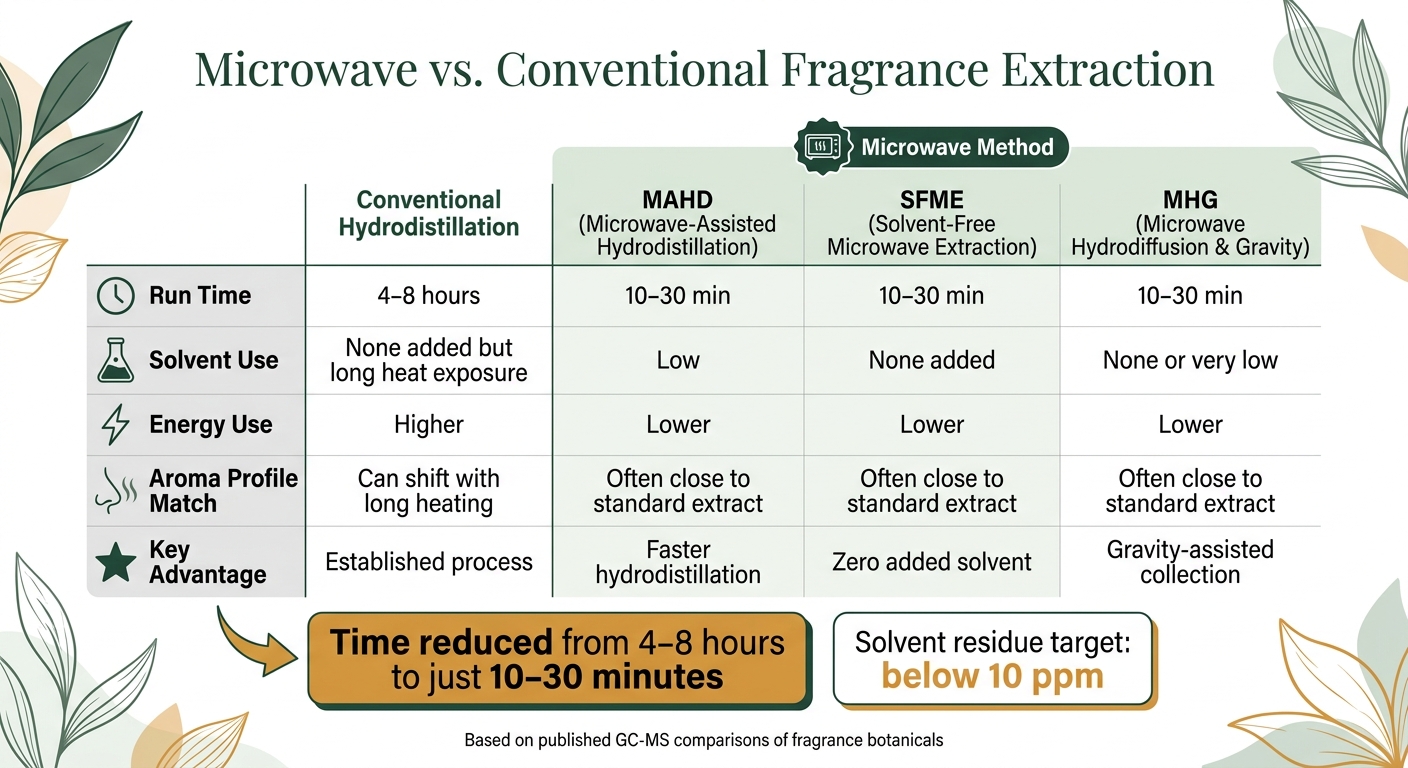
Microwave vs. Conventional Fragrance Extraction: Speed, Yield & Purity Compared
| Méthode | Durée du cycle | Utilisation de solvant | Consommation d’énergie | Profil aromatique | Caractéristique clé |
|---|---|---|---|---|---|
| Hydrodistillation conventionnelle | 4 à 8 heures | Souvent nul lors de la distillation, mais longue exposition à la chaleur | Plus élevée | Peut s’altérer sous l’effet d’une chauffe prolongée | Processus lent et thermique intensif |
| MAHD | 10 à 30 minutes | Faible | Plus faible | Souvent très proche de l’extrait classique | Hydrodistillation accélérée |
| SFME | 10 à 30 minutes | Aucun ajout | Plus faible | Souvent très proche de l’extrait classique | Sans aucun solvant ajouté |
| MHG | 10 à 30 minutes | Nul ou infime, selon l’installation | Plus faible | Souvent très proche de l’extrait classique | La chaleur libère les composés, la gravité les recueille |
Pour la création de parfums, le bilan est éloquent : les procédés par micro-ondes réduisent le temps de traitement, limitent l’usage des ressources et préservent fidèlement la signature olfactive de la plante d’origine.
Le fonctionnement de l’extraction assistée par micro-ondes
Cette célérité tient à la manière dont les micro-ondes chauffent l’humidité interne du végétal de l’intérieur. Lors d’une extraction assistée par micro-ondes, l’énergie se diffuse directement au cœur de la biomasse. L’eau présente au sein de la plante monte immédiatement en température, favorisant une libération précoce des molécules odorantes. Au lieu de chauffer la matière de l’extérieur vers le cœur, l’énergie est directement absorbée par les tissus végétaux.
Trois procédés majeurs reposent sur ce principe, selon des configurations distinctes.
MAHD, SFME et MHG : les principes
- MAHD (microwave-assisted hydrodistillation ou hydrodistillation assistée par micro-ondes) : les micro-ondes chauffent l’eau interne de la plante pour accélérer l’hydrodistillation traditionnelle.
- SFME (solvent-free microwave extraction ou extraction par micro-ondes sans solvant) : tire uniquement parti de l’eau contenue dans la matière végétale, sans aucun solvant additionnel.
- MHG (microwave hydrodiffusion and gravity ou hydrodiffusion par micro-ondes et gravité) : l’énergie thermique libère les composés aromatiques, que la gravité permet ensuite de recueillir.
Pourquoi les micro-ondes accélèrent l’extraction
Cette chauffe de l’intérieur vers l’extérieur explique pourquoi les études scientifiques constatent régulièrement des durées d’extraction considérablement écourtées, sans altération de la qualité olfactive. En d’autres termes, le rayonnement direct au cœur du tissu accélère le cycle tout en préservant le rendement.
Votre expert parfum personnel vous attend
Faites notre quiz olfactif express pour découvrir des parfums de créateurs et de niche authentiques, choisis selon vos goûts – explorez-les en décants et échantillons de 2, 5, 8 et 30 ml, pour essayer chaque fragrance avant de vous engager sur un flacon entier.
Trouvez votre parfumCe que révèlent les études : cycles accélérés, rendements stables, énergie préservée
Les micro-ondes activent l’eau intrinsèque du végétal depuis son cœur. Cette approche novatrice transforme l’ensemble de la cinétique du processus. Les travaux comparatifs publiés démontrent tous que les procédés assistés par micro-ondes s’achèvent bien plus rapidement que la distillation traditionnelle.
Une chute spectaculaire des temps d’extraction
Dans les recherches dédiées à la parfumerie, la voie des micro-ondes se distingue par sa rapidité, la chaleur prenant naissance au sein même de la matière première plutôt que de progresser depuis l’extérieur. Si le temps gagné fluctue selon les essences botaniques et les équipements mis en œuvre, le constat demeure intangible : l’extraction est nettement plus rapide. Reste à vérifier si ce gain de temps respecte la qualité finale.
Des rendements souvent similaires, parfois supérieurs
C’est ici que l’innovation prend toute sa valeur. Au fil des études répertoriées, les méthodes par micro-ondes affichent des rendements comparables à ceux de la distillation conventionnelle. Dans certaines conditions optimales, elles permettent même de légers gains. Bien que le rendement dépende toujours de la plante et des paramètres choisis, la conclusion s’impose : le volume extrait reste à la hauteur.
Une consommation réduite d’énergie et de solvants
À cet avantage s’en ajoute un autre, tout aussi précieux. En écourtant la durée du processus, la dépense énergétique diminue de façon sensible, tout particulièrement en comparaison des cycles prolongés de la distillation classique.
L’ensemble des études met ainsi en lumière une technique plus rapide, garante d’un rendement stable et respectueuse des ressources énergétiques.
Pureté et fidélité olfactive : les micro-ondes préservent-elles le parfum ?
Au-delà de la rapidité et du rendement, l’émotion olfactive demeure le critère souverain. Une méthode rapide perd tout intérêt si la fragrance s’avère dénaturée, terne ou déséquilibrée. En haute parfumerie, la pureté prévaut autant que la quantité. Le critère d’évaluation est sans appel : le profil aromatique reste-t-il fidèle à la matière première brute ?
Des profils chimiques très proches des extraits traditionnels
Les analyses par GC — MS confirment régulièrement que les extraits obtenus par micro-ondes conservent une composition chimique très proche de celle issue d’une distillation traditionnelle. Cette fidélité est cruciale pour la recherche olfactive et la sélection des matières premières : l’objectif n’est pas seulement d’extraire une matière végétale, mais d’obtenir une signature olfactive intacte, répondant aux exigences du parfumeur.
Cette correspondance analytique explique l’intérêt grandissant de la parfumerie pour les micro-ondes. Il ne s’agit pas uniquement d’un gain de temps en laboratoire, mais de la production d’extraits parfaitement aptes à l’évaluation olfactive la plus pointue.
Une exposition thermique brève pour limiter la dégradation
L’exposition réduite à la chaleur diminue considérablement le risque de dégradation thermique. C’est sans conteste l’un des bienfaits majeurs du procédé.
La distillation traditionnelle à la vapeur d’eau s’opère le plus souvent à 100 °C ou plus durant de longues heures. Ce traitement thermique prolongé peut altérer les nuances aromatiques délicates : certaines facettes s’estompent, tandis que d’autres prennent une fâcheuse tonalité cuite ou dévitalisée.
Les procédés sans solvant écartent par essence tout résidu chimique, un atout déterminant en quête d’une pureté absolue.
Des certitudes éprouvées et des territoires à explorer
Pour la MAHD, la SFME et la MHG, les données les plus solides émanent d’études comparatives poussées sur des espèces botaniques référentes. Sur ces matières premières, les micro-ondes préservent admirablement l’intégrité olfactive tout en écourtant l’extraction.
En revanche, les connaissances restent à approfondir pour des ingrédients plus rares ou moins documentés. Si les données actuelles s’annoncent prometteuses pour la haute parfumerie, des recherches complémentaires devront être menées sur une palette végétale élargie.
Les perspectives pour la parfumerie et l’exploration olfactive
L’intérêt majeur pour les créateurs et producteurs de parfum
Ces avancées transforment le rythme auquel les parfumeurs testent, sélectionnent et affinent les matières naturelles. En faisant passer le temps d’extraction de plusieurs heures à quelques minutes, les micro-ondes permettent de démultiplier les essais au cours d’une même journée de création.
Cet élan créatif se fait ressentir directement à l’orgue du parfumeur. Lorsqu’un extrait est obtenu si promptement, le retour olfactif est instantané. Le nez peut sentir, ajuster sa formule et relancer un essai sans attendre de longues heures.
De surcroît, les méthodes par micro-ondes sans solvant éliminent le recours aux composés chimiques auxiliaires, évitant ainsi la présence de traces résiduelles dans le produit fini. Un atout décisif lorsque l’on sait que les normes de la parfumerie exigent des teneurs en solvants résiduels strictement inférieures à 10 parties par million (ppm) pour les absolues.
Pourquoi les passionnés de parfums en Europe y sont sensibles
Cette rapidité d’exécution et cette pureté de traitement influencent directement la manière dont les amateurs découvrent les matières naturelles. Un traitement plus délicat permet de préserver les molécules olfactives les plus fragiles, qui pourraient être dégradées par une extraction excessivement longue.
Pour le connaisseur, c’est l’assurance de découvrir des essences naturelles au plus proche de leur expression originelle, notamment à travers des formats d’initiation raffinés : les décants de 2 ml, 5 ml et 8 ml proposés par Scento. Dans de telles dimensions de découverte, le sillage doit révéler une netteté absolue dès le premier souffle.
Conclusion : l’essentiel à retenir de la recherche contemporaine
L’extraction assistée par micro-ondes dessine une voie plus agile, plus pure et respectueuse des ressources pour métamorphoser la plante en extrait, tout en garantissant une authenticité olfactive rigoureusement démontrée.
Foire aux questions
Comment fonctionne l’extraction par micro-ondes ?
L’extraction assistée par micro-ondes utilise le rayonnement pour chauffer directement l’eau naturellement contenue au cœur du tissu végétal. Cette montée en température interne provoque l’ouverture des cellules végétales et libère les huiles odorantes ainsi que les principes aromatiques avec une remarquable efficacité.
Puisque le procédé s’appuie sur l’eau propre de la plante, il ne nécessite aucun ajout d’eau extérieure ni solvant de synthèse. Rapide et économe en énergie, il préserve l’absolue pureté des matières premières en limitant l’altération thermique lors du cycle.
L’extraction par micro-ondes modifie-t-elle l’odeur ?
Oui, elle sublime et module favorablement le profil olfactif final.
En extrayant les molécules odorantes plus vite et sans déperdition, ce procédé délivre une matière d’une rare netteté. Grâce à une énergie micro-ondes rigoureusement maîtrisée, il protège les composés délicats bien plus efficacement que les distillations à haute température.
Cette distinction est fondamentale : en parfumerie, la moindre variation lors de l’extraction peut transformer l’expression d’une note sur la peau. En écartant le risque de surchauffe, cette technologie restitue le parfum originel, frais et authentique de la plante vivante.
Quelles plantes se prêtent le mieux à l’extraction par micro-ondes ?
L’extraction assistée par micro-ondes donne d’excellents résultats sur une large variété de matières végétales, en particulier les fleurs, les épices et les plantes aromatiques.
En chauffant instantanément l’humidité interne du tissu, elle respecte les notes les plus subtiles tout en réduisant considérablement le temps de transformation, pour des extraits d’une pureté et d’une régularité exceptionnelles.

