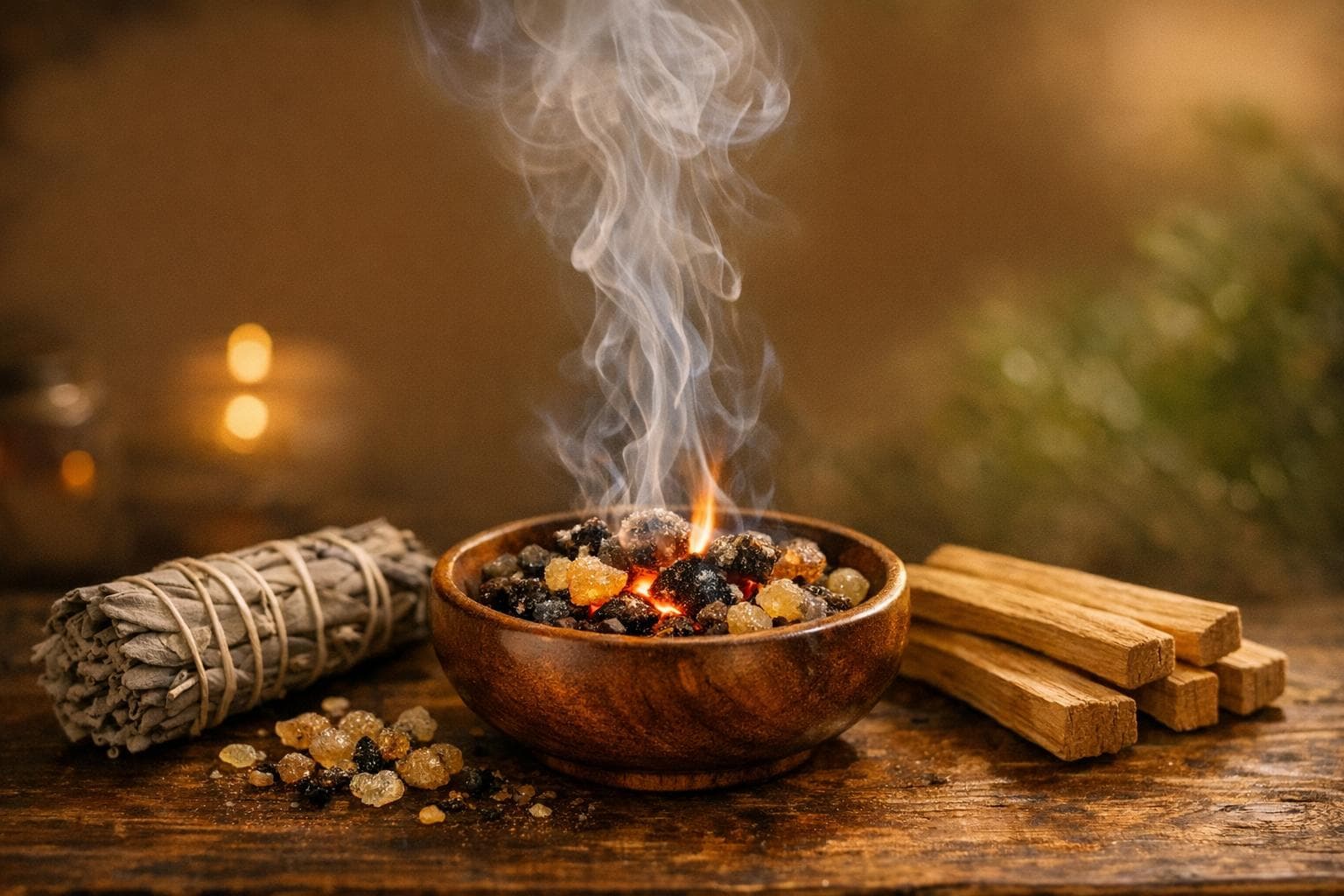
Les parfums sacrés font partie intégrante des rituels funéraires à travers les cultures depuis des siècles. Ces fragrances - telles que la sauge, le copal et le Palo Santo - servent à purifier les espaces, guider les esprits et relier les vivants au monde spirituel. Des offrandes de copal mésoaméricaines aux rituels de fumigation d’Amérique du Nord et aux cérémonies de fumée des peuples aborigènes d’Australie, chaque pratique met en lumière la portée symbolique et spirituelle des plantes aromatiques. Voici un bref aperçu :
- Purification : la sauge, le cèdre et le copal purifient les espaces et dissipent les énergies négatives.
- Guidage des esprits : des fragrances comme le foin d’odeur et les soucis aident à guider les âmes.
- Protection : le Palo Santo et le cèdre protègent contre les influences nuisibles.
- Continuité culturelle : malgré la répression historique, ces pratiques perdurent dans les rituels modernes, mêlant traditions ancestrales et pratiques commémoratives contemporaines.
Ces senteurs ne rendent pas seulement hommage aux défunts, elles apportent aussi du réconfort aux endeuillés, symbolisant la transformation et le lien entre les mondes.
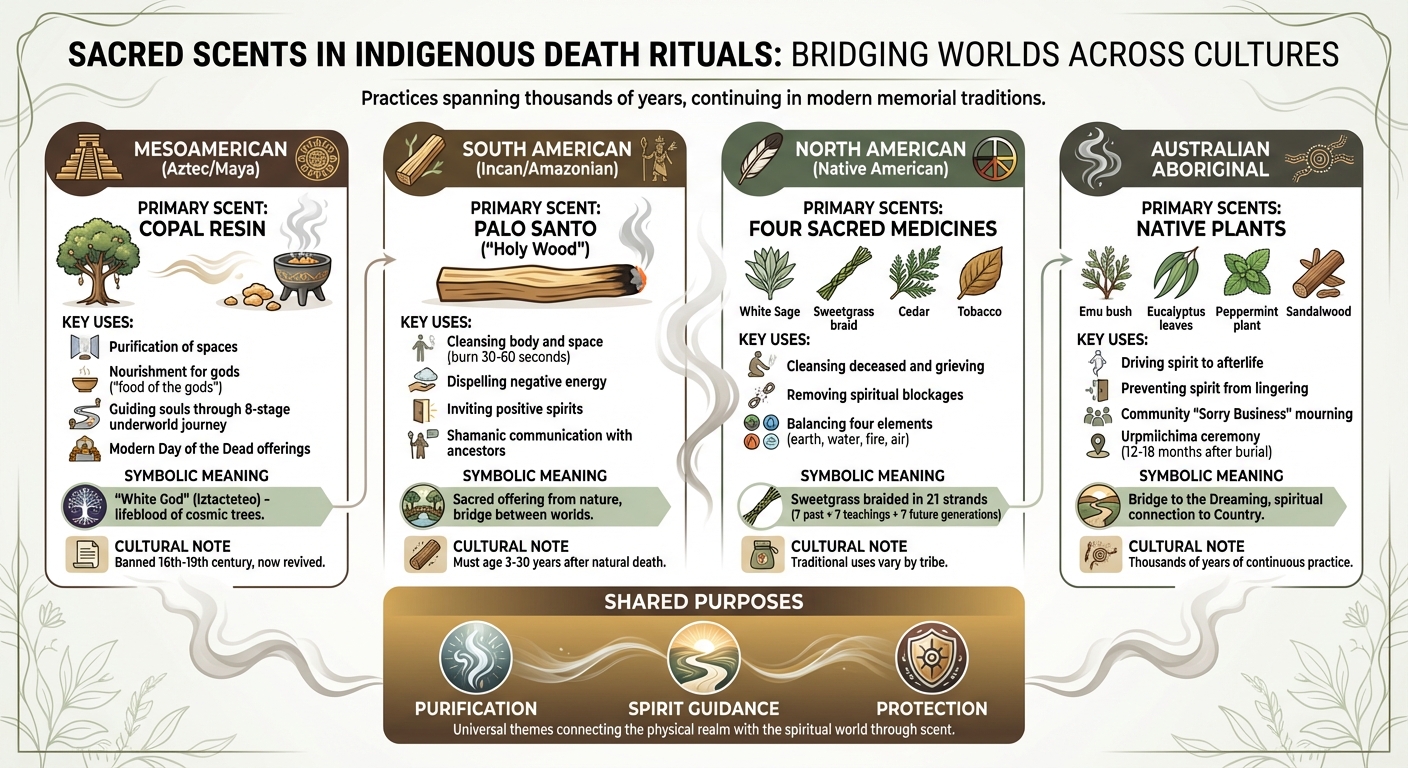
Parfums sacrés dans les rituels funéraires à travers quatre cultures autochtones
Rituels funéraires mésoaméricains et parfums sacrés
Le copal dans les rituels aztèques et mayas
Chez les Aztèques et les Mayas, la résine de copal revêtait une immense importance spirituelle, servant de nourriture aux dieux. Tandis que les humains dépendaient du maïs pour leur subsistance, on croyait que les divinités se nourrissaient de la fumée de résine de copal. Les Aztèques l’appelaient même Iztacteteo, ou "Dieu blanc", en référence à l’épaisse fumée blanche qu’elle produisait. Cette offrande n’était pas simplement symbolique - elle était essentielle au maintien de l’harmonie cosmique.
Le copal portait également une profonde signification symbolique. Les Aztèques considéraient les arbres comme des êtres sacrés et sensibles, reliant le monde souterrain aux cieux. À leurs yeux, la résine de copal représentait le sang vital de ces piliers cosmiques. Récolter la résine à l’aide d’épines de maguey - outils également utilisés dans les rituels d’autosacrifice sanglant - représentait un acte partagé de sacrifice, renforçant l’équilibre de la vie et du cosmos.
"Les prêtres des Idoles… nous apportèrent un encens fait d’une sorte de résine qu’ils appellent copal, et avec des brasiers de poterie pleins de charbons ardents, ils commencèrent à nous enfumer."
- Le conquistador espagnol Bernal Díaz del Castillo
Dans les rituels funéraires, le copal jouait un rôle multiple. Sa fumée était censée purifier les espaces, repousser les esprits malveillants et guider les âmes à travers le monde souterrain. Ce voyage, qui se déroulait en huit étapes sur plusieurs années, nécessitait un soutien continu des vivants, qui brûlaient du copal pour aider le défunt.
L’importance du copal dépassait son usage rituel pour s’étendre à l’économie aztèque. Les régions placées sous contrôle aztèque livraient de grandes quantités de cette résine en tribut à la capitale, Tenochtitlan. Fait remarquable, des échantillons de copal découverts au Templo Mayor - conservés pendant plus de 500 ans - gardent encore aujourd’hui leur arôme distinctif.
Ces pratiques anciennes continuent d’influencer les traditions modernes, notamment dans les célébrations actuelles du Jour des Morts, où l’usage du copal crée un pont entre passé et présent.
Jour des Morts : le copal dans la pratique contemporaine
Le rôle du copal dans les rituels mésoaméricains s’est naturellement prolongé dans son usage lors des cérémonies du Jour des Morts. Sur les ofrendas (autels), le copal représente l’élément air et l’on croit qu’il crée un passage sûr pour les esprits entrant dans les maisons de leurs proches. Dans une enquête menée auprès de 19 pratiquants, les raisons les plus fréquentes pour brûler du copal étaient d’élever les prières vers Dieu, de guider les esprits des défunts de retour à la maison et d’offrir une nourriture spirituelle aux disparus.
Cette tradition a transcendé les frontières et continue d’évoluer. Par exemple, en septembre 2018, le groupe de danse autochtone Grupo Tlaloc s’est produit à Denver, dans le Colorado, en intégrant le copal à des rituels de purification lors de ses cérémonies d’ouverture. Ce geste constituait à la fois une célébration de l’identité mexicano-américaine et un lien avec les anciennes pratiques religieuses mésoaméricaines. De même, en novembre 2022, le Maestro Carlos Casteñeda a souligné combien le copal demeure actuel, trouvant sa place dans des contextes rituels modernes aux États-Unis tout en honorant ses racines autochtones.
Bien que les autorités catholiques aient interdit l’usage du copal dans les offices religieux du 16e siècle jusqu’à la fin du 19e siècle, en raison de son lien avec des rituels autochtones jugés « païens », la tradition a perduré. Aujourd’hui, le copal se trouve facilement sur les marchés d’Amérique latine, ce qui permet à cette pratique ancestrale de rester accessible à ceux qui souhaitent la perpétuer.
Le Palo Santo dans les rites funéraires sud-américains
Purification et protection spirituelle avec le Palo Santo
Souvent appelé "bois sacré" en espagnol, le Palo Santo (Bursera graveolens) constitue un pilier des rituels funéraires sud-américains depuis l’époque inca. Les groupes autochtones du Pérou, de l’Équateur et du bassin amazonien tiennent ce bois parfumé en très haute estime, le considérant comme une offrande sacrée de la nature, précieuse même après la fin de sa vie naturelle [18, 21].
"Les guérisseurs et les chamans d’Amérique du Sud croient que le Palo Santo possède un esprit puissant qui doit être traité avec respect." - Marina, Modern ŌM
Lors des cérémonies funéraires, le Palo Santo est généralement allumé à un angle de 45 degrés, laissé à brûler pendant 30 à 60 secondes, puis éteint afin de libérer sa fumée dense et aromatique. Cette fumée, connue pour son parfum doux, boisé et aux accents d’agrumes, est délicatement dispersée autour du corps et dans l’espace afin de chasser les énergies négatives [18, 19]. Beaucoup pensent que son arôme invite les esprits bienveillants, créant une atmosphère protectrice et apaisante.
Pour garantir sa puissance, le Palo Santo provient d’arbres tombés naturellement et ayant vieilli de 3 à 8 ans - parfois jusqu’à 30 ans. Ce processus de maturation concentre ses résines aromatiques, telles que le limonène et l’α-terpinéol, essentielles à son parfum singulier et à ses propriétés spirituelles [19, 21].
Au-delà de son rôle purificateur, le Palo Santo est profondément ancré dans les pratiques chamaniques, en particulier lors des rites funéraires.
Le Palo Santo dans les cérémonies funéraires chamaniques
Pour les chamans amazoniens, ou curanderos, le Palo Santo est bien plus qu’un outil de purification - il constitue un lien essentiel entre les mondes physique et spirituel [18, 24]. Lors des cérémonies funéraires, les chamans utilisent sa fumée et ses huiles essentielles pour purifier l’esprit et apporter une guérison au corps. Comme le souligne Harlem Candle Co., on pense également que sa fumée ouvre des canaux de communication avec les ancêtres et les forces divines, aidant les chamans à guider le défunt dans son voyage spirituel. Cette tradition reste centrale pour des groupes tels que les Quechuas et les Aymaras [19, 21, 23].
Le Palo Santo appartient à la famille des Burseraceae, qui comprend également l’encens et la myrrhe - des résines jouant depuis des millénaires un rôle majeur dans les rituels funéraires de nombreuses cultures [19, 22]. Son arôme plus doux et plus suave que celui de la sauge en fait un choix privilégié tant pour les cérémonies traditionnelles que pour les pratiques contemporaines de purification.
Rituels de fumigation autochtones d’Amérique du Nord
La sauge dans les cérémonies funéraires
Pour de nombreuses tribus amérindiennes, quatre médecines sacrées - le tabac, le cèdre, la sauge et le foin d’odeur - jouent un rôle essentiel dans la purification des espaces cérémoniels, en particulier lors des rites funéraires. Parmi elles, la sauge blanche (Salvia apiana) occupe une place toute particulière dans les rituels de purification, destinés à éliminer les énergies négatives tant du défunt que des endeuillés.
La sauge blanche est considérée comme un pont entre les vivants et le monde des esprits, offrant purification et protection. Lors des rituels funéraires, sa fumée est soigneusement dirigée sur le corps ou dans l’ensemble de l’espace, souvent à l’aide de la main ou d’une plume d’aigle. Ce geste est perçu comme une manière d’invoquer l’énergie divine et de dissiper les blocages spirituels. Pour ceux qui sont en deuil, ce processus est essentiel, car on pense que la fumigation allège le poids émotionnel.
"Wakan Tanka (Grand Esprit) comprenait mieux les messages s’ils étaient transmis par la fumée que s’ils étaient prononcés avec des mots." - Université McGill
Les cendres de la cérémonie sont rendues à la terre, symbolisant la libération des énergies négatives dans la nature. Après la purification à la sauge, d’autres herbes sacrées comme le foin d’odeur et le cèdre sont utilisées afin d’établir un espace propice à la guérison et au renouveau.
Le foin d’odeur et le cèdre dans les rituels de deuil
Après les effets purificateurs de la sauge, le foin d’odeur et le cèdre agissent de concert pour rétablir l’équilibre et inviter des énergies de guérison. Le foin d’odeur (Hierochloe odorata), souvent appelé les cheveux sacrés de la Terre-Mère, est utilisé pour attirer les énergies positives une fois l’espace purifié. Le cèdre (Thuja occidentalis/plicata), affectueusement nommé "médicament de Grand-Mère", est employé pour protéger des atteintes spirituelles et accueillir la présence sacrée.
Le foin d’odeur est traditionnellement tressé en 21 brins, chacun porteur d’un sens profond : sept brins honorent les sept générations passées, sept représentent les sept enseignements sacrés (Amour, Respect, Honnêteté, Courage, Sagesse, Vérité et Humilité), et sept symbolisent les sept générations à venir.
Le cèdre, quant à lui, sert à protéger et sanctifier les offrandes, incarnant son rôle de médecine gardienne.
"Le cèdre, la grand-mère qui aimait son peuple." - Ogimaa Wab, conteur
Ensemble, ces herbes reflètent les quatre éléments lors des rituels de fumigation : le récipient symbolise l’eau, les herbes représentent la terre, le processus de combustion signifie le feu, et la fumée ou la plume incarne l’air. Cette pratique harmonieuse aide les endeuillés à retrouver paix et renouveau, la fumée étant doucement dirigée vers leurs yeux pour apporter la clarté, vers leurs oreilles pour accueillir la bienveillance, et vers leur cœur pour embrasser la positivité.
Cérémonies de fumée aborigènes australiennes pour les défunts
Purifier l’âme par la fumée
Depuis des millénaires, les communautés aborigènes australiennes pratiquent des cérémonies de fumée afin de purifier l’esprit du défunt et de le guider en toute sécurité vers l’au-delà. Ces cérémonies commencent souvent au domicile du défunt, où les Gardiens traditionnels brûlent des plantes indigènes telles que le buisson d’émeu, l’eucalyptus, la menthe poivrée ou le santal. La fumée aromatique qui s’en dégage est considérée comme un pont spirituel reliant le monde des vivants au Dreaming.
"La cérémonie de fumée vise à éloigner l’esprit du défunt et à le diriger vers l’au-delà." - Willed
Ce rituel sacré veille à ce que l’esprit ne s’attarde pas parmi les vivants et ne provoque pas de troubles. Fait intéressant, des études scientifiques modernes ont confirmé les usages traditionnels de l’emu bush (Eremophila longifolia), mettant en évidence ses propriétés antibactériennes, antifongiques et antioxydantes.
Le choix des plantes varie selon les régions, reflétant le lien profond que chaque communauté entretient avec sa terre, ou "Country". Pendant la cérémonie, les participants dirigent la fumée sur leur corps, recherchant protection et guérison spirituelle. Dans certaines communautés du Territoire du Nord, des lois traditionnelles strictes sont observées - comme s’abstenir de prononcer le nom du défunt ou d’afficher son image - afin de ne pas troubler son esprit.
Lien communautaire et connexion spirituelle dans les rites funéraires
Au-delà de la purification de l’esprit, les cérémonies de fumée jouent un rôle essentiel dans le renforcement des liens communautaires en période de perte. Lorsqu’une personne décède, les communautés entrent dans une période de deuil appelée "Sorry Business". Durant ce temps, les activités quotidiennes s’interrompent tandis que tous se rassemblent pour partager le chagrin et soutenir la famille endeuillée. La cérémonie de fumée devient alors le cœur de ce deuil collectif, symbole d’unité et de guérison.
"Les cérémonies de fumée sont utilisées pour l’inhumation, la célébration, la guérison et la purification, et elles sont aussi un geste de bienveillance qui rassemble les gens." - Aboriginal Cultural Immersions
Certaines traditions, comme celles du peuple Arunta, incluent des rituels supplémentaires tels que l’Urpmilchima, ou "piétinement des brindilles". Cette cérémonie, accomplie 12 à 18 mois après l’inhumation, consiste pour les endeuillés à danser autour de la tombe et à battre l’air pour aider l’esprit à trouver son repos final. Ces pratiques profondément spirituelles sont dirigées par des détenteurs du savoir, personnes dépositaire d’une sagesse culturelle transmise de génération en génération par les Anciens. Leur guidance garantit que les cérémonies demeurent fidèles à leurs origines sacrées plutôt que de devenir de simples représentations.
Ces rituels soulignent l’importance durable de la fumée sacrée et des pratiques cérémonielles pour relier les communautés, honorer les défunts et préserver l’harmonie spirituelle.
Votre expert parfum personnel vous attend
Faites notre quiz olfactif express pour découvrir des parfums de créateurs et de niche authentiques, choisis selon vos goûts – explorez-les en décants et échantillons de 2, 5, 8 et 30 ml, pour essayer chaque fragrance avant de vous engager sur un flacon entier.
Trouvez votre parfumThèmes communs : parfums sacrés et leur symbolique
Purification, guidage des esprits et protection
À travers les cultures et les siècles, les parfums sacrés ont été intimement liés aux rituels de purification, de guidance et de protection. Les communautés autochtones croient depuis longtemps que ces fragrances purifient les espaces, relient les vivants au domaine spirituel et protègent à la fois les défunts et les endeuillés des énergies néfastes.
Prenons la Bretagne romaine au 4e siècle apr. J.-C. Les sépultures de l’élite comprenaient souvent de l’encens importé du sud de l’Arabie ou de l’est de l’Afrique. Cela souligne non seulement l’importance pratique des résines aromatiques, mais aussi le pouvoir de transformation qu’on leur prêtait.
Significations symboliques des pratiques aromatiques
La portée des parfums sacrés va bien au-delà de leur usage pratique. Dans les traditions mésoaméricaines, le copal était chéri comme la "nourriture des dieux". Sa fumée était considérée comme une offrande, à l’image du maïs moulu, destinée à nourrir les esprits. De nombreuses cultures anciennes assimilaient même la sève des arbres au sang, voyant dans la résine un sacrifice sacré destiné à sustenter le divin.
Chaque senteur porte sa propre signification. La sauge est associée à la guérison et à la sagesse. Le foin d’odeur, souvent appelé les "cheveux de la Terre-Mère", représente la bienveillance. Le cèdre est censé repousser les forces nuisibles, tandis que le tabac agit comme un pont entre les mondes physique et spirituel. Ces fragrances incarnent souvent les éléments de l’air et du feu, leur fumée symbolisant la foi et la dévotion - particulièrement dans les rituels catholiques où l’encens représente l’ardeur de la vertu chrétienne.
Continuité à travers les rituels de parfum
Les senteurs sacrées restent un fil essentiel qui relie les traditions actuelles à des racines ancestrales. Le copal, par exemple, continue de jouer un rôle central dans les cérémonies de Danza du 21e siècle à Denver, dans le Colorado. Ces rituels sont des actes de résistance décoloniale : ils réaffirment les identités autochtones et renouent avec un héritage précolombien. Au Mexique, le copal, autrefois interdit dans les églises jusqu’à la fin du 19e siècle, a perduré dans les autels domestiques avant de se mêler aux pratiques catholiques de la Toussaint.
Ces rituels durables soulignent l’idée de la mort comme transformation. Les parfums sacrés agissent comme un pont, maintenant les liens entre les vivants et les disparus. Au-delà de leur rôle symbolique, ils ont également des usages pratiques. Par exemple, les propriétés antimicrobiennes du copal sont exploitées pour la fumigation des graines de maïs (pomixi), contribuant à améliorer les rendements agricoles.
Applications modernes et préservation
Préserver les pratiques olfactives autochtones
Les communautés autochtones continuent d’honorer leurs traditions de parfums sacrés, même si la mondialisation et les mutations culturelles menacent leur préservation. Ces pratiques se transmettent souvent au sein des familles, les mères et les grands-mères enseignant aux jeunes générations comment dresser des ofrendas et brûler le copal avec soin et intention. Dans des zones urbaines comme Denver, dans le Colorado, les cérémonies de Danza intègrent toujours le copal, reliant le temps et l’espace dans ce que la chercheuse Rebecca Jolene Mendoza décrit comme une connexion "temporellement et spatialement, à travers des milliers de kilomètres et des millénaires". Ces cérémonies ne se contentent pas de préserver la tradition ; elles agissent aussi comme une forme de résistance décoloniale, réaffirmant l’identité autochtone par la puissance des rituels aromatiques.
Les efforts pour récolter le copal de manière durable sont tout aussi importants. Les communautés protègent l’arbre Bursera Bipinnata, en utilisant des outils simples pour recueillir la résine de façon responsable. Cette approche garantit la pérennité d’une ressource culturelle vitale tout en apportant un soutien économique aux communautés rurales. Ces efforts de préservation protègent à la fois le patrimoine culturel et les ressources naturelles, assurant à ces traditions une place dans la vie contemporaine.
Les parfums sacrés dans les pratiques commémoratives modernes
Aujourd’hui, les pratiques commémoratives s’orientent vers des alternatives naturelles et écoresponsables. En octobre 2017, Sandra Daugherty a choisi Undertaking LA - une maison funéraire alternative fondée par la thanatopractrice Caitlin Doughty - pour l’inhumation de son père, Grady Ross Daugherty. La famille a opté pour une sépulture écologique, utilisant un cercueil en osier biodégradable qui se décompose naturellement, rejetant l’artificialité des funérailles traditionnelles.
"Tous les enterrements auxquels j’ai assisté ont été affreux... l’odeur du funérarium, l’apparence du cercueil et les fausses fleurs. Cela m’a toujours semblé vraiment kitsch et comme vide."
– Sandra, fille de Grady Ross Daugherty
Ce changement reflète des tendances plus larges aux États-Unis, où le taux de crémation a fortement augmenté - de 6 % en 1980 à 50 % en 2017. De nombreuses personnes se détournent de l’embaumement chimique et des doublures en ciment, préférant des matériaux biodégradables et des fragrances naturelles. Caitlin Doughty souligne cette transformation :
"C’est une magnifique transition du corps défunt vers la cendre et l’os. C’est une transition sacrée pour beaucoup de personnes".
Les principes amérindiens de guérison holistique trouvent également leur place dans les pratiques modernes du deuil. Ces principes mettent l’accent sur l’équilibre - en soi, dans sa communauté et dans son héritage culturel. Des rituels tels que la fumigation à la sauge, au cèdre ou au foin d’odeur sont désormais couramment utilisés pour purifier les espaces avant les cérémonies commémoratives. En outre, certaines personnes se tournent vers la superposition de fragrances - en utilisant huiles de bain parfumées, lotions et parfums tout au long de la journée - comme moyen de traverser le deuil et d’ancrer leurs émotions. Ces pratiques en évolution créent un pont riche de sens entre traditions ancestrales et rituels contemporains.
Découvrir les senteurs avec Scento

Alors que les traditions commémoratives continuent d’évoluer, l’exploration personnelle de senteurs soigneusement sélectionnées offre une manière tangible de renouer avec ces pratiques ancestrales. Scento propose des décants pratiques pour le voyage (2 ml, 5 ml et 8 ml, ainsi qu’en décant en flacon de 30 ml sur la plupart des parfums) qui vous permettent de découvrir des fragrances complexes sans vous engager sur des flacons entiers. En privilégiant des senteurs inspirées de matières traditionnelles comme les résines, les bois et les plantes - des éléments utilisés dans les pratiques spirituelles depuis des siècles - vous pouvez composer une garde-robe olfactive personnelle en accord avec vos propres rituels de mémoire.
Scento est un détaillant de décants et d’échantillons de parfum, et chaque produit peut être acheté à l’unité, sans aucun abonnement. Scento+ est l’adhésion optionnelle de Scento : la cotisation mensuelle vous revient intégralement sous forme de crédit en magasin, à dépenser sur n’importe quel parfum ; les membres bénéficient de 10 % de réduction, d’un échantillon offert avec chaque commande, d’un parfum offert tous les six mois et d’un cadeau d’anniversaire, et vous pouvez mettre en pause à tout moment ; pour résilier, contactez notre équipe. De nombreuses maisons de parfum indépendantes intègrent désormais des résines traditionnelles comme le copal dans leurs créations, rendant ces arômes anciens accessibles au public contemporain tout en préservant leur portée spirituelle. Que vous soyez attiré par des notes terreuses et résineuses ou par des profils botaniques plus aériens, explorer ces fragrances peut approfondir votre lien avec les traditions aromatiques qui ont aidé l’humanité à traverser la perte depuis des générations.
Conclusion: The Enduring Power of Sacred Scents
À travers les siècles et les cultures, les parfums sacrés ont servi de liens profonds entre les vivants et le spirituel. De la combustion du copal dans les rituels mésoaméricains à l’usage cérémoniel de la sauge dans les traditions nord-américaines, ces pratiques partagent un même dessein : purifier les espaces, guider les esprits et préserver le lien avec ceux qui nous ont quittés.
Si ces rituels perdurent, c’est parce qu’ils entremêlent communauté et spiritualité. Malgré les effets de la répression coloniale, le copal conserve sa place de "cœur aromatique" des rituels funéraires au Mexique et en Amérique centrale.
"La fragrance servait d’expression transcendante aux prières portées vers le divin".
Cette portée durable découle de la capacité unique du parfum à agir comme un médium physique reliant la terre au spirituel.
Les traditions autochtones offrent une perspective profonde sur le deuil et la mémoire, envisageant la mort non comme une fin, mais comme une transition où les liens perdurent à travers les rituels et le parfum. Dans ces coutumes, on croit que la fumée des résines sacrées nourrit les esprits - une pratique enracinée dans les anciennes cérémonies mésoaméricaines où le copal était façonné en épis de maïs cérémoniels comme offrandes.
Cette sagesse ancienne trouve sa place dans les pratiques commémoratives contemporaines. Avec un taux de crémation aux États-Unis passé de 6 % en 1980 à 50 % en 2017, on observe un glissement vers des cérémonies plus personnelles et plus riches sensoriellement. Qu’il s’agisse de l’acte traditionnel de fumigation ou d’explorations modernes du parfum, ces rituels offrent un moyen de rétablir l’harmonie entre le corps, l’esprit et l’âme dans les moments de perte.
Le lien entre parfum et mémoire préserve l’héritage et procure du réconfort dans le deuil. Les parfums sacrés continuent de transcender les générations et les géographies, reliant avec une fluidité naturelle les traditions ancestrales aux façons dont nous honorons et nous souvenons aujourd’hui.
FAQ
Pourquoi les parfums sacrés sont-ils importants dans les rituels funéraires et de deuil à travers les cultures ?
Les senteurs occupent depuis longtemps une place profonde dans les rituels funéraires de diverses cultures, symbolisant à la fois la révérence envers les défunts et l’accompagnement de leur voyage spirituel. Dans les coutumes mésoaméricaines anciennes, les offrandes d’encens parfumé étaient censées aider à guider les âmes vers l’au-delà tout en apportant du réconfort à la communauté endeuillée. De même, les Romains incorporaient des épices luxueuses telles que l’encens et la myrrhe pour rendre hommage aux morts et établir un lien avec les royaumes divins. En Égypte, les embaumeurs utilisaient des huiles aromatiques et des résines lors de la momification, à la fois pour préserver le corps et pour marquer la transition sacrée vers l’au-delà.
Dans de nombreuses cultures autochtones, les éléments aromatiques naturels tels que les herbes et les résines revêtent une signification sacrée, représentant la nature cyclique de la vie et de la mort. Ces senteurs agissent comme de puissants symboles sensoriels, créant un pont entre les vivants et les disparus tout en renforçant les croyances culturelles liées à l’harmonie et à la continuité.
À l’ère moderne, des plateformes comme Scento offrent l’occasion de redécouvrir le rôle durable du parfum dans la commémoration des êtres chers. Grâce à des fragrances soigneusement sélectionnées, elles permettent d’évoquer la révérence et de favoriser un lien profondément personnel dans les moments de souvenir.
Comment l’usage du copal a-t-il évolué des anciens rituels mésoaméricains aux traditions modernes du Jour des Morts ?
Le copal, résine parfumée issue d’arbres de la famille des Burseraceae, est profondément tissé dans les pratiques spirituelles et culturelles des civilisations mésoaméricaines depuis des siècles. Les sociétés anciennes telles que les Olmèques, les Mayas et les Aztèques vénéraient le copal pour ses propriétés sacrées, le brûlant souvent lors de rituels pour honorer les divinités, purifier les espaces et favoriser les connexions spirituelles. Sa sève rougeâtre, perçue comme un symbole du sang humain et de la vie, jouait un rôle profond dans les offrandes cérémonielles.
Aujourd’hui encore, le copal occupe une place majeure dans les traditions du Jour des Morts. Il est brûlé sur les ofrendas (autels) et lors des processions, sa fumée aromatique étant censée purifier les alentours et guider les esprits des défunts de retour vers les vivants. Cette pratique crée un pont entre les générations, honorant à la fois la mémoire et le cycle de la vie et de la mort. Bien qu’enraciné dans des traditions anciennes, le copal continue d’évoluer, trouvant sa pertinence dans des contextes urbains et mondiaux modernes, sans jamais perdre son essence spirituelle.
Pourquoi le Palo Santo est-il important dans les rituels funéraires sud-américains ?
Le Palo Santo, qui se traduit par « bois sacré », provient de l’arbre Bursera graveolens originaire du Pérou, de l’Équateur et du Brésil. Dans de nombreuses traditions autochtones sud-américaines, il revêt une profonde signification spirituelle, étant souvent considéré comme un lien entre les vivants et les esprits des ancêtres. Lors des rituels funéraires, la fumée aromatique du Palo Santo est utilisée pour purifier les espaces, bannir les énergies négatives et guider l’âme du défunt dans son voyage vers l’au-delà.
Connu pour son parfum doux, boisé et légèrement épicé, le Palo Santo est censé renforcer l’énergie spirituelle et affiner la concentration des intentions cérémonielles. Son rôle dans la purification et l’équilibre de l’environnement en fait un outil essentiel pour les chamans, aidant les communautés à honorer leurs proches et à assurer un passage serein vers le monde des esprits.

