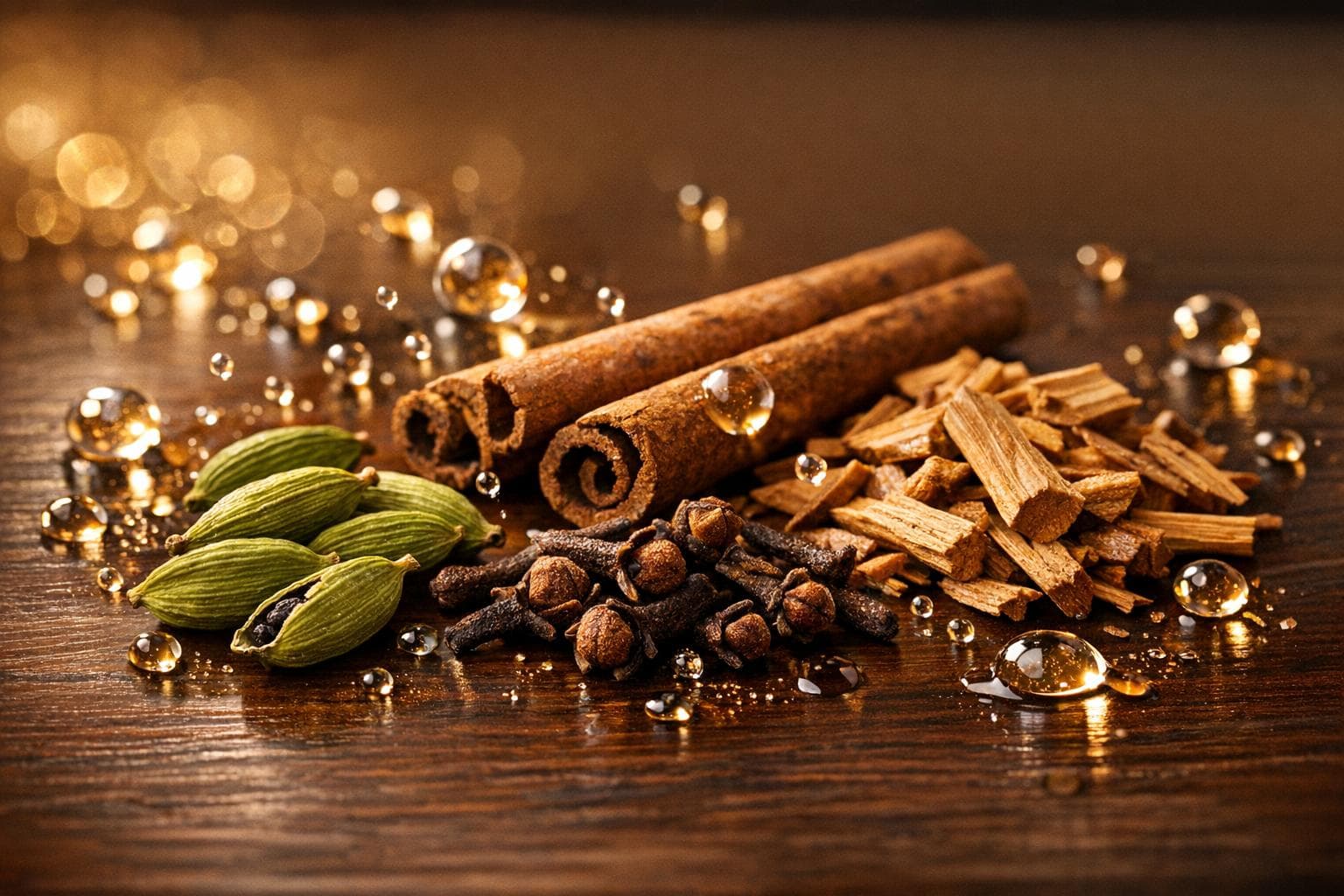
Les épices sud-asiatiques comme la cardamome, le clou de girofle, la cannelle et le bois de santal ont transformé la parfumerie moderne. Profondément ancrés dans des rituels anciens et le commerce, ces ingrédients définissent aujourd’hui les fragrances chaudes et sophistiquées recherchées à travers le monde. Les épices apportent complexité, tenue et caractère aux parfums, en se mêlant avec harmonie aux agrumes, aux fleurs et aux bois. Des maisons de parfum comme Guerlain, Le Labo et Byredo intègrent ces notes pour créer des sillages qui équilibrent héritage et goûts contemporains.
- Cardamome : Une chaleur vive et terreuse, utilisée dans les parfums masculins comme unisexes.
- Clou de girofle : Une épice affirmée à la douceur enveloppante, qui renforce la profondeur.
- Cannelle : Une douceur boisée, apportant confort et richesse.
- Bois de santal : Une note de fond douce et crémeuse qui ancre de nombreuses compositions.
Parmi les exemples modernes figurent Guerlain Épices Exquises (cardamome et oud) et Byredo Black Saffron (safran et bois). Les épices sont minutieusement équilibrées avec d’autres notes afin d’éviter toute dominance, souvent soutenues par des molécules synthétiques pour plus de précision. Qu’il s’agisse de créations de niche ou de parfums de créateur, ces épices continuent de relier les pratiques ancestrales à la création olfactive contemporaine.
South Asian Spices and Their Scent Characteristics
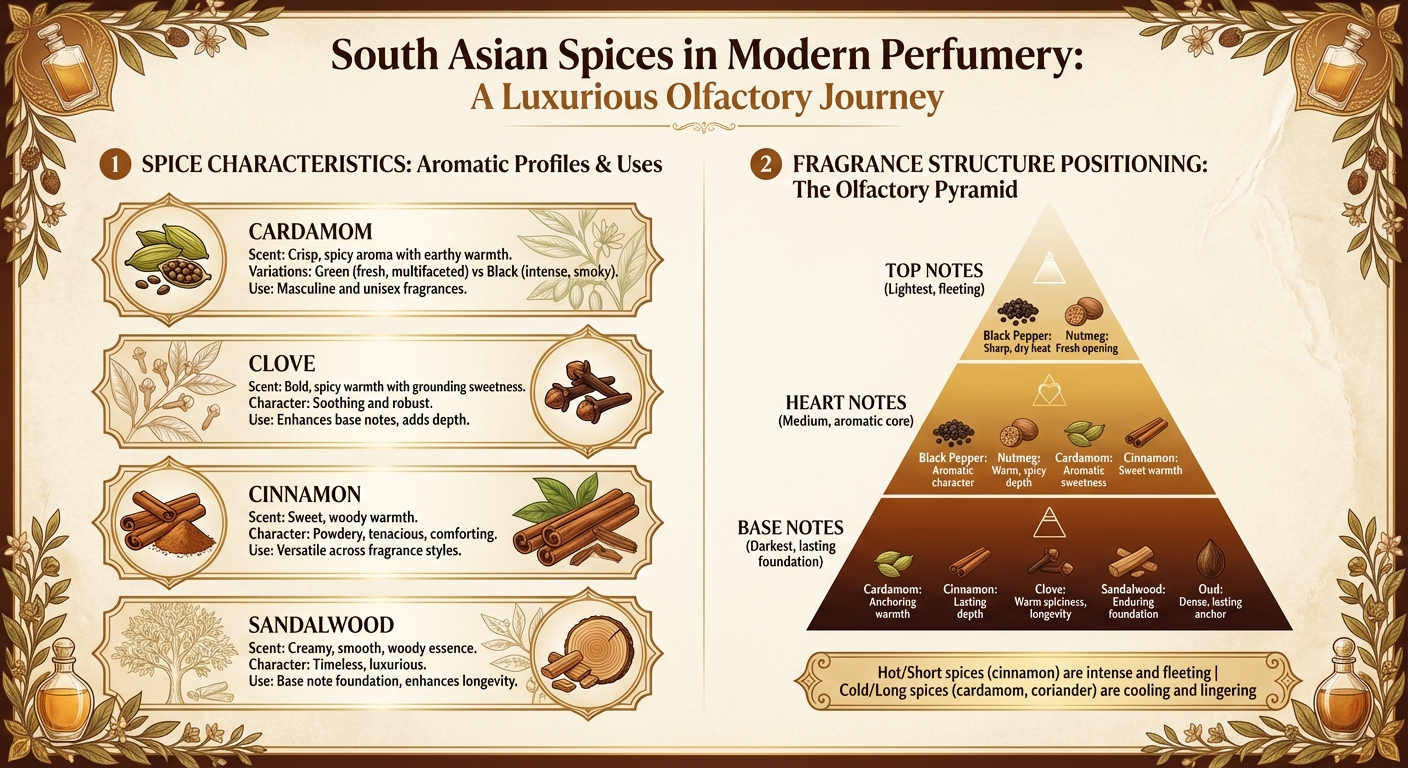
Les épices en parfumerie sud-asiatiques : caractéristiques et positions dans la fragrance
Les épices sud-asiatiques apportent des qualités aromatiques distinctes qui enrichissent les compositions parfumées, chacune ajoutant une dimension singulière à l’expérience olfactive.
Cardamome : fraîche et plurielle
La cardamome verte offre un arôme vif et épicé, relevé d’une touche de chaleur terreuse, tandis que la cardamome noire dévoile un profil plus intense et fumé. Cette dualité fait de la cardamome une favorite aussi bien dans les parfums unisexes que masculins.
Par exemple, One by Beautiful India® marie la cardamome du Guatemala au cypriol indien, au patchouli espagnol, à la bergamote italienne, au vétiver haïtien et à des notes himalayennes. Ici, la cardamome apporte une dimension chaude et terreuse qui structure la composition. De son côté, Le Labo Santal 33 associe la cardamome au bois de santal, au cuir et à l’iris, donnant naissance à un sillage fumé, velouté et irrésistiblement addictif.
La polyvalence de cette épice ouvre la voie à d’autres ingrédients audacieux qui redéfinissent les profils olfactifs.
Clou de girofle : intense et épicé
Le clou de girofle s’impose avec une chaleur épicée affirmée qui apporte de la profondeur aux parfums. Son caractère à la fois légèrement doux et robuste est souvent décrit comme apaisant et ancrant. Sa note chaude et épicée sublime généralement le fond d’une fragrance, en enrichissant sa complexité globale. Tant le bouton que la feuille de giroflier sont utilisés en parfumerie, chacun apportant un arôme distinct.
Des parfums comme Lush Yog Nog, Chanel Coco et Rich Hippie Rockstar mettent en lumière la capacité du clou de girofle à ancrer et intensifier les compositions grâce à sa chaleur inimitable.
Cannelle : douce et réconfortante
La cannelle introduit une chaleur douce et boisée, à la fois accueillante et polyvalente. Réputée pour sa qualité poudrée et tenace, cette épice pose une base réconfortante qui s’adapte à une grande variété de styles parfumés.
Parmi les exemples notables figurent Viktor and Rolf Spicebomb, Parfums De Marly Oajan, Creed Original Santal et Azzaro Pour Homme Intense, qui illustrent tous la capacité de la cannelle à apporter une touche distinctive aussi bien aux parfums de niche qu’aux parfums de créateur.
Bois de santal : doux et intemporel
Le bois de santal, avec son essence crémeuse et boisée, constitue l’épine dorsale de nombreuses fragrances inspirées de l’Asie du Sud. Sa richesse suave prolonge non seulement la tenue, mais permet aussi aux autres notes de rayonner. Les mélanges traditionnels du Tamil Nadu associent souvent le bois de santal à la cardamome, au clou de girofle et à la cannelle, créant des notes de cœur épicées et balsamiques qui s’épanouissent sur un fond somptueux de bois de santal et de musc.
Cet ingrédient intemporel offre une base idéale aux compositions parfumées sophistiquées, en équilibrant chaleur et profondeur avec élégance.
Parfums modernes aux épices sud-asiatiques
Exemples de fragrances épicées
Les parfumeurs d’aujourd’hui intègrent avec virtuosité les épices sud-asiatiques dans leurs créations, donnant naissance à des sillages allant d’une intensité cérémonielle affirmée à une chaleur douce et enveloppante. Ces fragrances reflètent une interprétation contemporaine des notes épicées traditionnelles.
Guerlain Épices Exquises offre un profil riche et chaleureux en mêlant la cardamome au bois de santal et à l’oud, évoquant un sentiment de célébration et de rituel. À l’inverse, Kayali Yum Pistachio Gelato 33 choisit une approche plus délicate, associant une pistache crémeuse à une cardamome douce et à une bergamote vive, rappelant la suavité réconfortante d’un kheer chaud. Sentier Fragrance Rose Taif marie cardamome et cannelle à la rose de Taïf, au géranium, au bois de rose et au bouleau, créant une expérience luxueuse et gourmande.
Plusieurs marques de créateur adoptent également ces épices. Maison Francis Kurkdjian Baccarat Rouge 540 utilise le safran pour apporter une touche ambrée chaude et exotique à son accord. De même, Byredo Black Saffron puise dans les racines indiennes de Ben Gorham, avec une composition épicée qui célèbre l’héritage. Memo Paris Cappadocia associe des notes florales à des bois crémeux, des résines et un safran aromatique, tandis que la collection Abu Dhabi de la marque met le safran et la cardamome à l’honneur comme ingrédients signatures.
| Parfum | Épice(s) mise(s) en avant | Contribution olfactive |
|---|---|---|
| Guerlain Épices Exquises | Cardamome | Chaleur cérémonielle riche avec oud |
| Kayali Yum Pistachio Gelato 33 | Cardamome | Confort doux et épicé |
| Sentier Rose Taif | Cardamome, Cannelle | Douceur aromatique luxueuse |
| Maison Francis Kurkdjian Baccarat Rouge 540 | Safran | Accent ambré chaud et exotique |
| Byredo Black Saffron | Safran | Profil affirmé inspiré de l’héritage |
| Sentier Oud Gaiac | Poivre noir | Chaleur aromatique vive |
Les épices dans les notes de tête, de cœur et de fond
Les parfumeurs positionnent soigneusement les épices au sein de la structure du parfum afin de créer des expériences olfactives dynamiques. Les épices sont souvent classées comme "chaudes/courtes" (intenses et fugaces, comme la cannelle) ou "froides/longues" (rafraîchissantes et persistantes, comme la cardamome et la coriandre), selon l’effet recherché.
Le poivre noir est fréquemment utilisé en notes de tête ou de cœur, où il délivre une chaleur vive et sèche. Par exemple, dans Sentier Oud Gaiac, il traverse des fleurs douces avec un caractère audacieux. La noix de muscade évolue d’une ouverture fraîche vers une profondeur chaude et épicée au cœur ou au fond, comme dans Sentier Monde à Part, où elle se déploie aux côtés de la mandarine et de la pomme verte. La cardamome ancre souvent les notes de cœur ou de fond, apportant douceur aromatique et chaleur. La cannelle offre des accents doux et chaleureux dans les notes de cœur ou de fond, procurant une profondeur durable dans des fragrances telles que Viktor and Rolf Spicebomb et Parfums De Marly Oajan. Le clou de girofle, avec son épice chaleureuse, renforce la tenue et la profondeur dans des parfums comme Chanel Coco et Lush Yog Nog. Enfin, le bois de santal et l’oud, connus pour leur structure moléculaire dense, servent de notes de fond durables qui soutiennent l’ensemble de la composition.
sbb-itb-fb213bc
Comment les parfumeurs équilibrent les notes épicées
Associer les épices aux fleurs et aux bois
Les épices sud-asiatiques, reconnues pour leur profondeur et leur complexité, exigent une maîtrise subtile afin de se fondre harmonieusement avec d’autres éléments olfactifs. Les parfumeurs ajustent méticuleusement les huiles d’épices afin qu’elles enrichissent une composition sans jamais la dominer. L’objectif est de créer du contraste, pour permettre à chaque ingrédient de rayonner.
Associer les épices aux agrumes, aux fleurs, aux bois ou aux notes crémeuses est une manière courante d’atteindre cette harmonie. Prenons par exemple l’eau de parfum "555" de Carrément Belle : elle juxtapose des épices chaudes comme l’écorce de cannelle, le clou de girofle et le poivre à des notes de tête hespéridées lumineuses. Pendant ce temps, leur fragrance "SO" utilise la coriandre, une épice fraîche et aromatique, pour relier une fraîcheur citronnée à un fond chaud et ambré, offrant un jeu de contrastes saisissant.
L’huile de bois de santal joue souvent un rôle essentiel, notamment dans les attars traditionnels, en servant de fixateur qui stabilise et sublime la structure du parfum. Elle permet à des fleurs délicates comme le jasmin de persister plus longtemps tout en les fondant dans une base crémeuse et boisée. Un exemple moderne de cette technique est le "Santal 33" de Le Labo, qui associe la cardamome au bois de santal, au cuir et à l’iris, créant un parfum qui évolue avec grâce d’une chaleur crémeuse vers une épice éclatante.
Les molécules synthétiques offrent également aux parfumeurs un contrôle accru sur les notes épicées, en aidant à alléger les éléments plus denses. Chanel No. 5, par exemple, incorpore des aldéhydes aliphatiques synthétiques afin d’apporter un éclat scintillant à son fond de rose et de jasmin. De même, le parfum "One" de One by Beautiful India équilibre le cypriol indien terreux et la cardamome du Guatemala avec du patchouli espagnol, de la bergamote italienne, du vétiver haïtien et une touche de fraîcheur himalayenne. Ce dialogue entre composants naturels et synthétiques illustre l’art d’une création parfumée raffinée.
Les épices dans les parfums de niche et de créateur
Dans l’univers des fragrances de niche et de créateur, chaque catégorie adopte une approche singulière des concentrations d’épices. Les maisons boutique et de niche, souvent moins contraintes par les formules traditionnelles, ont tendance à privilégier des matières naturelles ou renouvelables. Cette liberté créative leur permet d’expérimenter des concentrations audacieuses d’épices et des combinaisons inattendues. Par exemple, le "Eau Duelle" de Diptyque équilibre le cypriol épicé et le poivre rose avec la douceur crémeuse des gousses de vanille, pour un sillage à la fois réconfortant et aventureux.
L’intérêt des consommateurs pour les ingrédients naturels façonne également la parfumerie moderne. Les marques lancent de plus en plus de molécules qui imitent ou dérivent de composants naturels. Cette évolution s’accorde avec la popularité croissante des parfums "massmium" — des options accessibles proposées entre 12 € et 40 € — qui répondent à un usage quotidien et à l’expression de soi, au-delà des fragrances réservées aux grandes occasions. Les progrès des techniques d’extraction améliorent encore la clarté et le rendement, permettant aux marques de niche comme aux maisons de créateur de composer des parfums sophistiqués et faciles à porter. Ces créations mettent en valeur les épices sud-asiatiques de manière captivante, sans jamais saturer les sens.
L’impact durable des épices sud-asiatiques
Les épices sud-asiatiques jouent un rôle majeur dans l’histoire de la parfumerie depuis des millénaires, intimement liées au riche passé de la région. L’Inde, en particulier, fut un centre majeur des épices aromatiques sur les anciennes routes commerciales telles que la Route de la soie. À l’époque moghole, les senteurs et attars indiens étaient vénérés comme de véritables œuvres d’art, célébrés pour leur complexité et leur pouvoir de séduction.
Aujourd’hui, ces épices légendaires continuent d’influencer la parfumerie contemporaine. Des ingrédients comme la cardamome, le clou de girofle, la cannelle et le bois de santal demeurent essentiels, apportant profondeur et caractère aux fragrances de niche comme aux parfums de créateur. Les attars indiens traditionnels — des parfums hautement concentrés élaborés avec du bois de santal, du jasmin, de la rose, du vétiver et d’autres matières botaniques — ont naturellement trouvé leur place dans la création olfactive actuelle, comblant l’écart entre héritage et innovation.
Ce qui rend les fragrances épicées si captivantes, c’est leur adaptabilité. Que vous soyez attiré par l’élégance intemporelle des attars classiques ou par des créations modernes qui associent les épices sud-asiatiques aux fleurs, aux bois ou aux agrumes, chacun y trouve son bonheur. De nombreuses maisons proposent désormais des coffrets découverte, vous permettant d’explorer une variété d’accords épicés et aromatiques sans vous engager sur un flacon entier. Cette évolution illustre à quel point les épices sud-asiatiques continuent d’imprimer leur signature dans l’art de la parfumerie.
Pour celles et ceux qui souhaitent explorer les fragrances épicées, Scento constitue un point de départ idéal. Avec des formats de décantation allant du 2 ml jusqu’au décant en flacon de 30 ml, vous pouvez découvrir d’authentiques parfums de créateur et de niche mettant à l’honneur les épices sud-asiatiques, sans investir dans un flacon entier pouvant dépasser 300 $. Leur collection soigneusement sélectionnée — couvrant plus de 1 000 fragrances — permet d’identifier aisément les notes épicées qui s’accordent à votre style personnel, afin de composer une garde-robe olfactive véritablement à votre image.
FAQ
Comment les épices sud-asiatiques prolongent-elles la tenue des parfums ?
Les épices sud-asiatiques telles que la cannelle, le clou de girofle et la noix de muscade, associées à des éléments résineux comme le benjoin, l’encens et la myrrhe, jouent un rôle clé en parfumerie en tant que fixateurs naturels. Ces ingrédients contribuent à stabiliser les molécules parfumées les plus délicates et volatiles, en réduisant leur taux d’évaporation. Cela prolonge non seulement la durée du parfum, mais renforce également son sillage.
En ancrant les notes plus légères et fugaces, ces épices et résines créent un parfum harmonieux et durable qui vous accompagne tout au long de la journée.
Comment les molécules synthétiques subliment-elles les fragrances épicées dans la parfumerie moderne ?
Les molécules synthétiques ont révolutionné les fragrances épicées modernes en capturant l’essence des épices sud-asiatiques tout en dépassant les limites des extraits naturels. De nombreuses huiles d’épices, comme celles de cannelle et de clou de girofle, sont non seulement volatiles, mais aussi rares ou issues de procédés de récolte exigeants. Des composés créés en laboratoire, tels que le cinnamaldéhyde synthétique (qui reproduit la cannelle) et l’eugénol (qui évoque le clou de girofle), apportent une solution grâce à une plus grande stabilité, une tenue prolongée et un contrôle précis de l’intensité olfactive, garantissant une qualité constante à chaque production.
Ces notes conçues en laboratoire ouvrent également de nouvelles voies créatives, permettant aux parfumeurs d’imaginer des accords inspirés des épices qui vont au-delà de ce que la nature seule peut offrir. Elles participent en outre à une approche plus durable, en réduisant la dépendance à la culture intensive des épices et la pression exercée sur les ressources naturelles. Avec les décants soigneusement sélectionnés par Scento — disponibles en fioles de 2 ml, 5 ml et 8 ml, ainsi qu’en décant en flacon de 30 ml sur la plupart des parfums — vous pouvez découvrir ces fragrances épicées d’avant-garde sans avoir à investir dans un flacon entier.
Pourquoi les épices sud-asiatiques sont-elles un ingrédient clé des parfums modernes ?
Les épices sud-asiatiques telles que la cannelle, le clou de girofle, le poivre et l’oud occupent une place de choix dans la parfumerie moderne, célébrées pour leur capacité à insuffler chaleur, profondeur et un pouvoir de séduction intense aux fragrances. Historiquement, ces épices étaient au cœur de la parfumerie indienne, symbolisant souvent l’opulence et la sensualité, en particulier dans le faste des cours royales. Aujourd’hui, les parfumeurs continuent de puiser dans cet héritage pour créer des senteurs à la fois intemporelles et audacieuses. Ces qualités les rendent particulièrement adaptées aux saisons fraîches, où leur caractère réconfortant et rayonnant s’exprime pleinement.
Ce qui distingue ces épices, c’est leur remarquable polyvalence. Elles peuvent illuminer une fragrance avec une note de tête éclatante, apporter intrigue et complexité en cœur épicé, ou ancrer le parfum dans un fond profond et durable. Prenons l’oud, par exemple : son profil boisé et musqué a conquis le monde, devenant un ingrédient phare aussi bien dans les parfums de niche que dans les créations de créateur. Ce mariage entre importance historique, richesse sensorielle et adaptabilité assure aux épices sud-asiatiques une place centrale dans la création de parfums inoubliables.

