Les parfums contrefaits sont partout, et ils ne représentent pas seulement une perte d’argent — ils peuvent aussi être nocifs, car ils contiennent des ingrédients non testés susceptibles de provoquer des irritations cutanées ou des maux de tête. L’un des moyens les plus efficaces de vérifier si un parfum est authentique consiste à utiliser les codes QR. En scannant un véritable code QR, vous devriez être redirigé vers le site officiel ou le système de la marque, confirmant ainsi l’authenticité du produit. Mais les contrefacteurs s’améliorent, allant jusqu’à reproduire les codes QR. Voici un guide simple en 5 étapes pour vous aider à repérer les faux parfums :
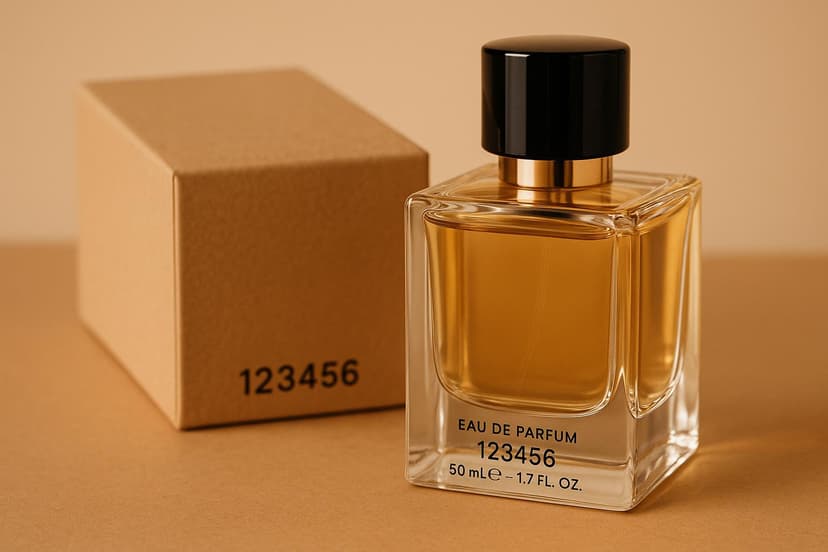
- Inspectez le code QR et les numéros de série : Vérifiez la netteté de l’impression, le positionnement centré et la correspondance des numéros de série sur la boîte et le flacon.
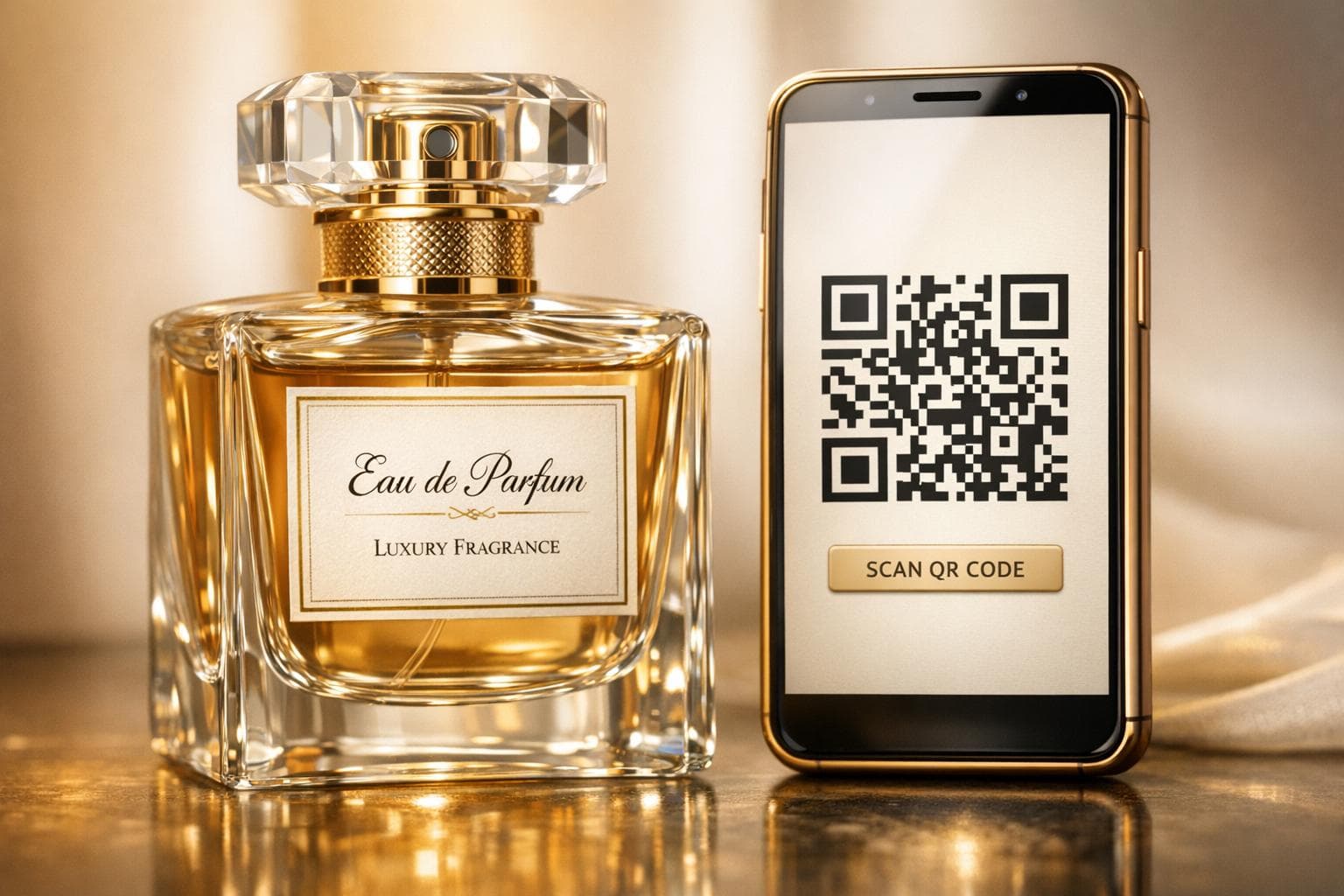
- Utilisez un lecteur de QR code fiable : Scannez le code avec une application de confiance et assurez-vous que l’URL correspond au site officiel de la marque.
- Vérifiez le site web lié : Confirmez la qualité du site, l’exactitude du domaine et les détails du produit.
- Recoupez les codes batch et les codes-barres : Utilisez des outils comme CheckFresh pour vérifier les codes batch et des bases de données UPC pour confirmer l’exactitude du code-barres.
- Examinez l’emballage et les détails du flacon : Recherchez des matériaux de haute qualité, un texte précis et des scellés sécurisés.
Les faux parfums échouent souvent à ces vérifications ; prendre quelques minutes supplémentaires pour les inspecter peut donc vous éviter un achat décevant ou risqué.
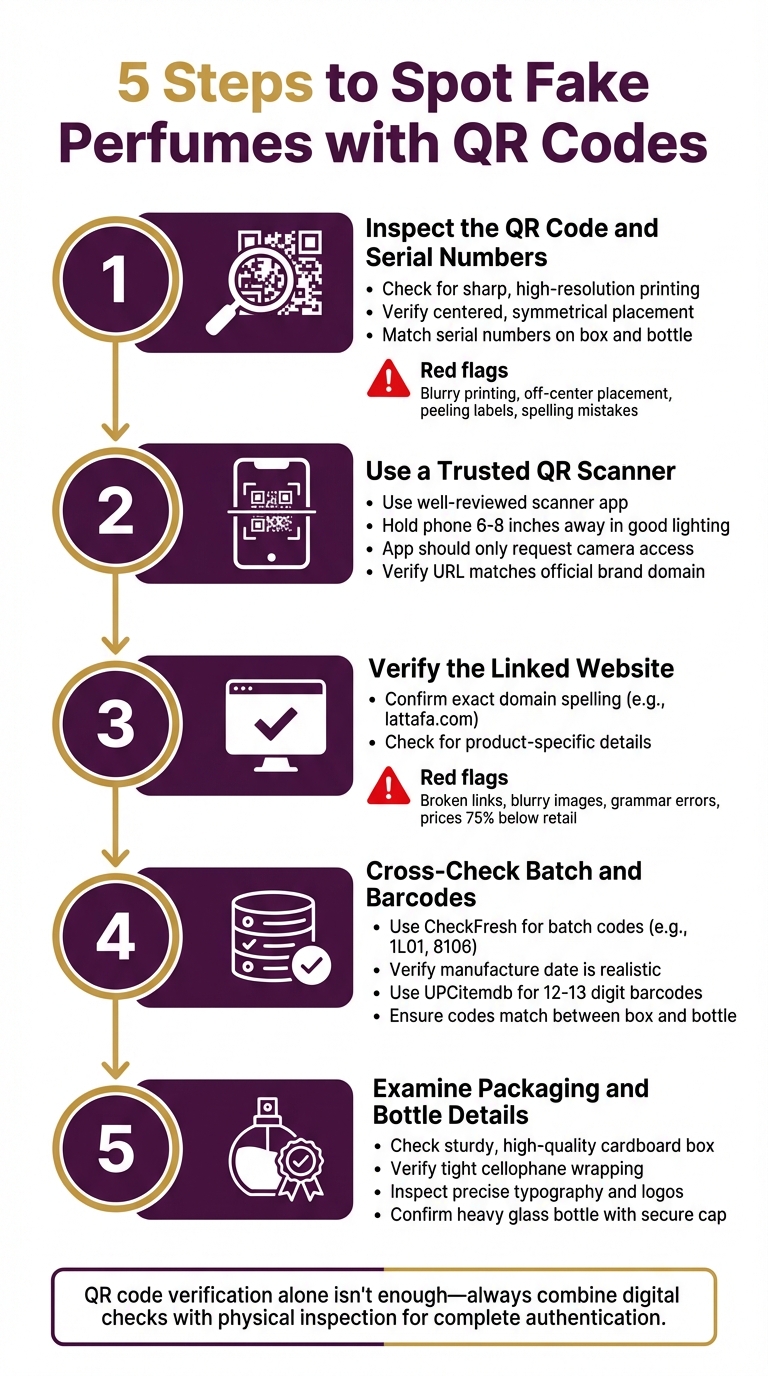
Processus en 5 étapes pour vérifier l’authenticité des parfums à l’aide de codes QR
Step 1: Find and Examine the QR Code
Commencez par inspecter soigneusement à la fois le dessous de la boîte et l’étiquette de sécurité extérieure afin de repérer les codes de suivi et de vérification. Vérifiez également la présence d’un code de vérification imprimé sur le flacon lui-même. Il est essentiel de s’assurer que les numéros de série figurant sur la boîte et sur le flacon correspondent. Si ce n’est pas le cas, ou si vous remarquez un autocollant qui semble avoir été appliqué séparément, il s’agit d’un signal d’alerte indiquant une possible contrefaçon.
Kritika Mishra de Fabbon souligne ce point :
Assurez-vous que le numéro de série n’est pas collé sur la boîte, car cela peut indiquer un faux parfum.
Une fois les numéros de série vérifiés, portez votre attention sur le code QR lui-même.
À quoi ressemble un véritable code QR
Un code QR authentique est l’expression même de la précision et de la qualité. Il présente une impression haute résolution, avec des contours nets et des caractères clairs et lisibles. Le code doit être placé de manière symétrique, centré et aligné avec les informations de lot et de production. Les véritables codes QR sont également conçus pour résister à l’usure — ils sont imperméables et résistants aux rayures, reflet des standards méticuleux de la fabrication de luxe.
Signes révélateurs de faux codes QR
Les codes QR contrefaits se trahissent souvent par leur mauvaise qualité. Soyez attentif à une impression floue ou irrégulière, à un positionnement décentré ou incliné, ainsi qu’à des étiquettes qui se décollent ou adhèrent mal. Les fautes d’orthographe dans le texte environnant ou des polices incohérentes sont d’autres signes révélateurs. De plus, si l’emballage extérieur présente un sceau de sécurité brisé ou manquant, il a probablement été altéré.
Comme le formule justement GQ South Africa :
Les fabricants légitimes ne tolèrent jamais un étiquetage négligé. Si quelque chose sur l’étiquette semble « étrange », il s’agit probablement d’une contrefaçon.
Étape 2 : Scannez avec une application fiable
Une fois que vous avez confirmé que le code QR semble légitime, l’étape suivante consiste à le scanner de manière sécurisée. Cette étape est essentielle, car un scan peu fiable peut vous rediriger vers de faux sites web ou même compromettre la sécurité de votre appareil.
« Scanner le code-barres ou le code QR devrait vous rediriger vers le site web du produit, ou au moins celui de l’entreprise. Si ce n’est pas le cas, le produit pourrait être une contrefaçon. »
Choisir une application de lecture de QR code digne de confiance
Optez pour une application de lecture de QR code bien notée, développée par un éditeur réputé. Assurez-vous qu’elle ne demande que l’accès à l’appareil photo et ne sollicite pas d’autorisations non pertinentes, comme l’accès à vos contacts ou à votre localisation — ce type de demande constitue un signal d’alerte évident. De nombreuses marques proposent désormais des solutions anti-contrefaçon, comme Scantrust, qui vous permettent de vérifier l’authenticité directement via leur site officiel sans nécessiter d’application distincte .
Scanner correctement le code QR
Pour effectuer le scan correctement, tenez votre téléphone à environ 6–8 pouces du code QR, dans un endroit bien éclairé. Veillez à ce que le code occupe la majeure partie de l’écran et ne soit pas masqué par des ombres ou des reflets. Si le scan ne fonctionne pas, vérifiez que le code QR n’est pas endommagé, taché ou usé.
Après le scan, examinez attentivement l’URL qui apparaît dans la barre d’adresse de votre navigateur. Elle doit correspondre au domaine officiel de la marque — par exemple lattafa.com pour les parfums Lattafa ou ramsonsperfumes.com pour les produits Ramson’s . Si vous êtes redirigé vers un site inconnu ou suspect, n’y saisissez aucune information personnelle et considérez le produit comme potentiellement contrefait.
Une fois que vous avez vérifié que le scan mène à la bonne destination, passez à l’étape suivante pour confirmer les détails du produit.
Étape 3 : Vérifiez où le code QR vous redirige
Après avoir scanné un code QR, il est essentiel de s’assurer que vous êtes dirigé vers un site web légitime. Commencez par vérifier l’URL dans la barre d’adresse de votre navigateur. Un véritable code QR doit vous conduire vers le domaine officiel de la marque — par exemple lattafa.com pour les parfums Lattafa ou ramsonsperfumes.com pour les produits Ramsons. Si le lien vous semble inconnu ou trop générique, c’est un indicateur fort que le produit peut être contrefait . De plus, le site vers lequel vous êtes redirigé doit fournir des détails spécifiques sur le produit, en accord avec l’article que vous inspectez.
Confirmer que le site web est officiel
Assurez-vous que le nom de domaine correspond exactement à celui de la marque. Les sites frauduleux utilisent souvent de légères fautes d’orthographe — comme « Chanelle » au lieu de « Chanel » — pour tromper les acheteurs. Un code QR fiable vous mènera directement à une page dédiée au produit, plutôt qu’à une page d’accueil générale. Cette page doit inclure tous les détails pertinents sur le produit, tels que les notes olfactives, les images et l’emballage, lesquels doivent correspondre au produit physique que vous avez en main . Certaines marques intègrent même des « codes QR sécurisés » avancés de fournisseurs comme Scantrust, permettant une vérification instantanée du produit sans nécessiter d’applications supplémentaires.
Signes d’alerte sur les pages liées
Une fois sur la page web liée, examinez de plus près sa qualité globale. Soyez attentif aux signes laissant penser que le site pourrait être frauduleux. Il peut s’agir de liens brisés, d’images floues ou de faible résolution, ainsi que de fautes d’orthographe ou de grammaire évidentes . Un site légitime présente des visuels nets, des polices élégantes et une navigation fluide. Vérifiez également que les détails du parfum affichés sur la page — comme les notes de tête, de cœur et de fond — correspondent au produit réel .
Un autre signal d’alarme majeur est un prix anormalement bas. Par exemple, si le prix ne représente qu’environ 25 % du tarif habituel, l’offre est probablement trop belle pour être vraie. Enfin, examinez l’étiquette du code QR elle-même. Les étiquettes authentiques sont généralement imperméables et résistantes aux rayures. Si vous constatez qu’elle se décolle facilement, cela peut indiquer un produit contrefait .
Votre expert parfum personnel vous attend
Faites notre quiz olfactif express pour découvrir des parfums de créateurs et de niche authentiques, choisis selon vos goûts – explorez-les en décants et échantillons de 2, 5, 8 et 30 ml, pour essayer chaque fragrance avant de vous engager sur un flacon entier.
Trouvez votre parfumÉtape 4 : Comparez les informations avec des outils de vérification
Après avoir effectué un scan sécurisé et vérifié le site web, l’étape suivante consiste à aller plus loin. Ces outils permettent de confirmer l’authenticité de votre parfum en décodant les codes batch et les codes-barres, révélant les détails de production et mettant en lumière les incohérences pouvant indiquer une contrefaçon.
Vérifier les codes batch avec CheckFresh
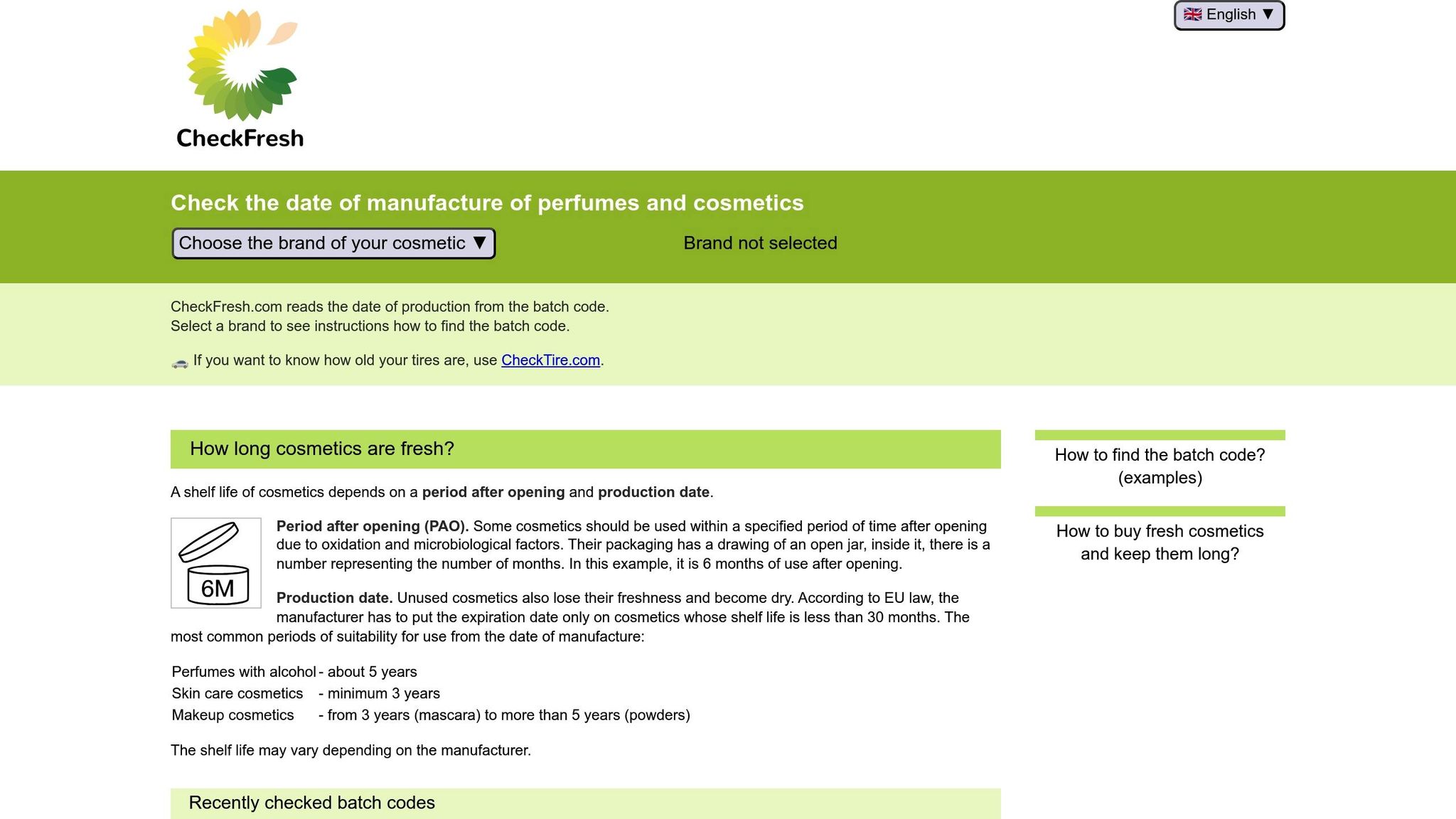
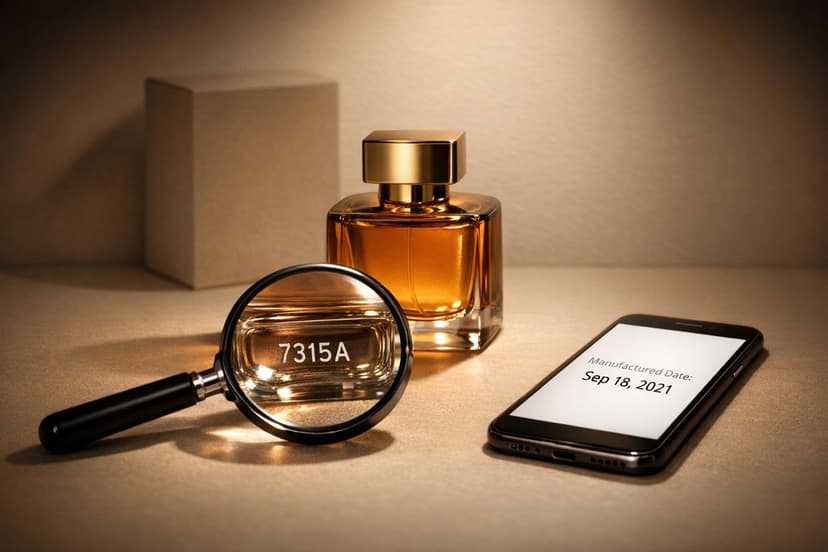
Un code batch, comme 1L01 ou 8106, est un identifiant unique qui vous indique quand et où un flacon a été fabriqué. Contrairement au code-barres plus long figurant sur la boîte, le code batch est généralement estampé ou imprimé avec une imprimante matricielle sur le fond du flacon ou à la base de l’emballage extérieur.
Pour vérifier un code batch, rendez-vous sur CheckFresh. Sélectionnez la marque, puis saisissez le code. Gardez à l’esprit que les fabricants utilisent des systèmes de codage différents. Par exemple, Coty Inc. peut utiliser un code tel que 0275, tandis que Christian Dior peut employer des formats comme 1L01. Ne confondez pas le code batch avec le code-barres de 12 ou 13 chiffres (par ex. 3614226905185) ou un numéro de référence catalogue — ceux-ci ne fonctionneront pas sur CheckFresh.
« La vérification du code-barres d’un parfum original est la première chose à faire après l’achat d’un nouveau parfum. » — UAE Moments
Une fois le code batch saisi, l’outil révèle la date de fabrication. Si la date est irréaliste — dans le futur ou plusieurs décennies dans le passé — c’est un fort signal de contrefaçon. Assurez-vous également que le code batch sur le flacon correspond à celui figurant sur la boîte. Toute discordance constitue un signal d’alerte majeur. De même, si le code est absent, taché, ou imprimé sur un autocollant plutôt que directement sur l’emballage, mieux vaut éviter le produit.
Utiliser des outils de recherche de codes-barres
Alors que les codes batch vous indiquent quand le parfum a été fabriqué, les codes-barres révèlent quel produit il s’agit. En saisissant le code-barres à 12 ou 13 chiffres dans une base de données comme UPCitemdb, vous pouvez confirmer les détails du produit. Par exemple, si votre flacon est étiqueté Chanel No. 5 Eau de Parfum 100ml, la base de données doit renvoyer le même produit — et non une taille, une concentration ou un parfum différent.
Si la recherche du code-barres fournit des informations qui ne correspondent pas au flacon que vous avez en main, c’est un signe clair d’altération ou de contrefaçon. Examinez également le code-barres lui-même. Il doit être imprimé directement sur l’emballage avec une encre de haute qualité. S’il est apposé sur un autocollant présentant des traces visibles de colle, c’est un autre signal d’alerte.
| Caractéristique | Code batch (CheckFresh) | Code-barres (UPCitemdb) |
|---|---|---|
| Objectif principal | Identifie la date de production et le lot. | Identifie le modèle du produit et le fabricant. |
| Méthode d’impression | Estampé ou matriciel (ajouté ultérieurement). | Impression standard de haute qualité (intégrée à l’étiquette). |
| Format | Alphanumérique court (par ex. 1L01). | 12 chiffres (UPC) ou 13 chiffres (EAN). |
Étape 5 : Recherchez d’autres signes de contrefaçon
Même si un code QR se scanne correctement, il ne suffit pas de s’appuyer uniquement sur une vérification numérique. Les contrefacteurs perfectionnent sans cesse leurs méthodes, ce qui rend indispensable une inspection physique minutieuse du produit. Les maisons de luxe accordent une attention méticuleuse à des détails tels que le poids de l’emballage, la qualité des matériaux et la précision du logo — des éléments souvent difficiles à reproduire pour les contrefacteurs.
Les codes QR qui ne fonctionnent pas correctement
Un code QR qui ne se scanne pas constitue un signal d’alerte majeur. Les marques authentiques investissent dans une impression de haute qualité et des tests rigoureux afin de garantir un fonctionnement irréprochable de leurs codes. Des échecs répétés de scan ou des erreurs telles que « page introuvable » suggèrent fortement que le produit pourrait être faux.
Teresa Murray, directrice de la veille consommateurs à la U.S. PIRG Education Fund, souligne :
Scanner le code-barres ou le code QR devrait vous rediriger vers le site web du produit, ou au moins celui de l’entreprise. Si ce n’est pas le cas, le produit pourrait être une contrefaçon.
Portez une attention particulière à l’URL qui apparaît après le scan. Si elle vous semble inconnue ou légèrement différente du domaine officiel de la marque, cela peut indiquer une contrefaçon. Lorsque les vérifications numériques suscitent un doute, un examen détaillé de l’emballage du produit peut apporter des éclaircissements supplémentaires.
Problèmes liés à l’emballage physique
L’emballage révèle souvent l’authenticité du produit. Les véritables parfums de luxe sont présentés dans des boîtes robustes, soigneusement confectionnées, en carton de haute qualité, avec des arêtes nettes et impeccables. Si la boîte semble fragile ou légère, il s’agit probablement d’un faux. En outre, les boîtes authentiques comportent un insert en carton rigide permettant de maintenir le flacon en place. Si le flacon bouge lorsque vous secouez délicatement la boîte, c’est un autre signe d’alerte.
Le film cellophane est un autre détail à examiner attentivement. Les produits authentiques présentent un emballage tendu, soigneusement plié, sans traces visibles d’adhésif. Les articles contrefaits, en revanche, ont souvent un emballage lâche ou désordonné. Comme le note GQ India :
Si l’expérience de déballage ne semble pas haut de gamme, faites confiance à votre instinct : ce n’est probablement pas le cas.
La typographie peut également trahir une contrefaçon. Vérifiez si le texte est flou, si les polices sont incohérentes, si l’espacement des lettres est irrégulier ou si les logos sont mal alignés. Certaines imitations présentent même de subtiles fautes d’orthographe, comme « Chanelle » au lieu de « Chanel », en espérant que l’acheteur ne s’en aperçoive pas. Les étiquettes authentiques sont précises, imperméables et résistantes aux rayures, tandis que les fausses peuvent avoir des bords grossiers, se décoller aux coins ou paraître décentrées.
Enfin, inspectez le flacon lui-même. Les flacons authentiques sont fabriqués en verre de haute qualité, sans bulles d’air ni jointures visibles. Le bouchon doit avoir une certaine densité et s’emboîter fermement. Ces petits détails peuvent faire toute la différence pour identifier un produit contrefait.
Conclusion
Identifier un parfum contrefait exige de l’attention aux détails et quelques gestes simples. Commencez par examiner soigneusement les codes QR, utilisez des applications de confiance pour les scanner, puis vérifiez l’authenticité du site web lié. Recoupez les codes batch via des plateformes comme CheckFresh et observez attentivement l’emballage. Les contrefacteurs peuvent reproduire des éléments extérieurs comme les codes-barres et le design de l’emballage, mais ils négligent souvent des aspects plus subtils, tels que le poids du flacon ou la complexité même de la fragrance.
Il est important de se rappeler qu’un simple scan du code QR ne suffit pas à confirmer l’authenticité. Prêtez attention à d’autres éléments, comme la validité du code-barres et le profil olfactif du parfum. Les parfums authentiques se dévoilent en plusieurs strates — notes de tête, de cœur et de fond — tandis que les contrefaçons dégagent souvent une odeur plate, excessivement alcoolisée, qui s’estompe rapidement . Prendre ces précautions vous assure non seulement d’obtenir ce pour quoi vous avez payé, mais protège aussi votre santé, car les faux parfums peuvent contenir des substances chimiques non réglementées et potentiellement nocives .
Pour une totale sérénité, achetez toujours vos fragrances de luxe auprès de revendeurs agréés. Par exemple, Scento propose des parfums de créateur authentiques en formats décantés plus petits — fioles de 2 ml, 5 ml et 8 ml, ainsi qu’un décant en flacon de 30 ml sur la plupart des parfums — vous permettant de découvrir de véritables senteurs sans vous engager sur un flacon entier.
Comme le dit si justement GQ India :
Le diable se cache dans les détails, de l’emballage au parfum. Voici sept façons claires de distinguer l’authentique de la contrefaçon.
Faites confiance à votre instinct lorsque quelque chose semble anormal. Quelques minutes supplémentaires consacrées à vérifier l’authenticité peuvent vous éviter une déception et vous garantir une véritable expérience de parfum de luxe.
FAQ
Comment choisir une application fiable de lecture de QR code ?
Pour vous assurer que votre application de lecture de QR code est fiable et sécurisée, gardez ces conseils à l’esprit :
- Privilégiez les boutiques d’applications officielles. Téléchargez uniquement des applications depuis des sources de confiance comme Google Play ou l’App Store d’Apple afin de garantir qu’elles répondent à des standards de sécurité établis.
- Vérifiez les notes et le nombre de téléchargements. Visez des applications notées 4,5★ ou plus et comptant des millions de téléchargements — cela reflète généralement la confiance des utilisateurs et leur fiabilité.
- Soyez attentif aux mises à jour et aux autorisations. Choisissez une application régulièrement mise à jour et ne demandant que les autorisations essentielles, comme l’accès à votre appareil photo.
- Testez-la avec un code QR fiable. Essayez de scanner l’étiquette d’un produit vérifié, comme un parfum acheté chez Scento. Une application fiable vous redirigera vers la page officielle d’authentification de la marque.
En choisissant une application bien notée, sécurisée, et en la testant avec un produit authentique, vous pourrez identifier les parfums contrefaits en toute confiance.
Comment savoir si un code QR sur un parfum est authentique ou faux ?
Lorsqu’il s’agit de codes QR sur les produits, l’authenticité est essentielle. Un véritable code QR est généralement dynamique ou sérialisé de manière unique, et relié à un système sécurisé basé sur le cloud. Cette configuration permet non seulement de vérifier l’authenticité du produit, mais aussi de signaler tout signe d’altération. À l’inverse, les codes QR contrefaits sont souvent statiques, non chiffrés et dépourvus de tout mécanisme de vérification, ce qui les rend faciles à dupliquer.
Si vous scannez un code QR sur un parfum ou tout autre produit, soyez particulièrement attentif. Des signaux d’alerte comme des liens brisés, des pages d’atterrissage génériques ou l’absence d’informations sur le produit peuvent indiquer un faux code. Pour plus de sécurité, utilisez toujours une application de scan QR fiable afin d’obtenir des résultats précis.
Pourquoi faut-il vérifier le code batch et le code-barres d’un parfum ?
Vérifier le code batch et le code-barres est une étape essentielle pour confirmer l’authenticité d’un parfum et retracer les détails de sa fabrication. Les parfums authentiques présentent des codes correctement alignés et intacts, correspondant aux enregistrements officiels fournis par la marque. Ces codes révèlent des informations importantes, comme la date de production et l’origine, vous donnant ainsi confiance dans la légitimité du produit.
Si vous remarquez qu’un code batch ou un code-barres est absent, ne correspond pas ou semble altéré, c’est un signal d’alerte indiquant que le parfum pourrait être contrefait. Examinez toujours ces détails avec attention avant de finaliser votre achat.
Vérification croisée avec le Scento Decoder : un complément de 30 secondes à la vérification par QR code
Les codes QR vérifient la légitimité de l’emballage. Les codes batch vérifient la date de production et la durée de conservation. Ils répondent à des questions différentes, et un contrôle rigoureux utilise les deux.
Après avoir scanné le code QR (Étape 1) et confirmé le domaine de destination (Étapes 2–3), l’étape suivante consiste à décoder le code batch. Scento a lancé un lecteur gratuit de codes batch précisément pour cela — collez le code, obtenez la date de fabrication et un niveau de confiance. Aucune inscription, plus de 600 marques, fonctionnement directement dans votre navigateur.
Si le Décodeur Scento ne reconnaît pas un flacon particulier (environ 5 % des codes de niche atypiques), les outils gratuits de référence restent d’excellentes solutions de repli. Pour les marques sans algorithmes de décodage publiés, le décodeur renvoie une date « estimée » avec cette mention clairement affichée — la page méthodologie explique ce que cela signifie et quelles marques relèvent de cette catégorie.
Pages de codes batch par marque : Tom Ford, Creed, Chanel, Maison Francis Kurkdjian, Amouage, Parfums de Marly, ainsi que sept autres. Chaque page présente le format de code propre à la marque, l’endroit où le trouver sur le flacon et la fenêtre de vérification.
Note éditoriale : Scento publie ce guide et exploite le Décodeur Scento. Nous l’indiquons en toute transparence.