Η ψηφιακή δημιουργία πρωτοτύπων βοηθά τους αρωματοποιούς να μειώσουν τον πρώτο γύρο εργαστηριακών δοκιμών από περίπου 50–100 συνθέσεις σε σχεδόν 10–20 προεπιλεγμένες επιλογές. Αυτό σημαίνει λιγότερη σπατάλη πρώτων υλών, χαμηλότερο αρχικό κόστος και ταχύτερη μετάβαση στις δοκιμές επί του δέρματος.
Με απλά λόγια: θα περιέγραφα την ψηφιακή δημιουργία πρωτοτύπων ως ανάπτυξη αρωμάτων με προτεραιότητα στο λογισμικό. Ο αρωματοποιός ξεκινά με ένα brief, το σύστημα προτείνει κατευθύνσεις για τη φόρμουλα και οι ομάδες ελέγχουν την ισορροπία των νοτών, τη διάχυση, την πτητικότητα και τη συμμόρφωση με τα πρότυπα της ΕΕ πριν από τη δημιουργία φυσικών δειγμάτων.
Τα βασικά σημεία:
- Η τεχνητή νοημοσύνη μπορεί να προτείνει αρχικές φόρμουλες μέσα από εξαιρετικά μεγάλες βιβλιοθήκες συνθέσεων
- Τα ψηφιακά εργαλεία επιτρέπουν την έγκαιρη σύγκριση επιλογών
- Τα ζητήματα κανονιστικής συμμόρφωσης μπορούν να εντοπιστούν πριν από την ανάμειξη
- Το δέρμα, η θερμότητα, η υγρασία και οι διαφορές από άτομο σε άτομο εξακολουθούν να μεταβάλλουν το αποτέλεσμα
- Η φυσική όσφρηση παραμένει ο τελικός κριτής
Ορισμένα ενδεικτικά δεδομένα:
- Ορισμένα συστήματα AI έχουν εκπαιδευτεί σε περίπου 1,5 έως 3,5 εκατομμύρια φόρμουλες
- Οι ομάδες μπορούν να περιορίσουν τις ιδέες σε μόλις 3–5 επικρατέστερες επιλογές
- Το αρχικό κόστος του έργου μπορεί να κυμαίνεται γύρω στα €1.000–3.000
- Για τα καλλυντικά στην ΕΕ, οι έλεγχοι επισήμανσης αλλεργιογόνων εξετάζουν συχνά όρια όπως 0,001 % για προϊόντα που παραμένουν στο δέρμα (leave-on) και 0,01 % για προϊόντα που ξεπλένονται (rinse-off)
Με άλλα λόγια: η ψηφιακή δημιουργία πρωτοτύπων είναι ένα φίλτρο, όχι ένα υποκατάστατο της όσφρησης. Τη θεωρώ έναν τρόπο για πιο στοχευμένη ανάπτυξη αρωμάτων, προτού το blotter, η δοκιμή στο δέρμα και η ολοήμερη εφαρμογή αποφασίσουν ποια δημιουργία θα επικρατήσει.
Αυτή είναι η κεντρική ιδέα πίσω από το παρακάτω άρθρο.
Πώς η ψηφιακή δημιουργία πρωτοτύπων υποστηρίζει την ανάπτυξη αρωμάτων
Χρήση μοντέλων δεδομένων για την πρόβλεψη της εξέλιξης και της διάρκειας του αρώματος
Οι ψηφιακές βιβλιοθήκες συστατικών περιέχουν τα βασικά δεδομένα που χρειάζονται οι αρωματοποιοί και οι ομάδες ανάπτυξης: μοριακό βάρος, πτητικότητα, οσφρητικούς περιγραφείς, επίπεδα χρήσης, δεδομένα αλλεργιογόνων και όρια ασφαλείας. Τα προγνωστικά μοντέλα αξιοποιούν αυτά τα στοιχεία για να εκτιμήσουν πώς μπορεί να εξελιχθεί ένα άρωμα στην κορυφή, την καρδιά και τη βάση του. Αυτό βοηθά τις ομάδες να αποφασίσουν ποιες φόρμουλες αξίζουν να περάσουν στον επόμενο γύρο δοκιμών.
Τα μοντέλα πρόβλεψης βάσει δομής μπορούν να αξιολογήσουν την πιθανή οσφρητική συμπεριφορά πριν από την ανάμειξη των συστατικών, εξοικονομώντας χρόνο στην αρχή. Ωστόσο, υπάρχει πάντα απόσταση ανάμεσα σε ένα μοντέλο και την πραγματική εφαρμογή. Η χημεία του δέρματος, η θερμοκρασία περιβάλλοντος και η υγρασία μπορούν να αλλάξουν την αίσθηση του αρώματος στο δέρμα, είτε πρόκειται για έναν ζεστό χώρο γραφείου είτε για μια αποπνικτική καλοκαιρινή μέρα. Γι’ αυτό οι πραγματικές δοκιμές εφαρμογής παραμένουν απαραίτητες.
Πώς η τεχνητή νοημοσύνη βοηθά στη δημιουργία και τη βελτιστοποίηση των συνθέσεων
Τα εργαλεία τεχνητής νοημοσύνης ξεκινούν από ένα δημιουργικό brief και προτείνουν φόρμουλες βάσει μοτίβων που εντοπίζονται σε μεγάλα σύνολα δεδομένων. Η πλατφόρμα Philyra της Symrise, εκπαιδευμένη σε περίπου 1,5 εκατομμύριο αρωματικές φόρμουλες από τους τομείς των εκλεκτών αρωμάτων, της προσωπικής φροντίδας και της οικιακής φροντίδας, δημιουργήθηκε για να αναδεικνύει νέους συνδυασμούς συστατικών και να περιορίζει την ανθρώπινη υποκειμενικότητα στα αρχικά στάδια της σύλληψης ιδεών.
Αν, για παράδειγμα, το brief ζητά ένα κιτρώδες άρωμα, το σύστημα μπορεί να παράγει διάφορες αρχικές φόρμουλες που συμμορφώνονται με τους κανονισμούς, προσφέροντας στον αρωματοποιό ένα ταχύτερο πρώτο προσχέδιο. Από εκεί και πέρα, η τεχνητή νοημοσύνη δεν αντικαθιστά το γούστο ή την κρίση. Προσφέρει επιλογές, και ο αρωματοποιός είναι αυτός που αποφασίζει την κατεύθυνση.
Γιατί οι ταχύτερες επαναλήψεις έχουν σημασία στην ανάπτυξη προϊόντων
Οι ψηφιακές πλατφόρμες καταγράφουν κάθε αλλαγή στη φόρμουλα, καθιστώντας τη σύγκριση των εκδοχών ταχύτερη και ευκολότερη στην παρακολούθηση. Αντί να προσέρχονται στη φυσική ανάμειξη με ένα πλήθος ανεπεξέργαστων ιδεών, οι ομάδες μπορούν να περιορίσουν το πεδίο σε 3 έως 5 προεπιλεγμένες προτάσεις. Αυτό σημαίνει λιγότερη σπατάλη πολύτιμων φυσικών εκχυλισμάτων και εξειδικευμένων μορίων, καθώς και πιο οργανωμένα αρχεία για μελλοντικά flankers και περιορισμένες εκδόσεις.
Αυτή η τελική επιλογή είναι που αξιολογείται από τα εργαλεία εικονικής δοκιμής στο επόμενο στάδιο.
Πώς λειτουργεί η δοκιμή αρωμάτων σε ψηφιακά και εικονικά περιβάλλοντα
Εργαλεία εικονικής δοκιμής και προγραμματιζόμενες συσκευές διάχυσης αρώματος
Μόλις οριστεί η τελική επιλογή, τα ψηφιακά εργαλεία βοηθούν τις ομάδες να αποφασίσουν ποια κατεύθυνση αξίζει να προχωρήσει στο εργαστήριο. Στις ψηφιακές και εικονικές δοκιμές, μοντέλα λογισμικού και ελεγχόμενα συστήματα διανομής αξιολογούν τις αρωματικές ιδέες πριν από —ή παράλληλα με— τις εργαστηριακές δοκιμές. Προγραμματιζόμενες συσκευές διάχυσης και ψηφιακά ελεγχόμενες οσφρητικές διεπαφές απελευθερώνουν μικροσκοπικές δόσεις αρώματος σε προκαθορισμένη σειρά, επιτρέποντας στους δοκιμαστές να συγκρίνουν νότες κορυφής, καρδιάς και βάσης υπό απόλυτα επαναλήψιμες συνθήκες.
Τα συστήματα μεικτής πραγματικότητας προχωρούν ένα βήμα παραπέρα, συνδυάζοντας τη χρονικά συγχρονισμένη απελευθέρωση αρώματος με οπτικά ερεθίσματα. Ο στόχος είναι απλός: κάθε συμμετέχων λαμβάνει το ίδιο οσφρητικό ερέθισμα στο ίδιο ακριβώς πλαίσιο, καθιστώντας τη σύγκριση πιο αξιόπιστη.
Φυσικά, οι ανθρώπινες ομάδες δοκιμών παραμένουν αναντικατάστατες. Ωστόσο, τα όργανα μέτρησης προσθέτουν μια αντικειμενική διάσταση στη διαδικασία. Τα συστήματα ηλεκτρονικής μύτης αναλύουν τις πτητικές οργανικές ενώσεις για να συγκρίνουν παραλλαγές και να ελέγξουν τη σταθερότητα μεταξύ των παρτίδων. Δεν αντικαθιστούν την ανθρώπινη αντίληψη, αλλά μπορούν να εντοπίσουν μετρήσιμες διαφορές μεταξύ των δειγμάτων.
Τι μπορεί να δοκιμαστεί πριν από την πλήρη παραγωγή
Τα ψηφιακά και εικονικά εργαλεία είναι ιδιαίτερα χρήσιμα ως στάδιο προεπιλογής. Πριν μια φόρμουλα προχωρήσει σε φυσική αξιολόγηση, οι ομάδες μπορούν να τα αξιοποιήσουν για να ελέγξουν ορισμένα πρακτικά ζητήματα:
- Ανταποκρίνεται η φόρμουλα στο αρχικό brief;
- Γίνεται ένα πρωτότυπο αντιληπτό με μεγαλύτερη σαφήνεια σε σύγκριση με ένα άλλο;
- Ταιριάζει η συμφωνία (accord) στο ζητούμενο ύφος;
- Μπορεί το κόστος ή η διαθεσιμότητα των συστατικών να αποτελέσουν εμπόδιο;
Ένα απλό παράδειγμα: τρεις ψηφιακά διαχειριζόμενες εκδοχές της ίδιας ξυλώδους-κεχριμπαρένιας ιδέας μπορούν να συγκριθούν για να διαπιστωθεί ποια εξισορροπεί καλύτερα τη φωτεινότητα, τη διάχυση και την αίσθηση πολυτέλειας. Τα ψηφιακά εργαλεία βοηθούν στον περιορισμό των επιλογών. Στη συνέχεια, οι δοκιμές σε blotter και στο δέρμα επιβεβαιώνουν το dry-down, το sillage και την αλληλεπίδραση με την επιδερμίδα.
Παράγοντες ασφάλειας και συμμόρφωσης στην ΕΕ και τη Γερμανία
Εάν μια φόρμουλα περάσει την προεπιλογή, ακολουθούν οι έλεγχοι συμμόρφωσης. Για την ευρωπαϊκή αγορά, τα αρώματα πρέπει να συμμορφώνονται με τον Κανονισμό (ΕΚ) αριθ. 1223/2009, καθώς και με τα πρότυπα REACH, CLP και IFRA. Τα ψηφιακά μοντέλα μπορούν να συμβάλουν στον έγκαιρο εντοπισμό ζητημάτων που σχετίζονται με αλλεργιογόνα. Για παράδειγμα, μπορούν να ελέγξουν αν ένα συστατικό υπερβαίνει το όριο επισήμανσης 0,001 % για προϊόντα leave-on ή 0,01 % για προϊόντα rinse-off. Ωστόσο, αυτοί οι έλεγχοι πρέπει να επιβεβαιώνονται σε πραγματικές συνθέσεις πριν από την κυκλοφορία.
Εκεί όπου οι ψηφιακές ροές εργασίας βοηθούν περισσότερο τις ομάδες συμμόρφωσης είναι η ιχνηλασιμότητα. Κάθε συστατικό, συγκέντρωση και εκδοχή της φόρμουλας μπορεί να καταγράφεται αυτόματα. Αυτό διευκολύνει τον έλεγχο αλλεργιογόνων και την προετοιμασία του φακέλου ασφαλείας, αναδεικνύοντας παράλληλα με σαφήνεια τι απομένει να αποδειχθεί πριν από τη διάθεση στην αγορά.
Ο προσωπικός σας ειδικός αρωμάτων σας περιμένει
Κάντε το σύντομο κουίζ αρώματος και ανακαλύψτε αυθεντικά αρώματα designer και niche, επιλεγμένα στα μέτρα σας – εξερευνήστε τα σε decant και δείγματα των 2, 5, 8 και 30 ml, ώστε να δοκιμάσετε το καθένα πριν επιλέξετε ολόκληρο μπουκάλι.
Βρείτε το άρωμά σαςΤι μπορεί και τι δεν μπορεί να βελτιώσει η ψηφιακή δημιουργία πρωτοτύπων
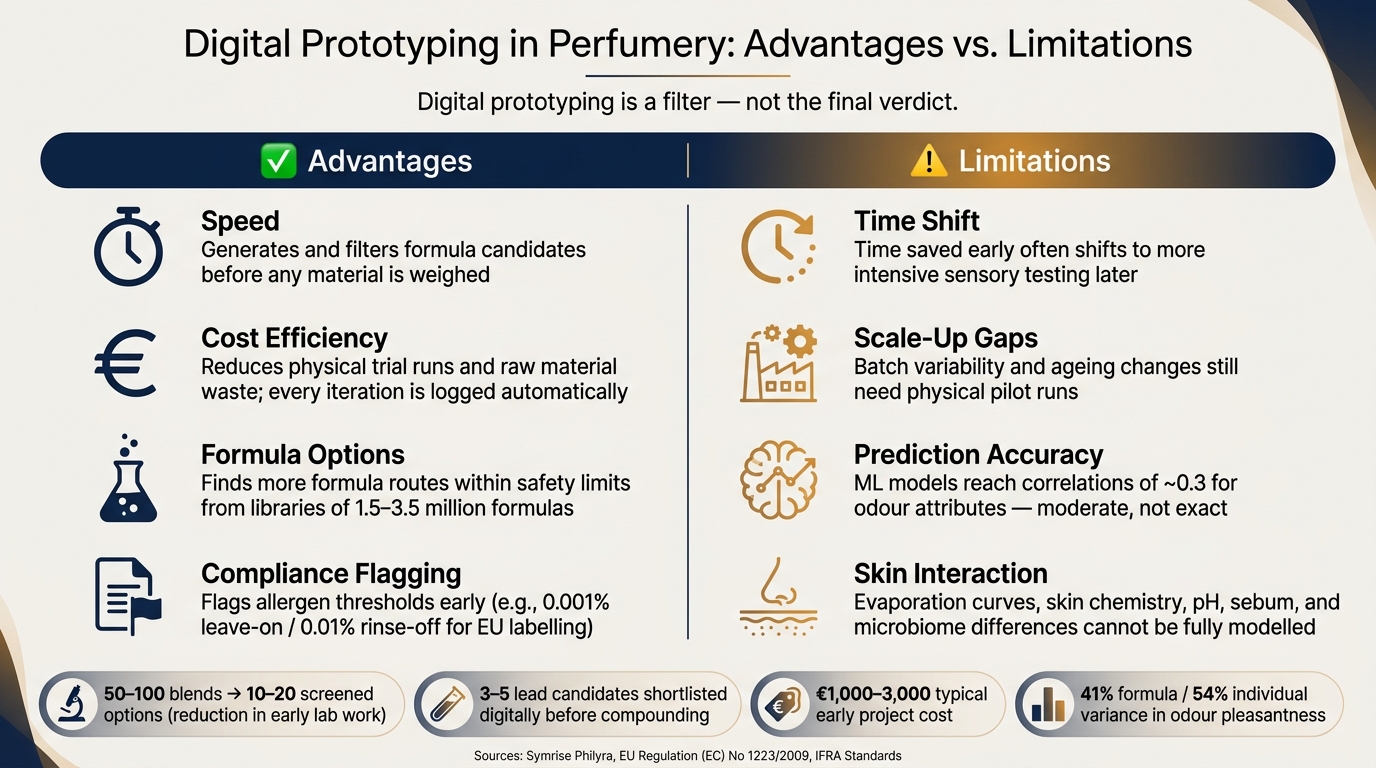
Digital Prototyping in Perfumery: Advantages vs. Limitations
Πλεονεκτήματα και περιορισμοί με μια ματιά
Μετά την προεπιλογή και τις εικονικές δοκιμές, το επόμενο ερώτημα είναι απλό: τι βελτιώνουν πραγματικά αυτά τα εργαλεία;
Η ψηφιακή δημιουργία πρωτοτύπων μεταμορφώνει τη δημιουργία αρωμάτων κυρίως στα αρχικά στάδια. Βοηθά τις ομάδες να αξιολογούν ιδέες ταχύτερα, να μειώνουν τη σπατάλη και να δοκιμάζουν περισσότερες κατευθύνσεις σύνθεσης πριν ξεκινήσει η ανάμειξη στο εργαστήριο. Και αυτό είναι ουσιαστικό. Όταν ένα σπάνιο absolute μπορεί να εκτοξεύσει την τιμή ενός τελικού μπουκαλιού πολύ πάνω από τα 300,00 €, ο περιορισμός των περιττών φυσικών δοκιμών εξοικονομεί σημαντικούς οικονομικούς πόρους και υλικά.
| Διάσταση | Πλεονέκτημα | Περιορισμός |
|---|---|---|
| Ταχύτητα | Δημιουργεί και φιλτράρει υποψήφιες φόρμουλες πριν από τη ζύγιση οποιουδήποτε υλικού | Ο χρόνος που εξοικονομείται αρχικά συχνά μεταφέρεται σε πιο εντατικές αισθητηριακές δοκιμές αργότερα |
| Κόστος και αποδοτικότητα | Μειώνει τις φυσικές δοκιμές και τη σπατάλη πρώτων υλών· κάθε εκδοχή καταγράφεται αυτόματα | Ζητήματα κλιμάκωσης παραγωγής —διακυμάνσεις παρτίδων και αλλοιώσεις λόγω παλαίωσης— απαιτούν ακόμη φυσικές πιλοτικές δοκιμές |
| Επιλογές συνθέσεων | Εντοπίζει περισσότερες πιθανές φόρμουλες εντός των ορίων ασφαλείας | Δεν μπορεί να υποκαταστήσει την κρίση ενός αρωματοποιού |
| Όρια πρόβλεψης | Αξιόπιστη για τεχνικά χαρακτηριστικά, όπως εκτιμήσεις διάχυσης και έντασης | Οι καμπύλες εξάτμισης, η αλληλεπίδραση με το δέρμα και η μακροχρόνια διάρκεια παραμένουν δύσκολο να αποτυπωθούν με ακρίβεια σε μοντέλα |
Οι αδυναμίες έχουν εξίσου μεγάλη βαρύτητα. Έρευνες πάνω σε μεθόδους μηχανικής μάθησης για την οσφρητική αντίληψη δείχνουν ότι τα μοντέλα πρόβλεψης για οσφρητικά χαρακτηριστικά επιτυγχάνουν συσχετίσεις άνω του 0,3 για μεμονωμένες αξιολογήσεις. Πρόκειται για μέτρια, όχι ακριβή συσχέτιση, αφήνοντας πολλά στοιχεία ανεξήγητα.
Επομένως, ο καλύτερος τρόπος προσέγγισης της ψηφιακής δημιουργίας πρωτοτύπων είναι ο εξής: αποτελεί ένα φίλτρο, όχι την τελική ετυμηγορία.
Γιατί η φυσική όσφρηση παραμένει αναντικατάστατη
Μια οθόνη εξακολουθεί να μην μπορεί να μεταφέρει ολόκληρη την εικόνα για το πώς συμπεριφέρεται ένα άρωμα στο πραγματικό δέρμα. Μόλις το άρωμα συναντήσει την επιδερμίδα, η χημεία γίνεται περίπλοκη με έναν καθαρά ανθρώπινο τρόπο. Τα επίπεδα σμήγματος, το pH, η υγρασία, ακόμη και οι διαφορές στο μικροβίωμα μπορούν να μεταβάλουν την εξέλιξη του αρώματος, εντείνοντας μερικές φορές τη γλυκύτητα ή αναδεικνύοντας απρόσμενες πτυχές στους μόσχους ή τα κεχριμπάρια.
Τα δεδομένα το επιβεβαιώνουν. Μια μελέτη έδειξε ότι η μοριακή ταυτότητα εξηγεί περίπου το 41 % της διακύμανσης στην ευχαρίστηση μιας οσμής, ενώ οι ατομικές διαφορές ευθύνονται για περίπου το 54 %. Με απλά λόγια, η φόρμουλα έχει σημασία, αλλά το άτομο που τη φορά έχει ακόμη μεγαλύτερη.
Γι’ αυτό η συμπεριφορά ενός αρώματος αλλάζει πάντα ανάλογα με το δέρμα, το κλίμα και τις συνθήκες. Ένα άρωμα που αποπνέει απαλότητα και διαύγεια σε έναν δροσερό χώρο μπορεί να γίνει πιο βαρύ ή πιο αιχμηρό στη ζέστη.
Η ψηφιακή δημιουργία πρωτοτύπων λειτουργεί ιδανικά ως σύστημα υποστήριξης αποφάσεων. Περιορίζει τις επιλογές, επισημαίνει κινδύνους και επιταχύνει τα αρχικά στάδια. Όμως, η τελική απόφαση προέρχεται πάντοτε από έναν αρωματοποιό που μυρίζει τη σύνθεση και από μια ομάδα δοκιμών που τη φορά καθ’ όλη τη διάρκεια της ημέρας.
Συμπέρασμα: Γιατί η ψηφιακή δημιουργία πρωτοτύπων είναι καθοριστική για τη σύγχρονη ανακάλυψη αρωμάτων
Η ψηφιακή δημιουργία πρωτοτύπων έχει γίνει η καθιερωμένη αφετηρία στην ανάπτυξη αρωμάτων. Όταν οι αρωματοποιοί προσομοιώνουν την πτητικότητα και αξιολογούν παραλλαγές στην οθόνη πρώτα, μπορούν να προχωρούν ταχύτερα και να περιορίζουν τη σπατάλη. Σε μια αγορά 52 δισεκατομμυρίων ευρώ, αυτού του είδους η αποδοτικότητα δεν είναι απλώς προαιρετική.
Η ροή εργασίας είναι ξεκάθαρη: ψηφιακή προσέγγιση αρχικά, φυσική δοκιμή στη συνέχεια. Ένας κανόνας, ωστόσο, παραμένει σταθερός: η τελική κρίση ανήκει στα πραγματικά δείγματα. Εργαλεία όπως το σύστημα Carto της Givaudan αποδεικνύουν το γιατί. Ένας αρωματοποιός μπορεί να επιλέξει πρώτες ύλες σε μια οθόνη αφής και να παραλάβει άμεσα ένα δείγμα παρασκευασμένο από ρομποτικό σύστημα. Επιταχύνει τις δοκιμές, ωστόσο η διαδικασία εξακολουθεί να βασίζεται στη φυσική αξιολόγηση. Τα ψηφιακά εργαλεία περιορίζουν τις επιλογές. Η όσφρηση στο δέρμα αποκαλύπτει το πραγματικό αποτέλεσμα.
Αυτή η ίδια λογική της δοκιμής πριν από τη δέσμευση διαμορφώνει πλέον και τον τρόπο με τον οποίο το κοινό επιλέγει αρώματα. Τα φιαλίδια 2 ml, 5 ml και 8 ml, καθώς και το μπουκάλι decant 30 ml για τα περισσότερα αρώματα, της Scento προσφέρουν στους Ευρωπαίους καταναλωτές έναν τρόπο χαμηλού ρίσκου να ζήσουν με ένα άρωμα πριν επενδύσουν σε ένα πλήρες μπουκάλι, το οποίο μπορεί να κοστίζει 300 € ή και περισσότερο. Αντί να βασίζονται σε εικασίες από ένα blotter ή έναν πρώτο ψεκασμό στο κατάστημα, μπορούν να το φορέσουν σε πραγματικές συνθήκες και να παρατηρήσουν πώς συμπεριφέρεται.
Το αποτέλεσμα δεν περιορίζει την τέχνη της αρωματοποιίας. Της προσφέρει μεγαλύτερη ακρίβεια.
Κύρια συμπεράσματα
- Τα ψηφιακά εργαλεία επιταχύνουν την ανάπτυξη και την αρχική αξιολόγηση, βοηθώντας τις ομάδες να προεπιλέγουν υποψήφιες φόρμουλες, να προβλέπουν την απόδοση και να εκτελούν ελέγχους συμμόρφωσης πριν από τη δημιουργία φυσικών δειγμάτων.
- Τα όρια παραμένουν ουσιαστικά: η χημεία του δέρματος, το πολιτισμικό πλαίσιο και οι συναισθηματικές αποχρώσεις δεν μπορούν να αποτυπωθούν πλήρως από ένα μοντέλο.
- Η φυσική όσφρηση εξακολουθεί να είναι η γέφυρα ανάμεσα σε μια ψηφιακή ιδέα και μια προσωπική επιλογή αρώματος — καμία οθόνη δεν μπορεί να αντικαταστήσει την εμπειρία ενός αρώματος που φοριέται για μια ολόκληρη ημέρα.
- Τα μικρά decants γεφυρώνουν αυτό το κενό για τους καταναλωτές, μειώνοντας το ρίσκο πριν από την αγορά ενός πλήρους μπουκαλιού.
Συχνές Ερωτήσεις
Πόσο ακριβής είναι η ψηφιακή δημιουργία πρωτοτύπων στην αρωματοποιία;
Η ψηφιακή δημιουργία πρωτοτύπων στην αρωματοποιία μπορεί να εξοικονομήσει σημαντικό χρόνο και να επιταχύνει ουσιαστικά την ανάπτυξη. Ωστόσο, η ακρίβειά της εξαρτάται από τον τρόπο χρήσης της.
Η τεχνητή νοημοσύνη μπορεί να προβλέψει την απόδοση μιας φόρμουλας με υψηλό βαθμό ακρίβειας, ενώ ορισμένα συστήματα αναφέρουν ακρίβεια έως και 95% όσον αφορά την αντιστοίχιση των αρωμάτων με τις προτιμήσεις των καταναλωτών.
Παρόλα αυτά, τα ψηφιακά πρωτότυπα θα πρέπει να αντιμετωπίζονται ως καθοδήγηση και όχι ως οριστική απάντηση. Αποδίδουν τα μέγιστα όταν συνδυάζονται με την ανθρώπινη τεχνογνωσία και την αισθητηριακή κρίση.
Τι εξακολουθεί να απαιτεί φυσική δοκιμή;
Ακόμη και με την ψηφιακή δημιουργία πρωτοτύπων, οι φυσικές δοκιμές παραμένουν απαραίτητες για την ολοκλήρωση ενός αρώματος με τον σωστό τρόπο.
Είναι το βήμα που αποκαλύπτει πώς συμπεριφέρεται μια φόρμουλα έξω από την οθόνη, πάνω στο πραγματικό δέρμα. Ένα άρωμα μπορεί να μοιάζει άρτιο σε ένα ψηφιακό μοντέλο και έπειτα να αλλάξει μόλις συναντήσει τη θερμότητα του σώματος, τον αέρα και το πέρασμα του χρόνου.
Οι φυσικές δοκιμές περιλαμβάνουν συνήθως:
- Patch tests για τον έλεγχο ερεθισμών ή αλλεργικών αντιδράσεων
- Δοκιμές σε blotter και στο δέρμα για την αξιολόγηση της εξέλιξης των νοτών και της αλληλεπίδρασης με τη χημεία του σώματος σε βάθος χρόνου
- Ελέγχους για το sillage, τη διάρκεια, τη σταθερότητα και τη διασφάλιση ποιότητας πριν από την παραγωγή
Σε αυτό το τελικό στάδιο εντοπίζονται συνήθως οι λεπτές ατέλειες. Ίσως οι νότες κορυφής να υποχωρούν πολύ γρήγορα. Ίσως το dry-down να μοιάζει επίπεδο στο δέρμα, αλλά όχι στο blotter. Ίσως το ίχνος του αρώματος να είναι πιο διακριτικό από το επιθυμητό. Οι φυσικές δοκιμές βοηθούν στην τελειοποίηση αυτών των λεπτομερειών πριν ξεκινήσει η παραγωγή.
Μπορούν τα ψηφιακά εργαλεία να επιταχύνουν τους ελέγχους συμμόρφωσης με την ΕΕ;
Ναι. Τα ψηφιακά εργαλεία καθιστούν τους ελέγχους συμμόρφωσης με τους κανονισμούς της ΕΕ σημαντικά ταχύτερους, αντικαθιστώντας τις χρονοβόρες χειροκίνητες διαδικασίες με αυτοματοποιημένους ελέγχους σε πραγματικό χρόνο.
Μπορούν να ελέγχουν τις αρωματικές φόρμουλες βάσει των προτύπων IFRA και των ευρωπαϊκών κανονισμών ασφαλείας, να επισημαίνουν ουσίες που υπόκεινται σε περιορισμούς ή απαγορεύσεις και να προτείνουν εναλλακτικές λύσεις πλήρους συμμόρφωσης. Αυτό επιτρέπει στους αρωματοποιούς να επικεντρωθούν στη δημιουργία, αποτρέπει τις δαπανηρές αναδιαμορφώσεις και εξομαλύνει τη διαδικασία εισόδου στην αγορά.

