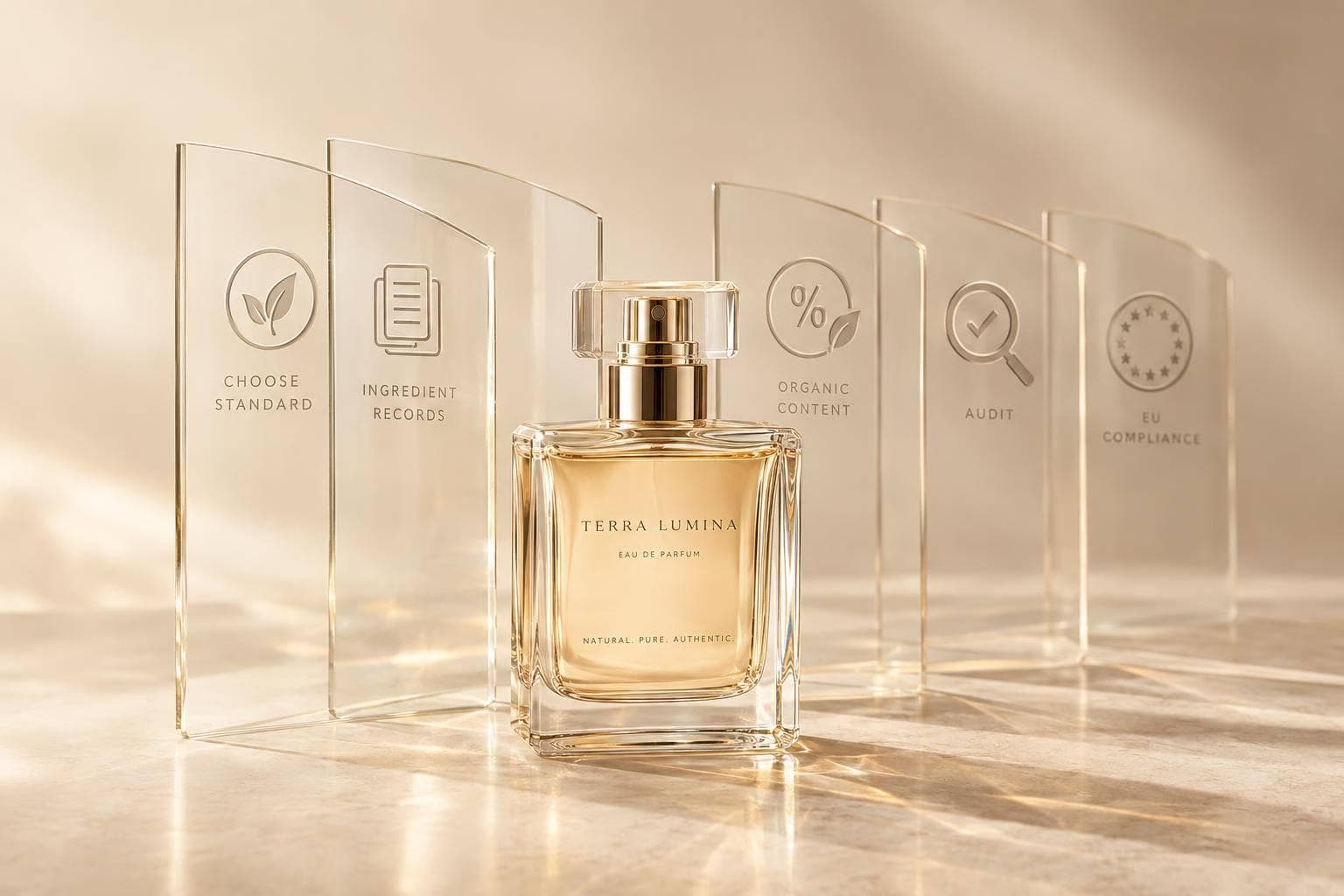
Organic perfume certification checks the whole product - not just its botanical ingredients. I start by choosing a named standard and certifier before buying materials or changing a formula.
For COSMOS ORGANIC, at least 95% of physically processed agro-ingredients must be organic. The finished perfume must also meet the applicable organic-content threshold, so I check the alcohol and the whole formula - not just the scent concentrate.
Here’s what I cover:
- Ingredients: supplier certificates, processing details and batch records.
- Formula and production: organic-content calculations, site audits and corrections.
- Packaging and claims: written approval for labels, online wording and any decanted formats.
- EU compliance: safety assessment, product records, notification and allergen labelling.
- After launch: renewals, traceability and approval before releasing changed stock.
My rule is simple: <u>no certification claim before written approval</u>. And organic certification does not replace cosmetic safety rules - including the expanded EU allergen requirements applying to newly marketed products from 31 July 2026.
Organic Perfume Certification: From Ingredients to Launch
Steps 1–2: Choose a Standard and Gather Ingredient Records
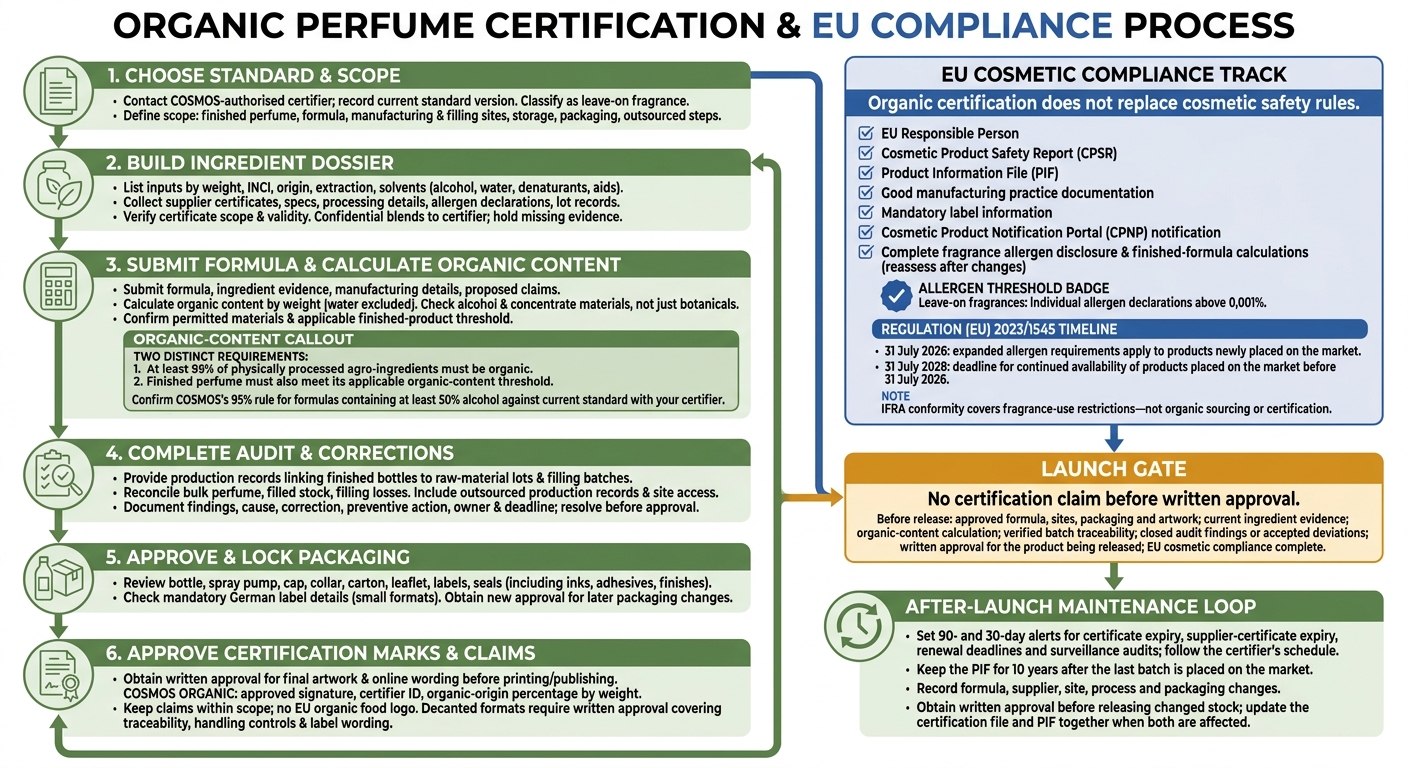
Choose your certification route before ordering materials or changing the formula. Contact a COSMOS-authorised certifier, record the current standard version and classify the perfume as a leave-on fragrance. Then build the ingredient file.
Define What the Certification Covers
Identify every site involved in blending, maceration, filtration, filling, labelling and storage - including outsourced work. The certification scope should cover the finished perfume, formula, manufacturing and filling sites, storage, packaging and outsourced steps.
Before you commit, ask the certifier to review the ingredient categories, processing methods, restricted substances and proposed packaging. Once the scope is set, list every formula input.
List Every Formula Ingredient
Record each material’s weight, INCI name, origin, extraction method and solvents. Include oils, absolutes, concretes, CO₂ extracts, isolates, alcohol, water, fixatives, colourants, preservatives, denaturants and processing aids.
For purchased fragrance blends, request details of their constituents and processing. If the composition is confidential, arrange for the supplier to share it directly with the certifier under a confidentiality agreement. A natural claim does not exempt a blend from review.
Collect Supplier Certificates and Batch Records
Support your chosen organic claim with traceable supplier evidence. Build a dossier that links each purchased material to its supplier, manufacturing site, specification, botanical origin, processing details, allergen declaration and incoming lot.
Check certificate numbers, scope and validity dates - not just whether a certificate exists. Food-organic evidence or other approvals do not replace a COSMOS compliance file.
Use the register below to track evidence, and mark materials as approved only after review. Check certificates before purchase and before expiry. Hold any material with missing documents or changes to its scope until the issue is resolved.
Ingredient Supplier Organic status Certificate evidence Processing method Batch traceability Review status Lavender essential oil Supplier A Organic claimed COSMOS or equivalent certificate; number and expiry recorded Steam distillation; botanical origin recorded Lot LAV-2026-041 linked to delivery and production batch Approved Ethanol Supplier B Pending verification Certificate, specification and denaturant statement requested Fermentation and subsequent processing documented Lot ETH-26-118 linked to perfume batch Pending clarification Proprietary fragrance blend Supplier C Natural/organic status not yet confirmed Confidential composition and supplier declaration sent to certifier Processing solvents and constituent materials under review Blend lot FB-2609 linked to production record Pending clarification Water Internal source or approved supplier - Specification and quality record Purification method documented Water lot or production record retained Approved
The completed dossier gives the certifier the records needed to review the formula before moving to content calculation and audit.
Steps 3–4: Submit the Formula and Complete the Audit
Once the dossier is complete, submit the full application: the formula, ingredient evidence, manufacturing details and proposed claims. The certifier reviews the file, requests clarification and, if needed, schedules an on-site audit or an audit of your contract manufacturer. Correct and document every non-conformity before approval.
Calculate Organic Content by Weight
List each ingredient’s share by weight and its organic status. Calculate the organic content of the finished formula; water does not count. Use the documented alcohol percentage and break the fragrance concentrate down into its individual materials.
Confirm the current threshold, including COSMOS’s 95% rule for formulas containing at least 50% alcohol. Check whether solvents, denaturants, synthetic fragrance materials and colourants are permitted and whether they count towards organic content.
Handle EU cosmetic compliance alongside the organic review.
Meet EU Cosmetic Safety Rules Separately
Organic approval does not replace EU cosmetic compliance. Before sale, arrange an EU responsible person, a Cosmetic Product Safety Report (CPSR), a Product Information File (PIF), good manufacturing practice and notification through the Cosmetic Product Notification Portal (CPNP). The PIF should identify the fragrance by name or code and list the supplier’s identity where relevant. An IFRA conformity document covers fragrance-use restrictions - not organic sourcing or certification.
Obtain an allergen disclosure for the complete fragrance composition. Calculate each regulated allergen’s concentration in the finished perfume, and check again whenever the formula or supplier changes. Leave-on fragrances require individual allergen declarations above 1%.
Apply the expanded requirements under Regulation (EU) 2023/1545 to products newly placed on the market from 31 July 2026. Products placed on the market before that date may remain available until 31 July 2028.
Prepare Production Records for the Audit
After the file review, prepare batch records showing traceability through filling. These records must link each finished bottle to its raw-material lots, including ethanol, and its filling batch. Reconcile the bulk perfume with filled stock and filling losses.
If production is outsourced, provide the contract manufacturer’s records and arrange site access. For each audit finding, record the cause, correction, preventive action, owner and deadline. The certifier may ask for more documents or a follow-up audit. Do not use the certification mark or claim certified organic status until you receive written approval.
Ο προσωπικός σας ειδικός αρωμάτων σας περιμένει
Κάντε το σύντομο κουίζ αρώματος και ανακαλύψτε αυθεντικά αρώματα designer και niche, επιλεγμένα στα μέτρα σας – εξερευνήστε τα σε decant και δείγματα των 2, 5, 8 και 30 ml, ώστε να δοκιμάσετε το καθένα πριν επιλέξετε ολόκληρο μπουκάλι.
Βρείτε το άρωμά σαςSteps 5–6: Approve Packaging and Label Claims
Once the formula file is audit-ready, approve and lock the packaging and label files before printing. Any later change to pumps, varnish or cartons needs a new approval. This keeps the audit tied to the exact pack approved.
Check Bottles, Cartons and Required Label Details
Review the whole pack: bottle, spray pump, cap, collar, carton, leaflet, labels and seals. Include inks, adhesives and finishes where requested. Record decisions to reduce packaging and explain why any protective components are needed. A recyclable bottle does not make the whole pack recyclable.
Check that the approved pack carries all mandatory German label details, legibly, even on the smallest format. Where permitted, ingredients or warnings may appear on the carton or an enclosed notice, but the container must still carry the required reference. Small packs are not automatically exempt.
Use Approved Certification Marks and Wording
Get written approval for final artwork and online claims before printing or publishing. Follow your chosen scheme’s rules: COSMOS ORGANIC requires the approved signature, certifier ID and organic-origin percentage by weight.
Keep claims within the certified product’s scope. Do not suggest that every ingredient or packaging component is organic, or use the EU organic food logo on perfume. Avoid “chemical-free” and “non-toxic”; natural materials can still sensitise.
For perfume sold in smaller formats, traceability rules also apply to the repackaging step.
Verify Certification Claims for Decanted Perfume
Decanting changes the certified presentation - not just the pack size. It requires written certifier approval covering traceability, handling controls and label wording.
Conclusion: Check Launch Readiness and Keep Certification Valid
Once the formula and packaging are signed off, work through one pre-launch checklist. Record the named standard and certifier; approved formula, site, packaging and artwork; complete ingredient inventory; current supplier certificates and batch records; organic-content calculation by weight; verified batch traceability; closed audit findings or accepted deviations; and written approval for the product being released.
Confirm EU cosmetic compliance before launch. Check that the EU Responsible Person, Cosmetic Product Safety Report, Product Information File (PIF), good manufacturing practice documentation, label information and CPNP notification are all in place. Keep the PIF for 10 years after the last batch is placed on the market.
Set 90- and 30-day alerts for certificate expiry, supplier-certificate expiry, renewal deadlines and surveillance audits. Follow your certifier’s schedule.
After launch, keep a change-control register covering changes to the formula, suppliers, site, process and packaging. Get written approval before releasing changed stock. If a change affects both the certification file and the PIF, update them together.
FAQs
How long does organic perfume certification take?
The available information doesn’t give an exact timeline. Certification includes independent third-party inspections and supply-chain checks. How long it takes depends on the brand’s existing documentation and how complex its ingredient sourcing is.
For specific timelines, brands typically contact Ecocert or the bodies managing the COSMOS standard directly.
What does organic perfume certification cost?
The provided information does not give exact fees for organic perfume certification. Costs depend on the certifying body, supply chain complexity and audit scope, including third-party verification and continued compliance checks.
Brands typically contact organisations such as Ecocert directly to establish fees based on their production scale and ingredient profile.
How can I verify a perfume’s organic certification?
Look for recognised logos such as COSMOS ORGANIC, Ecocert or NATRUE on the packaging. Check the stated percentage of organic ingredients, and make sure you distinguish COSMOS ORGANIC from COSMOS NATURAL.
A logo alone isn’t enough. Search the certifier’s official public database for the perfume or brand to confirm its certification status. If anything is unclear, ask the brand for the certificate issued by the certifying body.

