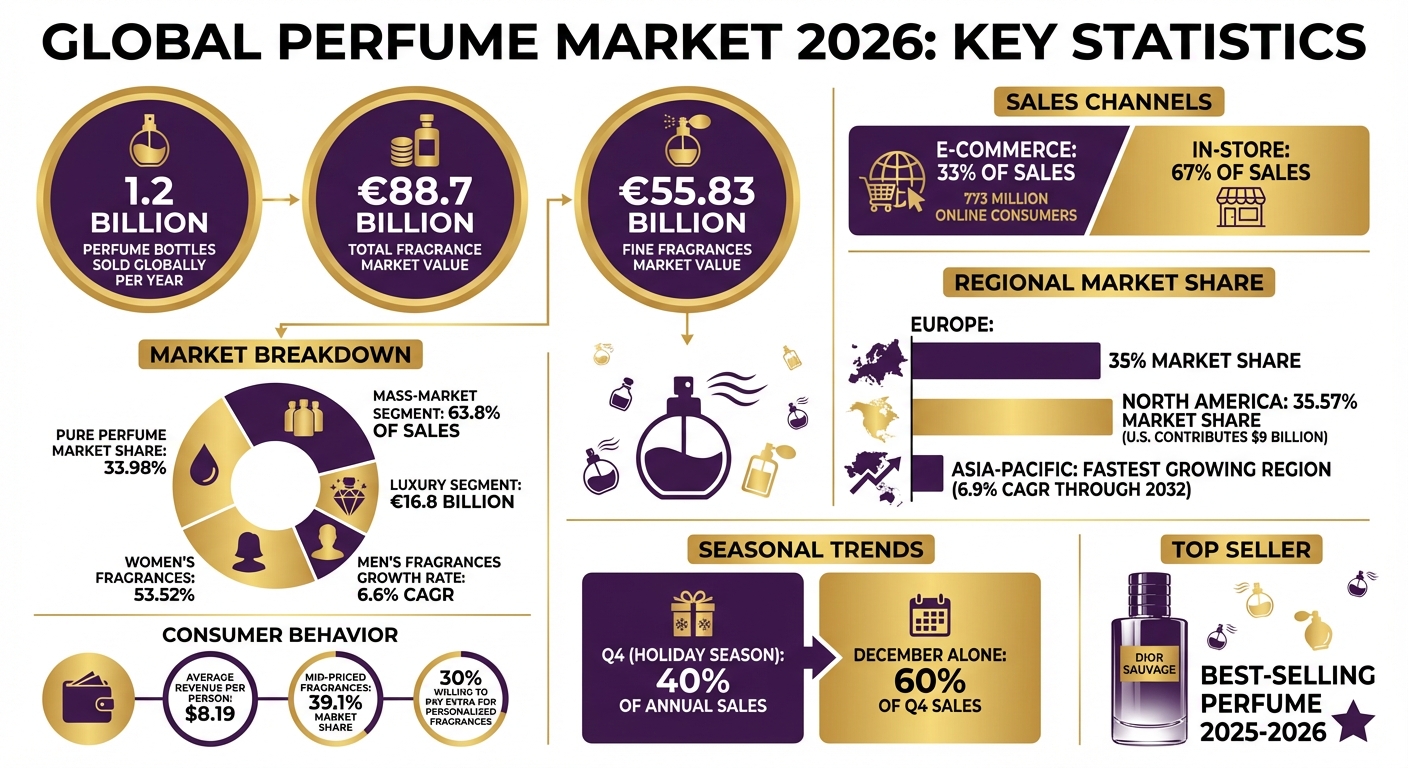
Κάθε χρόνο, 1,2 δισεκατομμύρια φιάλες αρώματος πωλούνται παγκοσμίως, με την αγορά αρωμάτων να προβλέπεται ότι θα φτάσει τα €88,7 δισεκατομμύρια το 2026. Αυτή η ανάπτυξη τροφοδοτείται από τις μεταβαλλόμενες συνήθειες των καταναλωτών, όπως η άνοδος του "fragrance wardrobing", όπου οι άνθρωποι διαθέτουν πολλαπλά αρώματα για διαφορετικές περιστάσεις. Το τμήμα μαζικής αγοράς αντιπροσωπεύει το 63,8% των πωλήσεων, ενώ η κατηγορία πολυτελείας αναμένεται να δημιουργήσει €16,8 δισεκατομμύρια.
Κύρια σημεία:
- Παγκόσμια Αξία Αγοράς (2026): €55,83 δισεκατομμύρια (εκλεκτά αρώματα), €88,7 δισεκατομμύρια (όλα τα αρωματικά προϊόντα).
- Κορυφαίες Περιοχές: Η Ευρώπη προηγείται με 35% μερίδιο αγοράς, ακολουθούμενη από τη Βόρεια Αμερική (€9 δισεκατομμύρια από τις Η.Π.Α.).
- Ταχύτερη Ανάπτυξη: Ασία-Ειρηνικός, με κινητήριο δύναμη την επέκταση της μεσαίας τάξης στην Κίνα και την Ινδία.
- Άρωμα με τις μεγαλύτερες πωλήσεις (2025–2026): Dior Sauvage.
Οι εποχικές τάσεις δείχνουν ότι το 40% των ετήσιων πωλήσεων πραγματοποιείται στο Q4, με τον Δεκέμβριο να είναι ο πιο δραστήριος μήνας. Το ηλεκτρονικό εμπόριο συνεχίζει να αναπτύσσεται, αντιπροσωπεύοντας το 33% των πωλήσεων, όμως οι αγορές στα φυσικά καταστήματα παραμένουν κυρίαρχες.
Η βιομηχανία αρωμάτων εξελίσσεται με αυξανόμενο ενδιαφέρον για επαναγεμιζόμενες φιάλες, gender-neutral αρώματα και προσιτές επιλογές πολυτέλειας.
Στατιστικά Παγκόσμιας Αγοράς Αρωμάτων 2026: Πωλήσεις, Περιφερειακό Μερίδιο & Τάσεις Καταναλωτών
Η κατάσταση του κλάδου ενόψει του 2026 #perfume #fragrance #topfragrances #nichefragrance #tiktok
Πόσες φιάλες αρώματος πωλούνται παγκοσμίως το 2026
Αν και ο ακριβής αριθμός των φιαλών αρώματος που πωλούνται παγκοσμίως το 2026 δεν είναι διαθέσιμος, η αξία της αγοράς αποτυπώνει με σαφήνεια το μέγεθός της. Η κατηγορία των αρωμάτων μόνο προβλέπεται να φτάσει τα $55,83 δισεκατομμύρια, και όταν περιλαμβάνονται τα προϊόντα προσωπικής φροντίδας και τα αρώματα χώρου, η ευρύτερη αγορά ανέρχεται συνολικά στα $88,7 δισεκατομμύρια. Αυτά τα μεγέθη αναδεικνύουν τη δυναμική καταναλωτική δαπάνη για αρώματα, αντανακλώντας τη σταθερή ανάπτυξη της κατηγορίας και τον ρόλο της ως προσιτής πολυτέλειας.
Η αξία της αγοράς αυξήθηκε από $53,04 δισεκατομμύρια το 2025 σε $55,83 δισεκατομμύρια το 2026, επιβεβαιώνοντας τη συνεπή ζήτηση για αρώματα. Αυτή η ανάπτυξη υπογραμμίζει τη γοητεία των αρωμάτων ως μικρές απολαύσεις που απευθύνονται σε ένα ευρύ φάσμα καταναλωτών.
Αναλύοντας περαιτέρω, το τμήμα των πολυτελών αρωμάτων σημείωσε 6,8% ετήσια ανάπτυξη, ενώ το τμήμα μαζικής αγοράς αντιπροσώπευε το 54,56% της συνολικής αγοράς. Σε παγκόσμια κλίμακα, τα μέση έσοδα που παράγονται ανά άτομο από τις πωλήσεις αρωμάτων το 2026 εκτιμώνται στα $8,19.
Όσον αφορά τις περιφερειακές επιδόσεις, η Βόρεια Αμερική ηγήθηκε με 35,57% μερίδιο αγοράς, με τις Ηνωμένες Πολιτείες και μόνο να συνεισφέρουν $9 δισεκατομμύρια σε έσοδα. Η Ευρώπη ακολούθησε από κοντά, με εκτιμώμενο μέγεθος αγοράς $12 δισεκατομμύρια.
Οι προτιμήσεις των καταναλωτών επηρέασαν επίσης την απόδοση διαφορετικών τύπων προϊόντων. Το Pure Perfume, γνωστό για την υψηλή του συγκέντρωση και τη διάρκειά του, κατέκτησε 33,98% του μεριδίου αγοράς το 2026, αντανακλώντας μια αυξανόμενη προτίμηση σε πιο διαρκή αρώματα. Επιπλέον, τα γυναικεία αρώματα συνέχισαν να κυριαρχούν, αντιπροσωπεύοντας το 53,52% της αγοράς, όμως τα ανδρικά αρώματα πλησιάζουν, παρουσιάζοντας ταχύτερο ρυθμό ανάπτυξης με σύνθετο ετήσιο ρυθμό ανάπτυξης 6,6%.
Αυτές οι τάσεις αναδεικνύουν τη δυναμική φύση της βιομηχανίας αρωμάτων και τα εξελισσόμενα γούστα των καταναλωτών παγκοσμίως.
Πωλήσεις αρωμάτων ανά περιοχή και χώρα
Τα πρότυπα κατανάλωσης αρωμάτων διαφέρουν σημαντικά σε όλο τον κόσμο, επηρεασμένα από ποικίλους οικονομικούς και κοινωνικούς παράγοντες. Η Ευρώπη ηγείται ως η μεγαλύτερη αγορά, και προβλέπεται να κατέχει το 35,3% του παγκόσμιου μεριδίου αγοράς έως το 2026. Την ίδια στιγμή, η περιοχή Ασίας-Ειρηνικού γνωρίζει ταχεία ανάπτυξη, με κινητήριες δυνάμεις την αστικοποίηση και τη διεύρυνση της μεσαίας τάξης, ιδίως σε χώρες όπως η Κίνα και η Ινδία.
Η Βραζιλία ξεχωρίζει παγκοσμίως για την υψηλή χρήση αρωμάτων, όπου τα αρώματα θεωρούνται απαραίτητα καθημερινά είδη και όχι αγαθά πολυτελείας. Αυτή η πολιτισμική προσέγγιση οδηγεί σε πολύ υψηλότερη συχνότητα χρήσης σε σύγκριση με τον παγκόσμιο μέσο όρο. Από την άλλη πλευρά, η Σαουδική Αραβία διαθέτει μία από τις υψηλότερες κατά κεφαλήν δαπάνες για πολυτελή αρώματα, συνεισφέροντας στο 35,7% της αγοράς Μέσης Ανατολής και Αφρικής έως το 2025.
Στην Ασία, η Κίνα αντιπροσώπευε το 30,3% της αγοράς αρωμάτων της Ασίας-Ειρηνικού το 2025, με τους καταναλωτές να προτιμούν premium διεθνείς οίκους και αρώματα ιδανικά για δώρα. Στην Ινδία, η αγορά αρωμάτων αναμένεται να φτάσει τα $3,1 δισεκατομμύρια έως το 2032, με πάνω από το 70% των πωλήσεων να προέρχεται από το τμήμα μαζικής αγοράς, καθώς οι νεότεροι καταναλωτές αυξάνουν τις δαπάνες τους για τον τρόπο ζωής τους.
Αυτές οι περιφερειακές διαφοροποιήσεις αναδεικνύουν τη διαφορετικότητα των καταναλωτικών συμπεριφορών, που αναλύονται περαιτέρω παρακάτω.
Φιάλες που πωλούνται ανά άτομο και χώρα
Εντός της Ευρώπης, η Γαλλία κατέχει το 24% της αγοράς, ακολουθούμενη από τη Γερμανία με 15%. Οι Γάλλοι καταναλωτές στρέφονται ολοένα και περισσότερο στην επένδυση σε ένα μόνο άρωμα υψηλής ποιότητας αντί να αγοράζουν πολλαπλές επιλογές χαμηλότερου κόστους.
Στο Ηνωμένο Βασίλειο, η Gen Z οδήγησε σε ετήσια αύξηση 70% στις πωλήσεις αρωμάτων έως το 2024, επηρεασμένη από τις τάσεις των social media και τη διαρκώς αυξανόμενη δημοτικότητα της δημιουργίας μιας "fragrance wardrobe". Στην Ιαπωνία, οι προτιμήσεις στρέφονται σε ελαφριά, διακριτικά και δροσερά αρώματα, αντανακλώντας την κουλτούρα περιποίησης της χώρας. Αυτό έρχεται σε έντονη αντίθεση με τη δυτική προτίμηση προς έντονα, μακράς διάρκειας premium αρώματα.
Αυτές οι πληροφορίες αντικατοπτρίζονται περαιτέρω στις αγοραστικές συνήθειες και τη συχνότητα αγοράς των καταναλωτών.
Πόσες φιάλες αρώματος αγοράζει ο μέσος καταναλωτής ανά έτος
Η ιδέα της "fragrance wardrobe" έχει αποκτήσει δυναμική παγκοσμίως, με πολλούς καταναλωτές να διαθέτουν και να εναλλάσσουν 5, 10 ή ακόμη και 15 αρώματα ανάλογα με τη διάθεση, την ενδυμασία ή την περίσταση. Οι έφηβοι άνδρες ειδικότερα έχουν αυξήσει αισθητά τις δαπάνες τους, με το τμήμα των ανδρικών αρωμάτων να αναπτύσσεται με CAGR 6,6%, γεγονός που αποτυπώνει ένα ευρύτερο ενδιαφέρον για ποικιλόμορφες συλλογές αρωμάτων. Τα travel sizes και τα discovery sets έχουν εξελιχθεί σε δημοφιλή σημεία εισόδου για καταναλωτές που εξερευνούν νέα αρώματα και οικοδομούν τις συλλογές τους. Επιπλέον, περίπου το 30% των καταναλωτών είναι πρόθυμο να πληρώσει περισσότερο για εξατομικευμένα ή bespoke αρώματα, αντανακλώντας μια αυξανόμενη ζήτηση για ατομικότητα και αυτοέκφραση.
Ο προσωπικός σας ειδικός αρωμάτων σας περιμένει
Κάντε το σύντομο κουίζ αρώματος και ανακαλύψτε αυθεντικά αρώματα designer και niche, επιλεγμένα στα μέτρα σας – εξερευνήστε τα σε decant και δείγματα των 2–8ml, ώστε να δοκιμάσετε το καθένα πριν επιλέξετε ολόκληρο μπουκάλι.
Βρείτε το άρωμά σαςΑρώματα με τις μεγαλύτερες πωλήσεις: ιστορικά και σύγχρονα
Η αγορά αρωμάτων διαμορφωνόταν ανέκαθεν από ένα μίγμα διαχρονικών κλασικών και νεότερων λανσαρισμάτων. Εξετάζοντας τα αρώματα με τις κορυφαίες πωλήσεις διαχρονικά, αποκτούμε μια εικόνα των μεταβαλλόμενων γούστων των καταναλωτών, σε σύνδεση με τις τάσεις ανάπτυξης της αγοράς και του fragrance wardrobing που αναφέρθηκαν νωρίτερα.
Αρώματα με τις μεγαλύτερες πωλήσεις όλων των εποχών
Chanel No. 5 παραμένει σύμβολο διαχρονικής κομψότητας. Από την κυκλοφορία του το 1921, έχει λατρευτεί από το 68% των γυναικών άνω των 45 ετών, χάρη στο αλδεϋδικό λουλουδάτο του μείγμα από τριαντάφυλλο και γιασεμί. Η σύνδεσή του με τη λάμψη του Hollywood έχει ενισχύσει ακόμη περισσότερο την εμβληματική του υπόσταση.
Ένα ακόμη εμβληματικό άρωμα είναι το Dior J’adore, ένα πολυτελές λουλουδάτο μπουκέτο που συνεχίζει να γοητεύει τις γυναίκες που αναζητούν εκλέπτυνση. Με την πάροδο των ετών, ο Dior έχει παρουσιάσει πιο intense εκδοχές του J’adore, ενισχύοντας τη διάρκειά του ενώ παραμένει πιστό στις ρίζες του. Αυτά τα θρυλικά αρώματα ευδοκιμούν συνδυάζοντας μοναδικά οσφρητικά προφίλ με συναισθηματική αφήγηση.
Το Bleu de Chanel κατέχει επίσης κορυφαία θέση παγκοσμίως, χάρη στο εκλεπτυσμένο μείγμα εσπεριδοειδών, ginger και σανταλόξυλου. Με μέση διάρκεια που ξεπερνά τις 7 ώρες, ανταποκρίνεται στις προσδοκίες των καταναλωτών τόσο για ποιότητα όσο και για απόδοση.
Αυτά τα κλασικά αρώματα θέτουν τη βάση, όμως τα σύγχρονα best-sellers αποκαλύπτουν πώς εξελίσσονται οι καταναλωτικές προτιμήσεις.
Αρώματα με τις μεγαλύτερες πωλήσεις το 2025–2026
Το Dior Sauvage κατέκτησε τον τίτλο του κορυφαίου best-seller παγκοσμίως για το 2025–2026. Ο ευέλικτος συνδυασμός του από περγαμόντο, πιπέρι Σιτσουάν και αμπροξάνη το καθιστά ιδανική επιλογή για ποικίλες περιστάσεις.
Το YSL Libre, που κατατάσσεται τέταρτο παγκοσμίως, ξεχωρίζει για το τολμηρό του μείγμα λεβάντας, άνθους πορτοκαλιάς και βανίλιας, συνδυασμένο με μια αφήγηση που εξυμνεί την ενδυνάμωση. Το Paco Rabanne Invictus, με τις δροσερές του νότες από δάφνη, grapefruit και amber, έχει επίσης εξασφαλίσει ισχυρή θέση στην αγορά.
Το Maison Francis Kurkdjian Baccarat Rouge 540 είναι ένα ακόμη ξεχωριστό παράδειγμα, με τις πωλήσεις του να εκτοξεύονται κατά 31,6%, εν μέρει χάρη σε viral τάσεις στο TikTok. Γνωστό για την εξαιρετική του διάρκεια, αναδεικνύει τον τρόπο με τον οποίο τα social media επηρεάζουν την ανακάλυψη αρωμάτων, ιδιαίτερα καθώς η Gen Z αύξησε τις δαπάνες της για αρώματα κατά 26% το 2024.
Και τα πρόσφατα λανσαρίσματα είχαν τον αντίκτυπό τους. Το Chanel Gabrielle Essence Twist & Spray, που παρουσιάστηκε τον Ιούλιο του 2025, και το Chloé Rose Naturelle Intense της Coty, που λανσαρίστηκε τον Νοέμβριο του 2025, προσέλκυσαν το ενδιαφέρον. Το δεύτερο σηματοδοτεί την πρώτη επαναγεμιζόμενη σειρά αρωμάτων της Chloé, σε αρμονία με τις αυξανόμενες απαιτήσεις για βιωσιμότητα. Παράλληλα, το Burberry Goddess, που κυκλοφόρησε στα τέλη του 2023, συνεχίζει να κυριαρχεί στις πωλήσεις με το εκλεπτυσμένο του μείγμα βανίλιας και ξυλωδών, ρητινωδών νοτών.
Ακολουθεί μια συνοπτική εικόνα βασικών best-sellers:
| Κατάταξη | Άρωμα | Οίκος | Βασικές Νότες | Διάρκεια |
|---|---|---|---|---|
| 1 | Dior Sauvage | LVMH | Περγαμόντο, Πιπέρι Σιτσουάν, Αμπροξάνη | 8–10 ώρες |
| 2 | Chanel No. 5 | Chanel | Αλδεΰδες, Τριαντάφυλλο, Γιασεμί | 6–8 ώρες |
| 3 | Bleu de Chanel | Chanel | Εσπεριδοειδή, Ginger, Σανταλόξυλο | 7–9 ώρες |
| 4 | YSL Libre | L’Oréal | Λεβάντα, Άνθος Πορτοκαλιάς, Βανίλια | 6–8 ώρες |
| 8 | Baccarat Rouge 540 | LVMH | Σαφράν, Amberwood, Κέδρος | 10–12 ώρες |
Οι πωλήσεις αρωμάτων μαζικής αγοράς εκτοξεύθηκαν κατά 17% στους πρώτους εννέα μήνες του 2025, πολύ πάνω από την ανάπτυξη 6% των prestige αρωμάτων. Αυτό αντικατοπτρίζει μια αυξανόμενη επιθυμία για premium εμπειρίες σε πιο προσιτά επίπεδα τιμής. Το μεσαίας τιμής τμήμα, που κατέκτησε το 39,1% της αγοράς το 2025, ενισχύει αυτή την τάση. Αυτά τα best-sellers αποτυπώνουν πώς η αγορά συνεχίζει να ισορροπεί ανάμεσα στην πολυτέλεια και την προσβασιμότητα, απευθυνόμενη σε ένα ευρύτερο κοινό.
Τάσεις και μοτίβα πωλήσεων αρωμάτων
Οι παγκόσμιες πωλήσεις αρωμάτων συνεχίζουν να αυξάνονται, με τη συμπεριφορά των καταναλωτών να διαδραματίζει καθοριστικό ρόλο στη διαμόρφωση της αγοράς για το 2026. Οι εποχικές αγοραστικές συνήθειες και η άνοδος των online αγορών αποτελούν βασικούς παράγοντες που επηρεάζουν τις στρατηγικές των brands και τις προωθητικές τους ενέργειες.
Πότε αγοράζουν οι άνθρωποι άρωμα: εποχικά μοτίβα πωλήσεων
Η εορταστική περίοδος κυριαρχεί στις πωλήσεις αρωμάτων, με το τέταρτο τρίμηνο μόνο να αντιπροσωπεύει το 40% των ετήσιων πωλήσεων. Ο Δεκέμβριος είναι ιδιαίτερα καθοριστικός, οδηγώντας το 60% των αγορών του Q4. Μέσα σε αυτόν τον μήνα, οι πιο πολυσύχναστες περίοδοι είναι η εβδομάδα πριν και η εβδομάδα των Χριστουγέννων, καθώς οι αγοραστές της τελευταίας στιγμής κατακλύζουν τα καταστήματα. Ένας στους πέντε καταναλωτές αγόρασε άρωμα ως γιορτινό δώρο κατά την πιο πρόσφατη εορταστική περίοδο, γεγονός που υπογραμμίζει τη δημοτικότητά του ως εκλεκτής επιλογής δώρου. Στις Η.Π.Α., οι πωλήσεις prestige αρωμάτων για το Q4 του 2025 προβλεπόταν να ξεπεράσουν τα $4 δισεκατομμύρια. Πέρα από τον Δεκέμβριο, η Ημέρα του Αγίου Βαλεντίνου και η Γιορτή της Μητέρας παρουσιάζουν επίσης αξιοσημείωτες αυξήσεις στις πωλήσεις, αν και δεν φτάνουν την κλίμακα των χειμερινών εορτών.
"Ο Δεκέμβριος έχει τη μεγαλύτερη επίδραση και αντιπροσωπεύει περίπου το 60% των συνολικών πωλήσεων του Q4. Η μεγαλύτερη συγκέντρωση δαπάνης τον Δεκέμβριο παρατηρείται κατά την εβδομάδα πριν και την εβδομάδα των Χριστουγέννων, όταν τα καταστήματα γεμίζουν με αγοραστές της τελευταίας στιγμής."
- Jacquelyn Wenskus, Director and Fragrance Category Analyst, Circana
Κατά την εορταστική περίοδο 2025–2026, οι προτιμήσεις των καταναλωτών χωρίστηκαν ανάμεσα σε δύο άκρα του φάσματος: τα πολυτελή υψηλής συγκέντρωσης "parfums" και τις πιο προσιτές επιλογές όπως body sprays και mini sizes. Αυτό αντανακλά μια ισορροπία ανάμεσα στην επιθυμία για απόλαυση και στις δημοσιονομικές εκτιμήσεις.
Online έναντι in-store πωλήσεων αρωμάτων το 2026
Ενώ οι πωλήσεις στα φυσικά καταστήματα εκτοξεύονται κατά την εορταστική περίοδο, οι online αγορές συνεχίζουν να κατακτούν ολοένα μεγαλύτερο μερίδιο της αγοράς αρωμάτων. Έως το 2025, το ηλεκτρονικό εμπόριο αντιπροσώπευε το 33% των παγκόσμιων πωλήσεων αρωμάτων, με 773 εκατομμύρια καταναλωτές να αγοράζουν αρώματα online. Ωστόσο, το φυσικό λιανεμπόριο παρέμενε κυρίαρχο με 67% των πωλήσεων, αν και το χάσμα μειώνεται σταθερά. Τα έσοδα από το e-commerce αρωμάτων αναμένεται να ξεπεράσουν τα $5 δισεκατομμύρια έως το 2027. Πλατφόρμες social media όπως το TikTok διαδραματίζουν σημαντικό ρόλο, επηρεάζοντας σχεδόν τις μισές online αγορές αρωμάτων, αν και μόνο το 2% των συναλλαγών πραγματοποιείται απευθείας μέσα από την εφαρμογή. Εργαλεία όπως η χαρτογράφηση αρωμάτων με τεχνητή νοημοσύνη και το scent profiling βοηθούν επίσης τους καταναλωτές να αισθάνονται μεγαλύτερη σιγουριά όταν αγοράζουν αρώματα online χωρίς να τα έχουν δοκιμάσει πρώτα.
"Παρότι το e-commerce είναι πρακτικό, το high-end άρωμα παραμένει μια βιωματική εμπειρία. Βλέπουμε μια μετατόπιση μακριά από το περιβάλλον grab-and-go των τεράστιων beauty halls προς πιο οικείες, multi-brand niche boutiques."
- Lynn King, Founder and CCO, Fleurit Parfums
Παρά την ευκολία των online αγορών, πολλοί καταναλωτές εξακολουθούν να προτιμούν να αγοράζουν αρώματα από εξειδικευμένα e-commerce sites ή φυσικές boutiques. Τα niche brands, ειδικότερα, προσελκύουν τους αγοραστές σε βιωματικούς χώρους όπου μπορούν να εξερευνήσουν αρώματα σε ένα περιβάλλον τύπου "tasting room" που οι online πλατφόρμες δεν μπορούν να αναπαράγουν πλήρως.
Συνήθη ποσοστά έκπτωσης στα αρώματα
Η αγορά αρωμάτων το 2026 είναι ιδιαίτερα ανταγωνιστική όσον αφορά την τιμολόγηση. Μόνο το 14% των αγοραστών προϊόντων ομορφιάς στις Η.Π.Α. συσχετίζει τις υψηλότερες τιμές με καλύτερη ποιότητα. Τα αρώματα μεσαίας τιμής κατέκτησαν το 39,1% της αγοράς το 2025, καταδεικνύοντας ισχυρή ζήτηση για εκλεπτυσμένα αρώματα σε προσιτά επίπεδα τιμής. Αυτή η τάση αποτυπώνεται στην ανάπτυξη 17% των πωλήσεων αρωμάτων μαζικής αγοράς, η οποία ξεπέρασε την ανάπτυξη 6% που καταγράφηκε στα prestige αρώματα.
Prestige brands με value pricing έχουν αναδειχθεί σε ισχυρούς παίκτες, προσφέροντας premium εμπειρίες σε χαμηλότερο κόστος. Παράλληλα, η άνοδος των "dupe" αρωμάτων - προσιτών εναλλακτικών στα αρώματα πολυτελείας - έχει ασκήσει πρόσθετη πίεση στις τιμές, μειώνοντας την ανάπτυξη του κλάδου κατά σχεδόν δύο ποσοστιαίες μονάδες. Τα brands μαζικής αγοράς βασίζονται έντονα στις διασημότητες για να ενισχύσουν τον όγκο πωλήσεων, ενώ τα prestige brands παρουσιάζουν ολοένα και περισσότερο επαναγεμιζόμενες μορφές, ώστε να καταστήσουν τα πολυτελή αρώματα πιο προσιτά.
"Οι αγορές mass και prestige συγκλίνουν, με premium-priced brands στο mass retail και value-priced prestige brands να υπεραποδίδουν έναντι των αντίστοιχών τους."
- Larissa Jensen, SVP and Global Beauty Advisor, Circana
Τα αρώματα αναμένεται να ηγηθούν της ανάπτυξης στην κατηγορία mass beauty, με προβλεπόμενη αύξηση 11% έως το 2026. Αυτή η δυναμική τροφοδοτείται από καταναλωτές που δίνουν προτεραιότητα στην προσιτή τιμή και την αξία χωρίς να θυσιάζουν την ποιότητα.
Συμπέρασμα: σύνοψη της αγοράς αρωμάτων το 2026
Έως το 2026, η παγκόσμια αγορά αρωμάτων προβλέπεται να φτάσει σε αποτίμηση $55,83 δισεκατομμυρίων για τα εκλεκτά αρώματα και $88,7 δισεκατομμυρίων για όλα τα αρωματικά προϊόντα. Αυτό σηματοδοτεί σταθερή ανάπτυξη σε σχέση με το 2025, με τον κλάδο να διατηρεί σύνθετο ετήσιο ρυθμό ανάπτυξης (CAGR) μεταξύ 4,7% και 6,1% έως τα μέσα της δεκαετίας του 2030.
Οι περιφερειακές δυναμικές συνεχίζουν να διαδραματίζουν βασικό ρόλο στη διαμόρφωση της αγοράς. Η Ευρώπη προηγείται με επιβλητικό 35% μερίδιο αγοράς, υποστηριζόμενη σε μεγάλο βαθμό από τη μακρά παράδοση της Γαλλίας στην αρωματοποιία και τα εντυπωσιακά $7 δισεκατομμύρια σε εξαγωγές αρωμάτων. Οι Ηνωμένες Πολιτείες ξεχωρίζουν ως η χώρα με τα υψηλότερα έσοδα, με εκτιμώμενες $9 δισεκατομμύρια σε πωλήσεις για το 2026. Εν τω μεταξύ, η περιοχή Ασίας-Ειρηνικού αναδεικνύεται ως η ταχύτερα αναπτυσσόμενη, με προβλεπόμενο CAGR 6,9% έως το 2032, χάρη στην αύξηση των διαθέσιμων εισοδημάτων σε αγορές όπως η Κίνα και η Ινδία. Αυτές οι περιφερειακές διαφορές επηρεάζουν επίσης τις προτιμήσεις και τις αγοραστικές συμπεριφορές των καταναλωτών.
Η άνοδος του e-commerce αναδιαμορφώνει τον τρόπο με τον οποίο τα αρώματα πωλούνται και ανακαλύπτονται. Ενώ το offline λιανεμπόριο εξακολουθεί να αντιπροσωπεύει το 77,5% των πωλήσεων, οι online πλατφόρμες αναπτύσσονται ταχύτατα, προσεγγίζοντας πάνω από 770 εκατομμύρια καταναλωτές παγκοσμίως και αυξανόμενες με περισσότερο από διπλάσιο ρυθμό σε σύγκριση με τα παραδοσιακά κανάλια. Καινοτομίες όπως η εξατομίκευση μέσω τεχνητής νοημοσύνης, τα virtual try-on tools και οι viral τάσεις σε πλατφόρμες όπως το TikTok μεταμορφώνουν τον τρόπο με τον οποίο οι καταναλωτές αλληλεπιδρούν με τα αρώματα. Ένα χαρακτηριστικό παράδειγμα είναι το Chanel SA με το λανσάρισμα του Gabrielle Chanel Eau de Parfum τον Ιούλιο του 2025, το οποίο προσφέρθηκε αποκλειστικά online - υπογραμμίζοντας τη στροφή προς digital-first στρατηγικές μεταξύ των luxury brands.
Επιπλέον, τα όρια μεταξύ mass και prestige αγορών γίνονται ολοένα και πιο δυσδιάκριτα. Τα αρώματα μεσαίας τιμής αντιπροσώπευαν το 39,1% της αγοράς το 2025, ενώ η βιωσιμότητα εξελίσσεται σε καθοριστικό χαρακτηριστικό. Πρωτοβουλίες όπως η επαναγεμιζόμενη σειρά αρωμάτων της Coty που παρουσιάστηκε τον Νοέμβριο του 2025 και η αυξανόμενη δημοτικότητα των gender-neutral και wellness-inspired αρωμάτων αντανακλούν αυτή τη μετατόπιση. Οι συνεργασίες με διασημότητες συνεχίζουν να ενισχύουν αυτές τις τάσεις, συμβάλλοντας στην εξέλιξη της αγοράς.
Συνολικά, αυτοί οι παράγοντες συνθέτουν μια λεπτομερή εικόνα των ποικίλων δυνάμεων που διαμορφώνουν το τοπίο των αρωμάτων το 2026, από τα περιφερειακά πρότυπα ανάπτυξης έως τις τεχνολογικές εξελίξεις και τις μεταβαλλόμενες αξίες των καταναλωτών. Ο κλάδος εξελίσσεται, όμως οι δυνατότητές του για καινοτομία και περαιτέρω ανάπτυξη παραμένουν ισχυρές.
Συχνές Ερωτήσεις
Τι οδηγεί την ανάπτυξη της αγοράς αρωμάτων έως το 2026;
Η αγορά αρωμάτων βρίσκεται σε τροχιά αξιοσημείωτης ανάπτυξης έως το 2026, επηρεασμένη από αρκετές εξελισσόμενες τάσεις. Ένας σημαντικός παράγοντας είναι η αυξανόμενη απήχηση των εξατομικευμένων και συναισθηματικά φορτισμένων αρωμάτων, καθώς οι καταναλωτές συνδέουν ολοένα και περισσότερο τα αρώματα με αγαπημένες αναμνήσεις ή συναισθήματα. Μια ακόμη κινητήρια δύναμη είναι η άνοδος των gender-neutral και unisex αρωμάτων, που αντικατοπτρίζει τις κοινωνικές μετατοπίσεις προς μεγαλύτερη συμπερίληψη και την υπέρβαση των παραδοσιακών έμφυλων κανόνων.
Η τεχνολογία διαδραματίζει επίσης καθοριστικό ρόλο, με καινοτομίες όπως οι προτάσεις αρωμάτων με τεχνητή νοημοσύνη και οι εικονικές συμβουλευτικές συνεδρίες να καθιστούν ευκολότερο από ποτέ για τους αγοραστές να εξερευνούν και να επιλέγουν αρώματα προσαρμοσμένα στα γούστα τους. Επιπλέον, η αύξηση των διαθέσιμων εισοδημάτων και η αστικοποίηση - ιδιαίτερα σε περιοχές όπως η Ευρώπη και η Ασία-Ειρηνικός - ενισχύουν τη ζήτηση τόσο στα luxury όσο και στα mass-market τμήματα. Συνολικά, αυτές οι μετατοπίσεις αναμένεται να ωθήσουν την παγκόσμια αγορά αρωμάτων πέρα από τα $82 δισεκατομμύρια έως το 2026.
Πώς έχει αλλάξει το e-commerce τις τάσεις πωλήσεων στα αρώματα;
Το e-commerce έχει αναδιαμορφώσει τον τρόπο με τον οποίο πωλούνται τα αρώματα, με σχεδόν το ένα τέταρτο όλων των αγορών αρωμάτων να πραγματοποιείται πλέον online. Αυτή η αλλαγή μεταφράζεται σε δισεκατομμύρια ετήσιων εσόδων, χάρη στην ευκολία των αγορών από το σπίτι και σε ένα παγκόσμιο κοινό άνω των 770 εκατομμυρίων καταναλωτών που επιλέγουν να αγοράζουν τα αρώματά τους ψηφιακά.
Πλατφόρμες όπως το TikTok έχουν ενισχύσει ακόμη περισσότερο αυτή την τάση, αξιοποιώντας ελκυστικό περιεχόμενο και αφήγηση για να μαγνητίσουν το κοινό και να ενισχύσουν τις πωλήσεις. Ακόμη και σε δύσκολες οικονομικές περιόδους, το e-commerce έχει αποδειχθεί σταθερή δύναμη, εδραιώνοντας τον ρόλο του ως βασικού παράγοντα στη σύγχρονη βιομηχανία αρωμάτων.
Γιατί το Dior Sauvage είναι το άρωμα με τις μεγαλύτερες πωλήσεις το 2025 και το 2026;
Το Dior Sauvage κυριαρχεί ως το άρωμα με τις υψηλότερες πωλήσεις τόσο το 2025 όσο και το 2026, χάρη στην ευρεία απήχησή του, το εκλεπτυσμένο οσφρητικό του προφίλ και τη δύναμη του οίκου Dior. Η διαχρονική του δημοφιλία τροφοδοτείται από έναν συνδυασμό στρατηγικών καμπανιών marketing, συνεργασιών με διάσημες προσωπικότητες και της φήμης του ότι προσφέρει μια sophisticated και υψηλής ποιότητας εμπειρία αρώματος.
Η ανάπτυξη της παγκόσμιας αγοράς αρωμάτων ενισχύει περαιτέρω την επιτυχία του, καθώς η κατηγορία των luxury αρωμάτων συνεχίζει να ανθίζει. Ανάμεσα στις πολυάριθμες επιλογές που είναι διαθέσιμες, το Dior Sauvage παραμένει αγαπημένη επιλογή των καταναλωτών σε όλο τον κόσμο, διασφαλίζοντας σταθερά τη θέση του ως ηγέτης του κλάδου.

