


You do not have to choose between a scent that fits you and a lower-waste way to buy it. In fragrance, the best path is simple: test first, buy later. That matters because many people still end up with bottles they barely use, with 4,3 unused bottles on average and about €340 tied up in scents that do not get worn.
If I boil the article down, it says three things:
- Personalization cuts regret. Better matching, AI-led sampling, and small decants help people find what suits their skin, mood, and routine.
- Lower-waste buying starts before checkout. The main problem is not only packaging. It is also unused juice sitting at home.
- These two trends work best together. Small formats like 2 ml, 5 ml, and 8 ml help me test with less risk before I spend €150–€300+ on a full bottle.
A few facts stand out:
- 60% of fragrance buyers now care more about brand story and ingredient integrity than price or celebrity pull.
- AI-guided sampling reached 94% satisfaction and cut purchase regret by 86%.
- 67% of European fragrance buyers own at least one bottle worn fewer than three times.
- Niche perfume is growing at 9,1% CAGR.
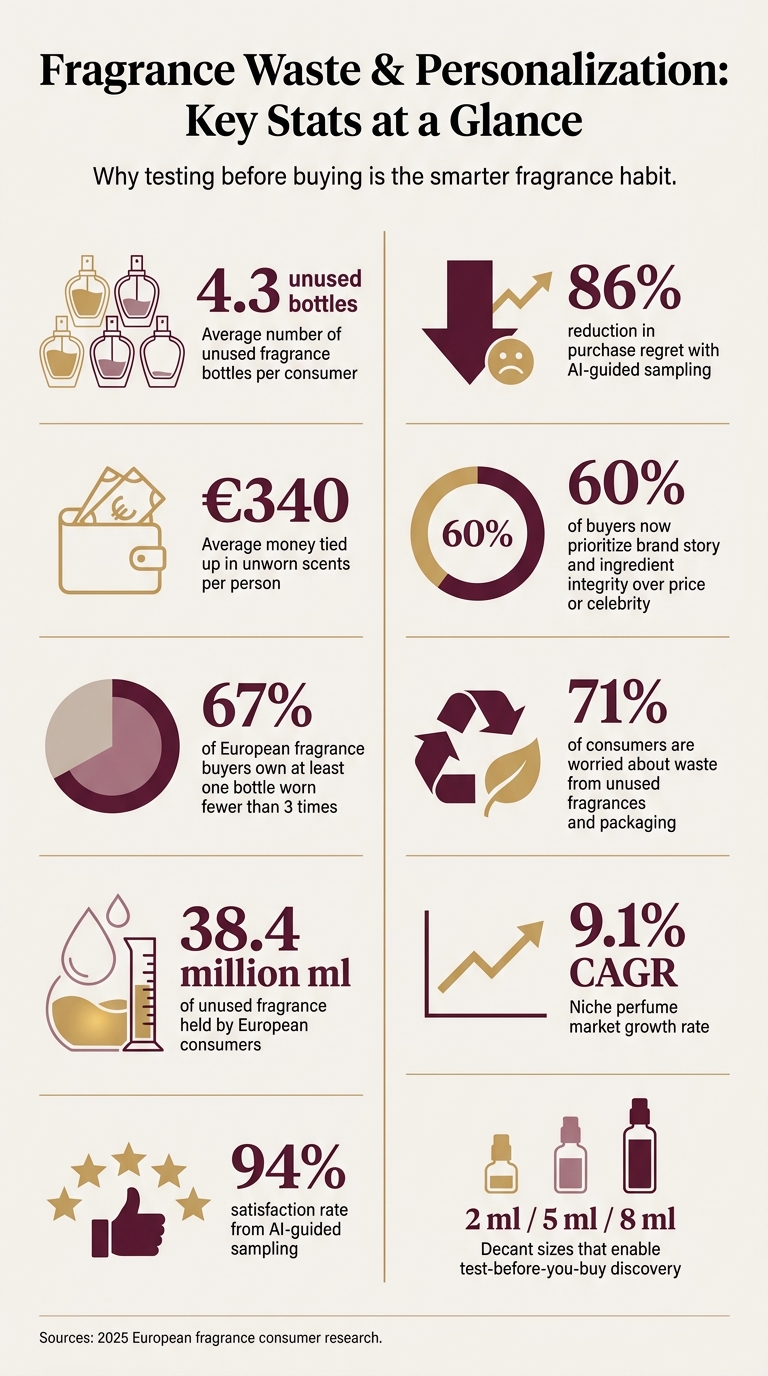
Fragrance Waste & Personalization: Key Stats at a Glance
The Future of Fragrance Trends and Opportunities
Quick Comparison
| Focus | What it aims to do | Main upside | Main trade-off |
|---|---|---|---|
| Personalization | Help me find a scent that fits | Fewer bad buys | Higher cost per ml in small formats |
| Lower-waste buying | Cut unused product and excess stock | Less money and product wasted | Proof and follow-through matter |
| Curated decants | Let me test before a full bottle | Lower risk, more control | Small sizes cost more per ml |
So my takeaway is clear: the smarter fragrance habit is gradual discovery, not blind buying.
Personalisation in fragrance: what consumers want and why demand is rising
Personalisation means picking a scent that works with your skin, the season, and the occasion. It helps cut the risk of ending up with a bottle that looks good on a shelf but barely gets worn. As interest has grown, the market has split into two clear paths: made-to-order scent design and guided discovery.
From bespoke scents to AI-guided discovery
That demand now shows up in three formats. At one end, bespoke perfumers create a scent from scratch around a client’s preferences. At the other, AI-guided recommendation tools suggest fragrances based on stated likes and dislikes. In the middle, curated discovery formats let people test and compare options before committing to a full bottle.
The two main models are bespoke creation and AI-led recommendation. Both do the same basic job: they narrow the field before purchase, which makes the choice feel less like guesswork.
Why personalised fragrance feels worth the extra step
For many shoppers, the extra step feels worth it because fragrance is personal in a way few products are. A scent can smell polished on paper, then sit very differently on skin. Add weather, setting, and mood into the mix, and it’s easy to see why a one-size-fits-all approach often falls short.
A 2025 study across six European markets, including Germany, found that AI-guided sampling delivered 94% satisfaction and cut purchase regret by 86%.
What holds personalisation back
There are trade-offs. Smaller formats and curated discovery tools often come with a higher price per millilitre than buying a full bottle outright. And while more choice sounds good in theory, too many options can leave people stuck instead of helped.
So the upside is a clearer fit. The downside is cost and choice overload. Put simply: lower risk, but usually a higher price per millilitre.
Twój osobisty ekspert od zapachów już czeka
Wypełnij nasz szybki quiz zapachowy i odkryj autentyczne perfumy designerskie i niszowe dobrane do Twojego gustu – poznaj je w postaci dekantów i próbek 2–8ml, aby przetestować każdy z nich, zanim zdecydujesz się na pełny flakon.
Znajdź swój zapachSustainability in fragrance: what it covers beyond the bottle
Sustainability in perfumery goes far beyond the bottle itself. It touches ingredients, extraction methods, packaging, shipping, and how the fragrance is used once it reaches someone’s shelf. If personalisation is about getting a better fit, sustainability asks a tougher question: how much waste comes with that choice?
Ingredients, sourcing and production standards
Fragrance ingredients carry a big footprint, and the old natural-versus-synthetic argument is messier than it first appears. Natural materials can demand intensive farming, more water, and long transport routes. Steam distillation, for example, produces around 5,51 kg CO₂-eq per kilogram of oil, while supercritical CO₂ extraction cuts that to 2,32 kg CO₂-eq, with the CO₂ recaptured instead of released.
Synthetic and biotech ingredients often do better when it comes to land use and pressure on biodiversity. But that doesn’t make them a clean pass. Some synthetic musks can persist in waterways, which brings a different set of concerns. As Bee Shapiro, founder of Ellis Brooklyn, put it:
"Clean fragrance to us is not a debate between natural or synthetic... a lot of naturally-derived or synthetic ingredients are more sustainable and sometimes also safer."
That line gets to the heart of it. “Natural” doesn’t always mean lower impact, and “synthetic” doesn’t always mean worse.
Packaging, refills and smaller-format buying
Packaging gets most of the attention because it’s the part people can see. But the bigger issue is often the product that sits unused. A nice box made from recycled paper won’t fix a bottle that ends up forgotten in a drawer.
That’s where the numbers get hard to ignore. European consumers hold an estimated 38,4 million millilitres of unused fragrance, and 67% of European fragrance buyers own at least one bottle worn fewer than three times.
Some brands are trying to deal with that problem at the source. British fragrance house Ffern makes only the exact number of bottles pre-ordered by confirmed members, four times a year. That means zero shelf stock and no overproduction waste.
Smaller sizes can help too. Decants in 2 ml, 5 ml, or 8 ml lower the chance that a full bottle goes to waste. You still get the fun of discovery, but with less left behind. Put simply: smaller formats can mean less waste.
Where sustainability gets complicated
This is where things stop being neat. Almost every sustainability move comes with a trade-off. Responsible sourcing can be hard to prove. Refill systems sound good, but only if people come back and use them. Better packaging helps, though it does little if the fragrance itself remains unused. And labels like “natural”, “clean”, or “eco-friendly” need proof, not just nice design and soft language.
| Measure | Sustainability Gain | Practical Limit |
|---|---|---|
| Natural ingredients | Generally high biodegradability | Intensive farming, irrigation and transport |
| Synthetic/biotech ingredients | Lower land pressure and consistent supply | Some compounds persist in waterways |
| Recycled/reduced packaging | Less virgin material use | Doesn’t address product waste |
| Refillable bottles | Cuts packaging per use over time | Requires repeat customer behaviour |
| Smaller-format buying | Reduces unused product | Higher cost per millilitre |
| Made-to-order production | Eliminates overstock waste | Limited scale, often premium-priced |
Packaging matters, of course. But the bigger lever is cutting overproduction and reducing the number of bottles that never get used. That’s the point where sustainability starts to overlap with personalisation, and where the trade-off becomes easier to see when both are set next to each other.
Personalisation vs. sustainability: where they clash and where they align
How consumer priorities differ
At first glance, personalisation and sustainability can look like they’re at odds. Personalisation is about identity, mood, and fit. It’s the pull toward a scent that feels exactly right for you. Sustainability looks outward. It focuses on cutting waste, choosing ethical ingredients, and expecting brands to be open about what they do. So the tension isn’t just about taste. It’s about how people buy, test, and end up using fragrance.
Younger European shoppers are starting to push back on the idea that they have to pick one side. 71% of consumers report being worried about the waste generated by unused fragrances and their packaging. In Germany, it’s common for shoppers to try a few 2 ml decants before buying a full bottle. That habit makes sense. It helps avoid regret, and it helps avoid waste.
How personalisation can support lower-waste buying
Better scent matching often means less waste. If a fragrance suits the person buying it, there’s a much better chance the bottle gets used instead of sitting half-full on a shelf. The rise of the fragrance wardrobe mindset also changes the equation. People aren’t trying to force one scent to do every job anymore.
Instead of buying one €300+ bottle and hoping it fits every season, setting, and mood, many shoppers now build a wardrobe step by step through smaller, tested purchases. In plain terms: try first, commit later, use more of what you own.
That’s where these two priorities start to meet.
A practical model for both: curated decants and gradual discovery
Scento is a good example of how discovery can serve both fit and lower waste. Curated decants in 2 ml, 5 ml and 8 ml sizes give shoppers room to test designer and niche fragrances, including houses like Amouage, Parfums de Marly and Creed, before committing to a full bottle. That cuts down on blind buys and lowers the odds of bottles going unused.
An optional 8 ml monthly subscription, starting from €12,90 per month per perfume, stretches that discovery over time. Sampling becomes part of a slower, more deliberate path to ownership.
| Driver | Main Motivation | Consumer Benefit |
|---|---|---|
| Personalisation | Identity, mood and fit | Scent profile that feels personal; strong emotional satisfaction |
| Sustainability | Waste reduction and ethics | Lower impact; less money wasted |
| Curated Decants | Discovery and risk reduction | Trial before commitment; fewer unused bottles |
Both aims start to point the same way when the buying process is built around testing first and committing with more confidence.
Conclusion: personalisation and sustainability work better together
Personalisation and sustainability work better side by side. It’s not a choice between one or the other. The model that wins is simple: find the right fit with less waste. When people test more carefully and avoid blind-buying, both aims start pulling in the same direction.
Shoppers are already moving this way. 60% now prioritise brand narrative and ingredient integrity over price or celebrity endorsements. That points to a clear shift toward products that feel more personal and are less likely to end up sitting unused.
Key points to remember
The best buying habits are pretty simple:
- Test in 2 ml–8 ml formats before buying a full bottle. Smaller sizes cut the risk of wasting money on something you won’t wear, and they give you space to figure out what suits you.
- Build a small fragrance wardrobe for seasons, moods and occasions. A tight edit of well-chosen scents means more of what you own gets worn instead of forgotten.
Scento offers 2 ml, 5 ml and 8 ml decants of designer and niche fragrances, so you can explore before committing to a €300+ full bottle. That approach supports personal fit and helps cut waste.
FAQs
How do decants reduce fragrance waste?
Decants help cut fragrance waste because they replace blind buying with informed testing. A lot of people buy full-size bottles before they know how a scent behaves on their skin or whether it suits their day-to-day life. The result? Bottles sit half-used, or untouched, on a shelf.
With affordable, travel-sized options, Scento gives customers a simple way to test fragrances in real life before committing to a full bottle. That means less buyer regret, fewer unused products, and less waste from extra packaging and disposal.
Is personalised fragrance worth the higher cost per ml?
Yes. A personalised fragrance approach can be worth the higher cost per ml because it cuts both financial risk and waste.
Spending a few euro on a 2 ml or 8 ml decant can save you from buying a €90 to €300 bottle that ends up sitting on a shelf half-used. So while the price per ml is higher, the long-term value can be better.
Are natural ingredients always more sustainable?
No. Natural ingredients are not automatically more sustainable.
They can use a lot of land, water, and energy. Some also face overharvesting, which can damage ecosystems and biodiversity.
Synthetic ingredients can, in some cases, have a lower environmental footprint. The key is the ingredient’s full life cycle: how it’s sourced, how much land and water it needs, and how it’s made.
So the better question isn’t whether an ingredient is natural or synthetic. It’s how that ingredient is produced from start to finish.