Cauti un parfum nou, dar nu stii daca sa alegi parfumuri naturale pe baza de ulei sau parfumuri de designer? Iata pe scurt:
- Parfumurile cu uleiuri esentiale sunt create din extracte vegetale si ofera un miros mai personal, apropiat de piele. Nu contin alcool, costa intre 21 €–102 € si persista de obicei 4–7 ore. Multe au si beneficii aromaterapeutice, precum efecte calmante sau energizante.
- Parfumurile de designer, adesea pe baza de alcool, ofera profiluri olfactive complexe, care evolueaza prin note de varf, de mijloc si de baza. Costa mai mult (100 €–480 €), persista 6–12 ore si sunt create pentru a se face remarcate si a transmite rafinament.
Comparatie rapida:
| Caracteristica | Parfumuri cu uleiuri esentiale | Parfumuri de designer |
|---|---|---|
| Interval de pret | 21 €–102 € | 100 €–480 €+ |
| Persistenta | 4–7 ore | 6–12 ore |
| Profil olfactiv | Simplu, natural, constant | Complex, stratificat, evolutiv |
| Ingrediente principale | Ingrediente botanice pure | Amestec de ingrediente naturale si sintetice |
| Proiectie | Intima, apropiata de piele | Puternica, usor de remarcat |
Fie ca apreciezi simplitatea naturala, fie luxul stratificat, intelegerea acestor diferente te ajuta sa alegi mai usor parfumul potrivit stilului si preferintelor tale.
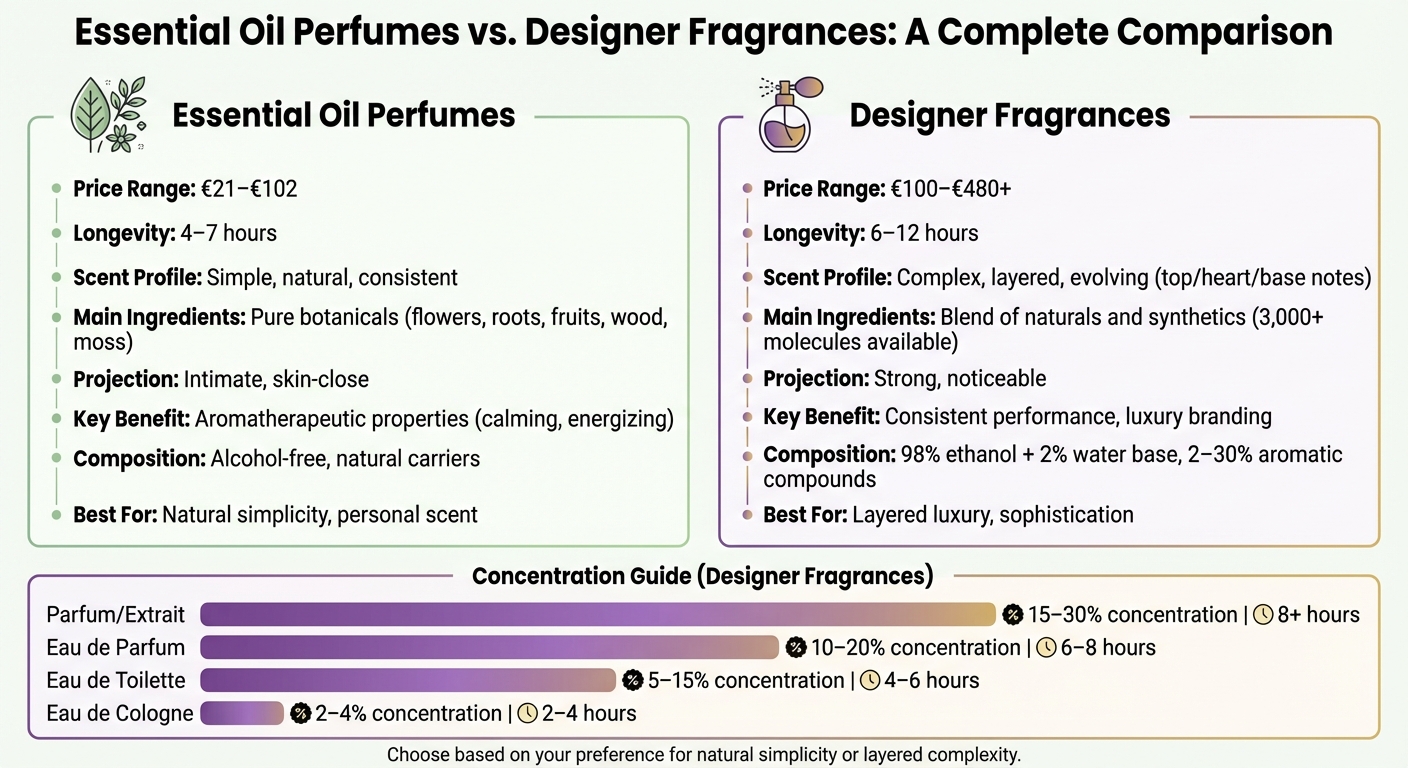
Grafic comparativ: parfumuri cu uleiuri esentiale si parfumuri de designer
What Are Essential Oil Perfumes?
Parfumurile cu uleiuri esentiale sunt o alternativa naturala si personala la parfumurile traditionale de designer. Create din extracte vegetale precum flori, radacini, fructe, lemn si muschi, acestea surprind esenta autentica a naturii. Spre deosebire de parfumurile de designer, care se bazeaza adesea pe molecule create in laborator, parfumurile cu uleiuri esentiale sunt realizate din uleiuri naturale, care interactioneaza cu chimia corpului tau pentru a crea un miros unic, aflat intr-o continua evolutie. Aceasta abordare naturala le deosebeste atat prin modul in care sunt produse, cat si prin felul in care se comporta.
Compozitie si productie
Parfumurile cu uleiuri esentiale sunt produse prin metode precum distilarea, extractia cu solventi si presarea la rece. Aceste procese folosesc surse vegetale regenerabile, evitand compusii sintetici pe baza de petrol. Variatiile sezoniere ale recoltelor de plante pot influenta subtil mirosul final, sporindu-le farmecul natural.
Stephen Nilsen, vicepresedinte pentru parfumerie la Givaudan, subliniaza esenta lor:
"Uleiurile esentiale surprind frumusetea nealterata a naturii, dar nu au parte din performanta, puritatea si rafinamentul materialelor sintetice."
Caracteristici-cheie
Metodele rafinate de extractie dau uleiuri foarte concentrate, cu caracteristici distincte. Parfumurile cu uleiuri esentiale folosesc adesea baze naturale, precum alcool organic din trestie de zahar, ulei de floarea-soarelui sau ulei din semintele de Limnanthes alba, in locul solventilor sintetici. Fiecare ulei esential contribuie cu propriile nuante, creand un profil olfactiv bogat si complex. Totusi, aceste parfumuri tind sa lase o dara olfactiva mai discreta, fiind o alegere mai personala si mai subtila.
Dincolo de aroma lor, multi utilizatori apreciaza proprietatile aromaterapeutice ale uleiurilor esentiale. De exemplu, lavanda este cunoscuta pentru efectul calmant, in timp ce uleiurile citrice sunt revigorante si energizante. Aceasta combinatie de subtilitate si atractie pentru starea de bine face din parfumurile cu uleiuri esentiale un plus aparte pentru orice colectie de parfumuri.
Ce sunt parfumurile de designer?
Spre deosebire de parfumurile create exclusiv din uleiuri esentiale naturale, parfumurile de designer sunt concepute cu grija pentru a oferi performanta constanta si o nota de lux. Aceste parfumuri, create de case de moda emblematice precum Chanel, Dior si Creed, ofera o modalitate accesibila de a descoperi branduri de lux. Cu aproximativ $100, poti avea un flacon de 30ml al acestor creatii "identitate imbuteliata", facand luxul mai accesibil.
Parfumurile de designer isi obtin caracterul complex prin combinarea extractelor naturale cu componente sintetice precum alcoolii, esterii si aldehidele. Parfumierii lucreaza cu o paleta de peste 3.000 de molecule sintetice, ceea ce le permite sa creeze mirosuri — precum cel inefabil al lacramioarei — care nu pot fi obtinute din natura. Sa vedem cum sunt create aceste amestecuri complexe la scara globala.
Compozitie si productie
Parfumurile de designer sunt fabricate la scara larga pentru a asigura consecventa si stabilitate. Formula consta de obicei dintr-un amestec de solventi format din 98 % etanol si 2 % apa, combinat cu 2–30 % compusi aromatici. Aceasta compozitie precisa asigura ca fiecare flacon miroase identic, spre deosebire de variabilitatea intalnita adesea in extractele naturale.
Procesul de productie implica macerarea, in care uleiurile de parfum sunt lasate sa se invecheasca in solvent, urmata de teste riguroase de stabilitate pentru a respecta standarde stricte. Debi Theis, Presedinta Henry Rose, subliniaza rolul ingredientelor sintetice:
"Folosind ingrediente sintetice sigure, putem elimina majoritatea alergenilor comuni care ar fi fost prezenti in mod natural in uleiurile aromatice extrase din surse botanice/vegetale."
In plus, ingredientele sintetice raspund preocuparilor etice, inlocuind materiale precum moscurile de origine animala sau plantele pe cale de disparitie, cum ar fi lemnul de santal indian.
Caracteristici principale
Parfumurile de designer sunt construite in jurul unei structuri piramidale cu trei niveluri: notele de varf, care creeaza o impresie imediata, notele de mijloc, care se dezvaluie in cateva minute, si notele de baza, care persista ore intregi.
Persistenta unui parfum depinde de concentratia sa. Parfum, cu 15–30 % compusi aromatici, poate persista peste 8 hours, in timp ce Eau de Cologne, cu doar 2–5 %, se estompeaza dupa 1–2 hours. Dincolo de mirosul in sine, brandingul de lux pune in valoare fiecare detaliu - de la flacoanele din sticla groasa, care protejeaza impotriva luminii, la pulverizatoarele de precizie, pentru o pulverizare uniforma, si capacele magnetice, care asigura o inchidere ermetica.
Dupa cum remarca editorii Ethos:
"Povestea este la fel de importanta ca mirosul: continuitate, modernitate si finisaje meticuloase, toate deodata."
Acest amestec de chimie avansata, mostenire de brand si maiestrie atenta explica preturile premium ale parfumurilor de designer. Tot din acest motiv, se estimeaza ca piata parfumurilor din U.K. va depasi 2 £ billion pana in 2029. Avand in vedere aceasta complexitate structurata, putem explora acum cum se compara parfumurile de designer cu parfumurile din uleiuri esentiale.
Expertul tău personal în parfumuri te așteaptă
Completează testul nostru rapid de parfumuri și descoperă parfumuri designer și de nișă autentice, alese pe gustul tău – explorează-le ca decanturi și mostre de 2, 5, 8 și 30 ml, ca să le poți încerca pe fiecare înainte de a alege un flacon întreg.
Descoperă-ți parfumulParfumuri din uleiuri esentiale vs. parfumuri de designer
Atunci cand alegi intre parfumurile din uleiuri esentiale si cele de designer, decizia se reduce adesea la diferentele de pret, persistenta si complexitatea mirosului. Aceste doua categorii ofera experiente distincte, care depasesc cu mult ingredientele folosite, influentand cat cheltui, cat timp persista mirosul si varietatea optiunilor disponibile.
Diferente de pret
Parfumurile din uleiuri esentiale au tendinta sa aiba preturi ridicate, in mare parte din cauza costului mare al procurarii materiilor prime naturale. De exemplu, pentru a produce doar one ounce de ulei pur de trandafir sunt necesare aproximativ 250 pounds de petale de trandafir - un proces care necesita multa munca si resurse. Adauga metodele de agricultura ecologica, ce evita pesticidele chimice, dar au recolte mai mici, si nu e de mirare ca aceste parfumuri sunt adesea scumpe.
Pe de alta parte, parfumurile de designer au costuri ridicate din cu totul alte motive. Dupa cum spun editorii The Ethos, platesti pentru "teatru intangibil" - branding luxos, campanii de marketing elaborate si ambalaje premium, precum flacoane din sticla grea si capace magnetice. Unele articole de lux duc lucrurile si mai departe, precum o replica a flaconului de parfum al Mariei Antoaneta, la pretul de $10.290 pentru doar 25ml.
Ceea ce distinge parfumurile de designer este investitia in procese precum macerarea, testarea stabilitatii si asigurarea consecventei de la un lot la altul - eforturi pe care brandurile accesibile le omit adesea.
| Caracteristica | Parfumuri cu uleiuri esentiale | Parfumuri de designer |
|---|---|---|
| Principalul factor de cost | Extractia materiilor prime naturale | Branding, marketing si formulare sintetica |
| Sursa ingredientelor | Ingrediente botanice pure (flori, ierburi, rasini) | Amestec de ingrediente naturale si sintetice create in laborator |
| Interval de pret | Foarte variabil; uleiurile rare pot fi extrem de costisitoare | De obicei ridicat (100 €–200 €+), reflectand prestigiul brandului |
| Consecventa | Variaza in functie de cultura si recolta | Foarte constanta datorita stabilizarii sintetice |
Aceste diferente de pret influenteaza si performanta, mai ales durata persistentei fiecarui parfum.
Persistenta: cat timp rezista
Parfumurile de designer sunt create pentru a rezista, persistand adesea 6–12+ hours, in timp ce parfumurile din uleiuri esentiale se estompeaza de obicei in 1–4 hours. Aceasta diferenta se datoreaza in mare parte fixatorilor sintetici precum Ambroxan si Iso E Super, care pot prelungi durata unui parfum de 3–5 ori fata de alternativele naturale, precum rasinile sau lemnul.
Parfumurile naturale, alcatuite din molecule mai usoare, se evapora mai repede decat cele sintetice. De exemplu, moscurile sintetice pot persista pana la 24 hours, in timp ce multi compusi naturali se disipa in doar 1–2 hours.
| Tipul de parfum | Concentratia de ulei | Persistenta obisnuita |
|---|---|---|
| Parfum / Extrait | 15 %–30 %+ | 8+ ore |
| Eau de Parfum (EDP) | 10 %–20 % | 6–8 ore |
| Eau de Toilette (EDT) | 5 %–15 % | 4–6 ore |
| Eau de Cologne (EDC) | 2 %–4 % | 2–4 ore |
Parfumurile de designer au si tendinta de a se proiecta mai departe, datorita moleculelor sintetice si continutului mai ridicat de alcool, care ajuta mirosul sa se raspandeasca. In schimb, parfumurile naturale ofera o evolutie mai dinamica - uleiul pur de trandafir, de exemplu, contine peste 400 de compusi care se evapora in ritmuri diferite. Totusi, aceasta complexitate vine cu pretul unei persistente mai scurte.
Profiluri olfactive si optiuni
Parfumurile cu uleiuri esentiale se concentreaza pe note simple si pure, precum lavanda, trandafirul sau lemnul de santal. Caracterul lor direct, botanic, se limiteaza la ceea ce poate fi extras din surse naturale, precum flori, plante aromatice si condimente. In schimb, parfumurile de designer sunt compozitii cu mai multe straturi, care contin de la zeci la sute de ingrediente. Folosind o structura in trei etape, cu note de varf, de mijloc si de baza, aceste parfumuri evolueaza in timp si ofera o experienta mai dinamica.
Parfumierii de designer au, de asemenea, acces la o paleta vasta de peste 3.000 de molecule sintetice, ceea ce le permite sa creeze familii olfactive care nu exista in natura, precum profilurile marine/ozonice sau gurmande. Acest nivel de rafinament se remarca intr-un test olfactiv in orb din 2025, in care doar 10 % dintre participanti au putut identifica faptul ca un parfum accesibil „inspirat de” semana cu parfumul original de designer.
Stephen Nilsen, Vice President of Perfumery la Givaudan, surprinde esenta acestui echilibru:
„Dansul dintre ingredientele naturale si cele sintetice in parfumerie este foarte asemanator: fara unul dintre ele, parfumul ramane plat, aspru si lipsit de miscare sau vitalitate.”
In timp ce parfumurile cu uleiuri esentiale se remarca prin puritate si simplitate, parfumurile de designer se disting prin complexitate, varietate si capacitatea de a evoca mirosuri pe care natura nu le-ar putea produce niciodata.
Cum face Scento parfumurile de designer mai accesibile
Parfumurile de designer sunt cunoscute pentru profunzimea si persistenta lor, insa preturile lor — adesea intre 100 € si 200 € sau chiar mai mult pentru un flacon — pot fi un obstacol major. Scento schimba regulile jocului, oferind parfumuri autentice de designer in formate decant mai mici (vialuri de 2 ml, 5 ml si 8 ml, precum si un decant de 30 ml in flacon pentru majoritatea parfumurilor). Aceasta abordare ingenioasa face parfumurile de lux mai accesibile si te ajuta sa eviti sa ramai cu un flacon scump, de dimensiuni mari, care nu se potriveste cu chimia pielii tale. Este o modalitate inteligenta de a imbina rasfatul cu spiritul practic.
Descopera pe deplin parfumurile cu decanturi
Parfumurile nu sunt statice — evolueaza in timp, dezvaluind diferite straturi si nuante pe masura ce se aseaza pe piele. Un parfum care miroase minunat in magazin se poate dovedi cu totul diferit dupa cateva ore. De aceea, este atat de important sa incerci un parfum in contexte reale. Decanturile Scento iti permit sa parcurgi intreaga evolutie a unui parfum de-a lungul mai multor zile, fie ca esti la serviciu, faci sport sau treci prin conditii meteorologice diferite.
Dimensiunea compacta a acestor decanturi le face si potrivite pentru calatorii, deoarece respecta regula standard 3-1-1 pentru lichidele din bagajul de mana. De exemplu, un decant de 8ml ofera aproximativ 120 de pulverizari, astfel incat ai suficient timp sa testezi un parfum, fara bataia de cap sau fragilitatea unui flacon de dimensiuni normale.
Planuri de abonament flexibile
Scento este un retailer de decanturi si mostre de parfum, iar fiecare produs este disponibil pentru o singura achizitie, fara abonament. Fiecare achizitie iti permite sa explorezi o varietate de familii olfactive — precum cele florale, lemnoase, ambrate sau proaspete — in ritmul tau, construind o colectie care se potriveste preferintelor si stilului tau de viata.
Valoarea testarii este clara: aproximativ 76 % dintre utilizatorii seturilor de mostre de parfum ajung sa cumpere formate mai mari dupa ce incearca patru sau mai multe parfumuri. Cu Scento, ai ocazia sa explorezi peste 1.000 de parfumuri de designer, fara presiunea de a te angaja de la inceput. Este o modalitate cu risc redus de a-ti descoperi preferatele.
Construieste o colectie de parfumuri pe gustul tau
Selectia atent aleasa de Scento te ajuta sa identifici profilurile olfactive care se potrivesc stilului tau. Dupa ce ti-ai descoperit parfumurile preferate prin intermediul decanturilor, decantul de 30 ml disponibil pentru majoritatea parfumurilor ofera o cale de mijloc ideala – perfect pentru parfumurile pe care le iubesti si le porti des, fara sa te angajezi la un flacon intreg. Acest sistem pe niveluri transforma cumparaturile de parfumuri intr-un proces placut si atent, permitandu-ti sa-ti construiesti o colectie care reflecta starea ta de spirit, ocaziile si gustul personal. Cumparaturile de parfumuri, reinventate.
Concluzie
Uleiurile esentiale, obtinute din extracte naturale, ofera beneficii aromaterapeutice, dar tind sa reziste mai putin, intre 2–6 hours. Pe de alta parte, parfumurile de designer au profiluri olfactive mai elaborate si evolutive, cu o persistenta de la 4 to 8+ hours. Merita sa tii cont de aceste diferente pe masura ce iti explorezi si iti rafinezi preferintele olfactive.
Bugetul este un alt factor important atunci cand faci o alegere. Parfumurile de designer de lux pot costa intre $100 si $500 sau mai mult, insa angajamentul fata de un flacon de dimensiuni mari nu este singura optiune. Datorita decanturilor Scento, disponibile in vialuri de 2 ml, 5 ml si 8 ml, precum si in varianta de decant de 30 ml in flacon pentru majoritatea parfumurilor, poti descoperi caracterul complet al unui parfum fara riscul de a cheltui prea mult.
„Testarea unei mostre economiseste bani si previne regretul.” — IRFE
Cu acces la peste 1.000 de parfumuri de designer, poti alcatui o colectie potrivita starilor tale de spirit, ocaziilor si stilului tau — fara sa-ti golesti buzunarele. Incepe cu decanturi Scento in formate mici si lasa-ti pielea sa decida daca ti se potriveste mai bine farmecul natural al uleiurilor esentiale sau complexitatea stratificata a parfumurilor de designer.
Intrebari frecvente
Prin ce se deosebesc parfumurile cu uleiuri esentiale de parfumurile de designer?
Parfumurile cu uleiuri esentiale au un farmec aparte si numeroase avantaje care le diferentiaza de parfumurile traditionale de designer. Create din extracte pure de plante, aceste parfumuri ofera arome bogate, stratificate, cu un caracter natural si complex. Dincolo de mirosul placut, ar putea oferi chiar si beneficii aromaterapeutice subtile — precum imbunatatirea dispozitiei, reducerea stresului sau sporirea capacitatii de concentrare.
Un alt atu al lor este compozitia delicata. Spre deosebire de spray-urile pe baza de alcool, parfumurile uleioase nu contin ingrediente agresive, fiind o alegere mai blanda pentru pielea sensibila si reducand riscul de iritatii. In plus, formula lor pe baza de ulei adera mai mult timp la piele, oferind un parfum persistent si mai profund, fara sa fie nevoie de reaplicari frecvente. Ca bonus, pielea se simte adesea hidratata, adaugand un plus de rasfat ritualului tau zilnic de parfumare.
Cum interactioneaza parfumurile cu uleiuri esentiale cu chimia corpului tau?
Parfumurile cu uleiuri esentiale au un mod fascinant de a se adapta chimiei naturale a pielii tale, facand ca fiecare parfum sa ti se potriveasca in mod unic. Atunci cand aceste uleiuri interactioneaza cu sebumul natural al pielii, pot intensifica sau estompa anumite note olfactive. De exemplu, daca ai pielea grasa, poti observa ca parfumurile persista mai mult si scot in evidenta notele mai bogate si mai profunde. In schimb, pielea uscata poate face ca acordurile mai usoare si mai delicate sa se estompeze mai repede.
Trasaturile unice ale corpului tau influenteaza, de asemenea, felul in care evolueaza un parfum. Factori precum temperatura corpului, nivelul pH-ului, alimentatia si chiar schimbarile hormonale pot modifica subtil felul in care miroase un parfum pe pielea ta. Pielea mai calda tinde sa intensifice parfumul, dezvaluindu-i mai repede straturile, in timp ce pielea mai rece il elibereaza mai delicat si mai lent. In plus, deoarece parfumurile cu uleiuri esentiale nu contin alcool, sunt adesea mai blande cu pielea sensibila si pot chiar oferi un plus de hidratare. Aceasta formula fara alcool permite parfumului sa evolueze armonios pe parcursul zilei, creand de fiecare data cand il porti o experienta olfactiva personala si mereu schimbatoare.
De ce sunt parfumurile designer mai scumpe decat parfumurile cu uleiuri esentiale?
Parfumurile designer au tendinta sa aiba un pret mai ridicat din mai multe motive. Adesea contin ingrediente rare si de inalta calitate, precum extracte naturale unice, si au concentratii mai mari de uleiuri parfumate. Crearea acestor parfumuri presupune ample eforturi de cercetare si dezvoltare pentru a obtine compozitii distinctive, cu persistenta indelungata. In plus, brandingul premium si ambalajele sofisticate contribuie semnificativ la costul lor.
Pe de alta parte, parfumurile cu uleiuri esentiale se bazeaza pe formule mai simple, combinand adesea uleiuri esentiale cu uleiuri purtatoare. Astfel, sunt mai accesibile si mai usor de produs. Ambele tipuri de parfum au farmecul lor, dar parfumurile designer ofera, in general, o experienta mai rafinata si mai luxoasa.

