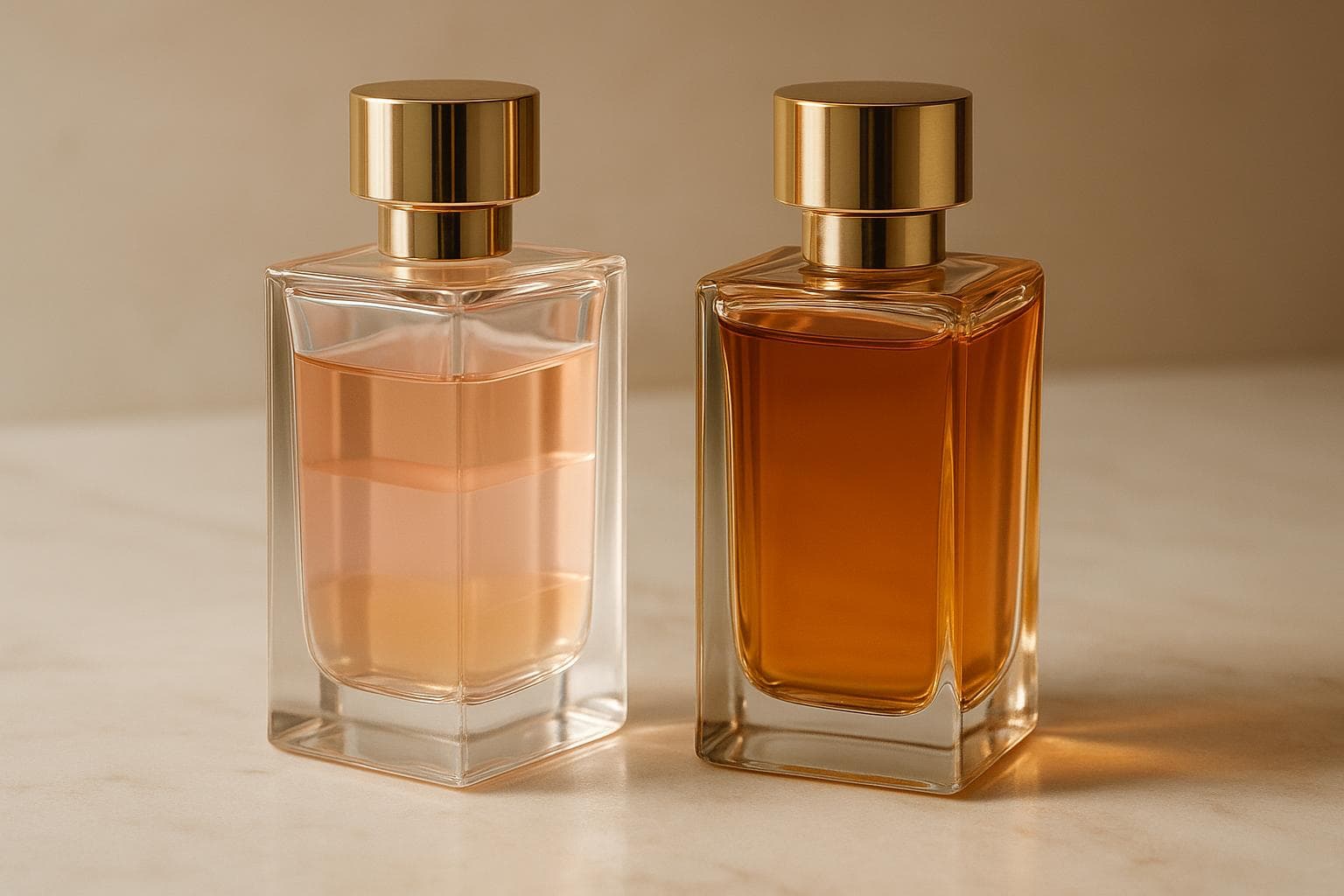
Stratificarea inseamna sa porti doua parfumuri deja formulate unul peste celalalt si poate fi anulata prin spalare; combinarea inseamna sa amesteci ingrediente sau esente intr-o compozitie noua, ceea ce nu poate fi anulat. Stratificarea este un experiment reversibil, combinarea presupune un angajament.
In materie de personalizare a parfumului, se disting doua metode populare: stratificarea parfumurilor si combinarea parfumurilor. Desi ambele iti permit sa personalizezi felul in care porti parfumurile, ele difera ca abordare, flexibilitate si rezultate.
- Stratificare: Aplica mai multe arome direct pe piele pentru a crea o combinatie unica, temporara. Metoda este flexibila si iti permite sa adaptezi combinatia in fiecare zi, in functie de dispozitie, ocazie sau vreme.
- Combinare: Amesteca parfumuri intr-o sticla sau intr-un decant pentru a crea o formula unica si constanta. Este o metoda mai permanenta, care necesita experimentare atenta.
Idei principale:
- Stratificarea este reversibila si potrivita pentru incepatori, fiind ideala pentru a experimenta fara angajamente.
- Combinarea este un proces cu rezultat fix, care ofera precizie, dar necesita rabdare si indemanare.
- Ambele metode te ajuta sa-ti explorezi si sa-ti extinzi garderoba de parfumuri fara sa cheltuiesti prea mult pe sticle intregi.
Fie ca preferi varietatea de zi cu zi, fie un parfum semnatura, intelegerea acestor metode te poate ajuta sa profiti la maximum de parfumurile tale.
Stratificarea parfumurilor: cum functioneaza si care sunt beneficiile
Cum functioneaza stratificarea parfumurilor
Stratificarea parfumurilor inseamna sa combini in mod deliberat doua sau mai multe arome pentru a crea profunzime sau pentru a evidentia anumite note. Nu este vorba doar despre pulverizarea la intamplare a mai multor parfumuri, ci despre un proces atent, in care ordinea si locul aplicarii fiecarui parfum sunt alese cu grija pentru a scoate in evidenta note precum vanilia, citricele sau notele lemnoase.
Pentru a stratifica parfumurile cu succes, trebuie sa intelegi cum functioneaza notele de varf, de mijloc si de baza. Notele de varf, precum citricele, plantele aromatice sau fructele usoare, se simt primele, dar se estompeaza repede, conturand impresia initiala. Notele de mijloc — de exemplu, florile si condimentele — dau parfumului personalitatea principala si persista in etapa intermediara. In cele din urma, notele de baza, precum cele lemnoase, rasinile si moscurile, ofera fundalul si persista ore intregi, pe masura ce parfumul se aseaza. Fiecare strat se evapora in ritmul propriu, creand o evolutie dinamica in timp.
Pentru cele mai bune rezultate, incepe cu parfumul cel mai intens si incheie cu cele mai usoare, pentru a pastra echilibrul. Aplica parfumurile pe punctele de puls, precum incheieturile mainilor sau zona din spatele urechilor, pentru a le intensifica difuzia si efectul.
Tehnici si strategii de stratificare
Daca esti la inceput, pastreaza lucrurile simple. Incepe cu doar doua parfumuri si include cel putin o aroma directa, cu o singura nota, precum vanilia, moscul sau lemnul de santal, pentru a evita notele discordante. Combinatiile din aceeasi familie olfactiva — de pilda, florale cu florale sau gurmande cu gurmande — sunt armonioase si usor de purtat. De exemplu, stratificarea unui parfum dominat de iasomie cu un spray parfumat pentru corp cu trandafir pastreaza caracterul suav si romantic.
Dupa ce capeti incredere, poti experimenta contraste mai indraznete. Incearca sa combini note complementare din familii diferite. De exemplu, vanilia alaturi de oud sau de note lemnoase adauga caldura si bogatie, in timp ce citricele stratificate peste lemnul de santal creeaza un efect revigorant, dar echilibrat.
Iti poti adapta combinatiile si in functie de anotimp sau de ocazie. In climatele calde sau vara, opteaza pentru arome proaspete, precum citricele, notele acvatice sau floralele usoare, cu o tusa de mosc ori note lemnoase dedesubt, pentru a le spori persistenta fara sa para grele. Toamna si iarna, combinatiile mai bogate — precum vanilia, tonka sau ciocolata stratificate peste baze cremoase ori lemnoase — adauga o caldura primitoare si reconfortanta. Pentru serviciu sau zi, alege combinatii mai discrete, care raman aproape de piele, in timp ce evenimentele de seara pot cere asocieri mai indraznete si mai intense.
Inainte sa alegi o combinatie noua pentru un eveniment important, testeaz-o intr-o zi obisnuita si urmareste cum evolueaza in timp — verifica dupa 10, 30 si 60 de minute. Folosirea unor decanturi mici, precum decanturile de 2 ml, 5 ml si 8 ml si decanturile de 30 ml pentru majoritatea parfumurilor de la Scento, este o modalitate rentabila de a incerca parfumuri de lux sau de nisa fara sa investesti in sticle intregi. Aceasta abordare bazata pe incercari si ajustari te ajuta sa-ti perfectionezi tehnica de stratificare.
Beneficiile stratificarii
Stratificarea parfumurilor aduce cateva avantaje distincte: persistenta prelungita, siaj mai amplu si posibilitatea de a-ti personaliza parfumul in fiecare zi. Combinand parfumuri intre ele sau asociindu-le cu lotiuni parfumate, poti profita de ritmurile diferite de evaporare ale fiecarui strat. O nota de baza mai intensa poate sustine aromele mai usoare si mai efemere, ajutand parfumul sa persiste mai mult pe parcursul zilei.
Layeringul adauga, de asemenea, profunzime si creeaza o dara de parfum mai pregnanta, sau sillage, fara sa devina coplesitoare. Aplicat cu grija pe punctele de puls — sau chiar discret pe haine — creeaza o aura delicata si dinamica, ce se misca odata cu tine. Aceasta tehnica iti permite sa adaptezi parfumul in functie de starea de spirit, tinuta, anotimp sau context. Fie ca iti doresti un parfum proaspat si curat pentru treburile zilnice, fie o aroma mai bogata si seducatoare pentru o seara in oras, layeringul iti ofera flexibilitatea de a obtine efectul dorit fara sa fie nevoie sa cumperi un flacon nou pentru fiecare ocazie.
In timp, layeringul te poate ajuta sa-ti creezi un parfum-semnatura, personal si unic — ceva care se distinge de optiunile obisnuite, disponibile in magazine, si devine o adevarata reflectare a stilului tau.
Combinarea parfumurilor: cum functioneaza si care sunt beneficiile
Cum functioneaza combinarea parfumurilor
Combinarea parfumurilor este o abordare mai permanenta decat layeringul. In loc sa aplici zilnic mai multe parfumuri direct pe piele, aceasta presupune amestecarea parfumurilor in afara pielii — intr-un flacon cu pulverizator sau un atomizor — pentru a crea o aroma personalizata si unitara. Amestecul devine o singura formula, cu rezultate constante de fiecare data cand o porti. In schimb, layeringul pastreaza fiecare parfum separat, permitandu-le sa interactioneze si sa evolueze pe pielea ta.
Procesul de combinare reflecta tehnicile folosite de parfumierii profesionisti. Incepe cu un parfum de baza dominant, de obicei cu note lemnoase, de ambra, mosc sau vanilie, care ofera structura si persistenta. Aceasta baza ar trebui sa reprezinte aproximativ 50–70 % din amestec. Apoi, adauga un parfum de mijloc — notele florale, condimentate sau fructate se potrivesc bine aici — care sa reprezinte 20–40 % din amestec si sa-i defineasca caracterul principal. La final, completeaza cu note de varf, precum acordurile citrice, verzi sau proaspete (10–20 %), pentru a lumina aroma si a-i crea un debut atragator.
Pentru a evita combinatiile discordante, foloseste familii olfactive compatibile. Pentru incepatori, asocierile sigure includ citrice cu moscuri lemnoase, vanilie cu ambra sau flori delicate cu moscuri curate. Aceste combinatii tind sa ofere rezultate echilibrate si armonioase. Pe de alta parte, amestecarea parfumurilor intense si dense — precum pielea animala cu note orientale grele sau florile albe bogate cu note gurmande dense — poate duce cu usurinta la rezultate coplesitoare sau confuze, daca nu este facuta cu atentie.
Urmand aceasta abordare structurata, poti crea un parfum personalizat, constant, adaptat preferintelor tale.
Sfaturi pentru incepatori in combinarea parfumurilor
Daca esti la inceput cu combinarea parfumurilor, porneste cu cantitati mici pentru a reduce riscurile si costurile. Foloseste decanturi de 1–3 mL sau atomizoare de voiaj de 5–10 mL pentru experimentele tale. Astfel, chiar daca un amestec nu iese asa cum te asteptai, vei fi folosit doar o cantitate mica de parfum, in loc sa risti un flacon intreg. Amesteca intotdeauna parfumurile intr-un recipient separat — niciodata direct in flacoanele originale — deoarece nu poti anula un experiment nereusit dupa ce aromele au fost combinate.
De exemplu, decanturile Scento sunt perfecte pentru a testa parfumuri de lux fara sa te angajezi sa cumperi flacoane intregi. Poti incerca sa combini 2 mL dintr-un parfum lemnos cu cateva picaturi dintr-un decant de vanilie, pentru a explora o combinatie de vanilie si note lemnoase. Aceasta metoda bazata pe incercari succesive iti permite sa experimentezi in voie, pastrand intacte parfumurile originale.
Tine un jurnal al combinatiilor in care sa notezi proportiile si impresiile pentru fiecare experiment. Dupa ce ai creat un amestec, lasa-l sa se odihneasca cateva ore sau peste noapte, pentru ca alcoolul si uleiurile sa se aseze. Testeaza-l mai intai pe o banda de hartie pentru parfum, apoi pe piele, ca sa vezi cum evolueaza in conditii reale. Acest proces rabdator, pas cu pas, te ajuta sa-ti rafinezi amestecurile si sa recreezi ulterior formulele reusite.
Beneficiile si provocarile combinarii parfumurilor
Combinarea parfumurilor iti ofera un spatiu pentru creativitate si posibilitatea de a adapta aromele exact preferintelor tale. Iti place un parfum lemnos, dar ai vrea sa fie mai dulce pentru seara? Sau poate ai vrea sa improspatezi un parfum gurmand pentru zi? Combinarea iti permite sa ajustezi parfumurile fara sa cumperi flacoane noi. In plus, da o noua viata parfumurilor pe care le folosesti mai rar, transformandu-le in creatii pe care le poti purta si diversificandu-ti garderoba olfactiva. Iar un amestec personalizat iti asigura un parfum-semnatura cu adevarat unic, pe care nimeni altcineva nu-l va avea.
Totusi, combinarea parfumurilor vine si cu provocari. Cel mai mare dezavantaj este caracterul ireversibil al greselilor. Odata amestecate, parfumurile nu mai pot fi separate. Turnarea a jumatate dintr-un flacon scump de 3,4 fl oz intr-un experiment nereusit poate fi o greseala costisitoare. In plus, combinarea unui numar prea mare de parfumuri complexe sau amestecarea unor familii olfactive incompatibile poate duce la arome confuze si coplesitoare, imposibil de purtat. Amestecurile prea intense pot provoca chiar dureri de cap sau greata, desi pe hartie par atragatoare. Merita sa retii si ca parfumurile evolueaza in timp: un amestec care miroase minunat imediat dupa combinare isi poate schimba nefavorabil aroma dupa o zi sau doua, asa ca e nevoie de rabdare si ajustari fine pentru a ajunge la formula perfecta.
sbb-itb-fb213bc
Layering sau combinarea parfumurilor: diferente esentiale
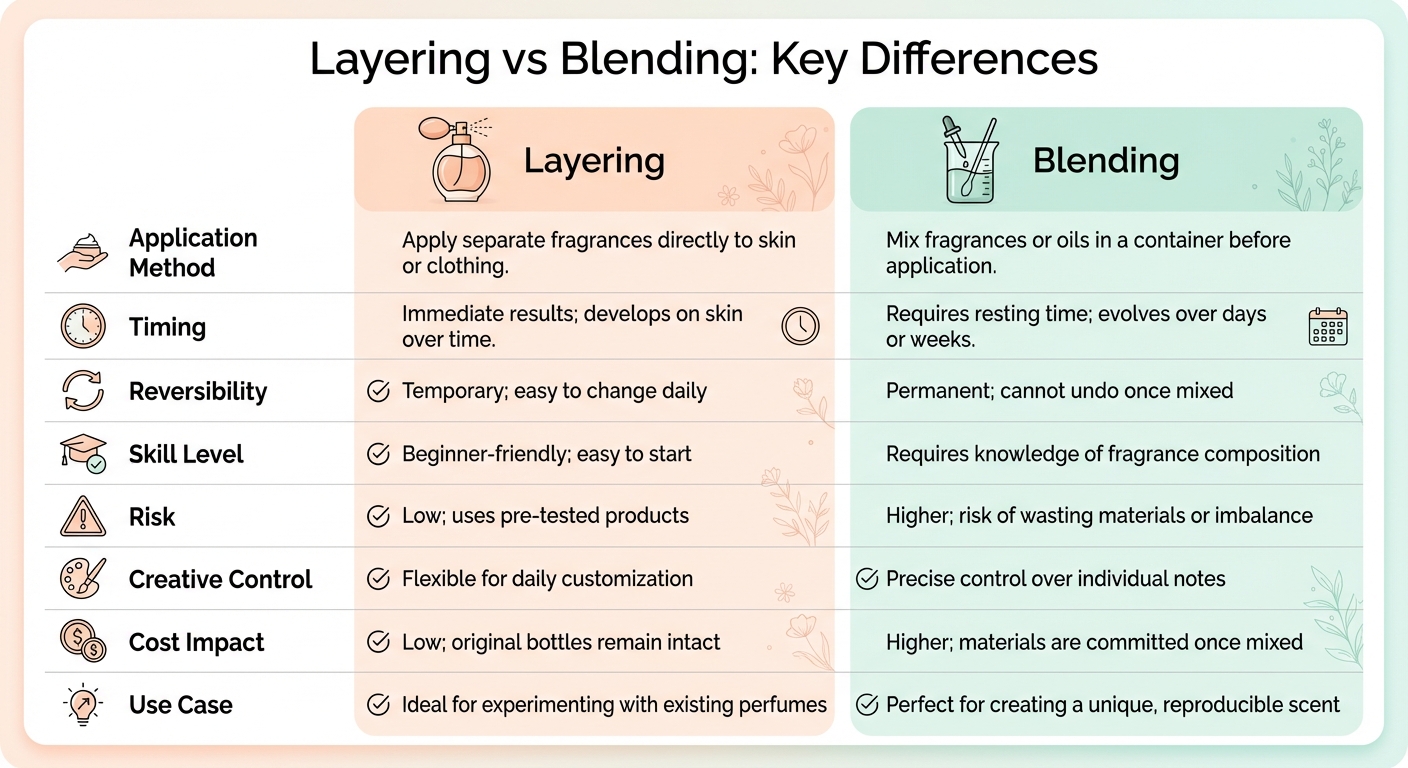
Grafic comparativ: stratificarea parfumurilor vs. mixare
Principalele diferente dintre layering si blending
Layering-ul si blending-ul sunt doua abordari distincte pentru personalizarea parfumurilor, fiecare oferind posibilitati unice. Layering-ul presupune aplicarea directa pe piele, par sau haine a doua sau mai multe parfumuri complete, lasandu-le sa interactioneze in mod natural, in timp real. In schimb, blending-ul presupune amestecarea materiilor prime pentru parfumuri sau a parfumurilor intr-un recipient separat, pentru a crea un miros unitar inainte de aplicare.
Diferenta esentiala consta in caracterul permanent. Layering-ul este temporar si reversibil - daca nu-ti place rezultatul, il poti spala pur si simplu si poti incerca ceva nou a doua zi, fara sa modifici parfumurile originale. Blending-ul, in schimb, este permanent. Odata ce parfumurile sunt amestecate intr-un recipient sau atomizor, nu mai pot fi separate.
Metodele difera si prin complexitate. In cazul layering-ului, de obicei incepi cu un miros mai intens, apoi adaugi unul mai lejer, ceea ce face ca procesul sa fie rapid si accesibil incepatorilor. Blending-ul, pe de alta parte, necesita masuratori precise, rabdare si uneori chiar o perioada de repaus, pentru a permite ingredientelor sa se armonizeze. Astfel, blending-ul li se potriveste mai bine celor cu un interes mai profund pentru compozitia parfumurilor, apropiindu-se de parfumeria practicata de amatori mai degraba decat de un ritual cotidian relaxat.
Tabel comparativ: stratificare vs. mixare
| Factor | Stratificare | Mixare |
|---|---|---|
| Metoda de aplicare | Aplica parfumuri separate direct pe piele sau pe haine | Amesteca parfumuri sau uleiuri intr-un recipient inainte de aplicare |
| Durata | Rezultate imediate; mirosul evolueaza pe piele in timp | Necesita timp de repaus; evolueaza pe parcursul zilelor sau saptamanilor |
| Reversibilitate | Temporar; se poate schimba cu usurinta de la o zi la alta | Permanent; nu poate fi desfacut dupa amestecare |
| Nivel de experienta | Potrivit incepatorilor; usor de incercat | Necesita cunostinte despre compozitia parfumurilor |
| Risc | Scazut; foloseste produse testate in prealabil | Mai ridicat; exista riscul de a irosi materiile prime sau de a obtine un amestec dezechilibrat |
| Libertate creativa | Flexibil, pentru personalizare zilnica | Control precis asupra notelor individuale |
| Impact asupra costurilor | Scazut; parfumurile originale raman intacte | Mai ridicat; materiile prime sunt folosite odata ce sunt amestecate |
| Utilizare | Ideal pentru a experimenta cu parfumurile pe care le ai deja | Perfect pentru a crea un miros unic, pe care il poti reproduce |
Ce tehnica ti se potriveste?
Daca iti doresti rezultate imediate, fara un angajament de durata, layering-ul este alegerea potrivita. Este perfect pentru incepatori sau pentru oricine se bucura sa experimenteze combinatii pe care le poate schimba de la o zi la alta. De exemplu, poti domoli intensitatea unui oud indraznet cu o nota de vanilie sau poti inviora un ambra dens cu o nota citrica. Layering-ul li se potriveste si celor cu un buget limitat, deoarece nu presupune modificarea permanenta a parfumurilor scumpe. Pentru consumatorii din SUA, este o modalitate practica de a adapta parfumurile la anotimpuri, de exemplu, dand mai multa prospetime unui parfum gurmand cu note proaspete de citrice pentru vara.
Blending-ul, pe de alta parte, este ideal pentru cei carora le place sa creeze ceva unic si semipermanent. Necesita precizie, rabdare si disponibilitatea de a experimenta pana cand obtii echilibrul perfect. Metoda este deosebit de utila daca ai mai multe decanturi sau mostre si esti gata sa dedici o parte dintre ele testelor. Cu volume mici, precum 2 mL, poti experimenta cu parfumuri de lux fara sa risti sa compromiti un flacon intreg, costisitor. Dupa ce perfectionezi un amestec, acesta devine propria ta „formula de casa” - un parfum-semnatura pe care il poti recrea si purta in mod constant.
In cele din urma, alegerea dintre layering si blending depinde de obiectivele tale si de nivelul de interes pentru personalizarea parfumurilor. Ambele metode iti ofera modalitati captivante de a-ti construi o garderoba olfactiva care iti reflecta stilul personal.
Cum iti construiesti garderoba olfactiva
Layering-ul si blending-ul sunt doua tehnici eficiente pentru a-ti crea o garderoba olfactiva echilibrata - o colectie de parfumuri atent aleasa si adaptata diferitelor stari de spirit, anotimpuri si ocazii. In loc sa ramai la un singur parfum-semnatura, aceste metode iti permit sa explorezi o varietate de combinatii. Layering-ul presupune combinarea parfumurilor gata de purtat direct pe piele, in timp ce blending-ul permite o abordare mai avansata si personalizata pentru crearea unor compozitii unice. Impreuna, cele doua metode pot transforma doar cateva parfumuri de baza in zeci de posibilitati, scutindu-te de costul achizitionarii mai multor parfumuri in format mare. Este o modalitate inteligenta si creativa de a explora parfumuri noi fara sa cheltui prea mult.
Incepe cu cantitati mici, sub forma de decanturi. Investitia in formate mai mici - precum decanturi de 2 ml, 5 ml si 8 ml, precum si un decant de 30 ml pentru majoritatea parfumurilor - iti permite sa experimentezi inainte sa te decizi asupra unui flacon intreg. De ce sa cheltui $100 to $300 pe un parfum care s-ar putea sa nu se potriveasca cu colectia ta? Un decant de 2 mL este perfect pentru a testa comportamentul unui parfum in conditii de zi cu zi, in timp ce un decant de 8 mL iti ofera suficient parfum pentru teste mai ample, cum ar fi layering-ul in diferite ocazii: in zilele de lucru, in weekend sau la iesirile de seara. Astfel, poti face alegeri informate inainte sa treci la formate mai mari.
Scento este un retailer de decanturi de parfum si mostre, iar fiecare produs poate fi cumparat o singura data, fara niciun abonament. Scento+ este abonamentul optional Scento: taxa lunara iti este returnata integral sub forma de credit in magazin, pe care il poti folosi pentru orice parfum; membrii beneficiaza de 10 % reducere, o mostra gratuita la fiecare comanda, un parfum gratuit la fiecare sase luni si un cadou de ziua lor, iar tu poti suspenda abonamentul oricand; pentru anulare, contacteaza echipa noastra. Aceasta formula minimizeaza riscul financiar asociat cumpararii unor flacoane intregi care s-ar putea sa nu ti se potriveasca. Testand parfumuri de designer si de nisa in cantitati mai mici, poti descoperi care merita cu adevarat un loc in colectia ta. In plus, experimentele de layering cu aceste decanturi te ajuta sa identifici parfumurile in care merita sa investesti in cantitati mai mari, precum 1 fl oz sau mai mult.
Pentru inceput, organizeaza-ti colectia actuala in functie de familiile olfactive (precum fresh, florale, lemnoase sau gurmande) si de ocaziile in care le porti (la birou, la o intalnire sau acasa, intr-un cadru relaxat). Apoi, identifica ce iti lipseste — poate nu ai un parfum lejer de vara sau unul intens, potrivit pentru seara. Foloseste decanturi pentru a testa parfumuri care ar putea completa aceste lipsuri, incercand fiecare parfum in cel putin doua sau trei combinatii de layering pe parcursul unei saptamani. Tine un jurnal simplu al testelor si noteaza cum evolueaza fiecare parfum si cum se imbina cu celelalte. Aceasta abordare bine gandita te asigura ca fiecare nou parfum din colectia ta are un rol clar si se potriveste cu restul. In locul cumparaturilor din impuls, alegerea parfumurilor devine un proces deliberat si satisfacator.
Intrebari frecvente
Care este diferenta dintre layering si blending si cum aleg varianta potrivita?
Layeringul presupune sa creezi un parfum personalizat aplicand, unul dupa altul, mai multe parfumuri sau produse parfumate. Aceasta tehnica iti permite sa creezi o aroma unica, cu mai multe fatete, care poate deveni semnatura ta olfactiva de zi cu zi sau poate adauga o nota de rafinament in plus ocaziilor speciale.
Blendingul presupune o abordare usor diferita. Acesta consta in combinarea mai multor note sau parfumuri, direct pe piele ori intr-un flacon, pentru a crea un parfum complet personalizat. Metoda este ideala pentru cei carora le place sa experimenteze si isi doresc sa creeze un parfum care sa le apartina in intregime.
Daca iti doresti un parfum versatil, pe care sa-l poti construi treptat, layeringul este alegerea potrivita. Insa, daca ai chef sa creezi si vrei sa obtii ceva cu adevarat unic, blendingul este cea mai buna optiune.
De ce ar trebui sa tin cont cand combin parfumuri acasa?
Experimentarea cu blendingul de parfumuri acasa poate fi destul de dificila si duce adesea la rezultate neasteptate. Fara sa intelegi cum se imbina diferitele note, ai putea obtine arome prea intense, neplacute sau pur si simplu lipsite de armonie.
Consecventa este o alta provocare. Spre deosebire de parfumierii profesionisti, cei mai multi dintre noi nu avem acces la instrumente specializate sau la ani de pregatire. Daca te aventurezi in acest proces creativ, incepe cu cantitati mici si noteaza totul in detaliu. Astfel, iti vei putea ajusta si imbunatati combinatiile pe parcurs.
Layeringul ajuta parfumul sa reziste mai mult?
Da, layeringul poate ajuta parfumul sa ramana mai mult timp pe piele. Cand folosesti arome complementare sau combini parfumul cu lotiuni ori uleiuri de corp asortate, creezi o baza care ajuta parfumul sa adere la piele si sa-si dezvaluie notele mai lent, in timp.
Aceasta abordare nu doar prelungeste persistenta parfumului, ci iti permite si sa-l personalizezi, oferindu-i un caracter distinctiv si individual.

