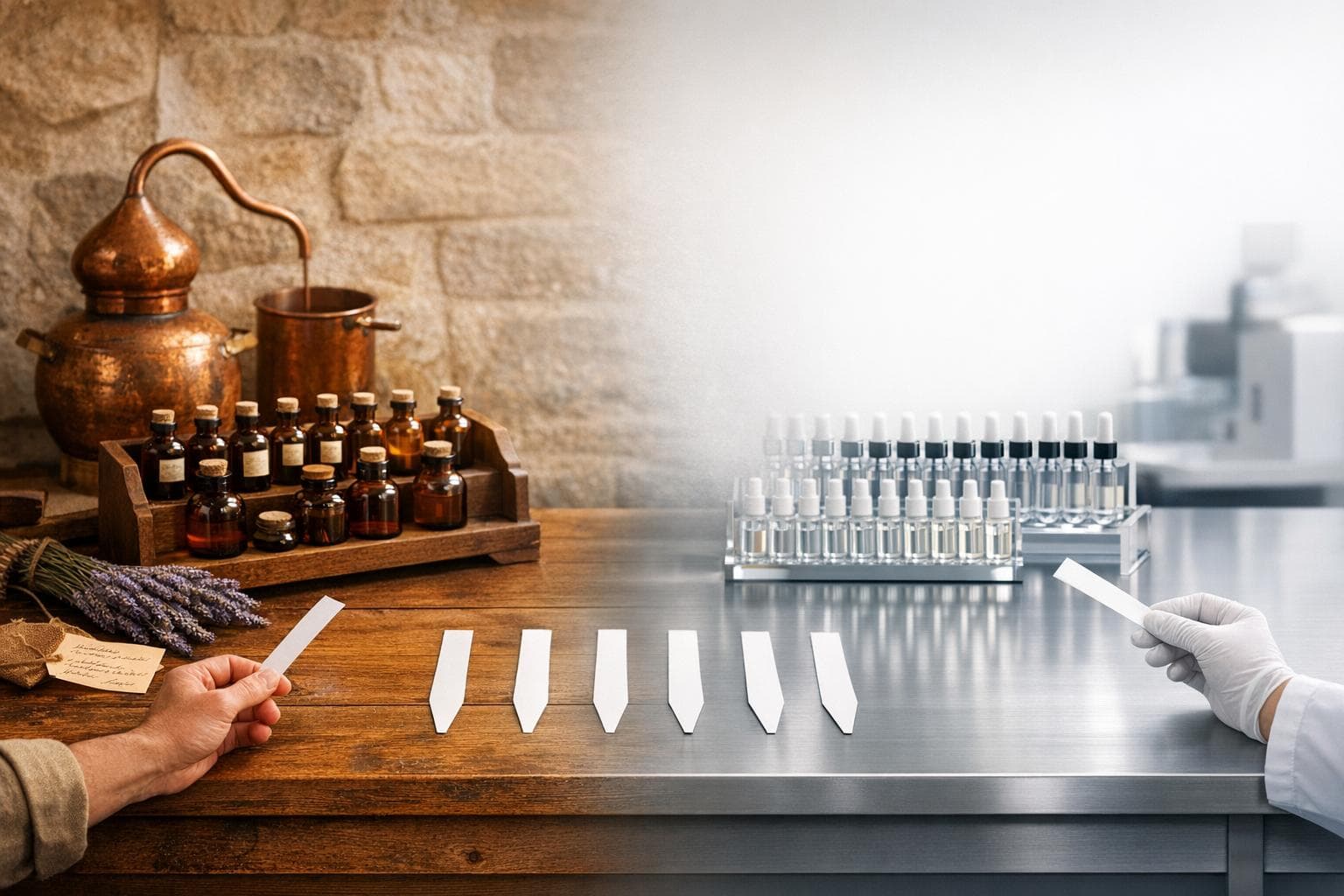
Scolile franceze de parfumerie au transformat arta crearii parfumurilor intr-o disciplina structurata. Incepand in Grasse in secolul al XII-lea, parfumeria a evoluat de la tabacarii care mascau mirosurile neplacute la un mestesug sofisticat, sustinut de institutii precum ISIPCA si Givaudan Perfumery School. Aceste scoli combina antrenamentul olfactiv, chimia si tehnicile de compozitie pentru a pregati experti care modeleaza industria globala a parfumurilor. Franta domina piata, detinand aproximativ 30 % din vanzarile la nivel mondial, datorita acestei mosteniri definite de precizie si creativitate.
Puncte cheie:
- Origini: Tabacarii din Grasse au introdus manusile parfumate in secolul al XVI-lea, castigand favoarea regala.
- Tranzitia industriala: Pana in secolul al XIX-lea, moleculele sintetice au extins posibilitatile olfactive, impunand o educatie formala.
- Institutii: Scoli precum ISIPCA (1970) si Givaudan (1946) instruiesc parfumierii in recunoasterea aromelor, chimia organica si compozitia parfumurilor.
- Impact: Absolventii au creat parfumuri emblematice, parfumierii formati in Franta influentand o treime din creatiile de parfumerie fina la nivel global.
Scolile de parfumerie din Franta continua sa duca mai departe aceasta traditie prin imbinarea artei cu stiinta, stabilind standardul de referinta la nivel global pentru parfumurile de lux.
Istoria scolilor franceze de parfumerie: De la ucenicia in bresle la influenta globala
Bazele timpurii ale educatiei in parfumerie in Franta
Bresle si ucenicie
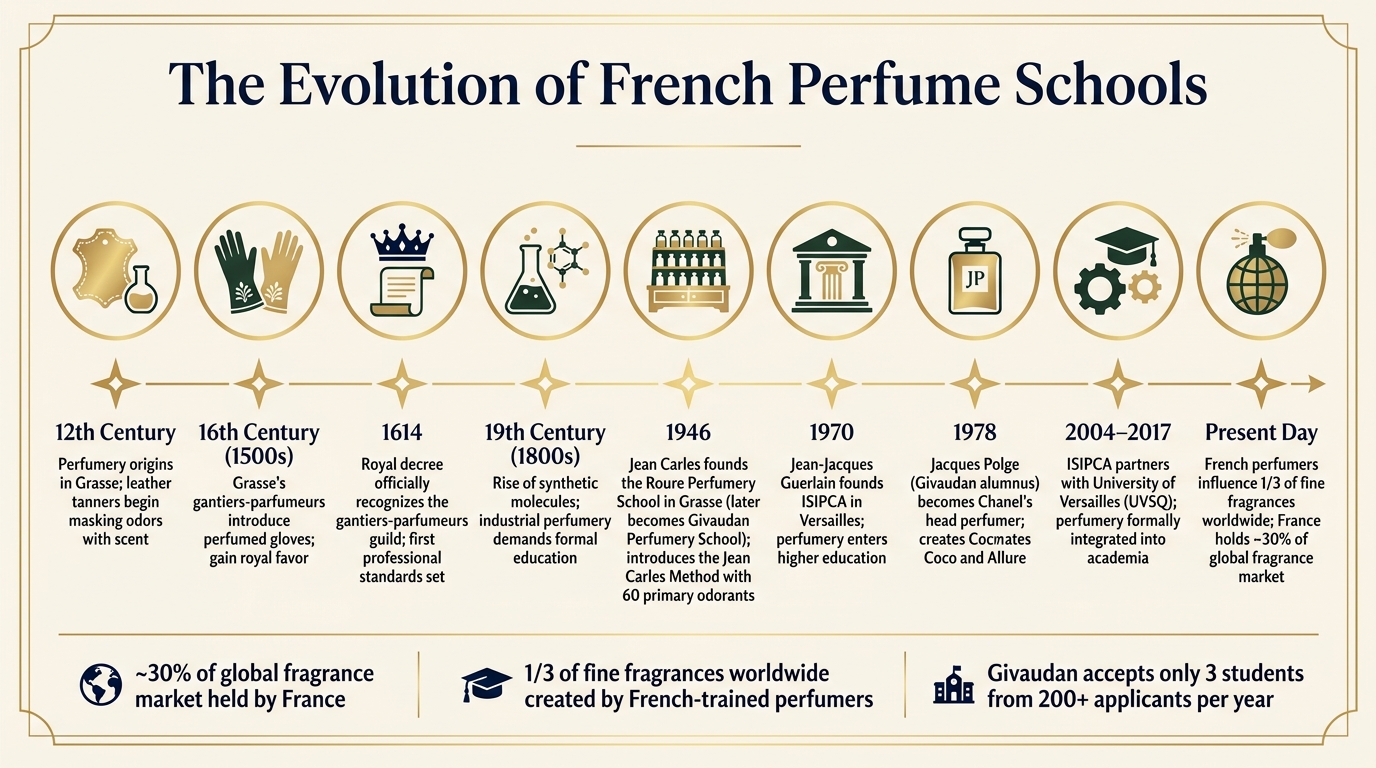
Inainte de aparitia scolilor formale, arta parfumeriei era un mestesug atent pazit, transmis prin relatia traditionala maestru-ucenic. Cei cunoscuti drept gantiers-parfumeurs – manusari-parfumieri – au jucat un rol esential in aceasta perioada incipienta. Recunoscuta oficial prin decret regal in 1614, breasla lor a stabilit primele standarde profesionale pentru parfumerie.
Instruirea era in totalitate practica. Ucenicii isi perfectionau abilitatile prin stapanirea unor tehnici precum distilarea cu abur pentru a extrage uleiuri esentiale, combinarea ingredientelor naturale si dezvoltarea memoriei olfactive. Aceasta din urma presupunea recunoasterea si retinerea aromelor materiilor prime – la fel ca invatarea alfabetului inainte de a scrie.
Rolul regiunii Grasse in formarea timpurie
Grasse, considerat adesea leaganul parfumeriei, a fost mult mai mult decat un simplu centru de cultivare a florilor. Casele sale de materii prime, cum ar fi Chiris, Lautier si Galimard, le ofereau viitorilor parfumieri o oportunitate nepretuita de interactiune directa cu ingrediente precum iasomia, trandafirul si lavanda. Microclimatul unic al regiunii a transformat-o in mediul ideal pentru cultivarea acestor plante aromatice.
O tehnica fundamentala predata in Grasse a fost macerarea la rece (enfleurage), o metoda delicata de extragere a esentelor din flori fragile precum iasomia. Aceasta abilitate, la fel ca multe altele, a fost transmisa prin experienta directa si practica, si nu printr-o instruire formala. Cu toate acestea, astfel de metode artizanale au inceput sa faca fata cu greu cererii tot mai mari de parfumuri pe masura ce industria a inceput sa se modernizeze.
Trecerea la parfumeria industriala
Pana in secolul al XIX-lea, limitele formarii traditionale in cadrul breslelor au devenit evidente. Cresterea productiei la scara larga impunea o consecventa si o eficienta pe care micile ateliere nu le puteau asigura. Introducerea moleculelor de sinteza a revolutionat domeniul, extinzand spectaculos paleta parfumierului si adaugand un nivel superior de complexitate acestei arte.
Pe masura ce chimia a devenit piatra de temelie a parfumeriei, necesitatea unei abordari sistematice a educatiei a fost de necontestat. Aceasta evolutie a marcat tranzitia de la uceniciile informale la programe academice structurate, pregatind terenul pentru infiintarea scolilor moderne de parfumerie – o etapa detaliata in sectiunea urmatoare.
Infiintarea scolilor moderne de parfumerie
Jean Carles si Roure Perfumery School
Pe masura ce parfumeria a evoluat de la metodele artizanale la o abordare industrializata, nevoia de educatie structurata a devenit evidenta. In 1946, Jean Carles, maestru parfumier, a fondat Roure Perfumery School in Grasse. Acest moment a marcat o cotitura, facand trecerea de la ucenicia informala la un cadru academic riguros. Carles a introdus ceea ce astazi este cunoscut drept Metoda Jean Carles, un sistem creat pentru a inlocui aproximarile cu precizia pura. Metoda sa a constat in organizarea a 60 de odoranti primari in categorii olfactive precum florale, lemnoase si citrice, invatandu-i pe studenti sa identifice contrastele majore inainte de a analiza nuantele subtile. De asemenea, a perfectionat arta combinarii aromelor testand proportii fixe (cum ar fi 1:9 sau 2:8) pentru a crea compozitii armonioase.
In ciuda pierderii simtului mirosului, Carles a folosit memoria si metodologia sa pentru a crea parfumuri iconice precum Ma Griffe si Miss Dior. Scoala fondata de el a devenit ulterior Givaudan Perfumery School, dupa integrarea in operatiuni internationale de anvergura. Sistemul inovator al lui Carles a pus bazele pentru ca Franta sa dezvolte noi institutii academice dedicate profesionalizarii parfumeriei.
ISIPCA: Abordarea academica a Frantei in parfumerie
In 1970, Jean — Jacques Guerlain a fondat ISIPCA la Versailles pentru a oferi studii superioare in formularea parfumurilor, cosmeticelor si aromelor alimentare. Intre 2004 si 2017, ISIPCA a incheiat un parteneriat cu University of Versailles (UVSQ), integrand oficial parfumeria in invatamantul universitar. Scoala este strans legata si de Osmothèque, o arhiva unica de parfumuri din Versailles. Aceasta arhiva se dedica cercetarii si recrearii formulelor olfactive pierdute, oferind studentilor un acces de neegalat la evolutia istorica si tehnica a parfumeriei. Alaturi de ISIPCA, initiativele regionale precum scoala PRODAROM din Grasse asigura adaptarea formarii la cerintele specifice ale industriei.
Scoala PRODAROM din Grasse
Grasse a trecut prin transformari majore ale industriei parfumurilor in anii 1970. Aromele alimentare au inceput sa domine, reprezentand peste jumatate din productia regiunii, in timp ce recolta anuala de flori a scazut vertiginos – de la 5.000 de tone in anii 1940 la mai putin de 30 de tone la inceputul anilor 2000, in mare parte din cauza extinderii alternativelor sintetice. Scoala PRODAROM a jucat un rol esential in pregatirea profesionistilor pentru a se adapta acestor schimbari. Aceasta imbina instruirea in lucrul cu materii prime naturale cu expertiza tehnica in sinteza aromatica, asigurandu-se ca viitorii parfumieri pot raspunde noilor exigente ale industriei.
Expertul tău personal în parfumuri te așteaptă
Completează testul nostru rapid de parfumuri și descoperă parfumuri designer și de nișă autentice, alese pe gustul tău – explorează-le ca decanturi și mostre de 2, 5, 8 și 30 ml, ca să le poți încerca pe fiecare înainte de a alege un flacon întreg.
Descoperă-ți parfumulCum formeaza scolile franceze de parfumerie un „nas”
Scolile franceze de parfumerie au transformat aceasta arta dintr-o traditie mostenita in bresle intr-o disciplina academica de inalta rigoare. Combinand antrenamentul olfactiv practic, cunostintele stiintifice si tehnicile creative, aceste institutii pregatesc studentii pentru universul complex al creatiei olfactive.
Antrenamentul olfactiv si memoria
Dezvoltarea unui simt olfactiv de o finete absoluta se afla in centrul fiecarui program francez de parfumerie. Studentii sunt instruiti sa identifice materiile prime intr-un mod sistematic, grupate pe familii olfactive precum citrice, florale, lemnoase si aromatice. La Grasse Institute of Perfumery (GIP), de exemplu, cursantii lucreaza cu peste 200 de materii prime specifice, parcurgand patru niveluri de pregatire pentru a-si dezvolta o memorie olfactiva extraordinar de precisa.
Repetitia este un factor esential. Studentii primesc truse pentru acasa, pentru a continua exercitiile de identificare a aromelor si in afara orelor de curs. Excursiile de studiu completeaza aceasta pregatire, oferindu-le ocazia de a vizita padurile de cedru din Maroc sau campurile de iasomie din Grasse. Aceste experiente imersive le aprofundeaza intelegerea materiilor prime in starea lor naturala. Johan Sulmoni, absolvent GIP, povesteste despre aceasta etapa:
„Scoala mi-a adus o multime de cunostinte si mi-a oferit o viziune concreta asupra modului de a compune un parfum... Pastrez o amintire incredibila din vizita de studiu in Maroc cu GIP, unde ne-am plimbat printr-o padure uriasa de cedru.”
Chimia si cunostintele tehnice
Desi recunoasterea aromelor este fundamentala, intelegerea partii stiintifice este la fel de importanta. Studentii asimileaza notiuni de chimie organica, calculatie a costurilor si standarde de reglementare – instrumente indispensabile pentru activitatea in industria moderna a parfumurilor.
ISIPCA, o institutie emblematica de parfumerie, reflecta acest echilibru prin deviza sa: „De la simturi la expertiza”. Programele sale cer adesea candidatilor o pregatire solida in chimie, biochimie sau matematica. Pregatirea acopera si parfumeria functionala, explicand modul in care aromele interactioneaza in diferite aplicatii, cum ar fi sapunurile, lumanarile parfumate sau difuzoarele de camera. Aceasta baza stiintifica solida sustine intregul proces creativ ulterior.
Invatarea compozitiei parfumurilor
Odata ce studentii stapanesc recunoasterea olfactiva si competentele tehnice, trec la compunerea propriu-zisa a parfumurilor. Acest pas incepe cu asimilarea notelor individuale, continua cu acordurile simple si culmineaza cu formule complexe. La GIP, intregul proces este structurat pe patru niveluri, fiecare concentrandu-se pe compozitii din ce in ce mai sofisticate:
| Nivel de pregatire | Arie de concentrare | Formula cheie |
|---|---|---|
| Nivelul 1 – Incepator | Materii prime de baza si istorie | Classic Cologne |
| Nivelul 2 – Intermediar | Acorduri complexe si parfumerie functionala | Formule orientale |
| Nivelul 3 – Avansat | Clasificare aprofundata si acorduri florale | Classic Fougère |
| Nivelul 4 – Expert | Formulare avansata si perspective din industrie | Classic Chypre |
Un principiu de baza predat in timpul sesiunilor de compozitie este regula 30/50/20: 30 % note de varf, 50 % note de mijloc si 20 % note de baza. Aceasta proportie ii ghideaza pe studenti in realizarea unor creatii armonioase si echilibrate. Atelierele de creativitate si exercitiile de transpunere narativa fac de asemenea parte din programa, incurajandu-i sa transforme idei si emotii in profiluri aromatice memorabile.
Aceasta rigoare in pregatire asigura mentinerea parfumeriei franceze ca lider mondial in arta creatiilor de lux. Imbinand traditia cu inovatia, aceste scoli continua sa defineasca excelenta in domeniu.
Cum au modelat scolile franceze de parfumerie industria globala
Contributia absolventilor
Absolventii scolilor franceze de parfumerie au lasat o amprenta profunda asupra creatiilor olfactive de lux. Spre exemplu, Jacques Polge, absolvent al scolii Givaudan, a devenit parfumier-sef al casei Chanel in 1978, creand parfumuri legendare precum Coco si Allure. In mod similar, Jean‑Claude Ellena, de asemenea format la Givaudan, a adus viziunea sa minimalista la Hermès in calitate de maestru parfumier, conturand identitatea olfactiva exclusivista a casei. Francis Kurkdjian, format la ISIPCA, nu doar ca a creat propria casa, Maison Francis Kurkdjian, dar a si realizat parfumuri de succes mondial pentru marile case de lux. El a surprins forta emotionala a acestei arte declarand:
„Parfumul este arta care face memoria sa vorbeasca.”
Influenta acestor absolventi este remarcabila. FashionNetwork noteaza ca „O treime din toate parfumurile fine create la nivel mondial isi datoreaza existenta absolventilor acestei scoli [Givaudan].” In plus, parfumurile franceze detin o cota de piata de aproximativ 30 % din vanzarile globale. Aceasta mostenire consolideaza parfumeria franceza ca punct de referinta al intregii industrii.
Cum s-au raspandit metodele de instruire franceze in intreaga lume
Succesul parfumierilor cu studii in Franta a determinat raspandirea universala a metodelor lor pedagogice. O metoda remarcabila este cea a lui Jean Carles, care trateaza materiile prime ca pe „litere ale alfabetului”. Studentii invata sa le asocieze in „acorduri” si, in final, in „fraze”, respectiv familii aromatice complete. Jean Guichard, de la Givaudan Perfumery School, explica:
„Studentii de aici trebuie sa stapaneasca 500 dintre aceste substante «la fel ca literele alfabetului». Apoi urmeaza «acordurile», asa cum sunt numite combinatiile de materii prime, si la final «frazele», familiile de note olfactive.”
Pentru a extinde accesul la aceste tehnici, institutii precum Givaudan au inaugurat centre de creatie in metropole precum New York, São Paulo, Shanghai, Singapore si Dubai. Aceste ateliere adapteaza metodologia franceza la preferintele olfactive si traditiile locale, pastrand precizia instruirii clasice in timp ce integreaza diversitatea regionala.
Locul parfumeriei franceze pe piata moderna a luxului
Scolile franceze au redefinit notiunea de parfum de lux imbinand maiestria tehnica cu povestea artistica. Aceasta abordare a inaltat parfumul de la statutul de simplu produs cosmetic la cel de opera de arta, in care fiecare sticla transmite o viziune si reflecta un mestesug exceptional. Astazi, aceasta filozofie modeleaza modul in care brandurile de lux isi promoveaza si pozitioneaza aromele in intreaga lume.
Alaturand expertiza tehnica franceza traditiilor din diverse colturi ale lumii, creatiile exclusiviste actuale ating atat un nivel inalt de calitate, cat si profunzime. Pentru consumatorii europeni, indeosebi din Germania, unde creatiile de nisa si cele de designer sunt tot mai apreciate, maiestria din spatele unor capodopere precum Chanel No. 5 sau o creatie Maison Francis Kurkdjian isi are radacinile adanci in tehnicile perfectionate in scolile franceze.
Jean Guichard subliniaza ca adevarata maiestrie nu se rezuma la memorarea ingredientelor, ci se afla in capacitatea de a le combina intr-un mod original. Acest echilibru intre pregatirea riguroasa si libertatea de expresie este esenta a ceea ce scolile de parfumerie din Franta au oferit lumii intregi.
Concluzie: Importanta durabila a scolilor franceze de parfumerie
Idei principale
Scolile franceze de parfumerie au pus bazele industriei parfumurilor la nivel mondial, unind arta si stiinta intr-un mod inegalabil. De la ucenicia timpurie in breslele din Grasse si metodologia structurata a lui Jean Carles, pana la institutii de renume precum ISIPCA (infiintata in 1970) si Givaudan Perfumery School, Franta a dezvoltat un sistem academic exemplar care descopera si formeaza talente de exceptie. Procesul extrem de selectiv al scolii Givaudan – care admite doar trei studenti din peste 200 de candidati in fiecare an – reflecta prestigiul si exigenta acestei traditii.
Aceasta pregatire meticuloasa a asigurat suprematia Frantei pe piata globala a parfumurilor, un succes cladit atat pe rafinament cultural, cat si pe excelenta tehnica. Asa cum remarca Jean Guichard, directorul Givaudan Perfumery School:
„Fiecare epoca are marile sale parfumuri... Un mare parfumier trebuie sa fie capabil sa exprime spiritul timpului sau, sa redea o epoca facand in acelasi timp ceea ce iubeste.”
Aceasta mostenire nu doar ca a definit o intreaga industrie, ci continua sa transforme felul in care percepem si apreciem aromele astazi.
Ce inseamna acest lucru pentru pasionatii de parfumuri de astazi
Pentru iubitorii de arome de astazi, in special in Germania, unde parfumurile de designer si de nisa se bucura de un interes tot mai mare, mostenirea scolilor franceze are o valoare autentica. Fiecare flacon semnat de case precum Chanel, Hermès sau Maison Francis Kurkdjian reflecta ani de disciplina, studiu si maiestrie vizionara. Aceste esente sunt mai mult decat mirosuri placute – ele sunt expresia unei culturi care imbina rigoarea cu inspiratia.
Aceasta traditie evidentiaza si importanta descoperirii in universul olfactiv actual. Avand in vedere ca sticlele originale depasesc frecvent pretul de 300 €, platforme precum Scento ofera o modalitate accesibila de a explora arome exclusiviste. Mostrele lor decantate de 8 ml permit pasionatilor sa descopere pe deplin evolutia unei compozitii, de la notele de varf pana la notele finale de baza – o abordare ce reflecta aprecierea pentru maiestria cultivata de scolile din Franta.
„Adevarata abilitate nu consta in retinerea ingredientelor, ci in capacitatea de inventie, iar aceasta presupune intotdeauna o doza de neprevazut.” – Jean Guichard, director, Givaudan Perfumery School
Scolile franceze de parfumerie au marcat definitiv acest domeniu, unde fiecare parfum remarcabil ramane o marturie a echilibrului perfect intre arta si stiinta – un echilibru desavarsit de-a lungul generatiilor.
Intrebari frecvente
De ce a trecut instruirea in parfumerie de la ucenicia in bresle la scoli formale?
Instruirea in parfumerie in Franta a evoluat de la sistemul traditional de ucenicie in bresle catre infiintarea unor institutii specializate, creand un cadru de invatare organizat si standardizat. Daca breslele se axau pe pregatirea practica, aparitia unor institutii precum ISIPCA a marcat tranzitia spre o abordare academica riguroasa. Aceste scoli au introdus o formare detaliata, tehnici stiintifice si cunostinte teoretice avansate, consolidand statutul profesiei. Imbinand descoperirile stiintifice moderne cu arta mestesugului traditional, aceasta schimbare a contribuit decisiv la profesionalizarea domeniului si la promovarea inovatiei.
Ce este metoda Jean Carles si de ce este inca predata?
Metoda Jean Carles este o tehnica fundamentala de instruire in arta parfumului, creata de parfumierul francez Jean Carles. Aceasta imparte 60 de compusi olfactivi intr-o clasificare bine structurata pe familii de note, cum ar fi cele florale sau lemnoase. Prin aceasta abordare, studentii analizeaza comparativ materiile prime din aceeasi categorie – de pilda, trandafirul in contrast cu iasomia – pentru a intelege si asimila particularitatile fiecarui element. Acest sistem metodic ramane o componenta definitorie in educatia olfactiva, ajutand cursantii sa isi dezvolte capacitatea de recunoastere a aromelor si intelegerea substantelor utilizate.
Ce abilitati dezvolta scolile franceze de parfumerie, dincolo de identificarea ingredientelor?
Scolile franceze de profil asigura o educatie integrata, imbinand stiinta, sensibilitatea artistica si cunostintele de afaceri. Cursantii invata sa recunoasca si sa clasifice ingrediente atat naturale, cat si sintetice, sa elaboreze compozitii armonioase si sa perfectioneze metodele de combinare. Totodata, acestia aprofundeaza istoria parfumului, tendintele pietei si comportamentul consumatorilor, descifrand aspectele legate de identitatea de brand si rolul cultural al esentelor. Aceasta formare extinsa le deschide absolventilor perspective vaste pentru cariere variate in industria internationala a parfumurilor.

