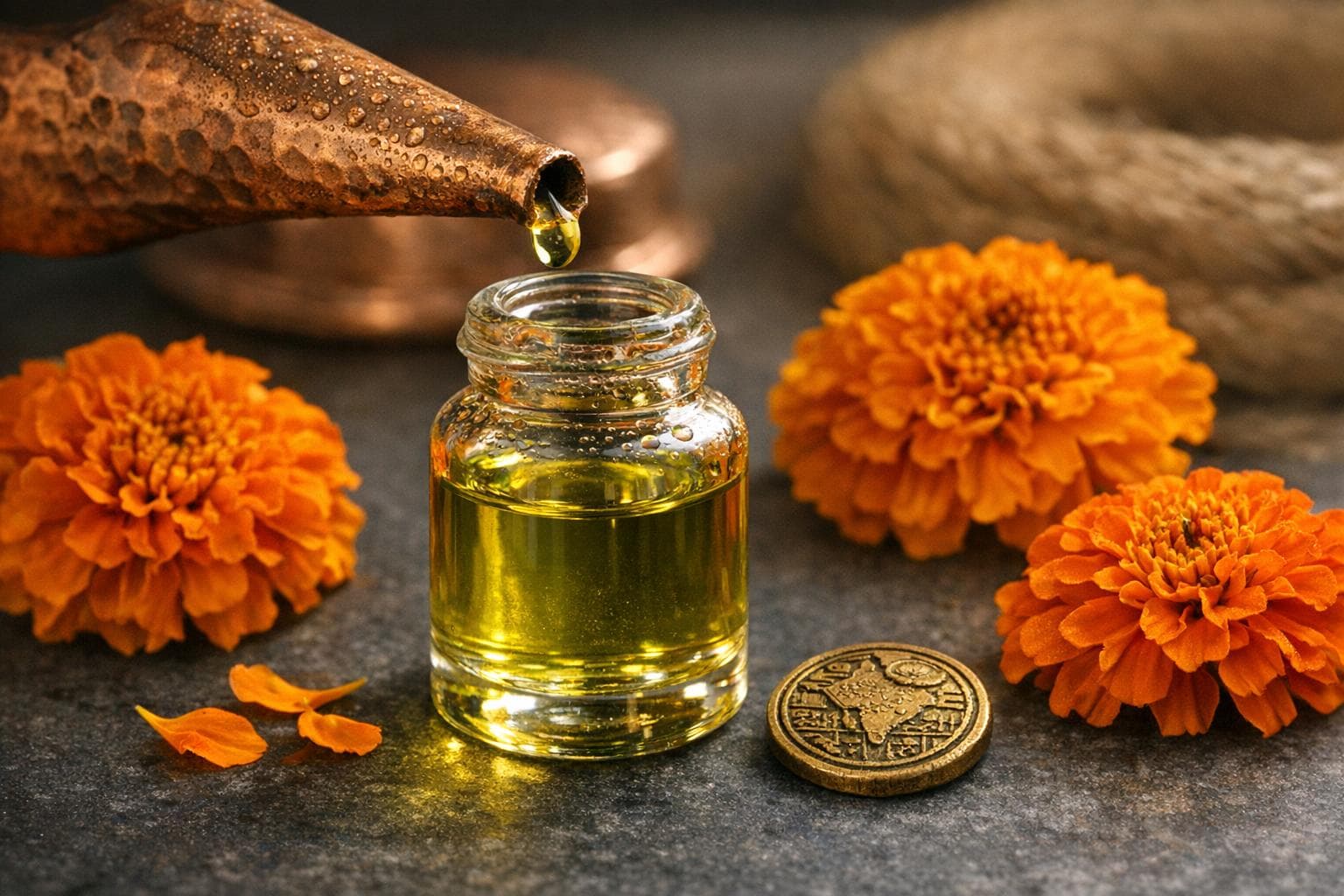
Marigold attar, un ulei parfumat creat in Kannauj, India, reprezinta peste 400 de ani de mostenire in arta parfumeriei. Renumit pentru aroma sa verde, subtil amaruie, cu subtonuri ierboase, acest attar este distilat folosind metoda straveche Deg — Bhapka, care imbina petale de craite, apa si ulei de santal in alambicuri de cupru. Recunoscut printr-o mentiune de Indicatie Geografica (GI) inca din 2014, acesta ofera garantia autenticitatii, similara protectiei GI a regiunii Champagne.
Repere esentiale:
- Proces: Din 40 kg de petale se obtin doar 3 grame de ulei, printr-un efort sustinut de 15 zile de munca manuala.
- Importanta culturala: Craitele sunt nelipsite din ritualurile si festivalurile indiene.
- Profil olfactiv: O fuziune de note citrice, accente de mar si tonuri pamantii.
- Apreciere internationala: Raspunde perfect preferintelor europene pentru un lux artizanal si natural.
In ciuda provocarilor climatice si a concurentei venite din partea alternativelor sintetice, Kannauj marigold attar continua sa cucereasca recunoasterea internationala, imbinand tehnici multiseculare cu cererea moderna pentru parfumuri sustenabile, fara alcool.
Rolul craitelor in viata din India
Craitele in ritualurile si festivalurile indiene
In India, craita, sau Gendha, ocupa un loc esential in practicile spirituale cotidiene. Fie ca impodobeste templele, alcatuieste ghirlandele nuptiale sau este impletita in atmosfera festivalurilor precum Diwali, Durga Puja si Navratri, ghirlandele de craite sunt sinonime cu momentele sacre. Nuantele lor vibrante sunt privite ca veritabile simboluri ale energiei solare si ale creativitatii.
Aceasta legatura profunda explica de ce craita este adesea transformata in „Pooja Attar”, o esenta creata anume pentru ritualurile religioase. Obtinut exclusiv din ingrediente botanice si lipsit de alcool, este considerat sattvic (pur), devenind alegerea ideala pentru rugaciune, meditatie si un element-cheie in tamaie si dhoop.
„Mestesugul attarului din Kannauj nu este doar o indeletnicire; este o mostenire definita de pasiune, traditie si o comuniune profunda cu natura.” - Al Naqi Fragrances
Aceste conexiuni culturale scot in evidenta importanta senzoriala si simbolica a craitei, oferind un context amplu pentru a-i intelege rolul in traditiile indiene.
Ce transmite Marigold Attar: Emotie si simbolistica
Aspectul stralucitor al craitei isi gaseste ecoul in parfumul sau – proaspat, verde si discret amarui, cu subtonuri ierboase. Spre deosebire de aromele dulci sau opulente, marigold attar ofera o prospetime aerata, ce aduce limpezime si liniste interioara. Aceasta trasatura se armonizeaza perfect cu utilizarea sa in aromaterapia traditionala indiana, unde este recunoscut pentru capacitatea de a induce o stare de calm si echilibru. Simbolismul cultural al florii, legat de puritate si bun augur, imbogateste experienta purtarii sau difuzarii acestui attar, transformandu-l intr-o compozitie incarcata de intentie si profunzime.
Rezonanta pentru publicul european
Legatura dintre semnificatia spirituala si cea senzoriala a unei flori este o idee universala. Desi craita este adanc ancorata in cultura indiana, importanta sa rezoneaza si in alte spatii culturale. De exemplu, in traditia crestina, craita era denumita „Mary’s Gold”, fiind asociata cu Fecioara Maria si monedele de aur oferite saracilor. De asemenea, in antichitatea greaca si romana, Calendula era legata de zeite precum Afrodita si Hera, avand un rol important in ceremoniile religioase. Aceste paralele reflecta modul in care florile europene, cum sunt trandafirii si crinii, imbina spiritualitatea cu arta, fiind prezente in nunti, ritualuri funerare si alte evenimente solemne, in timp ce miresmele lor au inspirat dintotdeauna lumea parfumeriei.
„Metoda noastra este atat minutioasa, cat si extrem de solicitanta ca munca fizica. Cu toate acestea, rezultatul este net superior. Este ca diferenta dintre o tesatura manuala si una industriala.” - Pranav Kapoor, Director, PKAPO Opulence
Pentru pasionatii de parfumuri din Europa, marigold attar reprezinta mai mult decat o incursiune in traditiile indiene – el raspunde admirabil interesului tot mai mare pentru profilele olfactive botanice, verzi si aromatice. Procesul traditional de distilare deg-bhapka, lent, manual si incarcat de istorie, impartaseste aceleasi valori cultivate de miscarile artizanale europene. Desi floarea ramane prin excelenta emblematica pentru India, maiestria si puritatea naturala din marigold attar poarta o atractie universala care depaseste orice granita.
Cum se creeaza Marigold Attar in Kannauj
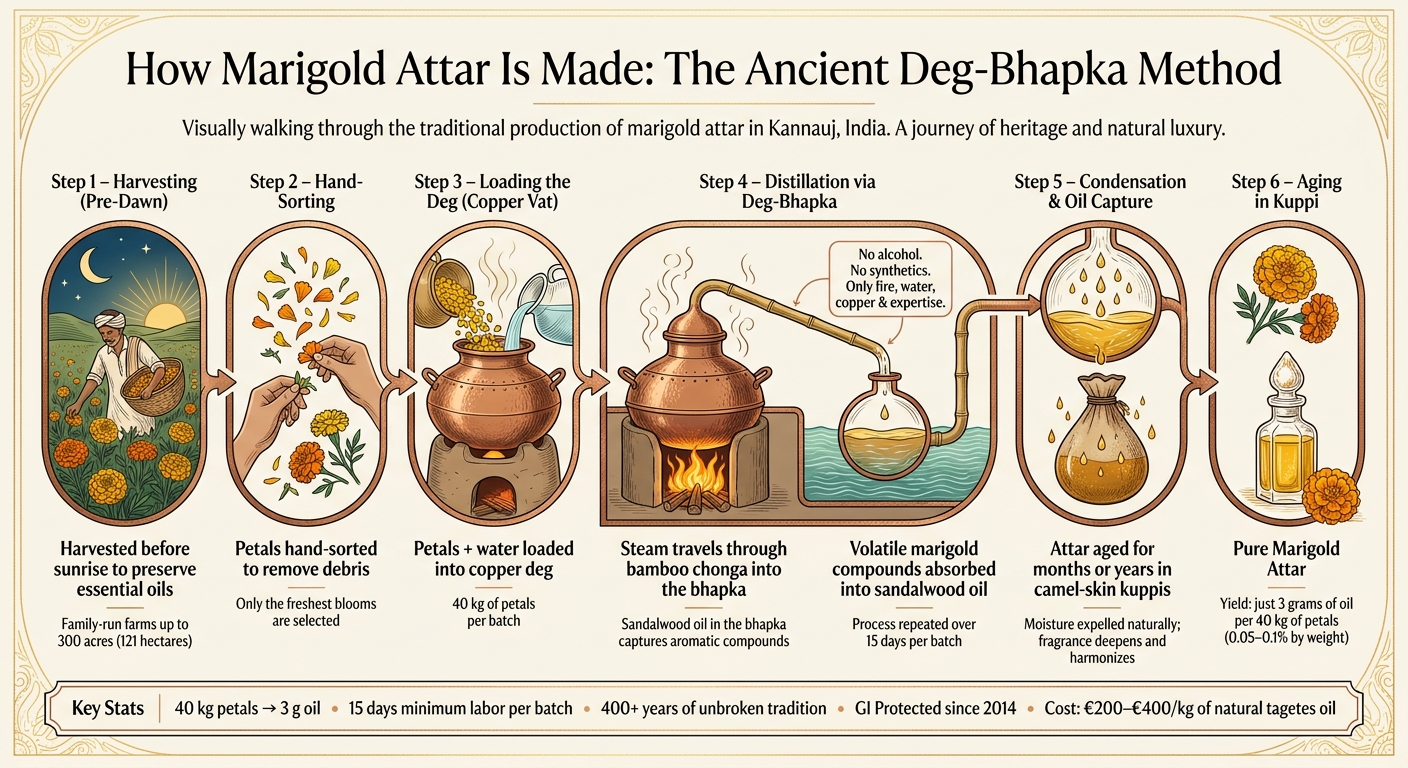
Cum se creeaza Marigold Attar: Stravechea metoda Deg — Bhapka
Cultivarea si recoltarea craitelor pentru attar
In Uttar Pradesh, cultivarea craitelor destinate productiei de attar se desfasoara in ferme de familie, unele intinzandu-se pe suprafete de pana la 300 de acri (aproximativ 121 de hectare). Culesul incepe inainte de rasaritul soarelui, moment in care florile ating apogeul aromatic, racoarea diminetii protejand uleiurile esentiale de degradarea provocata de caldura soarelui.
Dupa culegere, lucratorii sorteaza manual fiecare floare cu o atentie desavarsita, indepartand orice impuritate. Cele mai proaspete petale sunt transferate imediat in cazane de cupru pentru a pastra prospetimea aromei si pentru a asigura cel mai inalt standard calitativ.
Aceasta pregatire riguroasa este indispensabila pentru procesul traditional de distilare care urmeaza.
Metoda de distilare Deg — Bhapka
Metoda de distilare deg-bhapka, pastrata neschimbata de sute de ani, reprezinta inima intregului proces. Petalele de craite sunt asezate impreuna cu apa intr-un alambic generos de cupru, unde focul transforma amestecul in abur parfumat. Acest abur calatoreste printr-o conducta de bambus (chonga) catre un vas colector din cupru, mentinut in apa rece, denumit bhapka.
In interiorul recipientului bhapka, uleiul de santal actioneaza ca fixator, captand compusii aromatici volatili ai craitei pe masura ce aburul condenseaza. Aceasta procedura meticuloasa, care poate dura zile sau chiar saptamani intregi, desavarseste treptat profilul complex al esentei. Nu se adauga alcool si niciun fel de compusi sintetici; intreaga maiestrie se bazeaza exclusiv pe foc, apa, cupru si pura pricepere.
Randamentul este extrem de redus – sunt necesare aproximativ 40 de kilograme de petale pentru a obtine numai 3 grame de ulei esential pur. Fiecare lot presupune cel putin 15 zile de efort sustinut.
„Continuam sa respectam procesul stravechi de distilare. Suntem conservatori, lenti si traditionali, insa tocmai acestea sunt punctele noastre forte.” - Pranjal Kapoor, proprietar, M.L. Ramnarain Perfumers
Aceasta tehnica nu doar pastreaza vie mostenirea artizanala din Kannauj, ci protejeaza si chintesenta sa culturala. Odata distilat, attarul trece printr-o etapa de maturare pentru a-si desavarsi personalitatea.
Maturarea si evaluarea calitatii unui attar
Dupa distilare, esenta este lasata la maturat timp de cateva luni sau chiar ani. Acest proces permite ca notele de craita sa fuzioneze armonios cu baza de lemn de santal, rotunjind marginile taioase si oferind o echilibrare desavarsita. In mod traditional, attarul este pastrat in kuppis – recipiente din piele de camila care elimina in mod natural umezeala, pastrand intacte calitatile uleiului. Aceasta metoda antica de pastrare este o alta dovada a radacinilor istorice ale mestesugului.
Un attar maturat capata de obicei o tenta de la galben-deschis pana la auriu stralucitor si dezvaluie o aroma florala proaspata, verde, discret amaruie, cu inflexiuni ierboase.
„Maturarea permite parfumului sa isi dezvolte intreaga bogatie olfactiva. Anumite attaruri sunt maturate luni sau chiar ani de zile, dand nastere unor arome mult mai profunde si complexe.” - Al Naqi Fragrances
Calitatea unui attar se masoara prin modul in care evolueaza pe piele. O creatie autentica isi dezvaluie treptat notele de varf, de mijloc si de baza, oferind o experienta complexa si persistenta. O simpla picatura poate radia ore in sir sau chiar mai mult.
Profilul olfactiv si utilizarile esentei Marigold Attar
Cum miroase Marigold Attar
Marigold attar se distinge prin amprenta sa verde, incisiva, acompaniata de o amaraciune subtila, oferind un contrast frapant fata de accentele opulente si catifelate ale esentelor de trandafir sau iasomie.
Evolutia aromei se desfasoara in trei etape distincte. Compozitia debuteaza cu o deschidere energica, citrica, insotita de o nuanta usor medicinala, datorata moleculelor de ocimen si limonen. Dupa circa 20 de minute, parfumul face trecerea catre o inima cu accente de miere si mar, definita de fateta sa specifica de „mar verde”, conferita in mare masura de tagetenona. Faza de uscare, care se intinde pe mai bine de patru ore, scoate la iveala o caldura pamantie, innobilata cu tonuri lemnoase si ierboase, datorate sesquiterpenelor.
De asemenea, marigold attar reactioneaza fascinant in functie de chimia pielii fiecarui purtator. Pe o piele cu un pH mai acid, tonurile verzi si taioase devin predominante, in timp ce pe o piele mai calda si alcalina, inflexiunile calde de miere se dezvolta spectaculos.
„Aroma de craita este o intalnire inedita intre accente verzi, tonuri de mar si fatete ierboase amarui, fiind un ingredient pe cat de pretentios, pe atat de fascinant pentru parfumieri.” - CA Perfume Editorial
Acest profil stratificat transforma marigold attar intr-o optiune de o versatilitate remarcabila, ideala atat ca parfum de semnatura, cat si in cadrul ritualurilor traditionale.
Cum se foloseste Marigold Attar
In India, o singura picatura aplicata pe incheietura este suficienta, formula sa concentrata pe baza de ulei asigurand o persistenta de lunga durata. Dincolo de rolul de parfum, are legaturi adanci cu ceremoniile religioase si practicile ayurvedice, fiind apreciat pentru proprietatile sale antiinflamatoare si regenerante pentru piele. De-a lungul istoriei, a fost folosit inclusiv in baile ritualice ale familiilor regale.
Comportamentul aromei depinde mult de climat. La temperaturi ridicate, compusii volatili se exprima cu mai multa intensitate, in timp ce in climate mai racoroase, combinarea sa cu note de fixare precum santalul sau vetiverul sustine si prelungeste siajul.
Aceste utilizari ancestrale au deschis calea integrarii sale in parfumeria contemporana.
Marigold Attar in parfumeria moderna
In parfumeria de nisa actuala, caracteristicile unice ale marigold attar sunt folosite pentru a da viata unor creatii memorabile. Este adesea integrat ca nota de inima sau de tranzitie, conferind profunzime si o luminozitate aparte intregii formule.
„Intensitatea craitelor poate deveni coplesitoare daca nu este fin calibrata, dar in mainile unui maestru, aduce o semnatura luminoasa si de neuitat.” - CA Perfume Editorial
Forta sa olfactiva impune precizie, insa atunci cand este dozat cu maiestrie, compozitia devine armonioasa si captivanta. Totusi, marigold attar ramane o esenta extrem de costisitoare: randamentul de extractie este de numai 0,05–0,1% din masa vegetala, iar uleiul natural de tagetes poate ajunge la preturi cuprinse intre 200 € si 400 € pe kilogram.
Pentru cunoscatorii din Europa dornici sa exploreze creatiile cu note de craite, decanturile de mici dimensiuni – cum sunt cele disponibile pe Scento – reprezinta o solutie eleganta de a descoperi aceasta nota rara inainte de a alege o sticla intreaga.
Expertul tău personal în parfumuri te așteaptă
Completează testul nostru rapid de parfumuri și descoperă parfumuri designer și de nișă autentice, alese pe gustul tău – explorează-le ca decanturi și mostre de 2, 5, 8 și 30 ml, ca să le poți încerca pe fiecare înainte de a alege un flacon întreg.
Descoperă-ți parfumulPastrarea traditiei Marigold Attar: Trecut, prezent si viitor
Traditii de familie si secrete transmise din generatie in generatie
In Kannauj, arta de a crea attar de galbenele este mai mult decat o mestesugire – este o traditie de familie profund inradacinata. Unele familii de parfumieri activeaza in domeniu de un numar uluitor de 30 de generatii. Nu este vorba despre retete scrise sau instruire formala, ci despre experienta transmisa din tata in fiu, care ii invata cum sa controleze focul delicat alimentat cu balegar de vaca sau sa recunoasca lotul perfect doar dupa miros.
Pranjal Kapoor, parfumier din a cincea generatie si conducator al casei M.L. Ramnarain Perfumers, defineste perfect acest crez:
„Continuam sa respectam procesul stravechi de distilare. Suntem conservatori, lenti si traditionali, insa tocmai acestea sunt punctele noastre forte.”
Fidelitatea fata de traditie nu inseamna o respingere a lumii contemporane – ci reprezinta datoria de a apara calitatea intr-o societate dominata de graba. Cu toate acestea, aceasta pasiune se loveste tot mai des de presiuni financiare si ecologice.
Presiuni economice si ecologice
Distilarea prin procedeul deg-bhapka presupune costuri considerabile – este de patru ori mai costisitoare decat extractiile industriale. Concomitent, piata este invadata de „attaruri” sintetice, comercializate la preturi infime, de doar ₹30–40 pentru 10 ml. Pentru distilatorii artizanali, competitia cu aceste produse este o adevarata provocare.
La toate acestea se adauga schimbarile climatice, care au redus recoltele chiar si cu 40% in anumite sezoane. Cu toate acestea, craitele s-au dovedit a fi plante remarcabil de rezistente, adaptandu-se mai usor la temperaturi mari decat trandafirii. Agricultori precum Raju, aflat la a patra generatie de cultivatori de trandafiri, aleg sa integreze plantatiile de craite pentru a rezista noilor realitati climatice. Chiar si recipientele traditionale din piele de camila (kuppi) incep sa devina o raritate, materialul fiind din ce in ce mai greu de procurat din cauza restrictiilor legale si a ofertei scazute.
Declinul distileriilor istorice este evident: daca odinioara functionau peste 700 de unitati, astazi mai raman active sub 100, dintre care numai 20–25 mai produc attaruri veritabile de inalta clasa.
Marigold Attar pe scena internationala
In ciuda tuturor dificultatilor, marigold attar isi gaseste o noua viata la nivel mondial. Faima olfactiva din Kannauj castiga o binemeritata apreciere internationala. Se estimeaza ca piata parfumurilor din India va creste cu 1,32 miliarde €, cu un ritm anual de 15,23% intre 2022 si 2027. Pe masura ce creste interesul pentru compozitii pure pe baza de ulei, lipsite de alcool, creatiile artizanale din Kannauj devin tot mai cautate. Asa cum subliniaza Divy Gupta, fondatorul Raahi Perfumes:
„Dorim sa schimbam ideea preconceputa ca parfumurile uleioase ar fi inferioare. Attarurile autentice sunt blande cu pielea si au o persistenta remarcabila.”
Parfumierii din noua generatie fac pasi curajosi pentru a se apropia de publicul global. Platforme precum attarindia.com livreaza astazi in peste 50 de tari, inclusiv in Germania si pe intreg teritoriul Europei. Acesti creatori lanseaza adesea editii limitate, produse in cantitati mici, pentru a pastra caracterul nobil si exclusivist al acestei arte. Totodata, autoritatile din Uttar Pradesh si-au anuntat intentia de a transforma orasul Kannauj intr-o veritabila „capitala a parfumului”, initiativa menita sa impulsioneze turismul si sa consolideze vizibilitatea internationala.
Pentru cunoscatorii europeni de parfumuri de nisa, aceasta deschidere inseamna ca marigold attar – candva un secret bine pastrat – devine mult mai accesibil, oferind prilejul rar de a experimenta o traditie de sute de ani adusa in lumina prezentului.
Concluzie: O arta vie cu rezonanta universala
Marigold attar poarta cu sine o mostenire cu radacini in timpurile vedice, desavarsita la curtile imperiale mogule si ocrotita de-a lungul veacurilor. Creat cu ajutorul alambicurilor traditionale din cupru si al conductelor de bambus, tehnicile sale de extractie au ramas practic neatinse de trecerea timpului, pastrand o aura de autenticitate atemporala rara.
Cu toate acestea, disparitia multor distilerii artizanale ne aminteste cat de pretioasa a devenit aceasta maiestrie. Din cele peste 700 de distilerii active odinioara, astazi au mai ramas mai putin de 100. Mestesugul dainuie insa datorita artizanilor fideli acestei vocatii meticuloase. Dupa cum remarca Pranav Kapoor, Director la PKAPO Opulence:
„Metoda noastra este atat minutioasa, cat si extrem de solicitanta ca munca fizica. Cu toate acestea, rezultatul este net superior. Este ca diferenta dintre o tesatura manuala si una industriala.”
Aceasta daruire fata de maiestria pura a adus marigold attar recunoasterea meritata la nivel international. Statutul GI acordat in 2014 consfinteste valoarea patrimoniului sau protejat, oferind aceeasi certitudine a autenticitatii pe care consumatorii europeni o recunosc la un vin de origine controlata sau la o branza artizanala.
Pentru comunitatea pasionatilor de parfumuri din spatiul european, explorarea acestei mosteniri a devenit astazi remarcabil de simpla. O singura atingere de attar pur persista de-a lungul intregii zile, facand ca o cantitate redusa sa fie extrem de valoroasa. Servicii precum Scento ofera o cale accesibila de initiere, punand la dispozitie decanturi de la 2 ml, ideale pentru a descoperi aceste creatii bogate, pe baza de ulei, inainte de a investi intr-o sticla de colectie.
Intrebari frecvente
Cum pot recunoaste daca un marigold attar este autentic, cu certificare GI Kannauj?
Pentru a valida autenticitatea unui marigold attar, verificati prezenta marcajului GI (Indicatie Geografica), acordat in mod oficial in anul 2014. Aceasta certificare garanteaza ca esenta este distilata in Kannauj prin procedee artizanale traditionale. Cautati documentele insotitoare sau insemnele de pe ambalaj care atesta certificarea GI.
Este marigold attar sigur pentru aplicarea pe piele si cum se recomanda utilizarea lui?
Marigold attar este un ulei pur natural, fara alcool, recunoscut pentru caracterul sau delicat si compatibilitatea buna cu pielea. Cu toate acestea, este intotdeauna recomandat sa efectuati un test pe o portiune mica de piele inainte de utilizarea regulata. Acest gest simplu va permite sa preveniti eventualele sensibilitati cutanate, bucurandu-va de o experienta placuta.
De ce marigold attar miroase diferit in functie de persoana care il poarta?
Marigold attar dezvolta o evolutie olfactiva unica pe fiecare persoana, intrand in interactiune cu temperatura corpului, pH-ul pielii si uleiurile naturale ale epidermei. Creat prin metode ancestrale de distilare in Kannauj, acest parfum pur, fara adaosuri chimice, fuzioneaza armonios cu acesti parametri individuali, oferind o experienta senzoriala profund personalizata.

