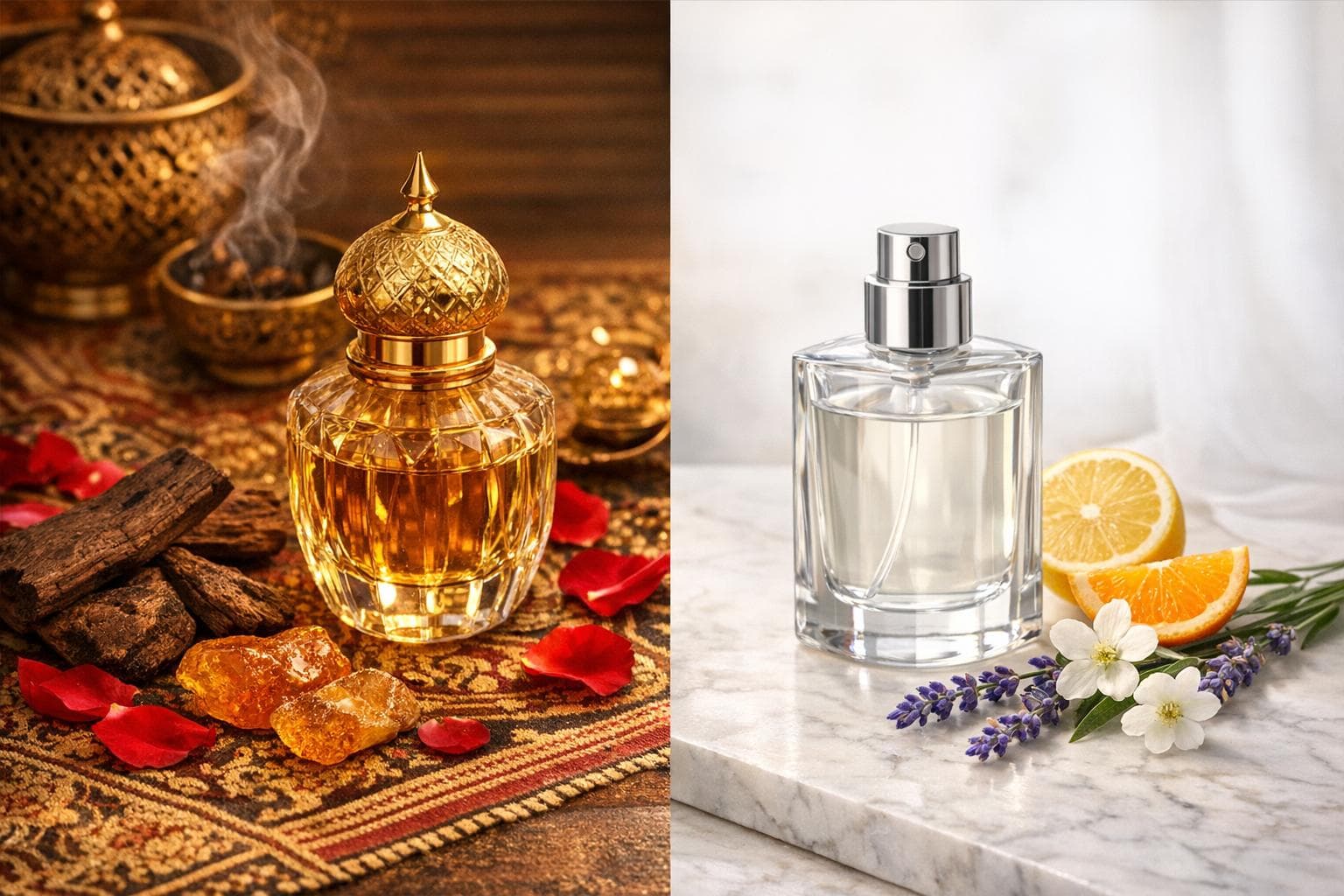
Ritualurile de parfumare din Orientul Mijlociu si Europa reflecta diferente culturale profunde, modelate de istorie, clima si valori. In Orientul Mijlociu, parfumul face parte dintr-un ritual zilnic elaborat, care implica uleiuri bogate, aplicarea in straturi si practici comunitare, precum arderea bakhoor. Parfumul este legat de identitate, religie si ospitalitate. In Europa, in schimb, parfumurile sunt mai simple, pe baza de alcool, si sunt alese ca forma de exprimare personala, adesea ca nota finala a stilului. Aceste traditii influenteaza ingredientele, metodele de aplicare si rolul parfumului in viata de zi cu zi.
Diferente esentiale dintr-o privire:
- Parfumuri din Orientul Mijlociu: Pe baza de ulei, persistente, indraznete (de ex., oud, ambra), ritualuri de aplicare in straturi, unisex.
- Parfumuri europene: Pe baza de alcool, mai lejere, sezoniere (de ex., note florale, citrice), aplicare redusa, optiuni diferentiate in functie de gen.
Comparatie rapida:
| Caracteristica | Orientul Mijlociu | Europa |
|---|---|---|
| Baza | Pe baza de ulei (attaruri, bakhoor) | Spray-uri pe baza de alcool |
| Note | Oud, ambra, mosc, sofran, trandafir | Citrice, lavanda, iasomie, bergamota |
| Aplicare | Aplicare in mai multe etape | Spray-uri simple pe punctele de puls |
| Persistenta | Foarte ridicata (24+ ore) | Moderata (necesita reaplicare) |
| Rol | Religios, social, legat de identitate | Stil personal, ingrijire personala |
Astazi, cele doua traditii se imbina: brandurile occidentale includ oud, iar consumatorii din Orientul Mijlociu descopera parfumuri sezoniere mai lejere. Pentru pasionatii de parfumuri, acest lucru creeaza ocazii de a combina ce e mai bun din ambele lumi.
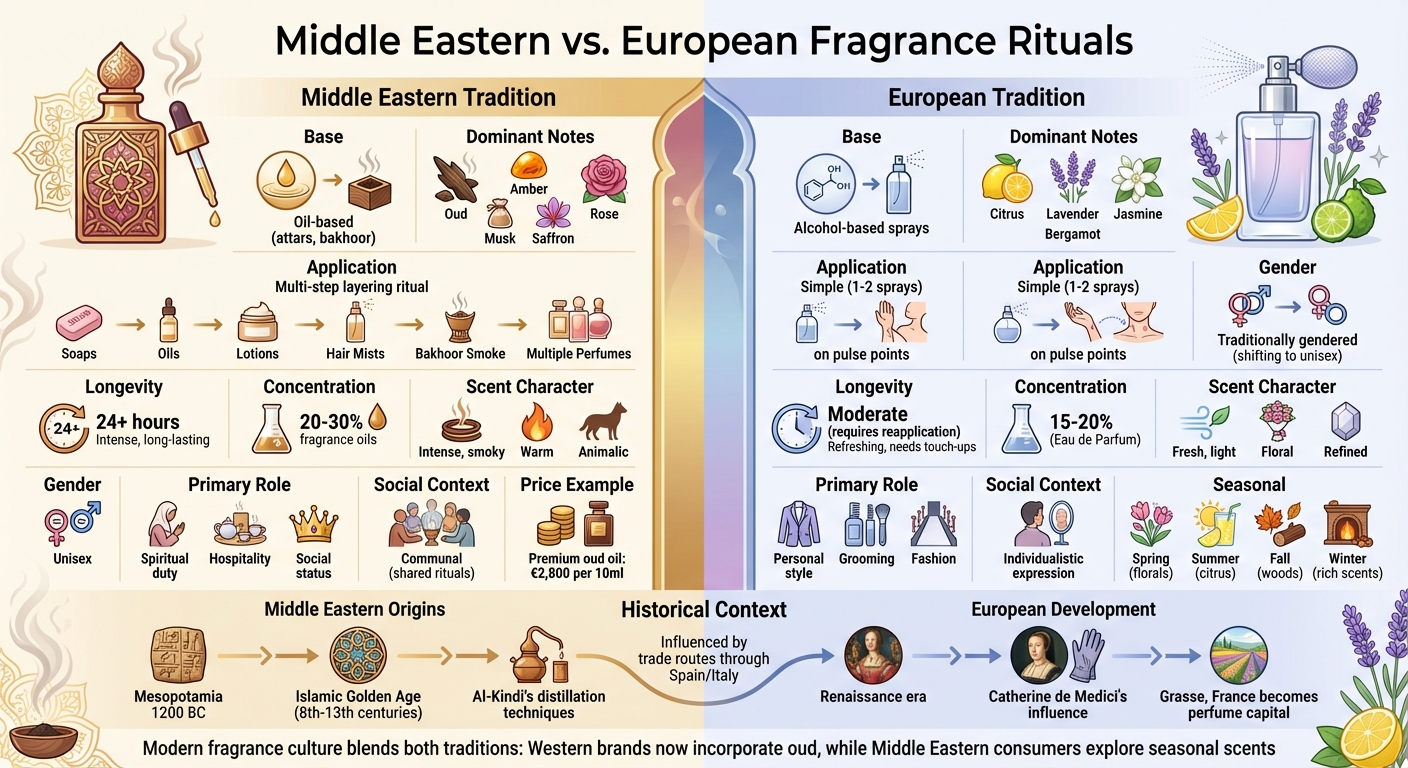
Tabel comparativ al traditiilor de parfumerie din Orientul Mijlociu si Europa
Istoria si originile traditiilor de parfumerie
Originile parfumeriei din Orientul Mijlociu
Povestea parfumeriei incepe in Orientul Mijlociu, cu radacini care ajung pana in Mesopotamia antica, in jurul anului 1200 BC. Aici si-a practicat meseria Tapputi, recunoscuta drept prima chimista si parfumiera din lume, pe teritoriul actualului Irak. Asezata la intersectia Drumului Matasii, regiunea a devenit un creuzet de ingrediente exotice. Mosc chinezesc, lemn de santal si oud indian, precum si sofran iranian s-au impletit cu daruri locale precum tamaia si smirna, creand o bogata paleta de arome.
Epoca de Aur Islamica (secolele 8–13) a marcat un moment decisiv pentru parfumerie, transformand-o din arta intr-o stiinta exacta. Alchimistii arabi si persani, precum Abu Yusuf Ya’qub al-Kindi (nascut in 801 AD), au pus bazele tehnicilor moderne. Scrierile lui Al-Kindi despre distilarea apei de trandafiri si extractia uleiurilor esentiale i-au adus recunoasterea de pionier al parfumeriei arabe. Iata ce explica parfumierul independent Alexandre Helwani:
"Al Kindi a scris multe tratate despre chimie, alchimie si parfumerie. Pentru mine, este un fel de parinte al parfumeriei arabe. A scris despre distilarea apei de trandafiri si extractia uleiurilor esentiale, cu secole inainte ca europenii sa manifeste interes pentru acestea."
Acesti inovatori timpurii au revolutionat parfumeria, perfectionand alambicul si creand formule de parfum lichid, progrese care aveau sa influenteze mai tarziu industria parfumurilor la nivel mondial.
Religia si mediul au avut un rol important in conturarea traditiilor de parfumerie din Orientul Mijlociu. Profetul Muhammad incuraja folosirea parfumurilor inainte de rugaciunile de vineri, integrand parfumul atat in practica religioasa, cat si in igiena personala. Clima calda si arida a regiunii a modelat, de asemenea, preferintele, favorizand attarurile pe baza de ulei, care rezistau evaporarii mai bine decat formulele pe baza de alcool. Geografia a adaugat un alt element: trandafirul de Damasc crestea in regiunile de mare altitudine ale muntilor Ta’if si Hajar, oferind un ingredient floral pretuit intr-un peisaj altminteri arid.
Aceste inovatii timpurii nu doar ca au definit parfumeria din Orientul Mijlociu, ci au pus si bazele contributiilor ulterioare ale Europei.
Dezvoltarea parfumeriei europene
Parfumeria europeana a aparut mai tarziu, puternic influentata de cunostintele si ingredientele aduse din Orientul Mijlociu prin rutele comerciale mediteraneene din Spania si Italia. Jurnalista Béatrice Boisserie subliniaza acest schimb:
"Lumea araba a inventat alambicul in secolul al 5-lea, iar procesul de distilare a fost perfectionat acolo cateva secole mai tarziu... odata raspandite in Europa prin Spania si Italia, aceste inovatii au contribuit semnificativ la dezvoltarea parfumeriei moderne."
La inceput, parfumeria europeana era centrata pe practicile religioase. Tamaia si smirna, importate din Orientul Mijlociu, au devenit elemente esentiale in ceremoniile bisericesti. Renasterea a adus insa o noua epoca. Odata cu avansul tehnicilor de distilare, Franta si Italia au inceput sa-si creeze propriile parfumuri. Spre deosebire de attarurile pe baza de ulei din Orientul Mijlociu, europenii au preferat formulele pe baza de alcool. Aceasta schimbare a fost determinata de clima mai racoroasa a continentului si de preferinta tot mai mare pentru parfumuri mai lejere si personale.
In Europa, parfumeria a trecut de la o experienta colectiva sau religioasa la un simbol al expresiei individuale si al statutului social, in special in randul elitelor. Aceasta evolutie a pregatit terenul pentru industria moderna a parfumeriei, asa cum o cunoastem astazi.
Ritualuri olfactive din Orientul Mijlociu
Ingrediente-cheie si profiluri olfactive
Parfumeria din Orientul Mijlociu isi are radacinile adanc infipte in folosirea ingredientelor bogate si puternice, care creeaza arome persistente. In centrul acesteia se afla note precum oud (lemn de agar), tamaie, smirna, ambra, mosc, sofran si trandafiri — in special soiurile ravnite Damask si Ta’if. Aceste ingrediente dau nastere unor profiluri olfactive distinctive, lemnoase, afumate, pieloase si condimentate, perfect adaptate climatului cald si uscat al regiunii. Spre deosebire de traditiile occidentale ale parfumeriei, in care aromele sunt adesea separate in functie de gen, parfumurile din Orientul Mijlociu sunt in mare parte unisex. Florile indraznete si oud-urile cu note animalice sunt la fel de apreciate de femei si barbati, fiind celebrate pentru siajul lor puternic. Pentru a intelege exclusivitatea acestor ingrediente, iata un exemplu: uleiul de oud de inalta calitate poate ajunge la aproximativ 2.800 € pentru doar 10 ml (0.34 fl oz).
Aceste ingrediente remarcabile sunt asociate cu ritualuri de aplicare la fel de elaborate.
Metode de aplicare si de suprapunere a aromelor
In Orientul Mijlociu, aplicarea parfumului inseamna mult mai mult decat un puf rapid inainte de a iesi din casa — este un ritual in mai multe etape. De obicei, incepe cu sapunuri parfumate folosite la dus, urmate de uleiuri de corp hidratante, lotiuni, parfumuri pentru par si uleiuri de parfum concentrate. Multi pasionati combina trei-patru formule pentru a crea un parfum rafinat si personalizat. Un element esential al acestui ritual este bakhoor — aschii de lemn sau rasini parfumate, arse pe carbune, care impregneaza cu aroma atat corpul, cat si hainele. Barbatii inmoaie adesea ciucurele dishdashei traditionale in uleiuri, astfel incat parfumul sa lase o urma subtila in timp ce se deplaseaza. Forat Al Haider, expert in parfumuri la Ghawali, explica:
"Nu este vorba doar despre a aplica un parfum inainte de a iesi din casa. Este un ritual. Face parte din rutina noastra zilnica, precum si din evenimentele ceremoniale."
Acest proces atent, parcurs pas cu pas, subliniaza importanta culturala a parfumului atat in viata de zi cu zi, cat si la ocaziile speciale.
Parfumul in viata sociala si religioasa
Parfumul joaca un rol esential in tesatura religioasa si sociala a culturii din Orientul Mijlociu. Potrivit traditiei, Profetul Mohammed si-a indemnat discipolii sa se imbaieze si sa poarte cel mai bun parfum inaintea rugaciunilor de vineri. Asa cum spune cu elocventa Murtadha Al Lawati:
"Sa mirosi bine in moschee este un semn de respect fata de religia ta si fata de semenii tai. Iti pregateste sufletul pentru a intalni sufletul cel mare."
In timpul Ramadanului, bakhoor este adesea ars pentru a intensifica atmosfera spirituala. Dincolo de practicile religioase, parfumul este parte integranta a vietii de zi cu zi, fiind un gest de ospitalitate. In casele traditionale, este obisnuit sa li se ofere musafirilor tavi cu parfumuri, iar uneori li se pune la dispozitie apa de trandafiri pentru a-si clati mainile la sosire. Momentele importante din viata, precum nuntile, sunt celebrate prin ritualuri elaborate de parfumare, subliniind rolul parfumului ca simbol al individualitatii si al statutului social. Intr-o regiune in care tinuta traditionala este adesea uniforma, parfumul devine o semnatura personala esentiala. Asa cum observa Rawya Catto, Director General al CPL Aromas Middle East:
"In aceasta parte a lumii, parfumul este unul dintre elementele care definesc personalitatea, statutul social si unicitatea cuiva."
Scopul este sa creezi un amestec atat de distinctiv, incat sa nu poata fi imitat cu usurinta. Daca parfumul tau devine prea usor de recunoscut, poate fi timpul sa-ti reinventezi semnatura olfactiva.
Cum de miros arabii mereu extraordinar — Secretul dezvaluit! | Ajmal | Raj Shamani Clips
European Fragrance Rituals
Traditiile europene ale parfumeriei contrasteaza puternic cu ritualurile bazate pe suprapunerea aromelor si pe uleiuri, specifice Orientului Mijlociu. In schimb, acestea privilegiaza parfumurile rafinate, usor de purtat, care se potrivesc climatelor si culturilor diverse ale continentului.
Ingrediente si note frecvente
Parfumeria europeana se remarca printr-o abordare nuantata, inspirata de peisajele diverse ale continentului. Fiecare regiune contribuie cu ingrediente unice, conturand o identitate olfactiva deopotriva lejera si complexa. De exemplu, Provence, France este renumita pentru lavanda si trandafirul de mai, recoltate in Grasse — centrul parfumeriei recunoscut la nivel mondial. Intre timp, Calabria, Italy este vestita pentru bergamota, un fruct citric care ofera o nota de varf acrisoara si vibranta.
Nordul Europei se inclina adesea spre aromele proaspete si curate, cu note de pin, acorduri marine, fructe de padure salbatice si menta. In schimb, regiunile mediteraneene prefera notele citrice, precum lamaia si bergamota, asociate cu accente ierboase, precum rozmarinul si cimbrul. In Europa Centrala sunt populare notele lemnoase si condimentate, precum pinul, bradul, scortisoara si cuisoarele, care evoca senzatia de caldura si confort in lunile mai reci. Europa de Est, pe de alta parte, se indreapta spre amestecuri mai intense, care combina flori salbatice, precum trandafirul si iasomia, cu ambra calda si vanilie.
Radacinile istorice ale parfumeriei europene sunt, de asemenea, adanci. Asa cum subliniaza Carrément Belle:
"Perfumerya s-a dezvoltat cu adevarat in timpul Renasterii, mai ales datorita impulsului dat de Catherine de Medici".
Aceasta istorie bogata a contribuit la afirmarea oraselor Grasse si Paris ca lideri mondiali in universul parfumurilor de lux.
Metode de aplicare si rotatia sezoniera
Ritualurile europene de parfumare se bazeaza pe spray-uri pe baza de alcool, precum Eau de Parfum (EDP) si Eau de Toilette (EDT), concepute pentru o aplicare rapida si dispersie ampla. Spre deosebire de traditiile din Orientul Mijlociu, care presupun aplicarea in straturi a uleiurilor parfumate, europenii aplica de obicei cateva pulverizari pe punctele de puls. Schimbarile de sezon au, de asemenea, un rol important in alegerea parfumului: notele florale domina primavara, citricele aduc prospetime verii, lemnul cu accente pamantii si condimentele incalzesc toamna, iar aromele bogate si voluptuoase definesc iarna.
Concentratia parfumului este un alt aspect esential. In verile toride, sunt preferate concentratiile mai lejere, precum Eau de Cologne, deoarece notele de varf se evapora rapid la temperaturi ridicate. In schimb, aerul rece al iernii poate estompa intensitatea unui parfum, ceea ce face ca variantele mai concentrate, precum Eau de Parfum, sa fie ideale pentru o persistenta mai indelungata. Pairfum London explica:
"Vara, cand temperaturile si umiditatea sunt ridicate, sunt de preferat concentratiile mai lejere, precum Eau de Toilette, Eau de Cologne, Eau Fraiche sau Splash Cologne".
Aceasta abordare atenta face ca parfumul sa ramana o parte fireasca din viata de zi cu zi si din modul de exprimare personala.
Parfumul ca expresie a stilului personal
Pentru europeni, parfumul este mai mult decat o simpla aroma — este o reflectare a identitatii si a stilului personal. Multi aleg un "parfum-semnatura", un parfum care ajunge sa fie sinonim cu prezenta si personalitatea lor. Parfumul este adesea privit ca o extensie a modei, iar fiecare isi alege aromele in acord cu propriul caracter sau chiar cu spiritul cultural al momentului.
Ocazia are un rol important in alegerea parfumului. Pentru mediile profesionale si activitatile de zi, sunt preferate notele usoare de citrice sau florale, in timp ce aromele mai profunde de ambra, vanilie sau condimente sunt rezervate serilor. In ultima vreme, interesul pentru crearea unei „garderobe olfactive” a crescut: fiecare isi alcatuieste o colectie de parfumuri pentru stari de spirit, contexte si ocazii diferite. Aceasta schimbare a sporit si interesul pentru parfumeria de nisa, unde calitatea si originalitatea primeaza in fata ofertelor de masa.
Consumatorii tineri sunt atrasi in mod special de acest trend, imbinand ingrediente clasice europene cu influente moderne pentru a crea parfumuri personale si distinctive. Aceasta abordare in continua evolutie face ca parfumeria europeana sa continue sa celebreze individualitatea, onorandu-si totodata bogatele traditii.
Expertul tău personal în parfumuri te așteaptă
Completează testul nostru rapid de parfumuri și descoperă parfumuri designer și de nișă autentice, alese pe gustul tău – explorează-le ca decanturi și mostre de 2, 5, 8 și 30 ml, ca să le poți încerca pe fiecare înainte de a alege un flacon întreg.
Descoperă-ți parfumulRitualuri olfactive din Orientul Mijlociu vs. Europa
Ritualurile de parfumare din Orientul Mijlociu si din Europa difera prin ingrediente, metode de aplicare si semnificatie culturala. Aceste distinctii depasesc preferintele personale si reflecta legaturi mai profunde cu clima, traditia si scopul purtarii parfumului.
Ingrediente si preferinte olfactive
Parfumurile din Orientul Mijlociu, adesea create sub forma de attar prin distilare cu abur, se bazeaza pe formule uleioase care ofera persistenta si bogatie olfactiva. In schimb, parfumurile europene folosesc de obicei solutii pe baza de alcool, care se disperseaza rapid, dar pot necesita reaplicare. Aceste diferente influenteaza nu doar felul in care se comporta parfumurile, ci si caracterul lor general.
Aromele din Orientul Mijlociu se construiesc pe note de baza indraznete, precum oud, ambra si mosc, creand compozitii profunde si opulente, cu accente afumate si rasinoase. In schimb, parfumeria europeana se bazeaza pe o piramida structurata de note de varf, de inima si de baza. Predomina citricele, florile si notele ierboase, rezultand compozitii mai lejere si mai echilibrate.
| Caracteristica | Traditia din Orientul Mijlociu | Traditia europeana |
|---|---|---|
| Baza principala | Pe baza de ulei (attar) | Pe baza de alcool |
| Note dominante | Oud, ambra, mosc, sofran, trandafir | Citrice, lavanda, iasomie, acorduri sintetice |
| Caracter olfactiv | Intens, afumat, cald, animalic | Proaspat, lejer, floral, rafinat |
| Persistenta | Foarte ridicata (adesea 24+ ore) | Moderata (poate necesita reaplicare) |
| Concentratie | 20–30 % uleiuri parfumate | 15–20 % (Eau de Parfum) |
Normele de gen contrasteaza, de asemenea, puternic. Parfumurile din Orientul Mijlociu sunt in mare parte unisex, florile bogate si oudul fiind purtate de toata lumea. In Europa, parfumurile au respectat in mod traditional categorii de gen, desi optiunile unisex devin tot mai populare.
Aceste diferente in construirea aromelor deschid calea catre ritualuri distincte de aplicare.
Stiluri si tehnici de aplicare
Modul de aplicare a parfumurilor reflecta rolul lor cultural. In traditiile din Orientul Mijlociu, aplicarea parfumului presupune mai multi pasi. Adesea incepe cu sapunuri si sampoane parfumate, urmate de uleiuri de corp, lotiuni, spray-uri parfumate pentru par si folosirea fumului de bakhoor pentru a parfuma hainele. In final, mai multe parfumuri sunt aplicate in straturi pentru a crea o aroma profund personala si unica. De exemplu, Mona Kattan, cofondatoarea Kayali, este cunoscuta pentru combinarea a pana la 15 arome diferite, pentru a-si crea parfumul-semnatura.
Prin comparatie, rutinele europene de parfumare sunt mult mai simple. Cateva pulverizari de Eau de Parfum sau Eau de Toilette pe punctele de puls sunt adesea ultimul detaliu al ritualului de ingrijire, punand accentul pe usurinta si caracterul practic, nu pe complexitate.
| Caracteristica | Ritualul din Orientul Mijlociu | Ritualul european |
|---|---|---|
| Obiectiv principal | Crearea unui amestec personal de nerecunoscut | Definirea unui parfum emblematic |
| Pasi de aplicare | In mai multe etape (uleiuri → lotiuni → fum → mai multe straturi) | Simplu (1–2 pulverizari) |
| Baza | Uleiuri concentrate (attars) si fum de bakhoor | Pulverizari pe baza de alcool |
| Profil olfactiv | Intens, persistent, cu siaj puternic | Mai lejer, sezonier, transparent |
Clima joaca, de asemenea, un rol important. Conditiile calde si aride din Orientul Mijlociu fac parfumurile dense, pe baza de ulei, mai practice, deoarece parfumurile pe baza de alcool se evapora rapid la asemenea temperaturi. In Europa, schimbarile sezoniere incurajeaza parfumurile mai lejere vara si aromele mai bogate si mai calde in lunile reci.
Ocazii si roluri sociale
Parfumul are semnificatii sociale si culturale distincte in aceste regiuni. In Orientul Mijlociu, este profund legat de practicile religioase si de eticheta sociala. De exemplu, Profetul Muhammad a subliniat importanta purtarii parfumului inaintea rugaciunilor de vineri, ca modalitate de inaltare a spiritului. Multe gospodarii ard bakhoor de mai multe ori pe zi pentru a parfuma hainele, a improspata spatiile de locuit si chiar a neutraliza mirosurile de mancare dupa masa.
Ospitalitatea este un alt aspect esential al culturii parfumului din Orientul Mijlociu. Oaspetii sunt adesea intampinati cu fum de bakhoor sau li se ofera ape florale, precum apa de trandafiri, pentru a-si clati mainile. Aici, parfumul nu este doar unul personal - este un gest de respect si grija, care reflecta convingerea ca trebuie sa lasi un loc intr-o stare mai buna decat cea in care l-ai gasit. In societatile in care tinutele traditionale, precum abaya sau kandura, sunt obisnuite, parfumul este o forma esentiala de exprimare personala si un indicator al statutului social.
In Europa, parfumul este mai strans legat de ingrijirea personala, moda si placerea estetica. Este o alegere care tine de stilul si starea de spirit individuale, nu de obligatii comunitare sau religioase. In timp ce consumatorii din Orientul Mijlociu isi alcatuiesc adesea garderobe ample de parfumuri, pe care le combina si cu care experimenteaza, europenii au preferat in mod traditional un singur parfum emblematic - desi aceasta tendinta se schimba treptat.
| Caracteristica | Traditia din Orientul Mijlociu | Traditia europeana |
|---|---|---|
| Rol principal | Datorie spirituala si sociala; ospitalitate | Stil personal, ingrijire si moda |
| Context social | Comunitar (ritualuri impartasite, cu tamaie si bakhoor) | Individualist (exprimare personala) |
| Semnificatie religioasa | Parte integranta a practicilor si adunarilor religioase | Utilizare preponderent laica |
| Exprimarea statutului | Element esential al identitatii personale si al statutului social | Un aspect intre multe alte optiuni vestimentare |
Valoarea acordata parfumului in Orientul Mijlociu este evidenta pe piata de lux. Uleiul de oud de inalta calitate poate costa pana la 2.650 € pentru doar 10 ml (0.34 fl oz), de la marci precum Ajmal. Amouage, o casa de parfumuri de lux de top din regiune, a raportat vanzari anuale de 198 € milioane in 2023. Aceste cifre subliniaza legatura culturala profunda cu parfumul - nu doar ca lux, ci ca parte esentiala a vietii de zi cu zi.
Explorarea ambelor traditii olfactive astazi
Granitele dintre traditiile olfactive din Orientul Mijlociu si cele europene devin tot mai difuze. Marcile europene de lux adopta oudul, un ingredient emblematic al parfumeriei din Orientul Mijlociu, in timp ce consumatorii din Orientul Mijlociu manifesta o preferinta tot mai mare pentru parfumuri mai lejere, potrivite sezonului. Acest schimb cultural a deschis calea catre crearea unei garderobe olfactive cu adevarat globale. Totusi, pretul ingredientelor de inalta calitate ramane o provocare. De exemplu, uleiul de oud premium poate costa pana la $2.800 pentru doar 0.34 fl oz, in timp ce attar-urile din Orientul Mijlociu, din gama medie, incep de la aproximativ $143, iar parfumurile europene de nisa depasesc adesea $270. Aceste schimbari de tendinte le ofera iubitorilor de parfumuri oportunitati captivante de a-si extinde colectiile.
Testarea parfumurilor inspirate din Orientul Mijlociu
Pentru cei curiosi sa descopere parfumurile din Orientul Mijlociu, testarea este o modalitate practica de a explora profilurile lor indraznete si complexe fara a se angaja la un flacon intreg. Ingrediente precum oudul, ambra si sofranul sunt puternice si transformatoare, rezista intre 12 si 14 ore si tind sa evolueze considerabil pe piele pe masura ce se incalzesc. Incercarea acestor parfumuri in formate mai mici, precum decanturi de 2 ml, iti permite sa descoperi cum interactioneaza cu chimia pielii tale aceste note profunde, rasinoase si uneori animalice, inainte de a investi intr-un flacon de dimensiune normala.
Scento ofera o selectie atent alcatuita de parfumuri inspirate de Orientul Mijlociu, in formate mai mici, facilitand experimentarea cu combinatii precum trandafir si oud sau amestecuri bogate de ambra, fara angajamentul financiar al unui flacon intreg. Aceasta abordare este, de asemenea, in acord cu practicile traditionale de layering din parfumeria Orientului Mijlociu. Cu decanturi disponibile in fiole de 2 ml, 5 ml si 8 ml si un decant de 30 ml pentru majoritatea parfumurilor, iti poti crea o garderoba de inceput cu uleiuri si pulverizari complementare - de exemplu, o baza de mosc, un attar floral si un parfum lemnos pentru versatilitate in layering.
Alcatuirea unei garderobe de parfumuri in stil european
In timp ce decanturile inspirate de Orientul Mijlociu ofera o modalitate accesibila de a explora parfumuri indraznete, traditiile europene pun adesea accentul pe alternarea parfumurilor in functie de sezon si stare de spirit. Colectiile de primavara si vara se inclina spre note florale proaspete si citrice, in timp ce toamna si iarna domina profilurile mai bogate, condimentate si gurmande. Totusi, ideea de a cheltui $200 sau mai mult pe un parfum pe care s-ar putea sa-l porti doar cateva luni poate parea nepractica.
Aici isi dovedesc utilitatea vialele Scento de 8 ml (aproximativ 120 de pulverizari). Ofera suficient produs pentru a ajunge pe durata unui singur sezon, facand mai usor sa adopti traditia europeana a rotatiei parfumurilor in functie de sezon. Modelul de abonament sustine si mai mult aceasta abordare, oferind selectii curatoriate lunar. Imagineaza-ti un amestec luminos de bergamota si lavanda pentru mai, un floral cu note dominante de iasomie pentru iulie si o combinatie reconfortanta de vanilie si tonka pentru iarna.
Acest sistem flexibil reflecta tendinta tot mai raspandita pe pietele occidentale catre garderobe de parfumuri, in care consumatorii pun varietatea si exprimarea de sine mai presus de fidelitatea fata de un singur parfum-semnatura. Este o abordare practica si moderna a parfumeriei, care iti permite sa explorezi fara excese.
Concluzie
Traditiile parfumeriei din Orientul Mijlociu si din Europa aduc fiecare un farmec aparte in lumea parfumurilor. Parfumurile din Orientul Mijlociu pun adesea in valoare note intense si persistente, precum oud, mosc si sofran, aplicate prin tehnici complexe de suprapunere. In schimb, parfumurile europene tind spre compozitii mai lejere, pe baza de alcool, care reprezinta o nota finala eleganta, nu o declaratie olfactiva construita din straturi profunde.
Totusi, aceste diferente au devenit mai putin stricte in timp. Brandurile occidentale de lux includ acum frecvent oud si ambra in colectiile lor, in timp ce consumatorii din Orientul Mijlociu exploreaza tot mai mult parfumurile de sezon si profilurile olfactive moderne. Acest schimb cultural a deschis calea catre crearea unei garderobe de parfumuri inspirate din ambele traditii, imbinand ce e mai bun din fiecare lume.
Cu toate acestea, experimentele cu parfumuri de lux pot fi costisitoare. Ingredientele premium vin adesea cu preturi piperate. Aici intervin optiunile de descoperire, precum decanturile Scento’s, de la 2 ml pana la un decant de 30 ml. Aceste formate mai mici iti permit sa explorezi fara sa te angajezi sa cumperi flacoane intregi. Fie ca suprapui un amestec de trandafir si oud sau incerci un citric vibrant de sezon, aceste decanturi iti permit sa experimentezi complexitatea parfumurilor din Orientul Mijlociu, ale caror note se pot dezvalui pe parcursul a 12 to 14 hours.
Explorarea ambelor traditii tine de curiozitate si experimentare. Incepe cu ceea ce te atrage - un bakhoor afumat, un floral european rafinat sau un attar bogat - si lasa-ti preferintele sa-ti contureze colectia de parfumuri.
Intrebari frecvente
Ce diferentiaza ingredientele parfumurilor din Orientul Mijlociu de cele europene?
Parfumurile din Orientul Mijlociu sunt apreciate pentru ingredientele lor opulente si intense, iar oud (lemn de agar) se remarca drept o emblema. Acest ingredient pretios ofera o aroma afumata, pieloasa si usor dulce. Printre alte elemente esentiale se numara mirul, tamaia, ambra cenusie, moscul si o varietate de mirodenii exotice, precum scortisoara, cuisoarele si salvia. Florile locale, precum iasomia si trandafirul de Damasc, au si ele un rol important, fiind adesea transformate in forme traditionale, precum bakhoor - aschii de lemn parfumate - sau paste de attar, parfumuri concentrate pe baza de ulei.
In schimb, parfumurile europene adopta o abordare mai lejera si mai proaspata. Acestea includ adesea ingrediente precum iasomie, trandafir, floare de portocal si bergamota, combinate cu nuante citrice sau verzi, aerate. Aceste compozitii urmaresc luminozitatea si subtilitatea, creand un profil olfactiv mai bland si mai delicat decat profunzimea indrazneata, rasinoasa, a creatiilor din Orientul Mijlociu.
Diferenta tine de esenta: parfumurile din Orientul Mijlociu imbratiseaza straturi bogate, lemnoase si condimentate, in timp ce parfumurile europene se concentreaza pe flori proaspete si note citrice, oferind o experienta mai delicata si mai discreta.
Care sunt principalele diferente dintre ritualurile parfumului din Orientul Mijlociu si cele europene?
Ritualurile parfumului din Orientul Mijlociu au o profunda incarcatura traditionala si sunt mult mai elaborate decat cele europene. In aceste culturi, parfumurile se impletesc firesc cu viata de zi cu zi, prin practici precum suprapunerea attarurilor pe baza de ulei, a oudului si a bakhoorului. Parfumul nu se limiteaza la piele, ci se extinde la par, haine si chiar la casa. Tamaia, precum bakhoorul, este adesea arsa pentru a parfuma spatiile de locuit si a-i intampina cu caldura pe oaspeti. Este obisnuit ca oamenii sa combine uleiurile traditionale cu parfumuri occidentale, creand un parfum cu totul personal si unic.
In schimb, obiceiurile europene legate de parfum sunt mult mai simple. Ritualul presupune de obicei cateva pulverizari de parfum pe baza de alcool aplicate pe punctele de puls, adesea ca nota finala a rutinei de dimineata sau inaintea unui eveniment special. Spre deosebire de accentul pus in Orientul Mijlociu pe suprapunerea parfumurilor si parfumarea casei, traditiile europene se concentreaza de regula pe un singur parfum purtat ca atare, aplicat cu masura, fara a include uleiuri sau tamaie in viata de zi cu zi.
De ce parfumurile din Orientul Mijlociu sunt adesea unisex, comparativ cu cele europene?
In traditiile din Orientul Mijlociu, parfumurile au o legatura profunda cu identitatea personala, trecand dincolo de limitele genului. Este obisnuit ca atat barbatii, cat si femeile sa poarte parfumuri indraznete, cu note florale sau de oud, considerate pe scara larga unisex. Aplicarea parfumului este mai mult decat o simpla rutina: este un ritual zilnic cu semnificatie. Acesta include adesea suprapunerea sau combinarea uleiurilor, practici adanc inradacinate in obiceiurile religioase si sociale.
Pe de alta parte, traditiile europene in materie de parfumerie s-au bazat mult timp pe marketingul diferentiat in functie de gen. Aromele florale mai usoare sunt adesea asociate cu feminitatea, in timp ce notele lemnoase sau moscate sunt legate de masculinitate. Acest contrast subliniaza o diferenta esentiala: cultura Orientului Mijlociu priveste parfumul ca pe o forma universala de exprimare de sine, in timp ce traditiile europene tind sa alinieze preferintele olfactive cu rolurile traditionale de gen.

