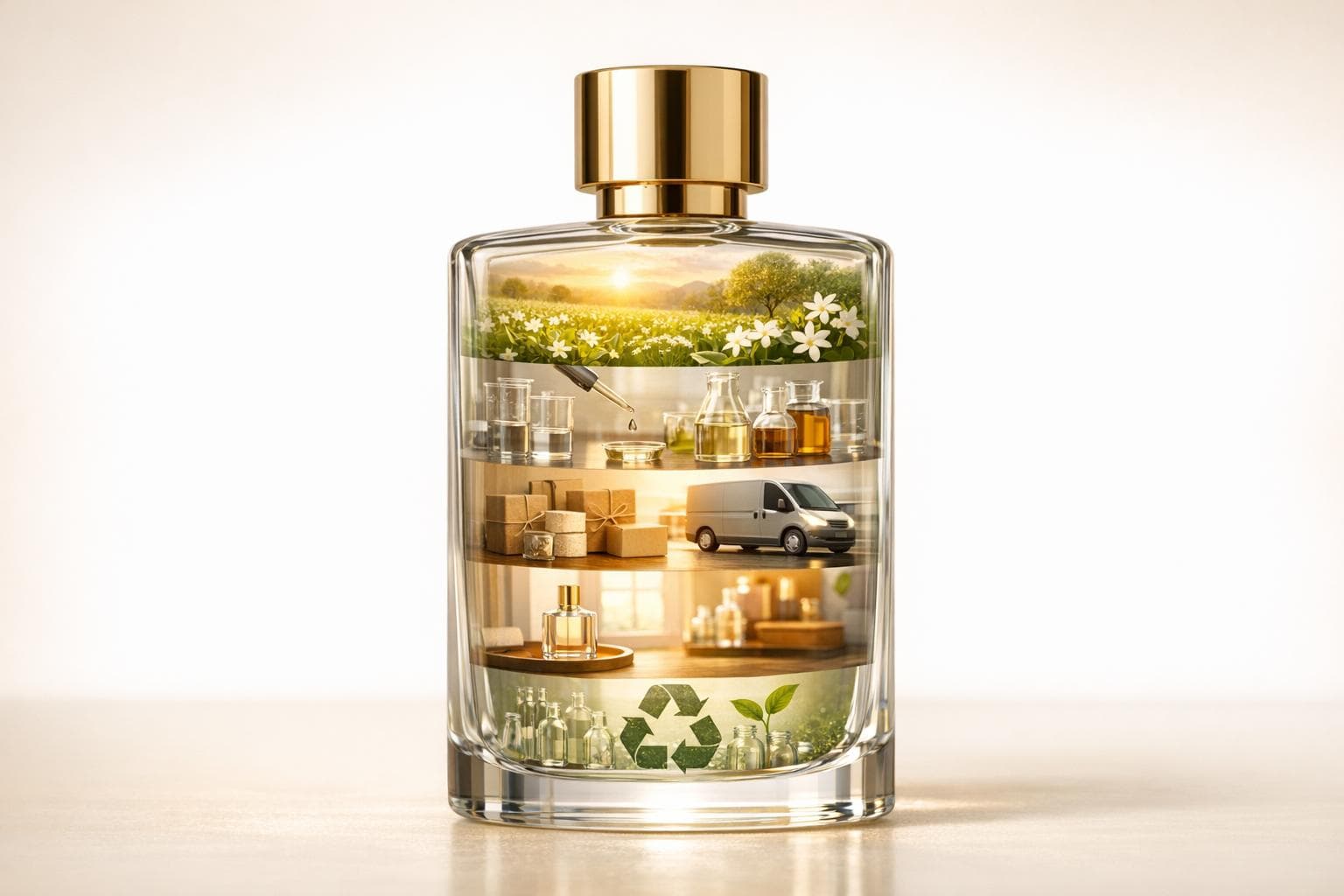
Parcursul parfumului, de la aprovizionarea cu materii prime pana la eliminare, implica procese complexe, cu consideratii de ordin ecologic si etic. Iata o scurta prezentare:
- Materii prime: Ingredientele sunt fie naturale (flori, lemn, rasini), fie sintetice. Sursele naturale necesita adesea o cantitate semnificativa de biomasa (de exemplu, esenta de portocale are un randament de doar 0,01 %). Optiunile sintetice sunt eficiente, dar depind de materii prime pe baza de petrol sau biologice.
- Formulare: Parfumierii combina pana la 100+ ingrediente pentru a obtine un parfum echilibrat. Instrumentele avansate asigura precizia, in timp ce expertiza umana evalueaza produsul final.
- Ambalare: Sticlele din sticla sunt predominante datorita posibilitatii de reciclare, in timp ce capacele combina adesea plasticul si lemnul. Designul ecologic vizeaza reducerea deseurilor si a amprentei de carbon.
- Distributie: Parfumurile sunt clasificate drept marfuri periculoase din cauza continutului de etanol, fiind transportate pe mare si pe uscat, ceea ce contribuie la emisii.
- Utilizare de catre consumatori: Depozitarea corespunzatoare (in locuri racoroase si intunecate) prelungeste durata de viata a parfumului. Decanturile si programele de reincarcare reduc deseurile.
- Eliminare: Sticlele din sticla sunt reciclabile, dar pulverizatoarele si capacele trebuie eliminate separat. Eliminarea necorespunzatoare poate dauna ecosistemelor.
Schimbarile mici, precum alegerea sticlelor reincarcabile sau a decanturilor mai mici si reciclarea corespunzatoare, pot contribui la reducerea impactului asupra mediului al alegerilor tale in materie de parfumuri.
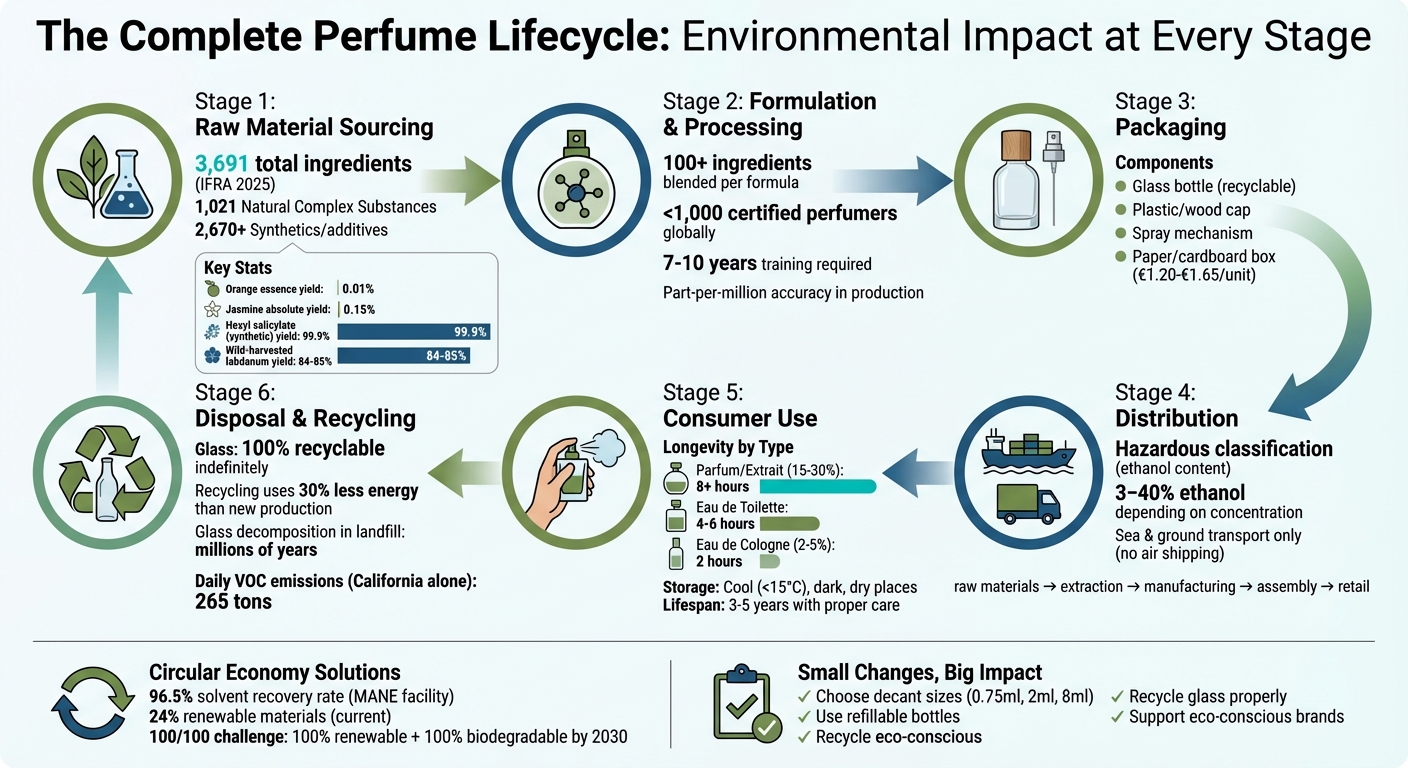
Ciclul de viata al parfumului: 6 etape, de la creatie la eliminare
Raw Material Sourcing
Lista de transparenta IFRA (2025) cuprinde 3.691 de ingrediente: 1.021 sunt substante complexe naturale, iar restul sunt sintetice sau aditivi. Acest echilibru reflecta o abordare constienta a industriei — combinarea materialelor naturale si obtinute in laborator ajuta la conservarea biodiversitatii si asigura o aprovizionare si o calitate constante. Iata o privire mai atenta asupra modului in care ingredientele naturale si sintetice sunt aprovizionate si prelucrate, avand in vedere sustenabilitatea si calitatea.
Ingrediente naturale: origine si extractie
Ingredientele naturale sunt grupate in cinci categorii principale: flori (precum trandafirul, iasomia si lavanda), lemn si radacini (precum lemnul de santal si vetiverul), rasini (inclusiv elemi si benzoina), condimente (precum piperul roz si vanilia) si coji de citrice. Metoda de extractie depinde de material. De exemplu:
- Distilarea cu abur este utilizata pentru uleiurile de lavanda si menta.
- Presarea mecanica recupereaza uleiurile citrice din subprodusele obtinute la producerea sucului, fiind o metoda foarte sustenabila.
- Extractia cu solventi volatili este necesara pentru flori delicate precum iasomia, pentru a obtine concrete, desi randamentul este extrem de redus — doar 0,15 %.
- Extractia cu CO2 supercritic ofera o alternativa fara solventi.
Sustenabilitatea depinde in mare masura de aprovizionarea trasabila si de practici inovatoare. De exemplu, esenta de portocale, cu un randament de doar 0,01 %, este sustenabila deoarece utilizeaza deseuri rezultate din productia de suc. In mod similar, rasinile recoltate din flora salbatica, precum labdanumul, au randamente de 84–85 %, cu un impact minim asupra mediului, deoarece nu necesita utilaje sau substante chimice. Toate ingredientele naturale sunt obtinute in urma unor audituri stricte privind practicile de munca, impactul asupra mediului si trasabilitatea.
Ingrediente sintetice: alternative create in laborator
Ingredientele sintetice sunt obtinute prin sinteza chimica din materii prime pe baza de petrol sau biologice, ori prin fermentare. Aceste materiale joaca un rol esential in reproducerea aromelor rare, prelungirea utilizarii materialelor naturale si asigurarea sigurantei si a consecventei. De exemplu, salicilatul de hexil, un ingredient sintetic pe baza de combustibili fosili, are un randament de productie de 99,9 %, cu mult peste eficienta majoritatii extractiilor naturale.
Pentru a evalua impactul asupra mediului, instrumente precum GREEN MOTION™ evalueaza ingredientele sintetice pe baza a sapte principii ale chimiei verzi, inclusiv aprovizionarea cu materii prime si generarea de deseuri.
Comparatia impactului asupra mediului este izbitoare. Ingredientele naturale necesita adesea cantitati considerabile de teren, apa si biomasa pentru un randament minim. In schimb, ingredientele sintetice genereaza mult mai putine deseuri (masurate prin factorul E) si contribuie la protejarea speciilor pe cale de disparitie impotriva recoltarii excesive. Atat materialele naturale, cat si cele sintetice sunt supuse unor evaluari riguroase de siguranta realizate de Research Institute for Fragrance Materials (RIFM) si trebuie sa respecte standardele IFRA. In plus, solventii utilizati in productia ingredientelor sintetice sunt reciclati eficient, cu o rata de pierdere de doar 3,5 %, demonstrand cum productia moderna reduce impactul asupra mediului.
Formularea si procesarea parfumului
Dupa aprovizionarea cu materiile prime, acestea trec printr-un proces meticulos pentru a deveni concentratele de parfum pe care le cunosti. In aceasta etapa, arta se intalneste cu stiinta. Parfumierii compun „partitura” parfumului, echilibrand notele de varf (impresia initiala), notele de mijloc (inima) si notele de baza (fundamentul persistent). In acelasi timp, sistemele automatizate se asigura ca fiecare lot reproduce formula originala cu o precizie absoluta. Dupa extragerea materiilor prime, uleiurile trec in etapa de amestecare, unde prinde contur parfumul final.
Metode de procesare a uleiurilor
Fiecare materie prima necesita o metoda de extractie specifica pentru a-i pastra esenta. De exemplu, distilarea cu abur este ideala pentru lavanda si vetiver, in timp ce extractia cu solvent se foloseste pentru florile delicate, precum trandafirul si iasomia, obtinand absolute din concrete. Cojile de citrice sunt prelucrate prin presare, un proces mecanic realizat la temperaturi ambientale, in timp ce extractia cu CO2 supercritic ofera o metoda fara solventi pentru ingrediente precum vanilia si piperul roz. Eficienta acestor metode variaza considerabil — uleiul esential de lavanda are un randament de aproximativ 1 %, in timp ce esenta de portocala produce doar 0,01 %. Aceste tehnici precise asigura cea mai inalta calitate pentru amestecare.
Amestecare si controlul calitatii
Dupa ce parfumierul definitiveaza o formula — care poate include uneori peste 100 de ingrediente — sistemele automatizate o reproduc cu o precizie de ordinul partilor per milion, in conformitate cu regulile stricte de Buna Practica de Fabricatie (GMP). Instrumente avansate, precum cromatografia gazoasa, analizeaza fiecare lot, iar evaluarile finale de siguranta IFRA confirma atat consecventa, cat si siguranta. In ciuda acestor progrese tehnologice, atingerea umana ramane esentiala. „Nasul” unui parfumier profesionist evalueaza produsul finit pentru a se asigura ca parfumul corespunde profilului dorit. La nivel mondial, exista mai putin de 1.000 de parfumieri certificati, fiecare urmand intre sapte si zece ani de pregatire pentru a stapani mii de parfumuri.
Ambalarea si imbutelierea
Dupa definitivarea formulei unui parfum, urmatorul pas este ambalarea — un proces care imbina identitatea brandului cu accentul pus pe responsabilitatea fata de mediu. Ambalajul standard pentru parfum include o sticla din sticla reciclabila, un capac functional, un mecanism de pulverizare, o eticheta, o cutie si un invelis exterior. Fiecare dintre aceste elemente contribuie la prima impresie a consumatorului si, totodata, la amprenta ecologica a produsului. Aceasta etapa asigura ca parfumul nu este doar atragator vizual, ci si aliniat cu obiectivele de sustenabilitate.
Design si selectia materialelor
Sticla ramane materialul preferat pentru sticlele de parfum, deoarece este reciclabila si pastreaza calitatea parfumului. Sticlele standard din sticla ofera un echilibru intre cost si sustenabilitate. Pentru capace si pulverizatoare se foloseste adesea plastic, desi reciclarea acestuia devine dificila atunci cand este combinat cu alte materiale. Recent, lemnul a devenit o optiune preferata pentru capace, materiale precum fagul, tecul, frasinul si nucul oferind o alternativa mai ecologica si placuta la atingere. Ambalajele secundare sunt de obicei din hartie sau carton, iar cutiile de lux costa intre 1,20 € si 1,65 € per unitate.
Pentru a evalua impactul asupra mediului, multe companii folosesc Evaluarea Ciclului de Viata (LCA), care urmareste amprenta de carbon de la extragerea materiilor prime pana la transport si eliminare. Adoptand principiile ecodesignului, brandurile se concentreaza asupra materialelor care reduc la minimum deseurile si prelungesc ciclul de viata al produselor lor.
Asamblare si branding
Etapa de asamblare imbina functionalitatea cu povestea brandului, asigurandu-se ca ambalajul reflecta esenta parfumului. Procesul incepe cu alegerea unei sticle care surprinde identitatea brandului — prin designuri elegante si minimaliste pentru liniile de lux sau prin estetici indraznete si colorate pentru publicul tanar. Etichetarea este o alta decizie importanta. Autocolantele sunt o optiune flexibila pentru editiile limitate sau actualizarile sezoniere, desi isi pot pierde rezistenta in timp. Alternativ, tampografia aplica cerneala direct pe sticla, creand un aspect durabil si rafinat, potrivit produselor premium.
Ultimii pasi presupun montarea componentelor functionale, precum pompele, capetele pulverizatoare si capacele, inainte de asezarea sticlei intr-o cutie proiectata la comanda. Tehnicile avansate de etichetare, precum finisajele holografice sau imprimarea directa, consolideaza identitatea brandului si ajuta totodata la descurajarea contrafacerii. Ambalajul atent conceput nu doar imbunatateste prezentarea produsului, ci sustine si practicile ecologice pe parcursul distributiei si eliminarii acestuia.
Distributie si transport
Odata ce un parfum este gata pentru distributie, acesta porneste intr-o calatorie printr-o retea logistica complexa. Procesul incepe cu transportul materiilor prime — precum petalele de trandafir bulgaresc sau lemnul de santal australian — catre unitatile de extractie. De acolo, uleiurile concentrate sunt trimise la fabricile de productie pentru amestecare. Dupa finalizarea formulei, lichidul parfumat este adesea transportat catre unitati separate, unde sunt fabricate sticlele de sticla si componentele ambalajului. Apoi, aceste piese sunt reunite pentru asamblarea finala, ceea ce presupune mai multe etape de transport. Fiecare etapa contribuie la amprenta de carbon totala a produsului, evidentiind complexitatea provocarilor distributiei.
Logistica si lanturile de aprovizionare
Transportul parfumurilor vine cu propriile provocari, in principal din cauza normelor de siguranta. Parfumurile, care contin concentratii de etanol cuprinse intre 3–8 % in Eau de Cologne si pana la 15–40 % in Perfume Extract, sunt clasificate drept materiale periculoase si inflamabile. Aceasta clasificare interzice, in general, transportul aerian, astfel ca brandurile depind de transportul terestru si maritim.
Transportul maritim este adesea folosit pentru capacitatea sa de a muta volume mari intr-o singura expeditie, dar are un cost pentru mediu - navele de marfa ard combustibili fosili si elibereaza sulf si particule in atmosfera. Transportul terestru, desi mai sigur pentru materialele periculoase, depinde si el in mare masura de combustibilii fosili. In plus, fragilitatea sticlelor de sticla impune ambalarea cu grija, ceea ce sporeste necesarul de materiale si efortul logistic.
"Retailerii si canalele de comert electronic plaseaza apoi aceste produse parfumate in locuinte, spatii de lucru si spatii publice, completand un lant valoric care se intinde de la molecula la amintire." — IFRA
Vanzari in magazine si online
Dupa ce depasesc obstacolele logistice, parfumurile ajung la consumatori prin doua canale principale: magazinele fizice si platformele de comert electronic. In comertul traditional, livrarile de marfa in vrac sunt trimise la centre de distributie, apoi ajung in magazinele individuale. Acest proces presupune mai multe etape de manipulare si straturi suplimentare de ambalaj. In schimb, vanzarile online simplifica procesul, livrand direct din centrele de procesare a comenzilor catre clienti.
Platformele de comert electronic precum Scento au introdus modalitati de a reduce la minimum deseurile si emisiile. Oferind decanturi in cantitati mai mici - precum decanturi de 2 ml, 5 ml si 8 ml, precum si decanturi de 30 ml in recipient din sticla pentru majoritatea parfumurilor - in locul sticlelor standard de 3,4 oz, acestea reduc greutatea si volumul expeditiilor. Aceasta abordare nu doar diminueaza emisiile generate de transport pentru fiecare comanda, ci raspunde si nevoilor consumatorilor care vor sa descopere parfumuri noi fara sa se angajeze la sticle de dimensiuni complete. Prin aceste cantitati atent alese, menite descoperirii, platforme precum Scento aliniaza preferintele consumatorilor la eforturile industriei de a crea practici de distributie mai sustenabile.
Expertul tău personal în parfumuri te așteaptă
Completează testul nostru rapid de parfumuri și descoperă parfumuri designer și de nișă autentice, alese pe gustul tău – explorează-le ca decanturi și mostre de 2, 5, 8 și 30 ml, ca să le poți încerca pe fiecare înainte de a alege un flacon întreg.
Descoperă-ți parfumulUtilizarea si pastrarea parfumurilor
Pastrarea farmecului initial al unui parfum depinde de utilizarea si pastrarea corecta. Desi majoritatea producatorilor recomanda folosirea parfumurilor in decurs de unu pana la trei ani, expertii considera ca, ingrijite corespunzator, multe parfumuri pot rezista trei pana la cinci ani. Secretul consta in a identifica factorii care duc la degradare si a lua masuri simple, preventive, pentru a o evita.
Moduri de utilizare si preferinte
Modul in care aplici un parfum influenteaza semnificativ felul in care se comporta pe piele. Aplicarea parfumului pe punctele de puls - precum incheieturile, gatul, zona din spatele urechilor si pliurile coatelor - ajuta la raspandirea aromei, pe care caldura corpului o difuzeaza in mod natural. Daca ai pielea uscata, aroma se poate estompa mai repede. O solutie rapida? Foloseste o crema hidratanta fara parfum inainte sa aplici parfumul, pentru a-i prelungi persistenta.
Concentratia parfumului determina si cat timp persista aroma. Parfum or Extrait, cu 15–30 % compusi aromatici, rezista adesea peste opt ore. In schimb, Eau de Cologne, cu doar 2–5 % compusi aromatici, se poate estompa in numai doua ore. Parfumurile sintetice rezista, in general, intre sase si douasprezece ore, in timp ce parfumurile naturale tind sa se estompeze in decurs de una pana la patru ore.
"Oxigenul este cel mai mare dusman al parfumului... Chiar si doar cateva ore cu capacul scos pot incepe sa-i afecteze echilibrul chimic." — Escentual
Modelul de decanturi Scento ofera o modalitate ingenioasa de a reduce risipa. In loc sa cumperi o sticla mare de 3,4 oz, care ar putea ramane nefolosita, poti descoperi parfumuri in cantitati mai mici - decanturi de 2 ml, 5 ml si 8 ml, precum si decanturi de 30 ml in recipient din sticla pentru majoritatea parfumurilor. Aceasta abordare nu doar reduce oxidarea, ci te ajuta si sa termini un parfum inainte de a trece la urmatorul, pastrandu-ti colectia proaspata si usor de gestionat.
Obiceiurile corecte de pastrare merg mana in mana cu aceste practici de utilizare.
Cele mai bune practici de depozitare
Pastrarea corecta a parfumurilor este la fel de importanta ca modul in care le folosesti. Baia, desi este la indemana, este unul dintre cele mai nepotrivite locuri pentru parfumuri. Variatiile de temperatura si umiditatea ridicata pot accelera procesul de expirare. In mod similar, expunerea la lumina soarelui si la caldura declanseaza oxidarea si destabilizeaza moleculele parfumului.
"Ideal ar fi sa pastrezi parfumul la o temperatura sub 15 degrees celsius pentru a-l mentine in conditii optime." — Escentual
Pentru a-ti pastra parfumurile, depoziteaza-le in locuri racoroase (de preferat sub 15°C), intunecate si uscate - precum un dulap inchis, un sertar din dormitor sau chiar in ambalajele originale. Pastreaza sticlele in pozitie verticala pentru a mentine inchiderea capacului. Pune intotdeauna capacul la loc si strange-l bine dupa fiecare utilizare, deoarece o sticla lasata deschisa isi poate pierde rapid echilibrul. Evita sa agiti sticlele de parfum, deoarece astfel se pot forma bule de aer care accelereaza oxidarea.
In cazul parfumurilor naturale sau cu note predominante de citrice, refrigerarea poate contribui la prelungirea duratei de viata, incetinind oxidarea ingredientelor botanice delicate. Cand sticla este aproape goala, transferarea lichidului ramas intr-un recipient mai mic reduce expunerea la aer. Urmareste semnele de expirare, precum un miros asemanator otetului, o culoare mai inchisa, un aspect tulbure sau evaporarea fara un motiv evident. Folosirea parfumurilor expirate poate provoca chiar iritatii ale pielii.
Optiuni de eliminare si reciclare
Odata ce ai maximizat durata de viata a parfumului tau prin utilizare si depozitare atente, eliminarea responsabila este ultimul pas pentru a-i incheia ciclul de viata. Sticlele de parfum, adesea fabricate din sticla, sunt 100 % reciclabile si pot fi procesate in mod repetat fara nicio pierdere de calitate. De fapt, reciclarea sticlei consuma cu aproximativ 30 % mai putina energie decat producerea de sticla noua din materii prime.
Procese de reciclare pentru sticla si plastic
Sticlele de parfum sunt de obicei realizate din materiale mixte – un corp din sticla, alaturi de componente din metal sau plastic, precum mecanismele de pulverizare si capacele decorative. Totusi, multe centre de reciclare nu accepta sticlele care mai contin parfum, din cauza riscului de contaminare. Pentru a evita acest lucru, este esential sa le cureti temeinic. Incepe prin a indeparta inelul metalic si carcasa din plastic. Apoi, goleste complet sticla, clateste-o cu apa fierbinte si las-o la inmuiat in otet alb cald timp de o ora, agitand-o usor din cand in cand. Apoi spal-o cu detergent de vase si las-o sa se usuce la soare timp de 24 de ore – razele UV ajuta la neutralizarea eventualelor mirosuri persistente.
Desi sticla este reciclabila, pompele si pulverizatoarele din plastic nu sunt, in general, acceptate in programele standard de reciclare si ar trebui aruncate separat. Centrele de reciclare sorteaza sticla dupa culoare (transparenta, verde sau maro) pentru a asigura calitatea materialului topit. Verifica simbolurile de reciclare de pe fundul sticlei, iar daca programul local nu accepta sticle de parfum, ia in considerare sa le duci la un punct comunitar de colectare a sticlelor, destinat reciclarii sticlei.
Idei creative de reutilizare
Daca reciclarea nu este o optiune imediata, sticlele de parfum goale pot fi reutilizate in moduri simple si elegante. Dupa ce sunt curatate, pot servi drept vaze pentru flori, suporturi pentru lumanari sau chiar difuzoare de camera. Pentru cei care calatoresc frecvent, atomizoarele reincarcabile (de obicei intre 3,1 ml si 5,2 ml) ofera o modalitate practica si sustenabila de a lua cu ei parfumul preferat, fara a recurge la sticle de voiaj de unica folosinta. Multe branduri de parfumuri ofera si servicii profesionale de reincarcare. Daca folosesti un program de reincarcare prin posta, poti reduce costurile de expediere si impactul transportului asupra mediului daca aduni trei sau patru sticle goale inainte de a le trimite.
Impactul asupra mediului al eliminarii necorespunzatoare
Sticlele de parfum aruncate necorespunzator pot avea consecinte de lunga durata asupra mediului. Sticla din depozitele de deseuri poate avea nevoie de milioane de ani pentru a se descompune. In plus, substantele chimice din parfumuri sunt concepute sa persiste. Atunci cand sticlele nu sunt eliminate corespunzator, aceste substante chimice pot fi incinerate sau deversate, contribuind la poluarea solului si a aerului. Etanolul, un ingredient esential in majoritatea parfumurilor (reprezentand 60–85 % din formula lor), este foarte solubil in apa. Daca este turnat in canalizare sau in cursuri de apa, se poate combina cu alte substante chimice si poate deveni aproape imposibil de eliminat, punand in pericol ecosistemele marine.
Numai in California, produsele de larg consum precum parfumurile elibereaza in atmosfera aproximativ 265 tons of volatile organic compounds (VOCs) in fiecare zi. Alegerea sticlelor de unica folosinta in locul alternativelor reincarcabile nu face decat sa sporeasca cererea de materii prime si de procese de fabricatie cu consum intensiv de energie, epuizand si mai mult resursele mediului. Aceste provocari subliniaza importanta adoptarii unei abordari circulare a consumului de parfumuri, in care reutilizarea si reciclarea joaca un rol central.
Abordari ale economiei circulare in industria parfumurilor
Industria parfumurilor se indeparteaza de modelul traditional „fabricare-utilizare-eliminare” si adopta o abordare circulara care pune accentul pe reciclarea si reutilizarea materialelor. Aceasta schimbare se aliniaza eforturilor mai ample din domeniul aprovizionarii, productiei si reciclarii, urmarind reducerea deseurilor. La nivel mondial, sectorul aromelor si al parfumurilor consuma aproximativ 820.000 tons de ingrediente aromatice in fiecare an, insa doar aproximativ 24 % dintre aceste materiale provin in prezent din surse regenerabile.
Solutii reincarcabile si bazate pe decanturi
Programele de reincarcare devin o modalitate populara prin care brandurile reduc deseurile de unica folosinta. Aceste programe le permit clientilor sa returneze sticlele de parfum goale pentru curatare si reincarcare, adesea cu formule vegane si netestate pe animale. Incurajandu-i pe consumatori sa adune mai multe sticle – de obicei trei sau patru – inainte de a le returna, aceste initiative contribuie si la reducerea emisiilor din transport. Sistemele de reincarcare nu doar ofera o optiune mai sustenabila, ci sunt adesea si o alternativa rentabila la achizitionarea unor sticle noi.
Modelele bazate pe decanturi reprezinta un alt pas spre sustenabilitate, oferind vialuri de dimensiuni mai mici, precum 2 ml, 5 ml si 8 ml, precum si un decant de 30 ml pentru majoritatea parfumurilor. Acestea le permit clientilor sa testeze parfumuri fara a se angaja la achizitionarea unor sticle de dimensiuni mari. Prin reutilizarea ambalajelor si economisirea materiilor prime si a energiei necesare pentru productia noua, aceste modele contribuie la reducerea amprentei totale de carbon a consumului de parfumuri.
Tehnici moderne de productie
Initiativele de reincarcare sunt completate de progrese in metodele de productie, care reduc si mai mult deseurile. De exemplu, unitatea MANE din Le Bar-sur-Loup, Franta, foloseste Jungle Essence™, o tehnica de extractie cu CO₂ supercritic, pentru a crea ingrediente precum Vanilla Pure si Pink Pepper. Procesul recupereaza un impresionant 96,5 % din solventi, impiedicand eliberarea acestora in mediu. In plus, L’Oréal‘s SPOT (Sustainable Product Optimization Tool) permite evaluarea ciclului de viata al ingredientelor pentru parfumuri. In 2023, L’Oréal a colaborat cu MANE pentru a evalua 27 de materii prime-cheie, folosind o metodologie aliniata la Product Environmental Footprint al Comisiei Europene.
Industria adopta, de asemenea, practici de upcycling, transformand deseurile din alte sectoare in materii prime valoroase. De exemplu, uleiurile de citrice sunt extrase din subprodusele industriei bauturilor, in timp ce terebentina provine din aschii de lemn si din terebentina sulfatica bruta generata de industria celulozei si hartiei. In 2021, Peter ter Kulve, presedintele diviziei Home Care a Unilever, a lansat provocarea "Cleaning has Meaning", cu obiectivul de a utiliza materiale 100 % regenerabile si 100 % biodegradabile pana in 2030.
"O noua bioeconomie se ridica din cenusa combustibililor fosili … Furnizorii si partenerii nostri de inovare joaca un rol esential in aceasta tranzitie: … cerem o transformare la nivelul intregii economii in modul in care folosim cu totii carbonul."
- Peter ter Kulve, presedintele diviziei Home Care, Unilever
Cei 5R in consumul de parfumuri
Pentru a minimiza impactul asupra mediului, industria parfumurilor adopta principiile celor 5R: reducere, reutilizare, reparare, recuperare si reciclare. Fiecare etapa vizeaza o alta faza a ciclului de viata al unui produs:
- Reducere: Biotehnologia este folosita pentru a reproduce arome rare, necesitand mai putine materii prime si reducand impactul productiei asupra mediului.
- Reutilizare: Programele de reincarcare a sticlelor mentin recipientele rezistente din sticla in circulatie, reducand deseurile.
- Reparare: Desi este mai putin relevanta pentru parfumuri, aceasta idee subliniaza importanta ingrijirii corespunzatoare a sticlelor, pentru a le prelungi durata de utilizare.
- Recuperare: Sistemele avansate, precum procesul MANE de recuperare a solventilor, cu o rata de eficienta de 96,5 %, previn pierderea resurselor in timpul productiei.
- Reciclare: Aceasta include reciclarea sticlelor de sticla de catre consumatori si procese industriale care transforma biomasa folosita in compost, in loc sa o trimita la groapa de gunoi.
In prezent, aproximativ 54 % dintre materialele din paleta unui parfumier sunt biodegradabile, iar ingredientele pentru parfumuri reprezinta doar 0.077% din consumul global de hidrocarburi in industrie. Ambitioasa provocare a industriei, "100/100 challenge", vizeaza materiale 100 % regenerabile si 100 % biodegradabile pana in 2030. Consumatorii pot contribui alegand branduri care ofera sisteme reincarcabile, folosesc ingrediente upcycled sau de origine biologica si pun la dispozitie optiuni clare pentru reciclarea sau reincarcarea sticlelor la sfarsitul ciclului lor de viata.
Concluzie
Fiecare etapa din ciclul de viata al unui parfum — de la procurarea materiilor prime pana la eliminare — are un impact asupra mediului. De exemplu, ingredientele naturale necesita adesea cantitati mari de materie vegetala pentru a obtine randamente minime. Procesele de fabricatie, precum distilarea cu abur si extractia cu solventi, consuma multa energie, in timp ce productia sticlelor depinde de cuptoare alimentate cu gaz natural. Adauga la toate acestea transportul: navele cargo emit sulf si particule in timp ce transporta sticle fragile in intreaga lume, iar amprenta asupra mediului creste si mai mult. Chiar si dupa folosirea parfumului, eliminarea necorespunzatoare poate dauna ecosistemelor.
Intelegerea acestor efecte deschide calea catre alegeri mai chibzuite. O evaluare a ciclului de viata realizata in 2023 de L’Oréal si MANE arata ca rasinile recoltate din natura, precum benzoinul, au o amprenta asupra mediului mult mai redusa decat culturile mecanizate, cu randamente de doar 0,12 %. Acest tip de transparenta iti permite sa faci alegeri de parfumuri in acord cu valorile tale.
Un punct de plecare practic? Alege marimi mai mici — precum vialuri de 2 ml, 5 ml si 8 ml si un decant de 30 ml pentru majoritatea parfumurilor — ca sa poti testa parfumurile inainte de a te angaja la un flacon intreg, care ar putea ramane nefolosit. Astfel, eviti o problema frecventa: sa cheltuiesti sute de dolari pe sticle care ajung sa adune praf. Dupa ce termini un parfum, ii poti oferi o a doua viata clatind sticla si reutilizand-o ca vaza sau organizator. Alternativ, recicleaza componentele din sticla la centre care le topesc pentru a obtine cioburi de sticla, folosite la fabricarea unor produse noi.
Dincolo de reutilizare, sprijinirea brandurilor care pun accentul pe practici ecologice poate face o diferenta semnificativa. Numai in California, parfumurile elibereaza zilnic aproximativ 265 de tone de compusi organici volatili. Alegand branduri care ofera sisteme reincarcabile, folosesc ingrediente upcycled sau creeaza formule biodegradabile, faci mai mult decat sa cumperi un parfum — contribui la o schimbare in directia sustenabilitatii.
Ajustarile minore in felul in care descoperi, folosesti si elimini parfumurile pot reduce semnificativ cantitatea de deseuri. Fie ca explorezi optiunile de decant, fie ca te asiguri ca sticlele goale sunt reciclate corespunzator, fiecare pas contribuie la o industrie a parfumurilor mai responsabila si mai sustenabila.
Intrebari frecvente
Care sunt efectele asupra mediului ale folosirii ingredientelor naturale in comparatie cu cele sintetice in parfumuri?
Efectele asupra mediului ale ingredientelor din parfumuri – fie ele naturale sau sintetice – depind in mare masura de modul in care sunt obtinute si produse. Ingredientele naturale, de obicei extrase din plante sau animale, pot provoca uneori probleme precum distrugerea habitatelor, exploatarea excesiva si scaderea biodiversitatii, daca nu sunt gestionate responsabil. Ingredientele sintetice, obtinute prin procese chimice, necesita adesea cantitati semnificative de energie si se bazeaza pe produse petrochimice, ceea ce poate duce la emisii de gaze cu efect de sera si poluare.
Cu toate acestea, progresele din chimia verde contribuie la reducerea impactului asupra mediului al ambelor tipuri de ingrediente. Practici precum aprovizionarea din surse regenerabile si metodele de productie atente la impactul ecologic devin tot mai raspandite, cu scopul de a reduce epuizarea resurselor si poluarea. Desi ingredientele naturale sunt adesea considerate mai bune pentru planeta, optiunile sintetice concepute cu atentie si gandite sa fie sustenabile pot oferi uneori o alternativa mai prietenoasa cu mediul.
Ce pot face pentru a reduce la minimum deseurile provenite din ambalajele parfumurilor?
Poti reduce deseurile de ambalaje ale parfumurilor alegand produse concepute cu sustenabilitatea in minte, precum sticle reincarcabile sau reutilizabile. Multe branduri aleg acum materiale precum sticla, materiale plastice reciclate si chiar componente biodegradabile, pentru a-si diminua impactul asupra planetei.
O alta modalitate de a reduce deseurile este sa alegi formate mai mici, precum decanturi sau spray-uri de calatorie, care te ajuta sa eviti consumul excesiv. Un alt pas catre un consum mai constient este sa sustii brandurile care practica upcycling-ul – transformarea materialelor reziduale in ambalaje sau chiar in ingrediente pentru parfumuri. Aceste alegeri gandite cu grija pot reduce semnificativ amprenta asupra mediului a obiceiurilor tale legate de parfumuri.
Cum imi pot pastra parfumul pentru a-si mentine prospetimea si a rezista mai mult?
Pentru ca parfumul sa-si pastreze prospetimea si calitatea, depoziteaza-l intr-un loc racoros si intunecat, ferit de lumina directa a soarelui. Expunerea la lumina poate descompune parfumul in timp, asa ca este important sa-l tii la adapost. Incearca sa mentii o temperatura constanta intre 55°F si 70°F, deoarece caldura poate modifica compozitia parfumului.
Tine intotdeauna sticla bine inchisa pentru a reduce expunerea la aer, care poate provoca oxidare si evaporare. Pentru protectie suplimentara, poti pastra parfumul in cutia originala sau intr-un recipient opac, care sa-l protejeze de lumina si de schimbarile din mediu. Acesti pasi simpli vor contribui la pastrarea mirosului, culorii si integritatii generale a parfumului.

