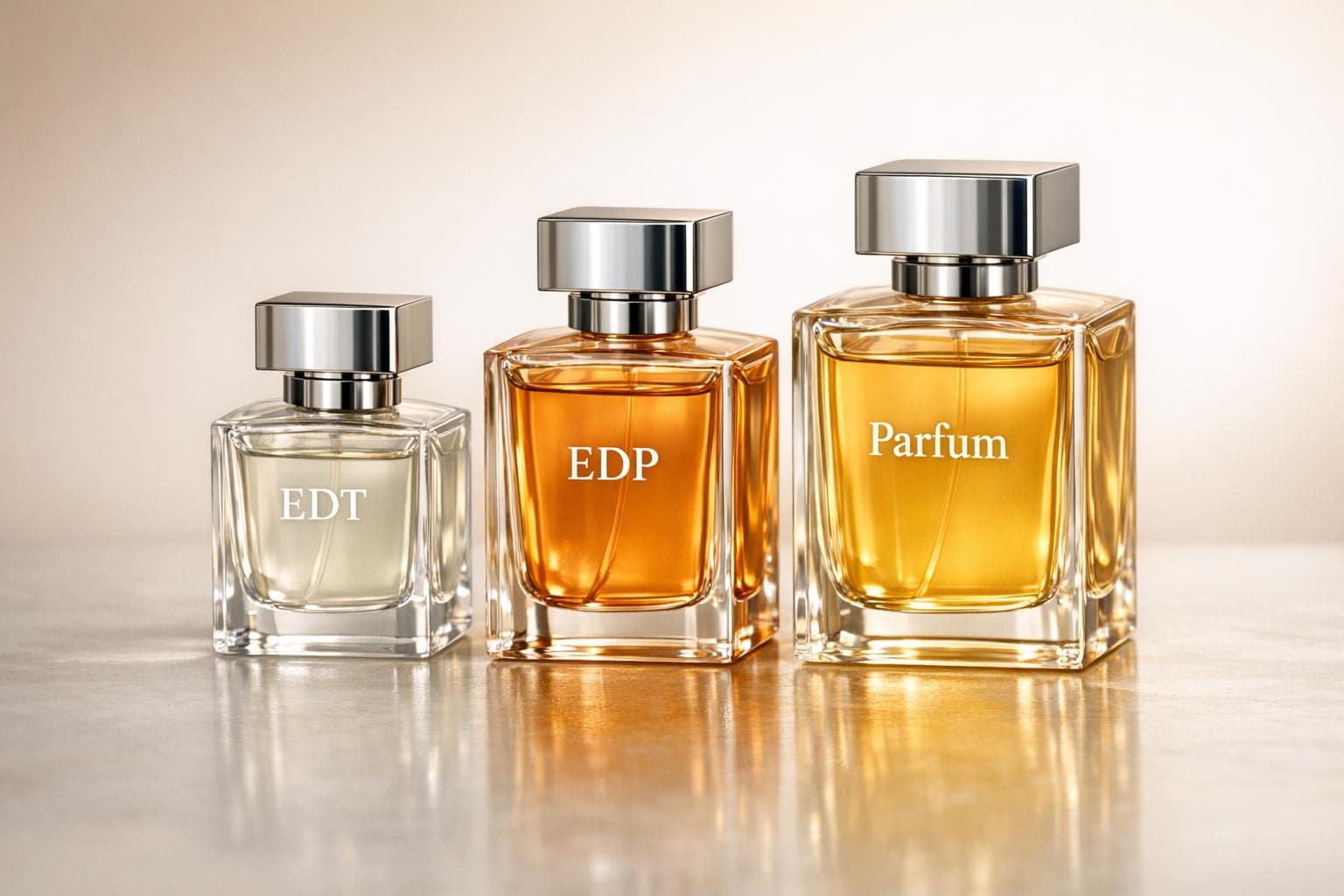
Parfum contine mai mult ulei parfumat decat eau de parfum: Floris situeaza parfum la 20–30 % si eau de parfum la aproximativ 15–20 %. Parfum sta, de asemenea, mai aproape de piele mai mult timp. Eau de toilette este cea mai usoara dintre cele trei, la aproximativ 5–15 %.
Eau de Toilette (EDT), Eau de Parfum (EDP) si Parfumul difera prin concentratia de ulei, longevitate si proiectie. Iata ce trebuie sa stiti:
- EDT: Cea mai usoara optiune, cu o concentratie de ulei de 5–15 %. Dureaza 3–6 ore. Cel mai potrivit pentru purtarea relaxata de zi sau in timpul verii.
- EDP: Intensitate medie, cu 15–20 % ulei. Dureaza 6–8 ore. Ideal pentru uzul zilnic sau evenimente de seara.
- Parfum: Cea mai mare concentratie, cu 20–40 % ulei. Dureaza 8–24+ ore. Perfect pentru ocazii speciale sau vreme mai rece.
Sfat rapid: O concentratie mai mare de ulei inseamna o persistenta mai indelungata, dar o proiectie mai discreta. Alegeti EDT pentru prospetime, EDP pentru versatilitate si Parfum pentru o persistenta luxurianta.
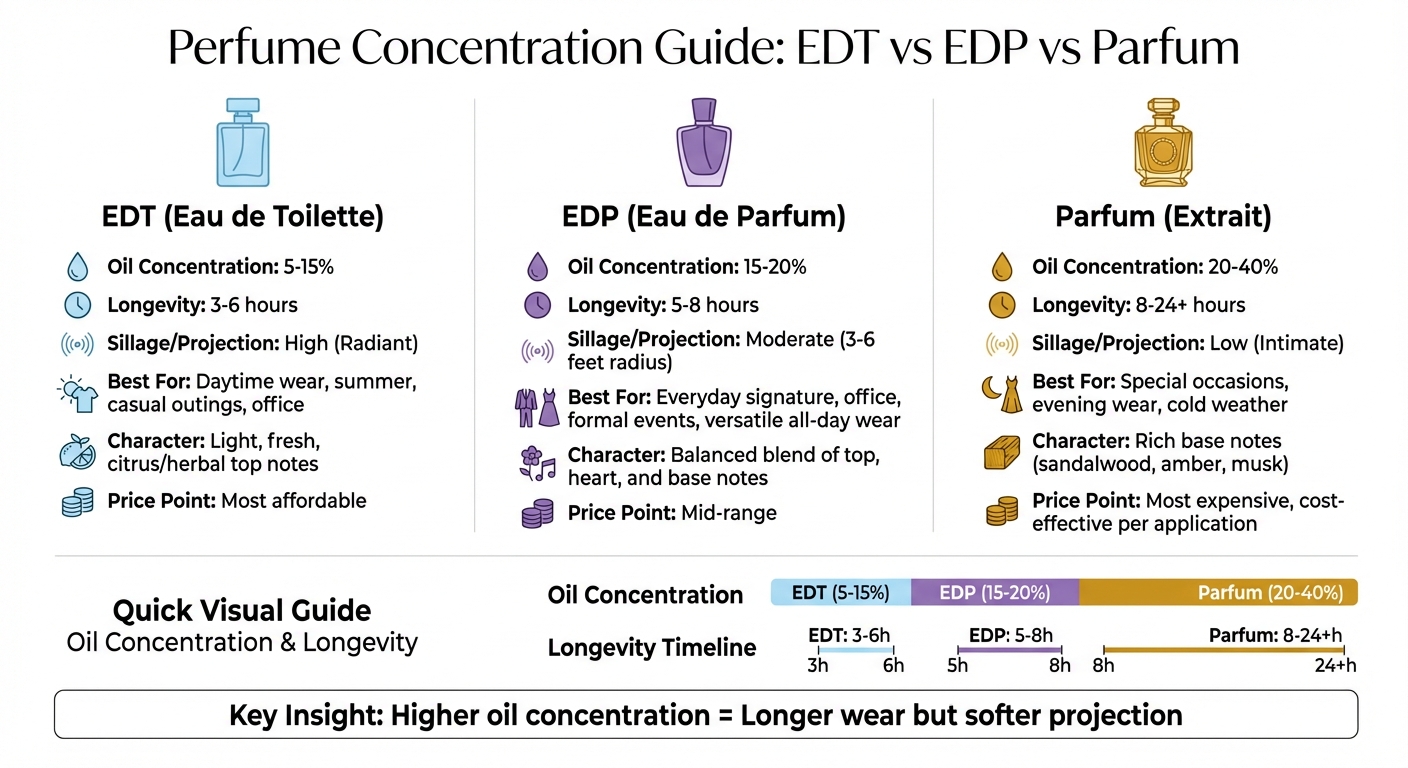
EDT vs EDP vs Parfum: Comparatie intre concentratia de ulei, longevitate si cea mai buna utilizare
EDT, EDP, and Parfum: The Basics
In inima fiecarui parfum se afla concentratia sa – raportul dintre uleiul pur de parfum, alcool si apa. Acest amestec determina cat timp dureaza un parfum si cat de puternic proiecteaza pe parcursul zilei. Sa analizam cele trei tipuri principale de concentratii si sa vedem cum difera performanta lor.
Ce este Eau de Toilette (EDT)?
Eau de Toilette, adica „apa de toaleta”, este renumita pentru compozitia sa usoara si revigoranta. Cu un continut mai ridicat de alcool, creeaza o explozie imediata si energizanta de parfum care se estompeaza relativ repede, durand de obicei aproximativ 3 pana la 6 ore. Notele de varf luminoase si proaspete – adesea citrice sau ierbale – ies cel mai mult in evidenta, facand din EDT o alegere excelenta pentru iesirile de zi relaxate, tinutele de birou sau zilele calduroase de vara.
Ce este Eau de Parfum (EDP)?
Eau de Parfum, sau „apa de parfum”, ofera o concentratie mai echilibrata de ulei si alcool, conferind aromei o profunzime si o longevitate superioare. Asteptati-va sa dureze intre 6 si 10 ore, suficient pentru a va insoti pe parcursul intregii zile fara a necesita reaplicare. Datorita amestecului sau armonios de note de varf, de mijloc si de baza, EDP a devenit favoritul pasionatilor de parfumuri si se afla frecvent in topul vanzarilor retailerilor de frumusete.
Ce este Parfumul?
Parfumul, cunoscut si sub denumirea de Extrait de Parfum sau „extract de parfum”, este cea mai concentrata si mai luxoasa optiune, continand 20–40 % ulei pur de parfum. Aceasta formula bogata, pe baza de ulei, adera pe piele, persistand pana la 24 de ore sau chiar mai mult. O atingere usoara pe punctele de puls este tot ce aveti nevoie, deoarece intensitatea sa asigura persistenta aromei. Parfumul pune accentul pe note de baza profunde, precum lemnul de santal, ambra si moscul, care se evapora lent, facandu-l perfect pentru evenimente formale, ocazii speciale sau lunile mai reci, cand va doriti un parfum cu o rezistenta maxima. Ingredientele sale premium si concentratia ridicata il fac, de asemenea, cea mai exclusivista optiune ca pret.
Comparatie intre concentratie si longevitate
Tabel comparativ: EDT, EDP, Parfum
Intelegerea diferentelor dintre Eau de Toilette (EDT), Eau de Parfum (EDP) si Parfum (Extrait) se rezuma la concentratiile lor de ulei si la modul in care acestea influenteaza timpul de purtare si proiectia. Iata detaliile:
| Tip de parfum | Concentratie de ulei | Longevitate tipica | Sillage / Proiectie | Cea mai buna utilizare |
|---|---|---|---|---|
| Parfum (Extrait) | 20–40 % | 8–24+ ore | Redusa (Intima) | Ocazii speciale, tinute de seara |
| Eau de Parfum (EDP) | 15–20 % | 5–8 ore | Moderata | Semnatura zilnica, birou, evenimente formale |
| Eau de Toilette (EDT) | 5–15 % | 3–6 ore | Ridicata (Radianta) | Zi, vara, iesiri relaxate |
Acest tabel evidentiaza echilibrul dintre concentratia de ulei, longevitate si proiectie, ajutandu-va sa alegeti parfumul potrivit pentru orice ocazie.
Ce arata comparatia
Relatia dintre concentratia de ulei si performanta devine mai clara atunci cand analizati detaliile.
O concentratie mai mare de ulei inseamna o purtare mai indelungata, dar o proiectie mai discreta. De exemplu, Parfumul este conceput sa dureze cel mai mult, ramanand adesea pe piele pana la 24 de ore. Cu toate acestea, siajul sau este mult mai intim. Pe de alta parte, EDT-ul, cu un continut mai ridicat de alcool, se evapora mai repede, lasand o trena olfactiva imediata, dar de scurta durata.
„Eau de Toilette, datorita concentratiei mai mari de alcool, are in general o proiectie mai puternica in comparatie cu formele mai concentrate precum Eau de Parfum sau aromele de Pure Perfume.” – Decanted UK
EDP ofera echilibrul perfect. Asigura o persistenta de 5–8 ore, ceea ce il face o alegere practica pentru utilizarea zilnica. Ofera o proiectie suficienta pentru a fi remarcat fara a incarca o incapere, situandu-se confortabil intre compozitia mai usoara a EDT-ului si opulenta Parfumului.
Parfumul inseamna eleganta discreta. Desi vine cu un pret mai ridicat, longevitatea si natura sa intima il transforma intr-o alegere rentabila la fiecare aplicare. Cateva picaturi pot dura intreaga zi, oferind o experienta olfactiva mai personala si mai rafinata.
In continuare, vom examina mai atent modul in care siajul si intensitatea contribuie la caracterul general al acestor parfumuri.
Ore pe piele in functie de concentratie: ce publica casele de parfumuri
Floris si Musk de Lumière publica fiecare cat dureaza concentratiile lor pe piele, iar cifrele lor nu coincid mereu. Casele publica intervale diferite si nicio lege nu le stabileste, asa cum subliniaza Fragrantica, asa ca tabelul numeste a cui este fiecare cifra.
| Concentratie | Continut de ulei | Ore pe piele |
|---|---|---|
| Eau fraîche | aproximativ 1–3 % (Musk de Lumière) | 1–2 ore (Musk de Lumière) |
| Eau de cologne | 2–5 % (Floris) | 2–3 ore (Musk de Lumière) |
| Eau de toilette | aproximativ 5–15 % (Floris) | 4–6 ore (Floris); 2–4 ore (Musk de Lumière) |
| Eau de parfum | aproximativ 15–20 % (Floris) | 6–8 ore (Floris); 4–8 ore (Musk de Lumière) |
| Parfum | 20–30 % (Floris) | 6–12 ore (Musk de Lumière, parfum/extrait) |
| Extrait de parfum | aproximativ 20–40 % (Musk de Lumière) | 6–12 ore (Musk de Lumière, parfum/extrait) |
Cifrele proprii ale celor de la Creed sunt mai restranse: ei indica eau de toilette drept „traditional 8-12 %” si eau de parfum drept „mai aproape de 18-20 %”. Eticheta e un reper, iar pielea ta e testul.
Eau de parfum vs parfum
La eau de parfum vs parfum, diferenta inseamna mai mult ulei, un parfum care sta mai aproape de piele si o purtare mai lunga. Denumirile „parfum”, „extrait” si „extrait de parfum” descriu toate cea mai inalta concentratie; Musk de Lumière noteaza ca „Extrait in franceza inseamna extract”.
Un parfum sau un extrait este o forma mai concentrata a parfumului. Thibaud Crivelli, fondatorul Maison Crivelli, a declarat pentru Marie Claire UK ca „extraiturile noastre sunt formulate la o concentratie de 30 la suta sau mai mare”.
Scento vinde ambele versiuni ale acestor parfumuri sub forma de decanturi, asa ca le poti compara pe propria piele inainte sa alegi o sticla intreaga.
| Parfum | Casa | 2 ml | 8 ml | Pe ml (8 ml) |
|---|---|---|---|---|
| Y Eau de Parfum | Yves Saint Laurent | 7,90 € | 22,90 € | 2,86 € |
| Y Le Parfum | Yves Saint Laurent | 7,90 € | 23,90 € | 2,99 € |
| Boss Bottled Eau de Parfum | Hugo Boss | 6,90 € | 20,90 € | 2,61 € |
| Boss Bottled Parfum | Hugo Boss | 6,90 € | 23,90 € | 2,99 € |
| The Most Wanted EDP | Azzaro | 6,90 € | 21,90 € | 2,74 € |
| The Most Wanted Parfum | Azzaro | 5,90 € | 18,95 € | 2,37 € |
| Oud Wood Eau de Parfum | Tom Ford | 15,90 € | 48,95 € | 6,12 € |
| Oud Wood Parfum | Tom Ford | 24,90 € | 75,95 € | 9,49 € |
La preturile de vanzare Scento, varianta parfum costa cu 1 € mai mult pentru 8 ml la Y si cu 3 € mai mult la Boss Bottled. La The Most Wanted costa cu 2,95 € mai putin, iar Oud Wood Parfum costa cu 55 % mai mult decat Oud Wood Eau de Parfum. La marimea unui decant, pretul nu creste odata cu concentratia, asa ca merita sa le testezi pe amandoua.
Pentru un raspuns simplu la EDP versus EDT, citeste comparatia completa EDP vs EDT sau vezi fiecare concentratie, de la eau fraîche la extrait.
Siajul si intensitatea explicate
Siajul: Trena parfumata
Siajul se refera la trena parfumata pe care o lasati in urma pe masura ce va miscati. Este ca o esenta persistenta a prezentei dumneavoastra, „urma” invizibila a parfumului atunci cand pasiti printr-un spatiu.
Eau de Toilette (EDT), datorita continutului mai ridicat de alcool, permite moleculelor parfumate sa se evapore rapid si sa se raspandeasca mai departe, creand o proiectie initiala mai puternica. Pe de alta parte, Parfum ramane mai aproape de piele, formand o aura olfactiva mai intima. Eau de Parfum (EDP) gaseste un echilibru, oferind un perimetru olfactiv de aproximativ 3–6 feet si mentinandu-si efectul timp de cateva ore.
„Eau de Toilette, datorita concentratiei mai mari de alcool, are in general o proiectie mai puternica in comparatie cu formele mai concentrate precum Eau de Parfum sau aromele de Pure Perfume.” – Decanted UK
Pentru mediile de lucru sau spatiile inchise, siajul subtil al unui EDT este ideal pentru a nu deranja persoanele din jur. In schimb, caracterul mai bogat si mai durabil al unui EDP sau al unui Parfum este perfect pentru evenimentele de seara sau ocaziile deosebite.
Iata un sfat util: evitati sa va frecati incheieturile dupa aplicarea parfumului. Acest gest poate distruge moleculele delicate si poate perturba siajul intentionat al compozitiei. In schimb, lasati parfumul sa se aseze in mod natural pe pielea hidratata, care ajuta la retinerea uleiurilor aromatice mai bine decat pielea uscata.
Intelegand siajul, puteti aprecia modul in care fiecare concentratie isi creeaza propria trena olfactiva distincta. Sa exploram acum intensitatea, care defineste modul in care un parfum este perceput de aproape.
Intensitatea: Puterea aromei
Intensitatea reflecta bogatia si profunzimea unui parfum – in esenta, cat de puternic si complex miroase atunci cand va aflati in imediata apropiere.
Parfumul, cu o concentratie de 20–40 % de uleiuri aromatice, ofera cea mai intensa experienta. Acesta evidentiaza adesea note de baza profunde, precum lemnul de santal, moscul si paciuliul, oferind o aroma complexa si somptuoasa. In contrast, EDT-ul se concentreaza pe note de varf usoare si aerisite, precum citricele si ierburile, creand o impresie proaspata si vibranta. EDP-ul asigura calea de mijloc, oferind un profil armonios, care se simte substantial fara a deveni coplesitor.
Concluzia principala: Parfumul ofera cea mai bogata si mai intima experienta olfactiva, ramanand aproape de piele. EDT-ul proiecteaza mai puternic la inceput, dar se estompeaza mai rapid, in timp ce EDP-ul atinge un echilibru versatil, cu o intensitate vizibila si o prezenta durabila de-a lungul zilei.
Expertul tău personal în parfumuri te așteaptă
Completează testul nostru rapid de parfumuri și descoperă parfumuri designer și de nișă autentice, alese pe gustul tău – explorează-le ca decanturi și mostre de 2, 5, 8 și 30 ml, ca să le poți încerca pe fiecare înainte de a alege un flacon întreg.
Descoperă-ți parfumulCand sa purtati EDT, EDP si Parfum
Purtarea pe timp de zi vs. purtarea de seara
Pentru timpul zilei, EDT (Eau de Toilette) este o optiune de baza. Profilul sau mai usor si mai proaspat se integreaza perfect in mediile de birou si la iesirile informale. Cu un continut mai mare de alcool, EDT-ul ofera o proiectie initiala sesizabila, dar se atenueaza de obicei in cateva ore – ideal pentru a pastra discretia in mediul profesional.
„Daca doriti sa evitati momentul clasic ‘Imi cer scuze, nu v-am auzit din cauza parfumului dumneavoastra’, atunci un EDT poate fi o alegere excelenta.” – Frances Shoemack, Fondator, Abel
EDP (Eau de Parfum) asigura echilibrul, facand o tranzitie fluida de la zi la noapte. Este suficient de versatil pentru utilizarea zilnica, oferind in acelasi timp profunzimea necesara pentru evenimentele de seara. Pentru acele ocazii cu adevarat speciale, Parfumul trece pe primul plan. Cu o concentratie de ulei de 20–40 %, creeaza o prezenta opulenta si de durata, care persista peste 12 ore, devenind alegerea ideala atunci cand doriti sa lasati o impresie memorabila.
Alegerea dintre aceste concentratii variaza si in functie de anotimp, deoarece temperatura joaca un rol esential in modul in care se manifesta aromele.
Recomandari in functie de sezon
Temperatura ambientala influenteaza semnificativ comportamentul unui parfum. In timpul primaverii si verii, caldura accelereaza evaporarea, ceea ce poate face ca aromele mai grele sa para apasatoare. De aceea, optiunile mai usoare, precum EDT sau Eau de Cologne (EDC), stralucesc pe vreme calda. Notele lor de varf citrice si revigorante, alaturi de concentratiile mai reduse de ulei, ofera o senzatie curata si aerisita, perfecta pentru acest sezon.
„Apele de colonie erau create din note citrice, cu o concentratie redusa de ulei – in jur de 5 % – asa ca am pastrat denumirea pentru creatii usoare si efervescente, ideale vara.” – Alberto Morillas, Maestru Parfumier, Firmenich
In toamna si iarna, concentratiile mai bogate preiau prim-planul. Aerul rece incetineste difuzia parfumului, facand din EDP si Parfum alegeri remarcabile. Notele lor de baza mai profunde – ganditi-va la lemn de santal, mosc si paciuli – strabat racoarea si isi mentin prezenta pe parcursul intregii zile. In plus, continutul mai ridicat de ulei asigura rezistenta aromei in ciuda aerului uscat de iarna. Pentru sezoanele de tranzitie, EDP ofera echilibrul perfect, adaptandu-se la schimbarile de temperatura si pastrand un caracter olfactiv constant si bine conturat.
Factori care influenteaza performanta parfumului
Performanta unui parfum nu se rezuma doar la esenta in sine – o serie de factori, printre care tipul de piele, metodele de aplicare si conditiile de mediu, pot influenta felul in care o aroma evolueaza si persista pe piele.
Tipul de piele si longevitatea parfumului
Tipul dumneavoastra de piele joaca un rol fundamental in modul in care un parfum rezista in timp. Pielea grasa tinde sa retina aromele mai mult timp, deoarece lipidele naturale se leaga de moleculele de parfum, incetinind evaporarea. Pe de alta parte, pielii uscate ii lipsesc lipidele necesare pentru a fixa aceste molecule, ceea ce face ca aroma sa se estompeze mai repede.
pH-ul pielii influenteaza si el evolutia unui parfum. De pilda, o piele mai acida (pH sub 5,5) poate conferi notelor citrice un accent metalic, in timp ce un pH mai alcalin (peste 5,5) poate reduce intensitatea generala a aromei. De asemenea, pielea cu o temperatura mai ridicata tinde sa amplifice forta unui parfum, insa ii poate accelera evaporarea.
„Parfumul interactioneaza cu pH-ul pielii dumneavoastra si, prin urmare, nu miroase la fel pe toata lumea.” – Yvan Jacqueline, Director General, Parfums de Marly
Pentru persoanele cu pielea uscata, Parfumul sau Eau de Parfum (EDP) reprezinta o alegere superioara datorita continutului mai ridicat de uleiuri – 20–30 % pentru Parfum si 15–20 % pentru EDP – in comparatie cu concentratia de 5–15 % a unui Eau de Toilette (EDT). Pentru a prelungi persistenta aromei, hidratati-va punctele de puls cu o lotiune fara parfum sau aplicati o cantitate fina de vaselina inainte de a pulveriza esenta preferata.
Tehnici de aplicare
Modul si zonele in care aplicati parfumul pot influenta considerabil performanta acestuia. Concentrati-va pe punctele de puls, precum incheieturile mainilor, gatul, zona din spatele urechilor, pliul coatelor si spatele genunchilor. Aceste zone cu o temperatura mai ridicata ajuta la difuzarea treptata a parfumului de-a lungul zilei.
Aplicarea parfumului imediat dupa dus este un alt secret eficient. Pielea curata, cu porii deschisi, absoarbe mai bine esenta, imbunatatindu-i longevitatea. Totusi, evitati frecarea incheieturilor dupa pulverizare – acest gest poate distruge moleculele si atenua notele de varf. Daca doriti sa aplicati parfum si pe par, pulverizati usor pe o perie inainte de a va pieptana. Aceasta tehnica reduce riscul de uscare cauzat de alcool, permitand totodata parului sa poarte delicat aroma.
Stratificarea (layering-ul) este o alta cale excelenta de a prelungi persistenta. Folosirea cremelor de corp sau a gelurilor de dus din aceeasi gama olfactiva potenteaza parfumul, in timp ce o aplicare usoara de ulei de jojoba sau de nuca de cocos pe punctele de puls poate actiona ca un fixator natural.
Factorii de mediu
Mediul inconjurator joaca un rol la fel de important in felul in care reactioneaza parfumul dumneavoastra.
- Temperatura: Caldura intensa (peste 35°C/95°F) accelereaza evaporarea, reducand longevitatea parfumului cu pana la 50 %. In schimb, vremea rece incetineste difuzia, pastrand aroma mai aproape de piele, dar extinzandu-i frecvent timpul de purtare.
- Umiditatea: O umiditate ridicata (70–90 %) poate atenua proiectia parfumului, facandu-l sa para estompat prin impiedicarea evaporarii corecte, in timp ce aerul uscat – obisnuit in spatiile incalzite sau in climatele aride – duce la evaporarea rapida a notelor de varf.
- Curentii de aer: Vantul sau sistemele puternice de aer conditionat pot grabi evaporarea, facand aroma sa se disperseze mult mai repede.
Pastrarea corecta este esentiala pentru a mentine integritatea parfumului dumneavoastra. Pastrati flacoanele intr-un loc racoros si intunecat, cum ar fi o garderoba din dormitor, si nu in baie, unde variatiile de temperatura cauzate de dusuri pot degrada compusii aromatici. Lumina UV este un alt inamic, degradand moleculele in timp. Acesta este si motivul pentru care multe creatii de lux sunt ambalate in sticla inchisa la culoare sau opaca.
| Factor de mediu | Impact asupra performantei | Cea mai potrivita concentratie |
|---|---|---|
| Caldura intensa (>35°C / 95°F) | Accelereaza evaporarea; timp de purtare mai scurt | EDT sau EDP cu profil lejer |
| Vreme rece | Incetineste difuzia; timp de purtare mai lung | EDP sau Parfum |
| Umiditate ridicata | Reduce proiectia; aroma poate parea atenuata | EDP lemnos/proaspat |
| Aer uscat | Pierdere rapida a notelor de varf | EDP opulent sau Parfum |
| Vant/Ventilatie | Accelereaza evaporarea | Concentratii superioare de ulei |
Cunoscand acesti factori, va puteti adapta alegerile olfactive si tehnicile de aplicare pentru a obtine cele mai bune rezultate, indiferent de conditii.
Alegerea parfumului potrivit pentru stilul dumneavoastra de viata
Alegerea concentratiei potrivite – fie ca este vorba de Eau de Toilette (EDT), Eau de Parfum (EDP) sau Parfum – depinde de rutina zilnica, de mediul in care va desfasurati activitatea si de preferintele personale. Daca sunteti in cautarea unei arome mai fine si mai discrete, EDT este o optiune remarcabila pentru birou, antrenamente sau zile calde de vara. EDP ofera o prezenta mai constanta, fiind perfect pentru zile lungi la birou sau ocazii care cer o persistenta de dimineata pana seara. Pentru evenimente speciale sau iesiri nocturne, Parfumul asigura o amprenta mai bogata si indelungata. In plus, continutul sau redus de alcool il transforma intr-o alternativa mai blanda pentru pielea sensibila.
Elementele practice, cum ar fi bugetul si clima, conteaza de asemenea. EDT este cea mai accesibila varianta, insa ar putea necesita reaplicare pe parcursul zilei. EDP, desi costa cu aproximativ 30–40 % mai mult, dureaza de obicei mai mult timp, reducand frecventa utilizarilor. Parfumul, datorita concentratiei mari de ingrediente pretioase, reprezinta investitia cea mai ridicata, dar ofera o persistenta inegalabila – rezistand adesea o zi sau o noapte intreaga cu o singura pulverizare. Si anotimpurile conteaza: alegeti EDT pe caldura si apelati la EDP sau Parfum in lunile reci.
Inainte de a investi intr-o sticla de dimensiune integrala, testati parfumul pe piele cel putin 30 de minute pentru a vedea cum reactioneaza cu chimia corpului dumneavoastra. Pentru cei care doresc sa descopere creatii de lux fara un cost imediat ridicat, Scento decanturile reprezinta solutia inteligenta. Disponibile in fiole de 2 ml, 5 ml si 8 ml, plus un flacon decant de 30 ml la majoritatea parfumurilor, acestea va ofera libertatea de a explora aromele in mod accesibil. Puteti chiar sa va alcatuiti o colectie versatila cu optiunea de 8 ml – poate un EDT proaspat pentru zi si un Parfum intens pentru seri sofisticate. Aceste strategii va permit sa creati cu usurinta o garderoba olfactiva care sa va completeze impecabil stilul de viata.
Intrebari frecvente
Cum influenteaza tipul de piele persistenta diferitelor tipuri de parfum?
Tipul dumneavoastra de piele are o importanta majora in ceea ce priveste persistenta unui parfum, intrucat influenteaza interactiunea uleiurilor parfumate cu organismul. Spre exemplu, pielea grasa sau usor acida tinde sa fixeze moleculele aromatice pe o perioada mai indelungata, facand esentele sa dureze mai mult. Pe de alta parte, pielea uscata sau intens alcalina poate provoca evaporarea mai rapida a parfumurilor, scurtandu-le timpul de rezistenta. Temperatura are si ea un rol – pielea mai calda poate amplifica si accelera difuzia parfumului, in timp ce pielea mai rece o incetineste, ajutand esenta sa ramana prezenta mai mult timp.
Cand corelati acest lucru cu diferitele concentratii de parfum, diferentele devin si mai evidente. Eau de Toilette (EDT), continand 5–15 % ulei de parfum, dureaza de regula aproximativ 3–4 ore, dar poate persista mai mult pe o piele cu tendinta grasa. Eau de Parfum (EDP), cu 15–20 % ulei, persista de obicei 5–7 ore si isi poate prelungi durata pe tenurile mai uleioase. Parfumul, cea mai concentrata alegere, cu 20–30 % ulei, poate rezista intre 8 si 12 ore, o piele grasa evidentiindu-i si mai mult profunzimea si longevitatea.
Deoarece chimia pielii fiecarei persoane este unica, cea mai eficienta metoda de a gasi creatia ideala este testarea parfumurilor direct pe propria piele. Dimensiunile decanturilor Scento (2 ml, 5 ml si 8 ml, plus un flacon decant de 30 ml la majoritatea parfumurilor) faciliteaza incercarea diverselor concentratii pentru a observa comportamentul acestora inainte de a alege un flacon complet.
Ce tip de parfum se potriveste cel mai bine fiecarui anotimp?
Alegerea unui parfum potrivit fiecarui anotimp depinde de note, concentratie si proiectie. In lunile reci, esentele calde si primitoare, precum cele de ambra, vanilie si condimente, se disting remarcabil. Aceste compozitii mai bogate ofera o senzatie de confort si persista mai bine in aerul curat si rece. Formatele precum Parfum (20–30 % ulei) sau Eau de Parfum (EDP) (15–20 % ulei) sunt optiuni ideale pentru serile de iarna sau zilele racoroase de toamna, asigurand atat rezistenta, cat si o prezenta distinsa.
Pe masura ce vremea se incalzeste, aromele mai lejere si aerisite capata intaietate. Ganditi-va la note de citrice, bergamota, ierburi proaspete si acorduri acvatice – perfecte pentru temperaturi inalte. Cum vremea calda amplifica in mod natural proiectia unui parfum, o varianta cu o concentratie mai redusa, precum Eau de Toilette (EDT) (5–15 % ulei), mentine o senzatie lejera si proaspata, fara a deveni apasatoare. EDT-urile sunt adaptate ideal pentru zilele insorite de vara, dupa-amiezile umede sau plimbarile in aer liber.
Pentru anotimpurile de tranzitie, cum ar fi primavara si inceputul toamnei, un EDP echilibrat sau un EDT cu structura mai densa functioneaza impecabil. Notele florale, fructate sau cele lemnoase discrete creeaza o armonie perfecta, adaptandu-se cu usurinta de la diminetile racoroase la dupa-amiezile blande. Cu esantioanele Scento, puteti incerca arome de sezon in dimensiuni practice de 2 ml pentru uz zilnic, ori puteti alege un Parfum de 8 ml pentru clipe aparte – o cale facila de a explora lumea parfumurilor fara a achizitiona imediat un flacon intreg.
Cum pot aplica parfumul pentru a rezista mai mult si a avea o proiectie mai buna?
Pentru a pune cel mai bine in valoare parfumul dumneavoastra, concentrati aplicarea pe punctele de puls – cum ar fi incheieturile mainilor, gatul si spatele urechilor. Aceste zone cu o caldura naturala ajuta la dispersia armonioasa a esentei. Pentru un efect amplificat, asigurati-va ca pielea este bine hidratata inainte de pulverizare, intrucat pielea hidratata retine aromele un timp mai indelungat. De asemenea, puteti pulveriza o trena fina pe haine sau pe par pentru o persistenta crescuta, avand insa grija sa nu exagerati – subtilitatea este intotdeauna o dovada de rafinament. Daca esenta isi pierde din intensitate de-a lungul zilei, o pulverizare discreta o poate revigora fara a o incarca.

