
AI-powered fragrance apps simplify finding scents that align with your personal preferences. By analyzing your lifestyle, personality, and past fragrance choices, these tools recommend perfumes tailored to your taste. Instead of relying on technical jargon like "top notes" or "olfactive families", users can describe scents in plain language - such as "rainy morning" or "warm and cozy." The AI then matches your input to a database of thousands of fragrances, reducing the risk of buying an expensive bottle you might regret later.
Here’s how it works:
- Data Collection: Apps use details like your age, habits, and emotional triggers to build a scent profile.
- Scent Matching: AI categorizes perfumes by scent families (e.g., floral, woody) and emotional moods to predict what you’ll enjoy.
- Personalized Journey: Users take quizzes, receive tailored recommendations, and can test fragrances with decants before committing to full-size bottles.
While AI simplifies the selection process, personal testing remains essential since skin chemistry can alter how a scent develops over time. These tools are transforming fragrance shopping, making it easier and more intuitive for consumers to find scents they love.
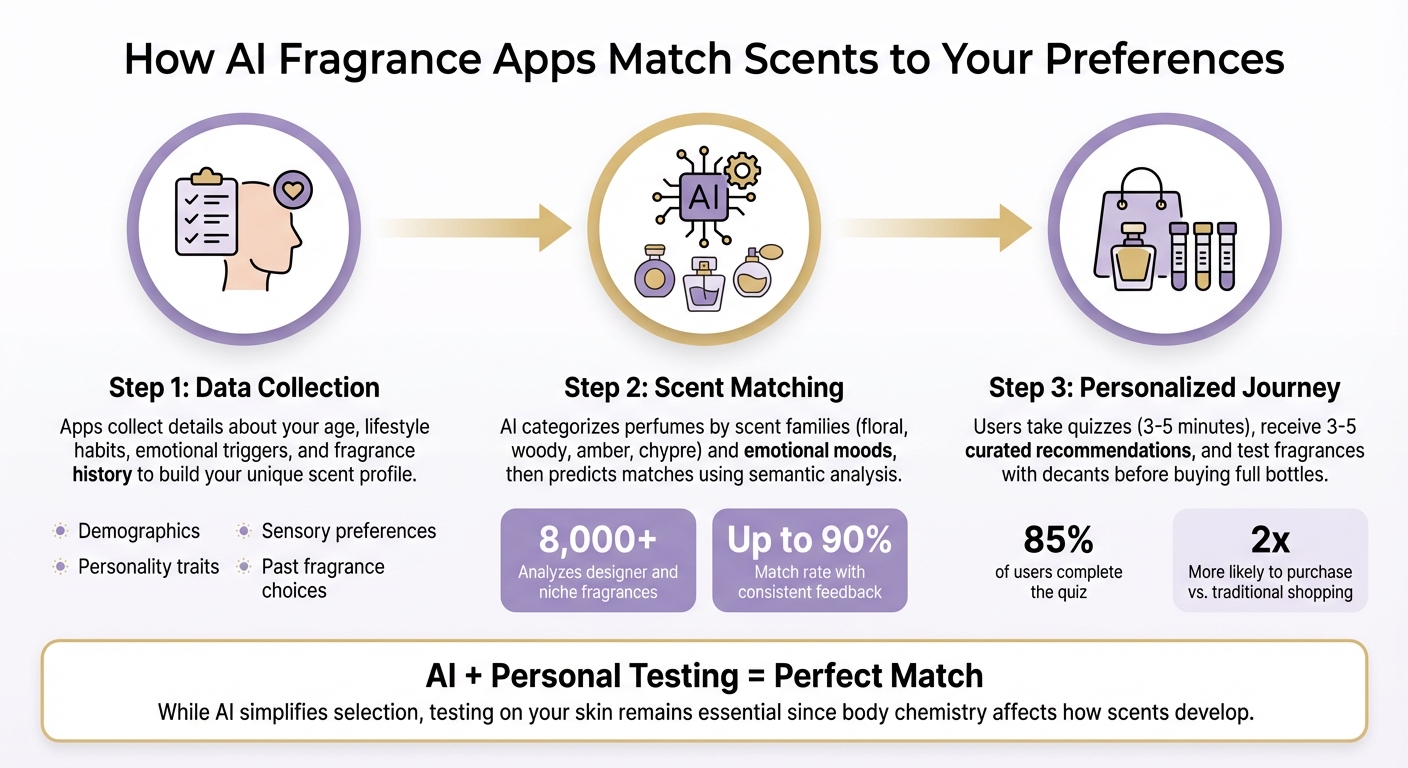
How AI Fragrance Apps Match Scents: 3-Step Process
How AI Learns Your Scent Preferences
AI fragrance apps craft your scent profile by analyzing your lifestyle, personality, and fragrance history. The more data you share, the sharper their recommendations become.
The process begins with how fragrances are categorized. AI systems group scents into major families like floral, woody, amber, and chypre, along with subcategories such as green, aromatic, musky, leathery, and gourmand. Each fragrance is further broken down into three layers: top notes (the first impression), heart notes (the core that emerges), and base notes (the lingering foundation). By mapping your preferences across these categories, AI predicts how likely you are to enjoy specific scent compositions. Let’s take a closer look at the fragrance families and note structures that shape these recommendations.
Scent Families and Notes Explained
Understanding fragrance families helps you better articulate your preferences. For instance, woody scents often feature notes like sandalwood or cedar, while floral fragrances highlight ingredients such as rose, jasmine, or lily. Amber scents (sometimes labeled as oriental) evoke warmth with vanilla and spices, and chypre blends elements like oakmoss with citrus for a more layered complexity.
AI doesn’t just rely on matching keywords. It uses advanced semantic analysis to interpret the meaning behind notes and accords. For example, if you mention liking "fresh and citrusy" scents, the algorithm identifies similar bright compositions, even if the specific ingredients differ. In retail trials using EEG headsets to monitor brain activity, 95% of participants preferred fragrances chosen by AI over those they initially selected themselves.
What Data AI Collects for Recommendations
AI goes beyond scent categorization by incorporating a variety of data inputs to refine your profile. It gathers details about your lifestyle, demographics, psychology, sensory preferences, emotional triggers, and behavior.
- Lifestyle and demographic data: Inputs like your age, location, and daily habits (e.g., whether you work in an office or spend time outdoors) help the system align recommendations with your practical needs.
- Psychological profiles: These are built through questionnaires with over 20 personal questions, covering traits like personality and even favorite colors. EveryHuman‘s Algorithmic Perfumery, for example, uses this method to create over 500 billion possible fragrance combinations from 46 core building blocks.
- Sensory and emotional inputs: Preferences can also be shaped by abstract concepts. You might share memories or moods - like "comforting" or "energizing" - to guide the algorithm toward scents that evoke those feelings.
- Fragrance history: Your past choices, including the scent families you gravitate toward, play a key role. Whether you’re seeking a signature scent, a seasonal update, or a thoughtful gift, this historical data helps fine-tune suggestions.
Some advanced systems even track behavioral data, such as how long you linger on specific quiz questions, or use EEG data to identify ingredient combinations that spark positive emotional reactions. Natural language processing also enables platforms to interpret your own words when describing a scent. Jo Dancey, Global Brand President at Jo Malone London, explains:
"This smart advisor lets people describe in their own words what they are drawn to and translates that into meaningful, tailored scent recommendations."
To get the best results, provide detailed input. Specify where you plan to wear the fragrance - whether it’s for the office, an outdoor wedding, or the gym - and use descriptive adjectives to capture the vibe you’re after. Regularly retaking quizzes helps the AI adapt to your changing tastes or seasonal goals. By continually learning from your preferences and feedback, these apps deliver increasingly precise matches over time.
The Technology Behind AI Fragrance Matching
AI uses machine learning to turn your scent preferences into personalized recommendations. By analyzing patterns, interpreting language, and cross-referencing thousands of fragrance profiles, these systems work to suggest scents that align with your tastes. It’s a process that combines your input with advanced algorithms to deliver tailored results.
Using Purchase History and User Patterns
AI doesn’t just rely on a single data point - it builds a deeper understanding of your preferences through your purchase history and interaction patterns. For instance, if you share a favorite fragrance, the algorithm breaks it down into its key components - notes, accords, and olfactive families - and searches for scents with similar or complementary characteristics.
It also tracks how you engage with discovery tools, noting which features you gravitate toward and how intensely you interact with them. Demographic data further sharpens these insights, helping AI understand why certain scents might resonate with you. This detailed approach has real-world impact: retailers using AI-powered matching have seen a 30% boost in conversion rates and average basket sizes. At the same time, it addresses decision fatigue, a common issue that leads up to 40% of shoppers to abandon their carts.
Matching Scents Through Database Analysis
AI’s capabilities extend beyond individual preferences by leveraging massive fragrance databases. For example, TheScentSeeker taps into a catalog of over 8,000 designer and niche fragrances. Each perfume is meticulously analyzed, breaking it down into its top, heart, and base notes, as well as its olfactive family.
More advanced tools take this even further. Osmo’s Principal Odor Map (POM) uses machine learning to study the chemical structure of scent molecules, predicting their aroma. Meanwhile, Givaudan’s Myrissi technology links scent accords to emotional states and colors, drawing from a database of over 25,000 consumer responses. This neuroscience-driven method doesn’t just match fragrances to your note preferences - it aligns them with your mood. Johan Chaille de Nere, Givaudan’s director of digital transformation, explains:
"Decoding and predicting the emotional impact of fragrance means that we can understand the implications for consumers because the difference between liking a fragrance and adoring it is purely emotional."
Understanding Text Descriptions Like "Fresh and Citrusy"
Natural language processing (NLP) allows AI to interpret your own words when describing scents. Whether you type in "fresh and citrusy" or something more abstract, NLP translates your description into specific scent attributes. Some platforms even go a step further, letting you upload visuals like photos or mood boards. The AI then analyzes these images to create a matching scent profile, eliminating the need for manual tagging.
This shift toward language-based discovery is changing the way people shop. With 91% of consumers more inclined to buy from brands offering personalized recommendations, the ability to describe your ideal scent in your own words bridges the gap between curiosity and confidence. AI transforms your input - whether verbal or visual - into a fragrance journey that feels uniquely yours.
Getting Started with AI Fragrance Apps
AI fragrance apps simplify the process of finding scents that resonate with your preferences. The journey begins with a short, engaging quiz that takes just 3–5 minutes to complete. Impressively, most platforms report an 85% completion rate for this step. This quiz is where the magic happens, turning your responses into personalized fragrance suggestions. To get the most accurate results, take your time and provide thoughtful answers.
Step 1: Complete the Fragrance Quiz
Start by identifying the intended user of the fragrance - whether it’s for yourself or someone else. You’ll then have the option to either name a favorite fragrance for cross-matching or specify your preferred scent families and notes.
The quiz typically introduces primary scent families like Woody, Amber, Floral, or Fresh, and allows you to refine your choices further with sub-notes such as Gourmand, Oceanic, or Citrus. Some platforms take it a step further by letting you describe your preferences in your own words. For instance, in December 2025, Jo Malone London unveiled its AI Scent Advisor, developed with Google Cloud. This tool uses natural language processing to interpret user descriptions. According to Semafor’s testing, this approach doubles purchase rates compared to traditional online shopping by asking targeted questions about preferences like "grounding woods" or "cozy spices". Jo Dancey, Global Brand President at Jo Malone London, shared:
"This smart advisor lets people describe in their own words what they are drawn to and translates that into meaningful, tailored scent recommendations".
You’ll also be prompted to set a budget and occasion - whether it’s for daytime, nighttime, work, or a special date. These details ensure the recommendations align with both your lifestyle and spending preferences.
Step 2: Review Your Personalized Matches
Once the quiz is completed, you’ll receive 3–5 curated recommendations. Each suggestion includes a detailed breakdown of its top, heart, and base notes, along with the emotional mood the fragrance is designed to evoke. Visual guides often accompany these matches, helping you understand how the scent evolves over time.
Before making a big commitment, it’s wise to start small. Sampling decants or testers allows you to experience how the fragrance interacts with your skin chemistry. This step is crucial since personal chemistry can influence how notes like musk or citrus unfold, meaning a scent that smells ideal in the bottle might shift once applied to your skin.
Step 3: Test and Adjust Your Preferences
AI platforms improve their recommendations as you provide feedback. After trying your samples, rate them to help refine the system’s understanding of your preferences. These platforms rely on both explicit feedback (like ratings) and implicit signals (such as the time spent browsing certain fragrances) to fine-tune their suggestions.
As your tastes evolve or the seasons change, retaking the quiz can refresh your recommendations. Many apps also offer AI-powered layering suggestions, helping you combine different scents to craft a unique signature. For example, in October 2025, IFF (International Flavors & Fragrances) launched ScentChat™, a platform that uses messaging apps and natural language processing to gather direct consumer feedback. This data is then used by perfumers to refine formulations. The more you engage, the sharper and more personalized your profile becomes.
Use these tailored insights to explore designer decants with tools like Scento and gradually build a fragrance wardrobe that reflects your individuality.
Your Personal Fragrance Expert Awaits
Take our quick scent quiz to discover authentic designer and niche fragrances matched to your taste — explore them as 2ml, 5ml, 8ml & 30ml decants and samples, so you can try each one before committing to a full bottle.
Find Your ScentUsing AI Recommendations with Scento

Once you understand how AI-powered fragrance matching works, the next step is putting those insights into action - without the risk of spending on full-size bottles that might go unused. That’s where Scento steps in, offering a smarter way to test and build your fragrance collection.
Discover Designer Fragrances with Scento Decants
Scento offers decants in 2 ml, 5 ml and 8 ml vials, and a 30 ml bottle decant on most perfumes, available as one-time purchases. These decants let you test AI-recommended scents without committing to a full bottle, ensuring you can see how a fragrance evolves on your skin over time.
For example, the 8ml decants provide approximately 120 sprays - enough to try a scent across various occasions, weather conditions, and times of day. This extended trial period allows you to observe how the fragrance interacts with your body chemistry and whether it complements your lifestyle. With a catalog of over 1,000 designer fragrances, Scento allows you to explore AI-curated options without the financial risk of blind-buying expensive bottles.
A Flexible Subscription for Ongoing Discovery
Scento is a perfume decant and sample retailer, and every product is available for one-time purchase without any subscription. Scento+ is Scento’s optional membership: the monthly fee comes back in full as store credit to spend on any perfume, members get 10% off, a free sample with every order, a free perfume every six months and a birthday gift, and you can pause anytime; to cancel, contact our team. This gives you the flexibility to select different scents based on your changing tastes, seasonal needs, or fresh AI recommendations, with each decant priced individually so you stay in control of your picks.
This system creates a continuous feedback loop that sharpens the AI’s ability to recommend scents that suit you. As you rate and review each fragrance, the AI algorithms adjust to better understand your unique scent profile. Industry data shows that AI fragrance tools can achieve match rates of up to 90% when provided with consistent user feedback. Additionally, buying decants individually eliminates the need for large upfront investments, making it easier to explore niche or designer fragrances you might not have considered otherwise. Over time, this process helps you build a curated fragrance wardrobe tailored to your preferences.
From Testing to Collection Building
Once you’ve tested fragrances and refined your preferences, you can confidently move from exploration to collection building. Scento now offers a 30 ml bottle decant on most perfumes, allowing you to transition seamlessly from trying scents to owning them.
This decant-to-bottle approach ensures you avoid the common mistake of purchasing a full-size bottle based on a single test, only to realize later it doesn’t suit you. By the time you’re ready to invest in a larger bottle, you’ll have worn the fragrance multiple times - confirming it works with your skin chemistry, lifestyle, and personal style. This thoughtful process transforms AI recommendations from theoretical matches into a personalized fragrance collection you’ll genuinely enjoy using.
Common Problems with AI Fragrance Matching
AI fragrance tools have made impressive strides, but they’re not without their challenges. While generally accurate, these tools still rely heavily on user input and can’t replace the personal experience of wearing a fragrance. Understanding these limitations can help you get the most out of AI recommendations.
Getting Better Results with Detailed Input
AI recommendations are only as good as the information you provide. Take Jo Malone London’s AI Scent Advisor, for example. Developed with Google Cloud’s Gemini models, it highlights how crucial descriptive language is in finding the right match. Jose Gomes, Vice President of Retail and Consumer Goods at Google Cloud, explains:
"When you can’t smell something, you have to be really evocative with language".
Users who described scents in vivid, specific terms - like "the freshness of an orchard" - had far better results than those who used vague descriptors. If your initial recommendations feel off, try retaking the quiz with more precise language. Swap generic terms like "floral" for something more detailed, such as "soft rose with a powdery finish" or "green, dewy florals." Mention fragrances you already own and enjoy to help the AI identify patterns in the notes you prefer. Also, provide context - whether you’re looking for a scent for the office, a romantic evening, or a seasonal occasion.
The impact of this approach is clear. Since Jo Malone launched its AI tool, customers who used it were nearly twice as likely to make a purchase compared to those who didn’t. It’s also worth revisiting your profile as your preferences evolve. While AI can guide you, personal testing remains key to finding the perfect match.
The Importance of Personal Testing
No matter how advanced the AI, nothing beats the experience of testing a fragrance on your skin. While AI can suggest scents based on your input, it can’t predict how a fragrance will interact with your unique skin chemistry. Factors like skin pH, body temperature, and natural oils can significantly change how a scent develops and lasts over time.
Francis Kurkdjian, Perfume Creative Director at Parfums Christian Dior, puts it this way:
"AI can mix scents, but it cannot understand the cultural context, the emotional resonance, nor does it have the artistry behind a truly great perfume".
Natalie Guselli, Head of Beauty & Commercial at Liberty London, shares a similar perspective:
"The magic of retail lies in human expertise. AI might guide us, but the final choice always comes down to how a scent feels when experienced".
After narrowing down your options with AI, take the time to test a few fragrances on your skin. This lets you experience how the scent evolves throughout the day, from the initial top notes to the deeper dry-down phase. Combining the efficiency of AI with the sensory experience of wearing the fragrance ensures you find one that truly resonates with your lifestyle and personal connection to scent.
Conclusion
AI has revolutionized the way we discover and shop for fragrances. Instead of wading through countless options, you can now answer a few targeted questions and receive tailored recommendations that align with your mood, lifestyle, and personal preferences. As Jo Dancey, Global Brand President at Jo Malone London, aptly states:
"We are entering a new era of digital scent discovery where AI can bridge the gap between curiosity and confidence".
This shift paves the way for a smoother, more personalized fragrance journey.
The economic advantages are undeniable. AI-powered fragrance tools not only minimize waste from unused full-size bottles but also enhance purchase confidence and boost conversion rates. By analyzing thousands of scent profiles and aligning them with your preferences, AI empowers smarter purchasing decisions. For instance, online shoppers who use AI fragrance tools are nearly twice as likely to make a purchase compared to those who don’t. Retailers have also reported conversion rate increases of up to 30% during peak shopping periods when these tools are employed.
This technology has also made fragrance exploration more accessible. Instead of committing to a full-size bottle, you can experiment with small decants, allowing you to test how a scent evolves on your skin without the financial risk. This approach resonates with modern consumers who prefer to curate a "scent wardrobe" for various occasions, rather than sticking to a single signature fragrance.
The shift in consumer behavior is well-captured by Harry Richards, Investment Director at Manzanita Capital:
"Now people have a scent wardrobe. They have different fragrances for different occasions, moods, and different times of the year… how customers interact with fragrance has changed".
AI has made this evolution possible, offering the expertise of a fragrance consultant at your fingertips, anytime and anywhere.
FAQs
How does AI choose the perfect fragrance for your lifestyle?
AI-driven fragrance apps use cutting-edge algorithms to craft a personalized "scent profile" based on your lifestyle and preferences. By asking about your daily habits, favorite activities, and typical occasions - whether it’s a busy workday, a weekend hike, or a formal event - the app matches your answers to the molecular composition of thousands of perfumes. For instance, it might recommend crisp citrus notes for an active day or deeper, warmer aromas for an elegant evening.
What makes these apps even smarter is their ability to learn from your feedback. As you explore, save favorites, or dismiss certain scents, the system fine-tunes its suggestions to better match your evolving preferences. Some platforms take it a step further by connecting personal memories - like the scent of a seaside vacation or a cherished childhood moment - to specific fragrances, creating a deeply personal and memorable experience.
Can AI fragrance apps consider how a scent interacts with my skin chemistry?
AI fragrance apps are crafted to align with your individual preferences, even factoring in how scents interact with your skin chemistry over time. By analyzing your input and preferences, these tools fine-tune their suggestions to match your unique profile. While the technology is still evolving, it serves as a valuable resource for discovering fragrances that truly resonate with you.
How do AI fragrance apps personalize scent recommendations?
AI-powered fragrance apps are reshaping how we discover scents by tailoring recommendations through a mix of advanced data analysis and user insights. These apps delve deep into the molecular makeup of perfumes, dissecting top, middle, and base notes to understand how individual ingredients shape a fragrance’s character. This detailed breakdown helps the AI pinpoint patterns in user preferences.
Beyond the science of scent composition, these apps rely heavily on user feedback. Ratings, reviews, and notes about what users like or dislike provide valuable clues to refine personal scent profiles. They also track user behavior, such as search history, wishlist additions, purchases, and repeat visits, to capture shifts in taste over time. Some platforms go a step further by incorporating contextual factors - like the season, time of day, or even demographic details - to ensure the recommendations feel relevant and timely.
By weaving together these diverse data points, the AI creates a dynamic feedback loop, constantly learning and improving its ability to connect users with fragrances that resonate with their unique preferences.

