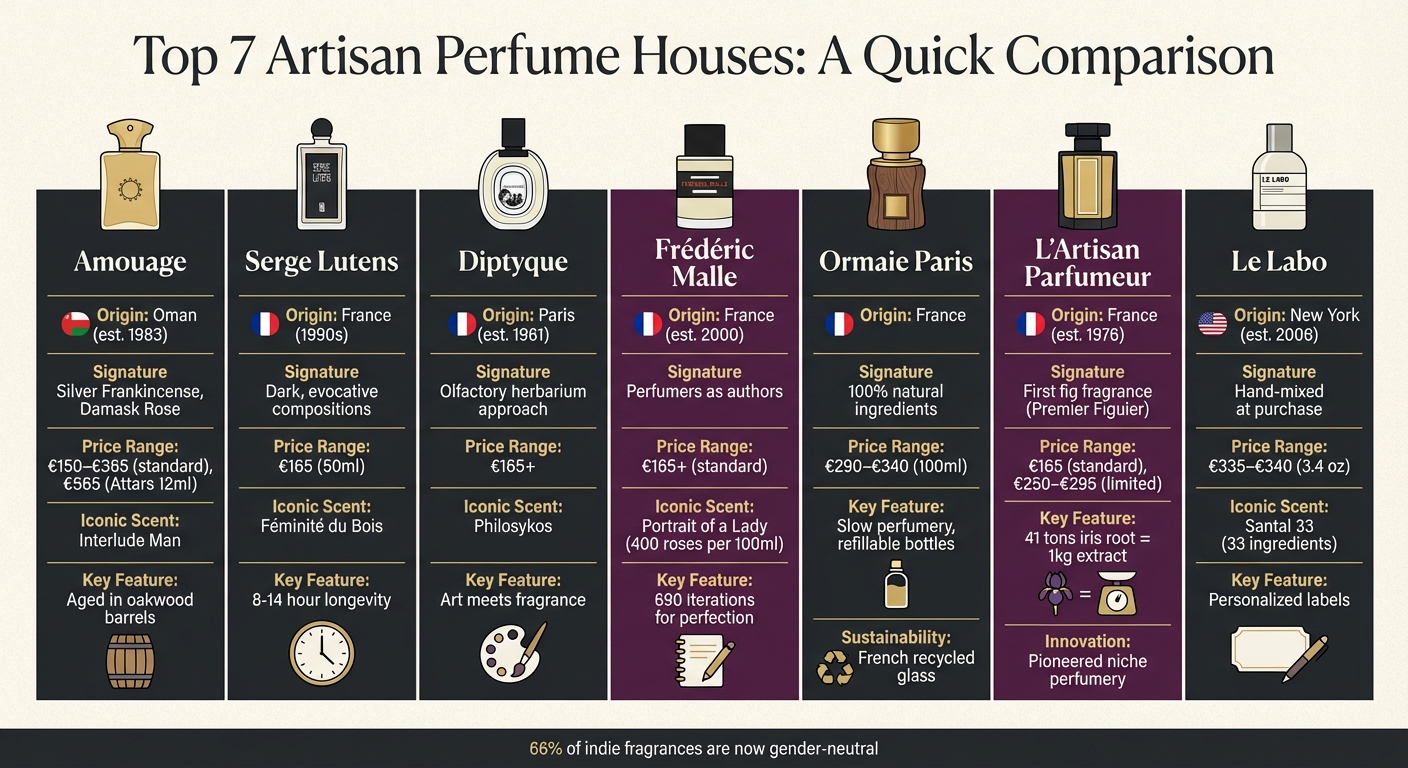
Artisan perfumery is all about craftsmanship, rare ingredients, and personal expression. Unlike mainstream brands, these niche houses focus on quality, storytelling, and individuality. Here’s a quick look at seven standout artisan perfume houses and what makes them special:
- Amouage: Known for its Omani heritage, bold scents, and rare ingredients like Silver Frankincense and Damask rose. Prices range from €150 to €365, with luxury options going higher.
- Serge Lutens: A visionary brand blending art and perfumery. Famous for dark, evocative scents like Féminité du Bois. Pricing starts around €165 for 50 ml.
- Diptyque: A Parisian brand combining art and scent, with iconic creations like Philosykos. Candles and perfumes start around €165.
- Frédéric Malle: Pioneering the concept of perfumers as "authors." Signature scents include Portrait of a Lady. Prices begin at €165, with exclusive lines priced higher.
- Ormaie Paris: Focused on natural ingredients and sustainability, with prices around €290–€340 for 100 ml bottles.
- L’Artisan Parfumeur: A historic house that introduced innovative notes like fig (Premier Figuier). Standard fragrances cost about €165.
- Le Labo: Known for hand-mixed scents like Santal 33, priced at €335–€340 for 3.4 oz.
These brands offer more than just fragrances - they create personal, sensory experiences. Many provide perfume samples or decants, making it easier to find a scent that matches your style.
Top 7 Artisan Perfume Houses: Price Comparison and Key Features
1. Amouage
Brand Heritage and Storytelling
Amouage, established in 1983 by Sultan Qaboos bin Said, was created to revive the art of Omani perfumery and present "The Gift of Kings" to the world. Initially, these fragrances weren’t available for purchase - they were gifted by the Sultan as a gesture of Omani hospitality. This royal legacy continues to influence the brand, from its ingredient selection to its iconic bottle designs. The men’s bottles are inspired by the Omani Khanjar dagger, while the women’s designs feature caps shaped like mosque domes, often embellished with Swarovski crystals for a luxurious touch. This deep connection to tradition reflects in every aspect of the brand, especially in its use of rare and exquisite materials.
High-Quality, Rare, and Natural Ingredients
Amouage is renowned for sourcing some of the most exceptional natural ingredients. One standout is Silver Frankincense, harvested from the dry wadis of Dhofar, a UNESCO-protected region celebrated for producing the world’s finest resin. Another is the Damask rose, cultivated in Oman’s Jabal Akhdar mountains. To extract just 3 ml of rose oil, an astounding 300 kg of these roses are required. The brand’s Attars - a line of pure perfume oils - are made without alcohol and feature frankincense, rose, myrrh, and oud, delivering a scent that lasts over 12 hours.
Craftsmanship and Artistry in Scent Creation
Amouage takes its artistry seriously, crafting perfumes with a level of precision rarely seen in the industry. At its Seeb factory, between 5,000 and 7,000 bottles are meticulously hand-finished each day. Details like golden medals are individually applied to each flacon, showcasing the brand’s commitment to perfection. Unlike many modern brands, Amouage ages its perfumes in oakwood barrels - sometimes for as long as six months - to allow the scents to mature and develop complexity. This blend of traditional Middle Eastern values and modern French techniques began under master perfumer Guy Robert, who famously said:
"The traditional values of Arab culture had to be distilled into a flacon full of French finesse".
His creation, Amouage Gold, became a masterpiece that perfectly married these two worlds, combining classic Arab notes with the elegance of French perfumery.
Distinctive Fragrance Profiles
Amouage’s fragrances are celebrated for their boldness and intricate compositions. Among its most iconic scents is Interlude Man, affectionately dubbed the "Blue Beast" for its unmatched longevity and powerful incense-driven sillage. This fragrance embodies the brand’s ethos of intensity and complexity, making it a favorite among enthusiasts.
The pricing reflects the craftsmanship: standard fragrances range from €150 to €365, while the Attars (12 ml) are priced around €565. For those seeking the ultimate luxury, the made-to-order Zadora containers can reach €150,000. The 2026 Essence collection further elevates the brand’s offerings with a 30% pure perfume oil concentration and an innovative double-infusion process using sandalwood chips.
Your Personal Fragrance Expert Awaits
Take our quick scent quiz to discover authentic designer and niche fragrances matched to your taste — explore them as 2ml, 5ml, 8ml & 30ml decants and samples, so you can try each one before committing to a full bottle.
Find Your Scent2. Serge Lutens
Brand Heritage and Storytelling
Serge Lutens built his perfume house on a foundation of artistic versatility, drawing from his experiences as a hairdresser, makeup artist, photographer, and filmmaker. His creative journey also includes launching Christian Dior‘s first makeup line in 1967. However, it was a visit to Morocco in 1968 that profoundly shaped his vision for perfumery. Reflecting on this pivotal moment, he shared:
"My first visit [to Morocco] in 1968 shaped my desire to affirm my own vision for perfume: going back to the purity of primary ingredients, which was a far cry from the soupy blends that dominated the market in the 1980s and 90s."
In the early 1990s, Lutens unveiled Les Salons du Palais Royal in Paris, a space inspired by 18th-century French literary salons. Here, perfume enthusiasts could explore bold creations like Ambre Sultan and Tubéreuse Criminelle. Lutens often pairs his fragrance launches with haikus, describing his work as "a combination of reality and imagination." This poetic and enigmatic approach has earned him the title "Master of Mystery" among critics, further cementing his reputation as a visionary in the world of perfumery.
Craftsmanship and Artistry in Scent Creation
Serge Lutens played a key role in the rise of niche perfumery by breaking away from traditional fragrance norms. His 1992 creation, Féminité du Bois, stands as a testament to this. Developed with perfumers Pierre Bourdon and Christopher Sheldrake for Shiseido, it transformed Atlas cedarwood - a note often associated with sharp, masculine qualities - into a soft and feminine accord. The addition of violet petals, cardamom, and amber redefined the essence of cedarwood, showcasing Lutens’ daring approach to scent composition.
His extraits de parfum have an impressive longevity, lasting 8–14 hours, significantly outpacing the 4–6 hours typical of mainstream eau de toilettes. These long-lasting fragrances account for over 30% of online discussions about niche perfumes.
Distinctive Fragrance Profiles
Serge Lutens’ creations are known for their dark, evocative, and story-driven character. Chergui evokes the essence of honeyed hay and the warmth of Morocco, while Sarrasins features an indolic jasmine so rich and intense that some describe it as almost edible. His upcoming 2024 release, Le Perce-Vent, captures the tranquility within a hurricane, blending clary sage, musk, and white amber.
Standard eau de parfums like Féminité du Bois and Ambre Sultan are priced at approximately €165 for 50 ml. For those seeking exclusivity, his bell-jar fragrances are available primarily at his boutique in Paris, offering a more intimate connection to his artistry.
3. Diptyque
Brand Heritage and Storytelling
Diptyque began its journey in 1961, founded by three Parisian artists who saw fragrance as more than just a product - it was an art form. Desmond Knox-Leet, a painter, Christiane Montadre-Gautrot, an interior designer, and Yves Coueslant, a theater administrator and set designer, brought their creative passions together to form a brand rooted in imagination and integrity, rather than commercial motives. This artistic vision became the backbone of Diptyque’s unique approach to perfumery.
In 1963, the Maison introduced its first three scented candles — Aubépine (Hawthorn), Cannelle (Cinnamon), and Thé (Tea). These candles were more than functional; they became decorative and sensory masterpieces. Five years later, in 1968, Diptyque launched its first fragrance, L’Eau. Inspired by a 16th-century English pomander recipe, this scent exemplified the brand’s ability to intertwine historical references with modern creativity.
Craftsmanship and Artistry in Scent Creation
Diptyque takes a collaborative, almost artisanal approach to its creations. Perfumers and illustrators work hand-in-hand, ensuring that each fragrance is paired with a visual narrative. The brand’s signature oval labels and distinctive lettering are more than just packaging - they are an integral part of the creative process.
The Maison also partners with skilled European artisans for its glass and ceramic components, ensuring every product exudes quality and attention to detail. Alongside this craftsmanship, Diptyque is committed to an eco-conscious ethos, with ongoing efforts to offer refillable, recyclable, and repairable options for its products.
Distinctive Fragrance Profiles
Diptyque’s fragrances are like stories captured in scent, each one taking you on a sensory journey. Through what they call an "olfactory herbarium" approach, the brand captures the essence of entire plants. For instance, Philosykos embodies every element of a fig tree - its leaves, fruit, and wood - while Eau des Sens reflects the bitter orange tree, from its blossoms to its branches.
The brand also ventures into unexpected territory with its accords. Orphéon carries a gin-and-tonic-like juniper note, evoking the ambiance of 1960s Parisian jazz clubs, while Fleur de Peau surprises with a subtle, earthy carrot nuance. Diptyque’s scents often stir vivid memories or spark the imagination, whether it’s the spice routes of old or childhood travels.
One of their enduring classics, L’Ombre dans L’Eau, has been in production since 1983, proving the timeless appeal of their creations. For those curious to explore, perfume decants offer a perfect way to experience the evolving character of these fragrances.
4. Frederic Malle
Brand Heritage and Storytelling
Frédéric Malle reshaped the world of niche perfumery by introducing a concept akin to publishing - where perfumers are treated as authors. When he launched Éditions de Parfums Frédéric Malle in 2000 with nine original fragrances, he gave perfumers unprecedented creative freedom. His deep understanding of French perfumery, rooted in his family’s legacy at Dior, played a pivotal role in his approach.
Malle rejected the constraints of marketing directives, budget caps, and consumer testing, allowing perfumers to focus solely on their artistry. He even broke tradition by prominently displaying their names on the bottles. As Malle himself described:
"I’m a publisher; you are my authors, you are free. No consumer tests, no price limits".
Craftsmanship and Artistry in Scent Creation
The brand pairs bold, intricate fragrances with understated packaging, ensuring the spotlight remains on the scents and their creators. These perfumes aim to stir profound emotional responses, going beyond simply smelling pleasant. Malle collaborates closely with his perfumers, often pushing for hundreds of revisions to achieve perfection. One fragrance, for instance, required 690 iterations before its final formula was approved. Anne Flipo, one of the house’s renowned perfumers, shared her vision:
"My ultimate goal is not just to create the ‘classics’ of tomorrow, but to develop radically new perfume aesthetics".
The use of advanced molecular distillation allows for the isolation of specific scent elements, described by one perfumer as crafting "Photoshopped raw materials". This meticulous process, combined with the use of rare ingredients, defines the brand’s uncompromising quality.
Use of High-Quality, Rare, and Natural Ingredients
Frédéric Malle’s dedication to quality is evident in every formulation. For example, each 100ml bottle of Portrait of a Lady contains extracts from approximately 400 Turkish roses, while Carnal Flower features the highest natural tuberose concentration in the industry. The house expertly combines rare natural ingredients with top-tier synthetics to create effects that nature alone cannot replicate. A prime example is Synthetic Nature (formerly Synthetic Jungle), which uses chemistry to evoke hyper-real green landscapes. Similarly, Monsieur highlights elements like Patchouli Coeur and Rhum absolute for a refined finish.
Since its inception, the collection has grown from nine fragrances to over 30, including the exclusive Desert Gems line, which incorporates luxurious ingredients like natural oud.
5. Ormaie Paris
Brand Heritage and Storytelling
Ormaie Paris was born from the creative partnership of Baptiste Bouygues, formerly of Louis Vuitton, and his mother, Marie-Lise Jonak, a former artistic director at Guerlain. Together, they turned personal memories into fragrances, a concept they describe as "the art of memory." Each scent tells a story - one recalls the scent of paper in a childhood classroom, while another honors the lavender worn by Baptiste’s father. As Baptiste puts it:
"ORMAIE was never created to fit a category. We are led by creativity, not by marketing."
This philosophy highlights the brand’s devotion to creativity and storytelling over fleeting market trends.
Craftsmanship and Artistry in Scent Creation
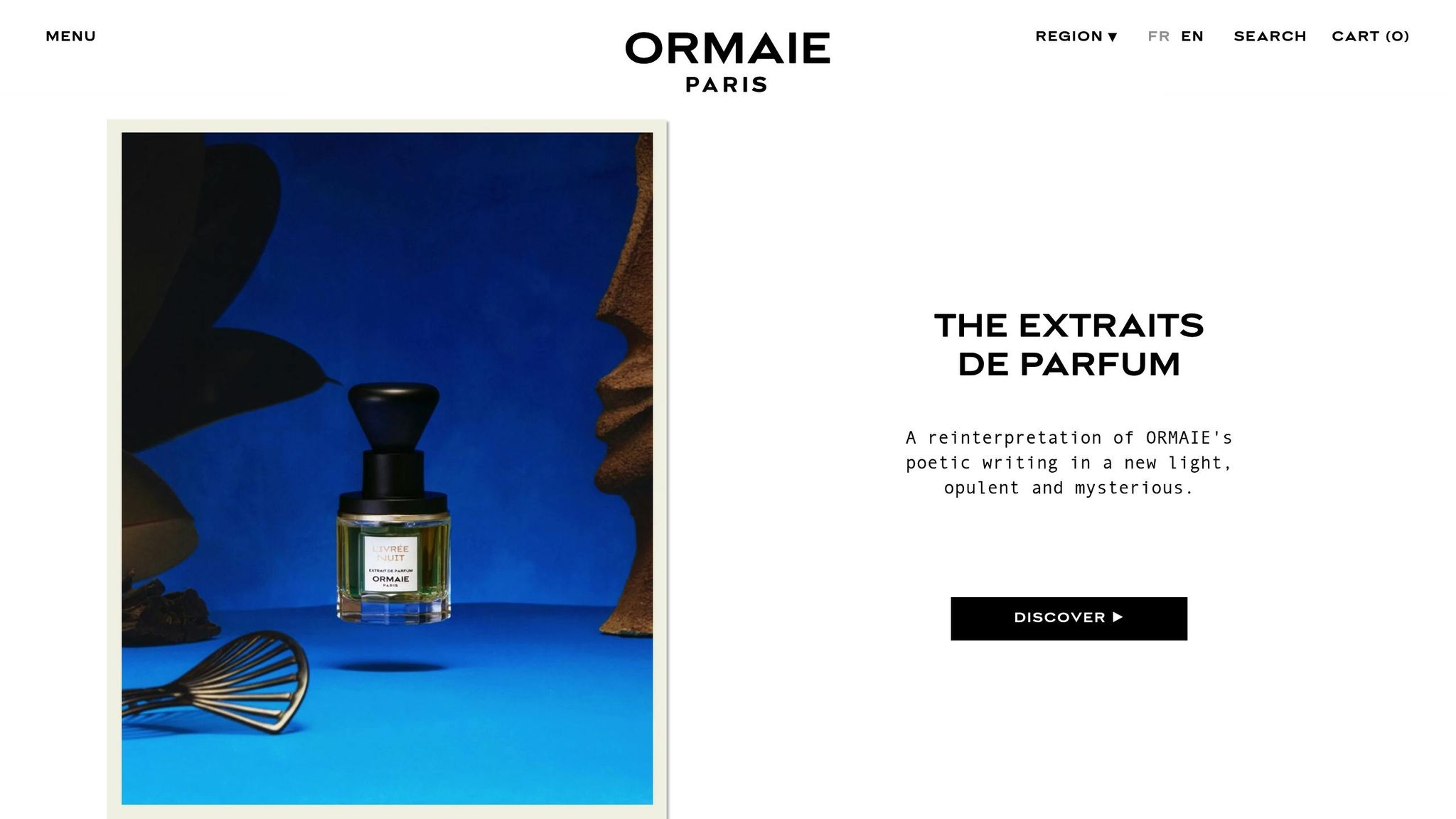
Ormaie practices what they call "slow perfumery", allowing their formulas to mature for months to ensure every detail is perfected. This dedication is mirrored in their packaging. Each bottle is crafted with 12 facets, symbolizing the 12 hours of the day, and topped with hand-carved caps made from renewable beechwood. The labels are gold-stamped on vintage machines in Paris, while the glass bottles are produced by the only French manufacturer that recycles its own magma. Every element reflects a commitment to artistry and sustainability.
Use of High-Quality, Rare, and Natural Ingredients
Ormaie places a strong emphasis on natural ingredients, with most of their collection crafted from 100% natural materials. They source rare components, such as shea butter for 28° and specialized lavender varieties for Le Passant. In their Extraits line, they incorporate about 5% synthetics to achieve a level of precision that nature alone cannot provide. Baptiste explains this approach:
"Nature doesn’t allow shortcuts. It asks for time, precision, and deep understanding."
The brand’s eco-conscious efforts extend to offering refillable 20 ml bottles with glass ampoules. Pricing reflects their meticulous craftsmanship, ranging from about €70 for discovery sets to €290–€340 for 100 ml bottles.
6. L’Artisan Parfumeur
Brand Heritage and Storytelling
L’Artisan Parfumeur, established in 1976 by Jean-François Laporte, played a key role in shaping the niche fragrance industry. At a time when niche vs designer perfumes had yet to be clearly defined and mass-market scents dominated, Laporte shifted the narrative by prioritizing artistic expression over commercial appeal. The brand introduced groundbreaking fragrances like Premier Figuier, the first to spotlight fig as a central note, and Mûre et Musc, which was among the first to highlight blackberries. Mûre et Musc became so iconic that it earned the nickname "the fragrance of the Parisian woman".
Craftsmanship and Artistry in Scent Creation
L’Artisan Parfumeur’s legacy is rooted in its dedication to creative freedom. The brand collaborates with master perfumers such as Jean-Claude Ellena, Anne Flipo, and Olivia Giacobetti, allowing them to work without commercial restrictions. Olivia Giacobetti, reflecting on her experience, shared:
"When I was just starting, [L’Artisan] was a completely different style of perfumery, simultaneously figurative and sensitive... Everything was allowed!"
For her creation of Premier Figuier, she received minimal direction, ensuring maximum creative liberty. This ethos is evident in the Natura Fabularis collection, where each bottle features a number prefix indicating how many iterations were needed to perfect the scent. For example, 2 Violacea required only two modifications, while 60 Mirabilis went through sixty rounds of refinement.
Use of High-Quality, Rare, and Natural Ingredients
L’Artisan Parfumeur places a strong emphasis on natural ingredients and traditional methods. Their "Grand Cru" limited editions are crafted from annual harvests, showcasing their dedication to quality. For instance, producing one kilogram of pure iris extract demands an astounding 41 tons of iris root. In Bucoliques de Provence, perfumer Fabrice Pellegrin honored the heritage of Grasse by blending lavender with a leather accord, inspired by the 16th-century tradition of scenting leather with flower macerations - a practice linked to Catherine de Medici.
Standard fragrances are priced at approximately €165 per bottle, while limited editions range from €250 to €295 for a 3.4-oz bottle. This pricing reflects the brand’s commitment to craftsmanship and the use of premium materials.
7. Le Labo
Brand Heritage and Storytelling
Le Labo debuted in 2006 with a bold idea: creating fragrances freshly blended by hand at the time of purchase. Founded by Eddie Roschi and Fabrice Penot in New York City, the brand reshaped the perfume world by introducing a working "lab" concept in its retail spaces. This setup focused on raw simplicity rather than traditional luxury aesthetics. Although Estée Lauder acquired Le Labo in 2014, the brand has stayed true to its artisanal roots, maintaining its unique identity and dedication to craftsmanship.
Craftsmanship and Artistry in Scent Creation
Every Le Labo fragrance is meticulously hand-mixed, labeled, and packaged, ensuring a personal touch in each bottle. Customers can even personalize their labels, though the default reads "For: You" if no customization is requested. As Rodrigo Ortiz of Viti Vinci remarked:
"Le Labo infuses artisan perfumery with a modern, industrial aesthetic".
This hands-on process not only adds a personal element but also ensures a level of quality control that mass production simply cannot match.
Use of High-Quality, Rare, and Natural Ingredients
Le Labo’s straightforward naming system reflects its ingredient philosophy: the number in each scent’s name represents the total number of components in its formula. For instance, Santal 33 contains exactly 33 ingredients, including sandalwood, cedarwood, cardamom, iris, violet, and ambrox. The brand prioritizes rare and costly materials that many mainstream fragrances avoid due to budget constraints. This commitment underscores the brand’s focus on quality and originality over traditional marketing strategies.
Distinctive Fragrance Profiles
Le Labo’s fragrances are celebrated for their earthy, musky, and woody notes, steering away from overly sweet compositions. Santal 33, one of its most iconic scents, has been likened to "a crackling fire and cashmere PJs", thanks to its blend of woody earthiness, violet, iris, and leather. Baie 19 captures the smell of petrichor - the aroma of wet earth after rain - through juniper berry, patchouli, and green leaves. Another 13, originally created for AnOther Magazine in 2010, features a bold dose of Ambroxan paired with jasmine and moss. With standard bottles priced at around €335–€340 for a 3.4‑oz size, Le Labo reflects its dedication to premium ingredients and craftsmanship.
Conclusion
The artisan perfume world represents the pinnacle of olfactory craftsmanship, turning fragrances into deeply personal narratives. Unlike designer brands that often follow fleeting market trends, these niche houses prioritize artistry, utilizing rare materials and limited production to create scents that stand apart.
This dedication to quality has sparked a notable shift in the fragrance landscape. For instance, about 66% of the indie fragrance market now embraces gender-neutral scents, aligning with a broader movement that values thoughtful creation over mass production.
Experts recommend sampling an indie fragrance at least three times to fully grasp its complexity, as niche ingredients can evolve uniquely depending on factors like skin chemistry and weather. Thankfully, many artisan brands offer accessible options like 10ml travel sprays or curated sample sets, making it easier to explore their distinct styles without a hefty investment.
To begin your journey, focus on identifying the fragrance families you naturally gravitate toward - whether that’s amber, woody, or floral profiles. Iconic houses such as Amouage, Serge Lutens, Diptyque, Frederic Malle, Ormaie Paris, L’Artisan Parfumeur, and Le Labo each bring their own unique vision to the table, enriching this ever-evolving story. Exploring these scents allows you to celebrate individuality, offering an opportunity to stand out rather than blend in.
FAQs
What makes a perfume house “artisan”?
An artisan perfume house is all about celebrating craftsmanship and artistry. These creators focus on using high-quality or rare ingredients, often producing fragrances in small batches to ensure every detail is perfect. The emphasis is on quality rather than quantity, resulting in scents that feel deeply personal and unique.
What truly sets these houses apart is their dedication to storytelling and exploring new techniques. They often incorporate unconventional ingredients, crafting fragrances that feel more like wearable art than just another product. This meticulous attention to detail and a commitment to exclusivity reflect the creator’s vision, offering creations that challenge and expand the boundaries of traditional perfumery.
How do I choose which house to sample first?
When diving into the world of fragrances, start by reflecting on what appeals to your personal taste and the distinctive characteristics of various perfume houses. For those drawn to luxurious, bold compositions, Amouage offers a range of rich, statement-making scents. If you lean toward adventurous and avant-garde creations, Serge Lutens delivers intriguing and unconventional options. If you’re just beginning to explore niche perfumes, Diptyque provides a great starting point with its approachable yet refined offerings. Sampling curated sets or popular favorites can also be a smart way to explore and identify the scents that truly resonate with you before investing in a full-sized bottle.
How can I try these scents without buying a full bottle?
Trying artisan scents can be a fun and affordable way to discover your next favorite fragrance. Options like 2 ml, 5 ml and 8 ml vials, and a 30 ml bottle decant on most perfumes let you experience a scent without the commitment of purchasing a full bottle. Many perfume houses and curated services offer these sizes, often as part of discovery sets or subscription plans, making it simple to explore a variety of fragrances before deciding to invest in a larger bottle.

