Belgium now leads the EU in perfume consumption per capita, with 1.486 kg per 1,000 people projected for 2026. This surpasses traditional leaders like France and Germany, showcasing Belgium’s growing demand for fragrances as part of daily routines. Key drivers include increased purchasing power, premium product preferences, and expanded physical retail spaces like Douglas stores. The Benelux region’s perfume market reached €1.3 billion in 2025, with a growth rate of 5.39% CAGR expected through 2034.
Key Highlights:
- Per-capita use: Belgium tops the EU with 1.486 kg per 1,000 population in 2026.
- Market value: Benelux region valued at €1.3 billion in 2025, growing to €2.09 billion by 2034.
- Retail trends: Physical stores dominate, making up 63.1% of fragrance purchases in 2024.
- Consumer shifts: Strong demand for premium fragrances over mass-market options.
- Cultural habits: Fragrance is an everyday essential, not just a luxury or gift.
Belgium’s central location between fragrance hubs like France and the Netherlands further strengthens its position as a key player in the EU fragrance trade.
Belgium Perfume Market Statistics 2026: Consumption, Growth & Demographics
Belgium’s Highest Per — Capita Fragrance Consumption in the EU
Consumption Statistics
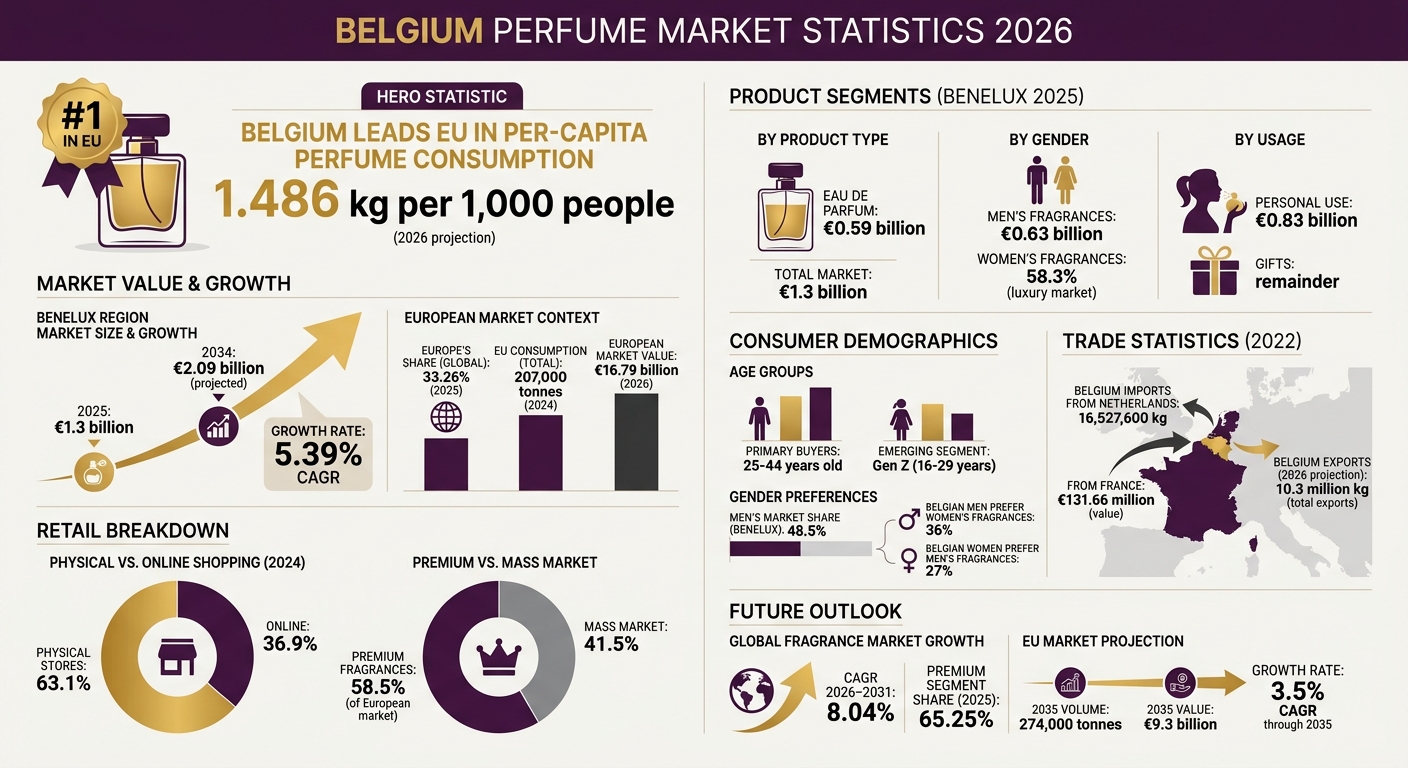
Belgium stands out in the EU with a per-capita fragrance consumption of 1.486 kg per 1,000 population projected for 2026. This remarkable figure highlights how fragrances have evolved from being an occasional indulgence to becoming a daily essential for many Belgians.
While Europe commands a 33.26% share of the global fragrance market in 2025, Belgium’s individual consumption patterns reveal a unique enthusiasm for scents. Although larger markets lead in total volume, Belgium’s per-capita consumption showcases a distinct and deeply rooted consumer behaviour. To put this into perspective, the EU’s total consumption of perfumes and toilet waters reached 207,000 tonnes in 2024, with the European market valued at €16.79 billion by 2026. Within this context, Belgium’s exceptional per-capita performance highlights its particularly fragrance-savvy population.
This high level of consumption is closely tied to economic trends that have shaped the market in recent years.
Economic and Market Factors
Belgium’s leadership in fragrance consumption can be attributed to several key economic factors. As a high-income, developed nation, it aligns with the broader European trend where wealthier countries tend to spend more on fragrances. By 2026, as purchasing power constraints eased, Belgian consumers increasingly gravitated toward premium fragrances, moving away from alternatives like deodorants and body mists.
Retail trends also played a significant role. The expansion of physical stores, such as Douglas opening four new locations in Belgium between 2023 and 2024, catered to the demand for in-store testing and purchasing. Offline retail maintained its dominance, accounting for 63.1% of the European fragrance market in 2024.
The Benelux region, which includes Belgium, the Netherlands, and Luxembourg, further underscores this robust market. The region’s fragrance market reached €1.3 billion in 2025, with projections to grow to €2.09 billion by 2034 at a compound annual growth rate of 5.39%. Within this market, Eau de Parfum led with €0.59 billion in sales, while men’s fragrances accounted for €0.63 billion in 2025. Additionally, premium fragrances captured a 58.5% share of the European market in 2024, reflecting Belgium’s shift toward higher-end products.
These economic trends, coupled with strategic retail investments, have firmly positioned Belgium as a leader in the fragrance industry. The country’s strong consumer spending and affinity for premium scents illustrate why fragrances are such an integral part of daily life for many Belgians.
Why Belgians Buy More Perfume: Cultural Factors
Belgium’s affinity for fragrance runs deep, rooted in cultural traditions where scent becomes a vital part of identity and social interaction. For Belgians, perfume isn’t just an occasional treat - it’s woven into the fabric of daily life, making it a consistent and essential element of self-expression.
The country’s unique position at the intersection of French and Dutch influences has shaped a heightened appreciation for refined personal grooming. This cultural backdrop has led to the widespread belief that a carefully chosen fragrance is as indispensable as any other aspect of daily presentation.
Perfume in Daily Grooming Routines
For many Belgians, applying fragrance is as routine as brushing their teeth. This daily ritual reflects a broader cultural expectation of polished personal presentation, often leaning towards premium products. Between 2023 and 2024, this trend became even more pronounced when Douglas opened four new stores across Belgium, catering to the growing demand for in-store fragrance testing and tailored recommendations.
The numbers back this up. In the Benelux region’s €1.3 billion fragrance market in 2025, personal use accounted for €0.83 billion. This highlights how Belgians primarily buy fragrances for themselves rather than just as gifts. The preference for Eau de Parfum, which captured €0.59 billion of the market, further underscores their desire for long-lasting and concentrated scents that can carry them through a busy workday.
While daily use dominates, fragrance also holds a special place in gift-giving traditions.
Perfume as a Luxury Gift
Perfume has long been a favourite luxury gift in Belgium, particularly for women. It remains the most gifted personal luxury item across Europe. In 2025, women’s fragrances made up 58.3% of the European luxury market, driven largely by this ritual of gifting.
When it comes to gifts, Belgians often opt for premium formulations. The "Parfum" segment, projected to grow at a CAGR of 8.23% through 2031, is especially popular for milestone celebrations and special occasions. Its appeal lies in its association with prestige, enhanced by elegant packaging, complex scent profiles, and curated fragrance sets. These elements make perfume a go-to choice for expressing gratitude or affection.
This gifting culture also creates predictable shopping patterns, with a surge in fragrance purchases during the final quarter of the year, coinciding with holidays and personal celebrations.
Who Buys Perfume in Belgium: Demographics
Belgium stands out as the EU leader in per-capita fragrance consumption, and its diverse demographic makeup plays a key role in driving this trend. By examining the age groups, gender preferences, and regional influences, we can better understand the dynamics shaping Belgium’s fragrance market. The consumer profile in Belgium is notably varied, with the majority of buyers falling within the 25–44 age range. This group, equipped with established grooming routines and disposable income, tends to gravitate toward premium options like Eau de Parfum, valued for its lasting scent and cost-effectiveness per use.
Meanwhile, Generation Z (ages 16–29) is quickly emerging as a critical driver of growth. This younger demographic leans toward fragrances that reflect personal identity rather than adhering to traditional gendered marketing. In the broader Benelux region, which includes Belgium, the men’s fragrance market alone is projected to hit €0.63 billion by 2025, highlighting the increasing influence of male consumers. Interestingly, surveys reveal that 36% of Belgian men are drawn to fragrances marketed toward women, while 27% of Belgian women prefer scents traditionally targeted at men. These statistics point to a growing shift away from rigid fragrance norms.
Age and Gender Breakdown
Older consumers in Belgium tend to favor well-known brands and prefer the tactile experience of in-store shopping. On the other hand, Gen Z shoppers are discovering new scents through social media platforms like TikTok and Instagram, showcasing a generational shift in how fragrances are marketed and purchased.
Gender preferences are also evolving. Although men’s fragrances make up about 48.5% of the Benelux market, traditional ideas still influence purchasing behavior. For instance, one in three Belgians believes it’s inappropriate for men to wear perfumes marketed toward women. However, brands like MIGLOT are actively challenging these outdated norms. Kristof Lefebre, founder of MIGLOT Parfums, emphasizes:
"At MIGLOT Parfums, we want you to feel free to wear what makes you happy. That’s why all our perfumes are gender-free... The concept of gender-neutral perfumes isn’t a trend; it’s the new normal."
This shift is particularly noticeable among younger buyers, who are more inclined to ignore gender labels when selecting fragrances.
Urban vs. Rural Buying Patterns
Geography significantly impacts fragrance-buying habits in Belgium. Urban consumers, especially in cities like Brussels and Antwerp, view fragrance as part of their lifestyle. They prioritize scent composition and brand storytelling, often seeking out exclusive editions and heritage brands through immersive retail experiences, such as fragrance bars and boutique shops. Notably, physical stores remain dominant, accounting for 63.1% of European fragrance purchases.
In rural areas and smaller cities, shoppers increasingly turn to online platforms to access niche and premium brands that aren’t readily available locally. The Benelux online fragrance market is expected to grow to €0.80 billion by 2025, driven largely by rural consumers seeking greater variety. This urban–rural divide shapes not only where people shop but also their preferences. Urban buyers lean toward higher-end concentrations like Parfum and Eau de Parfum, while rural consumers focus on accessibility and variety.
Best — Selling Perfume Brands in Belgium
Belgium’s fragrance market is led by luxury powerhouses like LVMH, L’Oréal, Chanel, and Coty. The Benelux perfume market, which includes Belgium, was valued at approximately 1.3 billion USD in 2025 and is expected to grow at an annual rate of 5.39%, reaching 2.09 billion USD by 2034. Premium fragrances dominate, holding 58.5% of the European market share, which highlights Belgian consumers’ preference for high-end, luxurious options. This strong focus on premium brands provides insight into how both global leaders and niche players are shaping Belgium’s fragrance scene.
Major International Brands
Belgium’s affinity for premium products keeps international luxury brands at the forefront of the market. LVMH stands out with iconic names like Dior and Guerlain, while L’Oréal’s portfolio includes Yves Saint Laurent and Lancôme. Other key players, such as Estée Lauder, Coty, and Puig, contribute with brands like Paco Rabanne and Carolina Herrera. These companies benefit from their established reputations, as Belgian consumers often associate their trust in these brands’ fashion and beauty lines with their fragrance offerings.
Economic stability has also played a role, shifting Belgian preferences towards premium fragrances rather than mass-market alternatives.
Growth of Niche Fragrance Brands
While luxury giants dominate, there’s a rising interest in niche and artisanal fragrances, reflecting Belgium’s growing desire for individuality. Globally, niche brands account for about 20% of perfume sales, and Belgian consumers are increasingly drawn to their unique compositions, compelling stories, and exclusivity. These fragrances cater particularly to urban buyers seeking distinctive olfactory experiences.
Retail innovation is also influencing this shift. AI-based tools are helping consumers explore and discover exclusive scents without relying solely on in-store sampling. Additionally, stricter European regulations on synthetic ingredients are prompting both major and niche brands to reformulate their products to align with "clean beauty" standards. This trend has opened doors for smaller brands that emphasize transparent ingredient sourcing, giving them a stronger foothold in the market.
Your Personal Fragrance Expert Awaits
Take our quick scent quiz to discover authentic designer and niche fragrances matched to your taste — explore them as 2–8ml decants and samples, so you can try each one before committing to a full bottle.
Find Your ScentFrance and Netherlands Border Effects
Belgium’s central position between key European markets plays a pivotal role in its thriving perfume trade. In 2022, the country imported a staggering 16.527.600 kg of fragrance products from the Netherlands, making it the top supplier by volume. At the same time, Belgium brought in €131,66 million worth of premium French fragrances, showcasing the Netherlands’ logistical efficiency alongside the enduring allure of French luxury in the Belgian market. These figures highlight Belgium’s unique position as both a consumer and exporter within this dynamic trade network, setting the stage for its influence on pricing and export trends.
Export Volumes to France and the Netherlands
Belgium’s projected perfume exports, expected to reach 10,3 million kg by 2026, underline its strategic importance in the regional fragrance market. The Benelux fragrance market, valued at €1,23 billion in 2025, is forecasted to grow to €1,98 billion by 2034. This growth is supported by EU regulations that simplify cross-border trade, creating a seamless corridor between France, Belgium, and the Netherlands.
Trade data further emphasizes Belgium’s balancing act between imports and exports. In 2024, the Netherlands exported 3.881.190 kg of perfumery products to Belgium, while France contributed slightly less, at 3.736.390 kg. These volumes not only reinforce Belgium’s role as a trade hub but also highlight the interplay of pricing and consumer preferences within the region.
Price Differences and Cross — Border Shopping
Economic challenges, particularly during the 2023 inflation crisis, have amplified Belgian consumers’ sensitivity to pricing. Retailers have adapted by expanding physical store networks to meet demand for hands-on shopping experiences and promotional deals. For instance, German beauty retailer Douglas opened its first brick-and-mortar store in Belgium in 2023, marking a response to these shifting consumer habits.
"In the context of the inflation crisis, in 2023, consumers showed a tendency to frequent physical stores in search of promotions and lower prices." – Euromonitor
This focus on affordability drove retail price reductions in 2025, spurring volume growth despite only modest increases in overall market value. At the same time, Belgian consumers increasingly engaged in cross-border shopping, comparing prices at French and Dutch retailers. As inflationary pressures ease, the premium fragrance segment - currently commanding 58,5% of the European market - is expected to regain traction by 2026. However, mass-market alternatives like body mists remain popular among budget-conscious shoppers, reflecting a diverse and evolving market landscape .
Belgian Perfume Market Forecast to 2030
Belgium’s fragrance market is on a growth trajectory, driven by recovering consumer confidence and rising demand for premium products. The Benelux perfume and fragrances market, valued at €1.3 billion in 2025, is expected to grow to €2.09 billion by 2034, reflecting a compound annual growth rate (CAGR) of 5.39%. This growth rate surpasses the European Union’s average of 3.5% through 2035, highlighting Belgium’s pivotal role in the regional fragrance landscape. These trends provide a framework for assessing broader European and global market dynamics.
European and Global Market Growth
The EU’s perfume market is projected to expand at a CAGR of 3.5% through 2035, with total volume anticipated to reach 274,000 tonnes by that year. Belgium’s above-average growth rate underscores its dual role as a leading consumer market and a hub for cross-border trade, thanks to its strategic location near major neighbouring markets.
Globally, the fragrance market is forecast to grow at a CAGR of 8.04% between 2026 and 2031. This growth is largely driven by the premium segment, which is expected to account for 65.25% of total sales in 2025. Belgium, with its high per-capita fragrance consumption, is well-positioned to capitalise on this trend, particularly as consumer purchasing power begins to recover from recent inflationary pressures.
Risks and Opportunities for Belgium
While growth prospects are strong, the Belgian market does face some near-term challenges. Belgium’s established reputation as a per-capita leader and a key player in cross-border fragrance trade provides a solid foundation, but emerging hurdles must be addressed. Retail value growth in 2025 is predicted to slow compared to 2024 due to unit price deflation. This trend reflects ongoing consumer caution and increased competition from mass-market alternatives like body mists and deodorants, which gained popularity during the 2023 inflation crisis.
From 2026 onwards, the outlook brightens. Premium fragrances are expected to regain traction as economic conditions stabilise and consumer spending loosens. The expansion of physical retail spaces also presents a significant opportunity, as shoppers increasingly seek in-person fragrance experiences. As Euromonitor International observes:
As consumers become less conservative in their spending, the performance of premium fragrances is set to become increasingly dynamic.
Looking ahead, the market is likely to see a growing divide between niche luxury offerings and more affordable mass-market products. While Eau de Parfum remains the dominant segment, Eau de Cologne is expected to be the fastest-growing category through 2034. Belgium’s rich fragrance heritage and discerning consumer base will play a key role in driving value across both premium and mass-market sectors as the decade unfolds.
Conclusion
Belgium’s role as the EU’s leader in per-capita fragrance consumption by 2026 reflects a unique blend of cultural priorities, geographic advantages, and shifting consumer preferences. For Belgians, fragrance isn’t just a part of daily grooming - it’s deeply tied to personal expression, gifting customs, and everyday rituals.
With the market projected to reach €2.09 billion by 2034, the growth trajectory highlights the resurgence of premium fragrances. The renewed focus on physical retail further cements Belgium’s importance as a key player for European fragrance retailers.
Beyond its borders, Belgium’s strategic location - nestled between fragrance powerhouses like France and high-demand neighbors - has positioned it as a pivotal hub in the European fragrance trade. The country’s ability to balance widespread appeal with the growing trend of luxury premiumisation reflects broader shifts across the continent. This dual focus not only shapes domestic consumption but also underscores Belgium’s role in influencing cross-border trends.
However, the market isn’t without its challenges. Increased regulatory scrutiny on fragrance ingredients and the push for sustainability under the European Commission’s Horizon 2020 Strategy present both obstacles and opportunities. As the EU fragrance market edges towards €9.3 billion by 2035, Belgium’s performance will serve as a key indicator of how premiumisation and consumer confidence evolve across Europe.
Belgium’s leadership in the fragrance sector is a testament to its cultural emphasis on scent, robust purchasing power, and forward-thinking retail strategies, solidifying its status as a trendsetter in the European market.
FAQs
How is “1.486 kg per 1,000 people” calculated for perfume use?
The statistic "1.486 kg per 1,000 people" comes from dividing Belgium’s total perfume consumption by its population and then multiplying the result by 1,000. This figure represents the average amount of perfume used per person across the country.
Why do Belgians prefer buying perfume in shops rather than online?
Belgians tend to favour buying perfume in physical stores. This preference stems from the opportunity to test scents directly, allowing them to experience the fragrance on their skin before making a decision. Additionally, they value the personalised advice offered by in-store experts, which helps guide them toward the perfect choice. The premium shopping experience, often associated with luxury and attention to detail, also enhances the appeal of purchasing in person. These elements highlight the importance of sensory engagement and a touch of exclusivity in their fragrance-buying habits.
How do French and Dutch borders affect perfume prices in Belgium?
Perfume prices in Belgium often reflect the effects of cross-border shopping, especially near the French and Dutch borders. Variations in excise duties and differing market conditions between these neighbouring countries can create noticeable price differences. This dynamic frequently influences how and where consumers choose to purchase, with many opting to shop across the border for better deals. Such patterns in cross-border shopping can, in turn, affect local pricing strategies and market trends within Belgium.