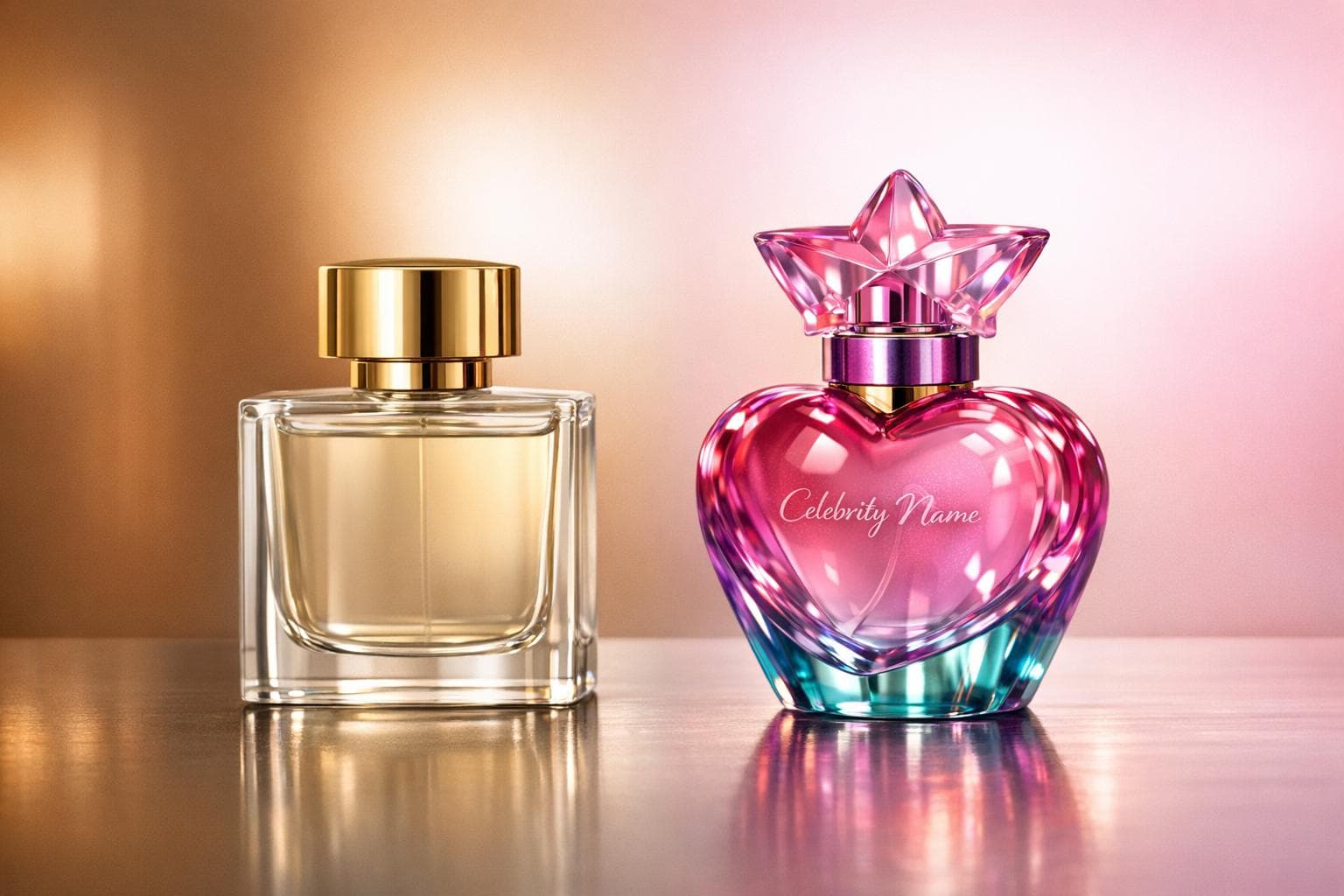
Celebrity fragrances and designer exclusives represent two distinct worlds in the perfume market. Celebrity scents are affordable, widely available, and often tied to the allure of famous personalities, with prices ranging from €30 to €100. Designer exclusives, on the other hand, prioritize luxury, rare ingredients, and artistry, with prices starting at €300 and reaching well over €600.
Key differences include:
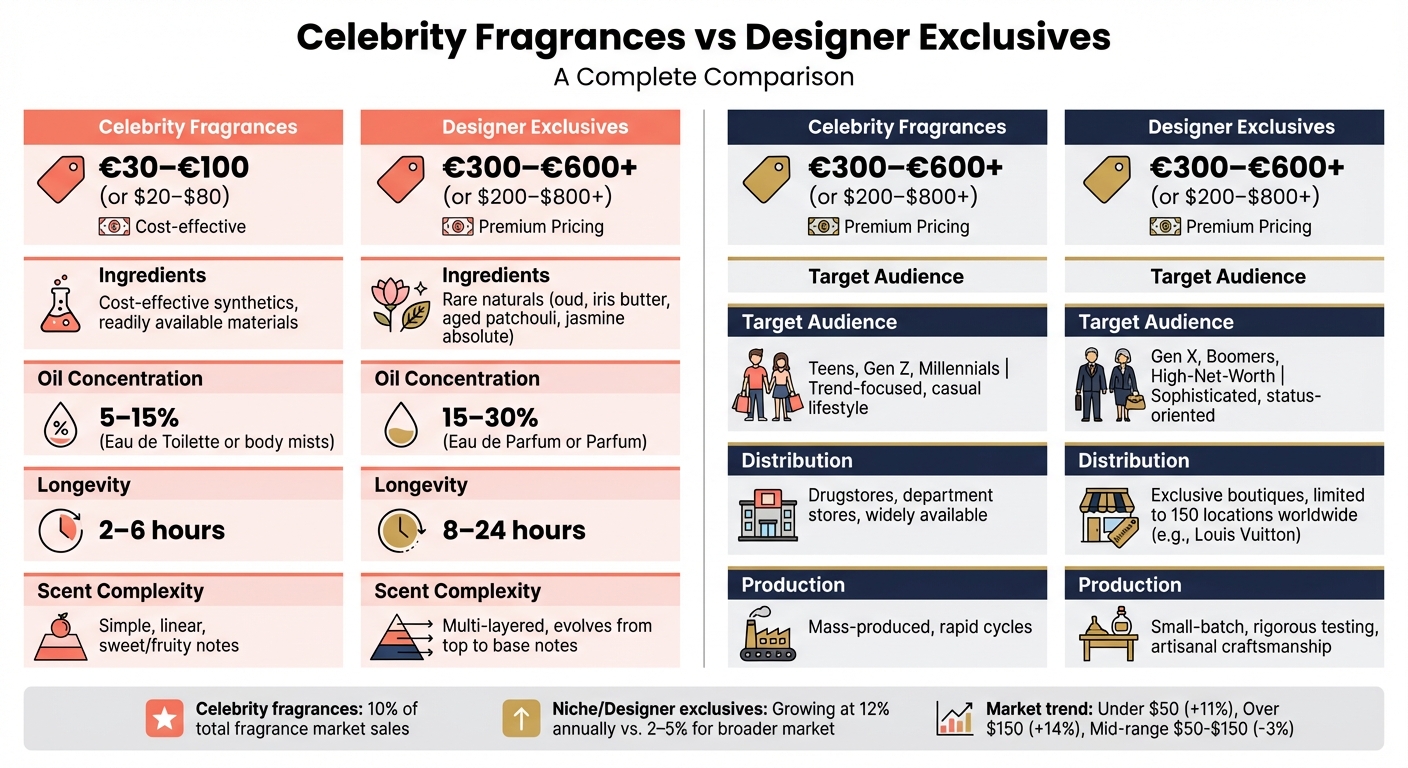
- Price: Celebrity fragrances (€30–€100) vs. designer exclusives (€300–€600+).
- Ingredients: Celebrity scents use cost-effective synthetics, while designer exclusives feature rare, high-quality materials like oud and iris.
- Longevity: Designer exclusives last 8–24 hours, compared to 4–6 hours for celebrity options.
- Target audience: Celebrity scents appeal to younger, trend-focused buyers, while designer exclusives cater to affluent, discerning consumers.
The market reflects a growing divide, with budget-friendly and high-end options thriving, while mid-range offerings decline. Whether you seek everyday accessibility or refined luxury, your fragrance choice reflects personal style and priorities.
Celebrity Fragrances vs Designer Exclusives: Complete Comparison Guide
What Are Celebrity Fragrances?
Celebrity fragrances are perfumes and colognes created in collaboration with public figures like singers, actors, athletes, and reality stars. These scents often carry the celebrity’s name and image, offering fans an affordable way to feel closer to their favorite stars. For many, owning a celebrity fragrance is like owning a piece of their idol’s lifestyle - an accessible touch of glamour wrapped up in a moderately priced bottle. This unique appeal makes celebrity fragrances a cornerstone of branding strategies.
One major advantage of celebrity fragrances is the instant trust they inspire among consumers. Carlos Timiraos, VP of Global Marketing at Coty Prestige, highlights this:
The beauty of a celebrity, unlike a designer brand, is there is consumer knowledge of this brand or product from the moment you hit the counter.
This built-in recognition not only reduces advertising costs but also guarantees immediate market appeal. It’s no surprise that celebrity fragrances make up around 10% of total fragrance sales.
Main Characteristics of Celebrity Fragrances
Celebrity fragrances are designed to appeal to a broad audience, often featuring universally loved notes like vanilla, fruity accords, musk, and amber. These familiar and crowd-pleasing ingredients are cost-effective, which helps keep production expenses low. This affordability translates to accessibility, as these fragrances are commonly available in drugstores, department stores, and online shops - perfect for impulse purchases or gifts.
Typically, celebrity fragrances are priced between $30 and $100, though recent launches are starting to compete with designer brands in both price and quality. For instance, Billie Eilish’s Eilish and Rihanna’s Fenty Eau de Parfum signal a shift toward premium offerings within this category.
Examples of Popular Celebrity Fragrances
The success of celebrity fragrances is evident in their sales figures. Jennifer Lopez’s Glow, launched in 2002, shattered expectations by earning $100 million in its first year - far outpacing the $20 million initially projected. Similarly, Britney Spears’s Curious sold over 500 million bottles worldwide and brought in $100 million within just five weeks of its release in 2004.
Some celebrity fragrances have achieved remarkable longevity. Elizabeth Taylor’s White Diamonds, for example, generated $54 million in 2011, two decades after its debut. Beyoncé’s Heat, crafted by Givaudan‘s Claude Dir and Olivier Gillotin, made a splash by earning $3 million at Macy’s in its first month and raking in over $400 million between 2010 and 2013.
Other notable examples include Ariana Grande’s Cloud, created with renowned perfumer Jérôme Epinette, and David Beckham’s Instinct, both of which remain fan favorites. Rihanna’s Reb’l Fleur, launched in 2011, was projected to earn $80 million on its own, further cementing the staying power of celebrity perfumes. These successes underscore the enduring allure of celebrity-backed scents in the fragrance market.
What Are Designer-Exclusive Fragrances?
Designer-exclusive fragrances are the luxury tier of the perfume world, crafted by high-end fashion houses for those with a taste for the extraordinary. Unlike mainstream scents designed for mass appeal, these collections focus on artistry and exclusivity, bypassing traditional retail channels entirely. Think of them as the haute couture of the fragrance industry - rare, refined, and deeply personal.
What sets these fragrances apart is their meticulous attention to detail. Unlike standard designer scents that balance natural and synthetic ingredients to keep costs manageable, exclusives rely on rare and precious materials like jasmine absolute, aged patchouli, and oud - ingredients often too costly for large-scale production. These perfumes also feature a higher concentration of perfume oils, typically 15–30%, compared to the 5–15% found in regular scents. The result? Longer-lasting wear - 8 to 24 hours versus the 4 to 6 hours typical of department store options.
Another hallmark of these fragrances is their limited distribution. Fashion houses intentionally restrict availability to their own boutiques or select luxury retailers. For example, Louis Vuitton offers its fragrances in just 150 locations worldwide, a fraction of its total store network. This scarcity creates what Louis Vuitton’s Chief Executive Michael Burke describes as "inclusive exclusivity":
"It’s about inclusive exclusivity. Dichotomy is the essence of the luxury brand".
Main Characteristics of Designer Exclusives
Designer-exclusive fragrances stand out for their creativity and boldness. Unlike mainstream scents, which often play it safe, these collections allow perfumers the freedom to experiment with unique and sometimes unconventional ingredients. For instance, Loewe has incorporated notes like beetroot and tomato into its high-end offerings, while other brands describe their creations with imaginative terms like "steamed rainbow". This adventurous spirit resonates particularly with younger consumers who prioritize individuality and craftsmanship over mass appeal.
The use of premium ingredients further justifies the higher price points. For example, it takes 500 kilograms of iris bulbs to produce just 1 kilogram of essential oil, and genuine oud is sourced from only 2% of agarwood trees. Master Perfumer Nathalie Feisthauer explains the philosophy behind this approach:
"Niche perfumery allows a more sincere, unrestricted form of creation and lets creators use exquisite raw materials which larger companies might find economically unviable".
These fragrances are often produced in small batches, sometimes as few as a few hundred bottles, ensuring exceptional quality and artisanal craftsmanship. Combined with their premium ingredients and higher concentrations, they deliver a performance that far surpasses standard perfumes. It’s no surprise that the niche fragrance market is growing at nearly 12% annually, outpacing the broader perfume market’s 2–5% growth.
Examples of Designer-Exclusive Fragrances
Several collections exemplify the sophistication of designer-exclusive fragrances. Tom Ford Private Blend, for instance, was a trailblazer in this space, setting the standard for luxury scent lines. Its unique profiles, distinct from Tom Ford’s more accessible offerings, have made the collection highly sought after. Discontinued bottles like Amber Absolute have even fetched prices as high as $4,300 on secondary markets.
Chanel Les Exclusifs is another standout, embodying the brand’s rich heritage through the use of ultra-rare ingredients. Among its offerings is the Grand Extrait, priced at approximately $4,200 per ounce, a testament to its exceptional quality and exclusivity.
Recent launches show how traditional luxury houses are expanding their presence in this niche category. In 2024, Rabanne debuted La Collection Rabanne with prices starting at $315, while Balmain introduced Les Éternels at $300. Bottega Veneta also entered the scene with a line priced at around $467 (£350). Ariel Ohana, Managing Partner at Ohana & Co, highlights the strategy behind these moves:
"There’s a clear intent not to disrupt [what they have], but to compete in a new tier".
Other notable entries include the Dior Maison Christian Dior Collection and Jil Sander Olfactory Series 1, the latter known for its unconventional scent combinations and striking bottle designs. Collectively, these exclusive lines have significantly boosted the niche fragrance market, adding nearly $250 million in value over three years, even as celebrity fragrances have waned in popularity.
Target Audience and Appeal
Celebrity fragrances and designer exclusives cater to two distinctly different groups, each with its own preferences and lifestyles. Celebrity scents are designed for teens, Gen Z, and millennials who are drawn to their affordability and the allure of a famous name. These fragrances offer fans a way to feel connected to their favorite stars, often serving as an accessible gateway into the celebrity’s world and persona.
On the other hand, designer exclusives appeal to older adults and affluent collectors who prioritize elegance and craftsmanship. These consumers aren’t chasing fleeting trends but are instead curating collections that reflect their refined tastes and social stature. As Don Loftus, President of Parlux Ltd, puts it:
Customers who would [previously] never have dreamed of buying a $250 fragrance [now] are, because they are so special.
The occasions for wearing these fragrances also differ. Celebrity scents are perfect for everyday use, offering a casual and approachable option, while designer exclusives are saved for formal events, professional settings, or moments that call for a memorable impression.
Appeal Comparison Table
Here’s a side-by-side look at what makes these two fragrance types stand out:
| Feature | Celebrity Fragrances | Designer Exclusives |
|---|---|---|
| Primary Age Group | Teens, Gen Z, Millennials | Gen X, Boomers, High-Net-Worth Individuals |
| Lifestyle | Accessible, casual | Sophisticated, status-oriented, professional |
| Usage Occasions | Daily wear, casual social settings | Formal events, business meetings, signature moments |
| Key Appeal | Fandom, accessibility, trend-alignment | Status, artistry, ingredient quality |
| Scent Profile | Sweet, fruity, gourmand, fun | Complex, woody, oriental, refined |
These distinctions highlight the mass-market appeal of celebrity fragrances, driven by fandom and affordability. For instance, during peak retail periods, Britney Spears’s Curious sold one bottle every 15 seconds, and Beyoncé’s Heat moved an astonishing 72,000 bottles in its first hour at Macy’s in 2010. In contrast, designer exclusives are all about rarity and the prestige of owning something truly special.
Your Personal Fragrance Expert Awaits
Take our quick scent quiz to discover authentic designer and niche fragrances matched to your taste — explore them as 2ml, 5ml, 8ml & 30ml decants and samples, so you can try each one before committing to a full bottle.
Find Your ScentPrice Differences
The price disparity between celebrity fragrances and designer exclusives is striking. Celebrity perfumes generally fall within the $20 to $80 range, making them an affordable option for teens and young adults on tighter budgets. In contrast, designer exclusives start at approximately $200 and can exceed $800, particularly for limited-edition collections. Custom blends can even surpass $1,000, reflecting the inclusion of rare materials like oud and iris essential oil.
One key difference lies in the ingredients and concentration. Celebrity fragrances tend to rely on synthetic components, with oil concentrations of 5–15%. Designer exclusives, however, use higher concentrations of 15–30% and incorporate rare natural elements. Packaging also plays a significant role - designer bottles often feature premium designs that emphasize their luxurious appeal. These elevated costs highlight craftsmanship and exclusivity, while the lower price points of celebrity scents cater to mass-market accessibility. Fragrance consultant Robert Sorce explains this shift in focus:
There’s no price resistance, so we’re going to cut out the bottom. It makes more sense to just invest more in the top.
This pricing strategy aligns with broader market trends. In early 2024, sales of fragrances priced under $50 rose by 11%, while those over $150 saw a 14% increase. Meanwhile, the "prestige middle" range, priced between $50 and $150, experienced a 3% decline as consumers gravitated toward either budget-friendly options or high-end luxury.
Pricing Comparison Table
| Feature | Celebrity Fragrances | Designer Exclusives |
|---|---|---|
| Price Range | $20 – $80 | $200 – $800+ |
| Oil Concentration | 5% – 15% | 15% – 30% |
| Longevity | 4 – 6 hours | 8 – 24 hours |
| Primary Ingredients | Synthetic-heavy for mass appeal | Rare naturals (Oud, Iris, Amber) |
| Perceived Value | Trendy, accessible, "fun" | Sophisticated status symbol, investment |
| Distribution | Drugstores, department stores | Exclusive boutiques, luxury retailers |
Despite their lower price points, celebrity fragrances remain a lucrative business. For example, Jennifer Lopez’s "Glow" achieved $100 million in sales within its first year. As scent critic Chandler Burr aptly puts it:
perfume is "the single best tool for monetizing celebrity that’s ever been created in the history of the world. It is a kind of financial alchemy".
Quality, Longevity, and Scent Complexity
When comparing celebrity and designer fragrances, the distinctions in quality, longevity, and scent complexity become strikingly clear. These differences begin with the ingredients. Designer exclusives often incorporate premium naturals like iris butter or hand-harvested blossoms, blended with refined synthetics to add depth and dimension. On the other hand, celebrity fragrances typically rely on more affordable synthetics, emphasizing bold, attention-grabbing top notes. This foundational contrast sets the stage for understanding how concentration and ingredient quality influence the overall experience.
Concentration levels also highlight these disparities. High-end perfumes generally fall into the Eau de Parfum (15–20%) or Parfum (over 20%) categories, while celebrity scents often stick to Eau de Toilette (5–15%) or even lighter body mist formulations. This difference explains why celebrity fragrances tend to fade within 2–4 hours, whereas designer exclusives can linger for 8 to 24 hours. The use of rare materials, such as aged patchouli or oud derived from only 2% of agarwood trees, contributes to the slower evaporation and longer-lasting nature of luxury scents.
Beyond concentration, scent complexity is another defining factor. Designer fragrances are meticulously layered, starting with vibrant top notes that transition into rich heart notes and finishing with enduring base notes like woods or musks. This carefully constructed evolution creates a dynamic, multifaceted scent profile. In contrast, celebrity perfumes often favor simple, linear compositions, typically leaning on sweet or fruity notes for broad, immediate appeal.
Finally, production standards reveal a stark contrast. Luxury fragrance houses prioritize precision, employing rigorous maceration processes, extensive stability testing, and strict quality control to ensure consistency across batches. These efforts extend to sophisticated packaging that reflects the craftsmanship of the scent. By contrast, celebrity fragrances focus on high-volume production with quicker turnaround times, often packaged in designs centered around the celebrity’s branding. These differences directly shape the user experience, with designer exclusives offering a polished, enduring impression that lasts throughout the day.
Quality and Longevity Comparison Table
| Feature | Celebrity Fragrances | Designer Exclusives |
|---|---|---|
| Ingredient Grade | Affordable synthetics; readily available materials | Rare naturals (e.g., iris butter, aged patchouli); tightly controlled |
| Concentration | Eau de Toilette (5–15%) or body mists | Eau de Parfum (15–20%) or Parfum (>20%) |
| Longevity | 2–4 hours (short-lasting) | 8–24 hours (long-lasting) |
| Scent Complexity | Simple, linear; focused on instant appeal | Multi-layered; evolves from top to base notes |
| Sillage/Projection | Often weak or minimal | Refined and impactful |
| Production | Mass-produced; rapid cycles | Small-batch; rigorous testing and precision |
How Scento Makes Designer Fragrances Accessible
One of the biggest hurdles in exploring designer-exclusive fragrances is, quite simply, the price. With a single bottle of Creed Aventus costing over $500 and Louis Vuitton Les Extraits retailing at $585, many fragrance lovers are left with a tough decision: settle for mass-market scents or risk splurging on a full-sized bottle they might not even enjoy.
Scento addresses this challenge by offering 8ml decants, carefully hand-poured from authentic designer bottles. Instead of spending $300 to $500 upfront, you can experience the same rare and luxurious ingredients - like iris, valued at three times its weight in gold, or oud, which can cost up to $80,000 per liter - in a more accessible format. Each decant provides about 120 sprays, making it the perfect way to "try before you buy." This approach eliminates the regret of blind purchases and opens the door to fragrances that might otherwise feel unattainable. It’s a game-changer for anyone looking to explore designer scents without breaking the bank.
Why Choose Scento?
The fragrance market has seen a major shift in recent years. Scents priced over $150 saw a 14% sales increase in early 2025, while mid-range options ($50 to $150) declined by 3%. Designer brands like Bottega Veneta and Balmain are now releasing ultra-premium lines priced between $300 and $467 per bottle, making it harder for many consumers to enjoy high-quality fragrances without paying a premium.
Scento changes the game by making variety affordable. Today’s fragrance enthusiasts are more interested in building a "fragrance wardrobe" - a collection of scents tailored for different moods and occasions - rather than sticking to one signature scent. With Scento’s decants, you can experiment with bold or unique notes, like cumin, beetroot, or heavy oud, over several days. This gives you the chance to see how a fragrance performs on your skin, from its longevity to its sillage, before committing to a full-sized bottle.
Scento’s decant service
Unlike flat-rate subscriptions, you only pay for the specific scents you choose. Each 8ml vial comes in sleek, travel-friendly atomizers featuring designs like Limone di Capri or Toile de Jouy, making them not only practical but also stylish additions to your daily routine.
To help you navigate the overwhelming world of fragrance - where more than 500 new scents launch every year — Scento provides personalized recommendations based on your preferences. As you refine your tastes, the service also offers the option to purchase 30ml or larger bottles of your favorites, allowing you to transition seamlessly from discovery to building a permanent collection. This thoughtful approach transforms fragrance exploration from an expensive gamble into a smart, risk-free journey through the world of designer exclusives. It’s luxury made attainable, one decant at a time.
Conclusion
The contrast between celebrity fragrances and designer exclusives boils down to three main elements: appeal, price, and quality. Celebrity scents provide an emotional connection at a wallet-friendly price, with easy access through mass retailers. On the other hand, designer exclusives, priced anywhere from $250 to over $600, offer a sense of exclusivity through rare ingredients like iris and oud, intricate compositions, and longer-lasting wear.
This divide mirrors the broader fragrance market, where consumers either opt for affordable, accessible options or invest in high-end experiences that express sophistication and status. This dynamic opens the door for creative solutions.
One such solution is Scento, which offers a smart way to explore luxury fragrances. Each vial provides approximately 120 sprays, giving you ample opportunity to test how a fragrance performs before making a larger investment.
The growing trend of "fragrance wardrobing" - owning multiple scents to suit different moods and occasions - makes discovery services like Scento even more appealing. Their model turns luxury fragrance exploration into a thoughtful and risk-free experience. With access to over 1,000 designer and niche options, you can build a personalized collection that perfectly matches your style without breaking the bank.
FAQs
Why are designer-exclusive fragrances more expensive than celebrity fragrances?
Designer fragrances come with a higher price tag, and there’s a clear reason for it: they emphasize luxury ingredients, artisanal techniques, and high-end branding. These perfumes often feature rare elements like Tasmanian mountain pepper or responsibly sourced botanicals. Add to that the painstaking production process and limited-edition releases, and you start to see why they stand out. Even the packaging and heritage-driven branding are designed to reflect their exclusivity.
On the other hand, celebrity fragrances lean heavily on the star’s name to attract buyers. They’re mass-produced and tend to use more standard ingredients, which helps keep their prices lower. While this makes them more affordable, it also means they lack the exclusivity of designer scents. The combination of rare materials, detailed craftsmanship, and limited availability justifies the premium pricing of designer perfumes.
Why do celebrity fragrances sell so well despite often being lower in quality?
Celebrity fragrances owe their success to the magnetic pull of star power. Fans are naturally enticed by the idea of owning something tied to their favorite celebrity, making these perfumes more about the personality behind them than the actual blend of notes. With huge social media followings, celebrities can transform their scents into instant sensations, sparking impulse buys and offering fans a way to feel closer to their idols’ lifestyles.
Another key factor is pricing. These fragrances are typically set between $40 and $80, striking a balance between affordability and allure. This makes them perfect for gifting or even casual experimentation. Add to that the appeal of limited-edition releases and aggressive marketing campaigns, and you’ve got a recipe for urgency and collectability. While they might not offer the depth or sophistication of designer or niche perfumes, their emotional resonance and clever market positioning keep sales consistently strong.
Why do designer-exclusive fragrances last longer than celebrity perfumes?
Designer-exclusive fragrances are known for their longer-lasting presence, thanks to higher concentrations of premium perfume oils and the use of top-tier ingredients. These perfumes are meticulously crafted to deliver a refined experience, emphasizing both quality and longevity.
On the other hand, celebrity fragrances often feature lower concentrations of oils and rely on more budget-friendly ingredients. While this approach makes them more affordable and accessible to a broader audience, it usually results in a shorter-lasting scent compared to designer-exclusive options.

