The International Fragrance Association (IFRA) sets global standards for fragrance ingredient safety and ethical sourcing. These standards, backed by scientific research from the Research Institute for Fragrance Materials (RIFM), regulate ingredient use through bans, restrictions, and purity requirements. IFRA not only ensures consumer safety but also promotes responsible practices like protecting endangered species and supporting sustainable alternatives. For example, the ban on natural musk in 2000 helped save musk deer populations while encouraging the development of synthetic substitutes.
Key takeaways:
- IFRA Standards address safety, biodegradability, and ethical sourcing.
- The IFRA — IOFI Sustainability Charter, signed by 140+ companies, emphasizes fair trade and eco-conscious practices.
- Brands must reformulate products to comply with updates, like the 51st Amendment introduced in June 2023.
- Tools like the IFRA Standards Library and Green Chemistry Compass guide compliance and ingredient evaluation.
How IFRA Standards Support Ethical Practices
What Are IFRA Standards?
The IFRA Standards serve as a worldwide framework for managing risks in the fragrance industry, ensuring that ingredients are used in a way that prioritizes safety. Think of them as the industry’s safety manual, built on rigorous scientific research.
These standards are informed by safety evaluations from the Research Institute for Fragrance Materials (RIFM), which consists of independent experts in fields like toxicology, dermatology, and environmental science. When RIFM identifies risks such as skin sensitization, toxicity, or environmental concerns, IFRA translates these findings into enforceable rules for fragrance manufacturers.
Ingredients are classified into three categories: banned, restricted, or subject to purity requirements. For example, banned substances are entirely prohibited due to their high risks, while restricted ingredients can only be used in controlled concentrations to limit allergic reactions. Purity criteria ensure that natural ingredients are refined to remove harmful components. A notable case is oakmoss, once widely used in perfumery but now restricted after being linked to skin sensitization, leading to reformulations of several classic scents.
Beyond safety, IFRA Standards now encompass environmental considerations. As of 2025, over 140 companies have joined the IFRA — IOFI Sustainability Charter, which evaluates ingredients for biodegradability, aquatic toxicity, and bioaccumulation. This dual focus on safety and environmental responsibility ensures that fragrance production aligns with ethical sourcing and sustainability goals.
Core Ethical Principles in IFRA Regulations
IFRA Standards go beyond safety by embedding ethical values into fragrance production. Their framework emphasizes sustainability, safety, and transparency, assessing not only consumer health but also the environmental and social impacts of ingredient sourcing.
For instance, IFRA banned natural musk as of October 31, 2000, to protect endangered musk deer populations. This decision led to the development of synthetic musks, proving that ethical choices can drive innovation in the industry.
The IFRA — IOFI Sustainability Charter further reinforces these principles by promoting green chemistry and adherence to the Nagoya Protocol, which ensures fair compensation for communities that supply natural ingredients.
"Our Charter is a collective effort to ‘raise the bar’ for sustainability in the flavor and fragrance sectors." — IFRA — IOFI Sustainability Charter
These ethical guidelines also inspire advancements in eco-friendly ingredient development. For example, Symrise created Lilybelle®, a biodegradable fragrance component derived from 83% renewable materials sourced from orange juice industry byproducts. Similarly, Gucci’s "Where My Heart Beats" fragrance uses alcohol made entirely from recycled carbon emissions, significantly reducing water usage and the need for agricultural land. These examples highlight how IFRA’s ethical approach fosters innovation while delivering measurable environmental benefits through sustainable practices.
Your Personal Fragrance Expert Awaits
Take our quick scent quiz to discover authentic designer and niche fragrances matched to your taste — explore them as 2–8ml decants and samples, so you can try each one before committing to a full bottle.
Find Your ScentAdvancing sustainability — IFRA Annual Report & Global Fragrance Summit 2025
How to Align Ingredient Sourcing with IFRA Standards
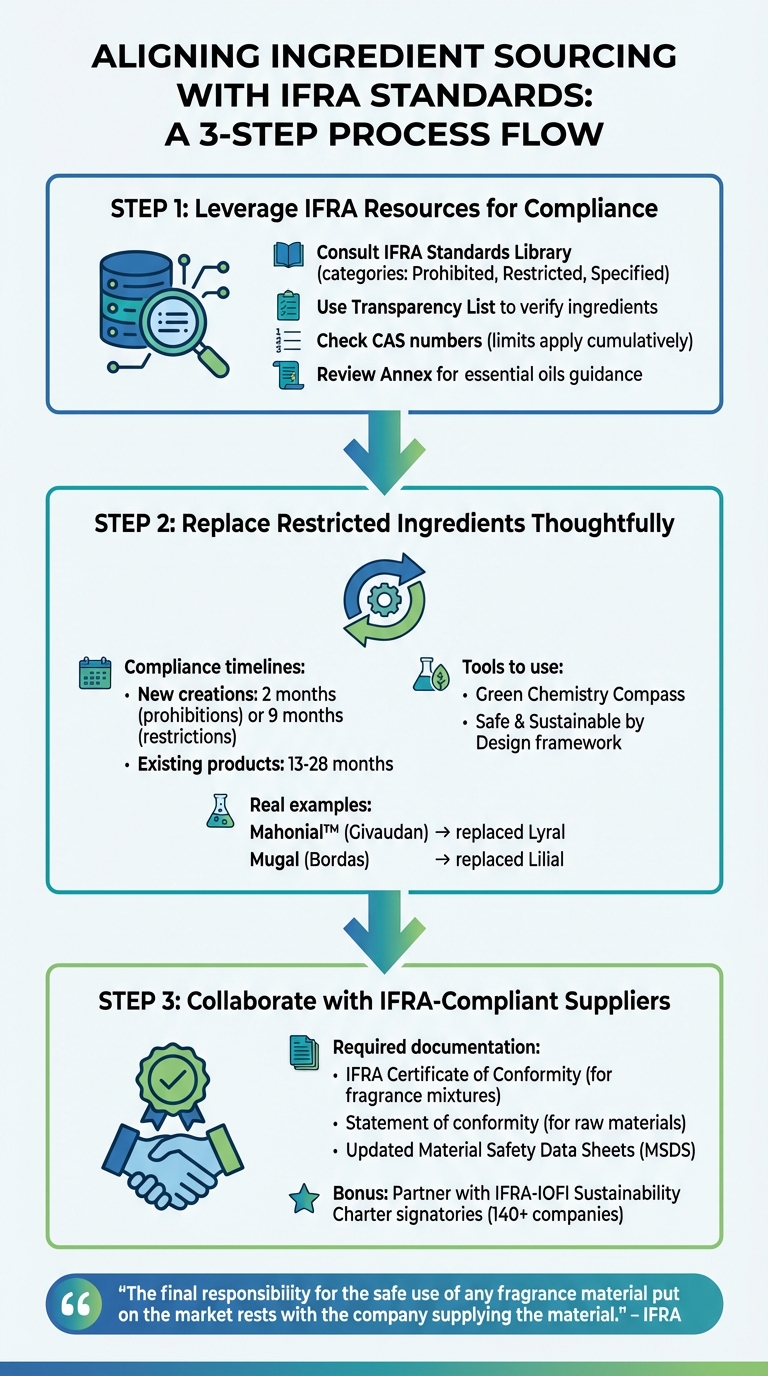
3 — Step Guide to IFRA — Compliant Ingredient Sourcing
To align your ingredient sourcing with IFRA’s ethical framework, follow these practical steps to ensure compliance and maintain high standards in your fragrance formulations.
Step 1: Leverage IFRA Resources for Compliance
Start by consulting the IFRA Standards Library, a comprehensive database that categorizes materials as Prohibited, Restricted, or Specified. This resource, paired with the Transparency List, helps confirm that all fragrance and functional ingredients meet the IFRA Code of Practice requirements. For essential oils containing multiple constituents, refer to the Annex, which provides guidance on summing the concentrations of all isomers.
Pay close attention to CAS numbers, as limits apply cumulatively. A single ingredient might have multiple identifiers, covering both generic and specific isomers. Once you’ve verified compliance, focus on replacing any restricted or prohibited ingredients.
Step 2: Replace Restricted Ingredients Thoughtfully
If an ingredient is restricted or banned, the timeline for compliance varies: new creations must adapt within 2 months for prohibitions or 9 months for restrictions, while reformulating existing products allows for 13 to 28 months.
Take inspiration from companies like Givaudan, which developed Mahonial™ as a substitute for the restricted ingredient Lyral over a three-year period (2022–2025). This replacement allowed perfumers to preserve floral scent profiles while adhering to regulations. Similarly, Bordas introduced Mugal, a floral-aquatic alternative to Lilial (Butylphenyl Methylpropional), which had been classified as a reproductive toxin in the EU. Mugal offers a safer, non-toxic option aligned with modern safety standards.
To avoid "regrettable substitutions" - where a replacement later proves problematic - use tools like the Green Chemistry Compass and the Safe & Sustainable by Design framework. These ensure that chosen alternatives are both safe and sustainable.
Once replacements are in place, verify that your suppliers also meet IFRA standards.
Step 3: Collaborate with IFRA — Compliant Suppliers
Request an IFRA Certificate of Conformity for every fragrance mixture you source. For raw materials, ask for a statement of conformity and detailed information on IFRA-restricted constituents.
"The final responsibility for the safe use of any fragrance material put on the market rests with the company supplying the material." – IFRA
Maintain updated Material Safety Data Sheets (MSDS) for all ingredients to ensure compliance with broader safety and regulatory standards. If a supplier cannot provide a Certificate of Conformity, consult IFRA’s list of professional service providers who can assist with certification.
For added assurance, consider working with suppliers who are signatories to the IFRA — IOFI Sustainability Charter. These companies commit to reducing environmental impact while maintaining strong governance practices and prioritizing employee well-being. This extra layer of commitment reflects a broader alignment with ethical and sustainable sourcing practices.
Maintaining Compliance and Developing New Formulas
Keeping up with ethical ingredient sourcing isn’t just about meeting current standards - it also means staying ahead of evolving regulations. For fragrance brands, this often involves adapting formulations to align with updates from IFRA (International Fragrance Association). These updates, typically issued every three years, outline new and amended safety standards. Occasionally, off-cycle amendments are introduced to address immediate risks, requiring swift action from companies to ensure compliance.
Regular Testing and Reformulation
When IFRA announces new restrictions, brands face strict deadlines. New products must comply within 2 to 9 months, while existing products are given 13 to 28 months to meet the updated standards. This timeline necessitates proactive reformulation to avoid disruptions.
One example of adapting to these changes is Bordas’ introduction of Mugal, a floral-aquatic alternative to Lilial (Butylphenyl Methylpropional). Lilial was classified as a reproductive toxin in the EU, prompting the need for safer substitutes. Mugal provides a non-toxic option that aligns with updated safety requirements.
For brands without in-house regulatory teams, partnering with third-party experts from IFRA’s approved list can simplify the process. These professionals assist in creating Certificates of Conformity and ensuring technical compliance. Pairing reformulation efforts with diligent tracking helps maintain alignment with IFRA standards over time.
Staying Updated on IFRA Standards
Continuous monitoring is essential for keeping up with IFRA’s evolving guidelines. Tools like the IFRA Standards Library - a searchable database of current standards and ingredient restrictions - make tracking easier. Additionally, IFRA Notification Letters outline specific timelines for implementing new or amended standards.
For detailed guidance, companies can turn to the IFRA — RIFM Guidance document, which provides instructions on applying standards across product categories. Local IFRA National Associations also offer region-specific support and expertise.
The IFRA Transparency List, which catalogs over 3,500 commercial ingredients, is another valuable resource for verifying compliance with the IFRA Code of Practice. Updated annually, this list works in tandem with the IFRA — IOFI Labelling Manual to ensure adherence to the Globally Harmonized System (GHS).
Choosing Eco — Friendly Ingredients
With sustainability taking center stage in the $68.14 billion global fragrance market, brands are exploring greener alternatives. The IFRA Green Chemistry Compass is a helpful tool for evaluating ingredients based on principles like waste prevention, renewable feedstocks, and design for degradation.
"The IFRA Green Chemistry Compass Tool was designed to guide the fragrance industry in evaluating and enhancing the environmental and health profiles of their products." – Martina Bianchini, President, IFRA
Some companies are already leading the way. In 2025, Gucci launched "Where My Heart Beats", a fragrance using 100% alcohol derived from recycled carbon emissions. This innovative approach reduces water consumption and agricultural land use compared to traditional methods. Similarly, L’Oréal and Cosmo International Fragrances introduced a waterless, low-energy extraction process that captures natural fragrance molecules using only air - eliminating the need for heating or chemical solvents.
When considering eco-friendly options, prioritize ingredients that meet OECD TG 301/310 guidelines for "readily biodegradable" status. This minimizes aquatic toxicity and prevents environmental bioaccumulation. The Green Chemistry Compass also encourages using materials with more than 50% renewable or recycled carbon content, distinguishing them as natural origin ingredients that meet modern sustainability benchmarks.
Conclusion
IFRA Standards provide a science-driven framework to ensure the safety of fragrance ingredients while addressing responsible sourcing and environmental considerations. Built on thorough RIFM assessments, these standards confirm that thousands of ingredients meet stringent safety requirements.
Beyond meeting legal requirements, adhering to IFRA Standards reflects a brand’s dedication to ethical practices and environmental responsibility. Over 140 companies have already signed the IFRA — IOFI Sustainability Charter, committing to initiatives like reducing their environmental impact, ensuring transparency, and sourcing ingredients responsibly.
For brands, compliance with IFRA Standards serves as a mark of trust and a competitive edge. With approximately 20% of people sensitive to at least one allergen - and fragrance allergies affecting 2–11% of the global population - these measures safeguard public health while enhancing a brand’s reputation. As the fragrance market grows at an annual rate of 8%, aligning with these standards positions brands to thrive in the long run.
Additionally, the industry’s move toward "safe and sustainable by design" solutions - such as carbon capture technologies - proves that IFRA Standards do not stifle creativity. Instead, they encourage innovation that benefits consumers and the planet alike, ensuring that responsible ingredient sourcing remains central to fragrance development for years to come.
FAQs
Are IFRA Standards legally required or voluntary?
The IFRA Standards act as a widely respected guideline within the fragrance industry, ensuring responsible ingredient usage and prioritizing safety. Although these standards aren’t legally enforced, they are broadly embraced across the sector. They also serve as a benchmark for ethical sourcing practices, helping companies maintain trust and accountability in their creations.
How can I tell if a fragrance is IFRA-compliant?
Fragrances are considered IFRA-compliant when they meet the maximum safe use levels outlined by the IFRA Standards. To verify this, look for documentation or certificates provided by the manufacturer that confirm compliance. These standards are designed to ensure the safe use of both individual ingredients and fragrance blends.
What happens to my favorite scent when IFRA updates its rules?
When the International Fragrance Association (IFRA) updates its regulations, it can mean your favorite fragrance gets reformulated. These adjustments ensure the scent complies with updated safety standards, which might involve altering ingredients or tweaking the overall scent profile to keep it both safe and in line with the latest guidelines.