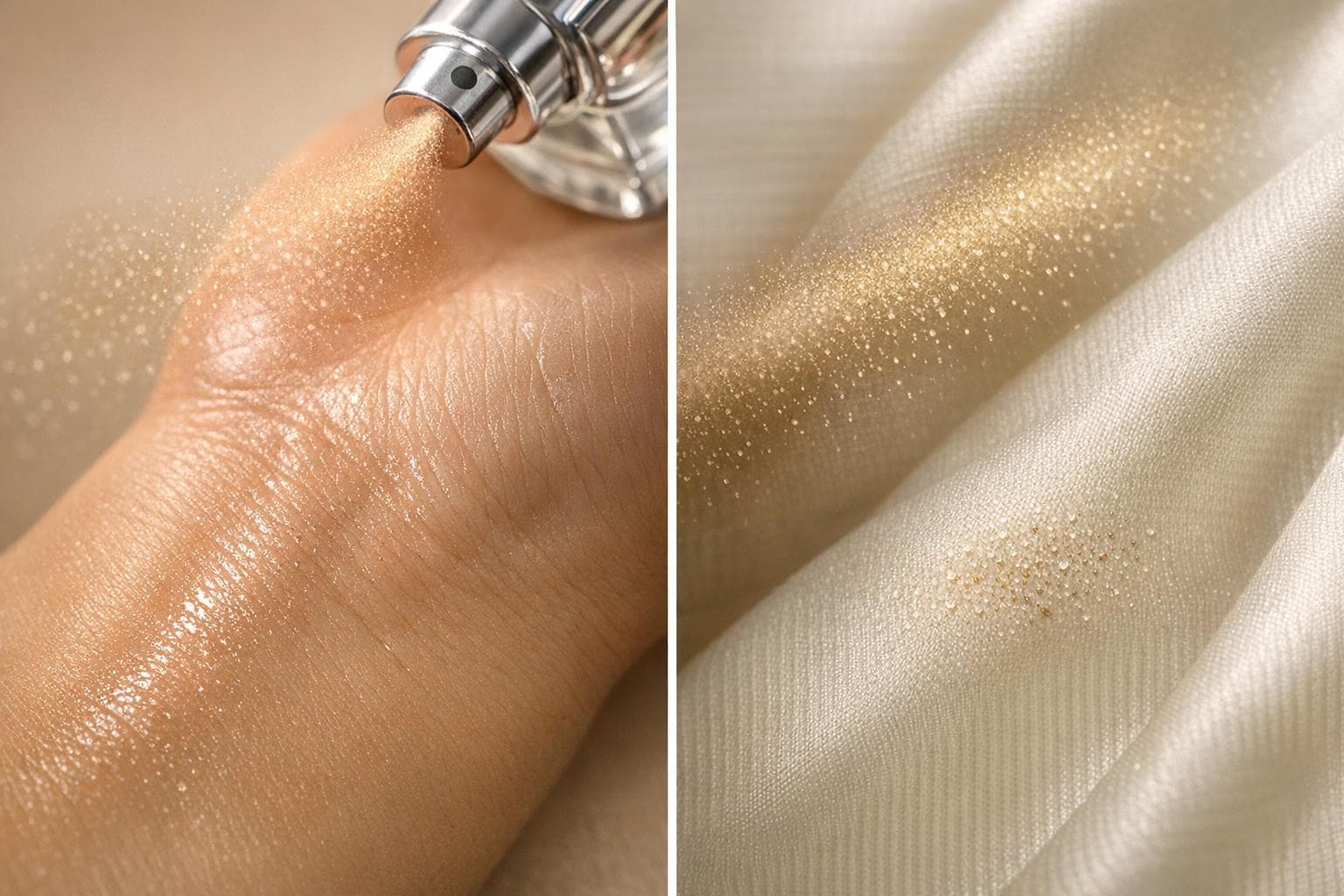
When it comes to perfume, where you apply it - on your skin or your clothes - can change how it smells, how long it lasts, and the risks involved. Here’s a quick summary:
- Skin Application: The warmth of your body helps the scent evolve over time, creating a personal fragrance unique to you. However, it may fade faster (6–24 hours) and could irritate sensitive skin.
- Clothes Application: Fragrance on fabrics stays closer to its original scent and lasts longer, sometimes for days. But it might stain delicate materials like silk or satin.
Each method has its pros and cons, and the choice depends on your needs - personal scent evolution versus long-lasting wear. For the best results, combine both: apply to pulse points for depth and to clothes for longevity.
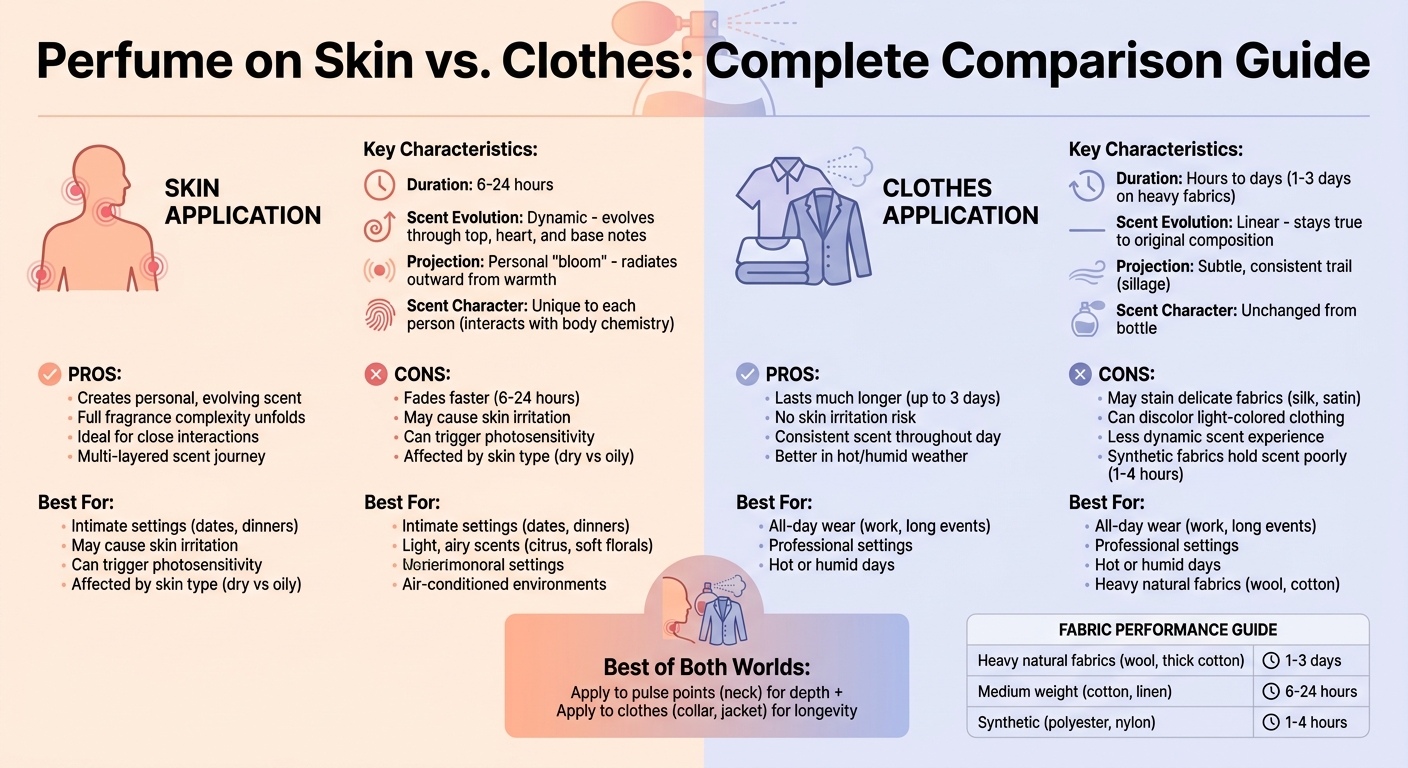
Perfume Application Comparison: Skin vs Clothes
The short answer: perfume usually lasts longer on clothes, but it develops more and projects further on skin. Spray your pulse points for the scent as it was made to unfold, and add one light mist on a stain-safe fabric, such as a cotton shirt or a wool coat, when you want it to stay with you all day.
Lab work backs both halves. In a test of fragrance materials on cotton and polyester fabric, cotton kept more of them, and the slow-evaporating materials that make up base notes lasted longest on both (Journal of Applied Polymer Science). On skin, a 2025 study on volunteers found that fragrance molecules evaporated more slowly from well-hydrated skin (International Journal of Cosmetic Science), which is why an unscented moisturiser before you spray helps.
How Application Affects Scent Projection
The way your perfume projects - how far and intensely it diffuses into the air - largely depends on where and how you apply it. Whether you choose skin or fabric as your canvas, each offers a distinct scent experience with unique projection qualities.
Skin Application: A Personal and Evolving Scent
Applying perfume directly to your skin engages your body’s natural heat to activate the fragrance. Pulse points, such as the neck, wrists, and behind the ears, emit warmth that helps release the perfume’s top, heart, and base notes. This heat-driven process creates what perfumers call a "bloom", a dynamic scent expansion that radiates outward. Additionally, your skin’s pH and natural oils interact with the fragrance, shaping a scent unique to you.
This is why the same perfume can smell slightly different from one person to another. Over time, the fragrance evolves on your skin, often becoming warmer and deeper as the hours pass. However, this method typically results in a lifespan of 6 to 24 hours before the scent fades.
"When perfume lands on skin, heat and natural oils speed up evaporation of the top notes, giving you a brighter opening and more projection on pulse points like neck and wrists." — Marie Helene Paillard, Takamichi Beauty Room
Clothes Application: Even and Lasting Diffusion
On the other hand, applying perfume to clothing provides a more consistent scent experience. Fabrics don’t generate body heat, so the fragrance remains closer to its original composition, without the layered evolution seen on skin. This results in a stable projection that lingers throughout the day. While the scent tends to stay nearer to the wearer, it creates a subtle trail - or sillage - as you move.
Natural fibers like wool and cotton are particularly effective at holding fragrance oils, while synthetic materials like polyester or nylon are less absorbent. The choice of fabric can influence both the intensity and longevity of the scent.
"Because clothes don’t emit the same warmth as skin, the diffusion of fragrance into the air (and thus projection) can be more subtle." — London Musk
Which Method Makes Perfume Last Longer?
When it comes to making your fragrance last, where you apply it plays a crucial role. While applying to skin offers immediacy and warmth, clothes can hold onto the scent for much longer. Each method has its own benefits depending on what you’re aiming for.
Skin Absorbs Fragrance Faster
Skin’s natural properties mean it absorbs perfume quickly. Body heat then activates the fragrance, but this also speeds up evaporation, typically limiting the scent’s lifespan to 6–24 hours. How long it lasts on your skin depends on factors like your skin’s oiliness and hydration levels. For example, oily skin tends to hold fragrance better, while dry skin causes it to evaporate faster. A simple trick? Use an unscented moisturiser before applying your perfume to help it linger longer.
Body chemistry also plays a big role. Things like pH levels, natural oils, and sweat can break down scent molecules faster than fabrics can.
"Skin also absorbs the fragrance, and combined with movement, sweat, plus the natural oils, it means that perfumes sprayed directly on the skin tend to have a shorter duration than those sprayed on fabrics." — House of Moksha
Clothes Hold Scent for Extended Periods
Unlike skin, fabric doesn’t have metabolic activity to speed up evaporation. This allows clothes to trap fragrance molecules in their fibres, keeping the scent fresh for far longer. Depending on the material, the scent can last anywhere from hours to days.
Heavy natural fabrics like wool or thick cotton can hold onto a fragrance for 1–3 days. Medium-weight materials, such as cotton or linen, usually retain scent for 6–24 hours. On the other hand, synthetic fabrics like polyester or nylon don’t perform as well. Their smooth, non-porous surfaces allow fragrances to evaporate much faster - often within 1–4 hours.
The concentration of your perfume also matters. Higher concentrations, like Eau de Parfum (EDP) or Extrait, contain more fragrance oils that cling better to fabrics, extending their longevity.
"If the scent has a high alcohol content, it’s best to apply it on the skin. If the fragrance has a low alcohol content, it can be sprayed on clothes for a more subtle and long-lasting effect." — Rajiv Sheth, Master Perfumer, All Good Scents
Your Personal Fragrance Expert Awaits
Take our quick scent quiz to discover authentic designer and niche fragrances matched to your taste — explore them as 2ml, 5ml, 8ml & 30ml decants and samples, so you can try each one before committing to a full bottle.
Find Your ScentSkin vs clothes compared, fabric by fabric
The two surfaces trade longevity for development. This is how they compare, followed by how each common fabric holds perfume and what to watch for.
| What changes | On skin | On clothes |
|---|---|---|
| How long it lasts | Shorter; dry skin lets fragrance evaporate faster than well-hydrated skin | Longer, especially on cotton, wool and other dense fabrics |
| How it smells | Develops with body warmth from top notes to base notes | Can smell flatter and more one-dimensional than on skin |
| Projection | Brighter opening and more projection on pulse points | Softer, closer to you |
| Main risk | Some fragrance ingredients can react with sunlight | Marks on silk, satin and light-coloured clothes |
| Use it for | A scent that unfolds on you | A scent that stays with you all day |
| Fabric | How well it holds perfume | Watch out for |
|---|---|---|
| Cotton | Well; in a textile study, fabrics with more cotton, a twill weave and a denser weave held fragrance longer | Marks show more on white than on dark clothes |
| Wool and other heavy fabrics | Well; dense fibres trap fragrance oils, and a concentrated perfume on a heavy coat can last for days | Spray from a distance and test an inside seam first |
| Linen | Fairly well, but a light, breathable fabric lets scent go sooner than a heavy one | Marks show more on light colours |
| Silk and satin | On silk, scent sits on the smooth surface and fades sooner | Perfume can mark silk and satin, and alcohol-based products can damage silk: spray your skin and let it dry before you dress |
| Polyester, nylon and other synthetics | Least; in a lab test cotton kept more fragrance than polyester, and on synthetics scent often fades within a few hours | Spray lightly and expect to top up |
Sources: the skin rows draw on the International Journal of Cosmetic Science (2025), DermNet and the experts quoted above; the fabric rows on Industria Textila (2020), the Journal of Applied Polymer Science (2006), London Musk, an Ohio State University silk care fact sheet and Purex.
If a mark does appear, the American Cleaning Institute advises pretreating a perfume stain with a prewash stain remover or liquid laundry detergent, then washing as usual. Keep the garment out of the dryer until the mark is gone, or the heat can set it.
Risks of Each Application Method
While applying perfume can elevate your personal style, each method - whether on skin or clothing - comes with its own set of challenges. Being aware of these risks can help you make better decisions about how to enjoy your favourite scents.
Skin Application May Cause Irritation
Applying perfume directly to the skin can sometimes lead to irritation, especially for those with sensitive or allergy-prone skin. Fragrances with high alcohol content can dry out the skin, while common allergens like linalool, limonene, and benzyl alcohol may cause redness, itching, or even rashes.
Additionally, perfumes with citrus or bergamot notes can make your skin more sensitive to UV rays. This heightened sensitivity can result in sunburns or hyperpigmentation. To reduce these risks, avoid applying perfume to broken, irritated, or freshly shaved skin, as it may cause stinging or inflammation.
A patch test is a simple way to check for adverse reactions. Dab a small amount of the fragrance on your inner forearm and wait 24 hours to see if any irritation occurs. For added protection, use an unscented moisturiser before applying perfume. This not only creates a barrier to reduce dryness but can also help the scent last longer.
Clothes Application Can Stain Fabric
If applying perfume to the skin isn’t ideal, spraying it on clothing might seem like a safer option. However, this method comes with its own drawbacks. Perfumes with high alcohol content, concentrated oils, or added dyes can stain or discolour fabrics. Delicate materials like silk and satin are particularly susceptible, and light-coloured clothing is more likely to show visible marks.
To avoid ruining your garments, always test the perfume on a small, inconspicuous area of the fabric first. For delicate or expensive items, this step is especially important. When applying perfume to clothing, use it sparingly and avoid saturating the fabric, as excessive amounts increase the likelihood of staining.
When to Use Each Application Method
Choosing between applying fragrance to your skin or clothing isn’t about following strict rules. It’s about tailoring your approach to fit the occasion and your desired scent effect. The way you apply perfume influences how it projects and lasts, so understanding the nuances of each method can help you make the most of your fragrance.
Apply to Skin for Close Interactions
Skin application works best in situations where a more personal and evolving scent experience is desired. Pulse points - like the neck, wrists, behind the ears, and collarbone - generate warmth that activates the fragrance, allowing it to unfold its top, heart, and base notes over time. This creates a multi-layered scent journey that develops throughout the day.
This method is particularly suited for intimate settings, such as dates or dinners, where the fragrance’s full complexity can be appreciated up close. Light, airy scents - like those with citrus or soft floral notes - thrive when applied to the skin, as the warmth enhances their development. Even in cooler, air-conditioned spaces, skin application ensures the scent remains expressive yet subtle.
Apply to Clothes for All-Day Wear
For longer-lasting wear and a more consistent scent, applying perfume to your clothes is a practical option. This method is ideal for situations like a full workday or an extended event, as fragrances tend to cling to fabrics much longer than they do to skin.
Unlike skin application, clothes application provides a steady, unchanging scent, staying true to how it smells in the bottle. Since it doesn’t interact with body heat, the fragrance remains more linear and less dynamic. This makes it a great choice for professional settings, where a polished and understated presence is key - especially in shared spaces like offices or elevators.
On hot or humid days, applying perfume to clothing can prevent the scent from becoming too intense. To avoid uneven patches or oil stains, hold the bottle 15 to 20 centimetres away when spraying. For a balanced approach, consider a hybrid method: one spritz on your skin (like your neck) for depth and one on your clothing (such as your shirt collar or jacket) for extended longevity.
Test a perfume on skin and fabric before you buy the bottle
Because one perfume can smell different on your wrist and on your scarf, try it both ways before you commit to a full bottle. Spray one wrist and an inside seam or a scarf in the morning, then smell both again at lunch and in the evening.
A decant makes that test cheap. Scento pours each perfume by hand from an original bottle into 2 ml, 5 ml and 8 ml vials, plus a 30 ml bottle decant on most perfumes, and an 8 ml decant holds about 120 sprays, roughly 30 days of daily wear. Every size and price is on our perfume decant prices page, and the full range is in our perfume collection.
Conclusion
Choosing how to apply your perfume depends on what you’re looking for in terms of scent performance and personal comfort. Applying fragrance directly to the skin creates a dynamic experience, as it interacts with your body chemistry to evolve from top to base notes. However, it’s worth noting that skin application may lead to quicker evaporation, with the scent fading within a few hours. For those with sensitive skin, this method might also pose a risk of irritation.
On the other hand, applying perfume to clothing offers impressive longevity. Fabrics like wool or cotton hold onto fragrance molecules, allowing the scent to remain consistent for days or even weeks. While this method preserves the original composition of the fragrance, it lacks the warmth and evolution provided by body heat.
"At the end of the day, how you wear your perfume is a personal choice. And it’s definitely not a one-size-fits-all method but knowing the pros and cons of each approach helps you wear your scent more effectively." — Embark Perfumes
For the best of both worlds, consider a combination: spritzing directly onto your skin for intimacy and warmth, while also adding a touch to your clothing for extended wear. A few sprays on your neck and collar can create a layered effect, blending depth with longevity. Ultimately, the method you choose should reflect your personal preferences and the occasion at hand.
FAQs
Can I spray perfume on both skin and clothes without it clashing?
You can apply perfume to both your skin and clothes, but it’s important to approach this thoughtfully. When applied to skin, the fragrance interacts with your body heat, allowing it to evolve and reveal its full character. On clothes, the scent tends to linger longer and project more noticeably. To strike a balance, use a light touch on both - this way, the layers complement each other rather than competing, letting you enjoy the fragrance’s full depth without it feeling overpowering.
Which fabrics are safest to spray to avoid stains?
When it comes to spraying perfume on clothing, natural fabrics like wool, leather, and durable cotton are your best bet. These materials tend to absorb and release scents gradually, without leaving visible stains. On the other hand, delicate or light-coloured fabrics such as silk or satin should be avoided. These materials are sensitive to the alcohol and oils in fragrances, which can cause damage or discoloration.
Synthetic fabrics like polyester or nylon are another category to approach with caution. They are more prone to staining and can cause the scent to fade more quickly. For the best results, stick to sturdy, non-delicate fabrics that can handle a spritz of your favourite fragrance without issue.
How do I make perfume last longer on skin without irritation?
To ensure your perfume lasts longer while keeping your skin comfortable, start by applying it to freshly cleaned and moisturised skin. Target key pulse points such as your wrists, neck, and the area behind your ears. Avoid excessive spraying or rubbing the fragrance into your skin, as this can irritate or disrupt the scent’s structure. A gentle misting is enough to extend the fragrance’s wear time while reducing the chance of sensitivity.
Should you spray perfume on your skin or your clothes?
Both work, for different jobs. Spray your pulse points when you want the scent to develop with your body warmth and project, and add a light mist on a sturdy natural fabric such as a cotton shirt or a wool coat when you want it to last all day. Keep perfume off silk, satin and light-coloured clothes, which can mark.
Does cologne last longer on skin or clothes?
Like perfume, cologne usually lasts longer on clothes, especially on cotton, wool and other dense fabrics, and smells fuller on skin. Lighter concentrations such as Eau de Toilette leave less fragrance oil per spray than Eau de Parfum or Extrait, so on fabric they fade sooner, according to the fragrance house London Musk.
How long does perfume last on clothes?
It depends on the fabric and the perfume. On a heavy fabric such as wool, heavy cotton or a coat, a concentrated perfume can last one to three days, according to the fragrance house London Musk, while on synthetics such as polyester it often fades within a few hours. Washing or dry-cleaning usually resets it.
Can perfume stain clothes, and how do you get it out?
Yes. Silk, satin and light-coloured clothes show marks most, and some perfume marks only appear later. To remove one, the American Cleaning Institute advises pretreating it with a prewash stain remover or liquid laundry detergent and then washing as usual; keep the garment out of the dryer until the mark is gone, or the heat can set it.

