A perfume isn’t just a scent - it’s a story, a memory, and an emotion bottled together. Fragrances are designed to evoke feelings and transport you to specific moments in time. This article dives into how perfumers create these scent narratives, from selecting ingredients to structuring top, heart, and base notes. Perfumer Francis Kurkdjian, known for his work with Dior and Maison Francis Kurkdjian, describes perfume as a “Sculpture of the Invisible,” blending notes to reflect identity and emotion.
Key Takeaways:
- Fragrance Structure: Perfumes unfold in three stages - top notes (initial impression), heart notes (depth and character), and base notes (lasting foundation). Each stage interacts to create a dynamic experience.
- Ingredients and Emotions: Perfumers map emotions to specific notes, like rose for joy or sandalwood for calm. Dominant notes anchor the scent, while supporting accords add complexity.
- Memory Connection: Scents are tied to the brain’s memory and emotion centers, making them powerful triggers for personal and universal memories.
- Crafting Process: From inspiration to refinement, creating a fragrance involves balancing simplicity and depth, often using rare materials like rose oil or saffron.
Perfume is more than chemistry - it’s storytelling through scent, designed to resonate deeply with the wearer’s emotions and memories.
Your Personal Fragrance Expert Awaits
Take our quick scent quiz to discover authentic designer and niche fragrances matched to your taste — explore them as 2ml, 5ml, 8ml & 30ml decants and samples, so you can try each one before committing to a full bottle.
Find Your ScentHow Fragrance Structure Creates a Story
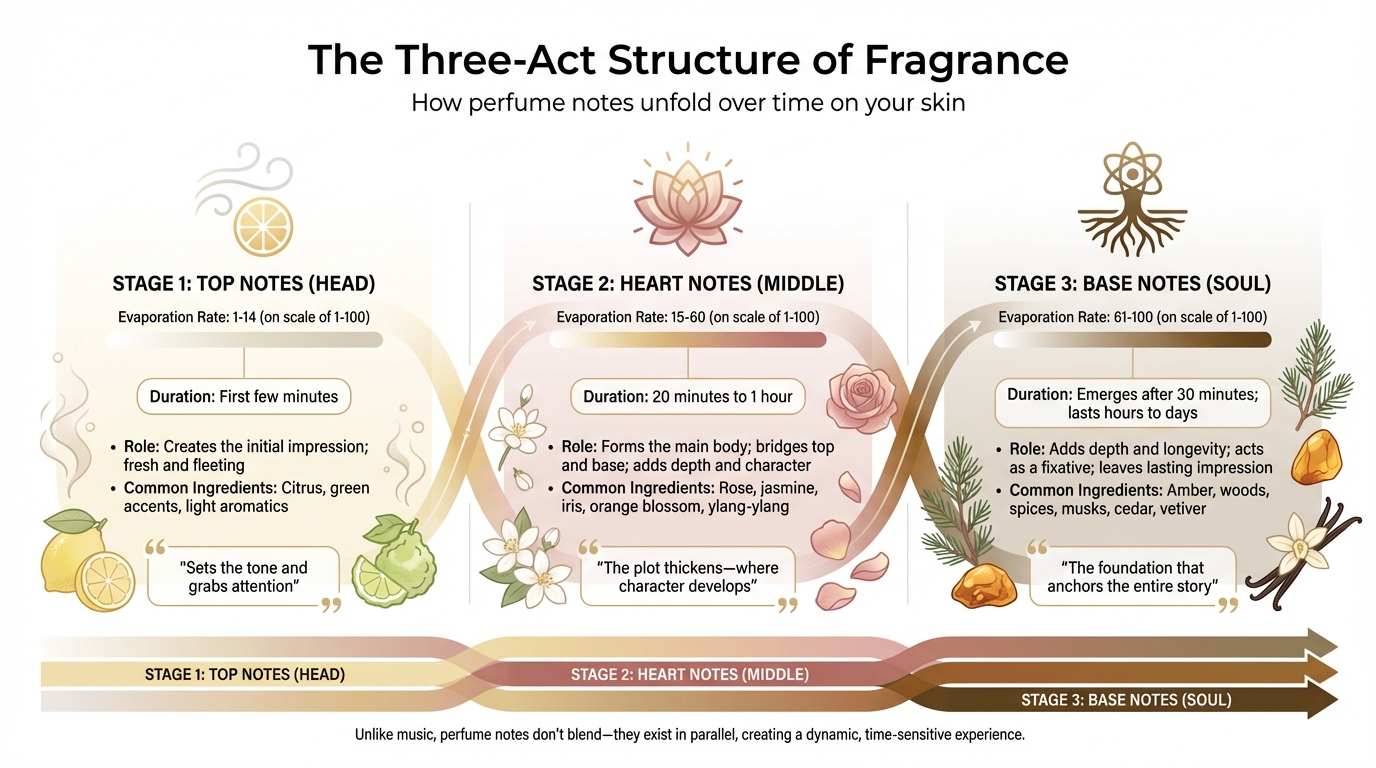
Perfume Fragrance Structure: Top, Heart, and Base Notes Timeline
Every perfume unfolds like a story, evolving over time as its notes reveal themselves. Unlike music, where harmonies blend seamlessly, perfume notes evaporate at different rates, creating a layered, time-sensitive experience.
"Each scent evaporates in a different way and, ultimately, the individual scents continue to exist in parallel. Things can truly blend in music, though not in perfume. That creates a challenge, but also an opportunity." — Jean‑Claude Ellena, Perfumer
The structure of a fragrance - its top, heart, and base notes - doesn’t work in isolation. These stages overlap and interact, forming a dynamic narrative on your skin that shifts over hours. Testing this evolution is easiest with perfume decants, which allow for multiple wears before committing to a full bottle.
Top Notes: The Opening Scene
Top notes are the first to greet you, creating an immediate impression. These light, airy notes often include citrus or green accents that lift the mood and grab attention. For instance, when Sue Phillips developed Tiffany Parfum for Tiffany & Co.’s 150th anniversary in 1987, she focused on top notes that could instantly lift spirits. Though these notes are fleeting - lasting only a few minutes - they are essential for setting the tone of the fragrance and establishing an emotional connection.
Heart Notes: The Plot Thickens
Once the top notes fade, the heart notes take center stage, adding depth and character. These notes, which can last from 20 minutes to an hour, often feature floral elements like rose, jasmine, iris, or ylang-ylang. In Tiffany Parfum, the heart includes Damask rose, Indian jasmine, iris, orange blossom, and ylang-ylang, creating a sense of elegance and sophistication. Beyond their aesthetic role, heart notes help smooth the transition to the base, softening its intensity as the fragrance continues to develop.
Base Notes: The Lasting Impression
Base notes are the foundation of any fragrance, leaving the final, enduring mark. These rich, long-lasting notes typically appear about 30 minutes after application and can linger for hours - or even days in the case of certain musks or animalic notes. Common base notes include amber, woods, spices, and musks, which provide depth and stability.
In 2006, Jean‑Claude Ellena designed Terre d’Hermès for Hermès using just 30 ingredients. He used cedar to evoke a vertical wooden stick and vetiver to symbolize grass roots reaching into the earth, crafting a fragrance with a vertical narrative. The base notes not only anchored the scent but also acted as fixatives, enhancing the lighter top and heart notes. This meticulous balance contributed to the fragrance’s massive success, doubling Hermès’ perfume sales.
| Note Class | Evaporation Rate | Role in Narrative |
|---|---|---|
| Top (Head) | 1 to 14 | Creates the initial impression; fresh and fleeting |
| Middle (Heart) | 15 to 60 | Forms the main body; bridges top and base; lasts 20 minutes to 1 hour |
| Base (Soul) | 61 to 100 | Adds depth and longevity; acts as a fixative; emerges after 30 minutes |
Using Ingredients to Express Emotion
Perfumers do more than just blend ingredients - they craft emotions into scents you can experience. This begins with emotional mapping, where a perfumer identifies a feeling - like joy, nostalgia, or serenity - and selects natural and synthetic notes to bring it to life. The science behind this is fascinating: scents bypass logical processing and head straight to the amygdala and hippocampus, the parts of the brain tied to emotion and memory. Studies reveal that 75% of daily emotions are influenced by scent, and pleasant smells can improve mood by as much as 40%.
Specific ingredients evoke distinct emotional responses. For joy and happiness, perfumers often use floral notes like rose and jasmine, paired with citrus for a refreshing burst and lively ingredients like fresh ginger root. A great example is Christine Nagel’s Twilly Eau Ginger, created in July 2021 for Hermès. This fragrance was designed to evoke boldness and joy, featuring high concentrations of fresh ginger root, softened by white peony and grounded with cedar. As Nagel described it:
"I actually like to think of Eau Ginger as a smiling Twilly."
When it comes to nostalgia, comforting notes like vanilla and tonka bean - evoking the warmth of baked goods - or atmospheric scents like aged books are often used. For serenity and calm, ingredients like sandalwood, musk, woody notes, and iris concrete (known as the "crown jewel" of perfumery) create a soothing effect.
Choosing Dominant Notes and Supporting Accords
Once the emotional triggers are identified, perfumers select dominant notes to convey the central feeling and build supporting accords to enhance the story. Dominant notes anchor the emotional message, while the supporting accords provide structure and complexity. These accords act like conductors, awakening memories and emotions by interacting with the limbic system. For instance, woody notes like cedar can stabilize and ground lighter floral or spicy elements, giving the fragrance a solid foundation. Supporting accords can also shift the tone of a dominant note - adding a "honeyed" or "golden" touch to musky vanilla can introduce warmth and brightness. These deliberate choices allow the perfumer to create a layered fragrance narrative that connects emotionally while leaving room for personal interpretation.
Finding the Right Level of Complexity
Striking the right balance between complexity and clarity is critical for emotional impact. While some fragrances may include up to 200 ingredients, perfumers often pare down their compositions to just a few essential notes to avoid muddling the scent’s message. Subtlety matters: the fragrance should be inviting but leave space for individual interpretation.
"Perfumery is an art, not a science, as many seem to believe. A scientific background is not necessary for the perfumer; scientific knowledge may even sometimes prove an obstacle to the freedom required in perfume creation." — Jean Carles, Perfumer
High-quality ingredients play a key role in delivering emotional depth without introducing harsh or chemical undertones. For example, it takes 10,000 rose blossoms to produce a single ounce of premium rose oil, and around 150,000 flowers to yield just 2.2 pounds of saffron. These rare materials add richness and authenticity, but it’s not about the quantity of ingredients - it’s about how they interact. The way notes work together determines whether the fragrance resonates emotionally or feels disjointed. This thoughtful balance sharpens the scent’s emotional focus and enhances its ability to evoke memories and personal connections.
How Scent Connects to Memory and Emotion
Scent and memory share a unique bond in the brain. The olfactory bulb, which processes smells, is directly linked to the amygdala and hippocampus, the regions responsible for emotion and memory. This close connection explains why scents often evoke such immediate and instinctive reactions, bypassing logical thought entirely. Neuroscientist Dr. Tara Swart captures this perfectly:
"Smell, emotion and memory, are very strongly connected. ... it’s the only [sense] that can’t be wrong."
When scent particles reach the brain, they spark the release of neurochemicals like dopamine, oxytocin, serotonin, and endorphins. These chemical reactions make scent-triggered memories especially vivid and emotional. Perfumers understand this interplay deeply. Mathilde Laurent, Cartier’s in-house perfumer, highlights the profound connection between scent and life itself:
"In French the verb sentir is both to feel, and to smell. If you can smell the odors of life, then you are alive; if you cannot, well, then you are dead."
The brain, rather than the nose, is the true storyteller. It catalogs every scent you encounter and weaves them into personal narratives. Francis Kurkdjian, Creative Director of Perfume at Dior, explains:
"Scent is very powerful... because it works on the part of the brain that links memory and emotion. When you smell something you’ve remembered once, every time you smell it again, you recall that face or image."
This intricate connection between scent, memory, and feeling invites us to explore how fragrances tell stories unique to each individual.
Creating Space for Personal Interpretation
Perfumers craft scents with an understanding of these neurological ties, leaving room for personal memories and emotions to shape the experience. Fragrance is deeply subjective - a single note, like rose, might bring to mind a grandmother’s garden for one person, while for another, it recalls a strict childhood memory. This personal variability is what makes scent so powerful.
Rather than dictating a specific emotion, perfumers create frameworks that allow wearers to layer their own associations onto the fragrance. Christine Nagel, Hermès perfumer, describes this approach:
"A fragrance touches or speaks to us through how it resonates with our emotions, memories and desires. It can make us feel seductive or protected in turn."
Interestingly, your brain eventually filters out your own perfume as it becomes familiar and non-threatening. While you may stop noticing it, others around you still experience its full effect. This phenomenon underscores the lasting impression a fragrance can leave on others, even as it quietly fades into the background for the wearer.
Building on Shared Human Experiences
While scent experiences are personal, they also tap into universal human connections. Certain smells evoke collective memories because they reflect shared interactions with nature and life stages. For instance, the combination of milk, vanilla, and green notes often triggers comfort, rooted in the early bond of breastfeeding.
Natural scents like cut grass, petrichor (the smell of rain), and woods such as cedar or vetiver hold universal appeal, symbolizing seasonal changes and humanity’s deep ties to the natural world. Geosmin, the compound released when rain meets soil, is a scent hardwired into our evolutionary history. Perfumers use these universally recognized scents to create fragrances that resonate broadly, even as cultural interpretations differ. For example, while the smell of a monsoon might signify disaster in Europe, it represents good fortune in India.
Familiar scents like fresh bread or old books also evoke comfort and nostalgia, anchoring fragrances in shared experiences. By blending these universal references with space for personal interpretation, perfumers create scents that feel both familiar and deeply individual. This balance is what transforms a fragrance into a wearable story, bridging the gap between collective memory and personal emotion.
The Perfumer’s Process: From Concept to Finished Fragrance
Creating a fragrance is far from a straightforward task - it’s a deeply personal and intricate journey. The process begins with inspiration, moves through an initial conceptual blend, and involves countless refinements before the final scent emerges.
Finding Inspiration and Ingredients
For perfumers, inspiration often stems from memories, personal experiences, and the world around them. Take François Demachy, Dior’s Perfumer-Creator, for example. He crafted Spice Blend based on a childhood memory of his father’s pharmacy in Grasse, particularly a "Spice Rhum" ointment bottle that left a lasting impression. Similarly, Renaud Salmon, Creative Director at Amouage, turned to his move to Oman in 2019 to create "Chapter I – Renaissance." This fragrance reflects both his personal transformation and the country’s evolving identity.
Travel and nature also play pivotal roles. Salmon’s visit to U.S. national parks inspired Opus XVI: Timber, a scent born from the towering sequoia trees, which reminded him of trimming cypress trees with his father in Belgium. Literature and folklore are equally influential — Scheherazade from One Thousand and One Nights inspired a perfume that begins softly, like a whisper, before revealing its strength over time.
The choice of ingredients is just as crucial as the inspiration. For instance, a single 100 mL bottle of Portrait of a Lady contains the essence of 400 Turkish roses. Some materials, like iris root absolute, can cost as much as $100,000 per kilogram. High-end perfumers often work with a palette of up to 700 natural and synthetic materials, each selected to evoke a specific emotion or memory.
"A perfumer has to be able to smell their imagination. They have to be able to smell something that doesn’t exist." – François Demachy, Perfumer-Creator, Dior
Once the inspiration and ingredients are in place, the focus shifts to refining the composition.
Testing and Refining the Composition
The journey from concept to finished fragrance involves meticulous testing and refining. The process often starts in the mind. Jean-Claude Ellena, former in-house perfumer at Hermès, explains:
"My nose simply performs a control function. I smell with my brain. It stores every scent and knows how to combine them. The perfumes I create originate in my head."
After the mental blueprint is clear, iterative testing begins. Dominique Ropion, the master perfumer behind Portrait of a Lady, describes the challenge of achieving originality:
"What I want to find is something with a strong identity, something that you can distinguish from something else that already exists on the market... it took so many attempts before getting what we were looking for."
Refinement often leads to simplicity. Ellena, for example, reduced his working palette from the industry average of 1,000 ingredients to just 200. His creation, Terre d’Hermès, uses only 30 ingredients, a stark contrast to older fragrances that might include 160 or more. This minimalistic approach ensures clarity and precision.
"If I question myself about the position of a note in the composition, it is a bad sign … and I have to start a new trial, without that note. When there is nothing else to take away or add, the perfume is finished." – Jean-Claude Ellena, Perfumer
While tradition and intuition remain central, modern technology has introduced new tools to refine the process further.
New Technology in Perfume Creation
Advancements in technology have revolutionized the way perfumers work. Molecular distillation, for example, allows the extraction of specific facets from natural ingredients. For the 15th anniversary of Portrait of a Lady in 2025/2026, Dominique Ropion used three distinct rose extractions - standard rose oil, molecularly distilled rose absolute, and rose oil processed through "low metallurgy" - to achieve the perfect balance of 400 Turkish roses per 100 mL bottle.
Chemists can now break down natural scents into their molecular components. Lavender, for instance, contains 300 individual molecules. Ellena used this technique to refine lavender, removing unwanted elements to create a bespoke lavender and licorice accord:
"The chemist broke the lavender down into its component molecules and removed the ones I didn’t want. Then I liked the scent."
Artificial intelligence also plays a role, particularly in tasks like evaluating formula stability and generating safety data. However, Francis Kurkdjian, Creative Director of Perfume at Dior, emphasizes its limitations:
"Artificial intelligence frees and helps perfumers by doing complex tasks much faster and easier, such as assessing the stability of a formula or getting safety data. However, I highly doubt that AI can create novel and groundbreaking scents."
Ultimately, while technology offers precision and efficiency, the heart of perfume creation still lies in human intuition and the ability to evoke emotion through scent.
Conclusion
Fragrance is more than just a combination of ingredients - it’s a story that captures moments, places, and emotions. As François Demachy describes it, perfumers "act like gatekeepers of time, freezing moments, places, people and feelings into an olfactive experience". The most memorable fragrances go beyond a list of notes; they tell stories that strike a personal chord. Renaud Salmon highlights this beautifully:
"A fragrance should carry a narrative that helps people connect emotionally with it. A list of twelve ingredients doesn’t help you imagine the soul of a perfume. But a story does".
This focus on storytelling opens up new ways to experience perfume. Scento embraces this idea by offering curated designer and niche fragrances in 2 ml, 5 ml and 8 ml vials, and a 30 ml bottle decant on most perfumes. These formats let you explore the artistry behind each scent without committing to a full-size bottle.
Uncovering how to choose your signature scent is about more than just finding pleasant notes - it’s about choosing a fragrance that resonates with your emotions, transforms your mood, and reflects the many layers of who you are. It’s the essence of the narrative that perfumers so carefully craft.
FAQs
How can I tell top, heart, and base notes apart on my skin?
Top notes are the first impression of a fragrance, coming to life immediately after application and typically lasting around 1–2 hours. As these fade, the heart notes take center stage, forming the core of the scent and remaining noticeable for several hours. Finally, the base notes emerge, adding depth and lasting power, lingering the longest on the skin. To pinpoint each layer, pay attention to how the scent evolves over time: the initial burst is the top note, followed by the heart, and eventually the base.
Why does the same perfume smell different on different people?
Perfumes can smell uniquely different from one person to another because of individual body chemistry. Factors like skin type, pH levels, and daily habits play a big role in how fragrance molecules interact with the skin. This interaction affects how the scent develops and how far it projects. Elements such as body temperature, diet, and even medications can further shape the way a fragrance unfolds, making it a personal experience for every wearer. To find a scent that truly works for you, it’s always best to test perfumes directly on your skin.
How do perfumers choose notes to match an emotion or memory?
Perfumers meticulously choose and combine ingredients to stir emotions or trigger memories. Their creative process often begins with inspiration - this could be a person, a raw material, or even an abstract feeling. From there, they build a multi-layered fragrance that tells a story. Each scent acts as a form of expression, weaving together notes to create an experience that connects with emotions like happiness, nostalgia, or calmness.

