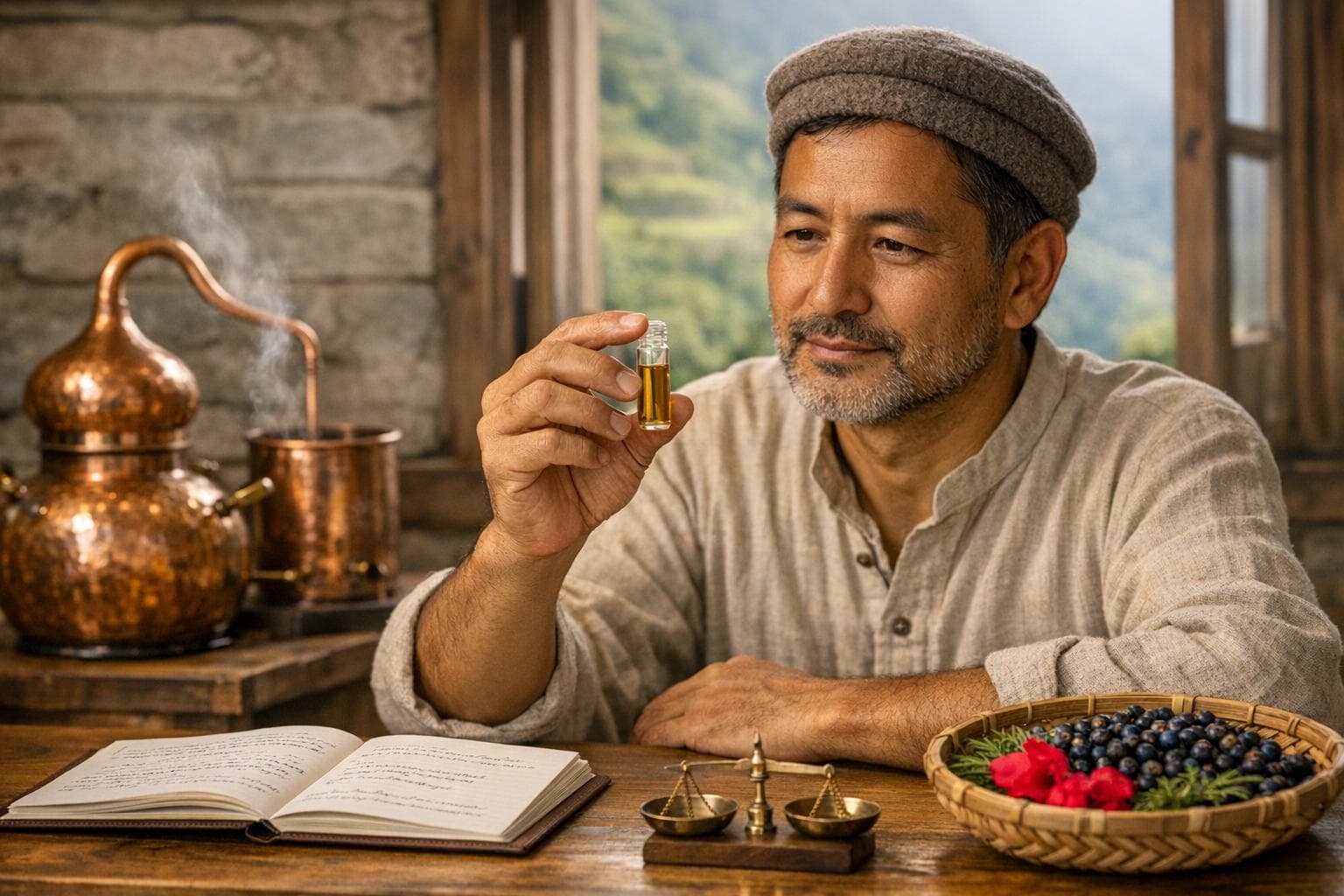
The Himalayas hold centuries-old fragrance-making practices, deeply tied to local plants like black juniper and wild wormwood. These traditions face challenges due to climate shifts, declining saffron yields, and younger generations moving to cities. Efforts to document techniques, support local artisans, and promote responsible plant use are key to ensuring these practices continue. Here’s how to safeguard this heritage:
- Documenting Knowledge: Recording extraction methods, plant uses, and artisan stories preserves both technical details and cultural significance.
- Economic Support: Fair pay, local branding, and training programs help artisans sustain their craft.
- Plant Conservation: Cataloguing species, transitioning to organic farming, and ethical harvesting protect resources.
- Education and Workshops: Teaching fragrance-making techniques connects ancient skills with modern markets.
- Quality Standards: Ensuring purity and proper production methods maintains the integrity of Himalayan scents.
These combined actions can help preserve the region’s fragrance legacy while supporting local communities.
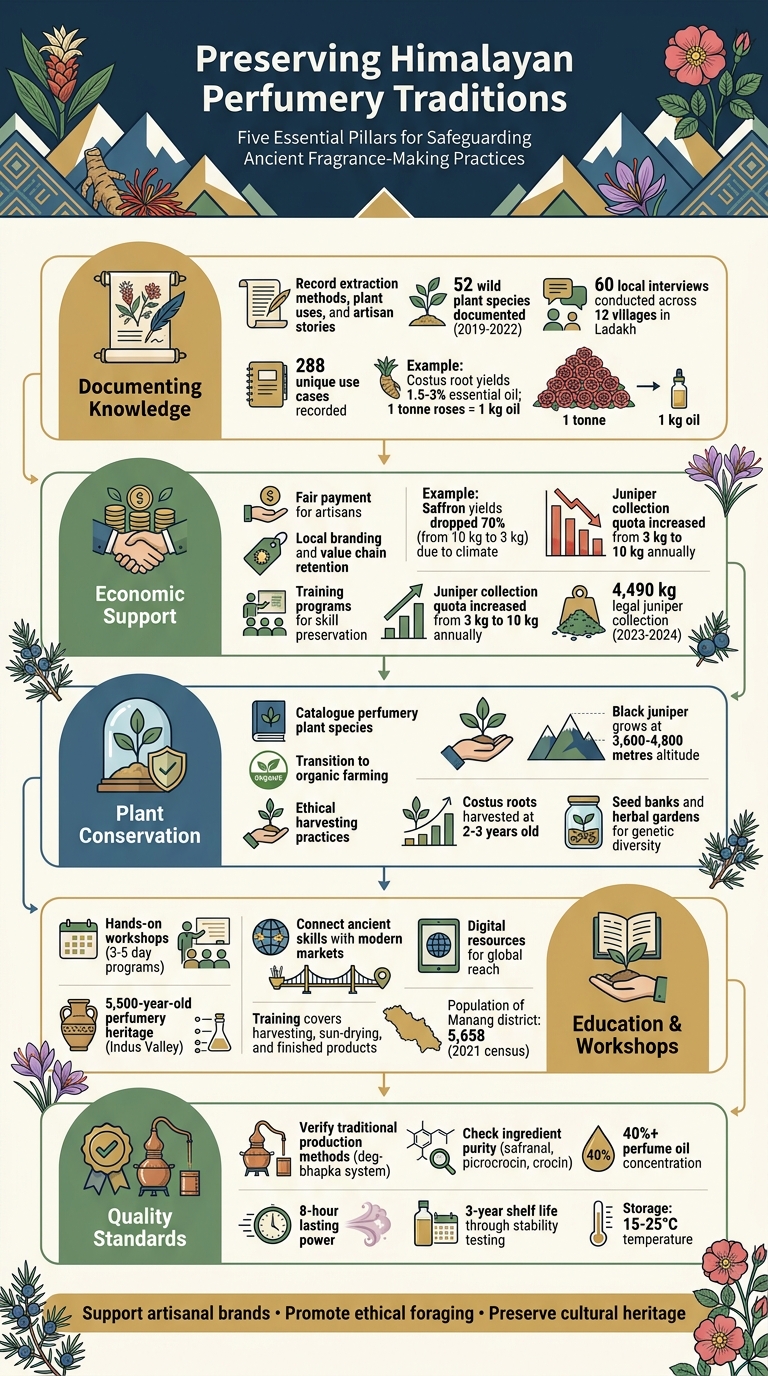
Five Pillars of Preserving Himalayan Perfumery Traditions
Recording and Archiving Methods
Without proper documentation, centuries of botanical expertise and extraction techniques could vanish entirely.
Recording Distillation and Extraction Methods
Precision is key when documenting extraction methods. For steam distillation, record critical parameters like temperature, pressure, duration, and equipment used. For instance, Costus root (Saussurea costus) yields around 1.5–3% essential oil, while a staggering one tonne of roses produces just one kilogram of oil. Track the scent’s evolution over time - immediately post-extraction, after a few hours, and several days later - to understand how base notes mature.
Between 2019 and 2022, Zohra Batool and a team from the CSIR–Indian Institute of Integrative Medicine documented 52 wild plant species and 288 unique use cases across 12 villages in Ladakh. Through interviews with 60 locals, they highlighted endangered plants like Himalayan thyme and pink arnebia, while preserving traditional Amchi medicinal knowledge.
For traditional methods like deg-bhapka - a copper still paired with a bamboo reed - capture detailed videos and written records. Include specifics like the ratio of raw materials to final oil yield, the condition of the plant material (dried or chopped), and the plant’s age at harvest (Costus roots, for example, are harvested at 2–3 years old). These meticulous records safeguard both the technical and cultural essence of perfumery.
Preserving Stories from Master Perfumers
Technical data alone doesn’t tell the full story. Personal narratives from artisans and gatherers add depth and preserve the soul of these traditions. Semi-structured interviews can document traditional harvesting times and sustainable foraging practices that prevent overharvesting. As Deskit Angmo, herbalist and founder of Makoii Apothecary, points out:
Much of our indigenous plant knowledge is fading, even though these remedies supported communities for centuries.
Beyond techniques, include the spiritual and seasonal significance tied to these practices. Kunzes Angmo, chef and founder of Artisanal Alchemy, reflects:
Food tells us how societies survived in harsh climates, what they valued, and how they adapted.
Supporting Local Artisans
Economic challenges are putting the rich heritage of Himalayan perfumery at risk. The migration of local communities, driven by financial instability, threatens to erase centuries of traditional fragrance-making knowledge. Without equitable pay and structured training, these traditions could vanish within a single generation.
Providing Fair Payment
Unpredictable weather patterns have made farming perfumery crops an unreliable source of income. In Kashmir, for example, a saffron farmer anticipated a 10 kg harvest but ended up with only 3 kg due to irregular rainfall and snowfall. This 70% drop in yield turns saffron cultivation into a financial gamble rather than a dependable livelihood. The National Saffron Mission, launched in 2010 with a budget exceeding Rs 400 crore, aimed to address this issue by improving irrigation systems. Yet, the majority of the 109 planned tube wells remain non-operational, leaving farmers vulnerable to the whims of the weather.
One way to ensure fair compensation is by enabling local artisans to retain the full value of their products. Instead of selling raw materials like saffron or juniper leaves at low prices, creating home-based brands allows these communities to benefit from the entire value chain. Protecting these resources from exploitation is equally important. Unauthorized harvesting by outsiders not only undermines conservation but also deprives locals of their rightful earnings. In Manang, Nepal, discussions between authorities and local practitioners led to an increase in the personal juniper collection quota - from 3 kg to 10 kg annually - to balance household needs with sustainability. Under this system, legal collection during the 2023–2024 fiscal year reached approximately 4,490 kg of juniper leaves. Fair pay and economic stability provide the groundwork for formal training programs that can preserve these skills for the future.
Creating Training Programs
To safeguard traditional perfumery skills, formal training is essential - especially given the financial struggles many artisans face. In the Manang district, where the population was just 5,658 according to the 2021 census, every trained artisan plays a vital role in keeping centuries-old practices alive. Buddhist nuns and master collectors hold valuable knowledge of processing techniques that create fragrances renowned for their quality and distinctive aroma.
Training programs should encompass the entire production process: harvesting black juniper (Juniperus indica) at altitudes between 3,600 and 4,800 metres, sun-drying the leaves, and hand-grinding them into incense. Additionally, education on conservation rules, such as those implemented by the Annapurna Conservation Area Project (ACAP), is crucial. ACAP Chief Rabin Kadariya highlights the need for sustainable practices, noting:
Plants take longer to recover when it is dry.
This underscores the importance of teaching responsible harvesting methods. Moreover, connecting these artisanal skills to urban and international markets can show younger generations that traditional perfumery can provide stable and rewarding careers - eliminating the need to migrate for work.
Responsible Sourcing of Himalayan Plants
Preserving Himalayan perfumery traditions requires a careful balance of traditional knowledge, sustainable practices, and support for local artisans. By focusing on responsible plant sourcing, we can protect these unique ecosystems and their resources for future generations.
The Himalayan region, with its slow-growing aromatic plants thriving at high altitudes, faces growing threats from increased commercial demand and climate change. Without proper management, these valuable resources, which have been part of perfumery for centuries, risk disappearing entirely.
Cataloguing Perfumery Plants
Accurate and detailed documentation forms the foundation of sustainable sourcing. Between 2019 and 2022, researchers from the CSIR–Indian Institute of Integrative Medicine conducted a comprehensive ethnobotanical study in five regions of Ladakh — Changthang, Kargil, Nubra, Leh, and Zanskar. Led by Zohra Batool, the team identified 52 wild edible and aromatic plant species across 25 families, recording 288 ways in which local communities utilize these plants. This includes several aromatic species now considered at risk.
Beyond mere listings, advanced tools like High — Performance Thin — Layer Chromatography (HPTLC) are employed to fingerprint plant accessions, ensuring both quality and traceability. For example, monitoring key compounds like safranal and crocin in saffron helps assess how changing climates affect its potency.
Bilal Mir, Senior Assistant Professor at the University of Kashmir, highlights the importance of involving local expertise in conservation efforts:
Engaging local villagers, women’s groups, and Amchi healers in decision-making ensures traditional harvesting practices such as seasonal collection and rotating harvest areas are upheld.
While cataloguing is essential, active measures like sustainable harvesting and cultivation are equally crucial for protecting these plants.
Protecting Plant Species
Transitioning from wild harvesting to organic cultivation offers a promising way to alleviate pressure on endangered species while meeting global demand. India’s varied agro-climatic zones provide ideal conditions for cultivating plants like Nardostachys jatamansi and Picrorhiza kurrooa, which are under threat. Additionally, organically cultivated products often command higher prices in international markets compared to their wild-harvested counterparts.
Small-scale initiatives showcase how conservation and commerce can work hand in hand. In 2022, environmental lawyer Deskit Angmo established Makoii Apothecary in Ladakh, producing small-batch herbal formulations using sustainably foraged Himalayan plants like wild rose, rosehip, and ephedra. Angmo explains:
Many wild species are slow-growing and fragile. Overharvesting can tip the balance. That’s why we follow strict foraging ethics and focus on small-batch production tied to the rhythm of the seasons.
Similarly, Ladakh Basket, an e-commerce platform co-founded by Thinles Norbu, collaborates with over 100 farmers and artisans in remote villages such as Rong and Changthang. By promoting fair pricing and reviving organic farming alongside selective foraging of plants like wild caraway and catmint, the platform not only preserves local ecosystems but also reduces youth migration by creating sustainable livelihoods. Efforts like establishing seed banks and herbal gardens further secure the genetic diversity of high-altitude aromatic plants for future generations.
Your Personal Fragrance Expert Awaits
Take our quick scent quiz to discover authentic designer and niche fragrances matched to your taste — explore them as 2–8ml decants and samples, so you can try each one before committing to a full bottle.
Find Your ScentSharing Knowledge Through Education
Efforts to preserve Himalayan perfumery traditions now heavily rely on education, complementing advancements in recording techniques and artisan support. Passing down knowledge across generations is essential to keep these traditions alive. Educational programs serve as a bridge, connecting ancient methods with modern markets, ensuring both cultural preservation and economic sustainability.
Creating Hands — On Workshops
Workshops provide an immersive way to teach traditional perfumery skills. In April 2026, the Fragrance and Flavour Development Centre (FFDC) and the Indian Institute of Integrative Medicine (IIIM) Jammu collaborated to host three-to-five-day workshops for farmers and other stakeholders in Jammu and Kashmir. Guided by FFDC Director Shakti Vinay Shukla and Aroma Mission Nodal Officer Suphla Gupta, these sessions took place at regional facilities. Participants were introduced to the entire production process - from harvesting and sun-drying plants like black juniper (Juniperus indica) and wild wormwood (titepati) to crafting finished goods such as liquid perfumes, incense sticks, and organic cosmetics.
The workshops stress the importance of value addition over basic cultivation. Farmers learn how to transform raw materials into polished, market-ready products with improved packaging and presentation. As Shakti Vinay Shukla points out:
If any farmer produces even 50 kg of a quality product, industry representatives are ready to place orders. The issue is not demand but ensuring correct production and proper presentation.
One key ingredient, black juniper, thrives at altitudes between 3,600 and 4,800 metres and carries a cedar-like scent. Traditionally, it is used in sacred incense (sang) for purification rituals. Buddhist nun Tashi Lama reflects on its significance:
Lighting sang purifies our environment. It’s something we do every day wishing that peace prevails in the world. Its cedar-like scent evokes calm and hope.
Collaborations with local monasteries, such as the historic Kagyu Monastery in Bhraka, and conservation groups like the Annapurna Conservation Area Project (ACAP) ensure the workshops integrate sustainable practices. They also teach participants to produce compact, travel-ready formats (10–30 ml), catering to modern consumer preferences.
These hands-on experiences lay the groundwork for further education, with digital resources poised to expand the reach of these techniques globally.
Building Digital Resources
Digital platforms are becoming a key tool in spreading Himalayan perfumery knowledge. FFDC and IIIM Jammu are working on creating online resources to connect local farmers, research labs, and international markets. These archives aim to showcase the region’s 5,500-year-old perfumery heritage, which dates back to the Indus Valley civilisation, offering a deep dive into this ancient craft.
A well-structured digital curriculum covers every step of the journey, from cultivation to finished products. It also includes modules on quality assurance and market presentation - two critical areas that often hinder farmers’ access to global opportunities. Suphla Gupta highlights the importance of this shift:
We have reached a stage where we must now aim higher, and value addition will play a crucial role in that journey.
Maintaining Production Standards
Quality control acts as the final line of defense in preserving the integrity of Himalayan perfumery traditions. While education spreads awareness, producers must ensure that every bottle reflects genuine craftsmanship. This involves verifying both the production techniques and the purity of ingredients - key factors that distinguish authentic traditional fragrances from mass-produced alternatives.
Verifying Production Methods
Ensuring quality begins with a focus on traditional practices. A prime example is the deg-bhapka system, which uses copper stills (degh) and bamboo reeds (chonga) to distill perfumes. This method creates a chemical profile that is unique to Himalayan fragrances and cannot be duplicated by modern industrial processes. Another hallmark of authenticity is the dry distillation technique used to produce Choya. Made from materials like resins or roasted seashells, Choya contributes a dense, smoky depth to traditional blends.
The choice of base oils also plays a critical role. Genuine Attars rely on sandalwood or high-quality vetiver as carriers, avoiding cheaper substitutes like paraffin-based oils. Pranjal Kapoor, owner of M.L. Ramnarain Perfumers, highlights the importance of preserving these traditional methods:
We continue to follow the age-old process of distillation. We are old, slow and traditional, but those are our strengths.
Stability testing is another key step. Samples are subjected to 40°C for three months, with UV chambers used to confirm a three-year shelf life. Natural antioxidants like Vitamin E and dark glass bottles help protect the fragrances from UV damage, ensuring their longevity without altering their scent. Once the production methods meet these standards, the next step is verifying ingredient purity.
Checking for Pure Ingredients
Authenticity doesn’t stop at production - it extends to the purity of the ingredients used. Purity checks often involve chemical analysis. For example, saffron-based perfumes are tested for three key molecules: safranal (aroma), picrocrocin (taste), and crocin (colour), which confirm the saffron’s authenticity. High-quality perfumes also stand out for their concentration, with many containing 40% or more perfume oil to ensure lasting power of up to eight hours.
Natural ingredients behave differently over time compared to synthetics. They may darken slightly as they age, a sign of their organic nature, whereas synthetics retain their original hue. Any unusual discolouration could signal degradation. Proper storage is essential too: maintaining temperatures between 15–25°C and low humidity helps prevent unwanted odours or changes in colour.
Sustainable sourcing is the final piece of the puzzle. By combining traditional craftsmanship with modern quality checks, Himalayan perfumery traditions remain protected while meeting today’s standards for authenticity and excellence.
Conclusion
Preserving Himalayan perfumery traditions requires a collaborative effort that brings together community involvement, habitat conservation, and thoughtful policy-making. At the heart of this is engaging local communities - villagers, women’s collectives, and traditional Amchi healers - to uphold age-old practices like seasonal collection and rotational harvesting. Protecting habitats is just as important; setting aside alpine meadows and river valleys as community reserves can limit development and overgrazing, ensuring these ecosystems remain intact. Together, these steps create a solid foundation for broader economic and policy initiatives.
Economic empowerment plays a key role. Initiatives like Ladakh Basket, which connects over 100 farmers and artisans from remote regions, show how fair-trade platforms can link biodiversity with fair income opportunities. This not only curbs migration but also fosters a renewed sense of cultural pride. Deskit Angmo, founder of Makoii Apothecary, highlights this beautifully:
Much of our indigenous plant knowledge is fading, even though these remedies supported communities for centuries. Through Makoii Apothecary, I aim to connect traditional wisdom with modern well‐being, while respecting ecology and culture.
To further support conservation and commerce, policies such as Geographic Indication (GI) tags and sustainable harvesting permits can be introduced. Establishing seed banks and herbal gardens will also help protect the genetic diversity of these valuable plants.
Addressing climate resilience is equally critical. Monitoring species migration and cultivating frost- and drought-resistant plant varieties can help mitigate the effects of rising temperatures. The ultimate aim is to ensure future generations can continue to benefit from the potent, high-altitude ingredients that define Himalayan perfumery.
Everyone has a role to play. Consumers can support artisanal brands that prioritize ethical foraging and small-batch production in harmony with the seasons. Meanwhile, organizations can equip farmers with the knowledge and tools needed to adapt to modern cultivation methods. By working together, we can safeguard both the cultural heritage and ecological balance of this unique tradition.
FAQs
How can I tell if a Himalayan attar is truly authentic?
To confirm the authenticity of a Himalayan attar, ensure it is kept in a cool, dry place, shielded from sunlight and humidity. Genuine attars are made from natural raw materials and possess a distinct aromatic profile. Poor storage conditions can compromise both the fragrance and its quality, making proper care essential.
What does ‘ethical harvesting’ mean for plants like black juniper?
Ethical harvesting of plants, such as black juniper, focuses on gathering plant materials in a way that prioritizes sustainability and responsibility. This approach safeguards the long-term survival of the species and preserves their natural habitats, ensuring they remain intact for generations to come.
How can consumers support artisans without harming wild plant populations?
Consumers can help preserve nature and support artisans by choosing products made from sustainably sourced ingredients. Opting for cultivated or ethically harvested raw materials can prevent overharvesting and safeguard wild herbs and plants, many of which are at risk of vanishing from their natural environments.

