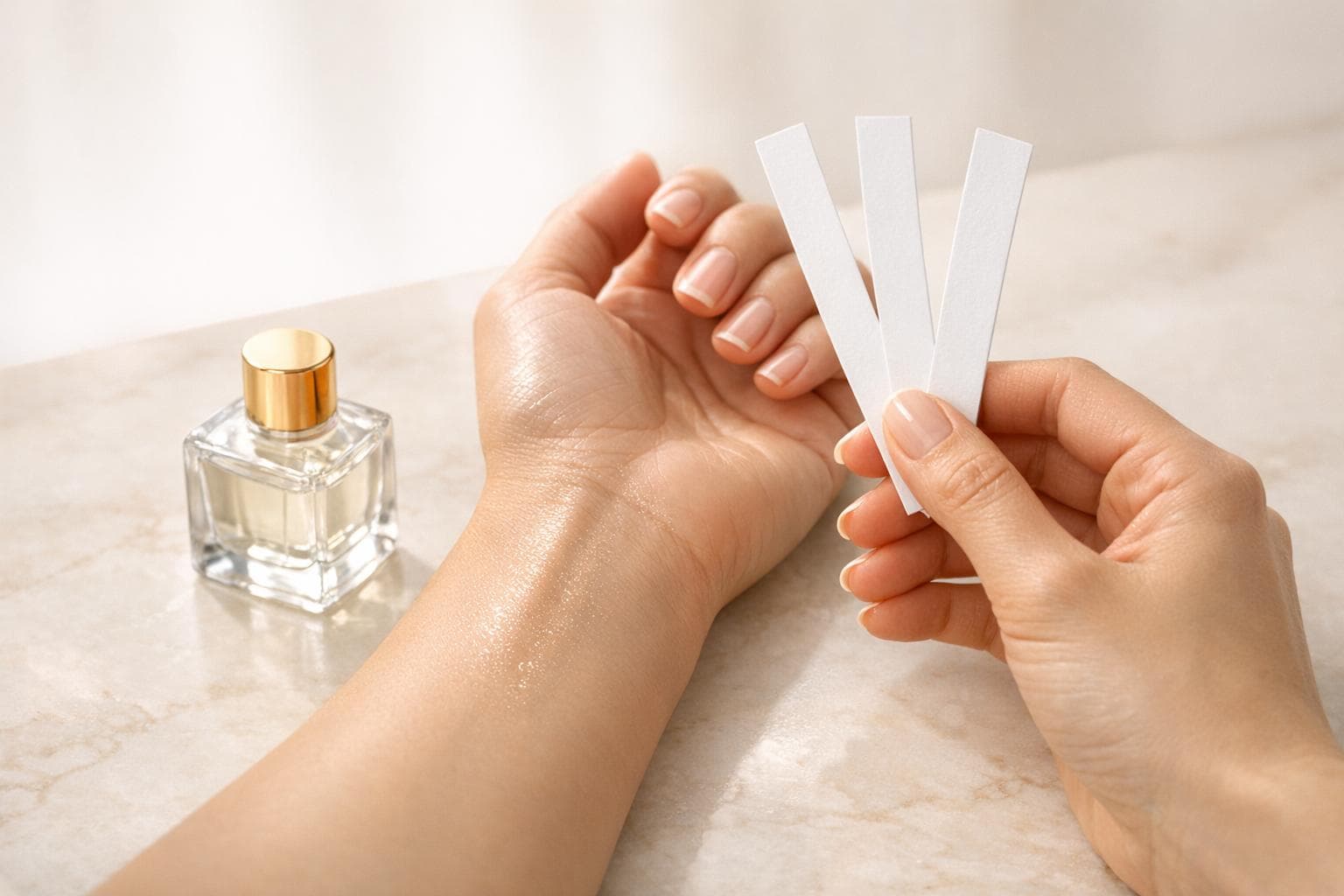
When testing perfumes, the choice between skin and blotter depends on what you’re looking to evaluate. Blotters give a quick, neutral snapshot of a scent’s top notes, making them ideal for narrowing down options. However, they can’t show how the fragrance evolves over time or interacts with your body. Skin testing reveals the full scent journey, including how it reacts with your natural oils and pH, but is limited by space and external factors like skin products or diet. The best approach? Start with blotters to shortlist a few scents, then test those on your skin to see how they wear throughout the day.
Key points:
- Blotters: Great for initial impressions and comparing multiple scents quickly.
- Skin: Shows how a perfume develops, its longevity, and its interaction with your body.
- Pro Tip: Use both methods. Start with blotters, then test your favorites on your skin.
Quick Comparison:
| Factor | Blotter Testing | Skin Testing |
|---|---|---|
| Scent Realism | Neutral, surface-level impression | Personal, full scent development |
| Note Accuracy | Highlights top notes | Reveals heart and base notes |
| Testing Capacity | Up to 5 fragrances | Limited to 2–3 spots on the skin |
| Temperature | Room temperature | Warm (~98.6°F), speeds up evaporation |
| Purpose | Shortlisting options | Finalizing decisions |
Combining both methods ensures you choose the right fragrance for your needs.
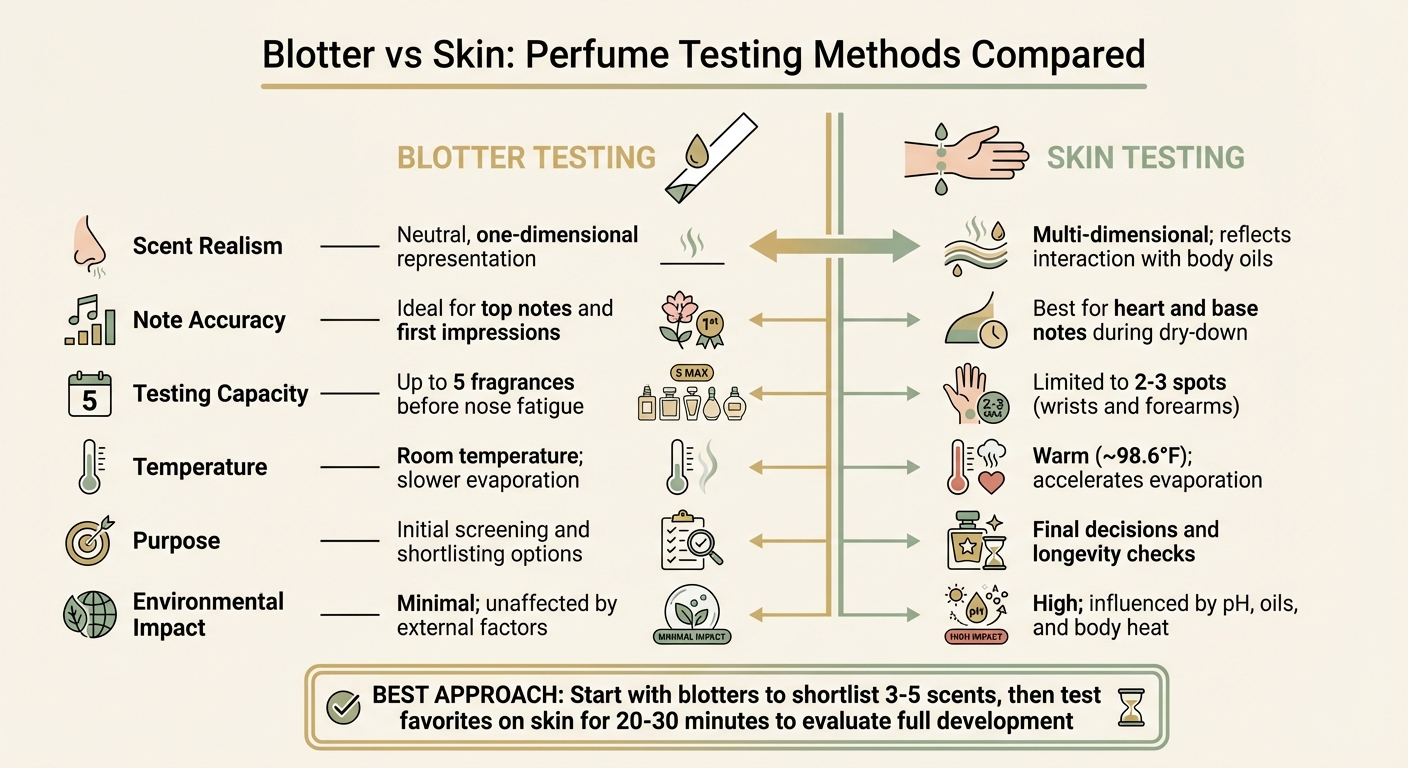
Blotter vs Skin Perfume Testing Comparison Chart
Testing Perfumes on Blotters
How to Use Blotters Correctly
Blotters, also known as perfume sticks or smelling strips, are crafted from neutral paper to ensure they don’t interfere with the fragrance’s composition. To use them properly, hold the bottle about 4–8 inches (10–20 cm) away and spray once. This distance prevents oversaturation and provides a more accurate representation of the scent.
Once sprayed, take an immediate sniff to catch the top notes, then revisit the blotter after 20–30 minutes to detect the heart notes. The base notes, which form the foundation of the scent, may take even longer to develop. To avoid overwhelming your sense of smell, limit testing to 3–5 fragrances at a time. If your nose feels overloaded, reset it by smelling coffee beans, fine pepper, or even the clean skin of your elbow. This approach helps you evaluate the fragrance’s integrity before moving on to a full wear test.
Benefits of Blotter Testing
Blotters provide a clean, unaltered snapshot of a fragrance, making them perfect for quickly comparing multiple scents. Since they don’t involve skin application, blotters allow you to assess the perfume without the influence of personal skin chemistry.
"Your skin has varying levels of oils, so the aromas may react differently on the skin compared to on the blotter." - Emily Venables, Fragrance Expert, The Perfume Shop
Another advantage? They’re budget-friendly. A pack of 200 neutral perfume strips costs roughly $4.50, making them an accessible tool for anyone serious about fragrance exploration. Blotters are especially handy for initial testing, offering a quick way to compare scents without committing to skin application.
Downsides of Blotter Testing
While blotters are useful, they do have limitations. They provide what some experts describe as a "one-dimensional experience". Unlike skin, which adds warmth and natural oils, blotters don’t allow the scent to fully evolve. This means you might miss how the fragrance transforms over time when interacting with body heat.
"Generally, paper crushes the scent... [Skin testing is] a three-dimensional experience." - Sylvaine Delacourte, Founder, Delacourte Paris
Since blotters can’t replicate how a perfume interacts with your skin chemistry, they should be seen as a preliminary step in the testing process. For a complete understanding of a fragrance’s performance, skin testing remains essential.
Testing Perfumes on Skin
How to Test Perfume on Skin
To properly test a perfume on your skin, spray it from a distance of about 4–8 inches onto pulse points like your wrists, neck, inside elbows, behind knees, or even the top of your ears. These areas generate warmth that helps the fragrance develop fully and naturally. Avoid spraying into the air, as this leads to wasted product and faster evaporation.
One common mistake is rubbing your wrists together after applying perfume. This action breaks down fragrance molecules, causing the scent to fade faster. For the best results, prepare your skin by applying an unscented lotion or oil beforehand. This helps the fragrance adhere better and last longer. After application, give the scent 20–30 minutes to settle and reveal its true character before making any judgments.
Benefits of Skin Testing
Testing a perfume on your skin gives you the most accurate impression of how it will perform in real life. Unlike blotters, which offer a more basic experience, your skin interacts with the fragrance through its natural oils and pH. This interaction creates what some describe as a "three-dimensional" experience, allowing you to experience the fragrance’s full evolution - from the fresh top notes to the deeper, lingering base notes.
"If a comparison were to be made between a blotter and the skin, we would speak of a one-dimensional experience on paper, and a three-dimensional one on the skin." - Sylvaine Delacourte, Founder, Sylvaine Delacourte Paris
Skin testing is also the best way to evaluate how long a perfume lasts. For example, eau de parfums typically remain on the skin for about five hours, while eau de toilettes tend to last closer to three hours. Additionally, the dry-down phase - when the base notes emerge - is something you can only fully appreciate through skin testing. Experts even suggest wearing the scent for an entire day, or sleeping with it on, to understand how it truly interacts with your body chemistry over time.
Downsides of Skin Testing
While skin testing has clear advantages, it does come with a few limitations. For one, your skin only has so much space, so it’s best to test no more than 2–3 fragrances at a time to avoid overwhelming your nose.
External factors can also influence how a fragrance develops on your skin. Things like your skin’s pH, the products you use, or even your diet can alter the scent’s character. A perfume that smells incredible on someone else might not work the same way on you due to these individual differences. To reset your sense of smell between tests, try sniffing a neutral area of your skin, like your elbow, or use coffee beans to clear your olfactory palate.
Skin vs Blotter: Key Differences
How the Methods Compare
Blotter testing provides a straightforward, surface-level glimpse of a fragrance, while skin testing delivers a more nuanced and personal experience.
"If a comparison were to be made between a blotter and the skin, we would speak of a one-dimensional experience on paper, and a three-dimensional one on the skin." - Sylvaine Delacourte, Founder, Sylvaine Delacourte Paris
The warmth of your skin - around 98.6°F (37°C) - speeds up evaporation, allowing heart and base notes to emerge faster. In contrast, blotters, held at room temperature, only highlight the fleeting top notes.
Additionally, the natural oils and pH levels of your skin interact with the fragrance, creating a scent profile unique to you. This is something a neutral blotter simply cannot replicate.
"Your skin has varying levels of oils, so the aromas may react differently on the skin compared to on the blotter." - Emily Venables, Fragrance Expert, The Perfume Shop
In other words, the same perfume can smell entirely different on your skin compared to paper - or even someone else’s skin.
Comparison Table: Skin vs Blotter
| Factor | Blotter Testing | Skin Testing |
|---|---|---|
| Scent Realism | Neutral, one-dimensional representation of the liquid | Multi-dimensional; reflects interaction with body oils |
| Note Accuracy | Ideal for top notes and first impressions | Best for heart and base notes during dry-down |
| Testing Capacity | Up to 5 fragrances before nose fatigue | Limited to 2–3 spots (wrists and forearms) |
| Temperature | Room temperature; slower evaporation | Warm (~98.6°F); accelerates evaporation |
| Purpose | Great for initial screening and shortlisting options | Essential for final decisions and longevity checks |
| Environmental Impact | Minimal; unaffected by external factors | High; influenced by skin pH, oils, and body heat |
| Performance Accuracy | Reflects how the fragrance smells in the bottle | Reveals wear-time, projection, and personal chemistry |
Up next, we’ll explore when to lean on each method for the best results.
Váš osobní odborník na parfémy už čeká
Vyplňte náš rychlý vonný kvíz a objevte autentické designové a nišové parfémy vybrané podle vašeho vkusu – prozkoumejte je jako 2–8ml dekanty a vzorky, abyste si každý mohli vyzkoušet, než se rozhodnete pro celou lahvičku.
Najděte svou vůniHOW TO APPLY FRAGRANCE ON A SCENT STRIP | COMMON MISTAKES
When to Use Each Testing Method
Each testing method uncovers a different side of a fragrance. Here’s how and when to use them for the best results.
Use Blotters for Initial Screening
Blotters are perfect for quickly narrowing down your options, especially when you’re browsing in-store or exploring a new collection. They help you test 3 to 5 fragrances before your nose becomes overwhelmed. To use a blotter effectively, hold the bottle 4 to 8 inches away and apply a single spritz. This captures the fragrance’s first impression - what perfumer Sylvaine Delacourte calls the "soul" of the perfume, untouched by the interaction with skin or alcohol evaporation.
Use Skin for Final Decisions
Once you’ve identified your favorites on blotters, it’s time to see how they interact with your skin. This step reveals how the fragrance works with your unique body chemistry and how it evolves throughout the day. Apply your chosen scents to pulse points like your wrists or forearms, but avoid rubbing them - this can break down the fragrance molecules. Wear the scent for several hours to experience the full development, especially the base notes.
"The real test is to sleep with it to validate the alchemy." - Sylvaine Delacourte, Founder, Sylvaine Delacourte Paris
Combine Both Methods for Best Results
For a thorough evaluation, start with blotters to eliminate scents that don’t immediately resonate with you. Then, test your top picks on your skin to assess their longevity and how they adapt to your daily life. To make this process even easier, try using 2ml or 8ml decants for more expensive or niche fragrances. Testing them at home over several days allows you to experience the scent in various settings - whether at work, during a workout, or in different weather conditions.
At Scento, we offer decants in 0.75ml, 2ml, and 8ml sizes, letting you seamlessly transition from blotter testing to extended skin trials. This way, you can explore authentic designer fragrances without committing to a full bottle that might cost over $300 and end up unused.
Conclusion: Which Testing Method Should You Use?
There’s no one-size-fits-all approach when it comes to testing fragrances. Blotters are ideal for a quick, neutral impression of a scent’s top notes, especially when you’re comparing several options and want to avoid overwhelming your senses. On the other hand, testing on your skin reveals how a fragrance interacts with your body chemistry, showcasing its depth and how it evolves over time.
The smartest strategy? Combine both methods. Start with blotters to narrow your choices down to three to five favorites, then move to skin testing for a deeper evaluation of your finalists. This two-step process gives you a thorough understanding of how a perfume performs, aligning with the best practices we’ve explored.
For high-end or niche scents, extended testing with decants is invaluable. Sampling 2 ml or 8 ml over a few days allows you to experience the fragrance in various settings - at work, during exercise, or even while you sleep. This extended trial helps ensure you’re confident in your choice, avoiding the disappointment of spending over $300 on a bottle that doesn’t feel right.
At Scento, our 0.75 ml, 2 ml, and 8 ml decants make this process seamless. They let you explore authentic designer fragrances in-depth, helping you invest in a scent that truly complements you.
FAQs
Why does perfume smell different on skin compared to a blotter?
Perfume reacts uniquely with your skin because it blends with your natural oils, body temperature, and individual chemistry. These interactions shape how the scent develops over time, offering a personal experience that a testing blotter just can’t replicate.
While blotters are useful for a quick first impression, they fall short when it comes to revealing how a fragrance will evolve and linger throughout the day. To truly gauge whether a perfume complements you, it’s crucial to test it directly on your skin.
How do skin pH and natural oils influence how a perfume smells?
Your skin’s natural chemistry - its pH level and oils - plays a major role in how a perfume smells on you and how long it lasts. When fragrance meets your skin, it interacts with your body’s unique makeup, creating a scent experience that’s entirely personal. That’s why the same perfume can smell slightly different on someone else.
The warmth and moisture of your skin amplify certain elements in the fragrance, particularly the heart and base notes, making the scent richer and more distinctive over time. However, your skin’s natural oils can sometimes tweak the scent’s profile or even influence its longevity. For the best results, apply perfume to your pulse points - like your wrists or neck - and let it settle naturally. Avoid rubbing your skin after applying, as this can break down the scent molecules and change how the fragrance develops.
What are the advantages of testing perfume on both blotters and skin?
When it comes to evaluating a fragrance, testing on both blotters and skin gives you a complete picture. Blotter testing is perfect for getting a quick sense of the top notes without any interference from your body chemistry. This approach makes it easy to compare several scents side by side in a neutral, consistent way.
Skin testing, however, takes things a step further. It lets you see how the fragrance interacts with your own body chemistry, uncovering its unique character and the way it changes over time.
Using both methods allows you to first capture the initial impression on a blotter and then experience the scent’s full journey on your skin. This dual approach helps you choose a fragrance with greater confidence and clarity.