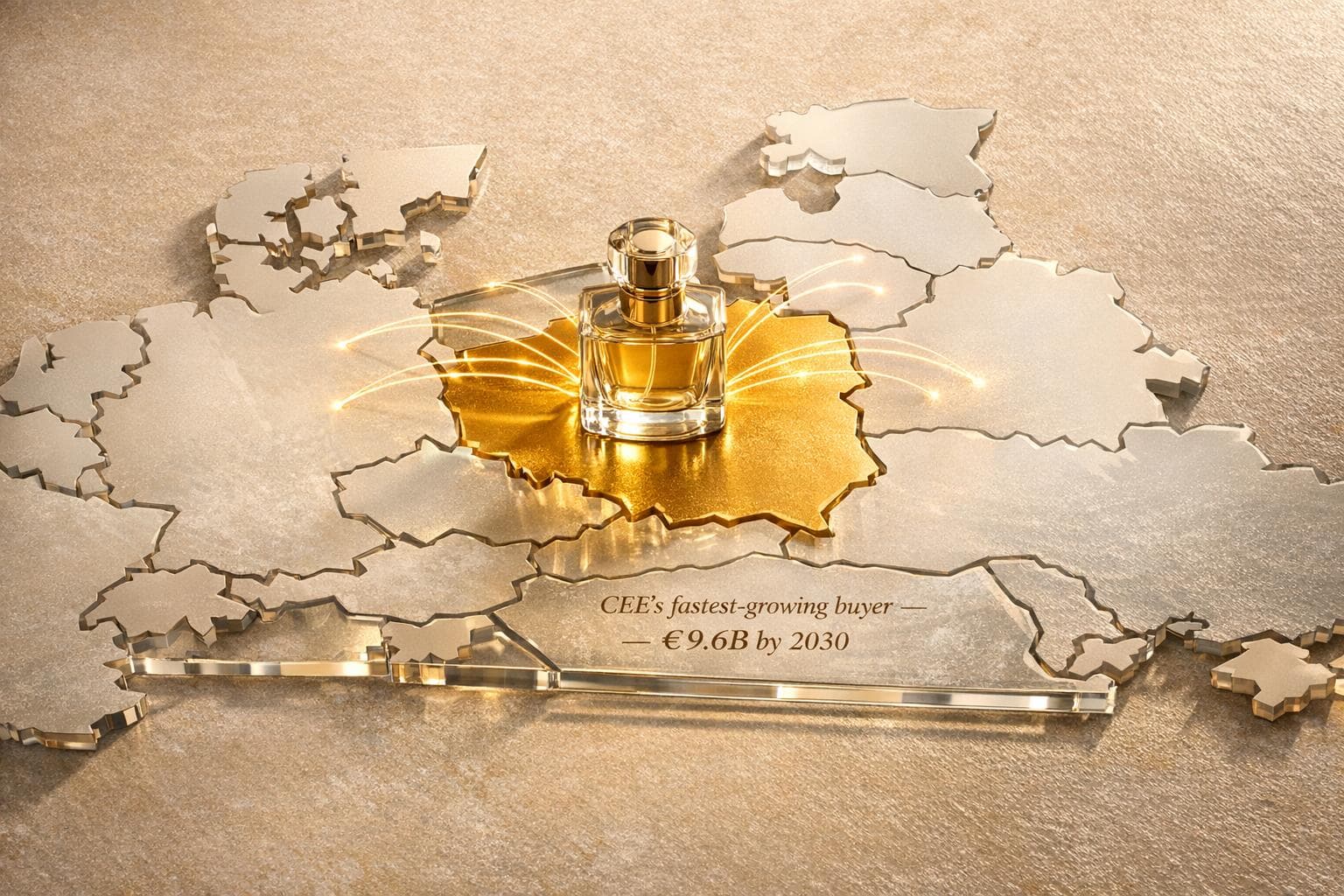
Polen ist inzwischen der am schnellsten wachsende Duftmarkt in Mittel- und Osteuropa. Bis 2026 wird das Land größere Märkte wie Deutschland und Frankreich überholen, angetrieben von veränderten Konsumgewohnheiten, steigenden verfügbaren Einkommen und einer Verlagerung hin zu Premiumprodukten. Düfte in Polen haben sich von gelegentlichen Luxusmomenten zu täglichen Essentials entwickelt, wobei Verkäufe von Eau de Toilette 10,2 % des gesamten Kosmetikmarktes ausmachen.
Zentrale Highlights:
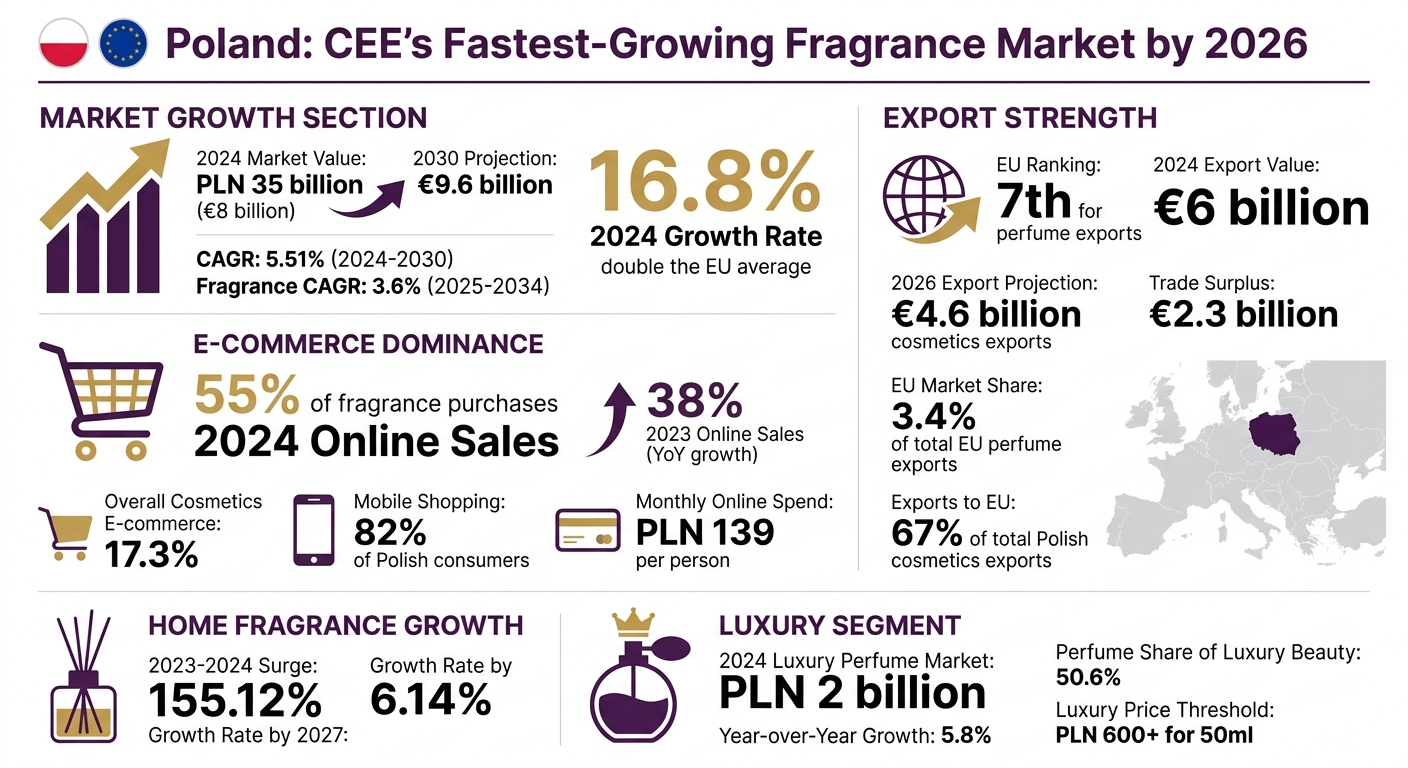
- Marktwachstum: Der polnische Kosmetikmarkt wuchs 2024 um 16,8 % und damit doppelt so stark wie der EU — Durchschnitt.
- E — Commerce — Boom: 55 % der Duftkäufe erfolgten 2024 online, gegenüber 38 % im Jahr 2023.
- Exporte: Polen belegt in der EU Rang 7 bei Parfümexporten, mit einem Exportwert von 6 Milliarden € bis 2024.
- Konsumententrends: Jüngere Käufer bevorzugen Body Mists, während Premium — Unisex — Düfte wohlhabendere Zielgruppen ansprechen.
- Zukunftsausblick: Für den Markt wird eine jährliche Wachstumsrate (CAGR) von 5,51 % prognostiziert, wodurch er bis 2030 ein Volumen von 9,6 Milliarden € erreichen soll.
Polens Duftindustrie floriert, indem sie massenmarkttaugliche Zugänglichkeit mit Premiumisierung in Einklang bringt und E — Commerce nutzt, um ein wachsendes Publikum zu erreichen.
Statistiken zum polnischen Duftmarkt 2024–2030: Wachstum, E — Commerce- und Exportdaten
Marktgröße und Wachstumsdynamik des polnischen Duftmarktes
Marktbewertung und Wachstumskennzahlen
Der polnische Markt für Schönheit und Körperpflege erreichte 2024 einen Wert von rund 35 Milliarden PLN (etwa 8 Milliarden €), wobei Prognosen ein Wachstum auf 9,6 Milliarden € bis 2030 erwarten lassen. Dies entspricht einer stabilen durchschnittlichen jährlichen Wachstumsrate (CAGR) von 5,51 % über das Jahrzehnt hinweg und etabliert Polen als einen bedeutenden Akteur in Europas Beauty — Industrie.
Auch der Kosmetiksektor des Landes unterstreicht seine Exportstärke. Bis 2026 sollen die polnischen Kosmetikexporte 4,6 Milliarden € erreichen und jährlich um 2,8 % wachsen, während die Importe voraussichtlich 3,4 Milliarden € bei einem jährlichen Zuwachs von 2,6 % erreichen werden. Die Exportwerte liegen konstant über den Importen und verdeutlichen Polens robuste Fertigungskapazitäten und seinen Wettbewerbsvorteil auf dem internationalen Markt.
Innerhalb dieses Sektors sticht der Markt für Raumdüfte durch seine dynamische Entwicklung hervor. Dieses Segment soll bis 2027 mit einer Rate von 6,14 % wachsen, getragen von einem gesteigerten Verbraucherinteresse an Wellness und der individuellen Gestaltung des Wohnraums. Wie von 6Wresearch hervorgehoben:
"Der Markt für Raumdüfte in Polen expandiert, da Verbraucher ein zunehmendes Interesse daran zeigen, ein angenehmes und personalisiertes Wohnumfeld zu schaffen."
Diese Trends unterstreichen die wachsende Inlandsnachfrage sowohl nach persönlichen Düften als auch nach Raumdüften, wobei Importe zusätzlich zur Marktdynamik beitragen.
Importtrends und Marktexpansion
Polens steigende Nachfrage nach internationalen Premiumdüften spiegelt sich in seinen sich wandelnden Importmustern wider. Die Kosmetikimporte verzeichnen ein konstantes Wachstum und sind seit 1999 jährlich um 7,1 % gestiegen. Bemerkenswert ist, dass die Vereinigten Arabischen Emirate im Jahr 2021 zum größten Lieferanten wurden und Importe im Wert von 2,8 Milliarden € stellten.
Die Kategorie Raumdüfte unterlag zwar Marktschwankungen, hat zuletzt jedoch ein bemerkenswertes Wachstum erlebt. Zwischen 2023 und 2024 legte dieses Segment um 155,12 % zu, trotz einer insgesamt negativen CAGR von -3,12 % im Zeitraum von 2020 bis 2024. Dieser sprunghafte Anstieg verdeutlicht die veränderten Verbraucherpräferenzen hin zu Produkten wie Duftkerzen, Stäbchendiffusoren und Raumsprays, da polnische Haushalte zunehmend Wert auf Atmosphäre und Aromatherapie legen.
Diese Veränderungen sowohl in der heimischen Produktion als auch bei den Importen veranschaulichen die dynamische Natur des polnischen Duftmarktes und eröffnen Wachstumspotenziale sowohl im Bereich persönlicher Düfte als auch bei Raumdüften.
Beauty — Markt: Polen schließt zu den Größten auf
Polens Position im Duftmarkt Mittel- und Osteuropas
Polen hat sich 2024 als der am schnellsten wachsende Kosmetikmarkt der EU etabliert und dabei etablierte Märkte wie Bulgarien, Ungarn, Deutschland, Frankreich und Spanien übertroffen.
Im Duftsektor ist Polens Wachstum bemerkenswert, mit einer CAGR von 3,6 % (2025–2034), die Frankreichs Wert von 3,8 % nahezu erreicht. Laut Research and Markets:
"Es wird erwartet, dass der Markt für Düfte und Parfüms in Frankreich und Polen wachsen wird ... aufgrund der steigenden Beliebtheit von Nischenparfüms und der zunehmenden Neigung der Verbraucher zu Luxuseinkäufen."
Polen hat seine EU — Mitgliedschaft erfolgreich genutzt, um sich von einem überwiegend inländisch geprägten Markt zu einem wichtigen Exporteur zu entwickeln. Derzeit trägt das Land 5,5 % der Bruttowertschöpfung (VAB) zum europäischen Kosmetikmarkt bei, wobei 67 % der polnischen Kosmetikexporte in andere EU — Mitgliedstaaten gehen. Dieser Wandel hat zu einem Handelsüberschuss von 2,3 Milliarden € geführt, wobei die Exporte 2024 einen Rekordwert von 6,0 Milliarden € erreichten. Polen belegt nun Rang 7 in der EU bei Exporten von Parfüm und Eau de Toilette und hält 3,4 % des gesamten EU — Anteils in dieser Kategorie.
Während Russland innerhalb des europäischen Duftmarktes 2024 weiterhin einen Anteil von 17,8 % hält, wird Polens Wachstum durch den Fokus auf Premiumisierung und den Aufstieg von Nischenmarken angetrieben, nicht durch reine Menge. Auch ein deutlicher Wandel in den Konsumgewohnheiten spielt eine Rolle, da Düfte nicht länger als gelegentlicher Luxus gelten, sondern als alltägliche Essentials. Euromonitor International hebt diesen Trend hervor:
"Es wird erwartet, dass Düfte ihren robusten Wachstumskurs beibehalten, gestützt durch sich wandelnde Gewohnheiten und eine zunehmende Nutzung. In Polen sind Düfte nicht länger besonderen Anlässen vorbehalten; das tägliche Tragen wird zur Norm."
Diese Exporterfolge und die veränderten Konsumgewohnheiten positionieren Polen als dynamischen Akteur im Duftmarkt und ebnen den Weg für tiefere Einblicke in seine sich wandelnde Verbraucherlandschaft im nächsten Abschnitt.
Konsumentendemografie und Kaufverhalten
Käuferdemografie: Alters- und Einkommenssegmente
Forschungen der Universität Łódź zeigen, dass vor allem Verbraucher mittleren und höheren Alters in Polen besonders empfänglich für Duftmarketing sind, wobei das Bewusstsein für die Vorteile von Düften mit dem Alter zunimmt. Unter den 31- bis 40 — Jährigen identifizieren 13,3 % Umgebungsdüfte als Auslöser für Impulskäufe, verglichen mit nur 7,7 % in der Altersgruppe der 21- bis 30 — Jährigen.
Geschlechtsunterschiede im durch Düfte beeinflussten Einkaufsverhalten sind gering. Rund 55,8 % der polnischen Frauen geben an, aufgrund von Düften im Geschäft mehr Zeit mit Einkaufen zu verbringen, verglichen mit 54,0 % der Männer. Ebenso räumen 14,5 % der Frauen ein, unter dem Einfluss von Düften mehr Geld auszugeben, leicht mehr als die 13,4 % der Männer, die dasselbe sagen. Shuvam Chatterjee, Forscher an der Universität Łódź, betont:
"Polnische Einzelhändler sollten Frauen mittleren und höheren Alters [mit Raumdüften] gezielt ansprechen."
Steigende verfügbare Einkommen verändern den Duftmarkt. Was einst als erstrebenswerter Luxus galt, wird für durchschnittliche polnische Verbraucher zunehmend zugänglicher. Laut Euromonitor International werden Premiumdüfte immer stärker als „erreichbares Upgrade“ denn als unerreichbarer Genuss wahrgenommen. Dieses Einkommenswachstum hat zu einer Marktpolarisierung geführt: Verbraucher orientieren sich entweder an budgetfreundlichen Optionen aus dem Discountbereich oder an hochwertigen Premiummarken, wodurch Produkte des mittleren Preissegments unter Druck geraten.
Diese demografischen Verschiebungen prägen unterschiedliche Kaufmuster sowohl im Massenmarkt- als auch im Premiumsegment.
Konsummuster im Luxus- versus Massenmarkt
Der polnische Duftmarkt entwickelt sich entlang zweier Hauptpfade. Massenmarktprodukte dominieren beim Volumen dank erschwinglicher Preise und breiter Verfügbarkeit, während Premiumangebote das Wertwachstum antreiben, indem sie Selbstinszenierung und die Faszination der Exklusivität bedienen. Gleichzeitig erschließen jüngere Verbraucher mit Body Mists einen dritten Weg: eine leichte und kosteneffiziente Alternative zu klassischen Parfüms, die sie für den Alltag bevorzugen.
Darüber hinaus treibt die Verlagerung von Düften als Begleiter besonderer Anlässe hin zu einem festen Bestandteil der täglichen Routine das Wachstum über alle Preisklassen hinweg an. Dieser Verhaltenswandel, gekoppelt mit stetigem Einkommenswachstum, erweitert den Markt sowohl für Luxus- als auch für Massenmarktanbieter. Während Düfte zu einem festen Bestandteil der täglichen Pflege werden, festigt Polen seine Rolle als bedeutender Akteur auf dem Inlands- und Exportmarkt und stärkt damit seine Position als am schnellsten wachsender Duftkonsument in Mittel- und Osteuropa.
Your Personal Fragrance Expert Awaits
Take our quick scent quiz to discover authentic designer and niche fragrances matched to your taste — explore them as 2–8ml decants and samples, so you can try each one before committing to a full bottle.
Find Your ScentE — Commerce — Durchdringung und Vertriebskanäle
Wachstum des E — Commerce bei Duftverkäufen
Bis 2024 entfielen 55 % der Käufe von Parfüms und Düften auf den Online — Handel, ein markanter Anstieg gegenüber 38 % im Jahr 2023. Dieses Wachstum übertrifft die allgemeine E — Commerce — Durchdringung im Kosmetikmarkt, die bei 17,3 % liegt, deutlich.
"Der E — Commerce — Anteil am Markt ist von 9,2 % im Jahr 2018 auf 17,3 % im Jahr 2024 gestiegen. Besonders starkes Wachstum ist im Parfüm- und Duftsegment zu beobachten, wo 55 % der Verkäufe im Jahr 2024 online stattfanden."
Mobiles Shopping spielt bei diesem Anstieg eine Schlüsselrolle: 82 % der polnischen Verbraucher nutzen Smartphones, um online einzukaufen. Unter jüngeren Käufern unter 24 Jahren steigt dieser Wert auf 91 %. Die breite Nutzung automatisierter Paketstationen, die von 83 % der Nutzer bevorzugt werden, hat das Einkaufserlebnis zusätzlich vereinfacht. Im Durchschnitt geben Polen 139 PLN pro Monat online für Kosmetik und Parfüms aus.
Diese starke inländische Entwicklung hat den Weg für eine intensivere Beteiligung am grenzüberschreitenden E — Commerce geebnet, da polnische Verbraucher zunehmend internationale Plattformen nutzen, um auf eine größere Produktvielfalt zuzugreifen.
Grenzüberschreitende Käufe und Zugang zum EU — Markt
Die Dynamik im heimischen E — Commerce spiegelt sich auch in den Trends beim grenzüberschreitenden Einkauf wider. Bis 2025 kauften 41 % der polnischen Internetnutzer auf internationalen Plattformen ein, was einem Anstieg um 5 Prozentpunkte gegenüber dem Vorjahr entspricht.
Plattformen wie Temu, Allegro, AliExpress und Shein haben deutlich an Zugkraft gewonnen, wobei Temu Allegro bei den Nutzerzahlen im Mai 2025 überholt hat. Käufer fühlen sich von diesen Plattformen angezogen, weil dort Produkte erhältlich sind, die lokal nicht verfügbar sind, oder weil bessere Preisoptionen geboten werden. Sichere Zahlungsmethoden wie BLIK (72 %) und Przelewy24 (64 %) haben das Vertrauen der Verbraucher gestärkt, während wettbewerbsfähige Preise und fortschrittliche Logistiksysteme den grenzüberschreitenden Einkauf zugänglicher gemacht haben. Zusammen positionieren diese Faktoren Polen als einen der am stärksten vernetzten Duftmärkte in Mittel- und Osteuropa.
Führende Marken und Marktanteile
Top — Marken und Verteilung der Marktanteile
Polens Luxusduftmarkt wird weitgehend von internationalen Schwergewichten dominiert, wobei Parfüms 50,6 % aller Verkäufe im Luxus — Beauty — Segment ausmachen. Zu den wichtigsten Akteuren in diesem Bereich zählen LVMH (Dior), Estée Lauder (Tom Ford), Chanel, Henkel und Beiersdorf. Neben diesen globalen Spitzenreitern konkurrieren auch lokale Hersteller wie Ziaja und Bielenda um einen Anteil am Markt.
Im Jahr 2024 erreichte das Segment der Luxusparfüms mit 2 Milliarden PLN einen Rekordwert, was einem Anstieg von 5,8 % gegenüber dem Vorjahr entspricht. Dieses Wachstum unterstreicht Polens Wandel von einem produktionsgetriebenen Markt hin zu einem Markt mit einer anspruchsvolleren Verbraucherbasis, die Premiumprodukte und Innovation schätzt. Diese Trends bereiten den Boden für das Verständnis der Strategien, die den Erfolg dieser führenden Marken ermöglicht haben.
Markenstrategien für den polnischen Markt
Führende Marken in Polen verfolgen einen zweigleisigen Ansatz und sprechen sowohl das gehobene Luxussegment als auch das Mass — Premium — Publikum an. LVMH etwa setzt auf Exklusivität und Prestige durch Boutiquen, die personalisierte Kollektionen anbieten. Coty Inc. hingegen (hinter Marken wie Hugo Boss, Gucci und Calvin Klein) fokussiert sich mit seiner Mass — Premium — Crossover — Strategie auf ein breiteres Publikum, unterstützt durch ein weitreichendes Vertriebsnetz.
"Der Erfolg von Luxusmarken wird von der Art des Managements unter Bedingungen hoher wirtschaftlicher Volatilität und im Umgang mit zentralen Markttrends abhängen." – Tomasz Wiśniewski, Partner bei KPMG in Polen
Da digitale Plattformen die Art und Weise, wie Verbraucher Produkte entdecken und mit ihnen interagieren, weiter verändern, setzen Marken zunehmend auf soziale Medien und Kooperationen mit Influencern. Ein herausragendes Beispiel ist der deutsch-polnische Influencer Jeremy Fragrance (Daniel Średziński), dessen zweisprachige Inhalte und Direct-to — Consumer — Kollektionen globale Trends mit lokalen Vorlieben verbinden. Bis 2025 werden voraussichtlich 25 % aller Luxus — Transaktionen in Polen online stattfinden, was Marken dazu veranlasst, digitale Innovation und nachhaltige Praktiken zu priorisieren.
Luxusparfüms in Polen werden typischerweise als Produkte definiert, die für einen 50-ml — Flakon über 600 PLN kosten. Diese sich entwickelnden Strategien unterstreichen die dynamische Natur des Marktes und weisen auf die Trends hin, die seine Zukunft prägen.
Marktprognosen bis 2030
Prognosen zu Wachstumsraten und Marktgröße
Polens Beauty — Sektor, einschließlich Düften, befindet sich auf einem Kurs anhaltenden Wachstums. Bis 2030 soll der breitere Markt für Schönheit und Körperpflege in Polen 10,2 Milliarden EUR erreichen, gegenüber 7,8 Milliarden EUR im Jahr 2025. Dies entspricht einer durchschnittlichen jährlichen Wachstumsrate (CAGR) von 5,51 % über den Prognosezeitraum. Düfte spielen bei diesem Wachstum eine bedeutende Rolle, getragen von der doppelten Dynamik aus Nachfrage nach Premiumprodukten und der zunehmenden Reichweite von Discountkanälen.
Insbesondere die Kategorie Raumdüfte floriert. Mit einer prognostizierten Wachstumsrate von 6,14 % bis 2027 verdeutlicht dieses Segment den Wandel der Verbraucherprioritäten hin zu Wellness und der Gestaltung einladender Wohnumgebungen. Produkte wie Duftkerzen und Diffusoren werden zu alltäglichen Essentials im Wohnambiente. Wie bereits erwähnt, profitiert der Markt von einem Gleichgewicht zwischen Massenmarktprodukten, die Volumen treiben, und Premiumangeboten, die den Gesamtwert steigern.
"Der Duftbereich ist besonders lebendig und profitiert sowohl von der Premium — Nachfrage als auch von der Durchdringung über Discountkanäle, die die Reichweite erweitern, während er zugleich Anlässe des Schenkens und der Selbstinszenierung bedient." – StrategyHelix
Diese Zahlen bilden eine starke Grundlage für das Verständnis der Faktoren, die dieses Wachstum antreiben.
Wachstumstreiber: Einkommen, Markenexpansion und Konsumententrends
Ein wesentlicher Treiber dieses Wachstums ist der Anstieg des verfügbaren Einkommens, der Premium- und Nischendüften neue Möglichkeiten eröffnet, da immer mehr polnische Verbraucher in höhere Einkommensklassen aufsteigen. Dieser Wandel fördert die tägliche Nutzung von Düften und erhöht die Kaufhäufigkeit.
Marken passen sich zudem den Verbraucherpräferenzen an, indem sie sich auf Transparenz bei Inhaltsstoffen und nachhaltige Verpackungen konzentrieren. Diese Clean — Label — Ansprüche entsprechen der wachsenden Nachfrage nach umweltbewussten Produkten. Darüber hinaus helfen digitale Strategien, darunter KI-gestützte Tools zur Duftpersonalisierung, Marken dabei, mit Polens sich wandelnder Konsumentenbasis in Kontakt zu treten. Diese Faktoren stützen nicht nur das aktuelle Marktwachstum, sondern bereiten auch den Weg für aufkommende Trends, die die künftige Marktlandschaft prägen werden.
Fazit
Polen ist auf dem besten Weg, bis 2026 zum am schnellsten wachsenden Duftmarkt Mittel- und Osteuropas zu werden, dank sich wandelnder Konsumgewohnheiten, die Düfte von gelegentlichen Luxusmomenten zu alltäglichen Begleitern gemacht haben.
Das Marktwachstum spiegelt einen doppelten Ansatz wider: Massenmarktoptionen erweitern die Zugänglichkeit, während Premiumdüfte bei wohlhabenden Konsumenten zunehmend an Bedeutung gewinnen. E — Commerce führt als primärer Vertriebskanal, angetrieben durch den Einfluss sozialer Medien und Prominenten — Empfehlungen. Formate wie Body Mists sind besonders attraktiv für jüngere Käufer, während hochwertige Unisex — Düfte wohlhabendere Zielgruppen bedienen. Diese Entwicklungen unterstreichen die dynamischen Veränderungen, die Polens Duftindustrie prägen.
Die Prognosen für Polens Markt für Schönheit und Körperpflege zeigen einen Anstieg von 7,8 Milliarden EUR im Jahr 2025 auf 10,2 Milliarden EUR bis 2030 bei einer jährlichen Wachstumsrate von 5,51 %. Dieses Wachstum wird durch steigende verfügbare Einkommen, innovative Markenführung sowie einen zunehmenden Fokus auf Wellness und Selbstinszenierung angetrieben.
Digitale Fortschritte verändern die Marktlandschaft grundlegend, wobei KI-gestützte Personalisierungstools und Influencer — Marketing neue Möglichkeiten für Marken schaffen, mit Konsumenten in Verbindung zu treten. Gleichzeitig fördert das steigende Interesse an Transparenz bei Inhaltsstoffen und umweltfreundlichen Verpackungen stärker digital ausgerichtete Retail — Strategien. Dieser technologische Wandel zeigt, wie Innovation und demografische Trends genutzt werden, um den Markt voranzutreiben.
Da diese Faktoren zusammenwirken – demografische Entwicklung, Kanalinnovation und der Aufstieg von Premiumprodukten – ist Polens Duftmarkt hervorragend positioniert, seine regionalen Wettbewerber zu übertreffen. Sein Wachstumspotenzial sowohl im erschwinglichen als auch im Luxussegment festigt Polens Rolle als bedeutender Exporteur und als Schlüsselfigur in der Duftindustrie Mittel- und Osteuropas.
Häufig gestellte Fragen
Was treibt Polens Duftboom jenseits steigender Einkommen an?
Polens Duftmarkt verzeichnet ein beeindruckendes Wachstum, das von weit mehr als nur steigenden Einkommen getragen wird. Die florierende Kosmetikindustrie spielt eine wesentliche Rolle, ebenso wie ein spürbarer Wandel der Verbraucherpräferenzen hin zu natürlichen und Nischendüften. Zudem hat die Expansion des E — Commerce Düfte leichter zugänglich gemacht und ihre Attraktivität erweitert. Diese Faktoren, gepaart mit einem wachsenden Fokus auf Körperpflege und Selbstinszenierung, haben Polen zu einem spannenden und dynamischen Akteur in der Duftlandschaft der EU gemacht.
Warum verlagern sich so viele Duftkäufe in Polen ins Internet?
Die Art und Weise, wie Menschen in Polen Düfte kaufen, verlagert sich dank des Aufstiegs des E — Commerce zunehmend ins Internet. Mit besserem Internetzugang und einer wachsenden Vorliebe für Komfort wenden sich Käufer Online — Plattformen zu. Diese sprechen Verbraucher an, indem sie eine große Produktauswahl, Zugang zu Bewertungen und maßgeschneiderte Empfehlungen bieten. Dieser Wandel gewann während der COVID-19 — Pandemie an Dynamik, als immer mehr Menschen digitale Einkaufsmöglichkeiten entdeckten. Mobiles Shopping hat diesen Trend zusätzlich verstärkt und das Stöbern und Kaufen noch einfacher gemacht. Ein weiterer Treiber dieser Entwicklung ist die Verfügbarkeit umweltbewusster und Nischenmarken online – Optionen, die in traditionellen Geschäften oft schwer zu finden sind. Diese Kombination aus Vielfalt, Komfort und Exklusivität hat E — Commerce für Duftliebhaber in Polen zur bevorzugten Wahl gemacht.
Welche Duftkategorien werden in Polen bis 2030 voraussichtlich am schnellsten wachsen?
Es wird erwartet, dass der Duftmarkt in Polen bis 2030 vor allem in zwei Schlüsselbereichen das stärkste Wachstum verzeichnen wird: personalisierte Düfte und nachhaltige Optionen. Dieser Wandel wird durch ein steigendes Interesse an maßgeschneiderten Duftkreationen und eine ausgeprägte Präferenz für umweltbewusste Produkte angetrieben und steht im Einklang mit den übergeordneten Branchentrends.