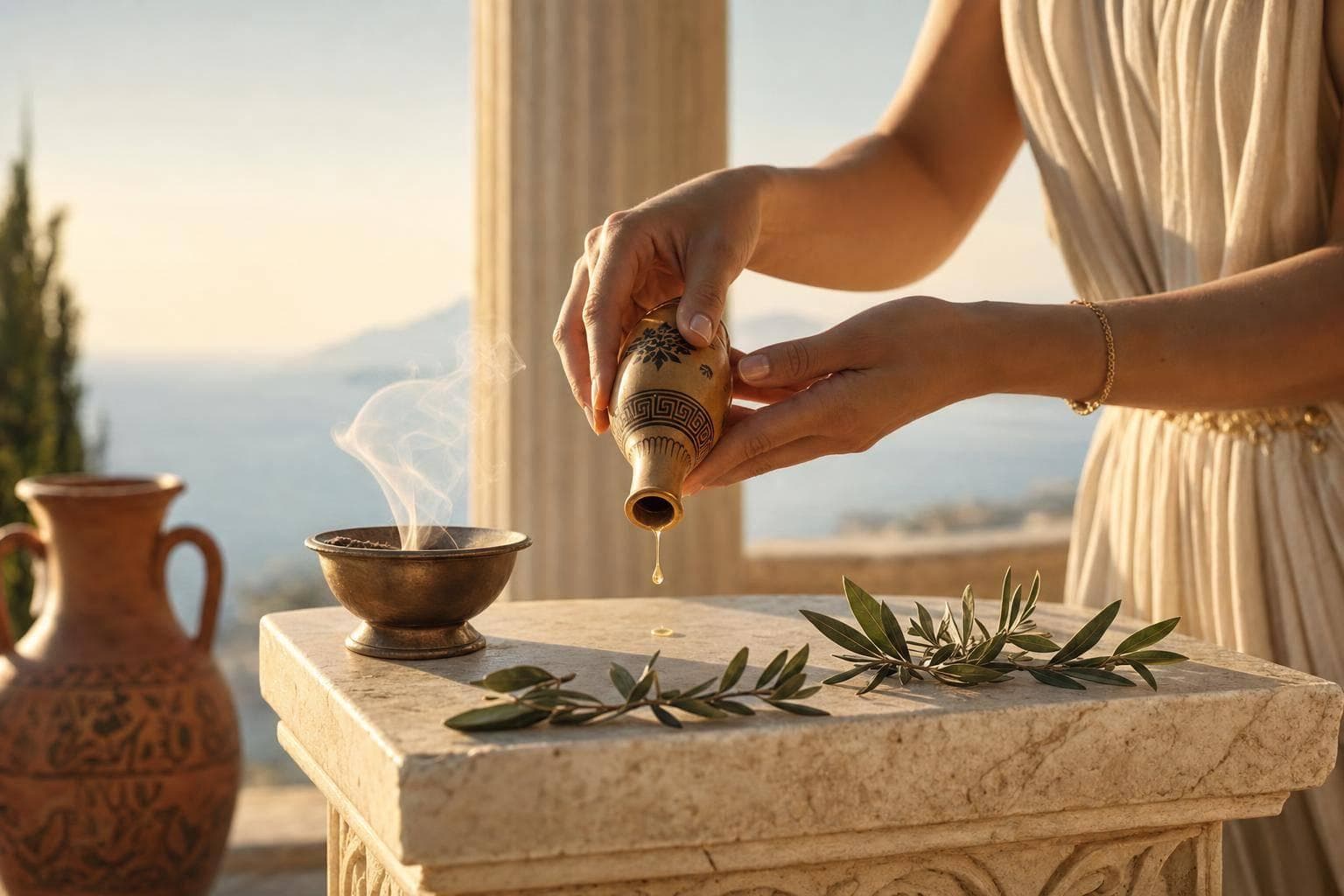
En la antigua Grecia, el perfume nunca fue una simple cuestión de oler bien. A mi juicio, se situaba en la encrucijada del mito, el culto, el cuidado personal, el comercio y los ritos funerarios; con vestigios que se remontan a c. 1.400–1.200 a. C. en los registros de los palacios micénicos.
Si busca la versión resumida, aquí la tiene:
- El mito dotó de significado al aroma: los dioses, las rosas, la ambrosía y los óleos inmortales vincularon el olor con la belleza y la presencia divina.
- El ritual otorgó un propósito al aroma: los aceites y el incienso se empleaban en templos, ofrendas y ritos fúnebres.
- La vida cotidiana brindó estatus al aroma: atletas, élites, novias y dolientes utilizaban aceites perfumados de diversas maneras.
- El comercio lo hizo posible: las tablillas palaciegas, los recipientes y las alusiones a tiendas revelan una producción y una venta organizadas.
- La investigación moderna llena los vacíos: los textos, la cerámica y los análisis químicos ayudan a los investigadores a reconstruir cómo funcionaban los perfumes griegos.
Un detalle resulta muy elocuente: las tablillas de Lineal B registran alrededor de 24 litros de aceite perfumado destinados a festines o al uso ritual. Esto demuestra que la fragancia no era una afición secundaria; ocupaba un lugar consolidado en la vida griega.
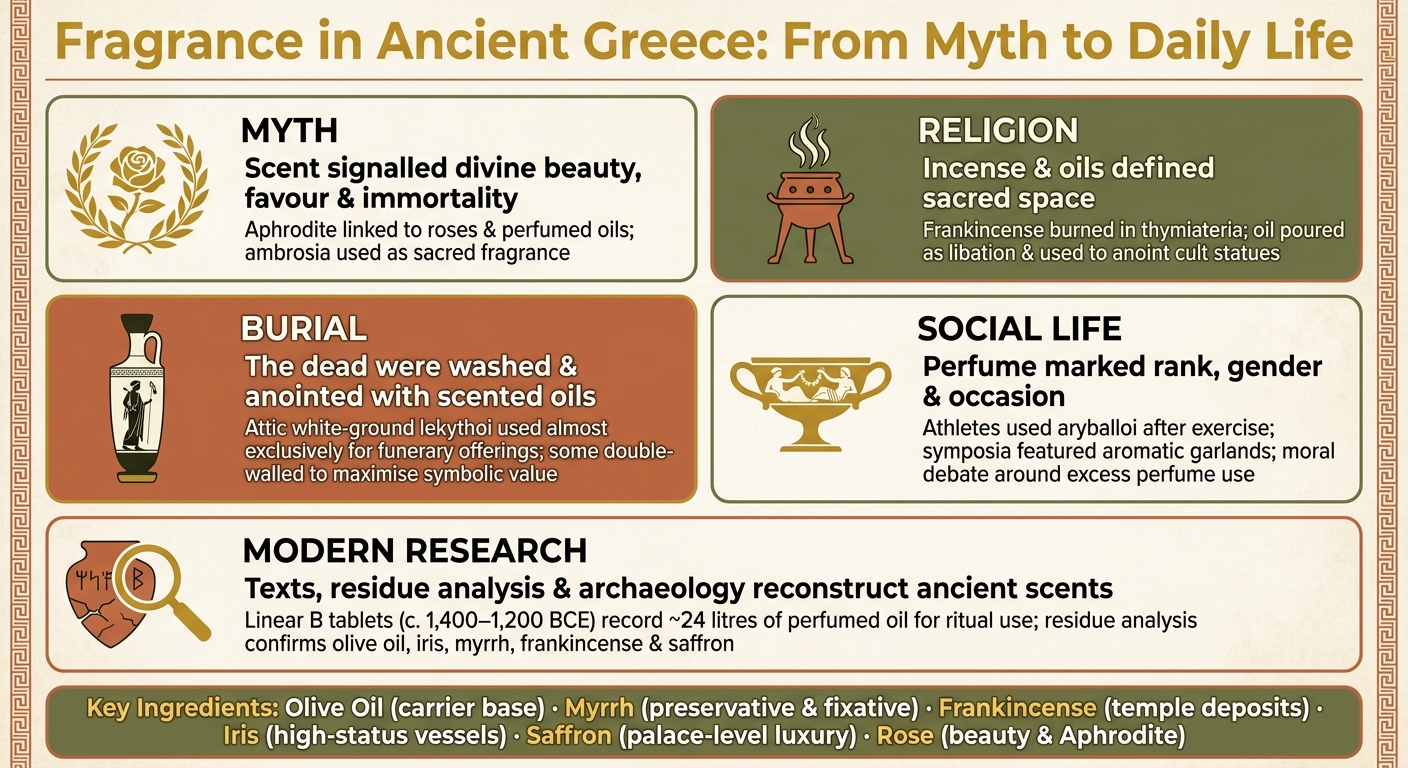
El perfume en la antigua Grecia: mito, ritual y vida cotidiana
De un vistazo
| Ámbito | Qué revela |
|---|---|
| Mito | El aroma representaba la belleza, el favor divino y la inmortalidad |
| Religión | El incienso y los aceites delimitaban el espacio sagrado y las ofrendas |
| Ritos funerarios | Se lavaba y ungía a los difuntos con aceites aromáticos |
| Vida social | El perfume podía denotar estatus, género, distinción o exceso |
| Investigación | El análisis de residuos y la arqueología contrastan los testimonios textuales |
Así pues, al abordar esta temática, la conclusión principal es clara: el perfume griego integró relato, ritual y práctica cotidiana en un único sistema. Por esa razón sigue fascinándonos en la actualidad.
Orígenes míticos: cómo explicaban los griegos el aroma a través de los dioses
El mito griego situó la fragancia en el seno de la vida divina. El aroma evocaba belleza, gracia y una suerte de distanciamiento de la existencia humana común. Si la sección anterior mostraba cómo los griegos empleaban los aceites perfumados en contextos cotidianos y rituales, el mito ayuda a comprender por qué el perfume poseía, ante todo, un aura divina.
Afrodita, las rosas y la belleza divina
El vínculo de Afrodita con el perfume reside en la esencia misma de su figura. En los Himnos homéricos y en la tradición literaria posterior, se manifiesta rodeada de rosas, mirto y aderezos perfumados. La fragancia no se limita a embellecer su imagen: proclama su hermosura y su poder.
Ese arquetipo mítico moldeó las concepciones griegas sobre la belleza y el deseo de forma más amplia. Las flores fragantes y los aceites aromáticos pasaron a personificar la seducción porque pertenecían al universo de Afrodita. Ungir el cuerpo con aceite perfumado equivalía, en cierto sentido, a evocar su presencia.
Ambrosía, néctar y el perfume de la inmortalidad
Por lo general, la ambrosía y el néctar se presentan como el alimento y la bebida de los dioses. Sin embargo, la literatura griega también les atribuye una dimensión aromática. Los especialistas consideran ambas materias como sustancias perfumadas con funciones cosméticas y rituales.
La poesía épica recurre a la ambrosía no solo como manjar divino, sino como fragancia protectora. En la Odisea, la ninfa marina Eidotea vierte ambrosía bajo la nariz de Menelao para que él y sus compañeros puedan soportar el hedor de las pieles de foca. Es un pormenor sutil, pero muy revelador: el aroma divino vence al olor mortal y traza una frontera entre lo sagrado y lo profano.
En los textos épicos e hímnicos, los dioses se presentan con frecuencia envueltos en dulzura o perfume. En el Himno homérico a Afrodita, cuando la diosa es ungida con óleo inmortal, la propia isla de Chipre se torna fragante. Aquí, el aroma no es solo individual: anuncia que la presencia divina ha descendido al mundo terrenal.
Plantas aromáticas nacidas del mito
El mito griego también explicaba el origen de las plantas aromáticas mediante relatos de metamorfosis. Las rosas, el mirto, el jacinto y el narciso están ligados a figuras divinas o heroicas, y sus leyendas suelen entrelazar el aroma con el duelo, el amor o el favor celestial. Estas narraciones no solo revisten interés como mitos fundacionales, sino como el modo en que los griegos descifraban el sentido del perfume.
Una planta olorosa funcionaba como la huella indeleble del mito. Los autores griegos dotaban al olor de una carga moral: los efluvios dulces pertenecían a los dioses y a los bienaventurados, mientras que el hedor remitía a la putrefacción y a la muerte.
Ese halo sagrado impregnó templos, ofrendas y ceremonias fúnebres. Del mito, la fragancia pasó al culto, a los dones consagrados a las divinidades y a las atenciones luctuosas.
Tu experto en fragancias personal te espera
Haz nuestro test olfativo rápido y descubre auténticos perfumes de diseñador y de nicho elegidos según tu gusto: explóralos en decants y muestras de 2, 5, 8 y 30 ml para probar cada uno antes de decidirte por un frasco completo.
Encuentra tu fraganciaUso sagrado y funerario: incienso, aceites y práctica ritual
Desde el mito, el perfume se integró en el ritual. A lo largo de la Edad del Bronce y hasta el periodo clásico, los aceites aromáticos y las resinas ardientes ocuparon un lugar primordial en el modo en que los griegos veneraban a los dioses y despedían a sus muertos.
Perfume e incienso en los templos
En los templos, el aroma iba más allá de resultar agradable: contribuía a definir el espacio ritual. El aceite de oliva perfumado se empleaba como libación, como unción de las estatuas de culto y como ofrenda en altares o recintos de sacrificio. Junto a él, se quemaban resinas aromáticas como el olíbano en incensarios conocidos como thymiateria. El humo oloroso ascendente proclamaba la presencia de los dioses y aislaba el espacio sacro de la cotidianeidad profana.
La pureza era fundamental en este contexto. La fragancia marcaba la frontera entre lo mundano y lo sagrado. Presentarse en un santuario con el cuerpo perfumado y recién ungido en óleo era señal de pureza y disposición interior, mientras que el aceite vertido alrededor de un altar ayudaba a conjurar el miasma - la impureza ritual - . En ese sentido, el perfume no constituía una simple ofrenda: formaba parte indispensable de la preparación litúrgica.
Evidencia micénica en tablillas y hallazgos
Este uso de las fragancias ya estaba estructurado a escala palaciega en la Edad del Bronce. Los registros detallados más antiguos de una producción sistemática de perfumes en Grecia proceden de los archivos palaciegos micénicos, redactados en escritura lineal B hacia 1.400–1.200 a. C. Las series de tablillas de Pilos y Cnosos - sobre todo las series Fp y Fr - documentan la elaboración y redistribución de aceite de oliva perfumado a gran escala. La base era el aceite de oliva (e-ra3-wo), aromatizado con sustancias como ládano, mirra y diversas resinas y hierbas.
Las tablillas describen este sistema con una precisión asombrosa. Los textos de la serie Un de Pilos registran alrededor de 24 litros de aceite perfumado reservados para lo que los investigadores interpretan como festines comensales o rituales. Otras partidas enviadas a los santuarios alcanzaban varios litros en un solo despacho. Se trataba de una cadena de suministro religioso centralizada. Ciertas asignaciones se destinaban a deidades específicas - entre ellas Poseidón - , mientras que otras iban dirigidas a miembros del sacerdocio y a mujeres de alto rango vinculadas al culto.
La arqueología corrobora estos registros escritos. Las excavaciones en yacimientos de la Edad del Bronce han sacado a la luz talleres especializados donde se procesaba materia vegetal aromática, junto con vasos de estribo y otros contenedores hallados en las inmediaciones de espacios sagrados.
Ritos funerarios y memoria
Esta misma concepción ritual presidía los cuidados fúnebres. La fragancia acompañaba al difunto desde el instante de su muerte hasta su recuerdo perdurable. Durante la prothesis - la exposición del cuerpo - , el cadáver era lavado, ungido con aceite perfumado y dispuesto en un lecho mortuorio, flanqueado por lekythoi (frascos de aceite). El óleo cumplía una función práctica al atenuar la crudeza de la muerte, pero también poseía un hondo valor simbólico: ungir al difunto era un acto supremo de piedad y dignidad.
Los lekythoi áticos de fondo blanco, elaborados en grandes cantidades durante el siglo V a. C., se fabricaban casi con exclusividad para uso funerario. Las fuentes literarias corroboran que los atenienses llevaban ungüentos aromáticos a sus muertos precisamente en estos recipientes. Algunos lekythoi presentaban incluso un cuerpo exterior simulado con un receptáculo interior más reducido, de suerte que una modesta cantidad del costoso bálsamo aparentaba ser una ofrenda suntuosa. Los análisis por rayos X en tumbas han confirmado esta estructura de doble pared, cuyo diseño primaba el valor simbólico por encima del volumen real.
Tras la inhumación, los dolientes regresaban para derramar aceite sobre la propia estela de la tumba, honrando la piedra como una personificación del cuerpo del finado.
De las honras fúnebres, el perfume pasó así a perpetuar los actos de memoria.
Vida cotidiana, estatus y el comercio del perfume en la antigua Grecia
Los aceites aromáticos utilizados en la liturgia no quedaron confinados en templos o sepulcros: formaban parte viva de la cotidianeidad.
Cuerpos perfumados: baño, deporte y vida social
Los griegos solían ungirse con aceite perfumado tras el baño y el ejercicio físico, aplicándolo desde aríbalos y alabastrones. Los relieves funerarios muestran incluso a atletas con frascos de alabastrón atados a las muñecas, lo que atestigua la absoluta naturalidad de esta costumbre. Tras el paso por el gimnasio, el aceite oloroso era símbolo de disciplina, esmero y distinción cívica.
Desde allí, el perfume se introdujo con presteza en la vida social de las élites. En los simposios, las guirnaldas florales y los aceites perfumados marcaban el tono de la refinada hospitalidad. En las bodas, las fragancias más sutiles realzaban las nociones de juventud, belleza y atracción erótica.
Género, clase y controversia moral en torno al perfume
Ese uso público del perfume lo convirtió también en objeto de debate social. En el Banquete de Jenofonte, Sócrates rechaza los perfumes en una reunión masculina y sostiene que el aroma del aceite de oliva propio del gimnasio es el olor legítimo para los hombres, mientras que el myron - el perfume elaborado - no convenía a los hombres libres. Esta perspectiva refleja una tensión más amplia: un aceite sobrio, propio del ejercicio atlético, era digno de un ciudadano, pero las fragancias complejas o marcadamente florales podían sugerir molicie o desenfreno.
Los escritores griegos consideraban a menudo el aroma como un distintivo de clase: el aceite moderado correspondía a los ciudadanos libres, las fragancias delicadas a las esposas y los perfumes orientales de importación se asociaban a las heteras. Los esclavos y los trabajadores manuales apenas tenían acceso a estos lujos.
Tiendas, ingredientes y aplicaciones medicinales
Si bien el perfume suscitaba debate, también se compraba, se vendía y se componía en un próspero comercio. En Atenas, las myropolia, o perfumerías, eran puntos neurálgicos de la vida social urbana. Aunque los moralistas censuraban estos establecimientos tachándolos de focos de molicie y vanidad, la perfumería constituía un oficio consolidado, sustentado por redes de abastecimiento que se extendían por el Mediterráneo y el Próximo Oriente.
Entre los ingredientes más habituales figuraban:
- la rosa, ligada a la belleza, el amor y Afrodita;
- la mirra, empleada tanto en perfumería como en ceremonias religiosas y funerarias;
- el azafrán, asociado a tejidos suntuosos y al adorno de mujeres de la alta sociedad;
- la mejorana, una hierba más común empleada en la elaboración de aceites aromáticos.
Estas mismas materias primas se utilizaban en la medicina. Los tratados de la tradición hipocrática recomendaban los aceites aromáticos para estimular el ánimo y combatir las miasmas del aire; algunos se aplicaban en masajes o para aliviar afecciones respiratorias, aprovechando las propiedades balsámicas, astringentes o reconfortantes de las plantas.
Cómo reconstruyen los especialistas los perfumes griegos y qué nos enseña hoy su legado
Fórmulas, análisis de residuos y arqueología experimental
Tras repasar el mito, el ritual y el comercio, la pregunta se impone: ¿cómo logran los investigadores recrear los aromas de la Antigüedad?
Lo consiguen aunando textos clásicos, piezas cerámicas, análisis de residuos y arqueología experimental. En conjunto, estos métodos revelan qué esencias combinaban, almacenaban y quemaban los perfumistas griegos.
Esta labor es decisiva, pues las evidencias suelen ser fragmentarias. Se conserva un recipiente, pero no la totalidad de su contenido; un texto enumera un ingrediente, pero omite el procedimiento exacto; el depósito de un templo preserva vestigios de resinas quemadas, pero no la fórmula íntegra del perfume. Al contrastar estas fuentes, los investigadores logran reconstrucciones cimentadas en testimonios materiales y no en meras conjeturas.
El resultado es una visión tangible de las materias primas con las que operaban los perfumistas griegos:
| Ingrediente | Función técnica |
|---|---|
| Aceite de oliva | Vehículo principal; base de la mayoría de las composiciones |
| Lirio | Nota aromática dulce; hallada en análisis de residuos en vasijas de alto estatus |
| Mirra | Conservante natural; fijador resinoso identificado en ajuares funerarios |
| Olíbano | Fijador balsámico; atestiguado en depósitos de templos y altares |
| Azafrán | Aporta calidez y profundidad; documentado en fuentes hipocráticas y palaciegas |
Llama la atención comprobar que el perfume griego no se concebía únicamente por su fragancia. Cada componente desempeñaba una función técnica: el aceite de oliva servía de soporte; las resinas actuaban como conservantes y prolongaban la fijación; otros ingredientes aportaban el acorde olfativo, al tiempo que denotaban rango social, contexto ceremonial o destino sagrado.
El principio perdura: en Grecia, el aroma se elegía por su función, su jerarquía y su significado ritual, nunca como un mero adorno.
Conclusión: aspectos clave desde el mito hasta la práctica cotidiana
El perfume griego nunca fue una simple búsqueda de deleite olfativo. El mito impregnó al aroma de un sentido sagrado y simbólico, mientras que su uso diario lo entrelazó con la higiene, el prestigio social, el culto y la memoria.
Los investigadores actuales reconstruyen este universo a partir de textos antiguos, restos cerámicos, análisis de residuos y arqueología experimental. Lo que sale a la luz es un oficio riguroso basado en aceites vehiculares eficaces y en sustancias aromáticas cargadas de trascendencia social y religiosa.
El perfume en Grecia fundió el mito, la maestría artesanal y la vida cotidiana en un sistema tan funcional como simbólico.
Preguntas frecuentes
¿Por qué era tan importante el perfume en la antigua Grecia?
En la antigua Grecia, la fragancia se hallaba en la confluencia de lo sagrado y la vida cotidiana. Se quemaba incienso y se empleaban aceites aromáticos en los templos, pero el perfume también acompañaba los grandes acontecimientos vitales, desde los nacimientos y las bodas hasta, de manera preeminente, los ritos funerarios.
Tampoco se circunscribía al ámbito ritual: tras el baño, los griegos se ungían con aceites perfumados como parte de su cuidado personal y distinción. Estos óleos eran sinónimo de pulcritud, elegancia y vigor, y ciertas esencias se prescribían asimismo para el bienestar corporal.
¿Cómo saben los especialistas qué contenían los perfumes griegos?
Los investigadores lo descubren al cotejar los testimonios de los restos arqueológicos, los textos clásicos y los análisis químicos de ingredientes o residuos.
Estudian los frascos de perfume y las vasijas de almacenamiento para comprender las fórmulas oleosas. A continuación, contrastan estos hallazgos con las fuentes escritas que detallan ingredientes y métodos de elaboración, tales como el uso de bases de aceite, la maceración y el tratamiento de resinas como la mirra.
¿Quiénes usaban perfume en la vida cotidiana de la antigua Grecia?
En la antigua Grecia, tanto hombres como mujeres empleaban aceites perfumados y fragancias en su día a día. Solían aplicárselos tras el baño, no solo con el fin de oler bien, sino como muestra de limpieza, elegancia y vitalidad.
El perfume desempeñaba igualmente un papel clave en la convivencia: estaba presente en los baños públicos y en los rituales de hospitalidad, donde se agasajaba a los huéspedes con lavados de pies perfumados y óleos aromáticos.

