
L’IA transforme la création parfumée en la rendant plus rapide, plus précise et hautement personnalisée. Voici ce qu’il faut savoir :
- Développement accéléré : les outils d’IA peuvent créer des échantillons de fragrance en 48 heures et finaliser des produits en 2 mois, contre 6 à 18 mois avec les méthodes traditionnelles.
- Senteurs personnalisées : l’IA analyse des données personnelles, telles que les humeurs et les préférences, afin de concevoir des fragrances sur mesure, faisant évoluer l’idée de « parfum signature » vers celle de « garde-robe olfactive ».
- Précision améliorée : l’IA générative prédit les interactions moléculaires avec une exactitude de 92 %, garantissant une meilleure qualité olfactive et le respect des réglementations.
- Priorité à la durabilité : l’IA aide les marques à sélectionner des ingrédients écoresponsables et à réduire les déchets durant la production.
- Implication des consommateurs : des outils tels que les casques EEG et les plateformes de retour en temps réel permettent aux utilisateurs de co-créer des fragrances adaptées à leurs besoins.
L’IA redéfinit la manière dont les parfums sont conçus, testés et vécus, en mariant la donnée à l’art pour répondre aux préférences évolutives des consommateurs.
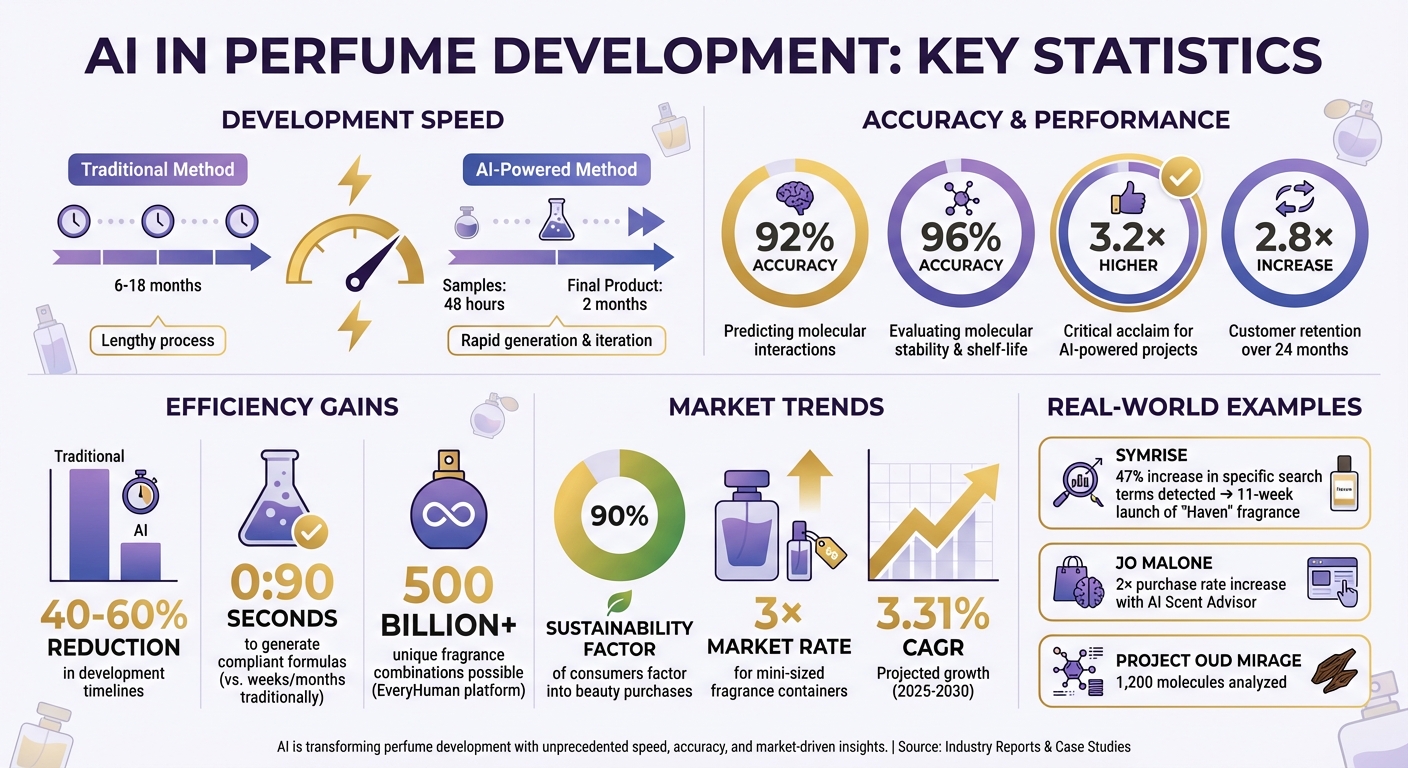
Impact de l’IA sur le développement des parfums : chiffres clés et bénéfices
IA générative et apprentissage automatique dans la conception de fragrances
Créer de nouvelles formulations olfactives grâce à l’IA générative
L’IA générative redessine la manière dont les fragrances sont développées en transformant des données chimiques brutes en formules olfactives innovantes. Cette technologie utilise les chaînes SMILES — un système standardisé permettant de représenter numériquement les structures chimiques — afin d’encoder les ingrédients parfumés sous forme d’empreintes moléculaires. En étudiant les motifs présents dans ces empreintes, l’IA peut révéler des liens statistiques entre les structures moléculaires et les senteurs qu’elles produisent.
Un exemple particulièrement remarquable est la méthode Odor Generative Diffusion (OGDiffusion), mise au point par l’équipe du professeur Takamichi Nakamoto.
« Comme l’explique le professeur Nakamoto, notre réseau de diffusion utilise les profils de spectrométrie de masse des huiles essentielles pour générer automatiquement et avec précision de nouveaux profils olfactifs ».
En 2023, Firmenich, grande maison suisse de parfumerie, a collaboré avec le Media Lab du MIT dans le cadre du Project Oud Mirage. Ce projet a utilisé l’IA pour analyser 1 200 molécules naturelles et synthétiques liées au oud, aboutissant à la création de « Oud Mirage Gamma ». La formule associait avec maîtrise des ingrédients naturels accessibles à du norlimbanol synthétique afin de reproduire la profondeur opulente du oud artisanal. La marque de niche Jorum Studio a ensuite lancé sur le marché la fragrance qui en est issue, Resinum, plus tard la même année.
Plus encore, les plateformes pilotées par l’IA peuvent désormais livrer des échantillons physiques de fragrance en seulement 48 heures, réduisant considérablement le temps nécessaire au développement.
Alex Wiltschko, fondateur d’Osmo, souligne le potentiel de cette technologie : « La génération peut prédire et créer des molécules entièrement nouvelles, jamais senties auparavant, plus durables, et résoudre des problèmes que les matières existantes ne peuvent pas résoudre, tels que la toxicité et la sécurité pour l’être humain et la planète ».
Au-delà de la génération de formules, l’IA se révèle précieuse pour affiner les créations parfumées afin de les aligner sur les préférences des consommateurs en temps réel.
Analyser les préférences des consommateurs grâce à l’apprentissage automatique
Après la création de formules innovantes, l’apprentissage automatique intervient pour ajuster les fragrances en fonction de tendances de consommation mouvantes. Cette technologie excelle dans l’identification de motifs cachés au sein des comportements des consommateurs, en analysant des sources de données variées, telles que l’activité sur les réseaux sociaux, les tendances météorologiques, les conditions économiques et même les playlists musicales. Les outils de traitement du langage naturel (NLP) enrichissent encore ce processus en traduisant les retours des consommateurs issus de plateformes comme les applications de messagerie et les groupes de discussion en enseignements exploitables par les parfumeurs.
Par exemple, au deuxième trimestre 2022, les systèmes d’IA de Symrise ont détecté une hausse de 47 % des recherches pour des expressions telles que « mousse humide », « lin froid » et « poire verte », portée par la tendance #cottagecore sur TikTok. Forte de cet éclairage, l’entreprise a développé et lancé la fragrance unisexe « Haven » en seulement 11 semaines.
L’apprentissage automatique joue également un rôle essentiel dans l’adaptation des fragrances aux marchés régionaux. En analysant des bases de données de sentiment linguistique, l’IA peut identifier des nuances culturelles — comme les associations industrielles négatives des notes de « cuir » à Séoul — et suggérer des ajustements de formule avant le lancement. Ces systèmes peuvent même prédire les interactions moléculaires, notamment la manière dont les fragrances adhéreront à la peau ou s’évaporeront, avec une exactitude impressionnante de 92 %. Ce niveau de précision soutient l’intérêt croissant des consommateurs pour les collections de parfums personnalisées, leur permettant de composer des senteurs en accord avec leurs goûts individuels.
Les entreprises investissent déjà massivement dans cette technologie. En juin 2025, Unilever a consacré 114 millions de dollars à la création d’une unité interne de conception de fragrances alimentée par l’IA. Cette initiative associe l’IA aux neurosciences afin de créer des senteurs exclusives capables d’améliorer l’humeur et le bien-être émotionnel au sein de ses marques mondiales. De même, Paco Rabanne a utilisé des données EEG pour mesurer l’activité cérébrale des millennials, identifiant des combinaisons d’ingrédients pour sa fragrance « Phantom » destinées à susciter des réponses émotionnelles spécifiques.
L’IA au service de la durabilité et de l’optimisation des ingrédients
Sourcing des ingrédients assisté par l’IA
L’intelligence artificielle transforme la manière dont les marques de parfums s’approvisionnent en ingrédients, en offrant des informations en temps réel sur l’impact environnemental et les enjeux éthiques. L’apprentissage automatique suit désormais les chaînes d’approvisionnement afin d’identifier les ingrédients liés à des espèces menacées ou à des récoltes non durables. Ces systèmes évaluent également les émissions de carbone de chaque composant, aidant les parfumeurs à choisir des options plus respectueuses de l’environnement.
Par exemple, DSM — Firmenich a lancé la plateforme EcoScent Compass entre 2024 et 2026. Cet outil évalue en temps réel la durabilité des ingrédients parfumés, en se concentrant sur les émissions de carbone et l’impact environnemental. Il permet la création de fragrances « circulaires » conçues pour répondre à des standards écoresponsables exigeants. De même, des plateformes comme NobleAI’s VIP et Chemcopilot intègrent les évaluations toxicologiques, les substitutions d’ingrédients et le suivi des émissions de carbone dans un flux de travail unifié. Cette approche permet aux fabricants d’équilibrer harmonieusement les indicateurs de durabilité et la performance chimique.
Les algorithmes prédictifs de l’IA ont atteint une exactitude de 96 % dans l’évaluation de la stabilité moléculaire et de la durée de conservation. Cela garantit que les ingrédients issus de filières durables peuvent maintenir une performance olfactive de haute qualité dans le temps. En outre, les systèmes d’IA automatisent les contrôles de conformité aux normes de l’IFRA et suggèrent des alternatives durables, réduisant considérablement le gaspillage.
Au-delà du sourcing, l’IA joue un rôle clé dans la réduction des déchets en optimisant les processus de formulation.
Réduire les déchets grâce à des formulations optimisées par l’IA
Le développement traditionnel des fragrances repose largement sur des méthodes d’essais et d’erreurs, nécessitant souvent des mois de tests et une utilisation importante de matières premières. L’IA change la donne en introduisant des simulations numériques et des modèles prédictifs qui rationalisent le processus. Les outils d’apprentissage automatique peuvent désormais prédire la stabilité moléculaire, la volatilité et l’adhérence à la peau avec plus de 92 % d’exactitude, réduisant le besoin de prototypes physiques et préservant les ressources.
L’une des innovations notables est le modèle Odor Generative Diffusion (OGDiffusion) du professeur Takamichi Nakamoto. Ce système automatise la création olfactive en calculant des mélanges précis d’huiles essentielles à partir de données de spectrométrie de masse, éliminant le besoin d’intervention humaine ou de synthèse moléculaire.
Les modèles de formulation pilotés par l’IA ont également réduit les délais de développement de 40 % à 60 %. Des outils comme Carto peuvent générer des formules conformes et viables en moins de 90 secondes — un bond immense par rapport aux semaines ou aux mois requis par les méthodes traditionnelles. Cette efficacité permet non seulement de préserver des ingrédients rares et coûteux comme la rose et le oud, mais aussi de réduire la consommation d’énergie tout au long du cycle de recherche et développement.
Personnalisation et développement de fragrances centrées sur le consommateur
Comment l’IA nourrit la personnalisation
L’IA transforme la manière dont les fragrances sont adaptées aux préférences individuelles. En analysant un ensemble de données personnelles — telles que les caractéristiques démographiques, les traits psychologiques, les souvenirs sensoriels et les comportements — l’IA crée des profils olfactifs détaillés. Elle associe émotions et expériences à des attributs moléculaires précis, comblant l’écart entre ressentis abstraits et fragrances tangibles.
Prenons l’exemple de Jo Malone London. En décembre 2025, la marque a présenté un conseiller olfactif IA alimenté par Google Cloud. Cet outil traduit les indications des utilisateurs, comme « matin pluvieux », en suggestions de fragrances personnalisées. Résultat ? Un doublement des taux d’achat. Autre exemple : International Flavors & Fragrances (IFF), qui a lancé ScentChat™ en octobre 2025. Cette plateforme recueille les retours des consommateurs en temps réel afin d’ajuster les formulations sur-le-champ.
Ce niveau de précision s’étend naturellement aux fragrances personnalisables, en parfaite harmonie avec le désir des consommateurs modernes de porter des senteurs adaptées à leur style de vie singulier.
L’essor des fragrances personnalisables
L’élan vers la personnalisation s’est mué en une tendance plus vaste : les fragrances entièrement personnalisables. Les consommateurs s’éloignent de l’idée d’un unique « parfum signature » et composent plutôt des collections correspondant à différentes humeurs, saisons et occasions. Cette évolution a stimulé la demande de formats miniatures, dont les ventes atteignent désormais trois fois le rythme du marché. La personnalisation pilotée par l’IA joue un rôle clé dans cet essor, tout comme l’attrait d’options personnalisées et faciles à emporter.
Des plateformes comme EveryHuman, lancée par The Fragrance Shop, portent la personnalisation vers de nouveaux sommets. À partir de 46 blocs constitutifs essentiels, elles peuvent créer plus de 500 milliards de combinaisons olfactives uniques.
« Il y a 600 parfumeurs dans le monde... mais cela ne signifie pas que vous et moi ne pouvons pas concevoir une senteur ni participer profondément au processus de création olfactive »,
- Alex Wiltschko, fondateur d’Osmo.
Cette tendance s’inscrit également dans le concept de garde-robe olfactive. Plutôt que de s’engager immédiatement dans l’achat d’un flacon complet, les consommateurs testent souvent plusieurs décants afin de trouver leur accord idéal. Si l’IA aide à affiner les choix en tenant compte d’éléments comme la chimie de la peau (pH, température, huiles naturelles), l’essai physique demeure essentiel pour découvrir l’accord parfait. Ensemble, ces tendances de personnalisation soulignent la manière dont l’IA révolutionne à la fois l’expérience consommateur et le processus de développement des fragrances.
Votre expert parfum personnel vous attend
Faites notre quiz olfactif express pour découvrir des parfums de créateurs et de niche authentiques, choisis selon vos goûts – explorez-les en décants et échantillons de 2, 5, 8 et 30 ml, pour essayer chaque fragrance avant de vous engager sur un flacon entier.
Trouvez votre parfumQuel avenir pour l’IA dans le développement des parfums ?
Neuroparfumerie et cartographie émotionnelle des senteurs
L’une des évolutions les plus fascinantes de la création parfumée est l’essor de la neuroparfumerie, où l’IA établit un pont entre les molécules odorantes et leurs effets émotionnels ou neurologiques. Au lieu de s’en tenir à la pyramide olfactive traditionnelle, les marques créent désormais des senteurs destinées à évoquer des états précis comme la détente, l’énergie ou la concentration. Un exemple marquant est le lancement de Phantom par Paco Rabanne en 2021. Cette fragrance a été développée à partir des enseignements de 45 millions de mesures cérébrales, aboutissant à une formule qui renforçait l’énergie et l’attraction chez les hommes de 18 à 35 ans en associant l’acétate de styrallyle à la lavande et au citron.
Dans une autre avancée novatrice, L’Oréal a collaboré avec l’entreprise de neurotechnologie Emotiv en 2022/2023 afin de concevoir un casque EEG pour Yves Saint Laurent. Cet appareil mesure l’activité cérébrale lorsque les clients découvrent différents accords, atteignant un taux de réussite de 95 % pour associer chaque personne à sa fragrance idéale. Ces avancées affinent non seulement la personnalisation, mais alignent également les parfums sur les besoins émotionnels de celui ou celle qui les porte.
D’ici 2030, cette technologie pourrait s’intégrer encore davantage à la vie quotidienne. Imaginez des objets connectés capables de surveiller le stress, le rythme cardiaque ou les cycles de sommeil, puis de suggérer ou de diffuser des senteurs adaptées à votre état émotionnel en temps réel. Imaginez un diffuseur intelligent dans votre intérieur, ajustant sa fragrance pour apaiser le stress ou stimuler l’énergie à partir de retours biométriques. Cette fusion des neurosciences et de l’IA ouvre la voie à un avenir où les fragrances seraient composées dynamiquement au rythme de vos émotions.
Systèmes de retour consommateur en temps réel
L’IA transforme également la manière dont les consommateurs influencent le développement des fragrances, en accélérant considérablement le processus. Traditionnellement, créer une nouvelle senteur pouvait prendre 6 à 18 mois, mais les outils de retour alimentés par l’IA réduisent désormais ce délai à moins de deux mois. Ainsi, des plateformes comme ScentChat™ d’IFF donnent aux consommateurs la possibilité de co-créer des parfums alignés avec leur humeur, des occasions particulières ou même leurs préférences en matière de durabilité.
« Des outils tels que ScentChat™ esquissent un avenir où les consommateurs co-concevront des parfums personnalisés adaptés à leur humeur, à l’occasion ou à leurs priorités en matière de durabilité. »
- Olivia Houghton, analyste principale Beauté et Santé, The Future Laboratory
L’IA exploite également les données en temps réel issues des tendances sur les réseaux sociaux et des comportements de recherche pour orienter les briefs olfactifs, garantissant que les nouveaux lancements résonnent avec les sensibilités actuelles des consommateurs. Des start-ups comme Osmo vont plus loin encore en développant une intelligence olfactive artificielle capable d’encoder et de reproduire numériquement les senteurs, permettant aux marques de s’adapter aux tendances avec une rapidité inédite.
« La fragrance est sur le point d’évoluer à la vitesse de la culture, et nous menons le mouvement. »
- Alex Wiltschko, fondateur, Osmo
Ces innovations permettent aux marques de tester, d’affiner et de lancer des fragrances plus rapidement que jamais, donnant aux consommateurs un rôle plus actif dans la création des produits qu’ils aiment. L’IA n’aide pas seulement les marques à suivre le rythme de la culture — elle place les consommateurs au cœur du processus créatif.
Conclusion
L’IA redessine l’industrie de la fragrance, transformant un processus autrefois laborieux, fondé sur l’essai et l’erreur, en une démarche fluide, structurée par la donnée. Des délais de développement qui s’étendaient auparavant sur 6 à 18 mois peuvent désormais être condensés à seulement 48 heures pour les échantillons et deux mois pour les produits finaux. Cette mutation intègre les forces de l’IA en matière de durabilité, de précision des ingrédients et de conception centrée sur le consommateur.
Les chiffres le confirment. Les projets de fragrance exploitant l’IA ont enregistré une reconnaissance critique 3,2× supérieure et une augmentation de 2,8× de la fidélisation client sur 24 mois par rapport aux méthodes traditionnelles. Alors que 90 % des consommateurs prennent en compte la durabilité dans leurs achats beauté et bien-être, la capacité de l’IA à identifier des alternatives écoresponsables tout en respectant les normes réglementaires est devenue indispensable. Le marché mondial de la fragrance, dont la croissance annuelle composée devrait atteindre 3,31 % entre 2025 et 2030, offre aux marques qui adoptent ces technologies une voie claire pour répondre à l’évolution des préférences des consommateurs.
« Le rôle de l’IA n’est pas de remplacer le savoir-faire et l’art de la parfumerie traditionnelle, mais d’amplifier la personnalisation des senteurs de luxe. »
- Olivia Houghton, analyste principale Beauté et Santé, The Future Laboratory
L’avenir de la fragrance s’oriente vers la personnalisation et la participation. Les consommateurs s’éloignent du parfum signature unique au profit de collections choisies, alignées sur leurs humeurs, leurs occasions et leurs valeurs. Des avancées émergentes comme la neuroparfumerie et l’olfaction numérique promettent des fragrances capables de s’adapter aux états émotionnels et aux tendances culturelles. Les marques qui sauront marier la précision technique de l’IA à la créativité humaine excelleront dans ce paysage en pleine évolution.
Cette transformation est déjà engagée, et son élan s’accélère rapidement. Comme l’affirme avec justesse Alex Wiltschko d’Osmo :
« La fragrance est sur le point d’évoluer à la vitesse de la culture, et nous menons le mouvement ».
La révolution de l’IA en parfumerie ouvre la porte à des fragrances qui vont au-delà de la beauté — plus intelligentes, plus durables et profondément adaptées aux préférences individuelles. En combinant l’innovation analytique à l’art intemporel de la création olfactive, l’IA redéfinit ce que peut être une fragrance.
FAQ
L’IA remplacera-t-elle les parfumeurs humains ?
L’IA transforme la manière dont les parfums sont développés, mais elle n’est pas destinée à remplacer entièrement le rôle des parfumeurs humains. En accélérant la formulation, en anticipant les préférences des consommateurs et en minimisant les déchets, l’IA agit comme un outil puissant qui complète la parfumerie traditionnelle plutôt qu’elle ne se substitue à son art. Si ces avancées rationalisent les processus, la compréhension profonde et intuitive de la senteur, de l’émotion et du contexte culturel demeure une faculté éminemment humaine, garantissant que la créativité et l’expression personnelle restent au cœur de la création parfumée. La collaboration entre l’IA et l’expertise humaine ouvre de nouvelles perspectives pour composer des senteurs mémorables.
Comment l’IA personnalise-t-elle une fragrance pour moi ?
L’IA s’appuie sur l’apprentissage automatique pour explorer en profondeur vos préférences olfactives, votre mode de vie et votre humeur. En analysant des détails tels que vos fragrances favorites, vos goûts personnels et même des facteurs contextuels comme le climat ou vos activités quotidiennes, elle compose une senteur véritablement personnalisée. Elle peut même transformer du texte ou des images en formules parfumées, convertissant vos inspirations en un parfum sur mesure. Cette approche fondée sur la donnée donne naissance à une fragrance pensée spécifiquement pour votre singularité.
Les parfums créés par l’IA sont-ils plus sûrs et plus durables ?
Les parfums conçus par l’IA apportent une dimension moderne à la sécurité et à l’écoresponsabilité dans l’univers de la fragrance. En exploitant l’IA générative, les marques peuvent privilégier des ingrédients respectueux de l’environnement, réduisant l’usage de matières nocives ou non durables. Ces avancées suppriment également le besoin de tests sur les animaux, puisque l’IA peut simuler avec précision les évaluations de sécurité. Au-delà de cela, l’IA affine les formulations afin de réduire les déchets et identifie des alternatives durables, soutenant des pratiques d’approvisionnement éthiques et diminuant l’empreinte environnementale de l’industrie.

