
La parfumerie du Moyen-Orient a fait entrer les accords oud, ambre, safran et rose dans les sorties occidentales grand public, avec des concentrations plus élevées et une meilleure tenue — une évolution visible aussi bien chez les flankers de créateurs que dans les lancements de niche.
L’industrie mondiale de la parfumerie évolue vers des sillages plus riches et plus tenaces, inspirés de la parfumerie moyen-orientale. Réputées pour des ingrédients tels que le oud, l’ambre et le safran, ces fragrances gagnent en popularité dans le monde entier. De grandes maisons occidentales comme Tom Ford et Dior intègrent désormais ces éléments, tandis que des marques du Moyen-Orient telles que Amouage et Arabian Oud poursuivent leur essor, le marché régional devant doubler de valeur d’ici 2032. Les plateformes sociales, en particulier TikTok et Instagram, amplifient des tendances comme le layering de parfums, rendant ces senteurs plus accessibles et désirables. Qu’il s’agisse d’options luxueuses ou plus abordables, les parfums du Moyen-Orient redéfinissent les préférences mondiales par leur profondeur et leur longue tenue.
How Middle Eastern Fragrances Are Changing Global Markets
L’impact des fragrances du Moyen-Orient sur les marchés mondiaux est manifeste dans l’évolution des ingrédients, des rituels et des formats de produits. De grandes maisons de luxe occidentales comme Tom Ford, Dior et Gucci ont adopté des éléments traditionnels moyen-orientaux tels que le oud, le safran et l’encens dans leurs collections. En effet, la demande européenne pour les fragrances à base de oud a bondi de 47 % au cours des cinq dernières années, reflétant une évolution de la perception du luxe à l’échelle mondiale.
Le layering, signature des rituels olfactifs du Moyen-Orient, a gagné une immense popularité. Cette pratique consiste à appliquer une huile parfumée concentrée sur les points de pulsation, puis une vaporisation d’Eau de Parfum, avant de terminer par une brume capillaire. Les plateformes sociales comme TikTok et Instagram ont joué un rôle clé dans la popularisation de ces rituels, en particulier auprès de la génération Z. De nombreux jeunes consommateurs associent désormais des huiles moyen-orientales à des parfums de créateurs occidentaux pour composer des fragrances uniques et longue tenue. Cet engouement pour les rituels parfumés personnalisés a poussé les marques à innover.
En réponse à l’évolution des préférences, les maisons lancent de nouveaux formats comme des « macro flacons » de 200 mL, des brumes capillaires spécialisées et des brûleurs de bakhoor modernisés aux lignes épurées et architecturales. La catégorie Eau de Parfum a également connu une croissance importante et représente désormais 38,7 % du marché moyen-oriental. Avec sa concentration de 15 à 20 % en composés aromatiques, ce format offre l’intensité et les 8 à 12 heures, voire plus, de tenue recherchées par les consommateurs d’aujourd’hui. Comme l’explique Rawya Catto, directrice générale de CPL Aromas Middle East :
"Le monde est amoureux du parfum, et plus il y a d’intensité, d’impact et de caractère, mieux c’est".
Les parfumeurs occidentaux réinventent également leurs profils olfactifs. Au lieu d’utiliser le oud uniquement comme note de fond opulente, ils l’associent à des ingrédients inattendus comme la vanille, le thé vert ou le caramel afin de créer des compositions plus légères et plus accessibles. La décision de Maison Francis Kurkdjian d’ouvrir une boutique à Riyad en février 2025 reflète la demande croissante pour des fragrances sophistiquées pensées pour le layering dans la région. Cela démontre que les marchés du Moyen-Orient ne sont pas de simples consommateurs, mais qu’ils façonnent activement les tendances mondiales.
L’influence des traditions olfactives du Moyen-Orient s’étend au-delà de la parfumerie fine. Des produits du quotidien comme les déodorants, les gels douche et les soins du linge intègrent désormais ces profils parfumés. Comme le souligne Ravi Ramchandani de Messe Frankfurt, les marques régionales "ne suivent plus les tendances - elles les définissent désormais".
1. Marques de parfums du Moyen-Orient
Les maisons de parfum du Moyen-Orient se sont métamorphosées, passant d’artisans locaux à symboles mondiaux du luxe. Des noms réputés comme Amouage (Oman), Ajmal (EAU), Arabian Oud (Arabie saoudite) et Lattafa sont célébrés pour l’usage d’ingrédients signatures tels que le oud (souvent qualifié d’"or liquide"), l’ambre, le musc, le bois de santal, le safran, l’encens et la rose de Damas. Ces marques ne se contentent pas de préserver la tradition : elles redéfinissent la parfumerie de luxe grâce à des techniques de pointe.
Une différence essentielle réside dans leurs méthodes de formulation. Contrairement aux parfums occidentaux à base d’alcool, qui tiennent généralement 4 à 6 heures, les attars moyen-orientaux à base d’huile offrent une remarquable longévité, durant 8 à 12 heures ou davantage. Le oud pur, en particulier, peut persister jusqu’à 24 heures, faisant de ces senteurs un incontournable pour celles et ceux qui recherchent des fragrances durables.
L’attrait mondial de ces marques est indéniable. Le marché des fragrances du Moyen-Orient suit une trajectoire fortement haussière, avec des projections indiquant une croissance de 4,05 milliards de dollars en 2025 à 7,52 milliards de dollars d’ici 2034. Cet essor reflète à la fois une appréciation croissante du savoir-faire derrière ces créations et l’influence des plateformes numériques comme TikTok et Instagram, qui ont initié les jeunes publics à leurs profils riches et superposés.
Des maisons de prestige telles que Amouage et Arabian Oud s’adressent au segment ultra-premium, en proposant des fragrances élaborées à partir des ingrédients les plus nobles et présentées dans des écrins somptueux. À l’inverse, des marques comme Lattafa et Swiss Arabian offrent des alternatives plus accessibles, délivrant l’intensité et la tenue des senteurs moyen-orientales à des prix séduisant un public plus large.
L’accessibilité s’est également nettement améliorée. Si les boutiques exclusives de villes comme Dubaï, Riyad, Londres et Paris demeurent des destinations phares, le e-commerce a ouvert la voie à une clientèle mondiale. Dans une initiative remarquable, Sephora Middle East a lancé en juillet 2025 un outil de recommandation de parfums alimenté par l’IA. Cette fonctionnalité aide les utilisateurs à découvrir des senteurs personnalisées selon leur humeur et les techniques traditionnelles de layering. En mariant héritage et technologie, les marques de parfums du Moyen-Orient honorent non seulement leurs origines, mais façonnent aussi l’avenir des tendances mondiales de la fragrance.
2. Parfums de créateurs occidentaux aux notes moyen-orientales
Des maisons de luxe occidentales comme Tom Ford, Dior, Gucci et YSL s’aventurent sur un nouveau territoire en intégrant la richesse des ingrédients moyen-orientaux à leurs fragrances. Délaissant leurs créations habituelles aux accents d’agrumes et de fleurs, ces marques adoptent désormais la profondeur du oud, de l’ambre, du safran et du musc. Le résultat ? Une fusion entre l’opulence orientale et la sensibilité occidentale.
Plutôt que de reproduire les styles traditionnels de la parfumerie arabe, les parfumeurs occidentaux expérimentent des associations singulières. Le oud, par exemple, est marié à des notes surprenantes telles que le thé vert, la vanille ou des accords aquatiques, rendant ces ingrédients puissants plus accessibles à un public plus large. Un exemple marquant est le lancement en mai 2024 de "Nomadic Dreams" par la marque de luxe basée à Dubaï Ghawali en collaboration avec Sheikha Maitha Al Maktoum. Cette fragrance mêle le oud traditionnel à la bergamote, à l’orange, au gingembre et au bois de cacao, avec une composition spécialement pensée pour séduire les goûts occidentaux. Forat Al Haider, directrice de l’innovation beauté chez Ghawali, a souligné un enjeu essentiel :
"Les gens ont l’idée que les parfums orientaux sont uniquement destinés aux Orientaux. Je pense que c’est l’une des idées reçues que l’on rencontre."
La réponse des consommateurs a été extrêmement positive, reflétant une évolution des préférences vers des senteurs audacieuses, superposées, avec davantage de tenue et de présence.
Pour répondre à cette demande, de nombreuses marques occidentales augmentent les concentrations parfumées à 20 % ou plus, imitant les formulations à base d’huile qui tiennent 8 à 12 heures ou davantage. Il s’agit d’un bond considérable par rapport à la durée de vie typique de 4 à 6 heures des parfums standards à base d’alcool.
Cependant, ces réinterprétations n’ont pas échappé aux critiques. Des préoccupations liées à l’appropriation culturelle ont émergé, comme l’a noté l’étudiante en pré-droit Sumaya :
"J’ai remarqué que le colonialisme et l’appropriation jouent un rôle croissant lorsqu’il s’agit des parfums arabes... On voit de grandes entreprises et des créateurs de luxe lancer des fragrances qui sentent presque à l’identique des senteurs arabes traditionnelles et en tirer profit."
Malgré ces critiques, la tendance continue de croître. Les maisons de luxe occidentales élargissent leurs collections inspirées du Moyen-Orient, créant des lignes dédiées qui célèbrent le dialogue des influences. Ce mouvement trouve un écho dans les propres créations inspirées du Moyen-Orient de Scento, marquant un nouveau chapitre dans l’industrie mondiale de la fragrance.
Votre expert parfum personnel vous attend
Faites notre quiz olfactif express pour découvrir des parfums de créateurs et de niche authentiques, choisis selon vos goûts – explorez-les en décants et échantillons de 2, 5, 8 et 30 ml, pour essayer chaque fragrance avant de vous engager sur un flacon entier.
Trouvez votre parfum3. La collection inspirée du Moyen-Orient de Scento
Scento a adopté une approche réfléchie pour faire découvrir des fragrances inspirées du Moyen-Orient, en proposant des décants permettant d’explorer cette catégorie somptueuse de manière accessible. En associant la richesse des senteurs arabes traditionnelles à une touche contemporaine, Scento permet aux consommateurs de découvrir l’attrait du oud, de l’ambre, du safran et du musc sans s’engager dans le coût élevé d’un flacon complet. Alors que les parfums traditionnels à base de oud dépassent souvent les 300 $, les décants Scento — disponibles en fioles de 2 ml, 5 ml et 8 ml, ainsi qu’un décant en flacon de 30 ml sur la plupart des parfums — rendent ces fragrances accessibles à un public plus large.
L’intérêt pour les fragrances centrées sur le oud a fortement progressé, avec une demande en Europe en hausse de 47 % au cours des cinq dernières années. Aux États-Unis, cette tendance s’inscrit dans une augmentation mondiale de l’intérêt de recherche pour "parfum arabe", qui a progressé de plus de 60 % en 2025. Les offres de Scento constituent un point d’entrée pratique pour les consommateurs curieux, leur permettant de découvrir la profondeur et la complexité de ces senteurs sans engagement financier important.
L’une des caractéristiques les plus remarquables de ces fragrances est leur impressionnante tenue. Cela permet aux utilisateurs de vivre pleinement l’évolution du parfum au fil du temps avant de décider s’ils souhaitent investir dans un format plus grand. À titre indicatif, un décant de 8 ml offre généralement environ 120 vaporisations, soit suffisamment de produit pour de multiples utilisations en diverses occasions.
Scento est un détaillant de décants et d’échantillons de parfum, et chaque produit peut être acheté à l’unité, sans aucun abonnement. Scento+ est l’adhésion optionnelle de Scento : la cotisation mensuelle vous revient intégralement sous forme de crédit en magasin, à dépenser sur n’importe quel parfum ; les membres bénéficient de 10 % de réduction, d’un échantillon offert avec chaque commande, d’un parfum offert tous les six mois et d’un cadeau d’anniversaire, et vous pouvez mettre en pause ou résilier à tout moment. Les abonnés peuvent découvrir chaque mois une sélection tournante de fragrances inspirées du Moyen-Orient, une option idéale pour la génération Z et les Millennials qui valorisent l’individualité et l’accessibilité dans leurs choix parfumés. Cette approche limite également le gaspillage, car elle évite l’accumulation de flacons à moitié utilisés — une solution judicieuse pour les passionnés de parfum.
Pour parfaire l’expérience, Scento propose quatre modèles d’atomiseurs : Limone di Capri, Rosso Fiore, Le Moooo et Toile de Jouy. Ces atomiseurs compacts sont parfaits pour une utilisation en déplacement, et la forte concentration des fragrances garantit que quelques vaporisations suffisent à laisser une impression durable. Pratiques, économiques et adaptés au voyage, ces atomiseurs subliment l’expérience globale des amoureux du parfum.
Avantages et inconvénients
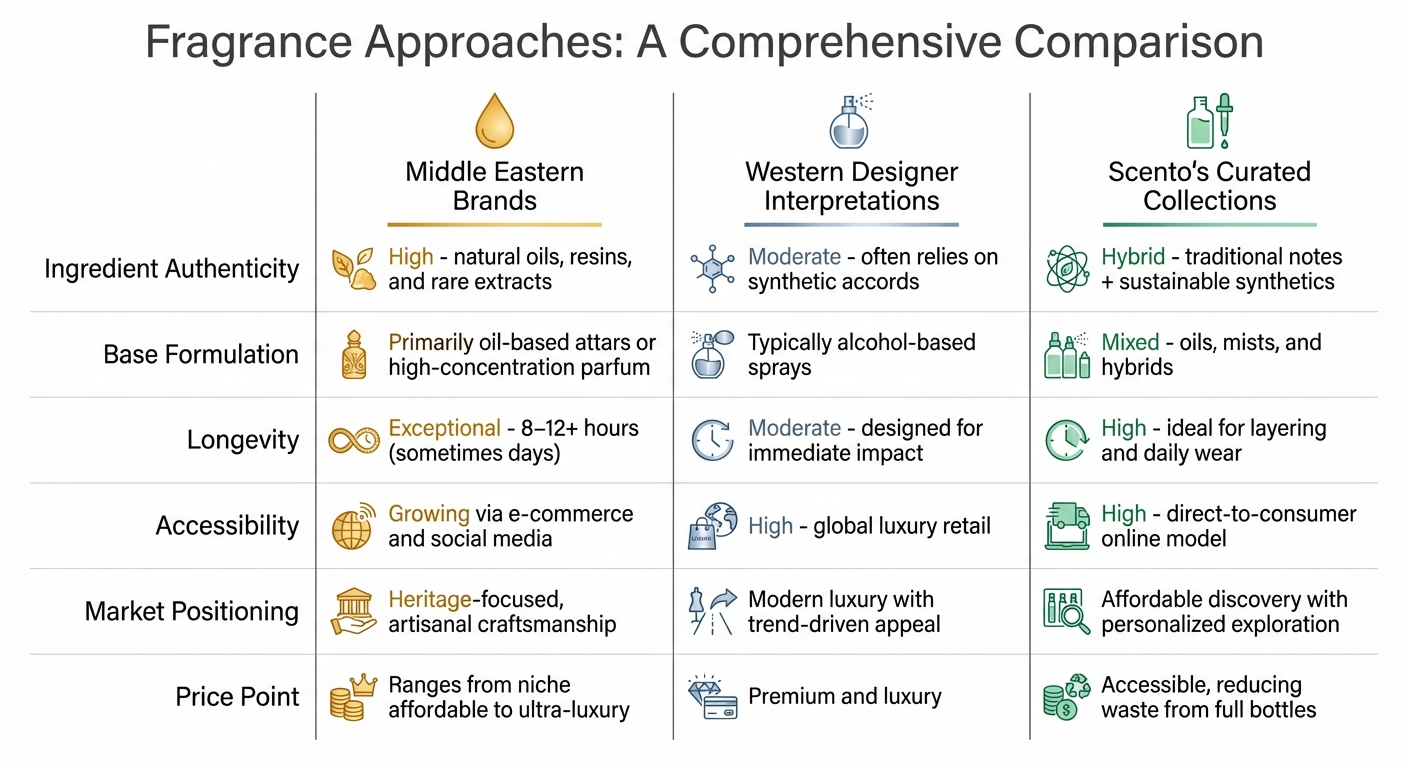
Comparaison des parfums moyen-orientaux, de créateurs occidentaux et Scento
À la lumière des éléments précédents, examinons plus précisément les forces et les défis des fragrances inspirées du Moyen-Orient par rapport aux interprétations des créateurs occidentaux et aux sélections soignées de Scento.
Les marques de fragrances du Moyen-Orient se distinguent par l’utilisation d’ingrédients authentiques et de grande qualité. Leurs formulations à base d’huile mettent souvent en avant des huiles naturelles, des résines et des extraits rares comme le oud pur — une matière si précieuse qu’elle peut nécessiter des décennies pour se développer. Ces attars sont réputés pour leur longévité exceptionnelle, tenant souvent 8 à 12 heures, voire plusieurs jours sur les tissus. Toutefois, les prix varient largement, allant d’options de niche accessibles à des flacons d’ultra-luxe où le oud, parfois surnommé "or liquide", peut coûter des milliers. Bien que les plateformes en ligne et les réseaux sociaux aient élargi l’accessibilité, l’instabilité régionale peut encore affecter les chaînes d’approvisionnement.
Les marques de créateurs occidentaux, quant à elles, excellent par leur portée mondiale et leur accessibilité. Elles ont introduit des notes moyen-orientales comme le oud et l’ambre auprès d’un public plus vaste, en les mêlant souvent à des accords floraux ou hespéridés populaires pour créer des fragrances modernes, portées par les tendances. Toutefois, beaucoup s’appuient sur des accords de oud synthétiques plutôt que sur des ingrédients naturels. Il en résulte souvent un effet "vaporiser puis s’effacer", où l’éclat initial du parfum se dissipe rapidement par rapport à la profondeur durable des huiles traditionnelles.
Scento comble l’écart en proposant des décants en fioles de 2 ml, 5 ml et 8 ml, ainsi qu’en décant en flacon de 30 ml sur la plupart des parfums. Ces collections soigneusement sélectionnées associent des ingrédients traditionnels hérités à des alternatives durables, permettant aux consommateurs d’explorer des fragrances inspirées du Moyen-Orient à forte concentration sans s’engager sur un flacon complet. Un décant de 8 ml, par exemple, offre environ 120 vaporisations, ce qui le rend idéal pour la découverte ou le layering sans le gaspillage ni la dépense d’un format classique.
Voici un aperçu comparatif de ces catégories selon des critères essentiels :
| Caractéristique | Marques du Moyen-Orient | Interprétations de créateurs occidentaux | Collections sélectionnées de Scento |
|---|---|---|---|
| Authenticité des ingrédients | Élevée : huiles naturelles, résines et extraits rares | Modérée : repose souvent sur des accords synthétiques | Hybride : notes traditionnelles + synthétiques durables |
| Formulation de base | Principalement des attars à base d’huile ou des parfums à forte concentration | Généralement des sprays à base d’alcool | Mixte : huiles, brumes et hybrides |
| Tenue | Exceptionnelle : 8 à 12+ heures (parfois plusieurs jours) | Modérée : conçue pour un impact immédiat | Élevée : idéale pour le layering et le port quotidien |
| Accessibilité | En croissance grâce au e-commerce et aux réseaux sociaux | Élevée : distribution mondiale dans le luxe | Élevée : modèle en ligne direct au consommateur |
| Positionnement sur le marché | Axé sur l’héritage et l’artisanat | Luxe contemporain à l’attrait guidé par les tendances | Découverte accessible avec exploration personnalisée |
| Gamme de prix | Va du niche abordable à l’ultra-luxe | Premium et luxe | Accessible, réduisant le gaspillage lié aux grands flacons |
Cette comparaison met en lumière la valeur singulière que chaque approche apporte au marché mondial de la fragrance. Ensemble, elles reflètent la manière dont la parfumerie du Moyen-Orient continue de façonner et d’influencer les tendances contemporaines.
Conclusion
La parfumerie du Moyen-Orient a profondément transformé la scène mondiale de la fragrance. Les chiffres à eux seuls illustrent une mutation dynamique du marché. Comme le souligne Rawya Catto, directrice générale de CPL Aromas, Middle East :
"Les marques régionales obtiennent enfin la reconnaissance mondiale qu’elles méritent et, au lieu de suivre les tendances, ce sont désormais elles qui les définissent".
Les ingrédients signatures de la région ont élevé les notions de tenue et de personnalisation, offrant des senteurs qui durent de 8 à 14 heures et peuvent être adaptées aux préférences individuelles. Des poids lourds occidentaux comme Dior, Tom Ford et Gucci ont embrassé cette influence en lançant des collections dédiées au oud, tandis que des noms plus accessibles comme Lattafa et Afnan proposent des alternatives de qualité entre 20 € et 40 €. Celles-ci contrastent fortement avec les fragrances de créateurs occidentaux, souvent proposées entre 120 € et 250 €, voire davantage. Cette évolution souligne l’attrait mondial croissant des traditions parfumées du Moyen-Orient.
Pour celles et ceux qui souhaitent explorer ces senteurs, les coffrets découverte et les décants — comme les fioles de 2 ml, 5 ml et 8 ml de Scento, ainsi qu’un décant en flacon de 30 ml sur la plupart des parfums — constituent une excellente manière de tester différentes intensités avant de s’engager sur un flacon grand format.
Le passage de la niche au grand public est désormais évident. Les fragrances arabes représentent aujourd’hui 6 à 7 % du marché mondial du parfum, avec des projections estimant une hausse à 9 à 12 % au cours de la prochaine décennie. Que vous soyez séduit par le charme artisanal des attars traditionnels ou par les compositions innovantes mêlant Orient et Occident, la parfumerie du Moyen-Orient continue d’imposer de nouveaux standards mondiaux grâce à son sens de la richesse, de l’intensité et de l’empreinte durable.
FAQ
Comment commencer le layering de fragrances moyen-orientales sans en faire trop ?
Commencez par une petite touche d’une fragrance sur les points de pulsation, comme les poignets ou le cou. Laissez-la se poser et révéler son caractère avant d’ajouter une autre senteur. Choisissez des fragrances aux notes complémentaires — par exemple en associant des fleurs légères ou des agrumes à des éléments plus profonds comme le oud — afin de créer un accord équilibré et raffiné. Appliquez progressivement, en laissant à chaque couche quelques minutes pour s’épanouir, afin que le résultat final soit harmonieux et jamais envahissant.
Comment distinguer un véritable oud d’accords « style oud » ?
Le véritable oud provient de la résine d’arbres Aquilaria infectés par une moisissure spécifique, créant une senteur profonde, fumée et nuancée de tonalités boisées complexes. À l’inverse, les accords « style oud » sont des recréations synthétiques ou assemblées qui n’atteignent souvent pas la profondeur ni la richesse authentiques du vrai oud. Pour les différencier, prêtez attention à l’origine et à la qualité de l’ingrédient — c’est ce qui fait toute la différence.
Comment essayer des senteurs de oud ou d’ambre avant d’acheter un flacon complet ?
Si vous êtes curieux de découvrir des senteurs de oud ou d’ambre mais hésitez à investir dans un flacon complet, les petits décants ou échantillons de parfum (comme les formats 2 ml ou 8 ml) constituent une excellente option. Ils vous permettent d’explorer la fragrance pour une fraction du prix. De nombreuses marques et enseignes proposent également des kits découverte ou des coffrets d’échantillons soigneusement composés. Ces ensembles vous donnent la possibilité d’essayer plusieurs fragrances dans le temps, afin de voir comment elles évoluent sur votre peau et s’accordent à votre style personnel.

