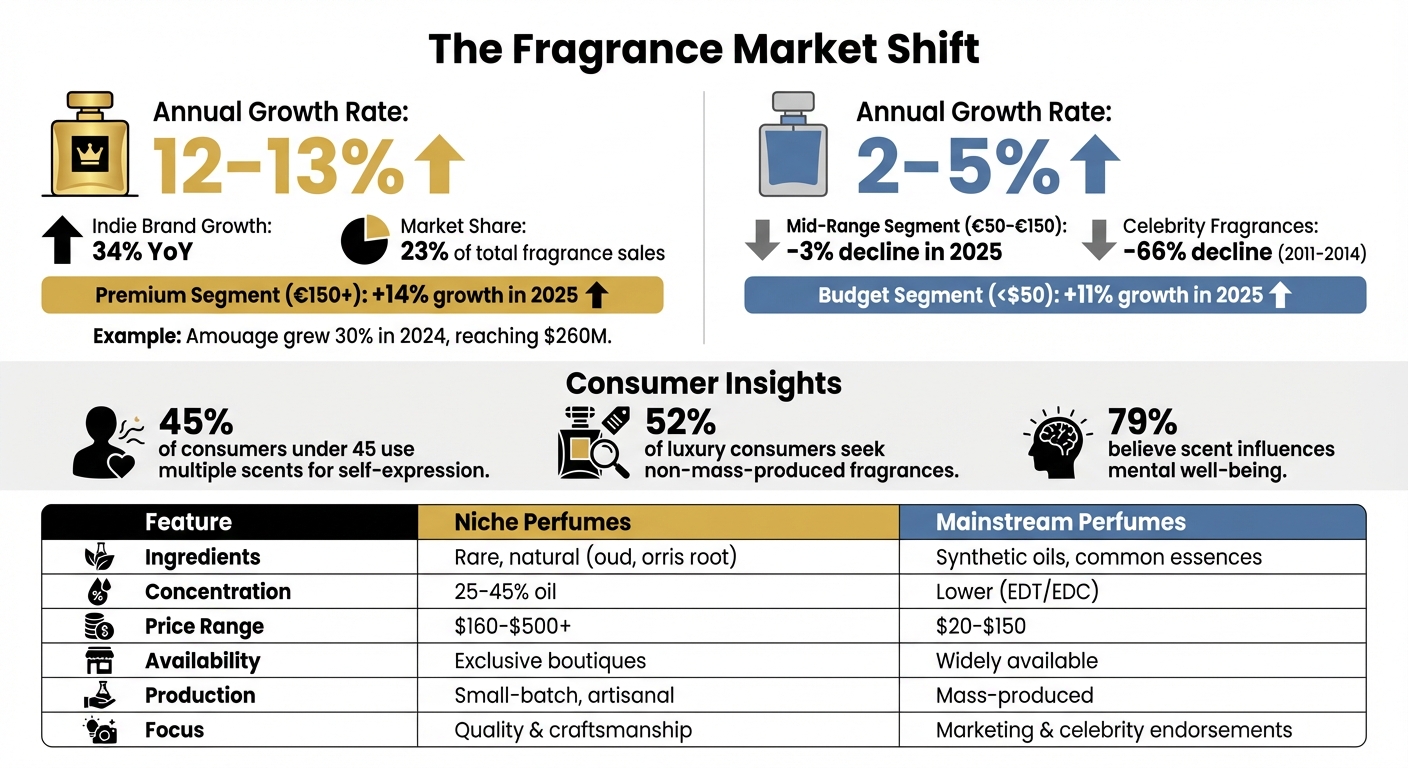
Les parfums de niche surpassent les fragrances grand public, avec une croissance annuelle des ventes de 12 % à 13 %, contre 2 % à 5 % pour les marques traditionnelles. En 2025, les parfums affichés à plus de 150 € ont progressé de 14 %, tandis que les options de milieu de gamme (50 €–150 €) ont reculé de 3 %. Qu’est-ce qui alimente ce basculement ?
Les marques de niche privilégient avant tout le parfum lui-même, en utilisant des ingrédients rares, de fortes concentrations (25 %–45 %) et une production en petites séries. Elles se passent d’un marketing tapageur pour se concentrer sur la qualité et l’exclusivité. Les consommateurs, en particulier les plus jeunes, considèrent désormais le parfum comme une forme d’expression de soi, 45 % des moins de 45 ans utilisant plusieurs senteurs pour refléter leur identité.
Les acheteurs du luxe recherchent également des créations en édition limitée, la personnalisation et des pratiques écoresponsables telles que les flacons rechargeables et les ingrédients issus de laboratoires. Pendant ce temps, les marques grand public peinent à rivaliser, les options soutenues par des célébrités perdant de leur attrait.
À retenir :
- Croissance : Les marques indépendantes représentent désormais 23 % des ventes de parfums, avec une croissance annuelle de 34 %.
- Tendances de consommation : Les jeunes acheteurs privilégient les senteurs singulières et le storytelling à l’attrait du marché de masse.
- Attrait du luxe : Les acheteurs haut de gamme investissent dans le savoir-faire artisanal et les services sur mesure.
- Durabilité : Les pratiques écoresponsables deviennent la norme sur le marché de la niche.
Les parfums de niche redessinent l’industrie en mettant l’accent sur l’individualité, la qualité et le savoir-faire — des valeurs qui résonnent profondément auprès des amateurs de fragrances d’aujourd’hui.
Parfums de niche vs grand public : croissance du marché et principales différences
1. Parfums de niche
Croissance du marché
Le marché des parfums de niche a connu une croissance remarquable ces dernières années. Les marques indépendantes représentent désormais 23 % des ventes totales de parfums, avec une croissance annuelle de 34 %. En 2024, les ventes de parfums aux États-Unis ont progressé de 12 %, atteignant 9,5 milliards de dollars, largement portées par le segment de la niche.
Prenons l’exemple de Amouage, figure emblématique de cette catégorie florissante. En juin 2025, la maison de parfums omanaise annonçait une croissance de 30 % pour 2024, dépassant les 260 millions de dollars de ventes annuelles au détail. Il s’agit d’une progression spectaculaire, son chiffre d’affaires ayant plus que doublé en seulement trois ans. Un tel succès a attiré l’attention des géants du luxe. À ce titre, l’acquisition de Creed par Kering pour 3,8 milliards de dollars souligne la confiance durable accordée au marché des parfums de niche.
Préférences des consommateurs
Les goûts des consommateurs évoluent au rythme de cette croissance. Près de 45 % des personnes de moins de 45 ans adhèrent désormais à l’idée d’utiliser plusieurs parfums pour exprimer leur identité personnelle. Ce changement reflète une évolution plus large des valeurs, où le storytelling et le lien émotionnel avec un produit occupent désormais le devant de la scène.
Linda Levy, présidente de la Fragrance Foundation, souligne cette tendance :
"Les marques indépendantes ont connu une croissance ‘exponentielle’. Elles évoluent souvent sur un pied d’égalité avec les grandes marques en matière de storytelling direct au consommateur et d’engagement".
Les réseaux sociaux, et TikTok en particulier, ont joué un rôle déterminant dans ce mouvement, permettant à des senteurs moins connues et plus atypiques de rencontrer un immense succès.
Exclusivité et personnalisation
L’attrait des parfums de niche réside dans leur disponibilité limitée et leur savoir-faire artisanal. Un exemple marquant remonte à décembre 2024, lorsque Krigler a ouvert une boutique au Peninsula Paris. Dès le premier jour, un seul client a dépensé 100 0 € (114 000 $) pour des flacons exclusifs en édition limitée.
Cette quête de qualité et de créativité est parfaitement résumée par Marc-Antoine Barrois, fondateur de la maison de parfum éponyme :
"Nous ne fixons aucune limite ni au temps de Quentin [Bisch], ni aux ingrédients que nous utilisons. Les coûts exacts restent secondaires face à la liberté créative".
Une telle approche séduit les 52 % de consommateurs de luxe qui recherchent activement des parfums qui ne soient pas produits en masse. Pour répondre à cette demande, les marques introduisent des outils de correspondance olfactive pilotés par l’IA et des services de création sur mesure, permettant aux clients de composer des parfums en accord avec leur style de vie unique. Ces innovations rehaussent non seulement l’expérience client, mais ouvrent également la voie à des avancées en matière de production et de durabilité.
Durabilité et innovation
L’exclusivité dans les parfums de niche va désormais de pair avec des pratiques durables, reflétant l’importance croissante de la conscience environnementale chez les consommateurs. Les marques adoptent des mesures telles que les packagings rechargeables, les ingrédients upcyclés et la personnalisation olfactive pilotée par l’IA pour répondre à ces attentes.
En Allemagne, 79 % des utilisateurs de parfums estiment que les senteurs peuvent influencer positivement le bien-être mental. Cela a stimulé l’intérêt pour les "neuro-parfums" conçus pour améliorer l’humeur ou apaiser le stress. Du côté de la production, les molécules cultivées en laboratoire et les matières premières issues d’un approvisionnement responsable deviennent la norme, à mesure que la durabilité passe d’un simple argument marketing à un véritable critère d’achat.
2. Parfums grand public
Croissance du marché
Les parfums grand public font face à des difficultés alors que les intérêts des consommateurs continuent d’évoluer. Le segment de prix intermédiaire, autrefois florissant — situé entre les options abordables et l’ultra-premium — s’est contracté, les parfums soutenus par des célébrités étant les plus durement touchés. Entre 2011 et 2014, les ventes de parfums de célébrités dans les grands magasins américains ont chuté de 66 %. Don Loftus, président de Parlux Ltd, a exprimé les difficultés du secteur :
"Le commerce de détail est vraiment difficile en ce moment, parce que tout est devenu tellement médiocre. Tout est une question de qualité... ce n’est pas comme sortir un soda".
Ces changements obligent les marques grand public à repenser leurs stratégies pour rester pertinentes.
Préférences des consommateurs
Contrairement aux parfums de niche, qui mettent l’accent sur la qualité des ingrédients et l’exclusivité, les marques grand public expérimentent désormais des lignes plus haut de gamme pour regagner la confiance des consommateurs. Des maisons de mode prestigieuses comme Bottega Veneta, Rabanne et Balmain ont lancé des collections premium affichées entre 300 $ et 467 $. Le consultant en parfumerie Robert Sorce souligne cette évolution :
"Beaucoup de marques prestigieuses se demandent : ‘Comment vraiment monter en gamme pour rivaliser avec ces marques de niche ?’".
Cependant, cette approche s’accompagne de défis. Les marques de niche ont bâti leur réputation sur des pratiques telles que des périodes de maturation prolongées et des concentrations plus élevées d’ingrédients de qualité, tandis que les marques grand public se sont traditionnellement appuyées sur des lancements fréquents et des endorsements de célébrités. John Demsey, Executive Group President chez Estée Lauder Companies, a reconnu cette évolution :
"La niche est devenue la nouvelle norme. De nombreuses idées issues de la niche sont devenues très commerciales".
À mesure que le marché évolue, les consommateurs accordent davantage de valeur à la qualité réelle du parfum — le "jus" lui-même — qu’au nom de la célébrité qui y est associé.
Votre expert parfum personnel vous attend
Faites notre quiz olfactif express pour découvrir des parfums de créateurs et de niche authentiques, choisis selon vos goûts – explorez-les en décants et échantillons de 2, 5, 8 et 30 ml, pour essayer chaque fragrance avant de vous engager sur un flacon entier.
Trouvez votre parfumAvantages et inconvénients
Dans le prolongement des observations précédentes sur les tendances du marché et les préférences des consommateurs, voici un aperçu plus précis des principales différences entre les parfums de niche et les parfums grand public. Le choix entre ces deux catégories dépend souvent de ce que vous valorisez le plus : l’exclusivité et le savoir-faire, ou la praticité et l’accessibilité.
Les parfums de niche se distinguent par l’utilisation d’ingrédients d’exception et de concentrations plus élevées en huiles parfumées (allant de 25 % à 45 %). Il en résulte des senteurs plus tenaces et plus complexes. Comme l’explique Renaud Salmon, directeur de la création chez Amouage :
"D’après mon expérience de création pour d’autres marques de luxe, ce chiffre [la concentration en ingrédients] est au moins dix fois supérieur à ce qui est habituellement autorisé."
Mais ce niveau de qualité a un prix. Les parfums de niche sont affichés à des tarifs nettement plus élevés que leurs homologues grand public, coûtant souvent 150 % à 250 % de plus, avec des flacons d’entrée de gamme à partir d’environ 160 $ l’once.
Les parfums grand public, en revanche, sont conçus pour être accessibles. Ils sont largement disponibles dans les grands magasins, les aéroports et en ligne, et leur prix abordable les rend séduisants pour un large public. Les fragrances à moins de 50 $ ont enregistré une hausse des ventes de 11 % au début de 2025, signe d’une forte demande pour des options économiques. Cependant, ces parfums reposent souvent sur des huiles synthétiques et des concentrations plus faibles, ce qui peut entraîner des profils olfactifs plus simples et une tenue plus courte.
| Caractéristique | Parfums de niche | Parfums grand public |
|---|---|---|
| Ingrédients | Éléments rares et naturels comme l’oud ou la racine d’iris | Huiles synthétiques et essences communes |
| Concentration | Élevée (25 %–45 % d’huile) | Plus faible (généralement EDT ou EDC) |
| Fourchette de prix | 160 $–500 $+ par flacon | 20 $–150 $, avec des brumes corporelles à moins de 50 $ |
| Disponibilité | Limitée aux boutiques exclusives et aux détaillants de luxe | Largement disponible dans les points de vente |
| Profil olfactif | Complexe et distinctif | Grand public, souvent guidé par les tendances |
| Production | Petites séries, artisanale, souvent remplie à la main | Production de masse avec des formules standardisées |
Chaque catégorie présente ses atouts et ses compromis. Que vous soyez sensible à l’art des parfums de niche ou à la praticité des options grand public dépend de vos préférences et de vos priorités personnelles.
Conclusion
L’essor des fragrances de niche marque un changement sensible dans la manière dont les consommateurs abordent le parfum. Pour beaucoup, en particulier les Millennials et la génération Z, le parfum n’est plus seulement une touche agréable dans leur routine, mais une forme d’expression de soi et d’identité. En effet, près de la moitié des jeunes acheteurs considèrent désormais la senteur comme une déclaration personnelle. Au lieu de s’en tenir à une seule fragrance signature, beaucoup composent désormais de véritables "garde-robes olfactives" adaptées à différentes humeurs et occasions.
Ce qui distingue les marques de parfums de niche, c’est leur dévouement au savoir-faire. Contrairement aux marques grand public, qui mettent souvent l’accent sur les endorsements de célébrités et les vastes campagnes marketing, les maisons de niche se concentrent sur l’art du parfum lui-même. Elles privilégient les ingrédients rares, des concentrations plus élevées et une production en petites séries pour offrir une expérience véritablement singulière.
Les chiffres reflètent cet intérêt croissant. Les marques de parfums indépendantes ont enregistré une croissance annuelle de 34 % et représentent désormais 23 % des ventes totales. Parallèlement, les fragrances ultra-luxe affichées à plus de 150 $ ont progressé de 14 % au premier trimestre 2025, tandis que le segment premium traditionnel (50 $–150 $) a reculé de 3 %. Ces données indiquent un marché de plus en plus polarisé entre des options accessibles et ceux prêts à payer davantage pour une qualité exceptionnelle.
Pour ceux que les parfums de niche intriguent, le coût d’entrée peut sembler intimidant — les flacons format standard débutent souvent autour de 160 $. C’est là que les formats découverte, comme les décants soigneusement sélectionnés de Scento, prennent tout leur sens. Proposés en fioles de 2 ml, 5 ml et 8 ml, ainsi qu’en décant en flacon de 30 ml sur la plupart des parfums, ils offrent une manière accessible d’explorer les senteurs de niche avant de s’engager dans l’achat d’un flacon entier.
La croissance continue des parfums de niche tient à leur capacité à offrir authenticité et personnalisation. Les consommateurs d’aujourd’hui sont attirés par des fragrances aux histoires captivantes, à l’approvisionnement transparent et aux compositions distinctives qui leur permettent de se démarquer. Avec des ventes de parfums en ligne appelées à croître de plus de 10 % par an et un segment du luxe qui devrait progresser de 3,85 % jusqu’en 2029, le marché de la niche semble promis à un succès durable. Cette évolution souligne une redéfinition plus large de la parfumerie de luxe — une parfumerie qui célèbre l’art, l’individualité et l’attrait d’un savoir-faire d’exception.
FAQ
Pourquoi les parfums de niche deviennent-ils si populaires ?
Les parfums de niche sont de plus en plus recherchés parce qu’ils offrent des expériences olfactives distinctives et personnelles, qui se démarquent de la foule des fragrances de grande diffusion. Les consommateurs se tournent vers des parfums qui expriment leur individualité plutôt que de simplement suivre les tendances populaires. Ces créations artisanales intègrent souvent des ingrédients rares, des compositions audacieuses et des éditions limitées, leur conférant une aura d’exclusivité et le sentiment d’avoir été façonnées avec une attention particulière.
Ce qui distingue les parfums de niche, c’est l’importance qu’ils accordent à l’art et à la qualité plutôt qu’à un marketing tapageur. Au lieu d’être séduits par les noms de marque ou une publicité massive, de nombreux consommateurs accordent une attention plus fine à la manière dont un parfum interagit avec leur peau, privilégiant le jus lui-même. Ce désir d’une expérience plus personnalisée et singulière alimente la demande croissante pour les parfums de niche, qui sont rapidement devenus l’un des segments les plus dynamiques de l’industrie mondiale du parfum.
Comment les parfums de niche adoptent-ils la durabilité ?
Les marques de parfums de niche redessinent l’industrie de la fragrance en mettant l’accent sur la qualité et des valeurs écoresponsables. Ces marques s’appuient souvent sur des ingrédients naturels issus d’un approvisionnement éthique comme la rose bulgare, la vanille de Madagascar et le patchouli indonésien. En évitant les substances chimiques synthétiques susceptibles de nuire à l’environnement, elles créent des parfums à la fois luxueux et respectueux de la planète. De plus, l’utilisation de concentrations plus élevées de matières premières d’exception permet aux senteurs de durer plus longtemps, favorisant une consommation réfléchie et réduisant le gaspillage.
Beaucoup de ces marques adoptent des techniques de production à faible impact, comme la création de parfums en petites séries et l’upcycling créatif de sous-produits tels que les écorces d’orange ou le marc de café en notes olfactives distinctives. Cette approche réduit non seulement les déchets, mais ouvre également la voie à des profils parfumés inventifs. En outre, elles accordent souvent une grande importance à des packagings durables, privilégiant des matériaux recyclés, des flacons rechargeables et des designs minimalistes pour éviter tout déchet superflu.
En associant des ingrédients issus d’un approvisionnement responsable, des méthodes de production innovantes et des packagings écologiques, les parfums de niche offrent une expérience sophistiquée en harmonie avec un engagement en faveur de la protection de la planète.
Pourquoi les jeunes consommateurs sont-ils attirés par les fragrances de niche ?
Les jeunes consommateurs, en particulier la génération Z, se tournent vers les fragrances de niche comme un moyen d’affirmer leur individualité et de raconter leur histoire personnelle. Des plateformes comme TikTok ont transformé la découverte du parfum en phénomène social, où les utilisateurs partagent avec enthousiasme leurs senteurs favorites et alimentent les conversations autour de créations artisanales ou en édition limitée. Cette "culture du parfum" en plein essor a fait de la quête de parfums rares et distinctifs un passe-temps à la fois séduisant et tendance.
Les marques de niche répondent pleinement à cette demande en proposant des collections exclusives, personnelles et portées par un récit. Pour ceux qui hésitent à investir dans des flacons grand format onéreux, des options comme les décants soigneusement sélectionnés de Scento — disponibles en fioles de 2 ml, 5 ml et 8 ml, ainsi qu’en décant en flacon de 30 ml sur la plupart des parfums — offrent une manière accessible d’explorer un large éventail de fragrances. Scento est un détaillant de décants et d’échantillons de parfum, et chaque produit peut être acheté à l’unité, sans aucun abonnement. Scento+ est l’adhésion optionnelle de Scento : la cotisation mensuelle vous revient intégralement sous forme de crédit en magasin, à dépenser sur n’importe quel parfum ; les membres bénéficient de 10 % de réduction, d’un échantillon offert avec chaque commande, d’un parfum offert tous les six mois et d’un cadeau d’anniversaire, et vous pouvez mettre en pause à tout moment ; pour résilier, contactez notre équipe.

