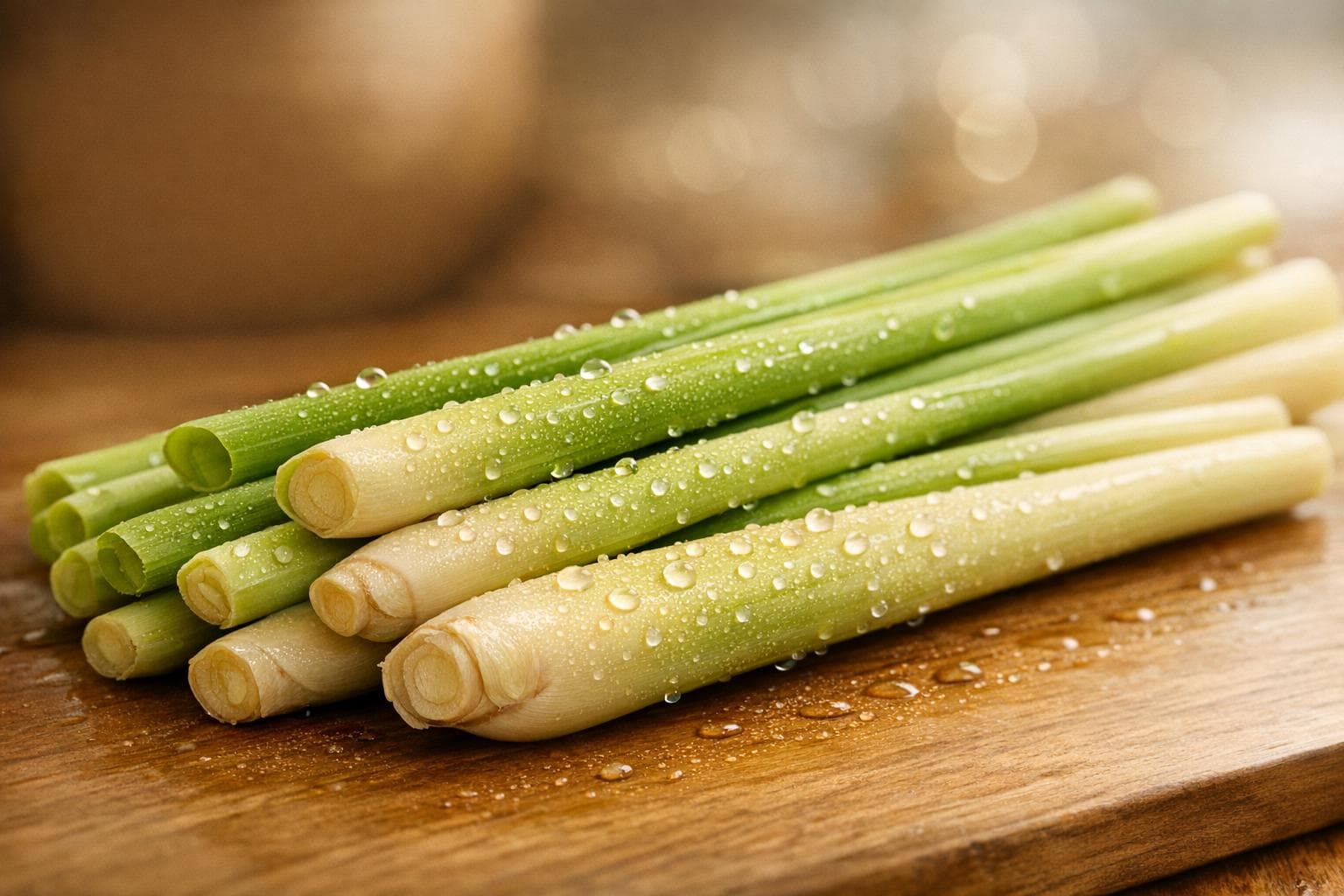
La citronnelle thaïlandaise (Cymbopogon citratus) est devenue un ingrédient phare de la parfumerie moderne, prisée pour sa forte teneur en citral (75–85 %) et son arôme multidimensionnel. Contrairement à la citronnelle des Indes orientales, sa variante thaïlandaise offre un sillage plus lumineux et plus raffiné, mêlant le zeste des agrumes à des nuances herbacées et florales. Elle est ainsi très appréciée dans les parfums de luxe, où elle s’exprime aussi bien en note de tête vibrante qu’en élément d’équilibre au sein des accords.
Points clés :
- Profil chimique : Riche en géranial, néral et β‐myrcène, ce qui lui confère un impact citronné vif avec une profondeur herbacée.
- Méthodes d’extraction : Des techniques comme l’extraction par solvant (rendement jusqu’à 2,08 %) et l’hydrodistillation (rendement de 0,95 %) garantissent l’intégrité aromatique.
- Polyvalence dans les accords : S’associe harmonieusement aux agrumes, aux herbes et aux fleurs, souvent soutenue par le bois de santal pour prolonger sa tenue.
- Défis de formulation : Exige une dilution précise pour éviter les irritations et préserver l’équilibre du parfum.
- Importance culturelle : Utilisée depuis plus de 2 000 ans en Asie du Sud-Est à des fins médicinales et spirituelles.
La citronnelle thaïlandaise figure désormais dans des parfums de créateur tels que "Green Tea" d’Elizabeth Arden et "Oyédo" de Diptyque. Sa forte demande génère également des bénéfices économiques, avec une production mondiale dépassant les 45 000 tonnes par an. Des pratiques durables, comme l’extraction de l’huile à partir de déchets de feuilles, renforcent encore sa valeur dans l’industrie de la parfumerie.
How Thai Lemongrass Oil Is Extracted
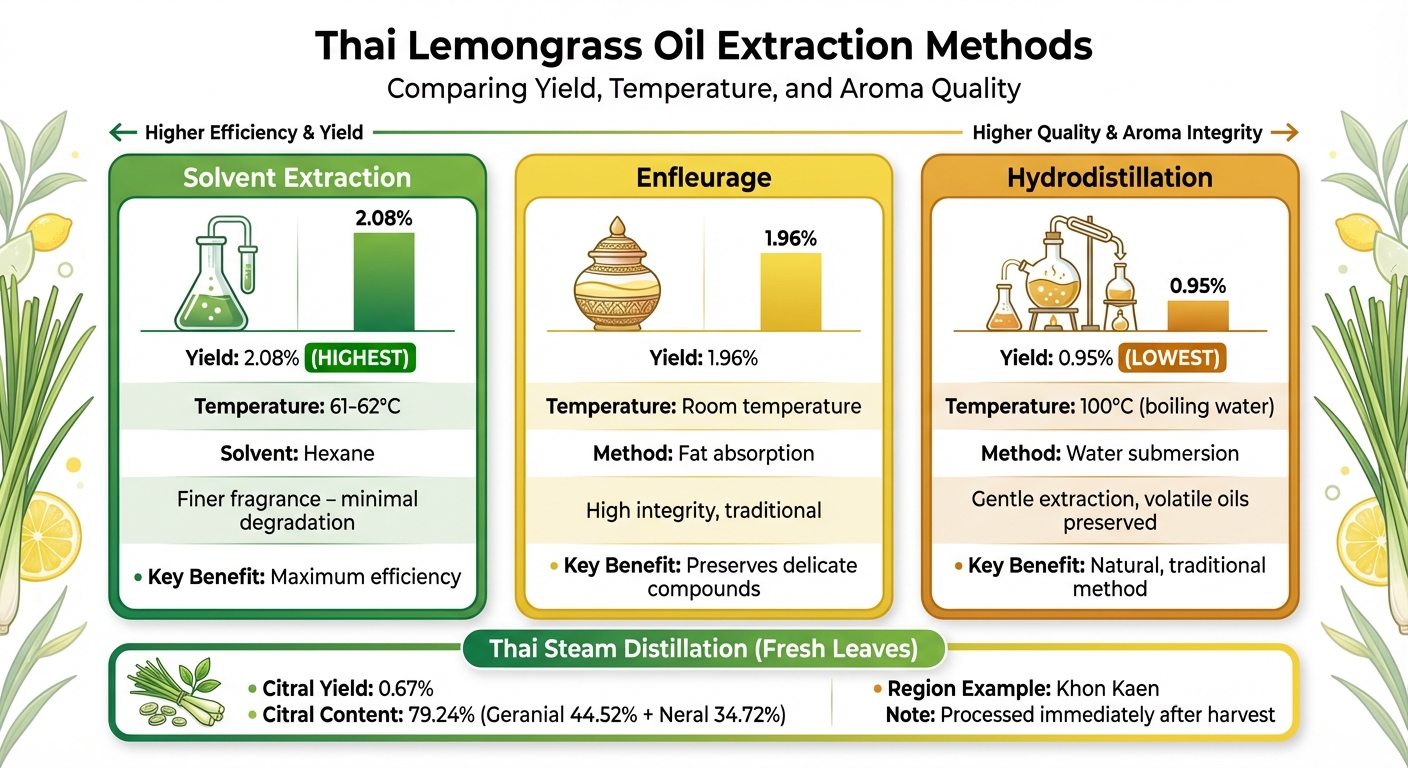
Méthodes d’extraction de l’huile de citronnelle thaïlandaise : comparaison du rendement et de la qualité
La méthode utilisée pour extraire l’huile de citronnelle thaïlandaise joue un rôle essentiel dans la détermination de son arôme comme de son rendement. Il existe trois techniques principales, chacune proposant sa propre approche pour concilier efficacité et préservation du parfum signature, riche en citral.
Extraction par solvant
L’extraction par solvant est réputée pour offrir le rendement le plus élevé, pouvant atteindre 2,08 % d’huile essentielle [10, 11]. Cette méthode utilise l’hexane à une température contrôlée de 61–62 °C, ce qui permet d’extraire les composés aromatiques tout en limitant l’exposition à l’air et à la chaleur. En protégeant les molécules délicates de la dégradation, ce procédé donne naissance à ce que certains acteurs du secteur décrivent comme un "parfum plus fin" par rapport à d’autres méthodes comme la distillation.
"La chaleur, les solvants chimiques ou l’exposition à l’oxygène au cours du processus d’extraction dénaturent les composés aromatiques, modifiant soit leur odeur, soit leur caractère, soit les rendant inodores." – Enems Project
Enfleurage et hydrodistillation
Pour ceux qui privilégient l’intégrité aromatique au rendement, des techniques traditionnelles comme l’enfleurage et l’hydrodistillation sont préférées. L’enfleurage consiste à utiliser une matière grasse pour absorber les composés aromatiques, avec un rendement de 1,96 % [10, 11]. L’hydrodistillation, quant à elle, immerge la citronnelle dans l’eau bouillante afin d’extraire en douceur les huiles volatiles. Toutefois, cette méthode produit un rendement plus faible de 0,95 % [10, 11].
Méthodes d’approvisionnement et de transformation en Thaïlande
En Thaïlande, les producteurs s’attachent à préserver la qualité de l’huile en réduisant au minimum le délai entre la récolte et la transformation. L’utilisation de feuilles fraîches immédiatement après la récolte, associée à la distillation à la vapeur, permet d’obtenir un rendement en citral de 0,67 %. Des régions comme Khon Kaen sont connues pour leurs méthodes de transformation rapides, qui contribuent à maintenir une teneur en citral d’environ 79,24 %. Celle-ci comprend une composition équilibrée en géranial (44,52 %) et en néral (34,72 %). Un tel soin garantit la capture de l’arôme authentique de la citronnelle thaïlandaise, répondant aux exigences élevées des parfumeurs du monde entier.
Ce que disent les parfumeurs de la citronnelle thaïlandaise
La fraîcheur de la note de tête
La citronnelle thaïlandaise est célébrée par les parfumeurs pour son impact citronné éclatant. Elle déploie une envolée nette et incisive de zeste de citron, accompagnée d’une fraîcheur verte évoquant l’herbe froissée. Sa forte teneur en citral — composé de géranial et de néral — lui confère une qualité distinctement "étincelante", faisant d’elle l’une des huiles naturelles les plus intensément citronnées qui soient.
"La dimension florale des notes d’agrumes, avec un parfum intensément naturel, asiatique et légèrement résineux." – Niks Anuman-Rajadhon, propriétaire de Teens of Thailand et Asia Today
Cette facette florale distingue la citronnelle thaïlandaise de ses homologues européennes, au profil souvent plus boisé. Les experts la décrivent comme dotée d’une "légèreté exquise", qui lui permet de sublimer des ingrédients plus opulents comme les huiles ou les muscs. Ce caractère effervescent évolue ensuite avec fluidité vers la complexité herbacée qui se révèle plus tard dans son profil olfactif.
Nuances herbacées et terreuses
La citronnelle thaïlandaise est recherchée pour son arôme à multiples facettes. Si son éclat hespéridé occupe le devant de la scène, elle dévoile également des nuances herbacées, balsamiques et subtilement florales. Le myrcène apporte une profondeur herbacée et balsamique, tandis que le géraniol insuffle une délicate tonalité florale évoquant la rose, enrichissant le cœur du parfum.
"La citronnelle allège la richesse de la viande et de l’huile. Elle remplace cette densité par une vivacité herbacée et une légèreté exquise." – Tanaporn Markawat, fils du fondateur de Naj Restaurant and Cooking School
En parfumerie, cette même propriété permet à la citronnelle thaïlandaise d’alléger des notes de fond denses sans perdre sa présence singulière, créant ainsi un équilibre harmonieux tout au long de l’évolution du parfum.
Accords et tenue
La complexité de la citronnelle thaïlandaise la rend remarquablement polyvalente dans les compositions. Les parfumeurs l’associent souvent à des agrumes, des herbes et des fleurs blanches, en ancrant ces alliances avec du bois de santal ou du cèdre afin d’en prolonger la tenue. Son caractère citronné puissant et durable exalte d’autres facettes hespéridées comme la bergamote et la mandarine, apporte de la profondeur aux herbes aromatiques telles que le basilic et la menthe, et adoucit les contours les plus vifs des fleurs blanches comme le jasmin.
sbb-itb-fb213bc
Défis de formulation et solutions des parfumeurs
Équilibrer l’intensité et prévenir les irritations
La citronnelle thaïlandaise, dont la teneur en citral peut atteindre 70–80 %, peut facilement dominer les autres notes, voire provoquer des irritations cutanées lorsqu’elle est utilisée pure. Pour maîtriser ces enjeux, les parfumeurs recourent à des dilutions précises, comme un ratio 4:3:3 d’alcool, d’huile essentielle et de fixateurs. Cette approche garantit un parfum équilibré tout en réduisant le risque d’irritation. Afin de protéger davantage la formule contre la dégradation causée par la chaleur, la lumière et l’oxygène, des antioxydants comme le BHT sont ajoutés selon des ratios de 0,5:1 ou 1:1. Le maintien d’un pH acide autour de 5,0 contribue également à stabiliser la composition.
"La production d’un parfum selon un ratio de formulation (4:3:3) d’alcool, d’huile essentielle issue de Cymbopogon spp et de fixateurs a donné un bon parfum organique avec une réponse aux effets indésirables presque nulle." – Jidimma Augustine Wapwera, Journal of Chemical Society of Nigeria
Les fixateurs jouent ici un rôle supplémentaire, en ancrant les notes de tête volatiles et en évitant qu’elles ne se dissipent trop rapidement.
Utiliser des fixateurs pour prolonger la tenue
La citronnelle est très volatile, ce qui en fait une note de tête fugace qui s’évapore en quelques minutes. Pour y remédier, les parfumeurs utilisent souvent l’huile de bois de santal comme fixateur. Le bois de santal ralentit le processus d’évaporation, permettant à la citronnelle de s’attarder davantage et d’évoluer avec fluidité de son ouverture vive et citronnée à sa phase médiane herbacée, jusqu’à une finale plus ancrée. Cette technique garantit une évolution naturelle du parfum et préserve son attrait dans le temps.
Méthodes d’assemblage proportionnel
Obtenir un parfum harmonieux exige une attention méticuleuse aux proportions de mélange. Une méthode courante repose sur la règle 30/50/20, dans laquelle 30 % de la formule sont consacrés aux notes de tête comme la citronnelle, 50 % aux notes de cœur et 20 % aux notes de fond. Compte tenu de la puissance de la citronnelle, des mesures précises sont essentielles pour éviter qu’elle n’éclipse l’ensemble de l’accord. Pour les applications topiques, les parfumeurs recommandent de diluer les huiles essentielles à des concentrations comprises entre 0,5 % et 2 %. Cela correspond à environ 1 à 2 gouttes d’huile essentielle par cuillère à café d’huile végétale, offrant le juste équilibre entre impact olfactif et sécurité cutanée.
La citronnelle thaïlandaise dans les parfums de créateur
Histoire et symbolisme
Depuis plus de 2 000 ans, la citronnelle est une plante précieuse en Asie du Sud-Est, célébrée pour ses vertus médicinales et sa portée spirituelle. Elle a occupé une place centrale dans les rituels et les offrandes aux temples à travers la région, de nombreuses traditions populaires sud-asiatiques lui attribuant le pouvoir de repousser les serpents et d’éloigner les esprits malveillants .
"Inspirez profondément, et vous absorberez un parfum intense et ornemental, tel une volute de filigrane courant sous l’avant-toit d’un temple bouddhiste thaïlandais." – Anthony Kuhn, NPR
Ce riche héritage culturel s’est naturellement prolongé dans la parfumerie de luxe contemporaine, où la citronnelle inspire des senteurs de spa et des produits d’aromathérapie conçus pour favoriser la relaxation et apaiser l’anxiété .
Usage dans les parfums de luxe
La citronnelle thaïlandaise se distingue dans l’univers du parfum par sa forte teneur en citral — de 75 % à 85 % — qui lui confère un caractère net et pluriel . Des maisons de création renommées, telles qu’Alpha Aromatics, ont mis à profit sa polyvalence pour composer des accords raffinés comme "Applewood Lemongrass" (avec patchouli et cèdre), "Black Ginger and Lemongrass" (rehaussé de bergamote et de vétiver) et "Yuzu Blossom Lemongrass" (associé à la fleur de cerisier et au bambou).
Dans les parfums de créateur, Elizabeth Arden met en lumière la citronnelle comme note essentielle de son parfum "Green Tea", lui offrant une fraîcheur lumineuse, citronnée et herbacée. "Oyédo" de Diptyque l’unit au citron et à une verdure aromatique pour un profil étincelant et singulier. Quant à la ligne "Verbena" de L’Occitane, elle incorpore des notes citronnées proches de la citronnelle pour une vivacité verte et incisive. Au-delà de la parfumerie classique, la citronnelle thaïlandaise est également un ingrédient recherché dans les savons et crèmes de luxe, appréciée pour son parfum rafraîchissant et ses qualités naturelles répulsives contre les insectes.
Avantages économiques et de production
La citronnelle thaïlandaise n’est pas seulement une merveille olfactive — c’est aussi une véritable force économique. Avec une production mondiale d’huile de citronnelle dépassant les 45 000 tonnes par an, cette plante offre un potentiel financier impressionnant. Par exemple, un seul acre de culture de citronnelle peut générer jusqu’à 4,8 millions de dollars par an, grâce à sa croissance rapide et à sa nature prolifique. Sa robustesse permet même une récolte à un stade précoce, garantissant un approvisionnement constant.
Les pratiques durables ont encore accru sa valeur. En extrayant l’huile essentielle à partir des déchets de feuilles, les producteurs transforment des sous-produits agricoles en matières premières de grande valeur. Grâce à la distillation à la vapeur d’eau, les déchets frais de feuilles de citronnelle atteignent un rendement en citral de 0,67 %, et l’huile extraite répond aux normes ISO-3217-1974. Cette approche améliore non seulement l’efficacité de la production, mais s’inscrit également dans une démarche d’approvisionnement respectueuse de l’environnement.
Conclusion
La citronnelle thaïlandaise est devenue un ingrédient d’exception dans la parfumerie moderne, grâce à sa teneur affirmée en citral et à son extraordinaire adaptabilité. Réputée pour son arôme vibrant et citronné, elle rayonne dans les compositions de tête, apportant une fraîcheur vive et ciselée difficile à égaler. Au-delà de son éclat, elle s’accorde aussi parfaitement avec des notes de fond plus opulentes, créant un équilibre harmonieux dans les accords parfumés.
La méthode d’extraction joue un rôle déterminant tant sur le rendement que sur le profil olfactif de l’huile de citronnelle. Une exposition excessive à la chaleur peut compromettre sa teneur en citral, soulignant l’importance d’un traitement minutieux.
Ce qui rend la citronnelle thaïlandaise encore plus fascinante, c’est son double rôle — offrir une puissance aromatique tout en procurant des avantages pratiques. Grâce aux bons fixateurs et à des techniques d’assemblage maîtrisées, son intensité peut être parfaitement équilibrée, tandis que ses propriétés antimicrobiennes naturelles ajoutent une dimension fonctionnelle aux formulations.
Ancrée dans une riche histoire d’usages médicinaux et spirituels, la citronnelle continue de gagner en importance. Des innovations telles que les techniques d’extraction durables et la revalorisation des déchets de feuilles de citronnelle enrichissent non seulement son potentiel créatif, mais renforcent également sa place dans le tissu économique de la parfumerie moderne.
FAQ
Qu’est-ce qui rend la citronnelle thaïlandaise si particulière dans la création de parfums ?
La citronnelle thaïlandaise se distingue en parfumerie par son arôme zesté, porté par les agrumes. Grâce à sa forte teneur en citral, elle délivre une senteur de citron nette et plus incisive que d’autres variétés de citronnelle, ce qui en fait un choix de prédilection pour créer des parfums frais et énergisants.
Ce profil olfactif singulier n’apporte pas seulement un éclat vivant aux parfums — il leur confère aussi profondeur et mystère. Il s’accorde harmonieusement avec les notes florales, épicées et herbacées, ce qui en fait un ingrédient polyvalent et audacieux qui sublime l’art de la composition parfumée.
Comment le procédé d’extraction influence-t-il la qualité et le rendement de l’huile de citronnelle thaïlandaise ?
Le procédé d’extraction de l’huile de citronnelle thaïlandaise influence considérablement à la fois la quantité d’huile obtenue et ses caractéristiques aromatiques. La distillation à la vapeur est souvent la méthode privilégiée, car elle préserve la forte teneur en citral qui confère à la citronnelle son parfum frais et citronné si distinctif. Cette méthode, à la fois douce et efficace pour maintenir la qualité, donne généralement un rendement d’environ 0,9 % à 1 % d’huile en poids.
Pour ceux qui recherchent un rendement plus élevé, l’extraction à base de solvants peut produire entre 2 % et 2,7 % d’huile. Cette technique capture à la fois les composés volatils et semi-volatils, mais elle peut légèrement modifier l’arôme ou laisser des résidus de solvants devant être éliminés. Une autre option est l’enfleurage, une méthode traditionnelle à basse température qui établit un équilibre entre qualité et quantité. Bien qu’elle produise environ 1,9 % d’huile, elle exige une main-d’œuvre considérable.
Les parfumeurs choisissent la méthode d’extraction en fonction de leurs besoins spécifiques — qu’ils privilégient la pureté du citral pour un parfum sophistiqué ou visent des quantités plus importantes pour répondre à des exigences de production plus larges.
Quels défis les parfumeurs rencontrent-ils lorsqu’ils utilisent la citronnelle thaïlandaise dans les parfums ?
La citronnelle thaïlandaise, célébrée pour son parfum vif et citronné, impose aux parfumeurs un ensemble de défis bien particuliers. L’un des principaux obstacles réside dans l’irrégularité de l’approvisionnement. Les récoltes saisonnières, les variations climatiques et le nombre limité de régions où la citronnelle prospère peuvent affecter à la fois la disponibilité et le prix d’une huile de citronnelle de qualité premium.
Le processus d’extraction ajoute un niveau de complexité supplémentaire. L’huile essentielle de citronnelle est très sensible à la chaleur, à l’oxygène et à certains solvants. Une mauvaise manipulation durant cette étape peut entraîner une dégradation du profil olfactif ou l’apparition de notes parasites indésirables. De plus, le rendement à l’extraction a tendance à être assez faible, ce qui exige des techniques minutieuses pour en préserver toute l’intégrité.
Un autre défi provient du citral, le principal composant de l’huile de citronnelle. Le citral est notoirement instable et sujet à la dégradation ou à l’altération au cours du traitement. Il est donc délicat d’en isoler et d’en conserver les qualités fraîches et éclatantes. Pour surmonter ces difficultés, les parfumeurs ont souvent recours à des fixateurs et à des formulations soigneusement élaborées, afin de préserver intacte la vivacité zestée de la citronnelle thaïlandaise dans leurs créations.

