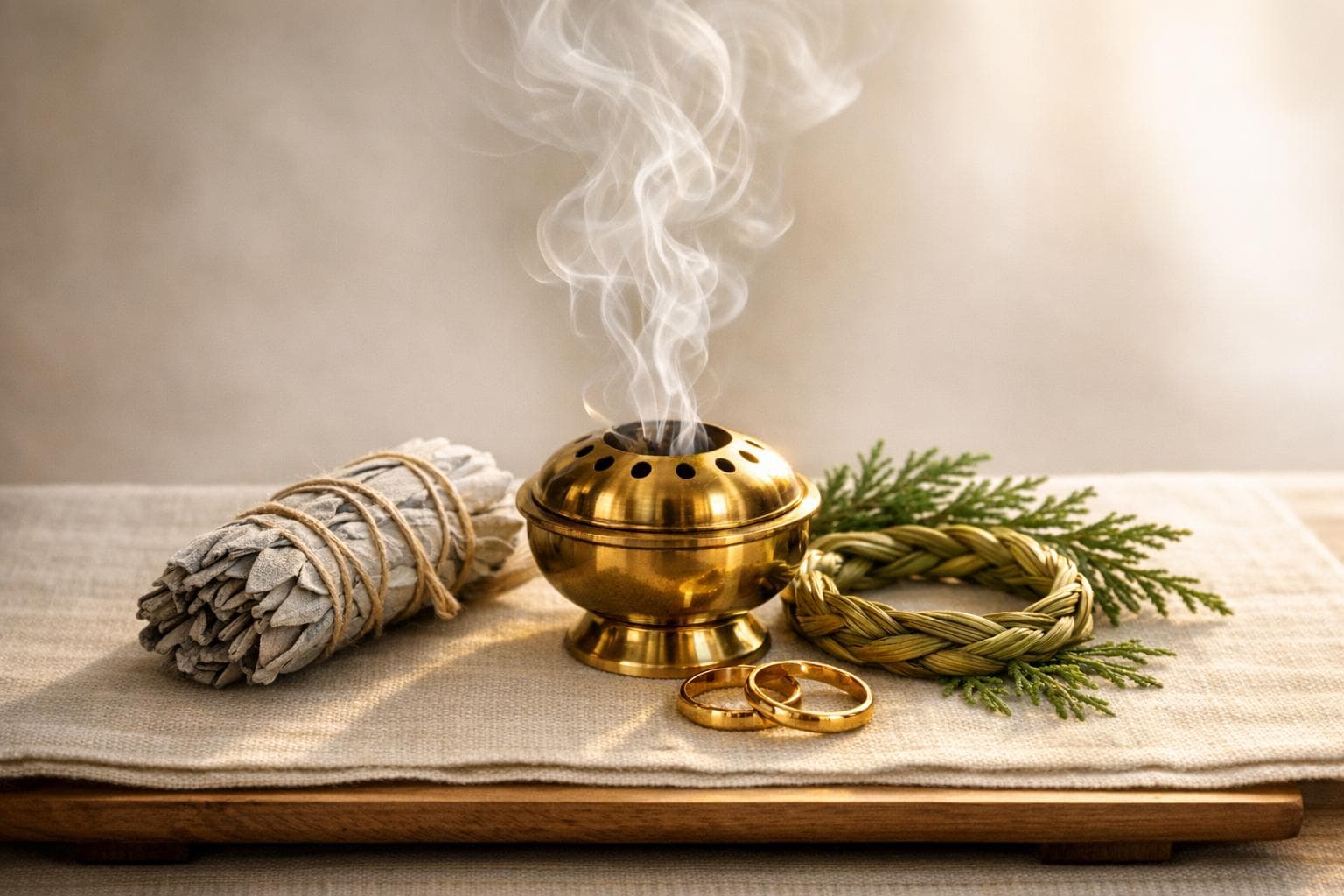
La fragrance joue un rôle essentiel dans les cérémonies de mariage tribales, symbolisant la purification, la protection et le lien spirituel. Les communautés autochtones du monde entier intègrent des rituels aromatiques pour bénir et guider les couples. Le rituel de fumigation sacrée, par exemple, utilise des herbes sacrées comme la sauge et l’herbe douce pour purifier les énergies et inviter la positivité. Les mariages du Moyen — Orient mettent à l’honneur le bukhoor pour purifier les invités, tandis que les traditions amérindiennes utilisent la fumée parfumée pour porter les prières. Chaque herbe, huile ou plante porte une signification particulière - la sauge offre la sagesse, l’herbe douce symbolise l’amour, et le cèdre procure l’ancrage. Ces pratiques créent une atmosphère sacrée, reliant les couples aux traditions ancestrales et veillant à ce que leur union débute sous les bénédictions de l’harmonie et de la protection.
Qu’est-ce que la fumigation sacrée dans les mariages tribaux ?
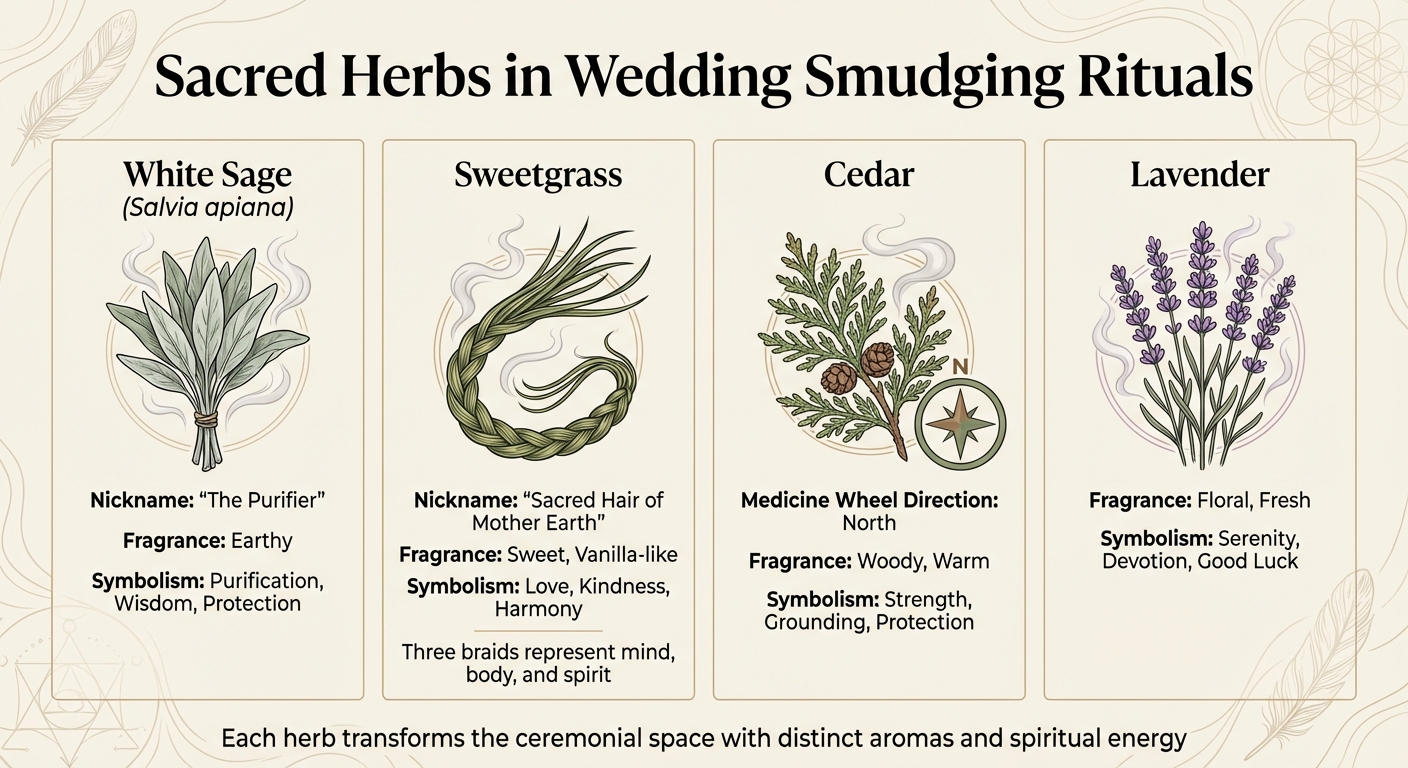
Herbes sacrées utilisées dans les cérémonies de fumigation des mariages tribaux
La fumigation sacrée est un rituel de purification profondément enraciné dans les traditions autochtones des Premières Nations. Au cours de cette cérémonie, des herbes sacrées sont brûlées afin de créer une fumée qui purifie l’espace et dissipe les énergies négatives. Dans le cadre des mariages, ce rituel permet d’ancrer la cérémonie et d’établir un lien spirituel, préparant ainsi le couple à son union. La fumée est considérée comme un pont entre les mondes physique et spirituel, dissipant les barrières émotionnelles et spirituelles.
"La fumigation sacrée est un acte sacré. Elle est pratiquée pour purifier et créer un espace sacré pour votre cérémonie de mariage... Elle vous place dans une concentration spirituelle, vous ancre et ouvre votre cœur."
– Jen Paul, célébrante des rites de passage
Le rituel de fumigation sacrée intègre les quatre éléments : l’eau (représentée par le récipient), la terre (les plantes), le feu (utilisé pour brûler les herbes) et l’air (la fumée elle-même). En général, l’officiant allume un fagot d’herbes jusqu’à ce qu’il se consume lentement, puis utilise une plume - souvent une plume d’aigle - pour diriger la fumée autour du couple. Ce geste les purifie et les protège alors qu’ils s’apprêtent à échanger leurs vœux.
Herbes sacrées utilisées dans la fumigation
Chaque herbe utilisée dans la fumigation porte sa propre signification spirituelle, ce qui en fait un élément précieux des bénédictions nuptiales. Par exemple, la sauge blanche (Salvia apiana), souvent appelée "La Purificatrice", possède un parfum terreux et sert à dissiper les énergies négatives tout en offrant sagesse et protection. L’herbe douce, avec sa senteur suave rappelant la vanille, symbolise la bienveillance, l’amour et l’harmonie. Le cèdre, connu pour son arôme chaleureux et boisé, représente la force, l’ancrage et la protection. La lavande, avec ses notes florales fraîches, est associée à la sérénité, à la dévotion et à la bonne fortune. Dans certaines traditions, le tabac est également utilisé comme offrande sacrée, symbolisant la communication avec le monde des esprits.
| Herbe | Profil olfactif | Symbolique principale dans le mariage |
|---|---|---|
| Sauge blanche | Terreux | Purification, sagesse, protection |
| Herbe douce | Doux, vanillé | Amour, bienveillance, harmonie |
| Cèdre | Boisé, chaleureux | Force, ancrage, protection |
| Lavande | Floral, frais | Sérénité, dévotion, bonne fortune |
Ces herbes n’apportent pas seulement des arômes distinctifs au rituel ; elles jouent aussi un rôle essentiel dans l’atmosphère et l’énergie de l’espace cérémoniel.
La vocation spirituelle de la fumigation
Le rituel de fumigation va au-delà du symbole ; il transforme activement l’énergie du lieu. Lorsque les herbes brûlent, la fumée emporte les énergies négatives ou stagnantes, laissant place à la positivité. D’un point de vue scientifique, il a été démontré que la combustion de la sauge blanche réduit les bactéries présentes dans l’air, tandis que les ions négatifs libérés peuvent améliorer l’humeur et favoriser la détente.
"La fumée produite par la combustion de ces herbes est considérée comme portant les prières vers le monde des esprits, et elle est utilisée pour nettoyer et purifier l’énergie d’un lieu, d’un objet ou d’une personne."
– Cassandra Okimosh, Nawapo
L’association de la sauge et de l’herbe douce est particulièrement puissante. La sauge dissipe les énergies négatives, tandis que l’herbe douce invite la positivité dans l’espace. Il est conseillé aux couples d’aborder la fumigation avec respect, en se procurant les herbes de manière responsable et en formulant des intentions ou des prières claires pour guider le rituel. Après la cérémonie, les cendres sont rendues à la terre, symbolisant l’achèvement du processus de purification et la libération de la négativité absorbée.
Les fragrances et leur signification dans les bénédictions nuptiales
Au sein des tribus autochtones, les fragrances occupent une place profonde dans les bénédictions de mariage, choisies pour leurs vertus spirituelles afin de guider et protéger le couple au commencement de son voyage conjugal. Chaque senteur porte une symbolique profonde, enracinée dans les savoirs ancestraux, et reflète la manière dont certaines plantes s’harmonisent avec l’énergie spirituelle.
Au cœur de nombreuses traditions autochtones d’Amérique du Nord se trouvent les quatre médecines sacrées : le tabac, la sauge, le cèdre et l’herbe douce. Elles sont souvent associées aux directions de la roue de médecine - le tabac à l’Est, l’herbe douce au Sud, la sauge à l’Ouest et le cèdre au Nord. Cet agencement souligne l’interconnexion entre nature et spiritualité, créant un environnement équilibré et riche de sens pour la cérémonie de mariage. Ensemble, ces fragrances purifient, protègent et bénissent l’union, mêlant rituels concrets et profondeur symbolique.
Sauge : sagesse et protection
La sauge est reconnue pour ses vertus purificatrices, dissipant les énergies négatives de l’esprit, du cœur et de l’environnement. Elle symbolise la clarté, la force et la sagesse - des qualités essentielles à une union durable. Le rituel consistant à brûler la sauge prépare les participants en libérant les fardeaux mentaux, afin de faire place à l’engagement sacré du mariage.
"La sauge est utilisée pour libérer ce qui trouble l’esprit et pour chasser l’énergie négative."
– Mushkiki
Dans certaines pratiques, la "sauge féminine" est spécifiquement utilisée par les femmes, représentant la sagesse maternelle et les savoirs transmis de génération en génération au sein de la lignée familiale.
Herbe douce : amour et harmonie
L’herbe douce, souvent appelée la "chevelure sacrée de la Terre Mère", imprègne les bénédictions nuptiales d’amour, d’harmonie et de bienveillance. Son arôme suave, rappelant la vanille, favorise l’unité et la paix, créant une atmosphère positive pour la cérémonie. Symboliquement, les trois brins d’une tresse d’herbe douce représentent l’esprit, le corps et l’âme, ainsi que des vertus telles que l’amour, l’honnêteté et la bonté. On croit que ces tresses portent directement les prières vers le monde des esprits.
"L’herbe douce est la chevelure sacrée de la Terre Mère. Son doux parfum rappelle aux gens la douceur, l’amour et la bonté qu’elle porte aux peuples."
– Mushkiki
Par ailleurs, la méthode traditionnelle de tressage utilise 21 brins, répartis en trois groupes de sept. Cette structure évoque les sept générations passées, les sept enseignements des grands-pères et les sept générations à venir, reliant l’union du couple à un héritage spirituel plus vaste.
Cèdre et lavande : sérénité et bonne fortune
Le cèdre, associé à la direction du Nord dans la roue de médecine, symbolise le repos, la sagesse et les conseils des aînés. Sa présence dans les cérémonies de mariage apporte l’équilibre et invite les énergies positives, tandis que sa fumée crépitante est censée appeler les bénédictions ancestrales.
La lavande, souvent intégrée aux rituels de fumigation, apporte une influence apaisante et est appréciée pour ses propriétés antiseptiques. Dans les cérémonies autochtones de fumée, brûler de la lavande - ou d’autres feuilles locales - sert à éloigner les esprits négatifs et à apporter la bonne fortune au couple.
Ensemble, ces éléments créent une atmosphère profondément spirituelle et protectrice, veillant à ce que le couple commence son chemin sous les bénédictions de l’amour, de la sagesse et de l’harmonie.
Comment réaliser un rituel de fumigation pour un mariage
Un rituel de fumigation pour un mariage intègre les quatre éléments - Terre (herbes ou bois), Eau (un récipient), Feu (pour allumer), et Air (fumée ou plume). Si le processus est simple, il exige une préparation attentive et une intention claire. Qu’il soit conduit par un officiant ou réalisé par le couple, ces étapes permettent d’honorer les racines autochtones du rituel tout en créant un moment profondément spirituel.
Préparer le matériel
Commencez par rassembler l’essentiel : un fagot d’herbes séchées (comme la sauge blanche, l’herbe douce, le cèdre ou la lavande), un récipient résistant à la chaleur, un briquet ou des allumettes, ainsi qu’une plume ou un éventail pour diriger la fumée. Des récipients traditionnels comme les coquilles d’ormeau ou les bols en céramique sont souvent inclus dans des kits soigneusement composés. Pour protéger le récipient de la chaleur et éteindre les herbes en toute sécurité, ajoutez une couche de sable ou de sel au fond.
Pour la plume, privilégiez des plumes de dinde d’imitation de haute qualité afin d’éviter l’utilisation d’espèces protégées. Les fagots de sauge blanche et les bâtons de Palo Santo peuvent être achetés auprès de fournisseurs spécialisés. Si votre lieu de réception interdit les flammes nues, des sprays de fumigation à base d’huiles essentielles de sauge ou de Palo Santo constituent une excellente alternative et sont largement disponibles.
Une fois votre matériel prêt, vous pouvez purifier l’espace et les participants.
Purifier l’espace et les participants
Tout étant en place, il est temps de purifier le lieu et les personnes présentes. Commencez par tenir le fagot d’herbes à un angle de 45°, allumez-le pendant environ 20 à 30 secondes, puis éteignez délicatement la flamme afin de créer un flux de fumée régulier. Ouvrez les fenêtres ou les portes pour permettre aux énergies négatives et à l’excès de fumée de s’échapper, puis marchez dans le sens des aiguilles d’une montre autour de l’espace de mariage. Utilisez votre plume ou votre main pour guider la fumée dans chaque recoin, du sol jusqu’au plafond.
"Marchez doucement, dans le sens des aiguilles d’une montre, autour de votre espace, en diffusant la fumée dans chaque coin, du sol jusqu’au plafond. Soyez méticuleux et intentionnel."
– House of Formlab
Pour purifier le couple, l’officiant peut faire passer la fumée au-dessus d’eux de la tête aux pieds, ou le couple peut utiliser ses mains pour ramener la fumée vers le visage, le cœur et le corps. Les invités peuvent également se purifier symboliquement en passant leurs mains au-dessus du bol fumant à leur entrée dans l’espace cérémoniel.
Intégrer la fumigation à la cérémonie
Une fois l’espace et les participants purifiés, intégrez le rituel de fumigation aux moments les plus significatifs de la cérémonie. Il trouve magnifiquement sa place à trois étapes clés : au début pour purifier l’espace, avant les vœux pour recentrer le couple, et à la fin comme bénédiction. Commencez le rituel avec une intention claire, telle qu’une prière, une affirmation ou une bénédiction, afin de donner plus de sens au geste. L’officiant peut brièvement expliquer la signification du rituel pour aider les invités à en comprendre et en respecter l’importance.
Lorsque le rituel est achevé, placez le fagot encore fumant dans le bol ignifuge et laissez-le s’éteindre naturellement. Ne laissez jamais des herbes brûler sans surveillance. Pour éteindre complètement le fagot, pressez-le dans le sable jusqu’à ce que toute fumée cesse.
Votre expert parfum personnel vous attend
Faites notre quiz olfactif express pour découvrir des parfums de créateurs et de niche authentiques, choisis selon vos goûts – explorez-les en décants et échantillons de 2–8ml, pour essayer chaque fragrance avant de vous engager sur un flacon entier.
Trouvez votre parfumRituels de fragrance à travers différentes tribus
L’usage de la fragrance dans les cérémonies de mariage est un fil universel tissé à travers de nombreuses cultures, chacune y apportant sa touche singulière. Si les herbes, les huiles et les rituels diffèrent selon les traditions, les thèmes communs de la purification, du lien spirituel et de la transformation demeurent éclatants. Ces pratiques, bien que distinctes, poursuivent un objectif partagé : préparer les couples à leur chemin matrimonial par des bénédictions et des gestes symboliques.
Rituels amérindiens
Dans les traditions amérindiennes, le feu et la fumée occupent une place centrale dans les cérémonies de mariage. Chez les Cherokees, par exemple, les couples allument trois feux cérémoniels à l’aide de sept types de bois. Chaque feu possède une signification symbolique - deux représentent les individus, tandis que le troisième incarne leur union et le Créateur. Durant la cérémonie, de la sauge, du tabac, de l’herbe douce et du maïs sont jetés sur les flammes.
"On croit que le feu possède un pouvoir de purification ainsi que la capacité de porter vers le Créateur les prières nuptiales du couple." – Bernard Paul, officiant
Les Navajos (Diné) intègrent des bénédictions au pollen de maïs dans leurs cérémonies. Un homme-médecine (hataałi) utilise ce pollen pour bénir une bouillie de farine de maïs placée dans un panier de mariage traditionnel (ts’aa’). Le panier est toujours orienté vers l’est, symbolisant la protection et l’accueil des énergies positives avec le soleil levant. De même, les Hopi et d’autres peuples pueblos incluent un lavage rituel des cheveux dans leurs cérémonies, utilisant de la mousse de yucca pour purifier et préparer à l’union.
Influences moyen-orientales et mondiales
Les rituels de fragrance s’étendent bien au-delà des traditions autochtones, les cultures du Moyen — Orient offrant une approche différente mais tout aussi riche de sens. Une pierre angulaire des mariages moyen-orientaux est le bukhoor - des copeaux de bois imprégnés d’huiles telles que l’encens, la myrrhe et l’oud. Les invités sont conviés à passer les mains dans la fumée parfumée avant d’entrer dans le lieu du mariage, geste symbolisant une purification et une préparation à cette joyeuse occasion.
"Avant d’entrer dans le lieu du mariage, les invités sont souvent invités à passer leurs mains au-dessus de la fumée du brûleur de bukhoor, se purifiant symboliquement et se préparant à cette joyeuse occasion." – Parfums Najmi
Pour la mariée, un bain purificateur appelé ghusl est souvent pratiqué, à l’aide d’huiles parfumées pour signifier un renouveau spirituel. De l’huile d’oud est ensuite appliquée sur ses cheveux et ses poignets, la parant d’un sillage persistant tout au long de la célébration.
En Afrique australe, les rituels de fragrance revêtent également une signification ancestrale. Chez les Xhosas et les Zoulous, des plantes comme l’Imphepho (Helichrysum) et l’Umsuzwane (Lippia javanica) sont brûlées pour entrer en contact avec les ancêtres. Tout comme dans les traditions amérindiennes, ces rituels soulignent l’importance des bénédictions ancestrales et de la guidance spirituelle.
Utiliser les rituels tribaux de fragrance dans les mariages modernes
Les couples d’aujourd’hui trouvent des façons d’honorer des traditions ancestrales tout en les tissant dans des célébrations nuptiales qui leur ressemblent. Intégrer des rituels tribaux à un mariage demande du soin et du respect, afin que les éléments choisis aient une portée personnelle et ne soient pas ajoutés uniquement pour leur esthétique. Michelle Cousins, fondatrice de Michelle Leo Events, suggère :
"Si vos invités ne sont pas familiers de certaines coutumes, pensez à inclure une brève explication dans votre programme de mariage ou à demander à votre officiant d’en donner le contexte".
Cette approche attentive aide chacun à se relier à la signification profonde de ces rituels et à l’apprécier pleinement.
L’industrie de la parfumerie de niche a enregistré une croissance de 15 % en 2022, révélant un intérêt croissant pour les fragrances inspirées de différentes cultures et hautement personnalisées. Les couples adoptent de plus en plus le scentscaping - l’art de composer des fragrances spécifiques pour différentes parties du mariage afin de refléter la symbolique stratifiée des rituels tribaux. Par exemple, de légères notes de jasmin peuvent créer une atmosphère sereine durant la cérémonie, tandis que de riches accents ambrés apportent de la chaleur à la réception. Les mariages à destination connaissent également une forte hausse des réservations de bars à parfums et à attars, avec une progression signalée de 75 %. Ces installations, proposant des fragrances sur mesure, varient de 300 € à 3 600 € selon le degré de personnalisation.
Ces adaptations mêlent coutumes anciennes et créativité contemporaine, par exemple à travers la confection de bâtons de fumigation personnalisés.
Fabriquer des bâtons de fumigation personnalisés
Créer vos propres bâtons de fumigation est une manière concrète d’insuffler du sens à votre cérémonie. Commencez par une herbe robuste et ligneuse comme la sauge, le romarin ou le cèdre, qui brûle bien et forme la base. Ajoutez ensuite des herbes aromatiques ou des fleurs reflétant vos intentions - la lavande pour le calme, la menthe pour la clarté, ou les boutons de rose pour l’amour. Pour un résultat optimal, gardez des fagots de 15 à 20 cm de long et ne dépassant pas 5 cm de diamètre.
Utilisez une ficelle 100 % coton, car les matières synthétiques peuvent dégager des odeurs désagréables lorsqu’elles brûlent. Enroulez le fagot fermement selon un motif diagonal en "X", en tenant compte du rétrécissement qui se produit lorsque les herbes sèchent. Un enroulement trop lâche peut faire se défaire le fagot. Suspendez les bâtons de fumigation la tête en bas dans un endroit frais et sombre pendant 2 à 4 semaines ; la lumière directe du soleil peut décolorer les feuilles et affaiblir leur fragrance. Fabriquer vos propres bâtons de fumigation est économique, surtout si vous utilisez des herbes de votre jardin, comparé au prix de 15 à 20 € des options achetées en boutique.
Options de fragrance pour les couples modernes
Pour les couples qui ne peuvent pas recourir à la fumigation traditionnelle en raison des restrictions du lieu, d’autres options olfactives permettent de préserver l’essence du rituel. De nombreux lieux interdisent les flammes nues ou la fumée, mais les huiles parfumées et les décants offrent une manière sans fumée d’honorer ces traditions. De compacts décants de 8 ml aux notes d’oud, de bois de santal ou de sauge peuvent être utilisés pour parfumer les tenues de mariage, les programmes, voire les sachets cadeaux destinés aux invités. Les décants de 8 ml soigneusement sélectionnés de Scento constituent une option pratique, offrant la possibilité de découvrir ces fragrances sans s’engager sur des flacons entiers.
Une autre idée consiste à installer une station de purification symbolique à l’entrée du lieu. Les invités pourraient traverser un léger voile d’air parfumé ou découvrir un brûleur de bukhoor avant la cérémonie. Pour assurer le confort de tous, privilégiez des fragrances naturelles ou hypoallergéniques. Ces attentions délicates permettent aux couples de célébrer leur héritage tout en répondant aux exigences modernes.
La fragrance dans les mariages tribaux : un pont vers l’héritage et la spiritualité
Dans les mariages tribaux, la fragrance va bien au-delà du simple plaisir sensoriel - elle constitue un lien profond avec l’héritage, la communauté et le royaume spirituel. Comme l’explique l’aînée dakota Sarah Running Eagle :
"Dans notre tradition, aimer quelqu’un signifie accepter une responsabilité non seulement envers cette personne, mais aussi envers tout ce à quoi elle est liée – sa famille, ses ancêtres, la terre qui nous soutient tous."
Des senteurs comme la sauge, l’herbe douce, l’oud et le cèdre jouent un rôle essentiel dans ces cérémonies. Elles portent les prières vers les cieux, purifient les énergies négatives et transforment le mariage en un acte sacré de renouveau.
La fragrance crée également des souvenirs durables, devenant un fil sensoriel qui relie les couples à leur histoire familiale. Dans les traditions arabes, par exemple, les invités peuvent recevoir de petits brûleurs de bukhoor en souvenir, perpétuant ainsi la mémoire de la cérémonie. Ces pratiques, bien qu’ancrées dans la tradition, continuent d’évoluer pour accompagner les expressions modernes de la culture et de l’amour.
Les couples d’aujourd’hui trouvent des façons d’honorer ces rituels intemporels tout en embrassant des éléments contemporains. Que ce soit à travers des rituels traditionnels de fumigation, la sélection de compositions olfactives raffinées comme les décants de 8 ml de Scento aux notes de bois de santal et de sauge, ou la création de senteurs sur mesure, l’essentiel demeure l’intention et le respect. Crow Medicine Man Thomas Yellowtail exprime magnifiquement ce sentiment :
"Le but du mariage est de créer l’équilibre – entre l’homme et la femme, entre les humains et la nature, entre les mondes physique et spirituel. Lorsque les gens comprennent cela et vivent en conséquence, ils créent une harmonie qui s’étend bien au-delà d’eux-mêmes."
Intégrer ces pratiques ne signifie pas transformer entièrement votre cérémonie. Commencez par explorer les traditions qui résonnent avec votre héritage, échangez avec des membres de votre famille ou des aînés tribaux, et choisissez des fragrances porteuses d’un sens personnel. Ce faisant, vous pourrez créer un mariage qui honore authentiquement la sagesse ancestrale tout en célébrant votre chemin unique à deux.
FAQ
Est-il acceptable d’utiliser la fumigation lors d’un mariage si vous n’êtes pas autochtone ?
Pratiquer la fumigation lors d’un mariage, en particulier en tant que personne non autochtone, demande réflexion et respect. Cette pratique revêt une importance spirituelle et culturelle profonde pour les communautés autochtones, et l’utiliser sans en comprendre pleinement les racines peut être perçu comme une appropriation culturelle. Si vous envisagez d’inclure la fumigation, prenez le temps de vous informer sur sa signification et ses origines. Tournez-vous vers des voix ou des responsables autochtones pour obtenir des conseils, et veillez à ce que votre démarche soit fondée sur un respect sincère. En cas de doute quant à sa pertinence, il peut être préférable d’explorer d’autres rituels en accord avec vos valeurs. Le respect et l’attention sont essentiels pour honorer les traditions sans causer de tort.
Que pouvez-vous faire si votre lieu interdit la fumée ou les flammes nues ?
Si votre lieu impose des règles contre la fumée ou les flammes nues, il existe de nombreuses alternatives sûres pour recréer la même atmosphère enveloppante. Les bougies sans flamme ou LED sont une option merveilleuse, offrant le vacillement de vraies bougies sans aucun souci de sécurité. Les fondants parfumés constituent une autre excellente solution, apportant à la fois une fragrance délicieuse et une ambiance chaleureuse. Ces options vous permettent de créer un cadre accueillant tout en respectant les règles du lieu.
Comment choisir les bonnes herbes ou les bonnes senteurs pour une bénédiction de mariage ?
Lorsque vous choisissez des herbes ou des senteurs pour une bénédiction de mariage, pensez à leur signification symbolique, à leur profil olfactif et à leur résonance personnelle. La lavande, par exemple, est souvent associée à la dévotion, tandis que le romarin est lié à la longévité, et les roses sont un symbole intemporel de l’amour. Des choix traditionnels comme l’oud, le bois de santal ou des herbes significatives localement sont souvent retenus pour leurs liens profonds avec l’héritage. Le plus important est de choisir des senteurs qui vous parlent et qui reflètent les bénédictions que vous souhaitez apporter à la cérémonie.