By Sebastian Dobrincu, Founder & Industry Analyst at Scento
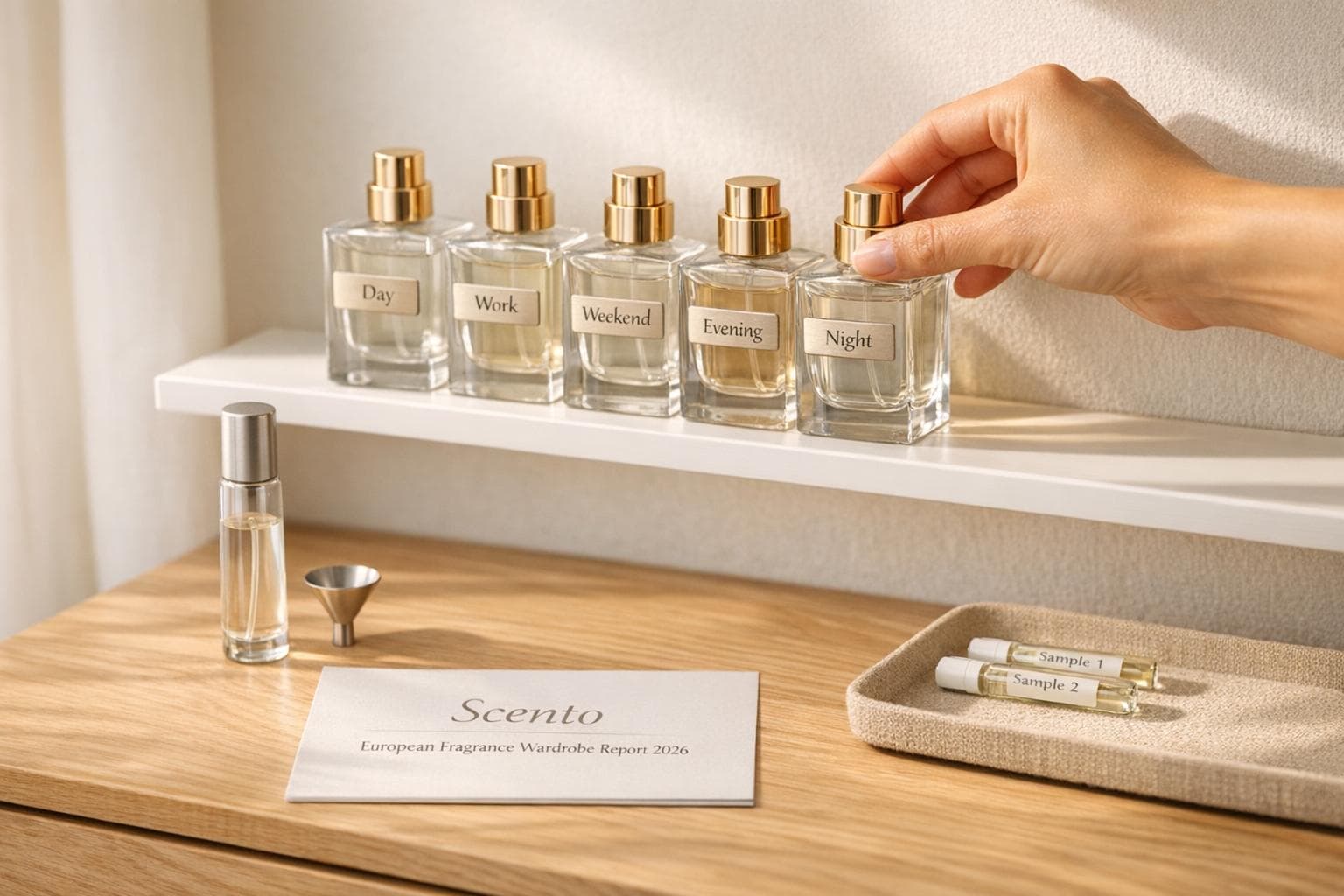
The European fragrance buyer of 2026 does not own a signature scent. She owns a wardrobe. He owns a wardrobe. They own a wardrobe. The single bottle that defined a generation has, structurally, been retired. In its place sits a rotating shelf of several wearable bottles, several more sitting in retirement, and a pattern of acquisition that looks less like a once-a-year purchase and more like a quietly continuous one. The shelf is no longer a shelf. It is an architecture.
In November 2025, Scento published a study mapping the cost of fragrance retirement: 67% of European households own at least one bottle they no longer wear, the average household keeps several unworn bottles, and the aggregate value of fragrance regret across the European Union exceeds €780 million. Twelve months on, with the broader wardrobe behaviour now mapped, this report extends the baseline from what gets wasted to what gets worn. It maps the architecture, the geography, the gender lines, and the generational fault lines of the European fragrance wardrobe in 2026.
Three core findings frame what follows. First, the average European wardrobe is several wearable bottles deep, with several more in retirement. Second, subscription buyers repurchase far more often than one-time buyers within their first ninety days. Third, unisex now accounts for the largest share of European decant demand, ahead of men's and women's combined gendered purchases. Each of these findings carries structural implications for retailers, brands, and the architecture of fragrance discovery itself. They are explored in turn below.
Methodology & Scope
This report combines Scento's review of leading European fragrance industry research with anonymised, aggregated behavioural signals from Scento's own discovery and subscription platform, October 2025 through April 2026. Proprietary platform figures are reported throughout as directional patterns rather than absolute volumes; customer-level, order-level, and revenue magnitudes are deliberately withheld. The report's purpose is to describe how the European fragrance wardrobe is changing, not to disclose the internals of any single retailer.
Wardrobe-size observations are framed against the November 2025 baseline finding that European households retire a meaningful share of the bottles they buy. Subscription behaviour is described by comparing the repeat-purchase pattern of buyers who began with a Scento subscription against those who began with a one-time purchase, over a fixed first-purchase window. Generational cohort observations are synthesised explicitly from Scento's review of leading European consumer-behaviour research over the same period and framed against the buying patterns observed on the platform; Scento does not capture buyer age. The €780 million European waste figure is sourced from Scento's November 2025 study and is the published baseline against which 2026 wardrobe behaviour is benchmarked. A detailed methodology document is available to credentialed press on request at [email protected].
The European Fragrance Wardrobe in 2026: Size Distribution
The European fragrance wardrobe has structurally enlarged. The buyer who owned two or three bottles a decade ago is no longer the modal European fragrance consumer. Industry research places the average active wardrobe well above the long-standing two-to-three baseline that defined the category through the early 2010s. United Kingdom 2025 fragrance category research places the wearable wardrobe higher still: more than half of UK fragrance users now own five or more bottles in active rotation. The wardrobe is the new norm, not the exception.
Scento's own platform signal is directionally consistent. The typical buyer explores several distinct perfumes from the Scento catalogue over a matter of months, and the most active buyers assemble notably deeper rotations. The platform signal deliberately understates the full wardrobe because it captures only what is bought through a single retailer, but the directional finding holds: the modal European buyer is acquiring perfumes on a continuous cadence rather than in a single annual decision. Layered against parallel acquisition from physical stores, gifting, and other online retailers, the multi-bottle wearable wardrobe is consistent with the behaviour Scento observes.
The reconciliation between the two pictures is the headline of this report. A handful of wearable bottles in active rotation, plus several more in retirement, equals the eight-bottle European bathroom shelf. Scento's November 2025 study found that 67% of European households own at least one bottle they no longer wear, with an aggregate €780 million of regretted spend. The "worn wardrobe" sits on top of the "retired wardrobe." Buyers continue to acquire even as the older bottles drift out of rotation. In a meaningful sense, the contemporary European fragrance wardrobe is two wardrobes: the one in active use and the one that has lost the rotation but never been thrown away.
Wardrobing has become a generational behaviour in the structural sense, not the trend sense. The buyer who keeps a single signature scent for life is now a structural minority. Across the European market, the majority of buyers cycle by season, by occasion, by mood, and increasingly by algorithmic recommendation surfaced through social platforms. Layering, the practice of combining two or more fragrances on the same wear, is now reported by more than two-thirds of European fragrance users and is no longer a niche signal. Scento's AI-led discovery quiz exists in part because the modal European buyer is no longer trying to identify her single scent, but trying to assemble a coherent rotation. The product, in 2026, is the rotation. Buyers seeking to construct one without committing to full bottles increasingly start with Scento's decant range, and the broader catalogue is browseable via the full Scento perfume catalogue.
The structural shift also shows up in the velocity of new-launch trial. Recent new arrivals move into rotation faster than they did three years ago, with the time from first availability to a buyer's wardrobe shrinking measurably. Where a 2018 buyer might have waited many months before adopting a new release, the 2026 buyer trials at the moment of release through decants and adopts quickly if the fragrance survives initial wear. The wardrobe is not just larger. It is faster. Amber-led compositions, in particular, now move from launch to top-tier status quickly when the social-platform signal cooperates.
Country Patterns: Germany, Italy, France, Romania and Greece
Country-level wardrobe patterns are the strongest evidence that the European fragrance market does not behave as a single aggregate. Buyers in different markets compose their rotations differently, prefer different houses, weight their wardrobes towards different families, and trade up at strikingly different speeds. Five markets stand out in the platform signal, each with a distinct wardrobe signature.
Germany. One of the deepest national wardrobes Scento observes. German buyers index towards niche houses, driven by the strong domestic penetration of Amouage, Parfums de Marly, and Creed. They maintain larger rotating wardrobes than the European average and trial new launches more aggressively. The German wardrobe is also the most internationally diversified, drawing on a wider geographical heritage of houses than any other market in our signal. Patchouli-anchored compositions are over-represented relative to the European average, particularly in the Q4 acquisition window.
Italy. A major national contribution. The Italian wardrobe concentrates around domestic heritage houses and Italian-coded niche, with a noticeably tighter note set than Germany. Italian buyers favour citrus-anchored heart accords and bergamot-forward openings. Xerjoff reaches a higher per-buyer share in Italy than in any other market we observe. Italians, in this signal, are wardrobe loyalists relative to Germans.
France. Smaller direct buyer base in our signal, larger cultural footprint. French buyers behave conservatively: smaller wardrobes, higher signature-scent retention, more stable note preferences. The structural irony of the French market is well-documented. France remains the global perfumery capital by production, by export, and by editorial influence, but the domestic consumer is among the most wardrobe-conservative we observe. The French market exports its taste; it imports comparatively little. Maison Francis Kurkdjian registers strong French repeat-purchase patterns, but the broader French wardrobe leans towards classical floral and chypre architectures that have been stable for decades.
Romania. Romanian buyers trade up. Premium-brand share among Romanian buyers is rising fastest of any market we cover, and the wardrobe-construction velocity is correspondingly high. The Romanian wardrobe of 2026 looks closer to the German wardrobe of 2018 than to the Romanian wardrobe of 2018. The catch-up trajectory is steeper than any other market in our signal.
Greece. The Greek wardrobe follows a "discovery wardrobe" pattern: buyers sample widely, with high decant-to-bottle conversion intent. They over-index on musk-led modern compositions and on lighter fresh-aromatic structures consistent with the climate. Byredo and Le Labo register higher per-buyer trial rates in Greece than in most other markets we cover.
The United Kingdom. Public UK fragrance category research places the UK market on a £2 billion trajectory by 2029, with a fast-growing dupe segment alongside a niche resurgence. More than half of UK fragrance users now own five or more bottles, and the average UK wardrobe trends materially larger than the European mean. The structural dynamic in the UK is bifurcation: the market is growing both at the high end (niche resurgence) and at the low end (dupe acceleration), with the middle squeezed between the two.
The country reads above describe the variance in taste and wardrobe behaviour across markets. They are illustrative of how differently Europe buys, not a disclosure of any market's commercial scale.
Gender Splits: Unisex, Men, Women
The single most under-told story in the European fragrance wardrobe of 2026 is that "unisex" is no longer a sub-category. In Scento's analysis, unisex fragrances are the largest single share of decanted purchases, ahead of men's-coded fragrances and women's-coded fragrances. The "his and hers" wardrobe binary that defined fragrance retail architecture for three decades has structurally collapsed into a "ours, mine, occasionally yours" graph, and the share of decanted purchases captured by unisex-coded compositions now rivals men's and women's combined.
The price mix tells a related story. Unisex compositions skew towards niche houses and a higher price tier than the gendered-designer mainstream, consistent with the heavy concentration of niche-house aesthetics inside the unisex category. Niche dominates unisex; designer dominates men's and women's-coded demand. Buyers selecting unisex compositions are systematically reaching higher up the price ladder, which in turn reinforces the trend: the niche wardrobe is structurally a unisex wardrobe in a way the designer wardrobe still is not.
Public research on European fragrance gifting tells a complementary story. Roughly three-quarters of fragrance gifts in the UK 2023 cycle were given to women, and gifting remains a structurally female-skewed channel across European markets. The gendered marketing of the 1990s and 2000s, however, no longer matches buyer behaviour for the active wardrobe. Women receive disproportionately more fragrance as gifts, but the wardrobe they actively manage is increasingly tilted towards unisex selection. This is the rare case where the supply-side category architecture lags the demand-side reality by a measurable margin. The retail wall labelled "Women" still exists. The wardrobe inside European homes increasingly does not respect that wall.
Three structural drivers underpin the unisex shift. First, the aesthetic of niche perfumery: niche houses have long been less interested in coding their compositions to a binary gender than designer brands, and as niche has gained European share the unisex aesthetic has come with it. Second, social-platform discovery: TikTok and Instagram do not gender-segment recommendations the way department-store sales floors do. Third, generational: Gen Z buyers reject the gendered-category framing on principle, and as that cohort enters peak fragrance-acquisition age the demand-side rejection of the binary becomes harder to ignore.
For brands and retailers, the implication is straightforward: the sales-floor architecture of "men's wall, women's wall" is increasingly anti-buyer. Men's-coded fragrance selections and women's-coded fragrance selections remain useful navigational shortcuts, but the heaviest velocity in our data is happening across gender, not within either pole. Unisex anchor notes — musk, sandalwood, ambroxan, oud — drive the largest single share of trial volume across our European signal. The wardrobe of 2026 is not a his-or-hers question. It is a what-am — I-wearing-today question, and the answer increasingly does not respect the gendered architecture of the shelf it came from.
Generational Cohorts: Gen Z, Millennials, Gen X
Scento's platform does not capture buyer age. The cohort observations below are synthesised from Scento's review of public European consumer-behaviour research over the same period, framed against the buying patterns observed in the data. They describe the demographic envelope around the wardrobe analysis, not direct measurement of it.
Gen Z (born 1997 to 2012, ages 13 to 28 in 2026). Public research finds that 73% of Gen Z fragrance users wear scent three or more times per week, with 66% reporting TikTok as a primary discovery channel. Gen Z spends an average of $204 per year on fragrance, the highest of any cohort at the same age. Wardrobe size: largest of any cohort, structurally fragmented, decant-led. The Gen Z wardrobe is also the first in which gourmand and "edible" notes routinely outsell the floral-aldehyde architecture that dominated the wardrobes of the 1990s. Vanilla-led gourmand wardrobes, tonka bean, and pistachio dominate the Gen Z note shortlist. Acquisition velocity is highest among Gen Z, retirement velocity is also highest, and the average bottle stays in active rotation for the shortest window of any cohort.
Millennials (born 1981 to 1996, ages 30 to 45). The "wardrobe maximalists." One of the largest contributors to the European fragrance market by spend. The Millennial wardrobe is the modal eight-bottle bathroom shelf — several worn, several retired — and the cohort most directly responsible for the €780 million waste figure. Millennials carry the deepest wardrobes, the highest average bottle count, and the most varied note distribution within the wardrobe.
Gen X (born 1965 to 1980, ages 46 to 61). Smaller wardrobes, longer hold times, higher signature-scent retention. The cohort most likely to wear a single bottle for five years or more. Gen X is also the cohort least exposed to social-platform fragrance discovery and the most likely to acquire through department-store relationships and travel-retail. Gen X-led wardrobes index towards classical chypre, classical oriental, and the heritage Italian and French houses; trial velocity is the lowest of any cohort, and retirement velocity is also the lowest. The Gen X wardrobe is the structural anchor of the "signature scent for life" model, which is why its retreat is the single most consequential demographic shift driving wardrobe behaviour in the broader European market.
The "edible" wardrobe trend. Gourmand-coded notes have grown in social-search volume by an order of magnitude year over year, and the edible-fragrance category — vanilla, tonka, pistachio, salt-skin, marshmallow, almond, caramel — is now the structural fastest-growing note family within Scento's catalogue. The Gen Z wardrobe leads this shift; the Millennial wardrobe follows; the Gen X wardrobe is least exposed. The edible wardrobe is one of the cleanest empirical signals that fragrance preference has moved decisively away from the floral-aldehyde architecture of the 1990s.
The signature-scent retreat. Across all cohorts, the share of European buyers maintaining a single fragrance for three years or more has fallen from a long-standing majority to a clear minority. Scento's platform signal confirms this: the most active buyers acquire many distinct fragrances over the course of a year, which is structurally incompatible with a signature-scent wardrobe. The signature scent has not disappeared; it has been demoted from "the wardrobe" to "an anchor within the wardrobe."
The affordability gap. 67% of European fragrance buyers in 2025 reported finding luxury fragrance at-counter unaffordable; this has driven both the decant economy and the dupe market in roughly equal measure. The decant economy answers the affordability gap by lowering the unit-price barrier to trial. The dupe market answers it by lowering the unit price of the bottle. Scento's category positioning sits squarely in the first response: trial via decant, then commit. Browsing this season's best-sellers through Scento's decant range is structurally the affordability-gap response that builds wardrobes rather than substitutes them.
Subscription vs One — Time Buyer Behaviour
Subscription buyers repurchase far more often than one-time buyers within their first ninety days. This is the single sharpest behavioural divergence in our 2026 data. The subscription wardrobe is structurally a building wardrobe; the one-time wardrobe is structurally a static wardrobe. The cohort split is not a marketing artefact; it is a structural fact about how each group of buyers approaches the wardrobe-construction problem.
The behaviour beneath the divergence is the interesting part. Subscription buyers steadily acquire a range of distinct fragrances across their first year, structurally building a rotating wardrobe; one-time buyers typically add only one or two. The subscription model produces wardrobe-building behaviour by default; the full-bottle blind-buy model produces wardrobe-static behaviour.
Subscription tier mix is the second structural finding. The overwhelming majority of subscription orders are placed against multi-perfume tiers rather than single-perfume tiers. The pattern reverses the industry's signature-scent assumption: when buyers commit to a subscription, they commit to variety — the most popular configuration is a multi-perfume monthly slot rather than a single-perfume one. The subscription buyer treats the subscription as a wardrobe-building tool rather than a signature-replacement tool, which is consistent with everything else in this report.
The "wardrobe-building" hypothesis becomes concrete in the acquisition curve. Subscription buyers build a multi-fragrance rotation over their first year on platform; one-time buyers more often construct the wardrobe one fragrance at a time, frequently pausing the project after the first or second decision. The subscription channel is, in effect, a wardrobe-construction service: a curated rotation that compounds into a full wardrobe over twelve months.
For brands, the implication is direct: the wardrobe-construction route via Scento's AI-led discovery quiz and the Scento decant range structurally outperforms the wardrobe-replacement route via single full-bottle decision-making on repeat-purchase, and produces a larger wardrobe within twelve months. This season's best-sellers are increasingly populated by fragrances first encountered through the subscription channel, and the Scento atomizer accessory range exists in part to support the multi-fragrance wardrobe rotation that subscription buyers exhibit. Readers seeking a deeper analysis of the subscription dynamic specifically can consult Scento's deeper analysis of European subscription perfume behaviour.
The €780M Waste Reality: Why So Much Goes Unworn
In November 2025, Scento published a study showing that 67% of European households own at least one perfume bottle they no longer wear and that the aggregate value of fragrance regret across the European Union exceeds €780 million. Twelve months on, with the wider wardrobe behaviour now mapped, the question is no longer how much gets retired. It is why so much gets retired in the first place. Scento's 2026 analysis identifies three structural drivers, each independently significant and compounding when present together.
The blind-buy economy. The dominant route to a new fragrance in Europe is still the full-bottle blind buy — a purchase informed by a 90-second store spritz, an Instagram Reel, or a TikTok recommendation. A 100ml bottle of premium niche perfume is a €120 to €350 wager on the in-skin chemistry of a fragrance the buyer has never lived with. The wager pays off when the chemistry works and the wear-pattern matches the wardrobe's needs; it fails when either condition does not hold. Buyers who routinely sample a fragrance at 2ml or 5ml before committing to a full bottle waste a materially smaller share of their budget over a multi-year horizon than buyers who blind-buy. The waste figure is not a function of bad taste; it is a function of decision architecture. The buyer who chooses without trial pays the trial cost in retirement.
The wardrobe-mismatch problem. The decision-architecture problem is not that buyers buy "bad" fragrances. Most full-bottle perfumes a buyer regrets, she once liked. The problem is that the bottle was bought for the wrong slot in the wardrobe. A summer beach scent purchased in February for a wedding ends up retired by July. A heavy oud bought for a holiday-season anchor ends up retired the following spring. The wardrobe slot the bottle was bought for either disappears or never existed in the first place, and the bottle is left without a wear-occasion. Our data shows buyers increasingly construct wardrobes around moods and moments rather than gendered identities — but the brick-and-mortar retail experience is still organised around "men's wall" and "women's wall" architecture that maps poorly onto the mood-and-occasion-driven wardrobe of 2026. The wardrobe and the shelf are misaligned. The retired bottle is the byproduct of the misalignment.
The signature-scent collapse. The cohort that bought one bottle and wore it for a decade is structurally retreating. Gen Z and Millennial buyers cycle through many bottles a year, by mood and by season. The bottles that get retired are not bad fragrances; they are bottles that no longer fit the rotation. The retirement velocity of fragrance has structurally accelerated, and the retail format has not kept pace. The aggregate effect is that the rate at which European wardrobes generate retired bottles is now higher than the rate at which retailers, brands, or recycling infrastructure can absorb them. The €780 million figure is what shows up on the bathroom shelf; the structural force behind it is the acceleration of wardrobe rotation.
The European fragrance wardrobe of 2026 is larger, more fragmented, more mood-driven, and increasingly subscription-led. The €780 million figure is not a moral indictment of the buyer. It is the cost of a retail architecture still designed for the signature-scent buyer of 1995 in a market that no longer behaves that way. The decant economy, the AI-quiz onramp, and the subscription wardrobe are three structural responses to the same wardrobe problem. Try, then commit. Rotate, then retire. Build, do not blind-buy. Scento operates inside this response architecture deliberately: Scento's decant range reduces the cost of the trial, the AI-led discovery quiz reduces the cost of the wardrobe-fit decision, the subscription cohort exhibits the building-wardrobe behaviour, and the Scento gift edit uses the same decant-first architecture to reduce gifting waste. The full Scento perfume catalogue, the season's best-sellers, and the Scento atomizer accessory range are the commerce surfaces through which this architecture surfaces to the buyer; the structural shift the data describes is the buyer architecture beneath them.
2027 Outlook: The Wardrobe Built One Decant at a Time
The European fragrance wardrobe will continue to enlarge in 2027. The active wardrobe will trend wider rather than deeper, and more numerous rather than more expensive at the per-bottle level. The driver is not gifting and is not category expansion at the household level; it is rotation.
Unisex will become the outright majority of all decanted purchases within the foreseeable horizon. The "his and hers" category framing will be retired as a sales-floor architecture by the end of the decade. The demand shift has structurally happened already; the retail update is a recovery operation, not a leading indicator. Brands that align their merchandising and discovery experiences around mood, moment, and family rather than gender will outperform on a structural basis.
The decant and subscription wedge will continue to absorb category share from the full-bottle blind-buy economy. Public research projects the European decant and sample market growing at 13 to 15% compound annually through 2030, materially above the broader fragrance category's 5% baseline. The wedge is structurally counter-cyclical to the waste figure: every euro that flows through the decant channel is a euro that does not flow through the blind-buy channel and therefore does not contribute to the €780 million annual waste aggregate.
Gen Z's note preferences — gourmand, edible, salt-skin, woody-resinous — will continue to displace the floral-aldehyde architecture of the 1990s wardrobe. Niche-house aesthetics will follow. The aesthetic shift is already visible in the new-launch calendar across European houses for 2027.
The biggest single editorial question for the European fragrance industry of 2027 is no longer how to grow the wardrobe — that has solved itself. It is how to retire the unworn bottle ethically, sustainably, and without the €780 million annual cost. Refill systems, take-back programmes, fragrance recycling infrastructure, and second-hand resale of unworn bottles are each candidates; none is yet at the scale required. Scento's positioning is structural: the decant-led wardrobe construction model reduces the bottles that need retirement in the first place. The AI-led discovery quiz, the decant range, the full perfume catalogue, and the season's best-sellers are the commerce surfaces through which this approach reaches the European buyer. The wardrobe of 2027 will be built one decant at a time. That is the structural finding of this report.
This analysis is based on Scento's review of European fragrance industry data, October 2025 to April 2026. A detailed methodology is available to press on request at [email protected].