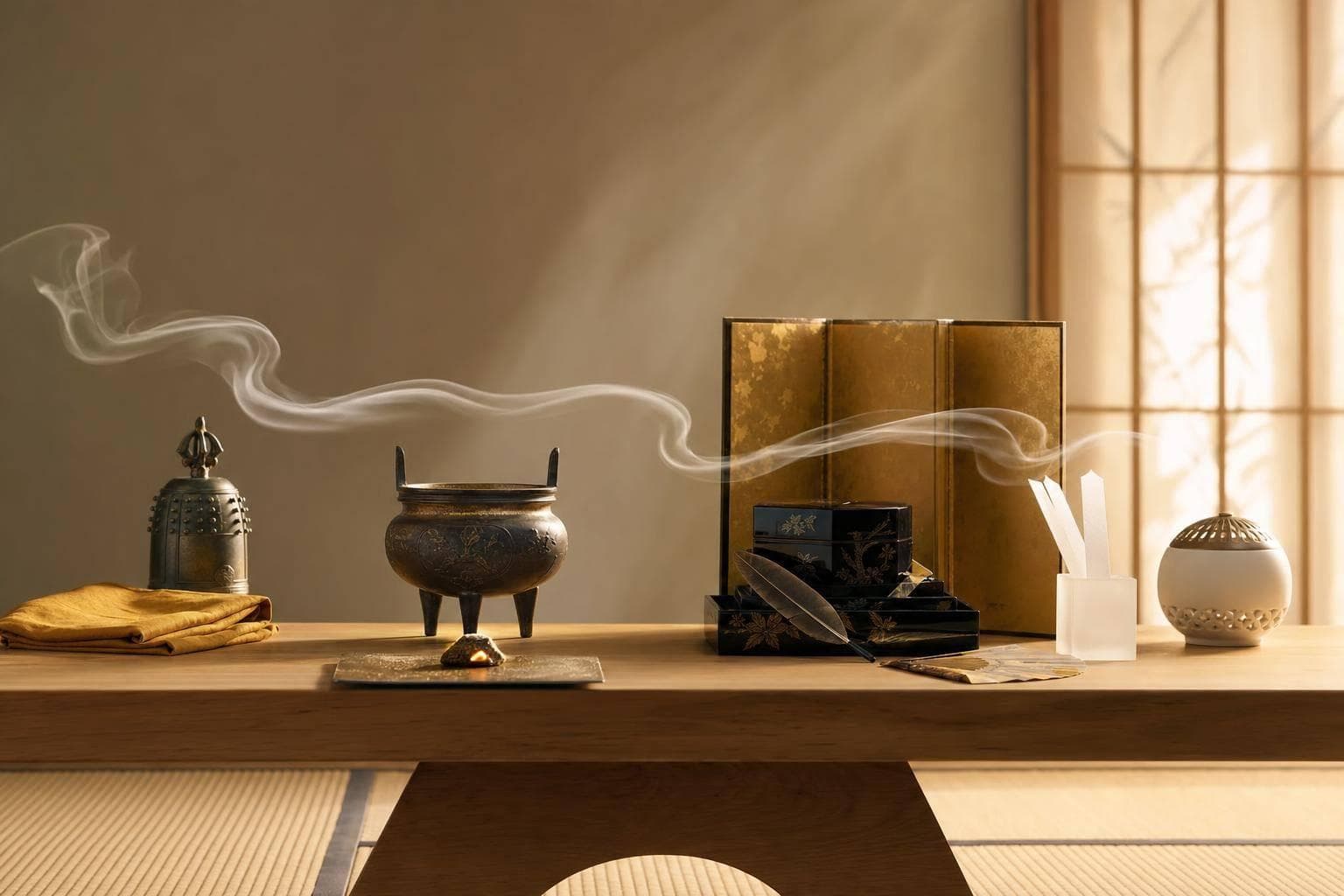
Kōdō este arta japoneza de a „asculta” tamaia, nu doar de a-i simti mirosul. I-as rezuma istoria astfel: a inceput in ritualurile budiste si la curte, a prins forma ca practica formala in perioada Muromachi (1336–1573), iar mai tarziu a influentat scrierile, obiectele si ideile despre frumusete din intreaga Japonie.
Iata varianta pe scurt:
- A inceput odata cu tamaia adusa prin comert si budism
- A trecut din temple in viata de curte a elitelor
- A devenit o arta formala, centrata pe lemnul de agar, in special jinkō si kyara
- A influentat poezia, jurnalele, lacul, ceramica si vestimentatia
- Este strans legata de concepte precum wabi-sabi si yūgen
- Conteaza si astazi, pentru ca ne invata sa acordam parfumului o atentie lenta si atenta
Un fapt imi atrage atentia: aceasta istorie se intinde pe mai bine de 1.000 de ani, de la perioada Nara (710–794) pana in zilele noastre. Iar de-a lungul acestui interval indelungat, ideea de baza a ramas simpla: parfumul poate fi discret si efemer, dar totusi poate lasa o impresie profunda.
Cred ca acesta este motivul pentru care kōdō merita in continuare atentia noastra, atat in arta, cat si in parfumerie.
Quick overview
| Perioada | Schimbarea principala |
|---|---|
| Nara (710–794) | Tamaia ajunge in Japonia prin religie si comert |
| Heian (794–1185) | Parfumul devine parte din viata de curte si din scrieri |
| Muromachi (1336–1573) | Kōdō prinde forma ca practica formala |
| De la Momoyama la Edo | Regulile, materialele si jocurile parfumate capata contur |
| Astazi | Scolile traditionale pastreaza vie practica |
In cele ce urmeaza, vom vedea pe scurt cum a evoluat kōdō de la folosirea ritualica la o arta rafinata si cum stilul sau discret si-a lasat amprenta asupra artei si gustului japonez.
Cum a evoluat Kōdō prin curte, temple si comert
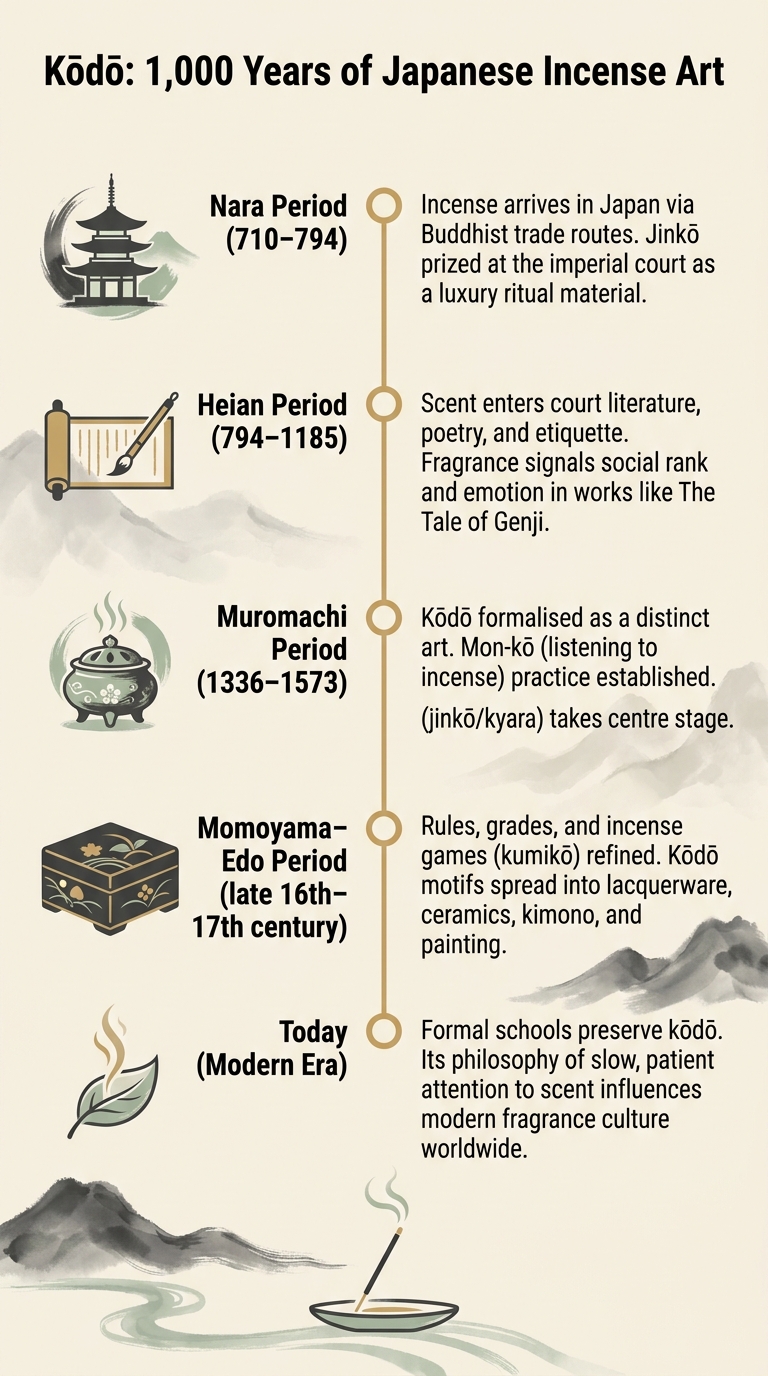
Kōdō: 1.000 de ani de arta japoneza a tamaiei
Primele utilizari ale tamaiei in religie si la curtea imperiala
Tamaia a ajuns in Japonia prin rutele comerciale asiatice si prin schimburile budiste. Mai intai s-a inradacinat in ritualurile templelor, apoi a patruns in viata de la curtea imperiala. In perioada Nara (710–794), jinkō era pretuit de cei de la curte. Tamaia era deja asociata cu rafinamentul, ritualul si prestigiul. De acolo, a trecut dincolo de spatiul religios, intrand in viata sociala a elitelor.
De la desfatare informala la ceremonie formala
In perioada Heian, folosirea tamaiei la curte a devenit o parte mai bine definita a culturii cotidiene. Tamaia aparea in poezii, jurnale si eticheta de la curte, semn ca patrunsese adanc in viata aristocratica. In perioada Muromachi (1336–1573), aprecierea tamaiei s-a formalizat. Oamenii au inceput sa practice mon-kō, adica sa asculte tamaia. Acesta este momentul in care aprecierea tamaiei devine kōdō.
Momente-cheie in evolutia Kōdō
| Epoca | Dezvoltare-cheie |
|---|---|
| Perioada Nara (710–794) | Tamaia a ajuns prin intermediul budismului si era pretuita la curte ca material de lux |
| Perioada Heian (794–1185) | Tamaia a devenit parte din cultura si literatura de la curte |
| Perioada Muromachi (1336–1573) | Aprecierea tamaiei s-a formalizat |
| Perioada Momoyama–Edo (sfarsitul secolului al 16-lea–secolul al 17-lea) | Kōdō s-a maturizat in continuare, ca arta recunoscuta de apreciere |
Aceasta formalizare a pregatit terenul pentru esentele lemnoase, instrumentele si jocurile care au ajuns sa defineasca practica kōdō.
Expertul tău personal în parfumuri te așteaptă
Completează testul nostru rapid de parfumuri și descoperă parfumuri designer și de nișă autentice, alese pe gustul tău – explorează-le ca decanturi și mostre de 2, 5, 8 și 30 ml, ca să le poți încerca pe fiecare înainte de a alege un flacon întreg.
Descoperă-ți parfumulMateriale, instrumente si jocuri cu tamaie, in centrul Kōdō
Kyara, jinkō si alte esente lemnoase aromatice
Pe masura ce kōdō s-a formalizat, accentul s-a mutat de la tamaie ca obiect ritualic la tamaie ca material cu valoare proprie. In centrul kōdō se afla jinkō, iar kyara este considerata cea mai pretuita categorie.
Kyara este cea mai rara si mai pretuita forma de jinkō. Odata ce kōdō a devenit o arta formala, lemnul insusi a ajuns in prim-plan. In kōdō, o bucata este evaluata in functie de raritate, origine si calitate, iar aceste detalii influenteaza felul in care este perceputa.
Ustensilele folosite pentru a incalzi si aprecia tamaia
Kōdō se bazeaza pe control: lemnul este incalzit, nu ars. Caldura blanda ii dezvaluie aroma fara sa-l arda, iar chiar si micile variatii de temperatura schimba felul in care se deschide parfumul.
Acest mod atent de manipulare duce direct la kumikō, unde participantii identifica aromele prin memorie si comparatie.
Cum a modelat kōdō arta, literatura si gandirea estetica japoneza
Tamaia in poezie, jurnale si literatura de curte
Pe masura ce kōdō s-a definit mai clar, vocabularul sau a patruns in literatura si arte. Scriitorii clasici foloseau aroma pentru a sugera rafinament, emotie si rang social. In The Tale of Genji, parfumul este strans legat de dispozitie, memorie si statut, ceea ce arata cat de importanta era aroma in viata de la curte.
Aroma nu era tratata ca un detaliu ostentativ. Functiona mai degraba ca o urma in aer, sugerand caracterul si emotiile fara sa le exprime pe deplin. Aceasta folosire subtila si indirecta a parfumului se potrivea poeziei de curte, jurnalelor si prozei, in care gesturile marunte aveau adesea cea mai mare greutate.
Aceasta aceeasi retinere a modelat si cultura vizuala.
Motive inspirate de tamaie in pictura, lacuri si artele decorative
Kōdō a modelat artele vizuale si decorative prin motive inspirate de tamaie, prezente in pictura, obiecte lacuite, ceramica si designul kimonourilor, transformand parfumul intr-un limbaj vizual asociat rafinamentului. Aroma a depasit cadrul ceremoniilor si a patruns in obiecte, interioare si spatiile de zi cu zi.
Poti observa aici schimbarea: tamaia nu mai era doar ceva experimentat intr-un cadru ritualic. A devenit si ceva sugerat prin model, suprafata si forma. O cutie lacuita, un vas ceramic sau un motiv textil putea transmite acelasi echilibru apreciat in kōdō.
Dincolo de obiecte, kōdō a modelat si ideile japoneze despre frumusete.
Wabi-Sabi, Yūgen si ideea unei arome subtile
Kōdō reflecta wabi-sabi si yūgen prin subtilitate, retinere si efemeritate. Accentul sau discret ajuta la intelegerea locului important pe care il ocupa aroma in gandirea estetica japoneza.
Nu este vorba despre exces, ci despre atentie. O aroma abia perceptibila, remarcata pentru o clipa si apoi disparuta, se potriveste ideilor de frumusete care pretuiesc sugestia in locul etalarii si experienta trecatoare in locul permanantei. Aceasta idee continua sa se regaseasca in kōdō si astazi.
Kōdō astazi si locul sau in cultura moderna a parfumului
Cum continua kōdō in Japonia astazi
Aceeasi disciplina continua sa modeleze felul in care se practica kōdō astazi. In Japonia, kōdō este inca o arta vie, pastrata de scoli formale si organizatii dedicate conservarii. Accentul pus pe materiale subtile si atentie sporita continua sa ghideze modul in care oamenii invata si experimenteaza aceasta arta.
Ce ii poate invata kōdō pe iubitorii moderni de parfum
In esenta, kōdō te invata rabdarea. In loc sa cauti arome puternice, te indeamna sa observi schimbarile subtile. Iti antreneaza simturile sa urmareasca felul in care se deschide un parfum, cum evolueaza in timp si cum transmite ceva discret, fara sa se impuna.
Acest mod de a asculta poate schimba felul in care oamenii se apropie de parfumeria moderna. Testarea nu mai inseamna doar un prim puf rapid, ci convietuirea cu un parfum pentru o vreme. Aceeasi rabdare se potriveste si cumpararii de parfumuri moderne: vialele de 2 ml, 5 ml si 8 ml de la Scento, precum si un decant de 30 ml pentru majoritatea parfumurilor, le permit cititorilor sa testeze un parfum in viata de zi cu zi inainte de a se angaja pe deplin.
Concluzie: de ce kōdō conteaza in continuare in arta si cultura
Kōdō conteaza in continuare pentru ca trateaza aroma ca pe ceva ce trebuie ascultat cu rabdare, subtilitate si atentie.
Intrebari frecvente
De ce i se spune lui kōdō „ascultarea” tamaiei?
Kōdō este numit „ascultarea” tamaiei pentru ca presupune mult mai mult decat simpla ei mirosire. Este o practica linistita si profunda, in care oamenii percep aroma incet si cu intentie, observand micile schimbari si detaliile fine ale parfumului.
Acest mod discret si atent de a experimenta parfumul trateaza aroma ca pe ceva ce trebuie perceput cu grija si inteles in profunzime. Asa se transforma momentul intr-o forma de arta.
Care este diferenta dintre jinkō si kyara?
In kōdō, jinkō este termenul general pentru lemnul de agar de calitate superioara, folosit pentru aprecierea tamaiei.
Kyara se afla in varful acestei categorii. Este cea mai rara si mai pretuita calitate, cunoscuta pentru complexitatea aromatica mai profunda si raritatea extrema.
Cum pot incepatorii sa experimenteze kōdō astazi?
Incepatorii pot incerca kōdō chiar astazi, printr-un mod calm si fara graba de a mirosi. Priveste-l ca pe un mic ritual: acorda-ti timp, fii atent si observa cum se schimba parfumul pe masura ce se deschide, in loc sa inspiri o singura data, in graba, si sa treci mai departe.
Daca vrei sa descoperi nuantele parfumurilor inspirate de kōdō intr-un mod modern, fara un angajament major, quizul AI de la Scento te poate indruma. Apoi, decanturile atent selectionate sau decanturile in recipiente de 2 ml, 5 ml si 8 ml, precum si un decant de 30 ml pentru majoritatea parfumurilor iti permit sa testezi cu usurinta un parfum pe piele inainte de a te decide pentru un flacon intreg.

